

The best faceless YouTube channel ideas share one trait: you can make a good video every week without being the star. That usually means explainers, tutorials, documentary-style stories, and screen recordings. Channels in finance, tech and business tend to pay more per view. Channels built on volume, like motivation or simple facts, tend to pay less. Whichever you pick, YouTube only pays for original work, so how you make the videos matters as much as what they are about.
Below are 15 ideas grouped by the kind of work they take. After that comes a test for choosing between them, a look at how faceless channels earn, and the mistakes that get channels demonetized.
TL;DR
- Pick a format you can repeat weekly, then a topic. Being able to list 50 episode ideas today matters more than a hot niche.
- Finance, investing, legal and business explainers tend to have the highest RPMs, roughly $10 to $25. Motivation and quick-facts channels often sit around $1 to $6.
- Raw text-to-speech slideshows and reused footage can get an entire channel demonetized under YouTube’s inauthentic content policy.
- Ad revenue is only one income stream. Affiliate links, memberships and your own products often matter more once you have an audience.
Table of Contents
- 15 faceless YouTube channel ideas, by type of work
- What each idea pays: RPM by niche
- How to choose: the 50-topic test
- Faceless channel monetization: the realistic options
- The rule that sinks faceless channels
- Make the first 30 seconds count
- Our perspective
- If you want a shortcut to the business side
- FAQ
- Sources
15 faceless YouTube channel ideas, by type of work
A faceless channel is a format plus a topic plus an angle. The same topic, say personal finance, can be a screen-recorded tutorial, an animated explainer or a narrated documentary. Those take very different amounts of effort. So we group ideas by how you will actually make them.
Explainers and education
These are the most dependable starting point because the value is in the information, not your appearance.
- Personal finance explainers. Budgeting, credit scores, retirement accounts, taxes. High advertiser demand, high responsibility: keep claims sourced and general.
- Investing and economics. How markets work, what a rate change means, how to read a company report. Narration over charts and simple animation.
- Legal explainers. Tenant rights, small business basics, contracts in plain English. Advertisers pay well here, but accuracy is non-negotiable.
- Everyday systems. How a power grid, a postal network or a supply chain works. Moderate research, strong visuals, easy to repeat.
- Science and “how it works” videos. Experiments, animations and diagrams. Evergreen, so older videos keep earning.
Tutorials and screen recordings
If you already know a tool or skill, this is the lowest-friction route.
- Software tutorials. Spreadsheets, design tools, note-taking apps, automation. Your voice and your screen are the whole production.
- Tech and AI tool walkthroughs. Fast-moving, so you need to publish consistently. Our guide to AI tools for YouTubers shows how creators speed up scripting and editing.
- Productivity and workflow channels. Show a real workflow on screen and explain why each step exists.
- Online business case studies. Walk through how a store, blog or affiliate site is built. This pairs naturally with affiliate income, which we cover below.
Stories and documentaries
These need more scripting and editing, but audiences watch longer.
- True crime and mysteries. Strong retention, with higher risk around facts, names and policy. Use public records and commentary, not reposted clips.
- History documentaries. Long-form docudramas tend to face less competition than 60-second history clips.
- Business and brand stories. Why a company rose or collapsed. Our breakdown of what we can learn from Mr. Ballen is a good study in how a storytelling channel keeps people watching without being a talking head.
Atmosphere and mood
Lower effort, lower pay, and the most exposed to the originality rules.
- Ambient and study music or ASMR. Cheap to start, hard to differentiate.
- Motivational and quote videos. Easy to produce, which is exactly why the niche is crowded and RPMs are low.
- Travel, geography and extreme places. Needs your own footage or well-licensed material plus real commentary.
We have a longer older list in 15 YouTube channel ideas without showing your face if you want more options to browse.
What each idea pays: RPM by niche
RPM is revenue per thousand views, after YouTube’s cut. It depends on what advertisers are willing to pay to reach your audience. Pixo’s 2026 roundup reports that personal finance and investing niches often see RPMs of $10 to $25, while motivation and simple-facts channels often land at $1 to $6.
Treat those as ranges, not promises. A YouTube product lead explained that CPM differences across regions come down mainly to how much advertisers spend to reach those viewers. Your audience’s location changes your income as much as your niche does.
| Type of idea | Typical RPM range | Effort per video | Policy risk |
|---|---|---|---|
| Finance, investing, legal explainers | $10 to $25 | High (research) | Medium (accuracy) |
| Software and tech tutorials | Mid-range | Low to medium | Low |
| Documentary and story channels | Mid-range | High (script, edit) | Medium |
| Motivation, quotes, simple facts | $1 to $6 | Low | High (reused material) |
The tutorial row is our own rough placement, since sources vary. Check your own YouTube Studio numbers after your first 10 uploads rather than trusting any table, including this one.
How to choose: the 50-topic test
Most faceless channels do not fail because of the niche. According to Pixo’s research, the usual cause after about six weeks is no repeatable production formula. Creators who last check two things before committing: can they write 50 episode topics today, and can they publish once a week without burning out?
Run your top idea through this checklist:
- Topics. Write 50 video titles in one sitting. If you stall at 15, pick a different idea.
- Research load. How many hours does one script take? Be honest.
- Visuals. Do you have a repeatable way to show things: screen capture, animation, your own footage, licensed clips?
- Fact risk. Could a wrong claim hurt a viewer or get the video flagged?
- Repeatability. Can video 30 use the same template as video 3?
The team at Kineo suggests the same logic: test one real topic against a matrix of research difficulty, visual needs, repeatability and policy risk rather than hunting for a perfect niche. No niche guarantees success.
If your skills are still undecided, our list of online business ideas for beginners can help you choose a subject you can speak about with authority.
Faceless channel monetization: the realistic options
Searchers often ask how to monetize a channel without a face. The answer is the same as for any channel, with one twist: your brand is the topic, not a personality.
YouTube ads
The Partner Program is the usual first goal. One current guide lists 1,000 subscribers plus 4,000 qualified watch hours in 12 months, or 10 million qualified Shorts views in 90 days, for full ad monetization. YouTube has been adjusting its tiers, so confirm the current thresholds in YouTube Help before you plan around them.
Affiliate links
Faceless tutorial and review channels are well suited to affiliate income, because the viewer is already watching a tool in use. You tag products in the description, point to a clear next step, and track what sells. Our guide to YouTube affiliate marketing for beginners walks through tagging and tracking. A link shortener such as PrettyLinks keeps description links clean and lets you see which ones get clicks.
Memberships, Super Chat and your own products
YouTube reported in 2022 that more creators were earning from non-ad sources like memberships and Super Chat than ever. That story is not a faceless case, but the lesson carries over. Made With Lau, with over 960,000 subscribers, was reported to earn more than $50,000 a month by combining ads, blog traffic and product sales.
So how many views for $10,000 a month? There is no fixed number. It depends on RPM, audience location and how many income sources you stack. A $15 RPM channel needs far fewer views than a $3 one, and a channel with a product needs fewer still. Use our roundup of YouTube earnings calculators to run your own numbers.
The rule that sinks faceless channels
This is the part many beginner guides skip. YouTube’s monetization policies say your content should be your original creation. They also say that mass-produced, repetitive or non-original content is not eligible, even with the original owner’s permission. Meaningful changes such as commentary, educational value or distinctive editing are what make reused material acceptable.
In practice, that rules out:
- Text-to-speech reading over stock footage with no real script.
- Compilations of other people’s clips with a title card.
- Dozens of near-identical videos with only the topic swapped.
Enforcement applies to the channel as a whole, not only the single video. One batch of low-effort uploads can put the rest at risk. If you use AI for research, outlines or voice, add your own analysis, structure and editing. Our post on ChatGPT for YouTubers covers ways to use it as an assistant rather than a replacement for your own work.
Make the first 30 seconds count
Without a face, the hook has to come from the idea and the visuals. YouTube Studio’s retention reporting shows how well different moments of a video hold viewers. Watch the early drop-off first. If viewers leave in the opening seconds, the title and thumbnail promised something the intro did not deliver.
A simple routine for each video:
- State the payoff in the first sentence.
- Show the most interesting visual immediately, not a logo.
- Check retention after 48 hours and note where people leave.
- Rewrite the next intro based on that, not on gut feeling.
If an intro is slowing you down, here is how to make a YouTube intro fast without editing experience. For a consistent look, learning from channels you admire helps you set up a visual style.
Our perspective
We have spent years watching people build online businesses, and the pattern with faceless channels is consistent. People shop for a niche for weeks, then quit after a month of uploads because the process was painful. The niche was rarely the problem.
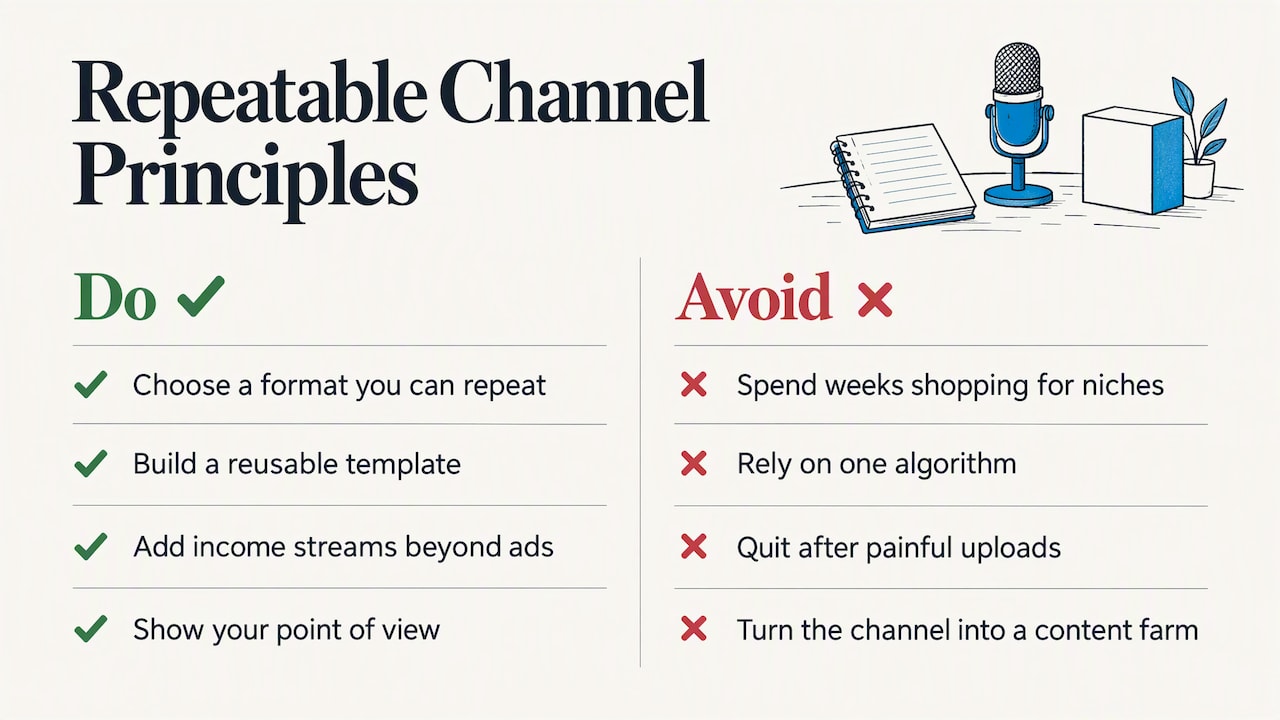
Our view is simple. Choose the format you can stand to repeat, build a template, and treat the channel as a small business with several income streams from day one. Ad revenue is the slowest to arrive and the least in your control. An email list, a recommended tool you actually use, and eventually your own product give you something that does not depend on one algorithm.
We also think anonymous does not mean impersonal. The channels that last have a clear point of view, even when no one is on camera. Say what you think, show your work, and be candid about what did not work. That is what separates a channel from a content farm, and it is also what YouTube’s originality rules reward.
— Nathaniel
If you want a shortcut to the business side
If your goal is a channel that earns beyond ad revenue, our Instant Course Access for Life is a one-off $97 payment. You can look at what it includes before you decide.
FAQ
What are the best faceless YouTube channels to model?
Look for channels that publish on a steady schedule with a repeatable format, such as a narrated explainer series or a screen-recorded tutorial series. Study their titles, how fast they get to the point, and how they show information visually. Model the structure, never the content.
Can you make money on YouTube without showing your face?
Yes, as long as the videos are original and add real value. YouTube’s policies focus on whether the content is original and authentic, not on whether you appear on camera. Add affiliate links, memberships or products to avoid relying on ads alone.
How many views do you need to make $10,000 a month on YouTube?
There is no single number. Earnings depend on RPM, viewer location and other revenue sources. A channel in a $10 to $25 RPM niche needs far fewer views than one at $1 to $6, and each added income stream lowers the number further.
What is the 7 second rule on YouTube?
It is a common creator rule of thumb that you have only a few seconds to earn a viewer’s attention. YouTube does not publish it as a rule. The measurable version is the early retention data in YouTube Studio, which shows where viewers leave.
Sources
- 27 Faceless YouTube Channel Ideas That Actually Work in 2026 (Pixo)
- YouTube channel monetization policies (YouTube Help)
- Measure key moments for audience retention (YouTube Help)
- 10 Faceless YouTube Channel Formats + 50 Video Ideas (Kineo)
- Pedro Pina answers your top questions (YouTube Blog)
- How Made With Lau’s Randy Lau found success (YouTube Blog)
- YouTube Partner Program Requirements 2026 (Air)