

At some point, most FBA sellers hit the same wall. The garage is full, the spare room is full, and the business starts to look less like an asset and more like a daily boxing shift.
I've seen that turning point up close. Self-prep works for a while, especially when SKU count is low and inbound volume is manageable. Then the workload changes. You're not just printing labels and sealing cartons anymore. You're checking supplier mistakes, fixing packaging, relabeling units, splitting shipments, and trying to stay compliant while inventory sits unavailable.
That pressure got more serious with Amazon's U.S. policy change. Amazon Seller Central states that starting January 1, 2026, Amazon will no longer offer prep and item-labeling services for FBA shipments in the U.S. store, which makes third-party prep centers a required operational layer for many sellers, not just a convenience (Amazon Seller Central policy update).
Are You Drowning in Boxes? Why Prep Centers Matter Now
If your week is disappearing into cartons, tape guns, and barcode rolls, you're already paying for a prep center. You're just paying for it in founder time, slower replenishment, and operational drag.

The big shift is that this problem no longer sits only with sellers who outgrew self-prep. Once Amazon exits prep and labeling for U.S. FBA shipments, a large share of sellers who used to rely on Amazon's internal service will need outside help. That changes the market dynamics. The primary question isn't only which fba prep center offers a decent per-unit fee. It's which one can still move inventory cleanly when everyone is competing for the same warehouse labor and receiving slots.
The old decision is gone
A lot of older advice treats prep centers like an optional efficiency hack. That framing is outdated. For many businesses, especially ones with wholesale, private label, replenishable arbitrage, or multi-SKU catalogs, prep is becoming infrastructure.
That means your prep center now affects:
- Stock availability: Delays at prep become delays in Amazon check-in.
- Advertising performance: If replenishment misses demand, ad momentum weakens.
- Cash flow timing: Inventory stuck in prep is inventory you've paid for but can't sell.
- Operational risk: One weak partner can bottleneck your whole catalog.
Practical rule: Once prep becomes a dependency, you should evaluate it the same way you'd evaluate a warehouse, software stack, or freight partner.
What serious sellers need to accept
The cheapest quote often loses money. A prep center that misses intake, mislabels bundles, or goes silent when supplier cartons arrive damaged can do more harm than a higher-priced operator with better systems.
The good operators don't just put stickers on products. They absorb complexity before Amazon sees it. That's the whole game now.
Unpacking the Core Services of an FBA Prep Center
An fba prep center sits between your supplier and Amazon. On paper, that sounds simple. In practice, it's where most preventable errors either get caught or get passed downstream.
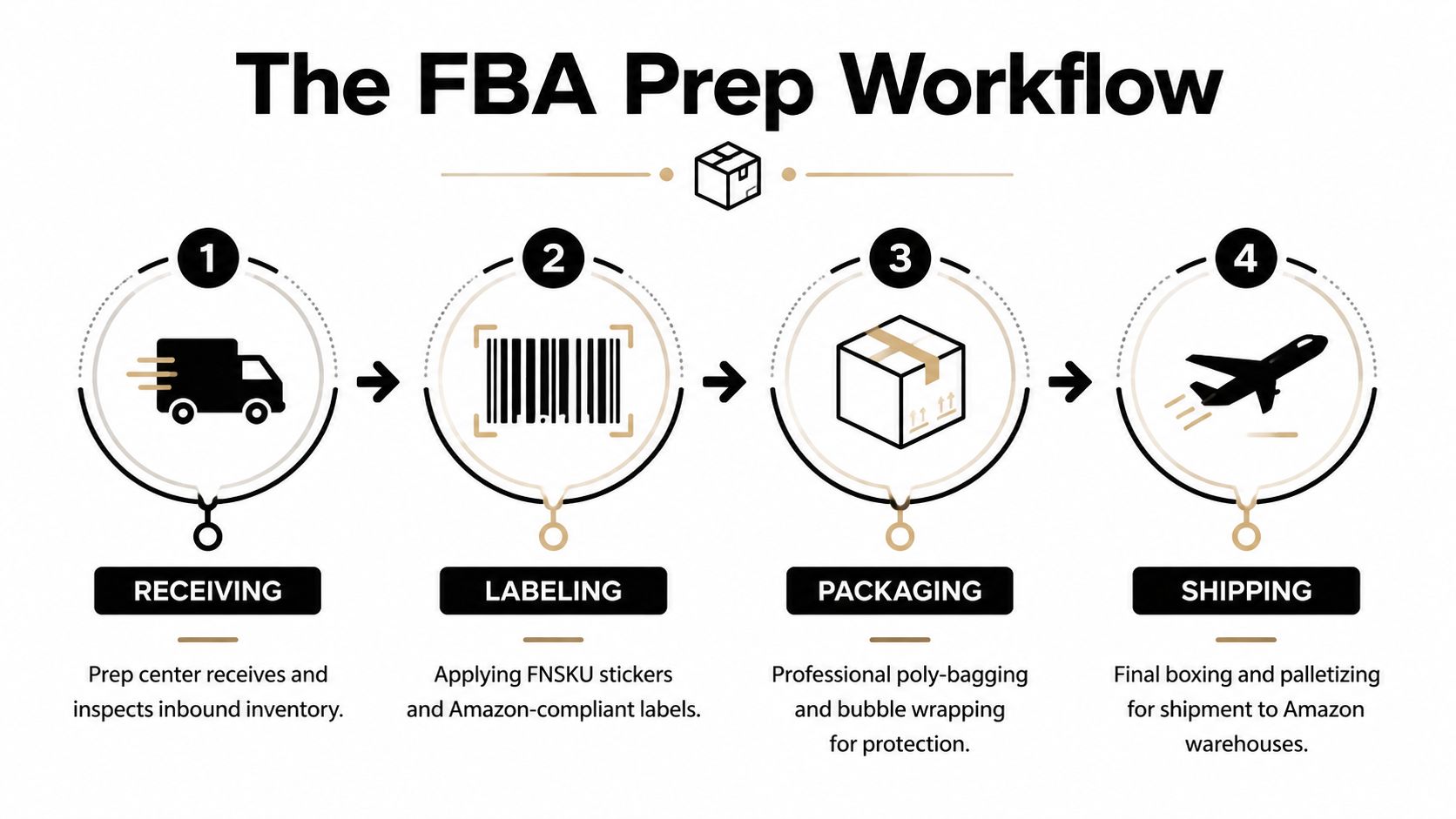
Receiving and inspection
Good prep centers earn their keep through these essential services. They receive cartons from suppliers, open shipments, count units, and inspect for obvious issues like damage, wrong variants, crushed retail packaging, missing sets, or bad expiration labeling.
If you source from multiple wholesalers or retail channels, this step matters more than most sellers realize. The prep team is often the first group to discover that the supplier sent the wrong case pack or mixed products in the same carton.
A strong operator doesn't just note the issue. They document it fast, isolate affected units, and ask for direction before bad inventory moves farther into the process.
Labeling and barcode control
A prep center typically applies FNSKU labels, covers existing barcodes when needed, and makes sure each sellable unit matches the listing and shipment plan. This sounds routine until a center handles dozens of similar ASINs and one barcode gets placed on the wrong SKU.
That's why I care less about whether a warehouse “offers labeling” and more about how they control workflow. Do they separate lookalike SKUs? Do they scan against inbound instructions? Do they maintain unit-level traceability?
For sellers evaluating options, this breakdown of how an Amazon prep company can save time and money is useful because it frames prep as an operational control point, not just outsourced labor.
Packaging and Amazon compliance
Amazon's prep rules are where sloppy operators get exposed. One example matters a lot. Amazon requires poly bags to be transparent and at least 1.5 mil thick, with a suffocation warning when the bag opening is 5 inches or larger, according to these FBA prep requirements.
Those aren't minor details. They can trigger receiving delays, repacking, or noncompliance issues. A competent prep center knows when a unit needs poly bagging, bubble wrap, or other protective handling before it reaches Amazon.
The best prep teams treat Amazon rules like production specs, not suggestions.
If you sell internationally or need another benchmark for service scope, it's worth reviewing examples of specialized Amazon prep services by AUSFF to see how serious providers structure receiving, labeling, packaging, and shipment readiness.
Bundling, kitting, and final shipment prep
Prep moves from compliance into margin protection. A center can assemble multipacks, create bundles, insert simple pack-ins when needed, and organize final cartonization for Amazon inbound shipments.
The useful distinction is this:
- Basic prep keeps units compliant.
- Advanced prep helps you sell differentiated offers without touching the inventory yourself.
For wholesalers and private label sellers, that difference matters. So does shipment creation discipline. If a prep center can't build clean outbound cartons, your inventory may technically be prepared but still poorly staged for the next step.
Understanding FBA Prep Center Pricing and Hidden Costs
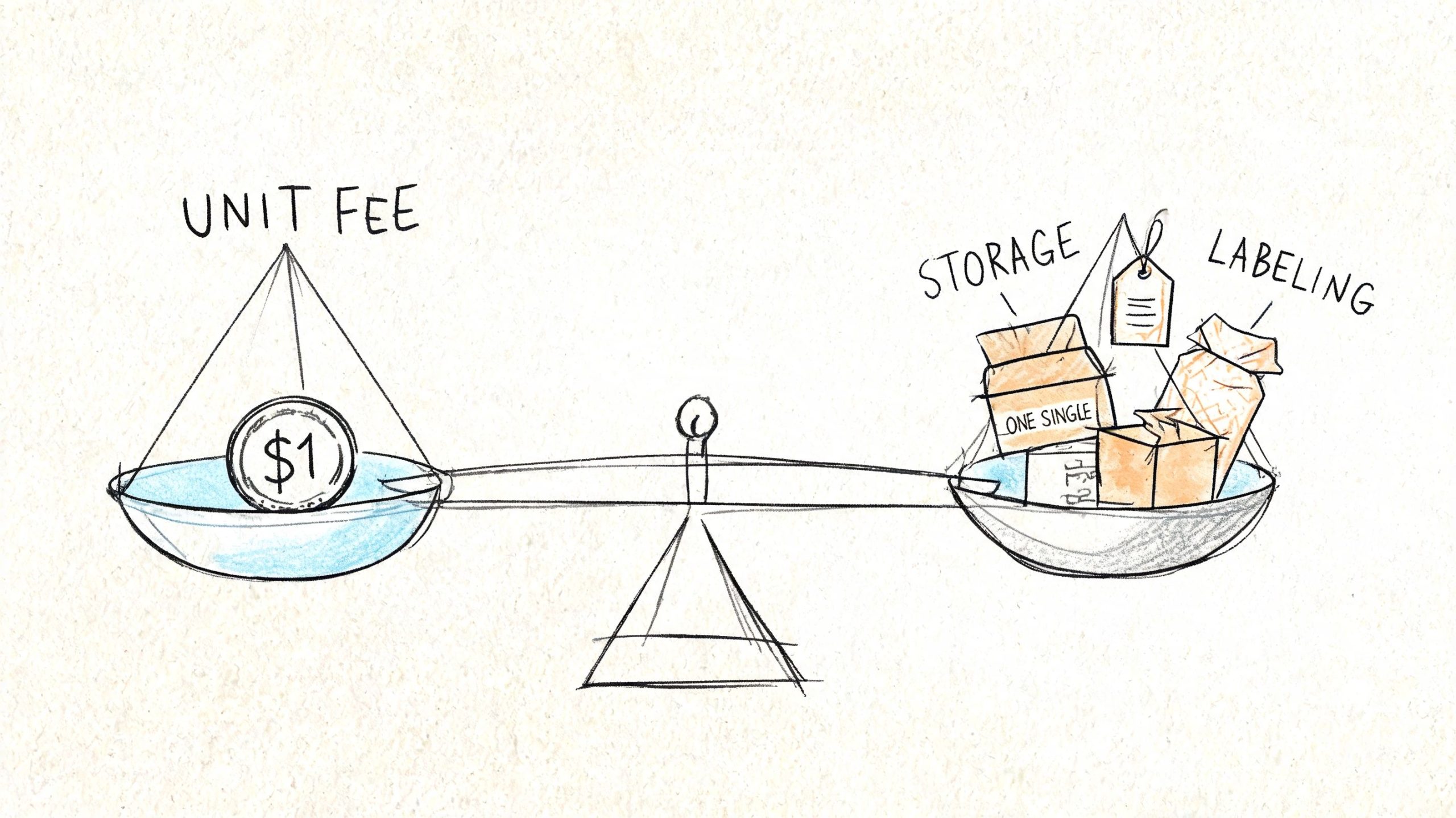
Most sellers start with the wrong question. They ask, “What's the unit fee?” The better question is, “What will my all-in landed prep cost look like after the center touches this shipment?”
How pricing is usually structured
Prep centers commonly price around a few models:
- Per-unit prep fees: Best for straightforward inventory with repeatable handling.
- Tiered volume pricing: Better if you move enough units to negotiate lower blended rates.
- Monthly retainer or subscription arrangements: More common when a center acts like an embedded ops partner.
- Hybrid pricing: A base unit fee plus line-item charges for anything outside standard workflow.
None of these are bad on their own. The problem starts when a seller compares base rates without comparing scope.
A center can look cheap on paper and still be expensive in reality if the quote excludes receiving, storage, bundling, carton forwarding, labeling complexity, or issue handling. If you want a cleaner picture of downstream unit economics, a practical place to sanity-check numbers is this Amazon FBA calculator.
What usually shows up as an add-on
The invoice pain points are usually operational, not deceptive. You just need to ask better questions before signing.
Watch for charges tied to:
- Pallet receiving: Some centers price cartons differently than pallet deliveries.
- Storage time: Especially if supplier shipments arrive early or Amazon routing changes.
- Special prep: Bubble wrap, poly bagging, set creation, expiration labeling, or fragile handling.
- Manual exceptions: Mixed cartons, bad supplier labeling, missing packing lists, or damaged units.
- Carton forwarding or split handling: Common when inventory gets redirected or divided across destinations.
If a quote says “all-in,” ask what happens when a supplier sends the wrong barcode, a case arrives crushed, or a bundle needs to be rebuilt.
That's where hidden cost usually appears. Not in the normal workflow, but in the exceptions.
The fee that matters most
I've learned to focus on the cost of delay, not just the cost of prep. A center with low rates and inconsistent processing can, in effect, become your highest-cost vendor because every stalled replenishment creates inventory gaps you can't recover easily.
This walkthrough is worth watching because pricing only makes sense when tied to process and service scope:
What to ask for before you compare quotes
Don't request a generic rate card and call it due diligence. Send each prep center the same operational scenario and compare responses.
Include:
- Your inventory type: Fragile, boxed, bagged, bundle-ready, expiry-dated, or standard.
- How shipments arrive: Supplier cartons, palletized freight, retail packages, or mixed lots.
- Expected issue frequency: Returns, retail arbitrage variance, or wholesale case consistency.
- Outbound expectations: Amazon SPD, LTL, carton forwarding, or storage buffers.
The sellers who get burned usually didn't buy the wrong prep center. They bought an incomplete quote.
Self-Prep vs Outsourcing A Data-Driven Comparison
There's a point where self-prep stops being “lean” and starts being expensive. The shift usually happens before sellers admit it, because founder labor feels free until it blocks sourcing, forecasting, and replenishment.
One industry comparison of in-house prep versus outsourced prep centers shows a meaningful difference across labor cost, turnaround, compliance accuracy, and weekly throughput. According to this FBA prep center breakdown, outsourced prep can bring labor cost down from about $1.20-$2.50 per unit in-house to $0.50-$2.00 per unit externally, reduce turnaround from 7-14 days to 2-5 days, improve compliance accuracy from roughly 85-90% to 98-99%, and increase weekly processing capacity from about 200-500 units to 2,000+ units.
DIY Prep vs. FBA Prep Center By the Numbers
| Metric | In-House (DIY) Prep | Outsourced Prep Center |
|---|---|---|
| Labor cost per unit | $1.20-$2.50 | $0.50-$2.00 |
| Turnaround time | 7-14 days | 2-5 days |
| Compliance accuracy | 85-90% | 98-99% |
| Weekly processing capacity | 200-500 units | 2,000+ units |
Those numbers line up with what a lot of experienced sellers eventually learn the hard way. The bigger benefit isn't just lower touch labor. It's that a specialized operation can process more units, faster, with fewer mistakes.
When self-prep still makes sense
Outsourcing isn't automatic. Self-prep can still work if you have a very small SKU set, low weekly unit volume, predictable packaging, and direct control over receiving space. It can also make sense when you're validating products and don't want to add another vendor yet.
But once your business depends on regular replenishment, the trade-off shifts. You're no longer deciding whether you can prep inventory yourself. You're deciding whether self-prep is the highest-value use of your time.
For a broader look at how founders think through this trade-off in digital commerce, this piece on the pros and cons of outsourcing for digital commerce startups is a useful complement.
What outsourcing changes operationally
A prep center offers advantages in four ways:
- Capacity: You stop tying growth to your own workspace and labor hours.
- Repeatability: Standardized prep reduces variation between shipments.
- Compliance discipline: Specialists catch avoidable inbound issues earlier.
- Focus: You can spend more time on sourcing, listings, pricing, and cash conversion.
That last point matters more than most spreadsheets show. If outsourcing frees you to make better inventory decisions, the value often compounds outside the prep line itself.
Much of the same logic appears in broader guides on optimizing online store workflows. The common thread is simple. Founders scale faster when they remove operational bottlenecks that offer low returns.
I'd rather pay for a clean prep process than personally save pennies while slowing down the whole business.
Your Vetting Checklist for Choosing an FBA Prep Partner
Most sellers spend too much time comparing rate cards and not enough time testing operational competence. A prep partner should be vetted like a warehouse operator with e-commerce systems, not like a freelancer who happens to own label printers.
Capacity and physical infrastructure
You need to know whether the warehouse can absorb your business during normal weeks and during spikes. One operator checklist points to at least 8 loading docks, forklift support, and 80,000+ sq ft as indicators of scalable receiving capacity, while also stressing software compatibility with Amazon Seller Central, Shopify, WooCommerce, or InventoryLab in order to reduce manual errors (prep center selection criteria).
That doesn't mean every smaller center is disqualified. It means you should ask whether their actual setup matches your needs.
Ask questions like:
- Receiving volume: How many inbound deliveries can they process at once?
- Physical flow: Do they have docks, forklifts, and a dedicated receiving area?
- Overflow handling: What happens when inbound volume spikes?
- Seasonal strain: How do they handle Q4 or promotion-driven surges?
Systems and integrations
Software matters because manual handling creates mistakes. If your prep center rekeys SKU data from emails and spreadsheets all day, errors will creep in.
Look for clear workflows around:
- Seller Central compatibility: They should understand shipment creation and FNSKU handling.
- Inventory tools: InventoryLab, Shopify, and WooCommerce integrations reduce manual duplication.
- Traceability: You want issue logs, photo documentation, and SKU-level tracking.
- Communication systems: Ticketing, intake forms, and standardized status updates beat random text messages.
Service levels and issue handling
Weak operators get exposed in these situations. You need to know what happens when reality gets messy.
Ask directly:
- What is your stated turnaround window? Ask for normal processing and peak-season expectations.
- How do you report damaged or incorrect inventory? You want photos, counts, and a documented escalation path.
- What happens if supplier cartons arrive mixed or incomplete? Their answer tells you whether they solve problems or create them.
- How do you handle urgent replenishment? Some sellers need fast-turn labeling on specific shipments.
A prep center's real quality shows up in exceptions, not in routine carton sealing.
Geography and business fit
Location is strategic. It affects inbound freight patterns, transit variability, tax considerations, and how quickly you can route inventory toward Amazon. The right location also depends on your model.
A few practical examples:
- Online arbitrage sellers: Often value rapid turnaround and frequent small-lot processing.
- Wholesale sellers: Usually care more about pallet receiving, case consistency, and throughput.
- Private label brands: Need stronger QC, packaging discipline, and launch coordination.
Don't pick a center just because it's “near Amazon.” Ask whether its location fits how your inventory moves.
Questions worth sending before the first call
A short written questionnaire can save a lot of time. I'd include:
- What inventory types do you handle best?
- Which tasks are included in your standard prep fee?
- How do you document receiving discrepancies?
- What software do you use for inventory tracking and client communication?
- Do you support bundle assembly and relabeling?
- What happens when inventory sits beyond normal processing windows?
- Can you share your standard operating process for inbound to outbound?
The best prep centers usually answer these clearly and without defensiveness. The weak ones answer vaguely, avoid details, or steer the conversation back to price.
Warning Signs and Red Flags to Avoid When Hiring
Some prep centers sound fine on a sales call and still create operational chaos once inventory starts landing. Sellers usually spot the red flags too late, after stock is already in the building.

Vague pricing and vague promises
If a center says “we handle everything” but can't define what “everything” includes, expect invoice surprises. The same applies to turnaround. “Fast” isn't a service level. It's marketing language.
A good partner should tell you what is standard, what triggers extra charges, and how exceptions are handled. If those answers stay fuzzy, move on.
Weak communication during basic issues
You don't need daily hand-holding. You do need fast communication when inventory arrives damaged, supplier counts are off, or units can't be processed as instructed.
Bad signs include:
- Long response gaps when inbound problems are reported
- No photo documentation for damaged or mismatched inventory
- No written intake process for receiving and discrepancy handling
- No clear owner for your account or support requests
If a prep center is hard to reach before you become a customer, that problem usually gets worse after they have your stock.
Location decisions made for the wrong reason
A lot of sellers choose location based on one simplistic idea, usually speed to Amazon. That's incomplete. Prep center location can also affect nexus exposure, inbound shipping cost, and transit variability, and some seller discussions specifically highlight the appeal of a sales-tax-free state like Oregon (prep center geography considerations).
That doesn't make Oregon automatically right. It means geography should be a business decision, not a slogan.
No contract clarity on liability
This is the one sellers skip when they're in a hurry. You need written terms covering damaged goods, lost inventory inside the warehouse, outbound mistakes, storage conditions, and what happens if the relationship ends while inventory is still on-site.
If liability isn't written down, you're relying on goodwill after a problem already cost you money.
Ask whether they carry business insurance. Ask who is responsible for errors caused by their staff. Ask how inventory is returned, forwarded, or liquidated if you stop using them. A legitimate operator should expect those questions.
Resistance to transparency
You don't necessarily need a physical visit, especially if you're remote or international. But you should expect some level of transparency. That could mean photos of the facility, documented SOPs, examples of issue reporting, or a walkthrough of their systems.
If a center resists every request for process detail, that's not professionalism. It's a warning.
Frequently Asked Questions About FBA Prep Centers
Is an fba prep center worth it for online arbitrage or retail arbitrage?
Usually, yes, if you're sending frequent small lots and don't want sourcing time consumed by repetitive handling. The caveat is fit. Arbitrage sellers often need flexible receiving, fast exception handling, and tolerance for mixed inventory. Some prep centers are built for consistent wholesale cartons and get frustrated by arbitrage-style variance.
Can international sellers use a U.S.-based prep center for Amazon.com?
Yes. Many international sellers use U.S. prep centers to receive supplier shipments, inspect units, apply labels, and forward inventory into Amazon's U.S. network. The important part is communication discipline. If you're in another time zone, you need a partner with clear issue reporting, photo documentation, and predictable workflows so you're not waking up to unresolved receiving problems.
Which software integrations matter most?
The practical shortlist is Amazon Seller Central, InventoryLab, Shopify, and WooCommerce. The exact mix depends on your business model, but the principle is the same. Better integration reduces manual entry, lowers mismatch risk, and makes it easier to keep SKU-level visibility across receiving and prep.
Should I use one prep center or split volume across two?
If your operation is growing, having a backup can reduce concentration risk. That doesn't mean splitting too early and creating unnecessary complexity. It means recognizing that prep is now a critical dependency. Once one center becomes a bottleneck, your whole replenishment cycle can suffer.
If you're building an FBA business that needs cleaner systems, better decision frameworks, and less operational guesswork, EntreResource is worth following. It's one of the better places to find practical breakdowns, calculators, and execution-focused guidance for sellers trying to scale without adding fluff.