

Your online store is working, but the easy growth is gone. Meta ads cost more than they used to. Email still converts, but it doesn't create new demand on its own. Amazon might already be crowded, and wholesale inquiries from random stores feel too scattered to trust.
That's usually when founders start asking how to get your products in stores.
Most advice points straight at big chains. That's the wrong first move for a lot of brands. The bottleneck is usually much smaller: can you prove that your product sells through in a handful of stores, consistently enough that a buyer takes you seriously? That gap gets missed in a lot of retail content, and LivePlan's coverage of underserved markets gets at the core issue. For smaller brands, the better question often isn't “How do I get listed?” but “How do I create enough local velocity and repeat purchase data for a store buyer to care?”
Retail expansion gets easier when you treat it like account-based selling, not blind outreach. That starts with choosing the right store type, right buyer, and right shelf context. If you haven't done that kind of targeting before, this primer on creating a B2B ideal customer profile is useful because retail works the same way. You need a clear picture of the store that can win with your product.
Starting Your Retail Journey the Smart Way
The smartest path into retail is usually boring on paper. Start with a few independent stores. Learn fast. Reorder fast. Fix the problems that only show up once your product hits a shelf.
That approach beats sending polished PDFs to large retailers before your operations are ready. Big buyers don't just ask whether the product looks good. They ask whether it will move, whether you can replenish on time, and whether adding your SKU improves the category.
Why independent stores are the real test
Independent stores give you something chains rarely give early-stage brands: room to prove yourself. A local grocer, boutique, gift shop, gym, or specialty market can validate product-market fit in a live retail setting without forcing you into a national-scale commitment.
What you want from those first stores is simple:
- Clear sell-through: The product doesn't just get ordered. It gets bought by customers.
- Repeat orders: The store wants more because the first batch moved.
- Usable feedback: You learn what customers pick up, ignore, or ask about.
- Operational stress-testing: You see whether your packaging, case packs, and fulfillment hold up in actual retail environments.
Practical rule: Don't chase prestige accounts before you can explain why your product deserves a second order from a small one.
What early retail success actually looks like
A lot of founders treat retail like a single sales event. It isn't. It's a system. You place the product, support the launch, monitor what sells, and use those results to win the next account.
The first milestone isn't “landed in stores.” The first milestone is “this SKU sells off the shelf without hand-holding.”
That changes how you build your plan. Instead of pitching fifty stores with a generic story, pick a narrow slice of retail where your brand belongs. Then build a pilot around a small cluster of stores that share customer profile, price point, and merchandising style.
A simple starting framework:
- Pick a local retail lane that already fits your brand.
- Choose a small group of target stores where your product solves an obvious shelf gap.
- Launch with focused support instead of spreading inventory thin.
- Track reorder behavior and collect enough proof to move upstream later.
Retail rewards evidence. Start where evidence is easiest to create.
Prepare Your Product for the Retail Shelf
A buyer says yes to a test order. Then the harder part starts. Your product has to arrive in one piece, scan into their system, sit on the shelf without looking flimsy, and leave enough margin for the store to care about reordering.
That is where many DTC brands get exposed. Online, a product can survive with premium shipping costs, custom handling, and founder attention on every order. Retail strips that away fast.

Price for the shelf, not just your Shopify cart
Retail pricing needs to work for three parties at once: you, the store, and the customer standing in front of the shelf. If one side loses, the product stalls.
Start with the wholesale number. Then pressure-test the retail price. A product that converts online at one price can look overpriced in a store if the category context is different, the package feels too small, or the shopper does not know your brand yet.
Run the math before outreach:
- Wholesale price: Leaves enough room for the retailer to make money
- Suggested retail price: Still feels competitive beside adjacent products
- Future channel margin: Can survive if you later add a rep, broker, or distributor
- Reorder economics: Does not create a cash crunch every time a small store wants more units
I learned this early. If you need every order to be large to stay profitable, independent retail will feel painful. Small stores are still the best proving ground, but only if your unit economics hold on modest opening orders and steady reorders.
Packaging has to work for the store team
Retail packaging is a working asset. It has to hold up in shipping, look clean on the shelf, and make sense to a staff member who is stocking six other brands that morning.
A few basics decide whether your product feels retail-ready or high-maintenance:
- UPC barcode: Needed for receiving and scanning
- Case pack logic: Easy to order, count, and restock
- Shelf durability: Packaging survives handling, stacking, and customer touch
- Clear front-of-pack message: Shoppers understand the product fast, without staff explanation
Format matters more than many online brands expect. HBS Online points out that underserved demand often comes from practical gaps in how products fit a channel, including pack size, pricing, and usability in a specific retail setting (HBS Online on finding underserved market needs).
That is why a winning DTC SKU sometimes needs a retail version. Smaller pack sizes, cleaner hierarchy on the label, or a sharper opening price point can make the difference between shelf interest and dead stock.
Good images help here too, especially when you are reviewing packaging mockups, line extensions, or shelf sets before production. Teams comparing visual workflows can compare AI product photography platforms to speed up that process.
Operations have to survive a second order
The first purchase order gets attention. The second one reveals whether you are ready for retail.
Independent stores are useful for more than access. They force discipline. You find out whether your lead times are believable, whether your case packs are annoying, and whether you can restock fast enough to keep momentum without tying up too much cash.
Use a simple readiness check before you pitch:
| Retail readiness area | What to confirm before pitching |
|---|---|
| Pricing | Wholesale and shelf price both work |
| Packaging | Barcode, case pack, and shelf presentation are ready |
| Operations | You can fulfill first orders and reorders reliably |
| Inventory | You will not stock out right after launch |
| Channel fit | Pack size and price point match the store type |
If you are tightening sourcing or cost structure before wholesale, this guide to buying in bulk for resale can help you think through margin and inventory planning.
The goal at this stage is simple. Put a retail-ready SKU into a small number of good-fit stores, support it well, and make reordering easy. That gives you the sell-through proof you need later.
A quick visual walkthrough helps if you're still translating DTC operations into wholesale expectations:
Retail punishes operational sloppiness before it rewards strong branding.
Build a Pitch Kit That Buyers Cannot Ignore
Most founder pitch materials are too vague. They talk about mission, community, and aesthetics. Buyers care about those things, but only after they understand whether the product fits their shelf and has a real chance to sell.
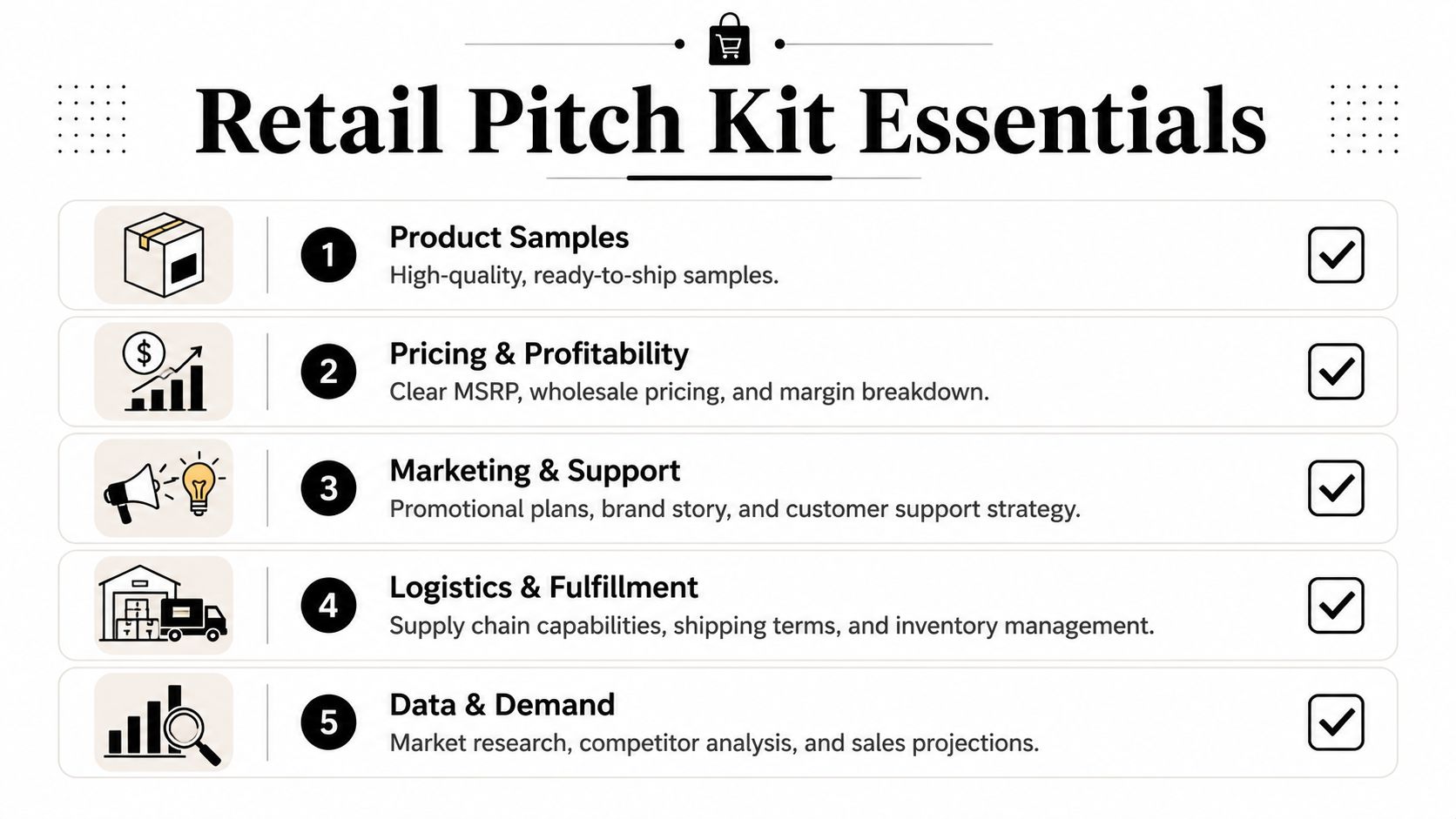
Your pitch kit should answer one question fast: why will this move in this store?
The two documents you actually need
You don't need a bloated deck for most early outreach. You need a clean line sheet and a sharp sell sheet.
Your line sheet is the operational document. Keep it plain and useful. Include:
- Product names and SKUs
- Wholesale pricing
- Suggested retail pricing
- Case pack details
- Available variants
- Ordering contact info
- Lead time and shipping notes
Your sell sheet is the persuasion document. Your buyer-specific angle lives in this concise overview. Indeed's retail guidance emphasizes that buyer-facing data matters as much as product quality, and best practice is to present analytical data on who buys the product, its growth trajectory, and competitor performance. It also notes that in-person pitching works better when backed by a concise sell sheet with data insights and brand details (Indeed on getting your product into stores).
What good buyer-facing proof looks like
If you already sell online, you're sitting on useful evidence. You just need to translate it into buyer language.
Strong signals often include:
- Customer profile: Who buys the product now, and why they buy it
- Demand trend: A qualitative growth story backed by your own store data
- Digital intent: Traffic patterns, email engagement, and ad reach that show interest exists
- Retail fit: Why this SKU belongs in this specific assortment
- Competitive context: What your product offers that nearby alternatives don't
Don't dump screenshots from Shopify, Google Analytics, and Instagram into a PDF and call it strategy. Curate the evidence. A buyer should be able to skim one page and understand the market case.
Bring samples, but don't expect samples to carry the meeting by themselves. The sample starts the conversation. The data closes the credibility gap.
Make the materials look professional
Presentation affects trust. If your photography looks improvised, buyers may assume the rest of the business is improvised too. For founders updating product visuals before wholesale outreach, it helps to compare AI product photography platforms and decide whether you need cleaner catalog images, lifestyle shots, or both.
A practical one-page sell sheet structure:
- Brand snapshot with a short positioning statement
- Hero product image that matches retail presentation
- Customer fit explaining who buys and where the product belongs
- Proof of demand using your own sales and audience data
- Product details including pricing, pack size, and reorder basics
- Retail support such as launch promotion, founder availability, or community audience
A line sheet gets you organized. A sell sheet gets you remembered. You need both.
Choose Your Retail Outreach Channel
A founder gets one encouraging reply from a regional chain and starts chasing big retail. Six months later, the product is in too many doors, reorders are uneven, and nobody can prove the item deserves broader placement.
A better path is slower at the start and faster later. Pick the outreach channel that helps you prove sell-through in a small group of independent stores first. That gives you cleaner feedback, tighter operations, and evidence you can use when larger buyers ask the hard question: will this move off the shelf?
Side-by-side channel trade-offs
Different channels solve different problems. Early on, the fundamental question is simple. Are you trying to learn, or are you trying to expand?
| Channel | Best For | Typical Cost | Control Level |
|---|---|---|---|
| Direct to retailer | Independent stores, local pilots, fast learning | Low direct cost, high founder time | High |
| Trade shows | Meeting many buyers in a short window | Higher travel and booth cost | Medium |
| Broker | Expanding after early retail proof | Commission-based, often a meaningful cut of wholesale revenue | Medium to low |
| Distributor | Wider reach once demand is established | Lower margin and less account control | Low |
| Wholesale marketplaces | Discovery and low-commitment trial orders | Platform fees and ongoing account management | Medium |
The mistake I see from online-first brands is picking the channel with the most reach before they have proof that the product can hold velocity in stores. Reach without reorder data is expensive guessing.
Direct outreach is usually the best first move
For most e-commerce brands entering wholesale, direct outreach to a short list of independent retailers is the highest-value starting point. You choose the stores. You hear objections directly. You see what happens after the product lands.
That learning matters more than scale at this stage.
Independent stores give you a better testing environment than a large chain because you can usually get placement faster, support the launch more closely, and read results without layers of bureaucracy. If the product stalls, you learn why. If it moves, you can document reorder timing, top-performing SKUs, and the kind of store where the product works best.
That becomes your retail case.
Direct outreach works best when you can:
- Research the store's assortment before reaching out
- Explain why a specific SKU fits that shelf
- Follow up quickly with samples, pricing, and reorder details
- Stay close enough to the launch to improve merchandising and restocking
Use brokers and distributors after you have proof
A broker can get meetings you would not get on your own. A distributor can simplify fulfillment across more accounts. Both can help. Both also take margin and reduce your direct contact with the store.
That trade-off only makes sense once you already know what kind of account produces healthy sell-through.
Hiring a broker before you have a clean story is usually premature. You are paying for access before you have enough evidence to convert that access into lasting placements. The stronger sequence is direct outreach first, a handful of good independent accounts next, then broker support once you can show repeat orders and stable shelf performance.
The same logic applies to distributors. Distribution solves reach. It does not solve product-market fit at retail.
Trade shows and marketplaces have a place
Trade shows work best when you already know your retail pitch is landing and you want efficient exposure to more buyers. They are less useful if you are still refining pack sizes, pricing, or your in-store story.
Wholesale marketplaces can also help, especially if you want another source of trial orders while keeping direct outreach active. Just do not let marketplace activity replace deliberate account selection. A random order is not the same as a strong pilot account.
For larger retail systems, preparation gets much heavier. If you plan to sell into mass retail later, review the operational requirements in this guide to Walmart Seller Central for marketplace and retail setup before you start pitching bigger accounts.
A practical selection filter
Use a simple filter:
- Need proof of sell-through? Start with direct outreach to independent stores.
- Need more buyer access after early wins? Add a broker.
- Need broader coverage and can accept thinner margins? Add distribution.
- Need extra discovery while you build a targeted store list? Test a wholesale marketplace.
- Need chain readiness? Wait until your reorder data, operations, and retail support are consistent.
Choose the channel that matches your current stage, not the one that sounds biggest. Early retail success comes from controlled testing, close support, and reorder evidence. Expansion gets much easier once you can show that a small set of stores already wants more.
Master the Buyer Meeting and Negotiation
The buyer meeting usually feels bigger than it is. In most early retail conversations, the buyer isn't looking for a keynote presentation. They're looking for signals that you're easy to work with, clear on the numbers, and honest about what the product can do.
A strong meeting often sounds less like a pitch and more like a practical working session.
How the conversation usually unfolds
You walk in with samples, a line sheet, and a sell sheet. The buyer picks up the product, turns it over, asks the shelf price, asks what's selling online, and asks where else it's placed.
Then the fundamental questions start.
Can you restock quickly?
What's the minimum opening order?
Who pays freight?
What happens if it doesn't move?
Do you have promotional support?
That's where founders either sound prepared or sound expensive.
Terms worth discussing early
Price matters, but it isn't the only term that shapes the relationship.
Talk through these points clearly:
- Opening order size: Keep it realistic. A smaller first order is often the right trade if it gets the account live.
- MOQ by SKU or case pack: Don't force inventory complexity onto the store.
- Payment terms: Some buyers will ask for terms that stretch your cash cycle. Know what you can accept.
- Shipping responsibility: Clarify who covers freight and when risk transfers.
- Return or buy-back expectations: Don't promise protection you can't absorb.
I've found it helps to speak plainly. “For a first order, we'd rather start tight, support the launch, and earn the reorder” is often stronger than trying to sound bigger than you are.
If a buyer senses that you're hiding fragility in the business, they'll assume every future order comes with a surprise.
Handling objections without sounding defensive
Most objections are not final rejection. They're requests for risk reduction.
If the buyer says the category is crowded, respond with your fit. If they say shelf space is limited, show why your product complements what's already there. If they say the brand is still early, offer a focused trial instead of arguing about your vision.
A few response patterns work well:
- “We don't know if it'll sell.” Suggest a narrow initial assortment and a defined review point.
- “We already carry something similar.” Explain the specific shopper or use case your product serves differently.
- “Your minimum is too high.” Reduce friction on the first order if the account is strategically useful.
- “Come back later.” Ask what proof would make the conversation easier next time.
Leave every meeting with one concrete next step. That might be a sample review, a revised quote, a trial order, or a follow-up after a set period. Ambiguous endings kill momentum.
Drive Sell-Through and Scale Your Retail Presence
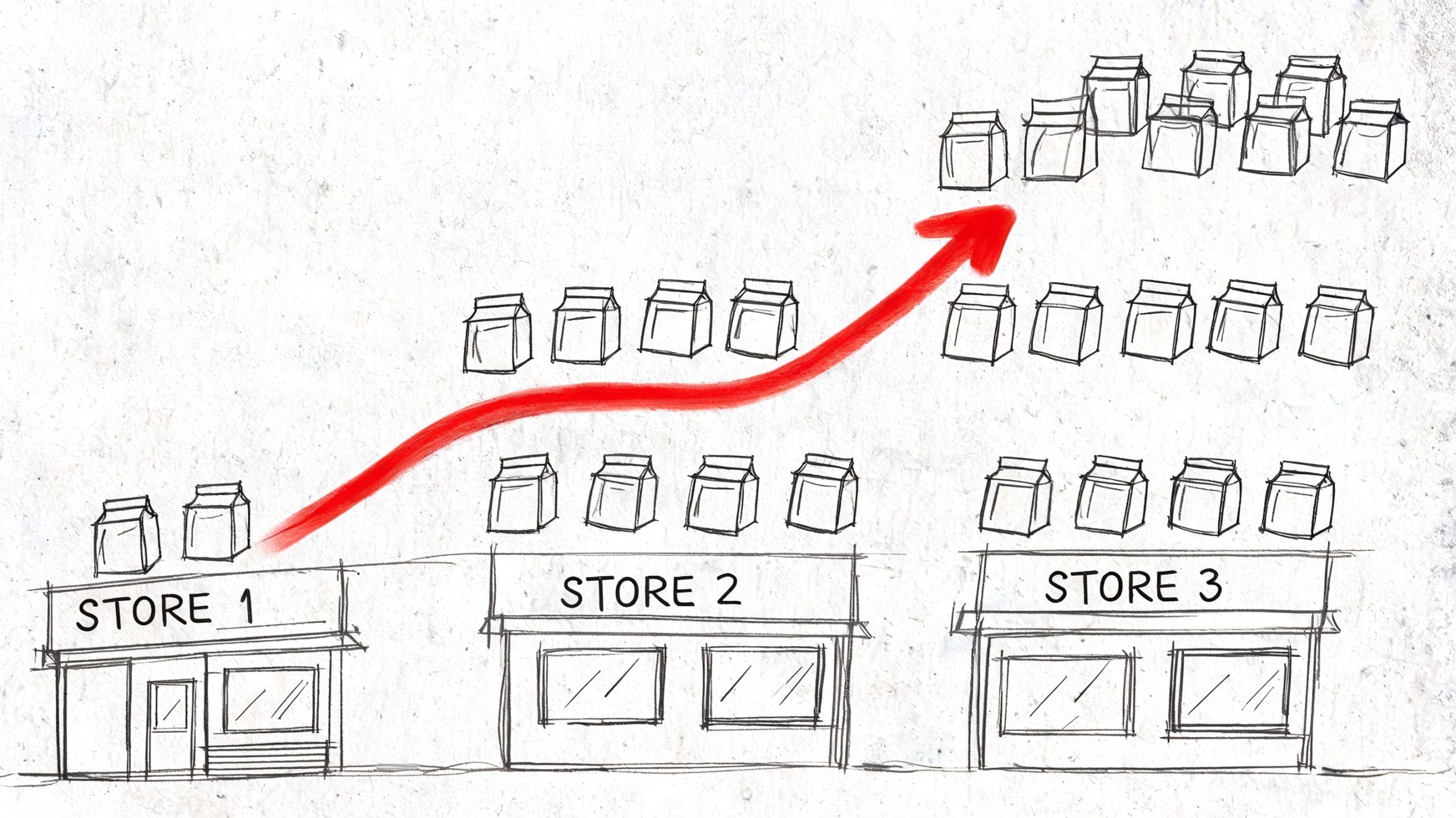
The first purchase order is not the win. Sell-through is the win. If the product sits, the account stalls. If it moves, you can ask for more inventory, more facings, more SKUs, and more stores.
That's the part many online founders underestimate. Retail growth comes after placement, not at placement.
Support the launch like it matters
A new SKU rarely sells because it merely exists on shelf. It sells because the store placed it well, staff understood it, and the brand helped create awareness.
Early support can include:
- Founder education for staff: Give the team simple language for what the product is and who it's for.
- Local audience activation: Send nearby customers to the store carrying your product.
- In-store merchandising support: Make sure placement and display stay clean.
- Fast replenishment communication: If stock starts moving, don't wait for the buyer to chase you.
Your online audience becomes useful here. A retail launch isn't separate from DTC. Your email list, social channels, and local community can help drive first-week movement.
Track the right retail signals
Observa's retail merchandising guidance is one of the clearest explanations of how suppliers should think about post-launch data. Practical merchandising decisions often hinge on more facings, more inventory, more SKUs, and more stores. Direct retail sales data can help a supplier argue for larger orders because repeated out-of-stocks may show the back room is understocked rather than demand being weak. Observa also notes that many stores restock only once a day, so if a product sells out in the morning, every hour until the nightly restock can mean lost sales (Observa on using retail data to sell more).
That gives you a much better expansion conversation than “customers seem to like it.”
Watch for:
- Reorders
- Out-of-stock patterns
- Top-performing SKUs
- Shelf space constraints
- Store-to-store differences
CrossBridge gives one especially practical benchmark for early proof. If a product sells about 2.8 units per store per week across a 10-store chain and gets multiple reorders in the first month, that becomes a defensible demand signal for larger buyers. I'm not repeating that as a universal target for every category. I'm pointing to the principle: buyers respond to store-level velocity plus reorders, not hope.
If you're managing launches in large retail environments, even understanding the store's replenishment rhythm helps. This overview of the Walmart restocking schedule is useful because it shows how timing and shelf availability affect what customers see.
Turn one pilot into a rollout case
The playbook for how to get your products in stores looks like this:
- Win a small set of aligned stores
- Support the launch aggressively
- Collect clean sell-through and reorder evidence
- Use that evidence to expand into nearby accounts
- Repeat the process with tighter operations each round
A buyer is far more likely to expand a proven SKU than to gamble on a story.
That's why the independent-store-first strategy works. It produces proof you can carry forward. Once you can show that a product moves in one store, then in a cluster, then across a region, the pitch changes. You're no longer asking a buyer to believe. You're showing them what already happened.
If you're serious about getting off the DTC treadmill, retail can become a strong second growth engine. Just don't approach it like a lottery ticket. Start with stores you can win, support, and learn from. Then use the numbers those stores give you to earn the next shelf.