
You’re probably in one of two spots right now. Either you’ve opened a dozen wholesale directories and found nothing but recycled lists, sketchy websites, and suppliers that won’t answer basic questions. Or you’ve found plenty of products, but every listing looks like a race to the bottom once you check Amazon, Walmart, or Google Shopping.
That’s the problem with most advice on wholesalers for resellers. It treats sourcing like a directory problem. It isn’t. It’s a margin problem, a positioning problem, and a supplier selection problem.
The opportunity is massive, but scale only helps if you source intelligently. The global wholesale market reached an estimated $57.73 trillion in 2025 and is projected to grow to $73.13 trillion by 2029, while global B2B ecommerce hit $32.1 trillion in 2025, giving small resellers more digital access to suppliers than ever before, according to RepSpark’s wholesale industry trends. That means access is no longer the bottleneck. Judgment is.
I learned quickly that a “good supplier” isn’t just one with low prices. It’s one that helps you keep margin, avoid stock headaches, and build an offer other sellers can’t copy overnight. If you sell in product categories with lots of variants, that matters even more. For example, if you’re researching niche inventory like accessories, this guide on sourcing wholesale jewelry for your business is useful because it shows how product-specific buying considerations shape the sourcing process.
Stop Guessing and Start Sourcing Profitably
Most resellers don’t fail because they can’t find suppliers. They fail because they choose suppliers before they choose a strategy.
That usually looks like this. You see a product on a marketplace, check that the buy box isn’t impossible, message the supplier, and ask for a price list. If the catalog looks decent, you start thinking about orders before you’ve answered the harder questions. Who else is selling it? What protects your margin? Will this line still make sense when fees, prep, defects, and reorders show up?
Start with the outcome you want
A supplier should match the business you’re trying to build.
If you want repeatable replenishment for Amazon FBA, consistency matters more than novelty. If you run a Shopify store, assortment and branding often matter more than finding the absolute lowest landed cost. If you flip closeouts, speed matters more than long-term exclusivity.
Use this simple filter before you contact anyone:
- Margin fit: Can this catalog support a healthy resale spread after all channel costs?
- Channel fit: Is this supplier workable for Amazon FBA, Shopify, eBay, or wholesale-to-retail?
- Inventory fit: Can you store it, prep it, and reorder it without chaos?
- Competition fit: Are you stepping into a commodity listing that dozens of sellers can access?
Practical rule: Don’t ask “Is this a real wholesaler?” first. Ask “Does this supplier create a business I’d still want six months from now?”
Directories are only the surface
Directories, marketplaces, and trade shows are useful, but they’re not your edge by themselves. Your edge comes from how you screen suppliers, how you assess product defensibility, and how you decide where not to compete.
That shift matters because access to wholesale is easier than it used to be. More suppliers are online, more catalogs are searchable, and more ordering happens through digital channels. Good. That gives resellers reach. It also means your competitors are looking at many of the same sources.
The play is to stop collecting supplier names and start building a sourcing system.
Understanding the Wholesale Landscape
Two suppliers can offer the same product category and produce completely different businesses for a reseller. I’ve bought from both. One gave me reorderable SKUs with enough margin to survive ad costs, returns, and marketplace fees. The other looked cheap on paper and turned into dead stock, price wars, and support headaches.
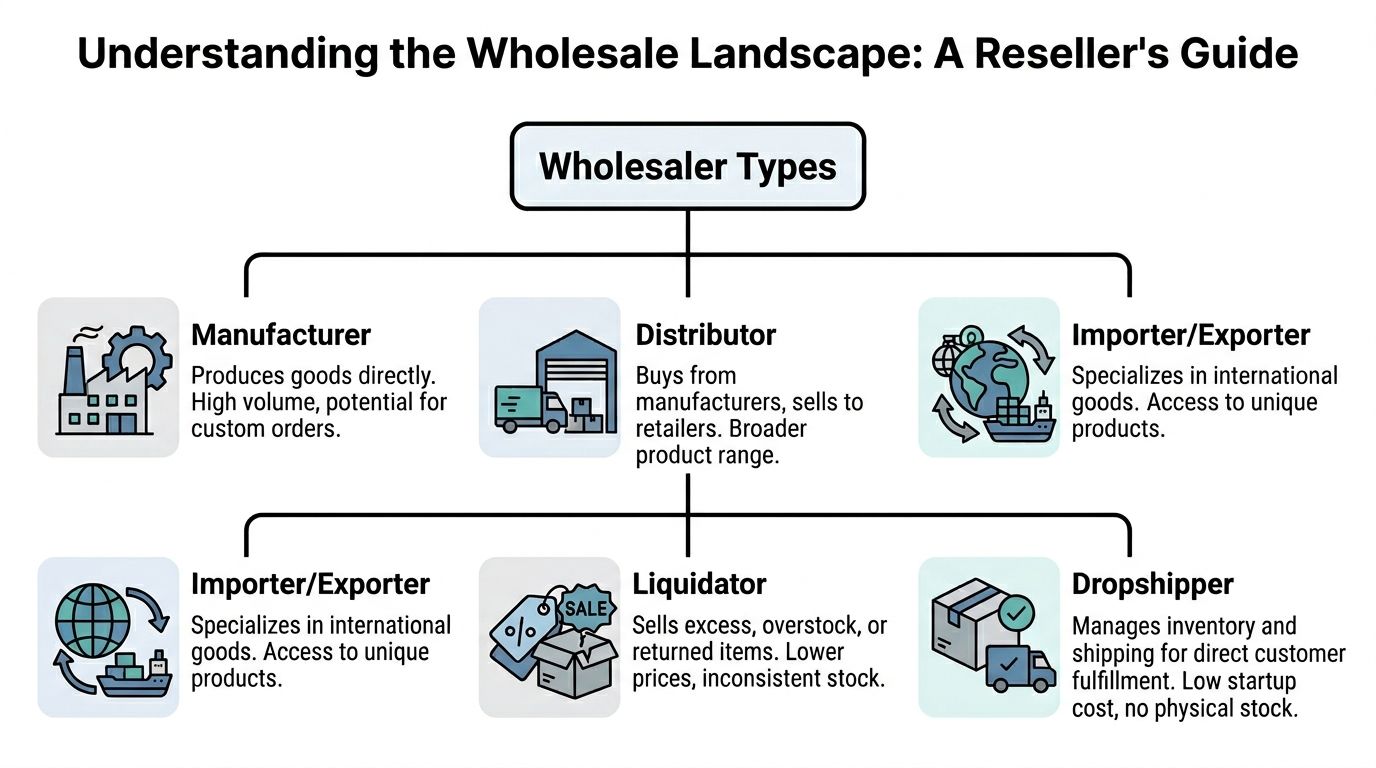
The difference usually comes down to supplier type. If you know how each one makes money, you can predict your likely margin, your reorder risk, and how exposed you’ll be to competition.
The supplier types that matter
Manufacturers give you the most control over margin and product specs. They make sense when you already know what will sell, want custom packaging, or need a variation other sellers do not have. The catch is commitment. Order quantities are higher, lead times are longer, and mistakes are more expensive because you are closer to the source.
Distributors are the easiest entry point for many resellers. They carry multiple brands, their ordering process is usually cleaner, and you can test a category without building a large position. You pay for that convenience. Margins are often tighter, and the same catalog may be available to dozens of sellers on Amazon, eBay, and independent stores.
Importers and exporters are useful when your edge comes from selection. They can help you source regional products, trend-driven items, or variants that are not common in domestic wholesale channels. I treat them carefully. Freight costs, customs delays, and inconsistent quality checks can erase a good buy fast.
Liquidators work best for sellers built around opportunistic inventory. You can find strong deals, but you usually cannot build a stable replenishment business on unpredictable lots. If your goal is repeatable revenue, liquidation should be a side channel, not the core of the operation.
Dropship suppliers lower your upfront cash risk. They also give up a lot of operational control. If their stock feed is wrong or their pick-and-pack process is sloppy, your store absorbs the customer complaint.
Match the supplier to the business model
The right supplier depends on how you sell and what kind of moat you want.
Amazon FBA usually rewards consistency. That pushes many sellers toward distributors or established manufacturers that can support repeat orders, predictable case packs, and fewer catalog surprises. Shopify and niche stores can justify a different approach. A unique assortment, custom bundle, or category specialization can matter more than squeezing every last point of margin out of a standard SKU.
I also look at whether the product is easy to compare. If buyers can check ten identical listings in thirty seconds, I assume pricing pressure will get worse. If the product requires some education, has spec-based buying criteria, or serves a narrower use case, I have more room to protect margin. That is one reason packaging, accessories, replacement parts, and business-use products can be attractive. Buyers often care about fit, size, material, or compliance details, not just headline price. For an example of how specification changes the buying decision, Afida's UK catering packaging advice is a useful reference.
Profit comes from fit, not access
A supplier is only valuable if their catalog matches a demand gap you can serve profitably.
That sounds obvious, but many resellers still source backwards. They find a big catalog first, then try to force products into a store or marketplace channel. I get better results with the reverse approach. Start with a narrow customer need, then look for a supplier whose line solves it better than the generic offers already flooding the market.
That might mean:
- a distributor with replacement parts for a product owners already use
- a manufacturer willing to add custom packaging or bundle inserts
- an importer carrying regional or hard-to-find variations
- a niche wholesaler serving one buyer type better than broadline competitors
If you want a practical companion to this step, this guide on how to buy in bulk for resale helps frame quantity decisions before you overcommit.
My rule is simple. Do not grade suppliers by catalog size alone. Grade them on whether they help you keep margin after fees, reorder without chaos, and stay out of commodity fights you cannot win.
Where to Find Your Future Bestsellers
There are more places to find wholesale suppliers now than ever. That doesn’t make sourcing easier. It just gives you more noise to filter.
Start with digital marketplaces
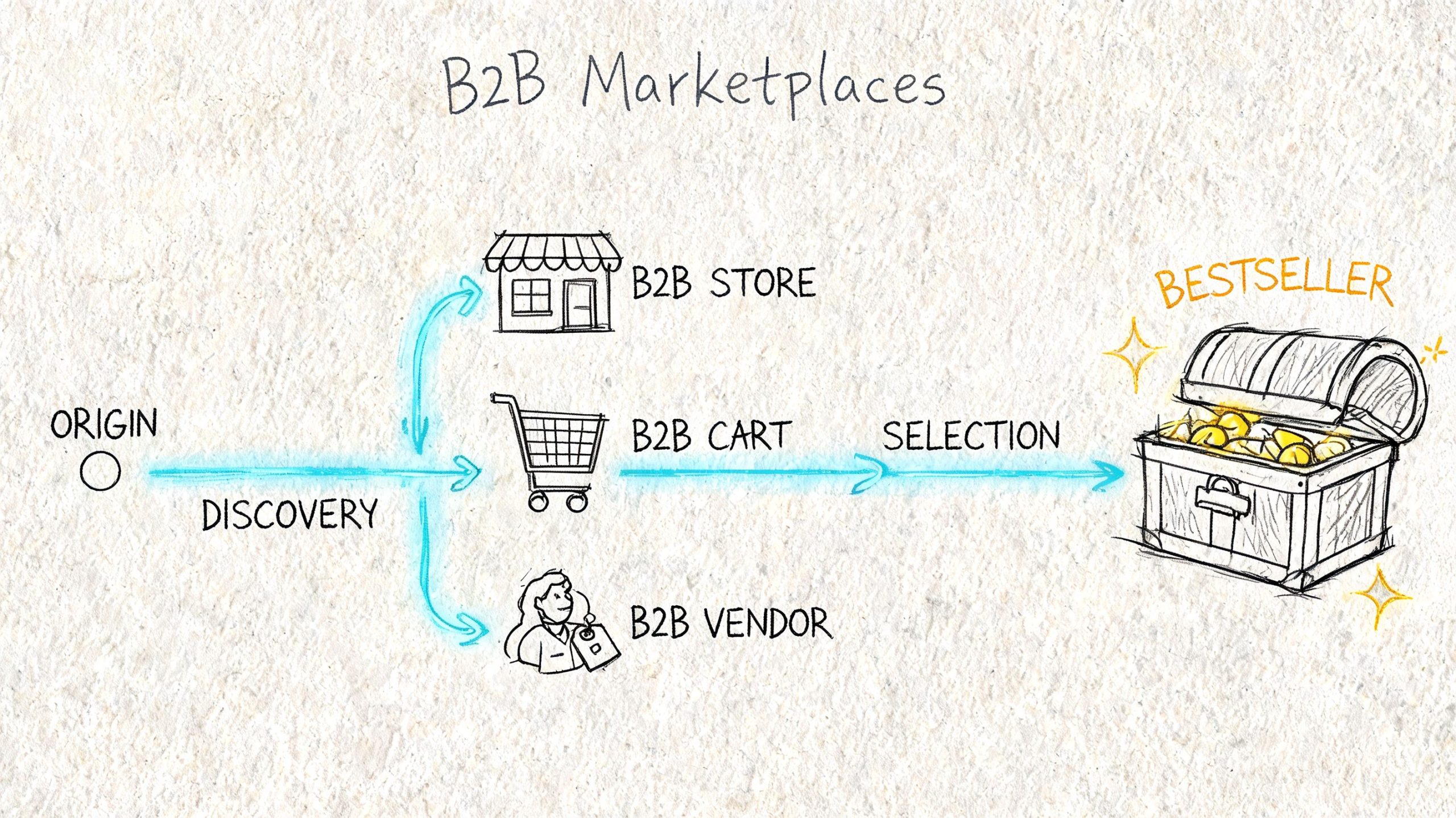
For many resellers, B2B marketplaces are the fastest way to build a lead list. Platforms like Faire, Tundra, Handshake, JOOR, and category-specific marketplaces are useful because they centralize discovery, basic supplier information, and product browsing.
The mistake is treating these platforms like the final answer instead of the first pass.
Use them to:
- Map the niche: Which brands keep appearing across categories?
- Spot assortment depth: Does the supplier have a coherent line or random products?
- Check product logic: Are there obvious replenishable items, accessories, or bundles?
- Build comparison sets: Shortlist similar suppliers before you contact any of them.
If you’re still refining your buying process, EntreResource’s guide on how to buy in bulk for resale is a useful companion because it helps frame quantity decisions before you overcommit.
Use smarter search queries
Google is still one of the best supplier-finding tools if you search like a buyer, not like a casual browser.
I use combinations like:
- wholesale distributor
- manufacturer usa
- importer reseller application
- [city or region] supplier
- trade show exhibitors
- [brand category] wholesale catalog pdf
PDF results can be especially useful because line sheets, dealer forms, and old exhibitor packets often surface there before polished marketing pages do.
Go offline when everyone else stays online
Trade shows still matter because suppliers often reveal more in person than they do on a website. You can see packaging quality, ask direct questions about reorder cadence, and judge whether the business looks built for retail partnerships or just broad distribution.
A local manufacturer can be even better. Smaller regional suppliers sometimes have no polished B2B portal, weak SEO, and minimal outreach. That’s exactly why they’re worth checking. They may offer responsive communication, regional relevance, or product variants that larger directories bury.
This walkthrough is worth watching if you want a visual look at supplier sourcing in practice:
My quick triage method
I don’t spend much time on a supplier until they pass three fast tests:
- The catalog has focus. Random mixed inventory is usually a bad sign unless the business is clearly a broad distributor.
- The products solve a market need. I’m not looking for “cool.” I’m looking for obvious buyer utility.
- The supplier looks workable. Clear terms, business information, product identifiers, and communication paths.
Good sourcing gets easier when you stop trying to evaluate everything.
The Vetting Checklist for Profitable Partnerships
Money is made or lost at this juncture. A polished website, a friendly sales rep, and a decent opening price don’t tell you much. A bad supplier can destroy margin through defects, delays, missing paperwork, inconsistent case packs, and inventory you can’t reorder when you need it.
The resellers who hold margin longer usually don’t win by chasing the lowest visible price. Top resellers extract disproportionate margins not through volume alone, but through strong supplier relationships and strategic selection. They analyze how to optimize profits when wholesale costs are fixed, a key step beyond just finding the lowest price, according to The4’s wholesale supplier analysis.
What I look for before I buy
I want to know four things. Is the supplier real? Is the product consistent? Is the relationship scalable? And does this supplier improve my economics beyond the line-item price?
That last point matters more than most sellers realize. If one supplier is slightly more expensive but ships cleanly, answers fast, honors pack details, and keeps inventory stable, they can be more profitable than the “cheap” option.
Cheap inventory gets expensive fast when you spend your week fixing supplier mistakes.
Supplier Vetting Checklist
| Category | Check | Notes |
|---|---|---|
| Business legitimacy | Verify legal business identity and contact details | Match website info, email domain, and paperwork |
| Catalog quality | Review product consistency and assortment logic | A focused catalog usually beats random variety |
| Channel suitability | Confirm they support your resale model | Ask about marketplaces, packaging, and invoicing |
| Communication | Test response quality and speed | Clear replies usually predict smoother operations |
| Samples | Order samples before any meaningful order | Inspect packaging, labeling, defects, and presentation |
| Reorder reliability | Ask how replenishment works | You want a partner, not a one-off score |
| Competition exposure | Learn where else they sell | Widely distributed goods can compress margin quickly |
| Terms clarity | Review MOQ, lead time, payment terms, and returns | Ambiguity now becomes conflict later |
| Documentation | Confirm invoice quality and business paperwork | Especially important for marketplace validation |
| Strategic fit | Decide whether they support a defensible niche | Don’t buy products you can’t protect |
Samples tell you more than product quality
Samples are often ordered just to judge the item. That’s not enough.
Use samples to inspect the full operating experience:
- Packaging quality: Can this survive inbound shipping and customer delivery?
- Labeling and identifiers: Are SKUs, variants, and carton details clear?
- Consistency: If you order multiple variants, do they feel like one coherent product line?
- Presentation: Does the product look retail-ready, giftable, or premium enough for the channel?
- Instruction quality: Missing inserts or poor translations can become support headaches.
I also pay attention to the supplier’s process during the sample stage. If the sample order is confusing, delayed, or sloppy, a larger order usually won’t improve things.
Vet the supplier, not just the product
Resellers often use supplier marketplaces and directories as shortcuts. Sometimes that’s fine. But it’s still smart to study how those middlemen work before you rely on them. If you’re considering directory-style sourcing tools, this SaleHoo review from EntreResource helps show what to look for beyond marketing claims.
A supplier is profitable when the relationship removes friction, not when the first spreadsheet line looks attractive.
Negotiating Terms and Onboarding Your Supplier
Once a supplier passes vetting, the next job is setting terms that keep the relationship usable. This isn’t about trying to “win” the negotiation. It’s about removing ambiguity before inventory is on the water, in your prep center, or halfway to Amazon.

The first serious outreach
Your first real supplier email should be short, specific, and businesslike. Don’t send a vague note asking for “more info.” Tell them what you sell, where you sell, what types of products you’re interested in, and what you need to evaluate fit.
Hello [Name],
I run an e-commerce resale business focused on [category] through [sales channels]. I’m interested in opening a wholesale account and reviewing your catalog, order requirements, and reseller terms. Please send your current line sheet, MOQ details, lead times, payment terms, and any dealer application documents. If available, I’d also like to place a sample order for selected SKUs before moving to a larger purchase.
That message does two things. It signals that you’re serious, and it makes the supplier answer operational questions instead of sending fluff.
Terms worth negotiating
Not every supplier will move on every point, but these are the ones to press on:
- MOQ flexibility: Ask whether they allow mixed-SKU opening orders or lower initial order thresholds.
- Price breaks: If they have tiered pricing, ask what grants access to the next level and whether your first order can qualify based on product mix.
- Payment terms: New buyers often start with prepay. Over time, strong communication and timely payment can support better terms.
- Lead times: Get estimated production or fulfillment timing in writing.
- Shipping method: Clarify who books freight, who labels cartons, and who handles special routing if you use FBA or a prep center.
- Damage and defect handling: Agree on the claim process before you need it.
Onboarding without chaos
Create a simple supplier file the moment you decide to move forward. Store account contacts, catalogs, invoices, sample notes, SKU mappings, reorder points, and any packaging requirements in one place.
Then place a controlled first order. Not the biggest order you can afford. The best first order is large enough to test the relationship and small enough to survive mistakes. You’re checking whether their real-world execution matches their promises.
If a supplier performs well on a modest first order, scaling becomes a decision. If they perform poorly, you’ve paid for information instead of a disaster.
Legal Essentials and Red Flags to Avoid
A legitimate wholesale relationship usually requires basic business documentation. If a supplier asks for a business license, resale certificate, seller’s permit, or tax documentation, that’s normal. Serious wholesalers want to know they’re dealing with an actual resale business, not a random retail buyer trying to get “wholesale prices.”
The documents that usually matter
Keep these ready before outreach gets serious:
- Business registration: Whatever structure you use, have your formation details accessible.
- Resale certificate or seller’s permit: This is often necessary when buying inventory for resale.
- EIN or business tax information: Many wholesalers ask for it during account setup.
- Marketplace documentation: If you sell on Amazon or another platform, be ready to explain your business model clearly.
If your channel requires strong invoice trails, this matters even more. Amazon sellers should understand invoice standards before placing inventory-heavy orders. EntreResource’s guide on how to properly validate suppliers when Amazon isn’t accepting invoices is a practical reference here.
Red flags that should slow you down
Some warning signs are obvious. Others only look minor until they create a major mess.
Walk carefully if a supplier:
- Avoids paperwork: They won’t provide clear invoices, terms, or company details.
- Pushes unusual payment methods: Especially if they resist standard business payment channels.
- Refuses samples: That usually means they don’t want scrutiny.
- Applies pressure fast: “Buy today” tactics are a poor fit for serious wholesale.
- Has inconsistent product details: Conflicting SKUs, unclear variants, missing specifications.
- Can’t explain fulfillment clearly: If they can’t describe shipping, prep, or lead times, expect friction later.
The last look before you commit
I like one final check before a meaningful order. Review the full chain, not just the supplier.
Ask yourself:
- Do I have the documents needed to buy and resell this properly?
- Will the invoices and packaging support my sales channel?
- If this order arrives imperfectly, do I know exactly how claims get handled?
That last review catches a lot of avoidable mistakes. Most bad wholesale experiences aren’t caused by one giant issue. They come from several small ignored warnings.
Frequently Asked Questions About Wholesale Sourcing
What’s the difference between a manufacturer and a distributor?
A manufacturer produces the goods. A distributor buys goods from manufacturers and resells them to retailers or other businesses. For resellers, manufacturers can offer stronger pricing and customization, while distributors often offer easier onboarding, broader selection, and lower operational friction.
Do I need an LLC to buy from wholesalers?
Not always. Requirements vary by supplier and by location. What matters most is whether you can provide the business and tax documentation the wholesaler requires, especially a resale certificate or seller’s permit where applicable. Some wholesalers are strict. Others are more flexible. Either way, approach them like a real business.
What should I do if the first order arrives damaged or defective?
Document everything immediately. Photograph the packaging, cartons, labels, and affected units. Compare what arrived to the purchase order and invoice. Then contact the supplier with a clear summary, organized evidence, and a direct request for resolution.
Use a short structure:
- What was ordered
- What arrived
- What’s wrong
- What resolution you want
Don’t make the email emotional. Make it easy for the supplier to process.
How do I know if a wholesale product is too commoditized?
Check how easy it is for other sellers to access the same item, how similar competing offers look, and whether you have any angle beyond matching price. If the product is identical across sellers and the supplier sells broadly, margin usually gets squeezed. The better play is a narrower niche, stronger bundle logic, or a supplier with a more distinctive catalog.
Wholesale sourcing gets easier once you stop chasing lists and start building a filter. Find demand gaps first. Match them to supplier types. Vet hard. Negotiate clean terms. Then scale only after the first order proves the relationship works.
If you want more practical breakdowns on Amazon FBA, online arbitrage, and building internet businesses without fluff, check out EntreResource.