
You might be looking at this from one of three angles right now. You’ve got boxes of books in a garage and want fast cash. You’ve spotted a possible arbitrage play and want to flip inventory on Amazon. Or you’ve finished a manuscript and want to turn it into a product.
All three count as selling books to amazon, but they’re not the same business. They use different workflows, different economics, and very different expectations. That’s where most beginners get tripped up. They mash together trade-ins, marketplace reselling, and self-publishing as if they’re interchangeable.
They’re not.
Why Selling Books on Amazon Is a Golden Opportunity
Amazon is where the buyers already are. In the United States, 71% of readers reported purchasing a book from Amazon in the past 12 months, and Amazon’s worldwide book category revenue reached $16.9 billion in the first 10 months of 2022. The platform’s position is tied to pricing, convenience, and a catalog of more than 12 million titles, which is why so many independent sellers and authors build there first instead of trying to create demand elsewhere from scratch (Statista chart on Amazon book buying).
That doesn’t mean every path is equally good for every person. It means Amazon gives you access to demand at a scale that’s hard to match.
Three ways people actually do this
Most practical book selling on Amazon falls into three buckets:
- Trade-in for quick cleanup. This is the low-effort route when you want to turn a few qualifying books into Amazon credit and move on.
- Third-party reselling through the marketplace. Arbitrage sellers, textbook flippers, and used book operators operate within this area.
- KDP publishing for creators. You make the product, upload it, price it, and market it.
Each route rewards a different kind of person.
If you want speed and simplicity, trade-in is the closest thing to a liquidation lane. If you want a repeatable inventory business, marketplace reselling is where the work starts. If you want ownership, influence, and a catalog you control, KDP is the creator play.
Practical rule: Don’t ask which path is “best.” Ask which path matches the assets you already have. Inventory, time, cash, writing ability, and tolerance for Amazon’s rules matter more than hype.
What works and what doesn’t
What works is choosing one model and learning its economics before you start buying supplies, scanning thrift shelves, or uploading files. What doesn’t work is listing random low-value books, guessing on condition, or publishing a manuscript with weak metadata and hoping Amazon magically finds readers.
Amazon gives you reach. It doesn’t give you margin, quality control, or discoverability for free.
The Quickest Cash Path Trading In Books to Amazon
If you want the least complicated way to move books, trade-in is the path. It’s not glamorous, and it won’t feel like building a business, but it is useful when you want to declutter without managing listings, customer messages, or shipping one order at a time.
How the trade-in process works
The workflow is simple:
- Go to Amazon’s trade-in area and search by ISBN or title.
- Check whether Amazon is currently accepting that book.
- Review the quoted value and the stated condition requirements.
- Accept the offer if it makes sense for you.
- Print the shipping label Amazon provides.
- Pack the books carefully and ship them in.
- Wait for inspection and credit.
The reason I like trade-in for the right books is that it removes the messy part of selling. You don’t create a listing, write condition notes for a buyer, or wonder whether your copy will sit unsold for months.
When trade-in makes sense
Trade-in usually fits a narrow set of books better than a broad home-library purge.
A good candidate often looks like this:
- Recent textbooks with clean interiors and no access-code issues
- Popular nonfiction in solid condition
- Clean copies with no heavy writing, water damage, or missing pages
- Books you don’t want to store while waiting for a marketplace sale
Weak trade-in candidates are usually obvious once you’ve sold books for a while.
- Mass-market paperbacks tend to be poor fits
- Older damaged books with notes, highlighting, or bent covers often won’t be worth the trouble
- Odd editions can create confusion if the exact match isn’t accepted
The biggest trade-in mistake is expecting reseller-level payouts from a convenience service. You’re getting speed and simplicity, not maximum extraction.
What to expect before you box anything
The trade-off is control. Amazon decides what it wants, what it’s willing to credit, and whether your copy meets the condition bar after it arrives. That’s why I treat trade-in as a cleanup tool, not a core revenue model.
If you’re unsure whether a book might be better as a direct resale item, use a scanner workflow first. Tools and app-based scanning habits matter a lot once you’re comparing options in the field, which is why many flippers start by learning a scanner-driven process before scaling sourcing. A practical example is this ScoutIQ review for book flippers, which shows how sellers evaluate books faster when they’re sourcing live inventory.
Here’s the honest filter I’d use:
| Situation | Better path |
|---|---|
| You want fast cleanup with minimal work | Trade-in |
| You want cash rather than store credit | Marketplace resale |
| You have many books and want to optimize margin | Marketplace resale |
| You wrote the book yourself | KDP |
Trade-in is useful. It just isn’t where most meaningful upside lives.
The Reseller Path Selling New and Used Books on the Marketplace
A seller scans a $3 thrift-store textbook, sees a $38 listing price on Amazon, and assumes the margin is there. Then fees, shipping, condition risk, and a return turn that “winner” into dead inventory. That is the reseller path in one snapshot. There is real money here, but only if you buy with discipline.
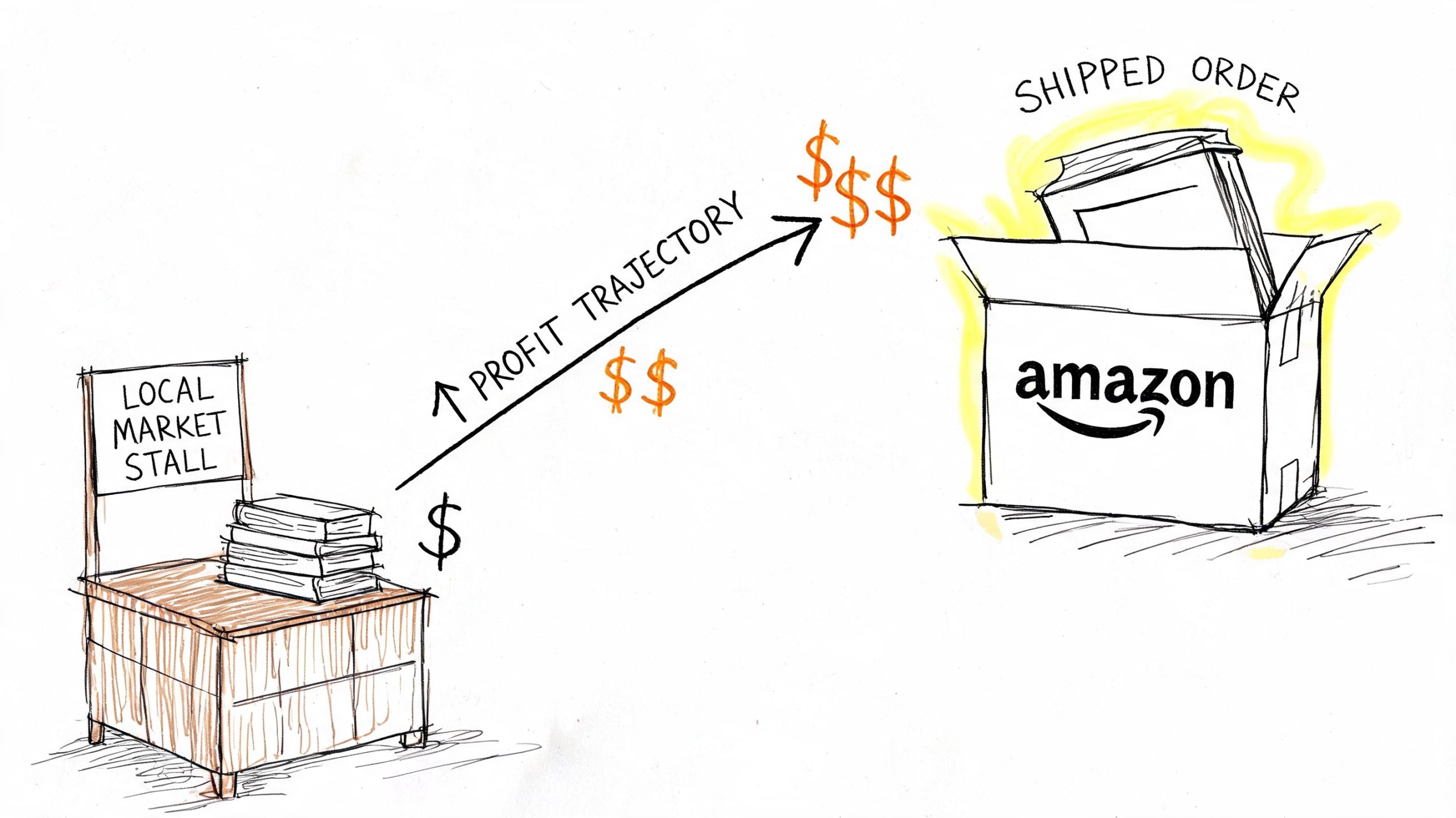
Compared with trade-in, resale gives you more upside and more work. Compared with KDP, you are not creating an asset. You are sourcing inventory and trying to buy below true resale value. That difference matters because the wrong book ties up cash fast.
What a viable sourcing rule looks like
The sellers who last in books are picky. Cheap books are everywhere. Profitable books are not.
For used books sold through FBA, a practical benchmark is to target titles with BSR under 100,000 and limited competition. Seller benchmarks cited by Forest Shipping connect that type of sourcing with 30-50% ROI on strong buys, with 60-70% of properly sourced textbooks and niche nonfiction selling within 30 days. Forest Shipping also points out that new sellers often get in trouble by grading too generously, which drives returns and account friction (Forest Shipping on selling used books on Amazon).
I use that as a filter, not a promise. A good buy usually checks four boxes at once:
- The exact ISBN has steady demand
- The used offers are not crowded
- The condition is easy to grade fairly
- The net payout still makes sense after fees and shipping
Miss one or two of those, and the listing gets shakier.
FBA versus FBM for books
This choice affects margin more than beginners expect.
FBA works when speed and scale matter
With Fulfillment by Amazon, Amazon stores and ships the book. Your listing gets Prime eligibility, and conversion is often better because Amazon handles fulfillment. I like FBA for books that should move quickly and for inventory I do not want sitting in my office.
FBA tends to fit when:
- The book has solid sales velocity
- The sale price leaves room after fees
- You want to process inventory in batches
- You plan to build volume rather than ship one by one
FBM works when the margin is thin or the title is niche
With Fulfillment by Merchant, you store and ship the book yourself. That means more daily handling, but it also gives you more control. I use FBM for slower titles, oddball academic books, and books I want to test before sending inventory into Amazon.
FBM tends to fit when:
- The book is slower moving
- FBA fees would wipe out the spread
- You want to confirm demand before committing inventory
- The title is specialized enough that storage time is a concern
Here’s the practical comparison:
| Fulfillment model | Good fit | Main drawback |
|---|---|---|
| FBA | Faster-moving, stronger-margin books | Fees and prep complexity |
| FBM | Slower or tighter-margin books | More hands-on daily work |
The fee problem that kills beginners
At this point, many reseller plans break.
A lot of new sellers look at sale price first and net profit second. That habit burns cash. Referral fees, fulfillment charges, storage, inbound shipping, supplies, and returns all hit the same book. By the time the order closes, a listing that looked profitable on the app can be mediocre or negative.
I price every book from the net. If I cannot estimate my payout before buying, I pass.
If you’re not running every candidate through a revenue calculator before buying, you’re not sourcing. You’re guessing.
That same discipline matters if you later decide to create your own inventory instead of reselling someone else’s. Sellers who want to compare resale margins with publishing economics should review how Amazon KDP works for self-publishers. It is a different model, but the decision is the same at the core. Know your cost structure before you commit.
The operating playbook that holds up
Reselling books on Amazon is simple to explain and easy to do badly. The boring habits produce the profit.
A practical workflow looks like this:
- Scan by ISBN: Confirm the exact edition first
- Check rank and offer count: Demand and competition matter more than optimistic list prices
- Grade conservatively: If the condition is borderline, lower the grade
- Choose fulfillment on purpose: Send proven movers to FBA. Test edge cases with FBM
- Track returns and complaints: Repeated problems usually come from bad grading or edition mismatch
One more mistake shows up a lot. Sellers buy books they would never want to list twice. If a title is hard to identify, easy to misgrade, or likely to trigger a condition dispute, I would rather leave it behind.
Later in the process, seeing another seller walk through the workflow can help. This video gives a useful visual overview of the book-flipping side of the model:
Which books sell well
Used textbooks, professional exam prep, niche nonfiction, and specialized academic subjects usually give resellers more room than common mass-market fiction. The reason is simple. Buyers search for specific titles, often by ISBN, and they are less price-sensitive when they need the exact book.
I would rather buy one clean niche title with steady turnover than a cart of cheap paperbacks that look easy to list. The first can be a business. The second is often just clutter with postage.
That is also why some sellers eventually switch paths. If you have expertise in a topic and keep noticing strong demand in one category, it can be smarter to write an ebook or publish your own title than keep chasing used inventory forever. Resale can generate cash flow. KDP can build an owned asset. The right path depends on whether you want quick flips, scalable listings, or a catalog with your name on it.
The Creator Path Publishing and Selling Your Own Book via KDP
A lot of sellers hit a point where chasing used inventory stops looking attractive. You spot the same demand patterns over and over, you know the reader, and you realize the better business might be creating the book instead of hunting for it.
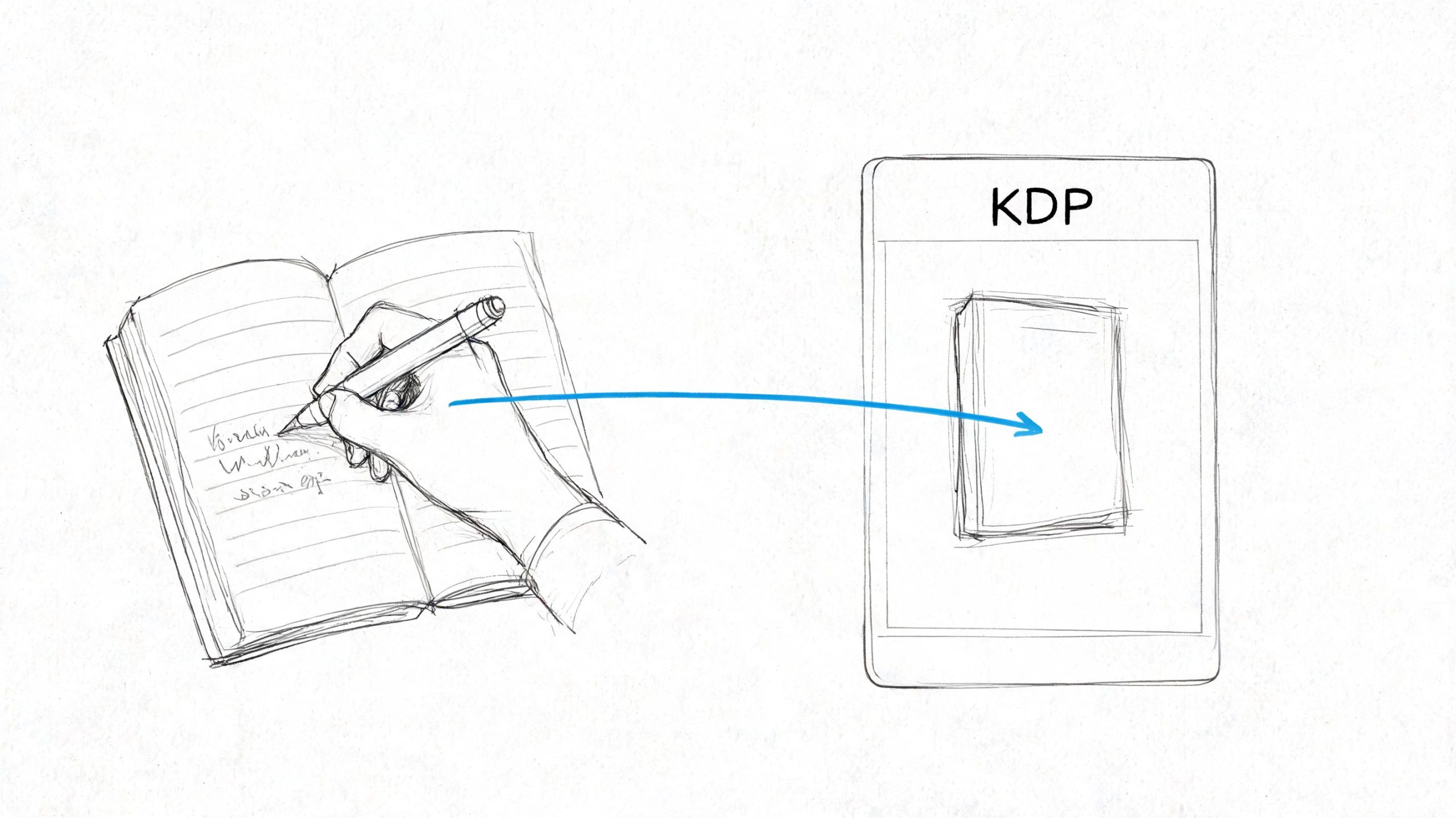
That is the KDP path. You own the listing, control the positioning, and keep the upside if the book gains traction. You also take on the hard part up front. Research, writing, formatting, cover design, metadata, and launch all sit on your side of the table.
The KDP workflow that matters
The dashboard is easy to learn. Product selection is where people win or lose.
A standard KDP process looks like this:
- Create your KDP account and enter bank and tax details.
- Prepare your manuscript file in the accepted format.
- Upload the manuscript and cover.
- Choose categories and keywords.
- Preview the book carefully.
- Set pricing and royalty option.
- Publish and start marketing.
For ebooks, Amazon offers a 70% royalty option on qualifying titles priced between $2.99 and $9.99, as outlined in this Cases Media guide to selling books on Amazon. New publishers fixate on that percentage. I pay more attention to whether the book solves a specific problem and whether the listing makes that obvious in a few seconds.
Why KDP books stall
A hard reality is that many self-published books never get meaningful traction because the author publishes before the market work is done. On Amazon, a strong manuscript can still disappear if the title is vague, the cover looks amateur, or the keywords do not match how buyers search.
That is the mistake I see most often. Authors treat KDP like a file upload task when it is closer to launching a product.
A useful book with weak packaging gets buried fast. A simpler book with sharp positioning can outsell it.
If you are still at the idea stage, start there. The manuscript matters, but so does the promise. This guide on how to write an ebook is a practical place to start if you are turning expertise into a book people will search for and buy.
Production details that affect sales
Formatting does not create demand, but formatting mistakes can kill conversion and reviews. Buyers may forgive a plain layout. They rarely forgive broken tables, bad spacing, or a paperback that looks self-made in the worst way.
The core specs are simple:
- Ebooks should be formatted in MOBI
- Paperbacks should use PDF
- Margins should fall in the 0.5-1 inch range
- Covers should be 300 DPI with a minimum of 1600x2560px
- Embedded fonts and clean previews matter before you hit publish
I always preview on more than one device format before approving anything. A book can look fine in a document file and still break inside Amazon's previewer.
Categories, keywords, and covers carry more weight than new publishers expect
KDP gives limited room for metadata, so every field has a job. Categories affect who you compete against. Keywords affect whether the right buyer sees the book. The cover affects whether they click.
That is why I pressure-test every title with three questions:
- Who is this book for, specifically?
- What exact phrase would that buyer type into Amazon?
- Does the cover look like it belongs beside the current top sellers in that niche?
If the cover misses the category standard, fix that first. Running ads to a weak cover usually means paying for proof that the packaging is off.
For a basic operational reference, this overview of Amazon Kindle Direct Publishing explains how the platform works from account setup through publishing.
Profit potential and trade-offs
KDP has better upside than trade-in and usually better scalability than reselling single used copies. One book can sell for years. A small catalog can turn into recurring income. That is the appeal.
The trade-off is time and uncertainty. You may spend weeks creating a book before you know whether the market wants it. You also absorb costs that resellers can often avoid, including editing, cover design, formatting help, and advertising if you want faster visibility.
I like KDP for people with topic knowledge, teaching experience, or a clear angle on a niche problem. It is a weaker fit for someone who only wants quick cash this month. In that case, trade-in or resale is usually the better lane.
Launch is where ownership starts
Publishing is not the finish line. It is the start of testing.
Watch the listing after launch. Check whether the cover earns clicks, whether the description does its job, whether pricing is too high for the niche, and whether the book is sitting in categories where it can realistically compete. Small changes can improve a listing. Bad assumptions can leave it dead for months.
Sellers who do well with KDP usually act like publishers, not hobbyists. They research demand, build a book for a defined reader, package it to match the market, and revise based on buyer response. That is what makes the creator path different from the other two models. It takes longer to get paid, but you are building an asset you control.
Choosing Your Path A Comparative Breakdown
If you’re deciding between these models, the cleanest way to do it is to match the model to your starting point. Most wrong decisions happen because people choose the path that sounds exciting instead of the one that fits their resources.
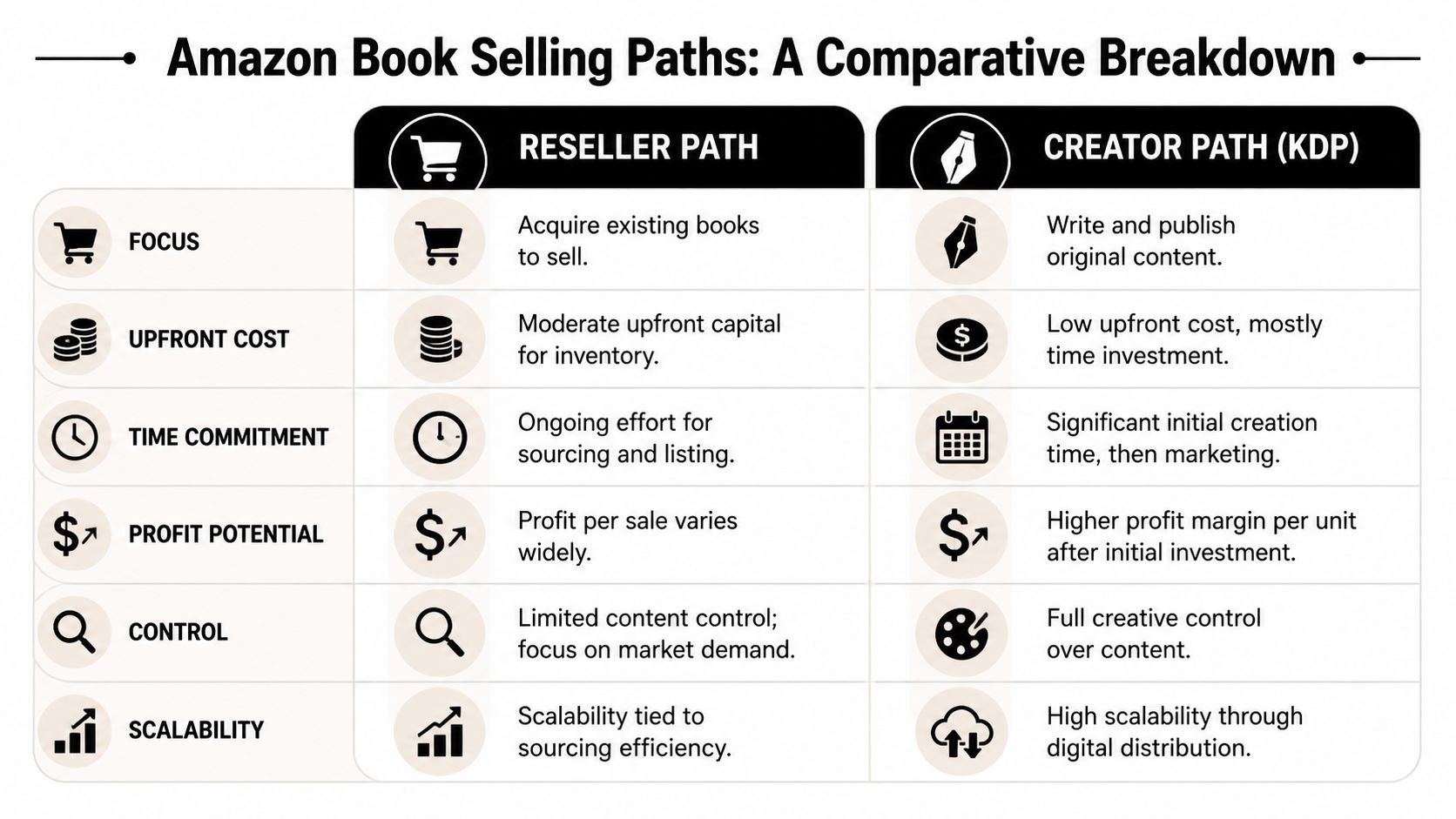
Side by side reality check
| Path | Best for | Money profile | Time profile | Scalability |
|---|---|---|---|---|
| Trade-in | Decluttering and quick exits | Modest and limited | Low effort | Low |
| Reseller | Operators who can source well | Variable, depends on net margins | Ongoing sourcing and listing work | Moderate |
| KDP | Authors, educators, and creators | Better unit economics if the book sells | Heavy upfront creation and launch work | High |
Trade-in is the easiest lane, but it caps out quickly. Reselling has the most moving parts, and that’s exactly why some sellers like it. You can improve sourcing, tighten grading, and build process. KDP is the longest route to first revenue for those beginning, but it offers ownership that resale doesn’t.
The question that usually settles it
Ask yourself which of these sounds most like your situation:
- I have books now and want them gone.
- I can source books consistently and I’m willing to manage inventory.
- I have knowledge or content worth packaging into a book.
That answer usually points to the right model faster than any theory.
One metric matters in more than one path
For both resellers and KDP publishers, Best Sellers Rank is one of the few practical signals you can use to estimate demand. According to the sales-rank estimator data, a print book at BSR #10,000 roughly equals 10 copies sold per day, while #100,000 is closer to 1 sale per day. For ebooks, #10,000 can mean about 20 daily sales (Amazon sales ranking calculator and estimates).
That matters because it changes how you judge opportunities.
If you’re reselling, BSR helps you decide whether a book is likely to move before storage and fees eat you alive. If you’re publishing through KDP, BSR helps you judge whether your launch and category fit are creating real velocity.
Don’t obsess over rank as a vanity score. Use it as a decision tool. The question is whether the rank suggests healthy sales relative to your model and margin.
A blunt recommendation
If you’re new and cash-conscious, start narrow. Trade in what isn’t worth managing. Resell only books that survive a strict net-profit check. Use KDP only if you’re ready to treat the book like a product.
That’s not the exciting answer. It’s the one that usually saves the most money.
Pricing and Prep Essentials for Maximum Profit
A lot of book sellers lose money on books that looked profitable five minutes earlier.
The problem usually is not sourcing alone. It is sloppy grading, lazy edition checks, weak listing prep, and pricing based on hope instead of net profit. I see this in all three paths, but it hits marketplace sellers and KDP authors hardest because both models can hide bad math until after the sale.
Trade-in sellers have the simplest workflow. Resellers need tighter operational discipline. KDP publishers need stronger product positioning. The prep work changes by model, but the rule stays the same. Profit comes from accuracy before you list.
Prep standards that prevent expensive mistakes
For used books, the first job is matching the exact product detail page. Wrong ISBN, wrong format, teacher's edition listed as a standard copy, or a missing workbook insert can turn one sale into a return, an A-to-z claim, or an account warning.
I use a short inspection routine before I list anything:
- Confirm the exact edition. ISBN, binding, publication year, and version all need to match.
- Check the interior. Writing, highlighting, stickers, and library markings change the grade.
- Verify completeness. CDs, access codes, workbooks, and inserts need to be disclosed or excluded.
- Inspect the cover and pages. Light shelf wear is one thing. Water damage, odor, or loose binding is another.
- Write condition notes that protect you. Clear notes beat salesy language every time.
If you want a practical reference, these Amazon book condition guidelines for grading used books help keep your language aligned with Amazon's standards.
KDP prep is different. You are not grading condition. You are removing friction before the customer hits Buy. That means clean formatting, a cover that fits the category, readable trim choices, and a product description that does not feel amateur. Amazon will print the file you upload, even if it has ugly margins or a weak cover.
Pricing used books without fooling yourself
Used-book pricing gets distorted fast because the visible sale price is not your profit.
A reseller has to account for Amazon fees, shipping or fulfillment costs, prep supplies, returns, and the time tied up in a slow-moving title. As noted earlier, fee load on lower-priced used books can eat so much of the sale that a title with apparent margin still is not worth listing.
I price used books with a simple filter:
- Estimate the actual selling price. Use the current competitive price, not the highest listing on the page.
- Subtract every Amazon fee. Do this before you buy, not after.
- Add your direct costs. Book cost, labels, poly bags, storage, and shipping count.
- Check sales velocity. A profitable book that sits for months can still be a poor buy.
- Decide whether the net justifies the work.
Low-dollar books train sellers into bad habits. If the profit only appears after ignoring fees or assuming the book sells immediately, the opportunity is weak.
Pricing KDP books with intent
KDP pricing is part math and part market positioning. The mistake I see often is pricing from personal effort instead of buyer expectation. Readers do not care how long the manuscript took. They compare your book to the alternatives on the same results page.
A few rules hold up in practice:
- Price inside the normal range for your category unless you have a reason not to.
- Use launch pricing on purpose. A temporary lower price can help early conversion and reviews.
- Watch conversion, not pride. If traffic is decent and sales are soft, price is one of the first variables to test.
- Compare print books by perceived quality. Trim size, page count, cover design, and topic authority all affect what buyers will pay.
For paperbacks especially, an overpriced book with a generic cover struggles. A fairly priced book with a strong package usually has more room to win.
A simple profit filter for all three paths
Each Amazon book-selling model has a different failure point, so I like using one screen before I commit time or money:
| Checkpoint | Trade-in question | Used resale question | KDP question |
|---|---|---|---|
| Demand | Is Amazon offering enough to bother shipping it? | Is this exact edition likely to sell in a reasonable time? | Is there clear buyer demand for this topic and format? |
| Prep risk | Is the book acceptable in its current condition? | Can I grade and list this copy accurately without return risk? | Does the file, cover, and listing look professional enough to convert? |
| Economics | Does the payout beat other disposal options? | Does the net profit survive fees, shipping, and holding time? | Does the price support both royalties and conversion? |
| Execution | Can I pack and ship it with minimal effort? | Can I prep, store, and fulfill it efficiently? | Can I launch and update the listing without constant rework? |
That table will not make the decision for you. It does force the right questions before you spend money, list inventory, or publish a book that is not ready.
The best path is the one that matches your situation. Trade-in works for speed. Reselling works for operators who can control margin. KDP works for people who can create and package a book readers will buy.
Honest math, accurate prep, and realistic pricing do more for profit than any sourcing trick. I have seen sellers ignore that and turn decent books into bad inventory. I have also seen careful sellers make average opportunities work because they stayed strict on condition, pricing, and execution.