

Print on demand (POD) lets you sell custom products, such as shirts, mugs, posters and tote bags, without buying inventory. You upload a design, a supplier prints and ships each item only after a customer orders it, and you keep the difference between the retail price and your costs. It is one of the cheapest ways to test a product idea. It is also crowded, so margins and marketing decide who makes money. This guide covers how the model works, what it really costs, how to choose a provider, and how to launch your first store.
TL;DR
- Print on demand means the supplier produces each product only after an order is placed, so you carry no inventory.
- Your profit per sale is the retail price minus the blank item, printing, packing, shipping and any provider fee, so price and provider choice matter more than design volume.
- Providers fall into two types: in-house producers and networks of outside print partners. Each trades off consistency against range.
- Order samples, check fulfillment locations and compare real delivery times before you spend a dollar on ads.
- Treat POD as a marketing business that happens to have a print supplier. Traffic is the hard part.
Table of Contents
- What print on demand is and how the model works
- Is print on demand still profitable?
- What it costs to start
- Two kinds of providers: in-house producers and print networks
- How to choose a print on demand provider
- Print on demand on Shopify: setup step by step
- Beyond pure POD: hybrid fulfillment
- Getting your first sales
- Mistakes that sink new POD stores
- Legal and tax basics
- Our perspective
- Learn the business side with us
- FAQ
- Sources
What print on demand is and how the model works
The flow is simple. You create a design, connect a store, and list products with that design on them. A customer buys. The order goes automatically to your provider, who prints, packs and ships it under your brand. According to Shopify’s overview of the model, the provider handles production once the order arrives, which removes the need to buy and manage stock.
The idea is older than ecommerce. Print on demand began as a printing technology and business process where items are made after an order, rather than in bulk in advance, and book publishing used it long before anyone printed a cat on a hoodie. If you are curious about the publishing side, our explainer on what self publishing is covers it.
For a store owner, that history matters less than three practical facts:
- You never hold stock. No warehouse, no unsold boxes of size XL.
- Your per-item cost is higher than bulk. You pay for convenience with thinner margins.
- You do not control the packing table. Quality, speed and mistakes sit with your supplier, but the customer blames you.
Think of a POD provider as your factory and your shipping department rented by the order. That is generous when you are testing, and limiting once you have a proven bestseller.
Is print on demand still profitable?
Yes, for sellers who treat it as a real business. No, for people who upload 200 designs and wait for sales.
The math is straightforward. Per Printcart’s breakdown, earnings per item equal the retail price minus the blank, printing, packing, shipping and any provider fee, and income varies with niche, product, market price and order volume. Nobody can promise you a number, and you should distrust anyone who does.
Here is a worked example with illustrative numbers (not a quote from any provider). Say a shirt costs you $14 all-in from the supplier, including shipping. You list it at $29.99. Payment processing on a typical Shopify plan is 2.9% plus $0.30 per transaction on the Basic plan, which is about $1.17 on that order. That leaves roughly $14.82 before ads and software. If it costs you $10 in ads to land one sale, you keep under $5. Raise the price to $34.99 with a stronger niche and a better offer, and the picture changes quickly.
That is why we push beginners to think about three levers before they think about designs:
- Price position. Niche gifts for a specific hobby or profession can carry higher prices than generic slogans.
- Cost of acquisition. If you rely on paid ads from day one, you need healthy margins. Organic channels such as social video, search and email lower it.
- Repeat purchase. A one-off shirt is a hard way to earn money. A line of products for the same audience is easier.
What it costs to start
POD has a low barrier, not a zero one. For a Shopify store, the research we reviewed puts the core costs at a subscription of at least $39 a month for a full online store, a domain around $14 a year, and card transaction fees. POD apps are generally free to install, with optional paid tiers. Per-item production costs in that same source run from $5 to $28 depending on the product.
Plan for these extras too:
- Samples. Order every product you plan to sell. Budget for this before launch.
- Mockups and design tools. Many have free tiers, but you may want paid ones as you grow.
- Marketing. This is the largest line item for most stores that succeed.
- Accounting and taxes. Set aside money for sales tax, income tax and a bookkeeping tool.
Prices change, so confirm current plan costs on each company’s own pricing page before you commit.
Two kinds of providers: in-house producers and print networks
The most useful way to compare providers is by how they make your product. Without naming anyone, there are two main types.
In-house producers run their own production facilities. One well-known example of the model is described in Shopify’s comparison of the two biggest names: the first owns its fulfillment process and produces products at company-owned facilities. Consistency is the advantage. You get one quality standard and one place to check when something goes wrong. The tradeoff is that unit costs are often higher.
Network providers act as a marketplace that routes your order to independent print companies. The same Shopify comparison notes that this type of provider uses more than 100 third-party print companies and offers a wider product range. Those partners are spread across 12 countries in North America, South America and Europe. The advantage is choice: you can compare partners on price and location, and often get lower costs. The tradeoff is variability. Two partners may print the same design slightly differently, so you need to pick one and stick with it after testing.
A third category is worth knowing about: global-hub providers that produce locally in many countries to shorten shipping, and marketplaces where you upload designs and the platform sells them for you, paying a royalty. The marketplace route removes the store-building work but also removes your control over pricing, branding and the customer list. We think most serious sellers want their own store eventually, because the customer relationship is the asset.
| Factor | In-house producer | Network of print partners | Marketplace with royalties |
|---|---|---|---|
| Quality consistency | High, one standard | Varies by partner | Platform standard |
| Unit cost | Usually higher | Often lower | No cost to you, but low royalty |
| Product range | Focused | Wide | Limited to platform catalog |
| Brand control | Full | Full | Limited |
| Best for | Brand-led stores | Price-sensitive testing | Zero-effort side income |
How to choose a print on demand provider
This is the part most reviews skip: the criteria. Use this checklist and score each provider you consider.
- Product catalog. Does it carry the exact blanks your niche needs (brand of tee, fit, sizes, colors)? A thin catalog caps your growth.
- Print quality. Order samples in the colors and sizes you will actually sell. Check the print for cracking after a wash, color accuracy and placement.
- Fulfillment locations. Sellers should confirm where production happens to keep transit times down. If most of your buyers are in the US, you want US production.
- Delivery times. A shirt shipped domestically in the US takes roughly 5 to 10 business days end to end, production plus shipping, according to one 2026 breakdown. Set that expectation on your product pages.
- Fees. Shopify’s own guidance on dropshipping suggests you avoid suppliers who charge monthly fees and check how efficiently they process orders. Some providers offer paid plans with product discounts. Do the math on your volume before paying.
- Integrations. Check it connects cleanly with your store platform and, if relevant, marketplaces.
- Branding options. Custom packing slips, inserts, neck labels and branded packaging separate a store from a drop-ship shell.
- Support. Send a test question before you launch. How fast and how well they answer tells you what a real problem will feel like.
Shopify also stresses that as you scale, the supplier relationship matters: choosing providers with deep expertise in specific categories helps keep quality and service consistent. For clothing specifically, we keep a list of dropship suppliers for clothing worth reading alongside this guide.
Print on demand on Shopify: setup step by step
Shopify is the most common home for POD stores, so here is the sequence we recommend. If you are brand new to the platform, start with our guide to starting an online store.
1. Pick a narrow niche
Choose an audience you understand: nurses, trail runners, board game groups, new dog owners. “Funny shirts for everyone” is not a niche. Write down who buys, why they buy and where they hang out online.
2. Create your store and connect a provider
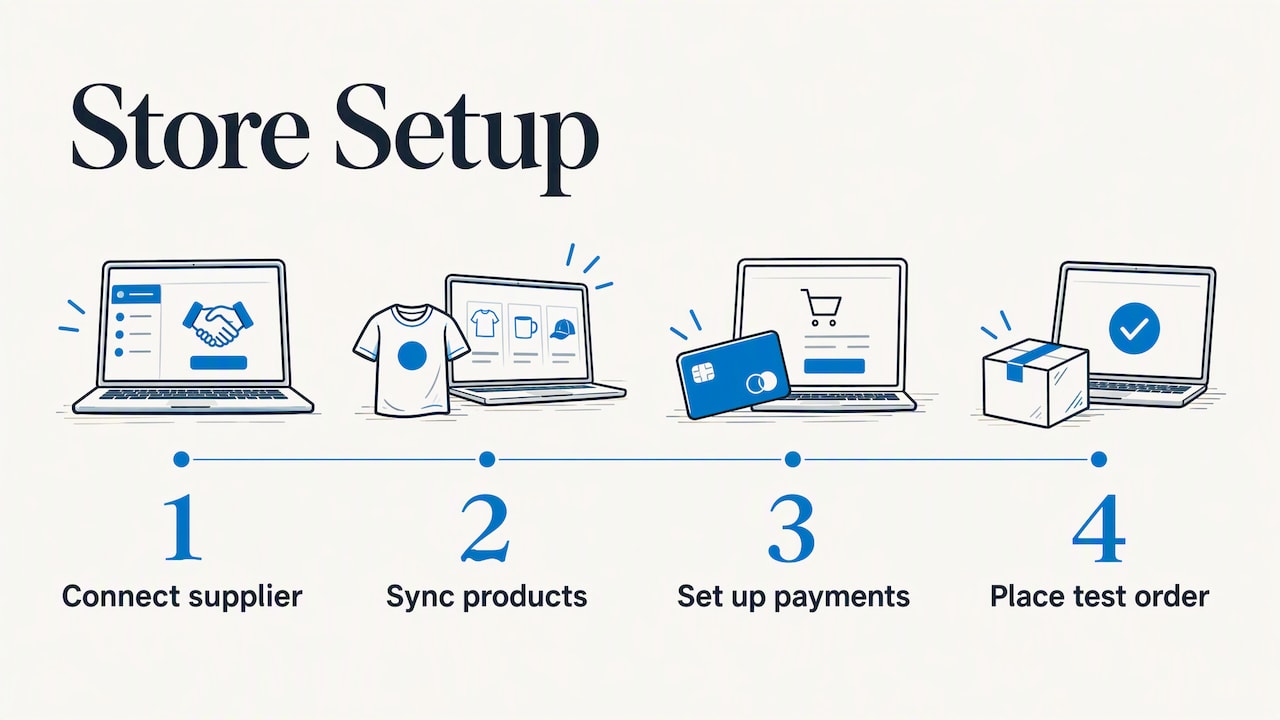
Open your Shopify store, install the provider’s app and link your account. Starting a POD store typically involves connecting a supplier, syncing products, setting up payments and placing a test order using Shopify’s test gateway or Shopify Payments test mode.
3. Order samples before you list
Place real orders for every product. Wash the shirt. Hang the poster. Photograph everything yourself, because customer photos beat generic mockups in trust.
4. Price for profit
Work backwards from your all-in cost, payment fees and your target ad spend per sale. Do not copy the cheapest competitor. If your price leaves no room for marketing, you do not have a business yet.
5. Write real product pages
Say who the product is for, what the fabric is, how long delivery takes and how returns work. Detail reduces refund requests and chargebacks.
6. Place a test order and check the workflow
Run a full test order from checkout to confirmation. Confirm the order reaches your provider and that the customer email says what you expect.
7. Know where your inventory lives
As of early 2026, Shopify was migrating fulfillment services to multi-location inventory management, so products can be stocked at your own locations and with a fulfillment app. That matters if you later hold a best seller in your own stock. Check Shopify’s help page for how your setup works today.
Beyond pure POD: hybrid fulfillment
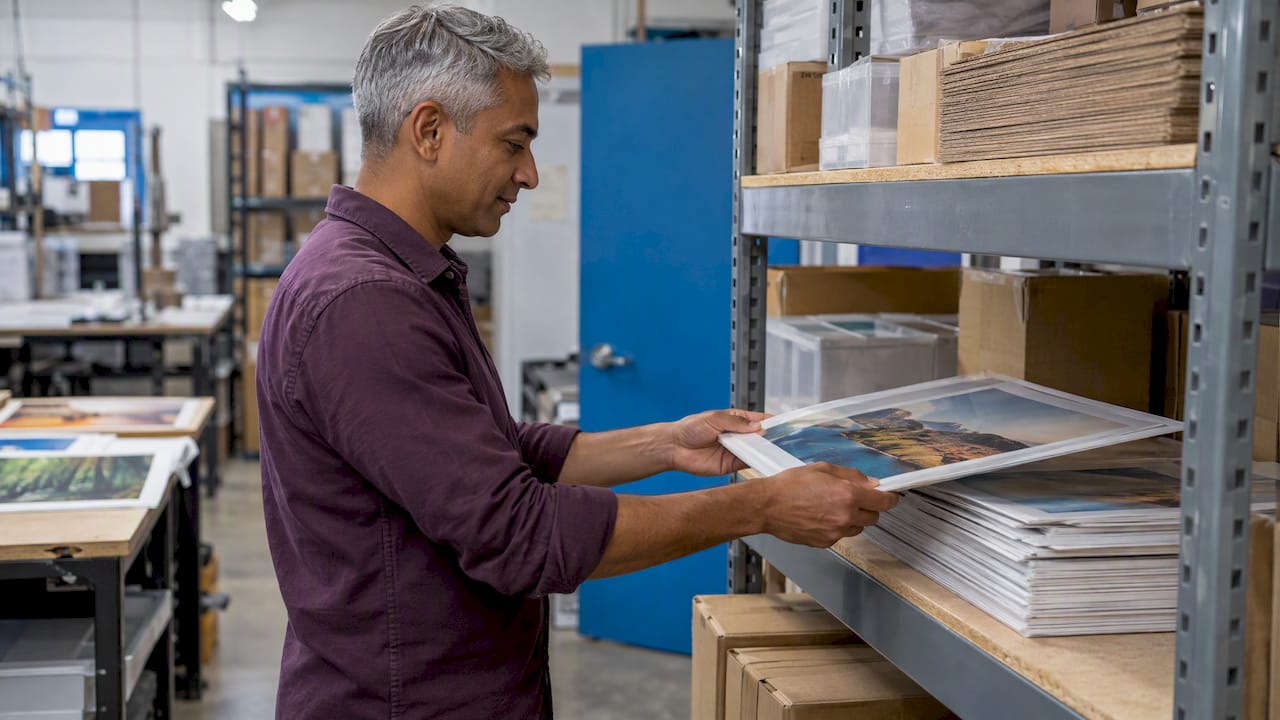
Once a product proves itself, many sellers move the winners off pure POD. They order a small batch, store it, and ship it themselves or through a logistics partner, which lifts margins. Small-run digital printing and fulfillment services that also handle storage, packing and distribution of printed materials are one route to this hybrid model. You keep POD for experiments and use bulk for proven designs. We cover the economics of holding stock in our comparison of Amazon FBA vs dropshipping.
Getting your first sales
A store with no traffic earns nothing. Plan your marketing before you upload your hundredth design.
- Short-form video. Product demos and niche humor travel well on social platforms. If you sell there, see how sellers use creators in our TikTok Shop seller guide.
- Paid social. Test small. Our Facebook ads test plan shows how to cap your risk while you learn what converts.
- Email. Collect addresses from day one and offer a small incentive. Email costs less than ads over time.
- Search and content. A blog or video channel in your niche builds an audience that you do not rent.
- Affiliate and creator partnerships. Send free samples to small creators in your niche and track results with trackable links.
Also vet the whole chain, not only the print partner. Our guide on vetting Shopify dropshipping suppliers before ads applies directly to POD.
Mistakes that sink new POD stores
- Copyrighted or trademarked designs. Do not use brand names, characters, lyrics or celebrity images. Platforms and providers remove listings, and the legal risk is yours.
- Too many products, no audience. Ten products for one audience beat a hundred for nobody.
- Ignoring shipping expectations. Customers used to next-day delivery will email within a week. State timelines clearly.
- Skipping quality control. One bad batch of prints becomes a string of one-star reviews.
- Underpricing. Discounting to match marketplaces destroys the margin you need for ads.
Legal and tax basics
A few questions come up again and again: whether you need an LLC, how sales tax works and what to do about income reporting. The answers depend on your state, your volume and your goals. An LLC can separate personal and business assets, but many sellers start as sole proprietors and form an entity later. Talk to a CPA or a small business attorney in your state before you decide, especially about sales tax registration, since rules differ by state and by where your customers live.
Our perspective
We have watched a lot of people try POD, and the pattern is consistent. The ones who stick treat it like any other online business: one audience, a clear offer, a margin that survives ad costs, and a habit of testing small. The ones who quit expected the provider to do the selling.
Our honest view is that POD is the best classroom in ecommerce. It lets you learn research, pricing, store design and traffic with almost no inventory risk. But we would not build a whole business on it without a plan to graduate your winners to better margins, better packaging and a customer list you own. Use it to find out what people actually buy, then double down.
— Nathaniel
Learn the business side with us
If you want a structured path rather than piecing advice together, our course library is built for people launching and growing online businesses. You get Instant Course Access for Life for a one-off $97, so you can work through it at your own pace.
Prefer to start free? Browse our freebies, or read our list of online business ideas for beginners to see where POD fits among your options.
FAQ
Is print on demand still profitable?
It can be, but not automatically. Profit equals the retail price minus the blank, printing, packing, shipping and provider fees, and then your marketing cost. Sellers with a defined niche, healthy pricing and low-cost traffic do best.
What is the best company to use for print on demand?
There is no single best. In-house producers favor consistency, print networks favor range and price, and global-hub providers favor local delivery. Match the type to your buyers’ location and your quality bar, then order samples before you decide.
Is print on demand a good idea for beginners?
Yes, as a low-risk way to learn ecommerce, because you never buy stock. Expect to spend your time on niche research, pricing and traffic rather than printing. Plan to move proven sellers into better-margin fulfillment later.
Do you need an LLC to sell print on demand?
Not necessarily. Many sellers begin as sole proprietors, and an LLC is a choice about liability and taxes that varies by state. Ask a CPA or small business attorney in your state, and register for sales tax where required.
Sources
- Print on Demand: What It Is & How To Start, Shopify
- Print on demand, Wikipedia
- What Is Print-on-Demand? POD Explained, Printcart
- Shopify Print on Demand: Apps, Costs, and Setup, Qualimero
- Printful vs Printify: Pricing, Quality, and Shipping, Shopify
- Dropshipping, Shopify Help Center
- Understanding inventory management, Shopify Help Center
- How to Start a Print-On-Demand Business On Shopify, Dynamic Mockups