
You've got a manuscript, a framework, a niche idea, or maybe a book that grew out of a course, newsletter, or consulting offer. The hard part isn't always writing it. The hard part is deciding what publishing path makes business sense.
That's where most advice on what is self publishing misses the point. It treats self-publishing like a creative workaround for writers who couldn't get a deal. In practice, self-publishing is often a deliberate decision to keep control of the asset, control the launch timeline, and control the economics.
If you think like an operator, a book stops being just a book. It becomes intellectual property with multiple monetization paths: ebook, paperback, hardcover, audiobook, lead magnet, premium bonus, backend offer, or authority builder for a larger business. That framing matters because self-publishing is now large enough to analyze like a real market, not a side hobby. One industry estimate places the self-publishing market at $1.85 billion in 2024 with a projected 16.7% CAGR through 2033, and another estimates over 4 million new self-published titles in 2025 across digital and print formats (self-publishing market statistics).
The useful definition is simple. Self-publishing means the author becomes the publisher. You make the production, pricing, distribution, and marketing decisions. You also take on the cost, the risk, and the operational workload.
That trade is exactly why many entrepreneurs prefer it.
Beyond the Gatekeepers An Introduction
If you're sitting on a finished manuscript right now, you probably have two competing thoughts. First, “I should get this out.” Second, “I have no idea how to do that without spending a year asking permission from agents, publishers, or platforms.”
That tension is why self-publishing has become mainstream. It isn't just a way to bypass gatekeepers. It's a way to build and ship an owned product on your terms.
The internet changed the economics of publishing. Digital tools, print-on-demand, and platform distribution removed a lot of the old production friction. The result is a category that now behaves like a standalone business sector, not a niche corner of the book world. In the U.S. alone, more than 4 million books were published in 2025, and self-published titles rose from 2.5 million to 3.5 million, accounting for most of that growth. The same industry analysis notes a global self-publishing market of about $1.85 billion in 2024 with a projected 16.7% compound annual growth rate through 2033, reaching $6.16 billion (U.S. book output and self-publishing growth).
Practical rule: If you can define the reader, price the offer, and reach the buyer, self-publishing is a business model, not a fallback plan.
That's the right mental model. You're not asking a publisher to validate the idea first. You're validating it through the market.
What self-publishing actually means
At the operator level, self-publishing means you control these levers:
- Product decisions: title, subtitle, cover, trim size, formats, and positioning
- Rights decisions: where the book appears, what exclusivity you accept, and what formats you keep
- Economic decisions: budget, price, promotional spend, and launch timing
- Audience decisions: whether you rely on retailer traffic or build direct channels too
That last point is where many first-time authors get sloppy. Uploading a file isn't a business. Owning the publishing decisions is.
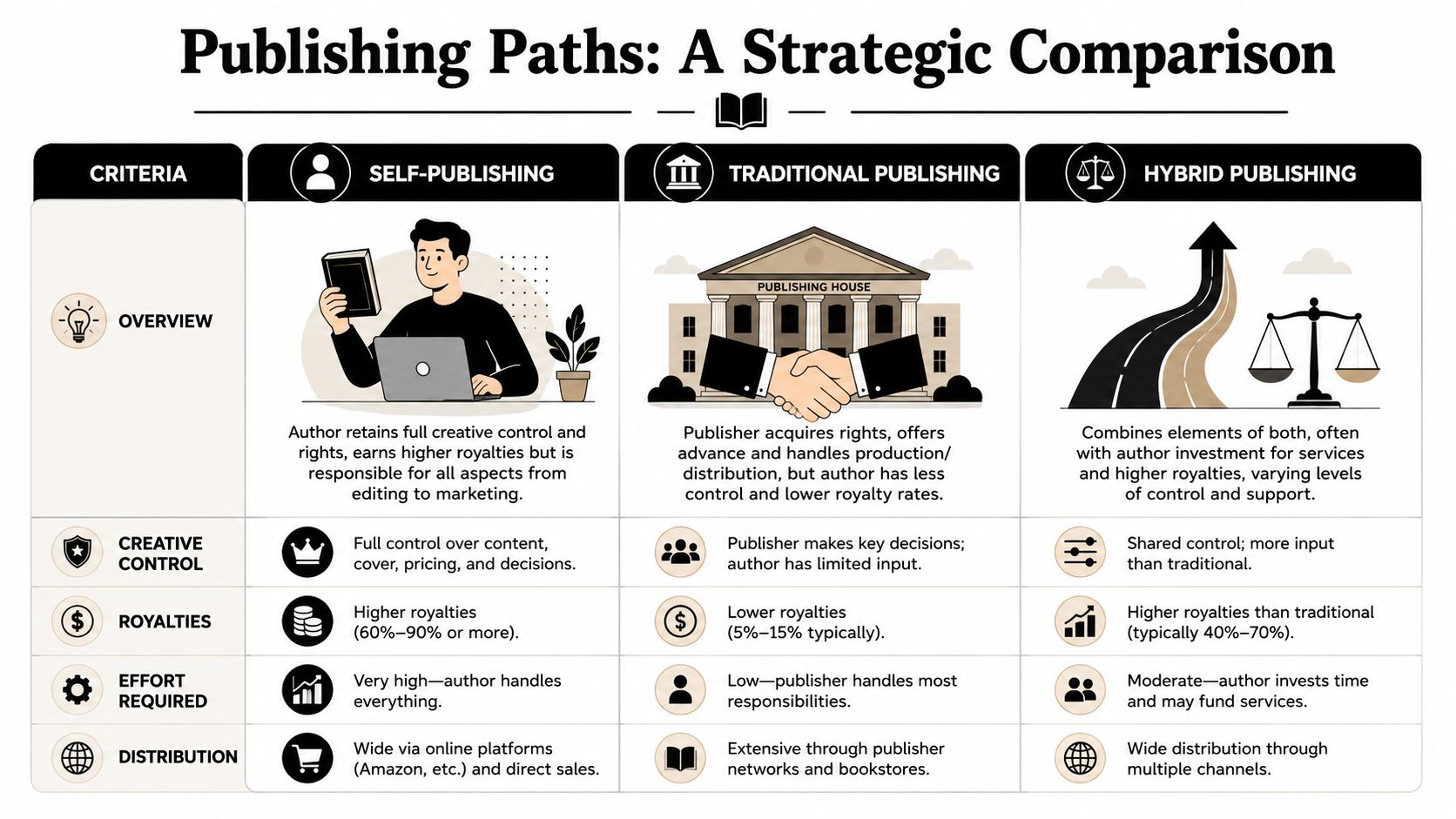
Choosing Your Business Model Publishing Paths Compared
The easiest way to understand publishing models is to compare them to selling products online.
Traditional publishing is closer to selling wholesale through a major retailer. You get access to infrastructure, but you give up control and margin.
Self-publishing is closer to building a direct-to-consumer brand. You fund the launch, control the offer, and keep more of the upside.
Hybrid publishing sits somewhere in between, but the details vary widely, so the contract matters more than the label.
The core trade-off
A strong way to think about self-publishing is this: you become the investor in your own book.
That's not just a metaphor. Self-publishing is a capital-allocation and rights-management model. The author takes responsibility for production and marketing costs, but keeps a much larger share of revenue per sale because there's no traditional publisher taking the main cut (publishing economics and rights trade-offs).
Here's the comparison that matters most:
| Model | Control | Upfront cost | Rights ownership | Speed to market | Marketing burden |
|---|---|---|---|---|---|
| Self-publishing | High | Author-funded | Usually retained by author | Fast | High |
| Traditional publishing | Lower | Publisher-funded | Often shared or licensed away | Slower | Still substantial |
| Hybrid publishing | Mixed | Often author-funded | Varies by contract | Moderate | Shared, but often still author-led |
Where each model works
Self-publishing fits when
- You already know the audience: This matters for niche nonfiction, business books, how-to content, and books tied to an existing offer.
- You care about speed: If the topic is timely, waiting through a long acquisition cycle can kill momentum.
- You want the asset: Rights, pricing control, and format expansion matter if the book supports a course, consulting funnel, speaking, or community.
I've seen this work especially well for founders and creators with email lists, search traffic, or an existing customer base. If you can sell a digital product, you can learn to sell a book.
For simpler formats such as journals, workbooks, and other straightforward product types, the mechanics overlap with low-content book publishing models, where speed, packaging, and discoverability matter more than literary gatekeeping.
Traditional publishing fits when
- You want external validation: A publisher's imprint can still open some doors.
- You don't want to manage production: Editing, design, and distribution can be offloaded.
- You're optimizing for institutional reach: Some authors care more about prestige channels than operational control.
Hybrid publishing fits when
This model can work, but only if the service package, rights terms, and distribution reality are clear. Some hybrid providers offer real support. Others mainly sell expensive author services under a publishing label.
If a hybrid offer sounds vague on rights, royalties, revisions, or distribution, treat that as a contract risk, not a branding detail.
The Self-Publishing Process From Manuscript to Marketplace
A founder finishes a strong draft on Friday, uploads it on Monday, and wonders why sales stall. The problem usually is not the idea. The problem is treating a book file as the product, instead of treating the full offer as the product.
Self-publishing works best when it is run like a controlled internet business. The manuscript is the raw asset. Editing, packaging, metadata, launch timing, and traffic determine whether that asset earns back its costs.
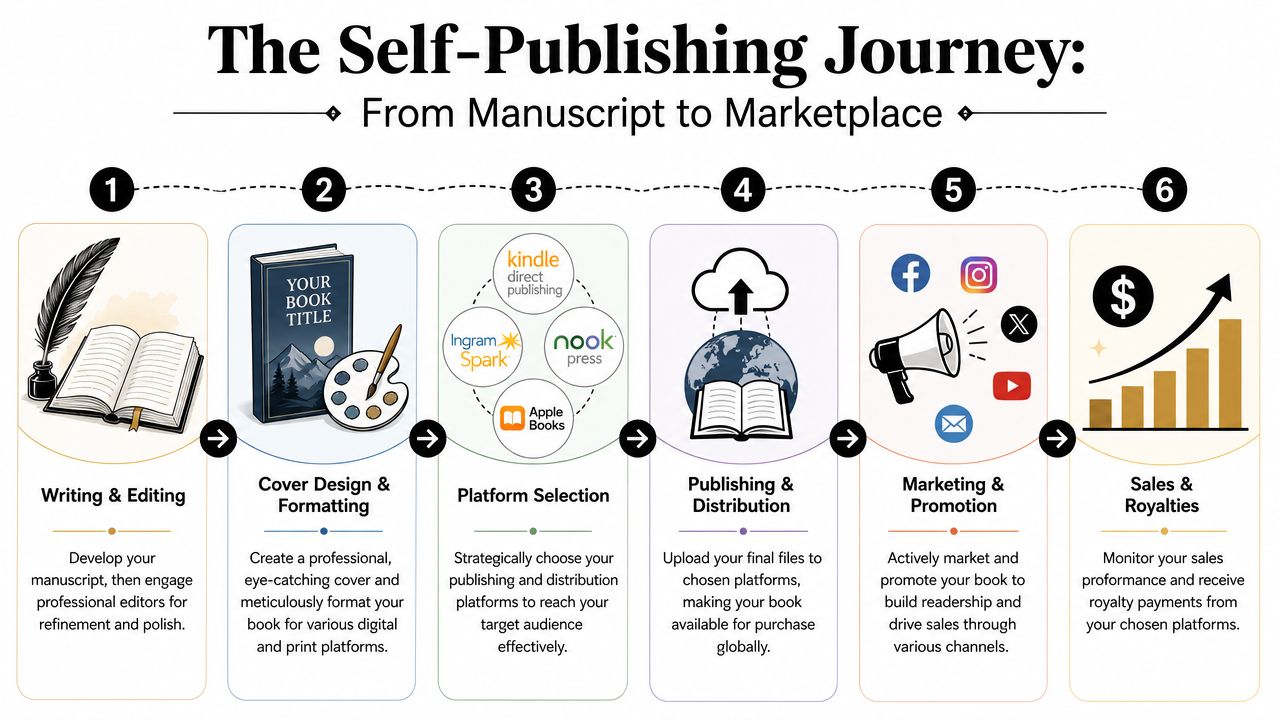
Phase one improves the asset before you ask the market to buy it
A draft is rarely ready for sale. I learned this the expensive way. Early on, I assumed clear expertise would carry weak structure. It did not. Readers will forgive a typo before they forgive a confusing promise, slow pacing, or chapters that feel out of order.
Production usually breaks into three layers:
- Developmental or structural editing for argument, organization, positioning, and reader flow
- Copyediting for clarity, consistency, grammar, and style
- Proofreading for final error checks after layout
Each layer solves a different business problem. Structural editing improves retention and reviews. Copyediting reduces friction. Proofreading protects the final product from obvious mistakes that hurt trust.
Cover design matters for the same reason landing page design matters. It affects click-through and conversion.
A strong cover signals category fit fast. A weak cover makes the book look self-funded in the worst way. Buyers decide in seconds whether your book belongs next to competing titles, so the cover has to match the market before it reflects your personal taste.
Phase two turns the manuscript into a sellable product
This phase is where many self-publishers lose margin without realizing it. They spend months writing, then rush formatting, subtitle choices, description copy, and retailer metadata. Those details shape discoverability and conversion, which means they directly affect revenue.
If you are building from scratch, it helps to plan and launch your ebook with the same discipline you would use for a paid digital product. That means a clear reader promise, a defined audience, and a launch plan before the upload.
The work here usually includes:
- Ebook formatting: reflowable layout, linked table of contents, clean chapter structure
- Print formatting: trim size, margins, typography, page count, front matter, back matter
- Metadata setup: title, subtitle, description, BISAC categories, keywords, author name, and series information if relevant
File prep is only part of it. You also need to choose the right digital format for the channel and reading experience. If you are still unclear on the technical side, review the differences between EPUB, MOBI, and PDF book formats before handing conversion work to a freelancer.
Metadata deserves more attention than first-time publishers give it. On most platforms, your subtitle, categories, and description act like storefront copy. They influence search visibility, click quality, and the buyer's first impression. I treat them the same way I treat ad copy and product page copy, because the job is the same.
Some books also need support assets before launch. Advance review copies, a one-sheet for podcast hosts, sample chapters, and a simple site with an email capture form can all improve the launch outcome. If the book supports consulting, courses, or lead generation, those assets stop being optional.
A short walkthrough can help if you want to see how the mechanics fit together:
Phase three publishes, tests, and starts distribution
Once the files are ready, the job becomes operational. You upload the files, set pricing, choose territories, review previews, and order print proofs. Always order proofs for physical books. Layout errors, spine issues, and paper color problems often appear only in the printed copy.
Launch week is not the finish line. It is the first real test.
At that point, the work shifts to demand generation and conversion improvement:
- Collect reviews ethically through advance reader copies and post-purchase follow-up
- Test the sales page by improving the subtitle, description, and opening copy
- Drive qualified traffic through email, partnerships, podcast appearances, short-form content, and paid ads if customer acquisition costs make sense
The business lens matters. A book with decent royalties can still lose money if traffic is expensive and conversion is weak. A book with modest direct profit can still be an excellent asset if it brings in leads for higher-margin offers. The process from manuscript to marketplace is really a process for turning intellectual property into a product line you can measure, improve, and scale.
Understanding Formats Pricing and Royalties
Most books today should be evaluated as a product line, not a single SKU. The same intellectual property can exist as an ebook, a print-on-demand paperback or hardcover, and an audiobook. Each format changes margin, buyer expectations, and operational complexity.
Format choice changes the business
Ebook is usually the easiest place to start. Delivery is digital, revisions are simple, and there's no physical inventory. This format often gives you the cleanest testing environment for title, subtitle, price, and audience response.
Print-on-demand adds physical presence without requiring you to warehouse copies. It's useful when readers want something tangible, when the book supports authority building, or when gifting and event sales matter.
Audiobook can extend reach to a different type of buyer, but it introduces production decisions around narration, audio quality, and rights.
A lot of confusion here comes from file formats. If you're publishing digitally, learn the differences between EPUB, MOBI, and PDF formats before you outsource conversion blindly. That one decision affects compatibility, reading experience, and downstream revisions.
Pricing is part positioning, part math
Authors often ask, “What should I charge?” The better question is, “What price supports my positioning and still leaves acceptable margin after platform deductions and acquisition cost?”
That changes by format:
| Format | Primary advantage | Main constraint | Pricing lens |
|---|---|---|---|
| Ebook | Fast to launch, easy to revise | Platform rules and digital competition | Test conversion and margin |
| Print-on-demand | Physical credibility, no inventory risk | Print cost reduces unit margin | Protect margin without killing demand |
| Audiobook | Expands format reach | Production complexity | Price against effort and audience fit |
The practical mistake is pricing in isolation. Don't ask only what comparable books charge. Ask what the buyer is really purchasing.
For a founder's nonfiction book, the buyer may be purchasing a framework, trust signal, or shortcut. For fiction, they may be purchasing immersion and series continuation. For a workbook, they're purchasing utility. Different value perceptions support different pricing decisions, even in the same category.
Royalties matter, but unit economics matter more
Self-publishing guidance often over-focuses on royalty percentages and under-focuses on profit. A higher royalty rate doesn't help if your ad costs, cover conversion, and category fit are weak.
The equation is simple:
Net revenue per sale minus variable platform costs minus customer acquisition cost = contribution margin
If that number is healthy, you can scale. If it's weak, your launch turns into expensive vanity distribution.
I treat pricing as a live lever, not a one-time decision. Start with a defensible price, watch conversion signals, then adjust based on buyer behavior and margin, not ego.
Choosing Your Publishing and Distribution Platforms
A common first-time mistake is treating platform choice like a branding decision. It is an operations decision. The platform stack you choose affects launch speed, cash flow timing, royalty structure, print quality control, metadata flexibility, and how much customer data you can keep.
Modern self-publishing runs on platform infrastructure, print-on-demand, and direct audience assets. The overview on self-publishing reflects that shift. Uploading a file is the easy part. Building a channel mix that supports repeat sales is where the business starts.
KDP prioritizes Amazon-native demand capture
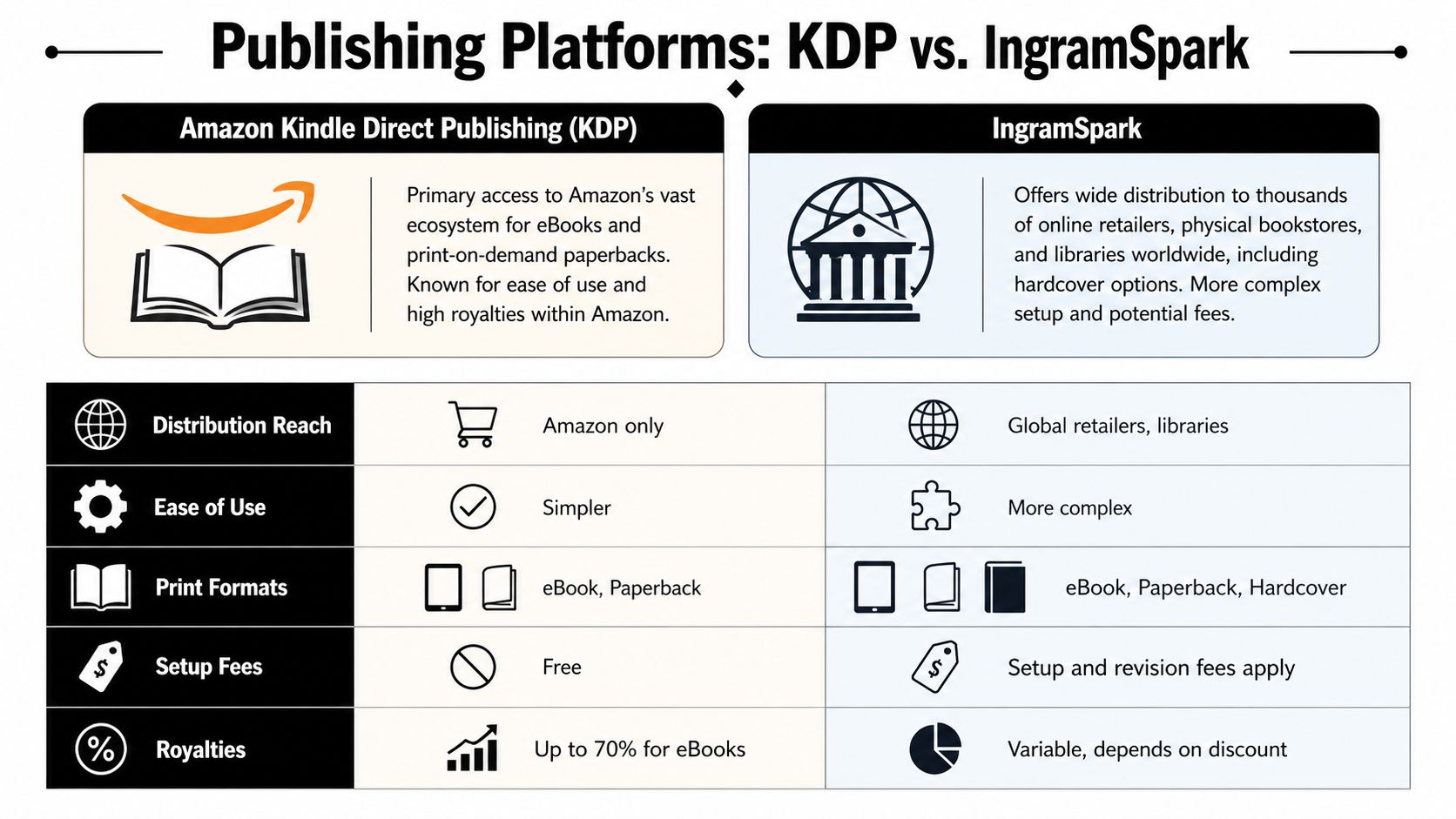
Amazon Kindle Direct Publishing is usually the default starting point because setup is fast and Amazon already has buyer intent. If the goal is to get a book live quickly, test demand, and start collecting sales data, KDP is hard to beat.
KDP fits best when you want:
- Fast launch speed
- Straightforward ebook and paperback setup
- Access to Amazon shopper traffic
- Fewer moving parts on day one
That simplicity has limits. You are operating inside Amazon's rules, Amazon's merchandising system, and Amazon's customer relationship. You get reach, but not much ownership.
If you want a clearer view of how the platform works, how Amazon KDP publishing works in practice covers the mechanics.
IngramSpark prioritizes wholesale reach
IngramSpark matters for a different reason. It gives you access to broader print distribution, including bookstores, libraries, and retailers that do not rely on Amazon as their primary supply channel. It also makes more sense when hardcover options or a wider wholesale footprint are part of the plan.
The trade-off is operational. Setup usually takes more care. Print specifications matter more. Distribution settings, returns, and discount decisions need attention because they affect where the book can realistically travel and what each sale is worth.
Here is the simple platform split I use:
| Goal | Better initial fit |
|---|---|
| Fast validation and Amazon visibility | KDP |
| Broader retail and library distribution | IngramSpark |
| Lower setup friction | KDP |
| More print format and wholesale flexibility | IngramSpark |
For many publishers, the answer is not KDP or IngramSpark. It is KDP for Amazon demand capture and IngramSpark for wider print distribution, with close attention to where each edition sits so you do not create channel conflict.
Direct sales deserve their own lane
Retail platforms are good at processing transactions. They are weaker at helping you build a durable audience.
I treat marketplaces as rented distribution and my site as owned infrastructure. That distinction matters. A retailer can sell the current book, but your website can collect email subscribers, pre-sell the next release, bundle formats, test offers, and improve lifetime value across multiple books.
The site does not need much. A solid author page, a dedicated book page, email capture, review outreach information, and a clean purchase path are enough to start.
Audiobooks follow the same logic. Choose based on rights, exclusivity terms, payout structure, and distribution reach, not on brand familiarity alone. Convenience is useful, but it should not override margin and control.
The EntreResource platform includes reviews and comparisons of publishing tools.
Budgeting Costs and Estimating Profitability
Self-publishing shifts from aspiration to business discipline.
A common gap in self-publishing coverage is unit economics and break-even analysis. Neutral guides note that authors bear all costs, and that expenses can range from thousands to tens of thousands of dollars, but many articles never show how to calculate the sales volume needed to recover that investment (self-publishing costs and break-even gap).
Your budget has fixed costs and variable costs
The cleanest way to budget a book is to split expenses into two buckets.
Fixed costs usually include editing, cover design, formatting, proofreading, ISBN decisions, author copies, and launch asset creation. You pay these whether the book sells one copy or many.
Variable costs usually include print charges, platform deductions, and ad spend tied to actual traffic and sales activity.
A simple budgeting view looks like this:
| Cost bucket | What sits inside it |
|---|---|
| Fixed launch costs | Editing, design, formatting, proofing, setup assets |
| Variable fulfillment costs | Print charges, platform deductions, transaction-related fees |
| Variable acquisition costs | Ads, promotions, affiliate payouts, launch partnerships |
The break-even formula is simple
You don't need fancy software to calculate this.
Use:
Total upfront investment ÷ net profit per sale = break-even units
That's the number of copies you need to sell before you recover the initial spend.
If you want to be more precise, break it into scenarios:
- Organic scenario: sales from email, audience, referrals, and existing traffic
- Paid scenario: sales after ad spend
- Blended scenario: your realistic mix
This changes how you make decisions. A book with decent royalties but weak conversion may never recover paid traffic. A lower-priced book might still work if it drives downstream consulting, course, or client revenue. A premium niche book can be rational even with smaller volume if each sale has strong margin.
What works and what usually doesn't
What works:
- Spending on cover and editing before spending on ads
- Using proofs and test readers before launch
- Treating price and positioning as variables you can refine
- Building direct audience assets while the book is in production
What usually doesn't:
- Launching with no metadata strategy
- Paying for traffic before the listing converts
- Assuming family, friends, and social followers equal a market
- Buying expensive publishing services you don't understand
Profitability usually breaks because the author guessed demand, ignored conversion, or overspent on services that didn't increase sales.
Marketing Your Book Like a Digital Product
Most self-published books don't fail because the file upload went wrong. They fail because the author treated launch as an announcement instead of a campaign.

Think in funnels, not posts
Your book needs the same components as any digital offer:
- Traffic sources: email, podcast appearances, social content, search, partnerships, paid ads
- Conversion assets: strong product page, credible cover, persuasive description, reviews
- Retention assets: author site, email capture, reader magnet, next-book follow-up
If you publish on Amazon, metadata becomes part of marketing. Title, subtitle, categories, and keyword fields all affect discoverability. If you want a practical breakdown of keyword handling inside the platform, this guide on Amazon backend keywords is useful because it frames metadata as a visibility lever, not a clerical detail.
Build momentum before launch
The strongest book launches start before the book is live. I like to line up advance readers, collect early feedback, and draft multiple versions of the product description before publication.
Then I watch for three signals:
- Are the right people clicking?
- Are they converting once they land?
- Does the book lead to a second action, such as an email signup, review, or backend offer?
That's how a book becomes more than a single sale. It becomes a customer acquisition asset, a trust-builder, and in some cases the front end of a larger business.
If you came here asking what is self publishing, the shortest honest answer is this: it's the business of owning your book's upside in exchange for owning its responsibility.
That trade isn't for everyone. But for entrepreneurs, it often makes more sense than waiting for permission.
If you're evaluating your next title, run it through a simple filter: Who is the reader, what problem does the book solve, where will demand come from, and how many sales do you need to justify the spend? Answer those four questions well, and self-publishing stops feeling vague. It starts looking like a real business.