

Facebook ads can work for dropshipping, but only when you know your break-even cost per purchase before you spend a dollar. Most failed tests aren’t a targeting problem. They come from thin margins, a store that doesn’t earn trust, or a budget split across too many ad sets to teach Meta anything.
This guide walks through the plan we’d follow: do the math, fix the store, launch one simple campaign, test creative, and read results without panicking. It’s written for the U.S. market, so the cost figures are American.
TL;DR
- Calculate your break-even cost per acquisition (CPA) first. Profit per order decides whether Facebook ads work for your product, not clicks.
- Cap your test spend at a set “maximum test loss”, typically 3 to 5 times your break-even CPA, so a failed test doesn’t drain the business.
- Start with one campaign, few ad sets and broad or Advantage+ audiences. Test creative before you test interests.
- If you get clicks but no sales, fix the product page and checkout before touching the ads.
- Judge ads on funnel metrics (landing page views, add-to-carts, checkouts), not on a single day of ROAS.
Table of Contents
- Start with profit per order, not with the ad
- Fix the store before you pay for traffic
- Set up tracking so you can trust the numbers
- Build your first campaign
- Creative is your real targeting
- How to read results without overreacting
- When to scale and when to stop
- Our perspective: what we’d tell a friend starting out
- Want a shortcut to the full system?
- FAQ
- Sources
Start with profit per order, not with the ad
Before you open Ads Manager, work out what one sale actually leaves you. Facebook ads for dropshipping still tend to work, but on thin margins profit per order is what decides the result. A product with a pretty ad and a $6 margin is a trap.
Here is a worked example. The numbers are illustrative, not benchmarks:
| Line item | Amount |
|---|---|
| Selling price | $40.00 |
| Supplier cost plus shipping | $18.00 |
| Payment processing and other fees | $1.50 |
| Profit before ads (break-even CPA) | $20.50 |
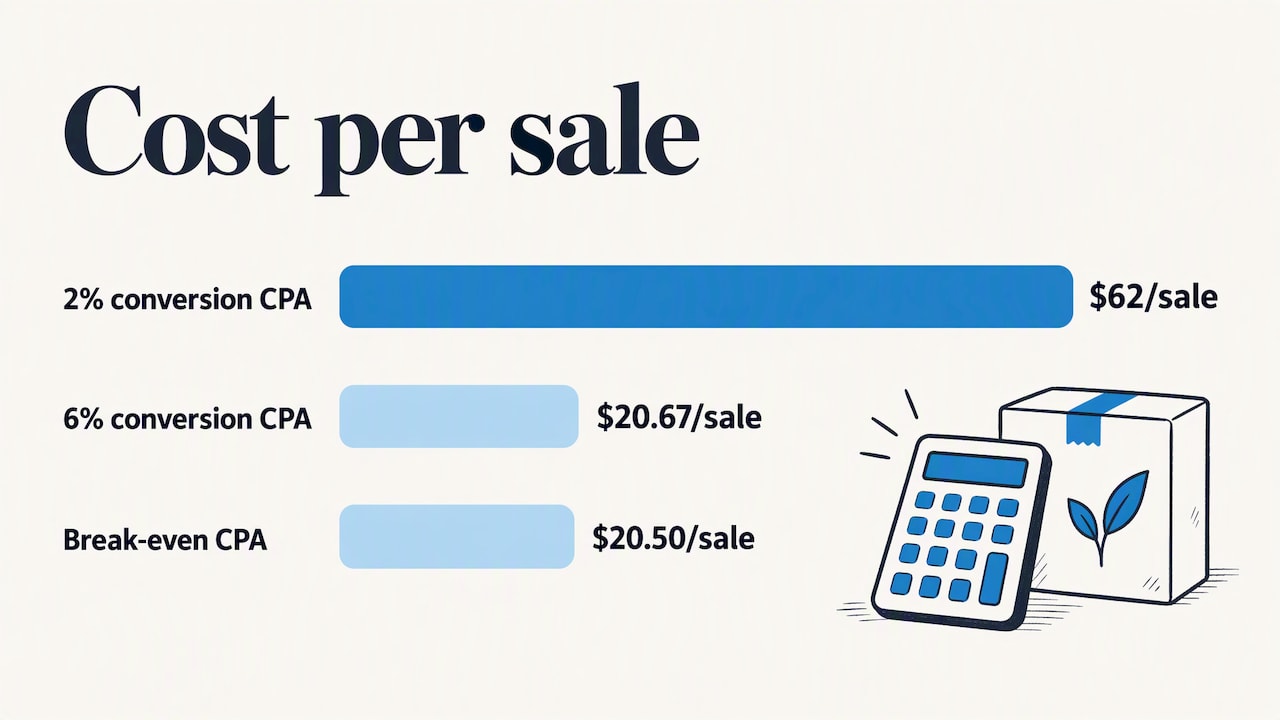
You can spend up to $20.50 to win one customer and still break even on the first order. Now compare that with what traffic costs. One 2026 guide puts the average U.S. cost per click at about $1.24, with a U.S. CPM of about $20.48. Treat those as rough guides, since your niche and creative move them a lot.
If your store converts 2% of clicks, a $1.24 click means roughly $62 per sale. That loses money against a $20.50 break-even. At a 6% conversion rate the same click costs about $20.67 per sale, which is right at the line. Two things move this equation: a better margin (higher price, cheaper supplier, bundles) or a better conversion rate. Ad targeting alone rarely closes a gap that big.
Set a maximum test loss
Decide in advance how much you’ll lose finding out whether a product works. A practical rule from AdAdvisor’s 2026 guide is to cap it at 3 to 5 times your break-even CPA. With a $20.50 break-even, that’s roughly $61.50 to $102.50 per product test. Write the number down. When you reach it without meaningful signals, you stop, and you don’t “just try one more day.”
Fix the store before you pay for traffic
A common beginner pattern is a decent click-through rate and zero sales. In one Shopify community thread, the likely culprits were supplier images and a long, generic product title that made the item look like something shoppers had already seen on marketplaces. Visitors then open a new tab, search the same product elsewhere and leave.
Before launching, check these:
- Product title. Short, specific and benefit-led, not a string of keywords copied from a supplier listing.
- Images. Your own photos or clear lifestyle shots beat stock supplier images. Show the product in use.
- Trust signals. Shipping times, a returns policy, contact details and real reviews, visible without scrolling far.
- Add to cart. One obvious button, above the fold on mobile.
- Checkout. Fewer fields, guest checkout, clear total cost. Our guide to checkout fixes that recover lost sales covers the details.
If you haven’t yet chosen a reliable supplier, do that first. Slow shipping and poor quality show up later as refunds and chargebacks, which eat the same margin your ads depend on. We cover this in Shopify dropshipping for beginners. For on-site tactics, see proven ways to lift store conversions.
Set up tracking so you can trust the numbers
You can’t optimize what you can’t see. Connect your store to Meta, install the pixel and the server-side connection your platform offers, and confirm the key events fire: view content, add to cart, initiate checkout and purchase. Place a test order yourself and check each event appears in Events Manager.
Also track real profit, not just the ROAS Meta reports. Platform numbers can differ from your store’s numbers, so compare both against your actual bank deposits and costs once a week. A simple profit dashboard or spreadsheet is enough at the start.
Build your first campaign
Keep the first test boring. A simple structure gives Meta’s delivery system the best chance of learning.
- Objective: Sales, optimizing for purchases (if you have no purchase history yet, you can temporarily optimize for an earlier event such as add to cart, but move to purchases as soon as you have data).
- Campaign structure: one campaign, one to three ad sets, three to five ads per ad set.
- Audience: broad or Advantage+ to start. More on that below.
- Placements: automatic placements at first.
- Budget: sized to your maximum test loss, not to your hopes.
Why you should not fragment a small budget
Meta’s delivery needs conversion data. Meta’s guidance is commonly summarized as about 50 optimization events per week for an ad set to leave the learning phase. Treat that as a guideline rather than a hard law. The practical lesson is that if your daily budget can’t comfortably support roughly that volume across your ad sets, consolidating beats slicing the account into many tiny audiences.
A “Learning Limited” label isn’t a verdict. It’s diagnostic context, and raising spend just to remove it is a good way to burn your test budget.
Broad, Advantage+ or interest targeting?
Meta’s current systems lean on conversion history and creative engagement to find buyers, which often makes broad or Advantage+ audiences a strong starting point. Manual interest targeting still has a role, but it’s best saved for tests once you have enough conversion volume to compare results reliably.
In practice: launch broad, let the creative do the targeting, and add interest or lookalike ad sets later as a comparison, not as the foundation.
Creative is your real targeting
When the algorithm picks the audience, your ad decides who stops scrolling. That makes creative the biggest lever you control. A few principles we use:
- Open with the problem or the payoff in the first two seconds. Show the neck pain, the messy cable drawer, the finished result.
- Show the product in use. Demonstrations outperform polished studio shots for most physical products, in our experience.
- One idea per ad. Test different hooks and angles rather than minor color changes.
- Use user-generated style video. It looks native in the feed. If you don’t have customers yet, you can generate UGC-style clips from product photos with AI tools for UGC-style video ads, then replace them with real customer footage as orders come in.
- Match ad and page. If the ad promises a specific benefit, the landing page headline should repeat it.
Plan a batch of five to eight different concepts for each product. Run them together, then keep the ones that earn add-to-carts and purchases at or below your break-even CPA.
How to read results without overreacting
New campaigns develop their own delivery patterns, and the first days are noisy. Resist cutting an ad after a bad morning. One practitioner discussion suggests giving each ad about 3 to 5 days of data before making big cuts, which is a sensible rule of thumb as long as you’re inside your maximum test loss.
Use funnel metrics to diagnose the problem:
| Symptom | Likely cause | What to try |
|---|---|---|
| Low click-through rate | Weak hook or creative | New hooks, new first frames |
| Clicks but few landing page views | Slow page or tracking issue | Check load speed on mobile, pixel setup |
| Landing page views but few add-to-carts | Low trust or weak offer | Rework title, photos, price, reviews |
| Add-to-carts but few checkouts | Shipping cost surprise or friction | Show total cost earlier, simplify checkout |
| Checkouts but few purchases | Payment options or trust at the final step | Add express payment methods, clarify returns |
Fix the earliest broken step first. A better ad can’t rescue a page that loses 98% of visitors.
When to scale and when to stop
Scale when an ad or ad set beats your break-even CPA across several days and the funnel metrics look healthy. Increase budgets in measured steps instead of doubling overnight, and keep winning creative running while you test new variants next to it. Fatigue shows up as rising cost per purchase and falling click-through rate, so keep a pipeline of new concepts.
Stop when you reach your maximum test loss with no profitable signal. That’s not failure, it’s a cheap answer. Move to the next product or angle with the lessons in hand.
Once a product proves itself, retargeting visitors who viewed or added to cart is a natural next step, since shoppers often need several touches before they buy. And remember Facebook isn’t your only channel: our guide on how to sell items on Facebook covers the organic side.
Our perspective: what we’d tell a friend starting out
We publish a lot about online business, and the dropshipping stories we see go wrong share the same pattern. People start with the ad platform because it feels like the lever. It isn’t. The levers are margin, trust and a testing discipline that keeps one bad product from ending the business.

Our advice is to treat your first ad budget as tuition with a hard cap. Choose a product with room for at least a $15 to $20 profit per order if you can. Build a page that would make you comfortable typing in your own card number. Launch one clean campaign, then let the data speak for a few days before you touch anything.
And be realistic about the headline stories. Videos about five-figure daily ad spend are rare outcomes shown after the fact. Your first goal is smaller and more useful: a repeatable, profitable test.
— Nathaniel
Want a shortcut to the full system?
If you’d rather learn the business side in one place, our Instant Course Access for Life is a one-time $97 purchase. It gives you lifetime access to the course material, so you can work through it at your own pace and come back as your store grows.
FAQ
How do I advertise dropshipping products on Facebook?
Connect your store and pixel, then create a Sales campaign with a small budget and a few distinct creatives. Start with broad or Advantage+ targeting, and set a maximum test loss before launch. Judge results on funnel metrics over several days, not on the first few hours.
How much do Facebook ads cost for dropshipping?
One 2026 benchmark guide lists an average U.S. CPC of about $1.24 and CPM of about $20.48. Your real cost depends on your niche, creative and season. What matters more is whether your cost per purchase stays under your break-even CPA.
Can I make $10,000 a month dropshipping with Facebook ads?
It’s possible in principle, but no one can promise it, and many beginners lose their first test budgets. Reaching that profit means finding a product with healthy margins, converting traffic efficiently and scaling spend carefully. Calculate your required orders from your profit per order first, then see whether the numbers are realistic.
Why do I get clicks but no sales?
The problem is usually after the click. Generic titles, supplier images and weak trust signals push visitors to compare the product elsewhere and leave. Improve the product page, shipping and returns information, and checkout before changing your targeting.
Sources
- Facebook Ads for Dropshipping: The 2026 Guide, AdAdvisor
- Good fb metrics and no sales?!, Shopify Community
- How Much Do Facebook Ads Cost in 2026?, Stackmatix
- How to Exit the Meta Ads Learning Phase Fast, Modern Marketing Institute