

You're probably in one of two places right now. You've either watched enough Amazon FBA videos to think, “I should start this,” or you've watched so many that the whole thing now feels more confusing than when you began.
That's normal. The problem isn't that Amazon FBA is impossible. It's that most beginner advice treats it like a shortcut instead of what it is: a logistics business with advertising, inventory, cash flow, and margin pressure layered on top.
I've seen more new sellers fail from bad math than bad product ideas. They pick something that looks promising, order too much, underestimate fees, launch with loose ad controls, and then realize too late that sales do not equal profit. If you want to learn how to start amazon fba the right way, start by thinking like an operator, not a gambler.
Setting Realistic Expectations for Your FBA Business
A new seller orders inventory, sees the units arrive at Amazon, gets the first few sales, and assumes the hard part is done. Then the fees hit, ad spend starts climbing, cash is tied up in stock, and the reorder deadline shows up faster than expected.
That's the part beginner content often skips.
Amazon FBA can simplify fulfillment. Amazon stores the product, ships orders, and handles many return workflows. You still control the decisions that determine whether the business works: product choice, landed cost, pricing, ad spend, inventory timing, and how much cash you keep available for the next order.
Core philosophy: Treat FBA like a real company from day one. If you do not understand your margins and cash flow before launch, Amazon will expose that quickly.
Start with a budget that matches reality
A lot of sellers underestimate startup costs because they focus only on buying inventory. Inventory is only one part of the bill. You also need room for samples, shipping, customs or prep, listing assets, PPC, and the mistakes that happen in every first launch.
I've seen underfunded sellers make the same bad decisions over and over. They lower the price too early, stop ads before they have enough data, delay a reorder, or place a second order with no clear read on profitability. None of those problems come from effort. They come from thin cash reserves.
A simple way to frame it:
- Tight budget means less room for product mistakes, slower testing, and more pressure on every reorder.
- Larger budget gives you more flexibility for inventory, PPC learning, creative testing, and unexpected costs.
- Underfunded launches often create panic decisions around pricing, coupons, and reordering.
If you're still comparing business models, this breakdown of Amazon FBA vs dropshipping gives a useful side-by-side view of why FBA usually needs more upfront capital but gives you more control over fulfillment and customer experience.
Understand the business you are building
Amazon makes account setup look simple because the setup is simple. The business is not.
You are building a retail operation inside someone else's platform. That means every decision runs through math. Margin matters. Cash conversion matters. Inventory timing matters. A product can sell every day and still be a weak business if the fees are too high, return rate is ugly, or reorders drain your cash.
New sellers rarely fail because they cannot open Seller Central. They fail because they never build discipline around the basics:
- Margin discipline
- Inventory planning
- Fee awareness
- Ad control
- Product selection
That last point matters more than beginners think. A mediocre product with clean numbers will usually beat an exciting product with bad economics.
Set expectations around time, too. Your first product is not only there to make sales. It is there to teach you how Amazon charges fees, how PPC changes your margin, how quickly inventory moves, and how long cash stays tied up between placing an order and getting paid back through sales. Sellers who learn that early tend to stay in the game. Sellers who chase revenue screenshots usually burn out when the numbers stop working.
How to Find Your First Profitable FBA Product
Most bad product research starts with emotion. Someone sees a trendy item, spots a few sellers doing volume, and assumes the market is open. It usually isn't.
The product research process needs structure. I like a four-filter screen: demand, competition, profit, and compliance. That framework is consistent with seller guidance that recommends validating a product before ordering inventory, and one expert guide suggests aiming for products in the $20 to $50 range with roughly 25% to 35% gross margin after expenses while also checking for restrictions and IP issues before sourcing (product validation guidance).
Here's the visual version of the process:
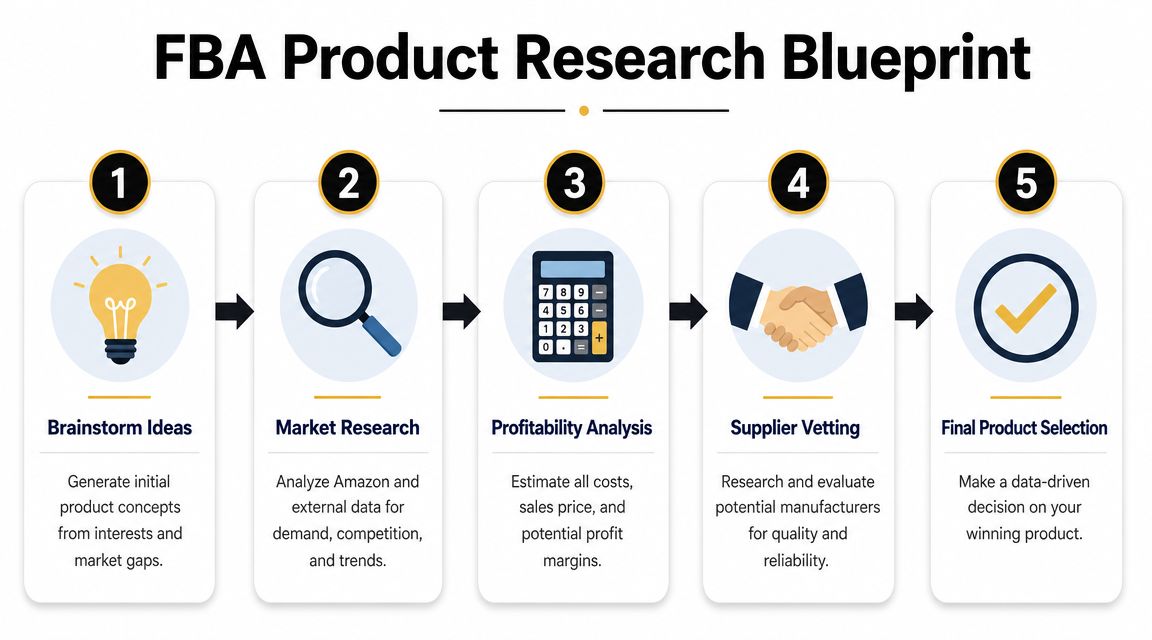
Filter one and two
Start with demand, then move immediately to competition. Don't separate them. A product with demand but ugly competition is still a weak opportunity.
I usually look for products with steady, year-round usefulness. Not novelty spikes. Not obvious seasonal gimmicks. Not products that only move when a trend video takes off.
A good beginner candidate often looks like this:
- Useful item: solves a routine problem
- Stable pricing: not a listing that swings wildly
- Room to improve: bad images, weak copy, or poor bundling from current sellers
A weak beginner candidate often looks like this:
- Brand-dominated niche: one or two entrenched players control attention
- Review velocity is aggressive: new entrants will have trouble catching up
- Price race is already underway: everyone is undercutting everyone else
Use tools like Helium 10 or Jungle Scout for discovery, but don't let the tool make the decision for you. Tools can show demand signals. They can't tell you whether you can enter the market profitably with your account, your budget, and your offer.
For more niche ideas, this list of what to sell on Amazon is a useful starting point, especially if you're narrowing categories rather than hunting random SKUs.
Filter three and four
Here's where beginners either become operators or stay hobbyists. They stop at demand and competition, then skip the math.
Your profit screen should include:
- Product cost
- Freight to your destination
- Prep and packaging
- Amazon referral and FBA fees
- Storage exposure
- Expected launch ad spend
- Return risk
Then check compliance before you buy anything. Some products look perfect until you realize the category is gated, the product triggers hazmat rules, the listing has IP complaints, or your seller account can't sell it.
A product isn't viable just because people want it. It's viable when you can source it, list it, win traffic, and keep margin after all the friction.
A practical example helps.
Better choice: a simple home organization accessory with stable demand, lightweight shipping, and obvious room for better images and packaging.
Bad choice: a meltable beauty item, or a fragile oversized item with mediocre margins, restriction risk, and customer expectations you can't control.
The product should survive stress testing, not just look good in a software dashboard.
A useful walkthrough sits below if you want another angle on the research process.
A practical product screen
Use this before you contact any supplier.
| Check | What you want to see | What should worry you |
|---|---|---|
| Demand | Consistent need and repeat relevance | Trend spikes or obvious seasonality |
| Competition | Listings you can improve on | Amazon-heavy or brand-heavy offer stacks |
| Profit | Healthy margin after full costs | Thin margin before ads even start |
| Compliance | Eligible, ungated, low IP risk | Restrictions, complaints, hazmat, meltable |
If a product fails one of these, move on. Beginners lose money when they try to rescue bad opportunities with optimism.
Sourcing Suppliers and Calculating True Costs
A product idea is only as good as the landed cost behind it. I've watched sellers spend days comparing niches, then place an order without really understanding what each unit will cost by the time it reaches an Amazon warehouse. That's backwards.
Start with the operating reality. The startup-cost hurdle is real. Beyond the $39.99 per month Professional plan, sellers still have to fund inventory, prep, and shipping upfront, and the cash needs vary widely depending on whether you're doing retail arbitrage, wholesale, or private label (beginner cost realities).
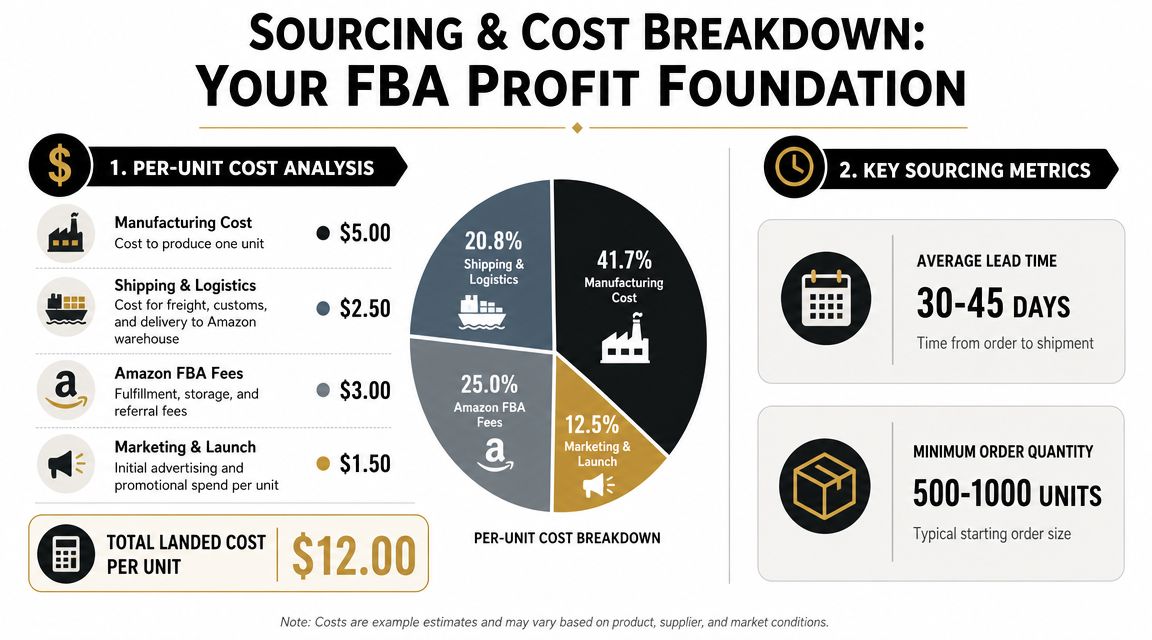
What your landed cost actually includes
Landed cost is not your supplier quote. It's the all-in cost of getting one sellable unit into Amazon's system.
That usually includes:
- Unit cost from supplier
- Packaging and inserts
- Inspection
- Freight
- Customs and import-related charges
- Prep or labeling
- Delivery into Amazon
- Expected Amazon selling fees
- Launch advertising allocation
This is why I tell beginners not to get seduced by cheap quotes. A product can look attractive at the factory level and still become a weak FBA item once shipping, fees, and ad spend are layered in.
If you want to run the numbers before ordering, the Amazon FBA calculator is a practical way to estimate whether the product still works after fees.
Choosing the right sourcing model
Not every seller should start the same way. The model matters because it changes your capital pressure and your risk.
| Model | What it looks like | Main trade-off |
|---|---|---|
| Retail or online arbitrage | Buying existing products and reselling them | Lower barrier to testing, less control |
| Wholesale | Buying established brands in bulk | Can be more stable, but margin pressure and account eligibility matter |
| Private label | Building your own branded version | More control and brand potential, more upfront risk |
Private label gives you the most control over listing quality, positioning, and long-term asset value. It also exposes you to the most beginner mistakes if your math is sloppy. Arbitrage can teach you Amazon operations faster, but it won't teach branding in the same way.
Supplier vetting that actually matters
When I talk to suppliers, I care less about polished sales language and more about consistency. I want direct answers on packaging, defects, lead times, and whether they can follow instructions without friction.
Ask simple questions and watch how they respond:
- Can you confirm packaging specs in writing
- Can you provide samples
- Can you hold quality consistently across the order
- Can you label to Amazon requirements if needed
- Can you communicate clearly when something changes
Practical rule: The wrong supplier doesn't just reduce margin. They create delays, defects, relabeling headaches, and customer complaints you'll pay for later.
If you're importing internationally, broader logistics knowledge helps. This guide on strategies for South African exporters is useful because it frames supply chain decisions through shipping, documentation, and operational coordination rather than just “find a factory and hope.”
A cheap product with expensive chaos is still expensive.
Creating Your High-Converting Amazon Listing
The listing is where research, positioning, and conversion all collide. A lot of new sellers build listings like they're filling out a form. That's a mistake. Your listing is a sales page inside Amazon's rules.
The job is simple to state and hard to do well. You need to help the Amazon algorithm understand relevance while helping a shopper decide, quickly, that your product is the safest choice.
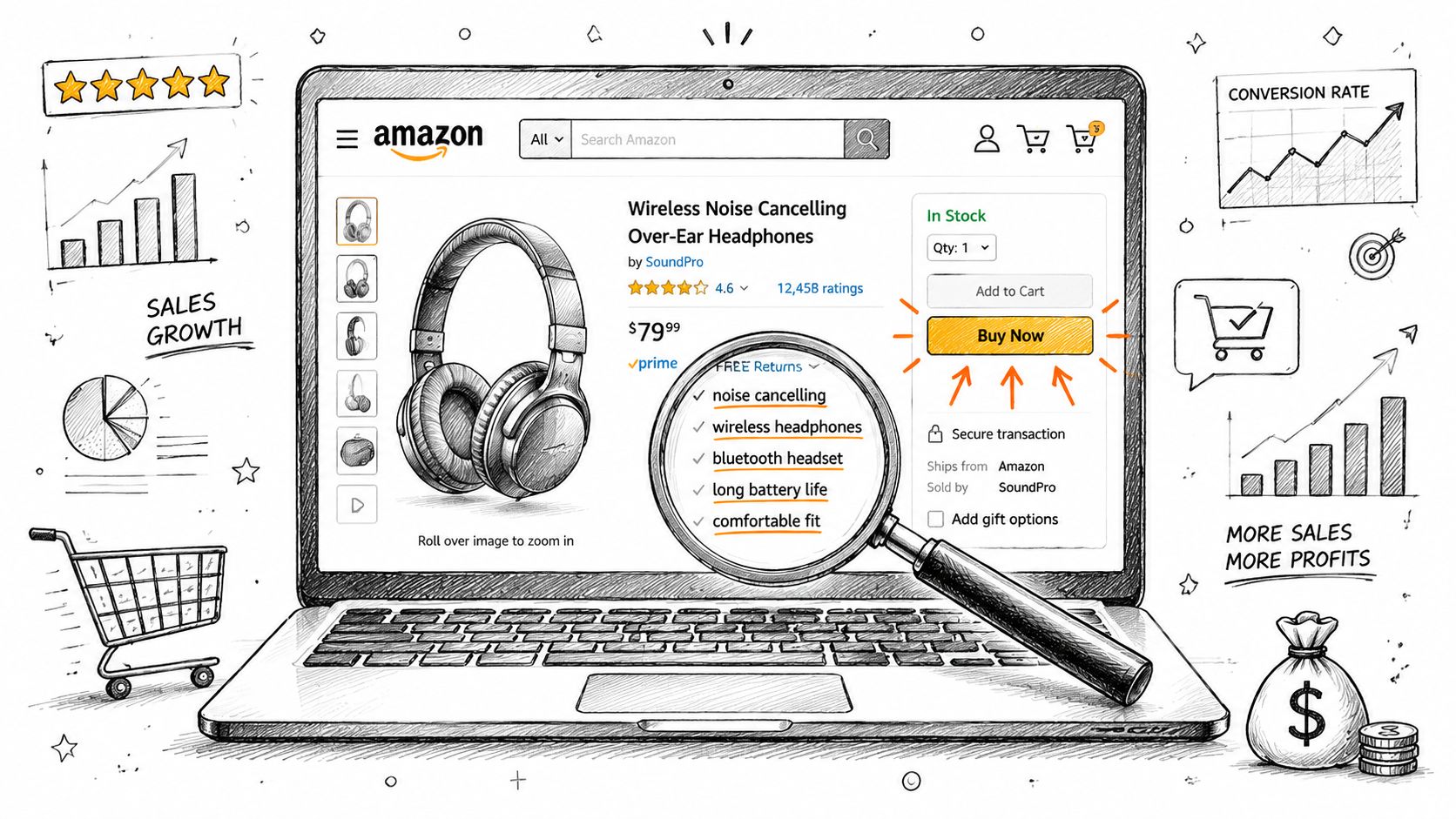
Build the listing from the customer backward
Most weak listings are seller-centered. They describe features but don't translate them into outcomes.
A stronger listing usually follows this pattern:
- Title includes the main keyword and the clearest product identifier
- Images explain the product visually before the customer reads much text
- Bullets answer practical buying questions
- Description or A+ content removes hesitation and reinforces trust
If you sell a kitchen organizer, don't just say it's made from durable material. Show where it fits, what it holds, what problem it solves, and why it's easier to use than the generic options already on the page.
Use keywords without wrecking readability
Amazon SEO still matters, but keyword stuffing makes listings worse. The best approach is simple. Put the primary keyword where it naturally belongs, then cover secondary phrases through bullets, backend terms, and image context.
I like to think in layers:
- Primary keyword goes in the title if it fits naturally.
- Secondary keywords appear in bullets where they support real buying intent.
- Supporting terms live in backend search fields and image alt concepts during asset planning.
Don't chase every variation if it makes the copy awkward. Amazon rewards relevance, but shoppers buy clarity.
Your copy should answer the question a buyer is already asking: “Will this work for me, and can I trust this seller?”
The parts that increase conversion
You can't fake trust on Amazon. You build it with presentation.
Here's what usually moves the needle:
- Main image quality: clean, sharp, compliant, easy to understand at a glance
- Secondary images: demonstrate use cases, size, materials, and differentiators
- Bullet structure: front-load benefits, not filler
- A+ content: reinforce the brand story and reduce confusion
- Clear expectations: fewer surprises means fewer returns
A common beginner mistake is hiding weak differentiation under polished copy. If the product isn't meaningfully better, the listing can only do so much. But when the product is solid, good creative and strong positioning improve conversion enough to justify the effort.
Think like a skeptical shopper. If something on the page feels vague, fix it before launch.
Executing Your Product Launch and Getting First Sales
The launch phase is where discipline matters most. You don't need a dramatic launch. You need controlled signal gathering.
A useful benchmark is that first-year profitability is far from guaranteed. One seller analysis reported that about 64% of sellers become profitable within their first 12 months, and it tied success closely to advertising control and avoiding over-ordering that triggers storage problems (first-year profitability analysis).
Keep your launch goals narrow
Most beginners make one of two mistakes. They either spend too little and learn nothing, or they spend too fast and can't tell what worked.
The first month should answer a few practical questions:
- Are shoppers clicking your listing
- Are they converting after they land
- Which search terms lead to actual purchases
- Is your pricing helping or hurting conversion
- Can your margin support the traffic you're buying
That's it. Early launches are for feedback, not ego.
A cleaner way to launch
I prefer a simple launch structure over a bloated one.
Start with Amazon PPC. Run an automatic campaign for discovery and a manual campaign for tighter control. The automatic campaign helps uncover search term behavior. The manual campaign lets you push traffic toward the terms and product angles that look promising.
Use pricing carefully. You don't need to panic-discount your product. But if your offer is new and reviews are limited, a sharper introductory price can reduce buyer hesitation.
Gather social proof the right way. If your brand is eligible for Amazon programs like Vine, use those tools within Amazon's rules. Early reviews help shoppers trust a new listing, but don't build your entire launch around chasing them.
Watch the dangerous signals
The launch can go wrong even when sales are happening.
Watch for:
- Ad spend rising while conversion stays weak
- Search terms generating clicks but no purchases
- Inventory moving too slowly for the amount ordered
- Price cuts becoming your only lever
A launch is healthy when data gets clearer each week. It's unhealthy when you keep spending but understand less.
The sellers who survive aren't always the ones with the flashiest products. They're the ones who can shut off waste, improve the listing, tighten the offer, and protect cash while the product finds its place.
Managing and Scaling Your FBA Operations
A new seller gets the first few weeks right. Sales come in, PPC looks active, and the product starts moving. Then intense pressure shows up. Amazon pays on a schedule, the supplier wants the next deposit, storage fees start building, and one bad reorder can trap cash for months.
That is the part many beginners underestimate.
Managing FBA well means treating it like an operating business, not a winning product. The sellers who last usually are not the ones chasing the most SKUs or the biggest top-line revenue. They are the ones who understand margin, protect cash, and make decisions from clean numbers instead of hope.
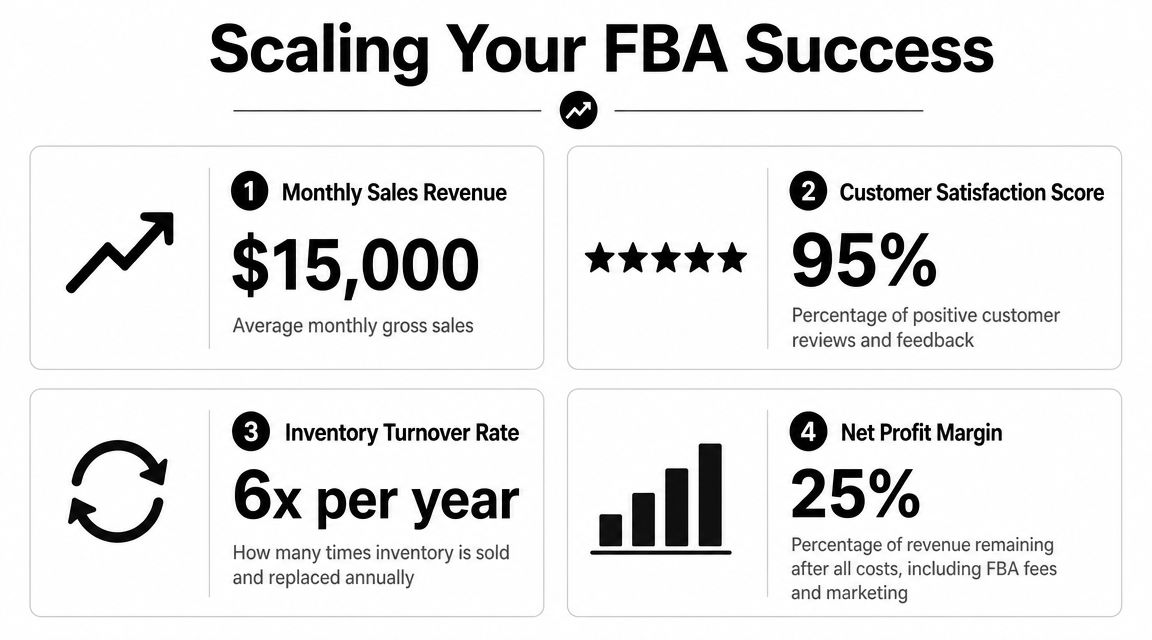
Track the numbers that actually control the business
I learned early that revenue can hide a lot of problems. A product can sell every day and still put you in a bad cash position if fees, returns, ad spend, and reorder timing are off.
Watch a small set of numbers consistently:
- Unit session percentage to see whether the listing converts traffic into orders
- TACoS to judge whether ads support total sales without eating too much margin
- Net profit by SKU to catch weak products before they drain the business
- Sell-through rate and weeks of cover to plan reorders without guessing
- Return rate and refund impact to spot quality, packaging, or expectation problems
- Keyword-level conversion to identify traffic worth paying for
A monthly SKU-level profit review is a good minimum. Weekly is better once volume increases.
Cash flow matters more than beginners expect
Profit on paper does not always mean cash in the bank.
Amazon holds money on a payout cycle. Inventory often has to be paid for weeks or months before it sells. Freight, prep, storage, coupons, PPC, and refunds hit at different times. That timing gap is where new sellers get squeezed.
I prefer to ask four simple questions before placing a reorder:
- How many sellable units do I have left across FBA, inbound shipments, and reserve stock?
- What is the lead time from deposit to Amazon check-in?
- How much cash will this reorder consume before it starts coming back?
- If sales slow down by 20 to 30 percent, can the business still absorb this order?
That last question saves people from expensive optimism.
Inventory punishes sloppy decisions
Stocking out hurts ranking and sales history. Over-ordering hurts cash and raises storage risk. Both mistakes are common, but over-ordering usually does more long-term damage because it reduces your options.
Use a simple operating standard:
| Decision area | Weak approach | Better approach |
|---|---|---|
| Reorders | Reorder because sales looked strong last week | Reorder from average sell-through, lead time, and a safety buffer |
| Ad spend | Raise budget as soon as revenue rises | Raise budget only if contribution margin still works |
| Expansion | Launch another SKU before the first one is stable | Add products after the first SKU has predictable conversion, supply, and margin |
| Cash use | Pull out cash after a good month | Keep working capital in the business until inventory cycles are stable |
I would rather miss a little growth than carry six months of stock I cannot exit cleanly.
Build repeatable systems before adding more products
Scaling usually looks boring from the inside. That is a good sign.
For most sellers, healthy growth comes from improving the operation they already have:
- Tighten conversion before buying more traffic
- Cut search terms that spend without producing profit
- Set reorder points and supplier check-in dates in advance
- Audit fees and reimbursements regularly
- Standardize packaging, prep instructions, and purchase order details
- Keep a simple weekly reporting sheet for sales, margin, ad spend, and inventory position
Tools like Helium 10 and Jungle Scout can help with research. EntreResource also publishes step-by-step Amazon FBA content and calculators for sellers who want practical operating guidance without relying only on YouTube.
Know when to expand and when to wait
A second product makes sense when the first one is predictable. That means you understand conversion rate, reorder timing, landed cost, fee structure, and ad efficiency well enough to forecast the next 60 to 90 days with some confidence.
If those pieces are still unstable, another SKU usually adds noise instead of growth.
Scale after your numbers are reliable, not after a good month.
Brand Registry matters for private label sellers because it gives you more control over listings and brand assets. Even then, systems do the heavy lifting. Good operators review the numbers, fix leaks fast, and manage each SKU like its own profit-and-cash-flow decision.
Frequently Asked Questions About Starting FBA
Is FBA better than FBM
It depends on the product and your operation. FBA makes sense when you want Amazon handling storage, shipping, returns, and customer service. FBM can make more sense for certain bulky items, lower-volume products, or sellers who already have strong fulfillment systems. For most beginners, FBA is easier operationally, but it also requires more attention to inventory planning and fees.
Can you start Amazon FBA from outside the United States
Yes, many sellers do. The main challenge isn't location by itself. It's handling account setup, supplier coordination, shipping, tax and business documentation, and support workflows without slowing down operations. If you're outside the U.S., choose fewer variables early and keep your process simple.
How does Amazon handle returns with FBA
With FBA, Amazon handles the customer-facing return process. You still need to monitor the downstream impact. Returns affect margin, inventory condition, and reorder planning. If a product has unclear sizing, fragile packaging, or misleading images, returns will expose that quickly.
Do you need a lot of products to start
No. Starting with one good product is usually smarter than starting with several weak ones. One product teaches you the systems: research, sourcing, listing optimization, advertising, and inventory control. A messy multi-product launch often hides problems instead of solving them.
Should beginners start with private label or arbitrage
That depends on your budget, risk tolerance, and goals. Arbitrage can teach marketplace mechanics with less brand-building complexity. Private label gives you more long-term control if you want to build an actual asset. If you choose private label, take the financial side seriously from the beginning. That's where most beginner mistakes get expensive.
If you want help evaluating whether a product is actually viable before you spend on inventory, ads, and freight, start with the numbers first and the excitement second. That approach isn't flashy, but it's the version of Amazon FBA that tends to survive.