

You find a promising affiliate network, the payout looks strong, and then the search results get ugly. One thread says the network pays late. Another says tracking is fine but support disappears after approval. Then you open a review site and every write-up sounds like sales copy.
That confusion isn't a side issue. It's the job. Affiliate marketing is already a mainstream channel, and buyers rely heavily on third-party research before committing. Wix cites a Rakuten-commissioned study showing 81% of advertisers and 84% of publishers were already using an affiliate program, and the same roundup notes eMarketer projected U.S. affiliate marketing spending to reach nearly $12 billion in 2025 while 74% of U.S. online shoppers visit multiple affiliate websites before buying (Wix affiliate marketing statistics). That means bad affiliate marketing reviews don't just waste time. They can push real budgets and real purchasing decisions in the wrong direction.
I've learned to stop asking, "What's the best affiliate tool or network?" The better question is, "Which source is trustworthy for this specific decision?" That's why I keep a small stack of review sources and use each one differently. If you also want a framework for evaluating the review itself, LinkJolt's software review guide is worth reading alongside this list.
1. EntreResource

A review looks very different once you've had to live with the tool it recommends. That is why I use EntreResource early in the process. It gives me something star ratings cannot. Operator context.
I do not use it as a final verdict site. I use it as a calibration source. If I am comparing affiliate software, tracking tools, or content monetization options, I want to see whether the writer understands setup friction, reporting gaps, channel fit, and the amount of upkeep a tool creates after signup. EntreResource usually writes from that angle.
A lot of the value comes from reading across its affiliate marketing category, not from treating one post as a standalone answer. I trust review publishers more when their recommendations connect to a larger body of practical work. That context helps me separate "good tool" from "good tool for this business model."
I also like using pieces like these affiliate marketing tips from EntreResource as a check on my own criteria before I compare vendors. A review source gets more useful when it teaches you what to inspect, not just what to buy.
Why I use it first
EntreResource is strongest when I am still defining the decision. At that stage, the wrong question is often the expensive part. A beginner might ask which platform has the highest payout potential, while an experienced operator is usually asking different questions: How hard is implementation? Does this fit a content site, a newsletter business, or paid acquisition? What gets messy at scale?
That is where EntreResource tends to help. The founder-led tone usually stays close to execution and trade-offs. I see more discussion of fit, workflow, and limitations than I do on generic roundups that force every product into the same template.
The affiliate software category itself is crowded and mature, with established vendors, overlapping features, and a lot of polished marketing. In a market like that, feature lists stop being enough. I want a source that explains why one tool is easier to operate, which team it suits, and what kind of complexity comes with the upside.
Practical rule: If a review does not tell me who the tool is for, who should skip it, and what becomes harder after adoption, I treat it as marketing.
Another reason I keep EntreResource in the mix is transparency. It discloses affiliate relationships and surfaces discounts and coupon references. That does not remove bias, but it does make the business model visible. I would rather read a useful review with disclosed incentives than a "neutral" review that hides how it gets paid.
Best use case
Use EntreResource to vet the reviewer before you vet the product. It works well for software comparisons, stack-fit questions, and early-stage research where you need better criteria, not just more opinions. It is less useful for raw complaint volume, payout dispute patterns, or community-style chatter about individual networks.
What I like
- Operator perspective: The content usually reflects how tools behave in actual workflows, not just in demos.
- Useful surrounding context: Affiliate decisions are often connected to SEO, YouTube, ecommerce, publishing, and audience growth.
- Maintenance signals: Updated resources, active publishing, and live discount references suggest the site is still being maintained.
What to watch
- Monetized recommendations: Read with clear eyes and verify any shortlist elsewhere.
- Limited crowd feedback: This is not the place I go for high-volume user complaints or payment-history patterns.
2. Affpaying
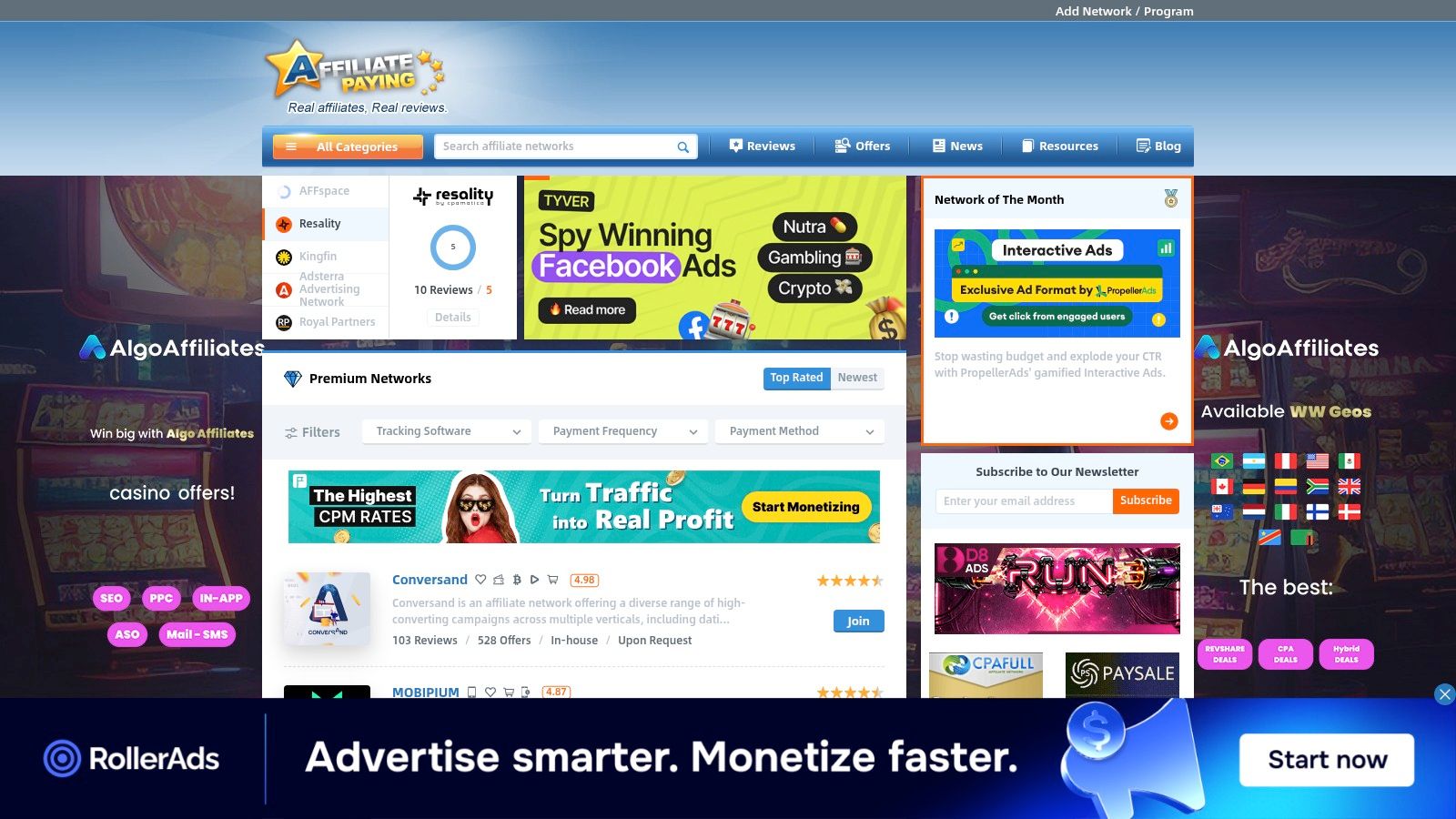
When I want to pressure-test a network's reputation fast, I open Affpaying. Not because every review there is perfect. They aren't. I use it because timestamps, payout notes, and recurring complaints can reveal patterns that glossy review pages hide.
This is one of the better first-pass filters for affiliate and CPA networks. You can usually scan payout terms, minimum thresholds, traffic types, supported verticals, and review recency without digging through a dozen forum threads. That's useful when you're trying to answer simple but expensive questions like: Are people getting paid? Are account managers responsive? Is this network still active?
I also like pairing it with educational reading before making a final call. For example, these affiliate marketing tips from EntreResource help frame what to check beyond the commission headline.
What Affpaying does well
Affpaying helps spot operational risk, not just opportunity. A lot of affiliate marketing reviews over-index on payout size and underweight payment consistency, support quality, and offer stability. Public user reviews are messy, but a cluster of similar complaints around delayed payments or poor communication is still useful.
That matters more as affiliate marketing keeps growing. Post Affiliate Pro summarizes industry estimates that place the global affiliate marketing market at roughly $17 billion in 2025, up from about $15.7 billion in 2024, with projections ranging from $27.78 billion by 2027 to $36.9 billion by 2030. The same summary also notes that 57% of marketers are increasing investment in affiliate marketing (Post Affiliate Pro industry roundup). More money attracts more programs, and not all of them deserve trust.
A network can look attractive in a dashboard and still be painful in practice. Affpaying is where those pain points often show up first.
Best use case
Use Affpaying before joining an unfamiliar network, especially in CPA-heavy niches. I don't use it as a final verdict. I use it as a risk screen.
What I like
- Structured network data: Good for quick comparison.
- Timestamped public feedback: Useful for spotting stale or active programs.
- Integration clues: Tracking platform notes can save setup headaches.
What to watch
- Review quality varies: Some comments are thin, emotional, or incomplete.
- Niche skew: Coverage is stronger in CPA and adjacent verticals than in mainstream SaaS brand programs.
3. OfferVault
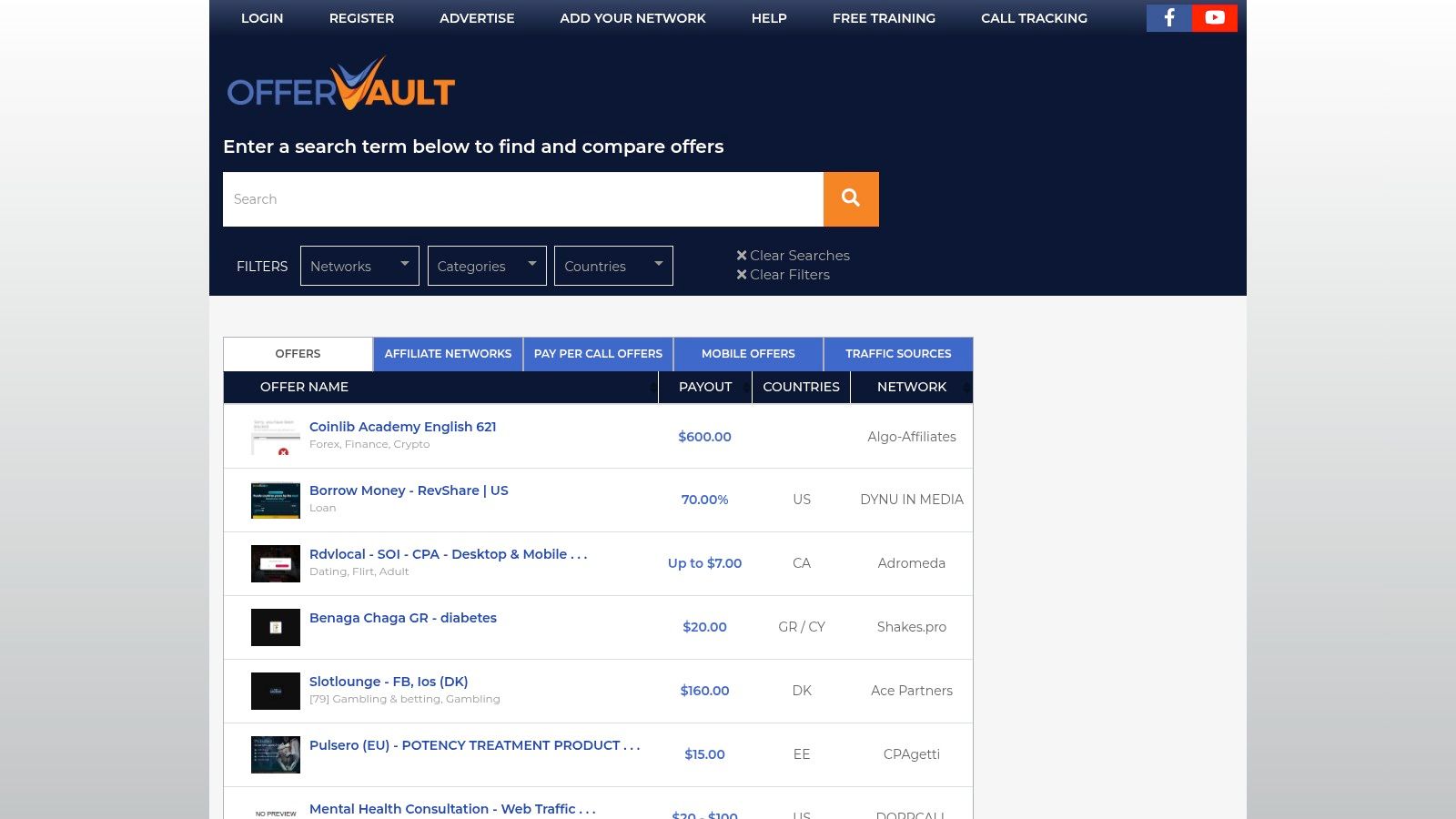
OfferVault isn't where I go for polished editorial analysis. It's where I go when I need market visibility. If you want to know who carries an offer, what category it sits in, and whether multiple networks are competing on the same type of traffic, it's hard to beat for speed.
That speed matters because network sales pages often make an offer look unique when it isn't. OfferVault helps cut through that. If I see the same offer category or similar funnel structure across several networks, I know I need to stop treating the payout as the deciding factor and start looking harder at tracking, caps, approval quality, and rep responsiveness.
Where it fits in my workflow
I use OfferVault near the top of the process, before deep due diligence. It helps answer discovery questions fast.
What I check first
- Offer duplication: If several networks run similar offers, I compare approval friction and support quality next.
- Vertical saturation: Dense verticals usually demand tighter compliance and better tracking discipline.
- Network source: I always click through to the originating network and verify the current terms there.
One reason this matters is fraud. GetResponse notes that affiliate fraud can include fake leads, fake sales, cookie stuffing, and conversion-tracking tampering, while also pointing out that IAB Europe reported the European affiliate market reached €12 billion in sales revenue in 2023 (GetResponse on affiliate scams and fraud). In a large, incentive-heavy market, any aggregator should be treated as a discovery layer, not proof that the economics are clean.
Best use case
Use OfferVault to scan the field quickly, compare similar offers, and identify which networks deserve a closer look. It works best for discovery. It works poorly as a standalone trust signal.
What I like
- Fast offer discovery: Great for CPA, CPL, and CPS scans.
- Cross-network comparisons: Useful when one offer appears in multiple places.
- Efficient filtering: Helpful when you're niche-mapping.
What to watch
- Lag risk: Aggregated data can trail the network's actual terms.
- Variable listing quality: Some network pages are richer than others.
4. G2 Affiliate Marketing Category
If I'm evaluating software rather than offers, I switch modes completely and go to G2's affiliate marketing category. Software reviews require a different lens than network reviews. The central questions become onboarding, reporting clarity, integration quality, support, and whether the product can handle the attribution model you need.
G2 is useful because it concentrates a lot of buyer feedback in one place. That doesn't make it unbiased. Vendor influence and incentivized reviews are real concerns on any software marketplace. But with enough review volume, you can often separate broad product patterns from isolated complaints.
A nice companion read here is EntreResource's Afflytics review, especially if you're comparing software through an operator lens instead of a procurement lens.
How I read G2 without getting fooled
I don't pay much attention to the average rating by itself. I care more about the language reviewers use around implementation. Are they describing setup friction? Do they mention attribution quirks? Are support interactions specific or generic?
This matters more now because the review environment itself has changed. Affiliboost's gap analysis highlights recent FTC guidance saying businesses may not buy or sell fake consumer reviews or testimonials, and it emphasizes the risk when reviews are presented as independent opinions but are incentivized or fabricated (Affiliboost on review credibility and FTC guidance). That's exactly why I treat "verified review" as a positive signal, not a guarantee.
My filter: On G2, the most useful reviews usually describe implementation details, support interactions, and reporting limitations. Thin praise tells me almost nothing.
Best use case
Use G2 when you already know the software category and need to shortlist tools like impact.com, PartnerStack, Tapfiliate, Refersion, or similar platforms. It is strongest for comparing user experience and operational fit.
What I like
- Review density: Helpful for finding recurring product strengths and weaknesses.
- Comparison views: Good for narrowing a shortlist quickly.
- Use-case filtering: Useful when your company size changes the requirements.
What to watch
- Incentivized sentiment: Read below the star rating.
- Vendor presentation effects: Placement and profile polish can shape perception.
5. Capterra Affiliate Software Category
Capterra's affiliate software category is where I go when I want a cleaner, buyer-oriented comparison view. Compared with G2, it often feels more checklist-driven. That's not a criticism. Sometimes checklist-driven is exactly what you need.
If you're trying to compare pricing structure, feature snapshots, and side-by-side software fit, Capterra is efficient. It tends to work well for SMB and mid-market teams that need enough detail to narrow options without reading dozens of longform reviews first.
Why I still cross-check it
Capterra is strongest when I already know my requirements. If I need recurring commissions, ecommerce integrations, custom tracking links, or a lightweight admin setup, its category filters and comparison format help me narrow the field quickly.
What it doesn't do as well is expose nuanced implementation friction on its own. That's why I treat it as a sorting tool, then validate on vendor demos, product docs, and other review sources.
Google's 2024 core and spam updates targeted scaled content abuse and low-value mass-produced pages, as discussed in Google's creator guidance video on search quality changes. That has made generic "best tools" pages less reliable across the web. In practice, that means a structured review directory like Capterra becomes more useful when you use it for raw comparison inputs, not final judgment.
Best use case
Capterra is good for narrowing a long list into a shortlist. I use it when I want to compare software basics quickly before moving into trial accounts, demos, and support conversations.
What I like
- Easy side-by-side comparisons: Good for fast vendor elimination.
- Buyer-guide framing: Helpful for less experienced teams.
- Broad SMB coverage: Often surfaces tools smaller brands consider.
What to watch
- Presentation bias: Sponsored visibility can shape what you see first.
- Surface-level confidence: Good summary data can hide deep implementation problems.
6. AffiliateProgramFinder

AffiliateProgramFinder is the directory I use when I need breadth across niches. Sometimes I don't need a network review first. I need to know what programs even exist in a vertical, what type of commission structure they use, and whether the approval path looks realistic for the content model I'm building.
That's where this site is handy. It centralizes basic program data you would otherwise gather manually across brand pages and network dashboards. For niche planning, that saves a lot of repetitive work.
Where it earns a spot
This is particularly useful for content sites and creators building monetization plans around a category like SaaS, AI tools, hosting, travel, education, or finance. It helps you identify whether a niche has enough viable programs to justify content investment before you spend weeks producing review content around a weak monetization pool.
I also like it for cookie-window and approval-requirement scanning. Those details often decide whether a program is worth your attention, especially if your traffic comes from content that converts slowly rather than impulse clicks.
What I check
- Program diversity: A healthy niche usually has multiple monetization paths.
- Approval friction: Some programs are fine on paper but unrealistic for newer publishers.
- Commission model fit: Recurring, one-time, and lead-based structures behave very differently.
Best use case
Use AffiliateProgramFinder during niche research or when you're expanding into a new vertical. It's a discovery and planning tool more than a reputation engine.
If a directory helps you find a program faster, that's useful. If it makes you trust the program by itself, that's a mistake.
What I like
- Niche mapping: Fast way to see viable programs by category.
- Program facts in one place: Saves manual tab-hopping.
- Useful for planning: Especially good before content production starts.
What to watch
- Less historical review depth: You still need outside validation.
- Directory limits: Always confirm details on the official program page.
7. AFFBun
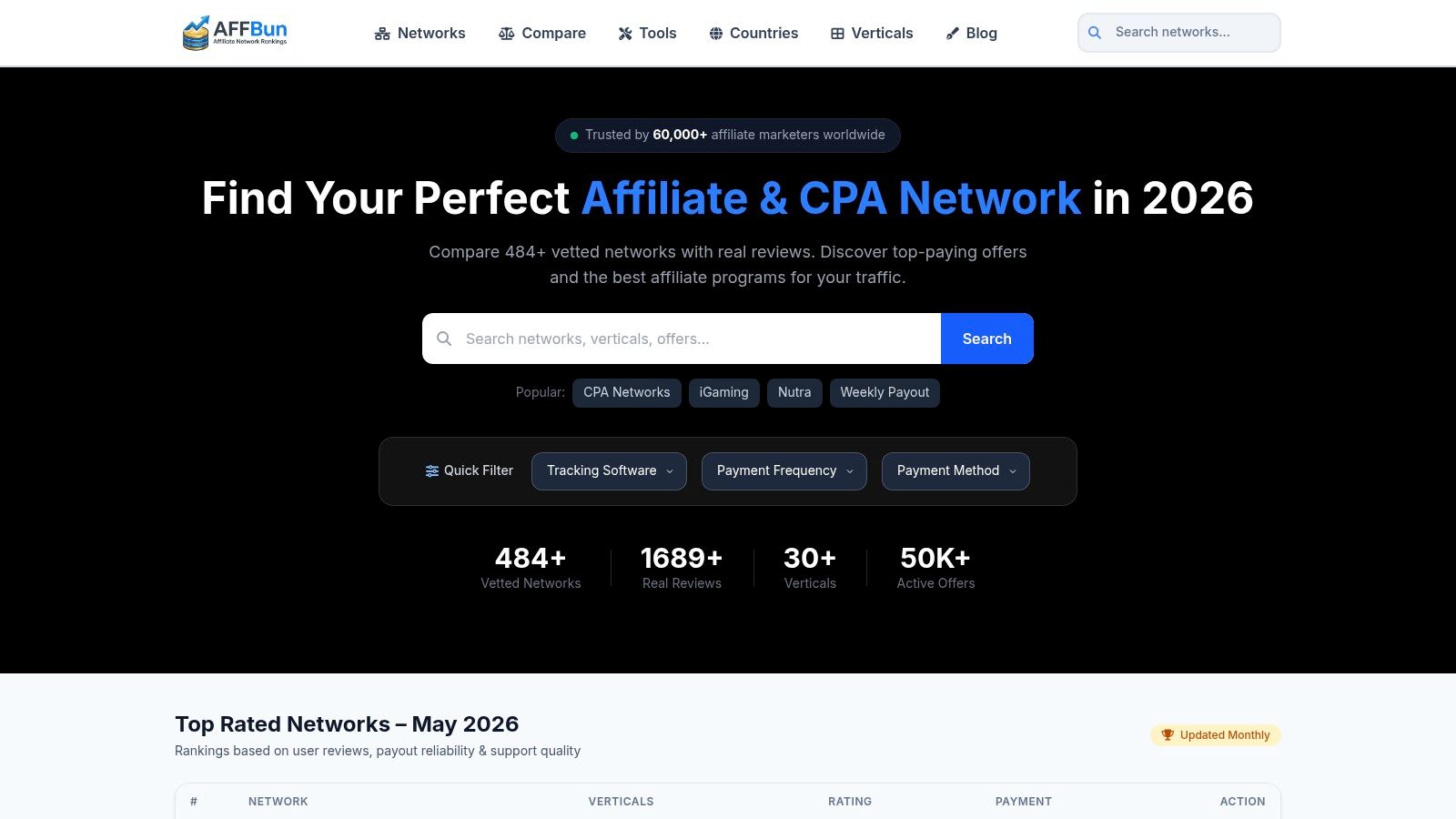
AFFBun feels more modern than many older affiliate directories, and that helps. When a review database is easier to scan, I can compare lesser-known networks without burning time on clunky navigation.
I don't use AFFBun as a replacement for Affpaying. I use it as a complement. It tends to be useful for side-by-side network sorting, especially in CPA-oriented categories where payout practices, offer counts, traffic rules, and GEO coverage matter quickly.
Why I keep it in the stack
Some affiliate marketing reviews are too narrative. AFFBun is more data-forward. That makes it handy when you're trying to compare several unfamiliar networks and need a clean first screen before contacting reps or sending test traffic.
It also helps with verification mindset. In affiliate, "top-performing" claims can be distorted by bad attribution, inflated reporting, or poor fraud controls. A cleaner comparison environment pushes you to ask better questions about transparency and tracking quality instead of chasing headline payouts.
What I like
- Fresh interface: Easier to scan than many legacy directories.
- Comparison orientation: Useful for evaluating multiple networks quickly.
- Good fit for CPA research: Especially in mobile, utilities, finance, sweeps, and iGaming-adjacent niches.
What to watch
- Category skew: Retail and SaaS brand programs are lighter here.
- Limited third-party depth on some listings: Test traffic and rep conversations still matter.
Best use case
AFFBun is strong when you're narrowing unfamiliar networks in CPA-heavy spaces and want another angle on payout practices and platform details before committing budget.
Top 7 Affiliate Marketing Review Sites Comparison
| Tool | Implementation complexity 🔄 | Resource requirements ⚡ | Expected outcomes 📊 | Ideal use cases 💡 | Key advantages ⭐ |
|---|---|---|---|---|---|
| EntreResource | Low, read/apply playbooks 🔄 | Low, time to consume content, basic tools ⚡ | Actionable tactics that can drive revenue/testing gains 📊 ⭐⭐⭐ | Solo founders, creators, niche site builders seeking execution playbooks 💡 | Deep, tactical how‑tos + verified discounts for faster tool selection ⭐ |
| Affpaying | Low, lookup & vet networks 🔄 | Low, research time + test campaign spend ⚡ | Better risk screening; spotting payment/support issues 📊 ⭐⭐ | Affiliates evaluating CPA/iGaming networks before joining 💡 | Long history and timestamped user reviews for reliability signals ⭐ |
| OfferVault | Low, search aggregator use 🔄 | Low, research + confirm with networks ⚡ | Fast discovery of CPA/CPL/CPS offers and payout comparisons 📊 ⭐⭐ | Market scanning and quick offer matching across networks 💡 | Powerful search and broad offer coverage for quick comparisons ⭐ |
| G2 (Affiliate category) | Low, read reviews & compare features 🔄 | Low, time to filter reviews; run trials ⚡ | Shortlists for platform capabilities, integrations, onboarding 📊 ⭐⭐⭐ | Companies vetting partner/affiliate platforms and support quality 💡 | Dense, recent user feedback and comparison grids for tool selection ⭐ |
| Capterra (Affiliate category) | Low, side‑by‑side comparisons 🔄 | Low, review reading and demos ⚡ | Clear pricing/feature snapshots and buyer guidance 📊 ⭐⭐⭐ | SMBs comparing affiliate software features and costs 💡 | Buyer's guides and transparent update cadence for vendor comparison ⭐ |
| AffiliateProgramFinder | Low, searchable program lookup 🔄 | Low, research time to validate programs ⚡ | Rapid mapping of niche programs (rates, cookies, approvals) 📊 ⭐⭐ | Creators/publishers building monetization plans around verticals 💡 | Centralized program facts that speed selection and planning ⭐ |
| AFFBun | Low–Medium, use comparisons & verification tools 🔄 | Low, research + test traffic for confirmation ⚡ | Data‑forward shortlists for CPA verticals and payout practices 📊 ⭐⭐ | CPA publishers in mobile, finance, iGaming, and utility niches 💡 | Modern UI, verification focus and side‑by‑side network comparisons ⭐ |
Your Due Diligence Playbook for Affiliate Marketing
No single site gives me enough confidence to trust a network, offer, or software platform on its own. That's the core lesson behind affiliate marketing reviews in 2026. The review source matters as much as the review content.
My usual process is simple. I start broad, then narrow. For program discovery, I use OfferVault or AffiliateProgramFinder. For network reputation and payment-history clues, I check Affpaying and AFFBun. For software decisions, I compare G2 and Capterra. If I need an operator-level take on how a tool fits into a broader business model, I read EntreResource.
That layered approach matters because affiliate marketing isn't small anymore. As noted earlier, the channel influences a meaningful share of ecommerce activity and continues attracting budget. In the U.S., eMarketer projected affiliate marketing spending would climb to $15.8 billion by 2028, according to the Wix roundup cited earlier. More spend creates more tools, more programs, more content, and more incentives to manipulate perception. Good due diligence becomes a competitive advantage.
I also apply a few simple trust filters every time:
- Disclosure quality: I want to see whether the publisher is transparent about affiliate relationships.
- Evidence of use: Screenshots, implementation detail, and specific drawbacks matter more than polished praise.
- Review recency: Old praise on a changed platform is almost useless.
- Cross-source consistency: If multiple sources disagree sharply, I slow down and look for what each one is measuring.
- Fraud awareness: I want to know whether the review considers attribution quality, fake leads, tracking integrity, and payout reliability.
The biggest mistake I see is treating discovery tools like final authority. A directory helps you find options. A review platform helps you collect user sentiment. Neither replaces a test campaign, a demo call, or a close read of program terms.
That's the trade I make every time. Spend a little longer verifying the reviewer, the network, and the software now, or spend much longer cleaning up bad partnerships later. If you're also thinking about where affiliate research is heading next, this piece on scaling affiliate revenue with AI is a useful follow-up.