
You're running Google Ads, posting on social, sending emails, and maybe publishing content that ranks. Sales come in, but the answer to one basic question stays fuzzy: what caused the sale?
That's where attribution modeling earns its keep. It gives you a way to assign credit across the customer journey instead of handing all the praise to the final click. For a growing business, that matters because budget decisions get expensive fast when you reward the wrong channel.
Done well, attribution helps you see which channels introduce demand, which ones nurture it, and which ones close it. Done poorly, it gives you false confidence and pushes money into whatever happened to show up last.
Why Your Marketing Feels Like a Black Box
A customer clicks a paid social ad early in the week, reads one of your articles from search a day later, opens an email, then comes back through a branded search and buys. Your dashboard gives most or all of the credit to the final step. Now brand search looks like your star performer, even though other channels did the work of getting that buyer there.
That gap is why marketing feels hard to read. Revenue shows up. Spend goes out. The path between the two is full of partial signals, missing data, and channels that influence a sale without getting visible credit.
The clearest way to understand attribution is to look at it like a basketball possession. One player gets the point on the stat sheet, but the score often started with the steal, the outlet pass, and the assist that created an open shot. Marketing works the same way. Paid social might start the possession, search might advance it, email might set up the final move, and direct traffic might get credit for the finish.
Practical rule: The channel that closes the sale often is not the channel that created demand.
Attribution modeling is the method used to assign credit across those touchpoints. In plain terms, it organizes the customer journey, applies a set of rules or an algorithm, and helps you judge performance by channel, campaign, or page.
For entrepreneurs, the core issue is not the definition. It is whether the data is good enough to trust. If your CRM is not connected, UTM tagging is inconsistent, conversions are missing, or iOS and cookie limits are hiding touchpoints, your model can look precise while pointing you in the wrong direction. I see this mistake often. A business cuts top-of-funnel spend because last-click reports make retargeting and branded search look like they produce demand on their own.
That is how ad spend gets wasted.
Before arguing about advanced models, make sure your measurement basics are in place. Start with tracking and analytics basics for online businesses so you can tell the difference between a reporting artifact and a real performance signal.
The Six Common Attribution Models Explained
A buyer sees a paid social ad on Monday, reads one of your blog posts from search on Wednesday, clicks an email on Friday, then comes back direct on Sunday and buys. Attribution models answer one practical question: which channel gets the assist, and how much?
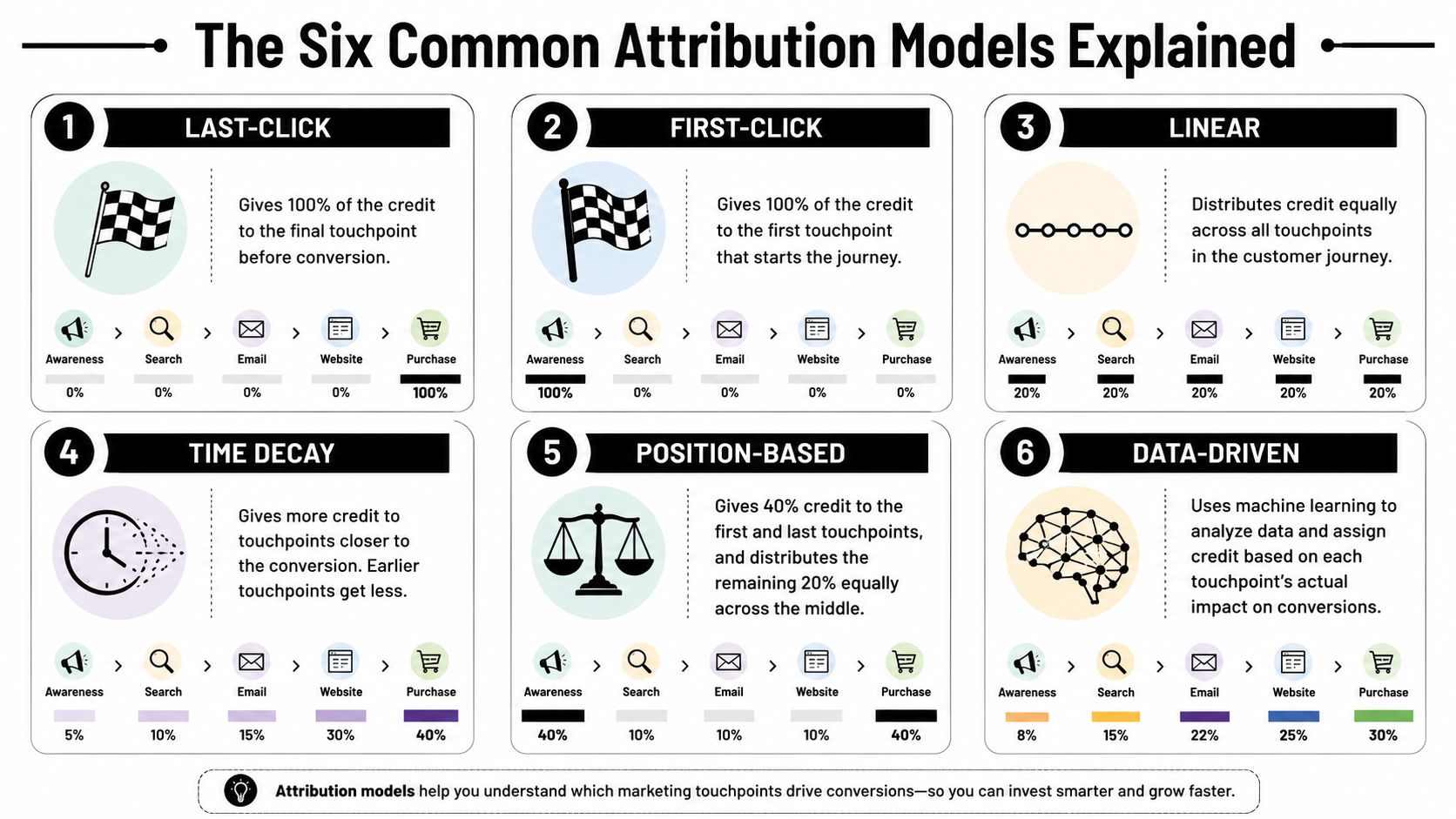
Using the basketball analogy, the sale is the made basket. Different models score the possession differently. Some give all the credit to the player who took the shot. Others give credit to the player who started the break, the one who made the key pass, and the one who finished. That difference matters because it changes where you put your budget next month.
Last-click attribution
How it works
The final touch before the purchase gets all the credit. In this journey, direct traffic gets 100%.
Best for…
Teams that need a fast, simple read on what closes.
Biggest blind spot
It makes closers look like creators of demand. Direct, branded search, and retargeting often absorb credit that was earned earlier by content, social, or prospecting campaigns.
First-click attribution
How it works
The first touch gets all the credit. Here, paid social wins the whole conversion.
Best for…
Founders who want to know which channels introduce new buyers to the business.
Biggest blind spot
It ignores everything that helped the buyer gain trust and make the final decision. That limits its value for budget decisions once you are trying to improve the full funnel.
Linear attribution
How it works
Every touchpoint gets equal credit. In this example, paid social, organic search, email, and direct each receive the same share.
Best for…
Businesses that want a balanced view without making strong assumptions about which touch mattered most.
Biggest blind spot
Equal weighting is tidy, but buyer journeys are rarely tidy. A quick blog visit and a well-timed email usually do not carry the same influence.
Time-decay attribution
How it works
Touches closer to the conversion receive more credit than earlier ones. Email and direct get more weight than paid social in this path.
Best for…
Longer buying cycles where late-stage touches often help convert existing interest.
Biggest blind spot
It can understate the value of the channel that started the possession. That becomes expensive when your growth depends on creating new demand at the top of funnel. If you run paid acquisition, this is one reason to study frameworks from operators who actively manage traffic, such as this training on paid traffic strategy and campaign scaling.
Position-based attribution
How it works
Position-based models give extra credit to specific moments in the journey, usually the first touch, the last touch, or another milestone in the middle.
Two common versions are:
- U-shaped model: Extra weight goes to the first and last touch, with the remaining credit split across the middle interactions.
- W-shaped model: Extra weight goes to the first touch, a key middle-stage milestone such as lead creation, and the final conversion touch.
Best for…
Businesses that know introduction and conversion both matter, but still want some credit assigned to the middle assists.
Biggest blind spot
The weights are fixed in advance. They are useful for reporting, but they still reflect your assumptions about how buyers move.
A clear rule-based model is often better than a complex model built on bad tracking.
Data-driven attribution
How it works
This model uses your observed conversion paths to estimate how much each touchpoint contributes, rather than applying a fixed rule to every journey.
Best for…
Businesses with enough clean data, reliable conversion tracking, and enough volume to make pattern detection useful.
Biggest blind spot
It can be hard to audit. If your CRM misses offline conversions, your UTMs are inconsistent, or your channels are not stitched together well, the output can look polished while pushing you toward the wrong budget cuts.
No model is universally right. The right one is the model your business can explain, trust, and act on without fooling itself.
Rule-Based vs Data-Driven Models A Deeper Dive
A lot of attribution decisions come down to one practical question. Do you want a model you can explain in a sales meeting, or a model that can adapt to patterns your team may not spot on its own?
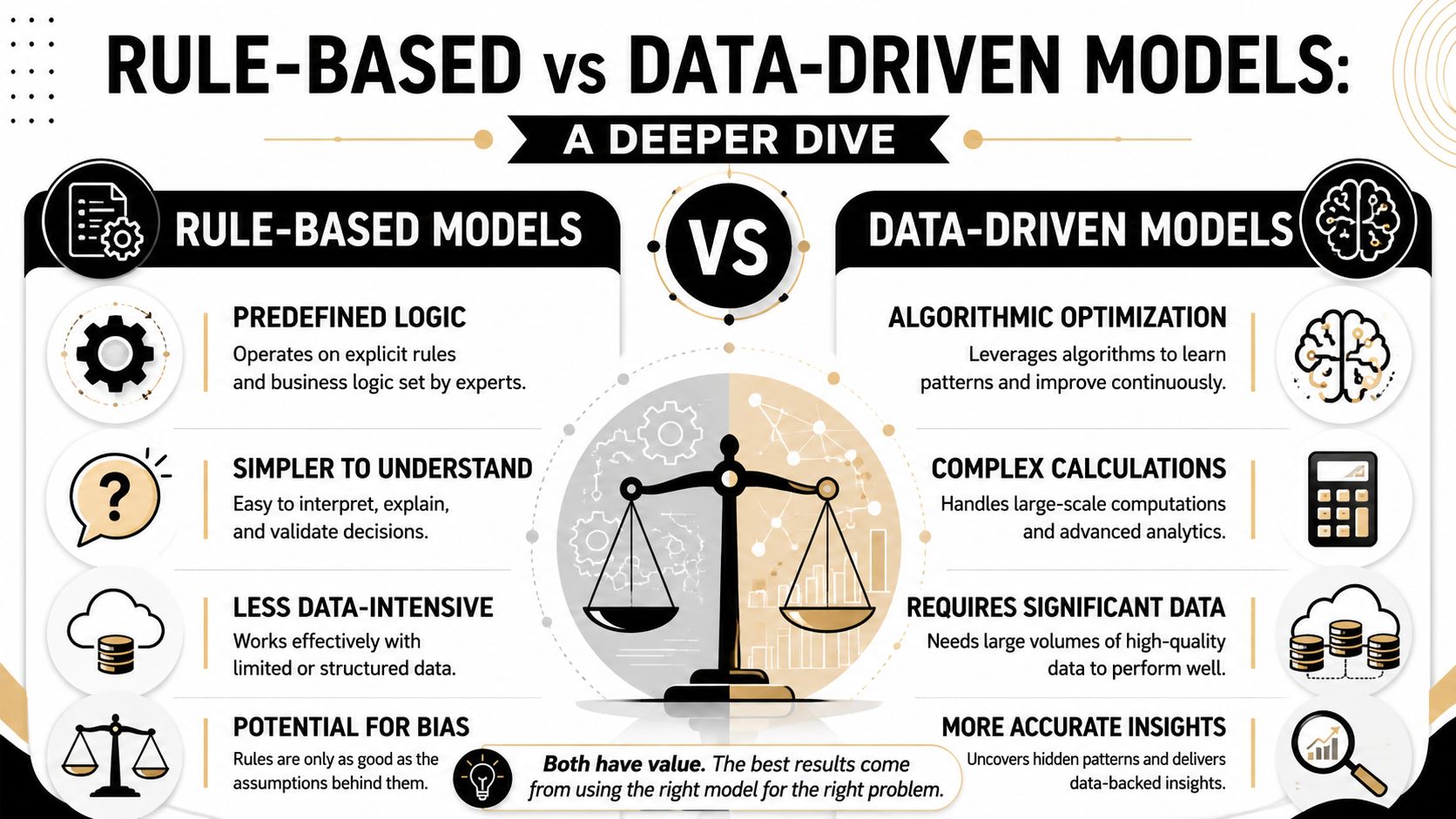
That is the fundamental split between rule-based and data-driven attribution.
Rule-based models work like a basketball team assist chart with scoring rules set before tipoff. You decide how much credit goes to the player who started the play, who made the key pass, and who finished at the rim. In marketing terms, that means assigning fixed weights to touches such as the first click, a lead form, or the final conversion session. The upside is control. The downside is that your assumptions stay fixed even when buyer behavior changes.
That fixed logic is often useful for growing businesses. Founders can understand it fast. Media buyers can audit it. Operators can trace why paid search, email, or organic content got credit without guessing what happened inside a black box.
A simple setup usually looks like this. Collect touchpoints and conversions, order them by user and time, then apply explicit logic to assign credit before rolling results up by channel, campaign, or landing page. It is not flashy, but it is workable.
Data-driven attribution takes a different route. Instead of assigning credit by rule, it estimates contribution from the conversion paths your business has recorded. In plain English, it tries to learn which channels tend to assist a sale, not just which one happened to appear first or last. Amplitude's explanation of attribution model frameworks is useful if you want to understand the mechanics behind that approach.
Many entrepreneurs frequently make an expensive mistake. They assume data-driven automatically means more accurate.
It does not.
Data-driven models only help when the inputs are dependable. If your CRM misses offline deals, your UTMs are messy, or returning visitors keep showing up as new users, the model can push budget away from channels that are doing real work earlier in the funnel. That is why attribution and conversion rate work are tied together. Before you reallocate spend, spend some time diagnosing leaky funnels for growth.
Here is the trade-off in practical terms:
- Rule-based models are better when tracking is still uneven. You can inspect the logic and spot problems faster.
- Data-driven models are better when you have enough clean volume. They can catch patterns a fixed model will miss.
- Rule-based models are easier to defend internally. Everyone knows how credit was assigned.
- Data-driven models are easier to overtrust. The output looks precise even when the setup is weak.
Google Ads does offer data-driven attribution guidance, but the platform still depends on conversion volume and clean measurement. The model is only as good as the tracking behind it.
My rule of thumb is simple. If the business cannot clearly explain how conversions are tracked across channels, start with a transparent rule-based model. Get the plumbing right first. Then test whether a data-driven approach changes decisions in a way that matches reality.
For teams scaling paid acquisition, the stakes rise quickly as more channels enter the mix. Paid Traffic Mastery by Molly Pittman is a useful resource for building that judgment, because attribution gets harder once Facebook, search, email, content, and retargeting are all claiming the same win.
See How Attribution Models Change Your Results
Take one sale worth $100. The buyer's path looks like this:
- Facebook ad
- Google search leading to a blog post
- Email click
- Direct visit and purchase
Nothing about the buyer changes. Only the attribution model changes. That's the point. The same sale can tell completely different stories depending on the credit rules.
Four ways to score one journey
Last-click attribution
Direct gets the full sale because it was the final touch before purchase.
- Facebook Ad: $0
- Google/Blog: $0
- Email: $0
- Direct/Purchase: $100
First-click attribution
Facebook gets the full sale because it started the journey.
- Facebook Ad: $100
- Google/Blog: $0
- Email: $0
- Direct/Purchase: $0
Linear attribution
There are four touches, so each gets an equal share.
- Facebook Ad: $25
- Google/Blog: $25
- Email: $25
- Direct/Purchase: $25
Position-based attribution using a U-shaped structure
Using the common U-shaped rule described earlier, the first touch gets 40%, the last touch gets 40%, and the middle touches split the remaining 20%. On a $100 sale, that means:
- Facebook Ad: $40
- Google/Blog: $10
- Email: $10
- Direct/Purchase: $40
Attribution Model Comparison for a $100 Sale
| Model | Facebook Ad | Google/Blog | Direct/Purchase | |
|---|---|---|---|---|
| Last-Click | $0 | $0 | $0 | $100 |
| First-Click | $100 | $0 | $0 | $0 |
| Linear | $25 | $25 | $25 | $25 |
| Position-Based | $40 | $10 | $10 | $40 |
That table is why attribution matters. If you manage by last-click alone, you'd likely cut Facebook and content faster than you should. If you manage by first-click alone, you might overfund awareness and ignore what closes.
What this means for budget decisions
The practical lesson isn't “pick one perfect model.” It's that your budget can drift in the wrong direction when the model doesn't match how your business sells.
This is also where funnel analysis matters. If attribution tells you where credit goes, conversion analysis tells you where the journey breaks. If you want a useful companion read on diagnosing leaky funnels for growth, that's worth reviewing alongside your attribution reports.
Attribution tells you who deserves credit. Funnel analysis tells you where buyers get stuck. You need both.
Your Quick Start Guide to Implementing Attribution
A common small-business scenario goes like this. Paid social is bringing in traffic, branded search keeps showing up before purchase, email gets the last click, and nobody is sure which channel is actually pulling its weight. That uncertainty leads to bad budget calls fast.
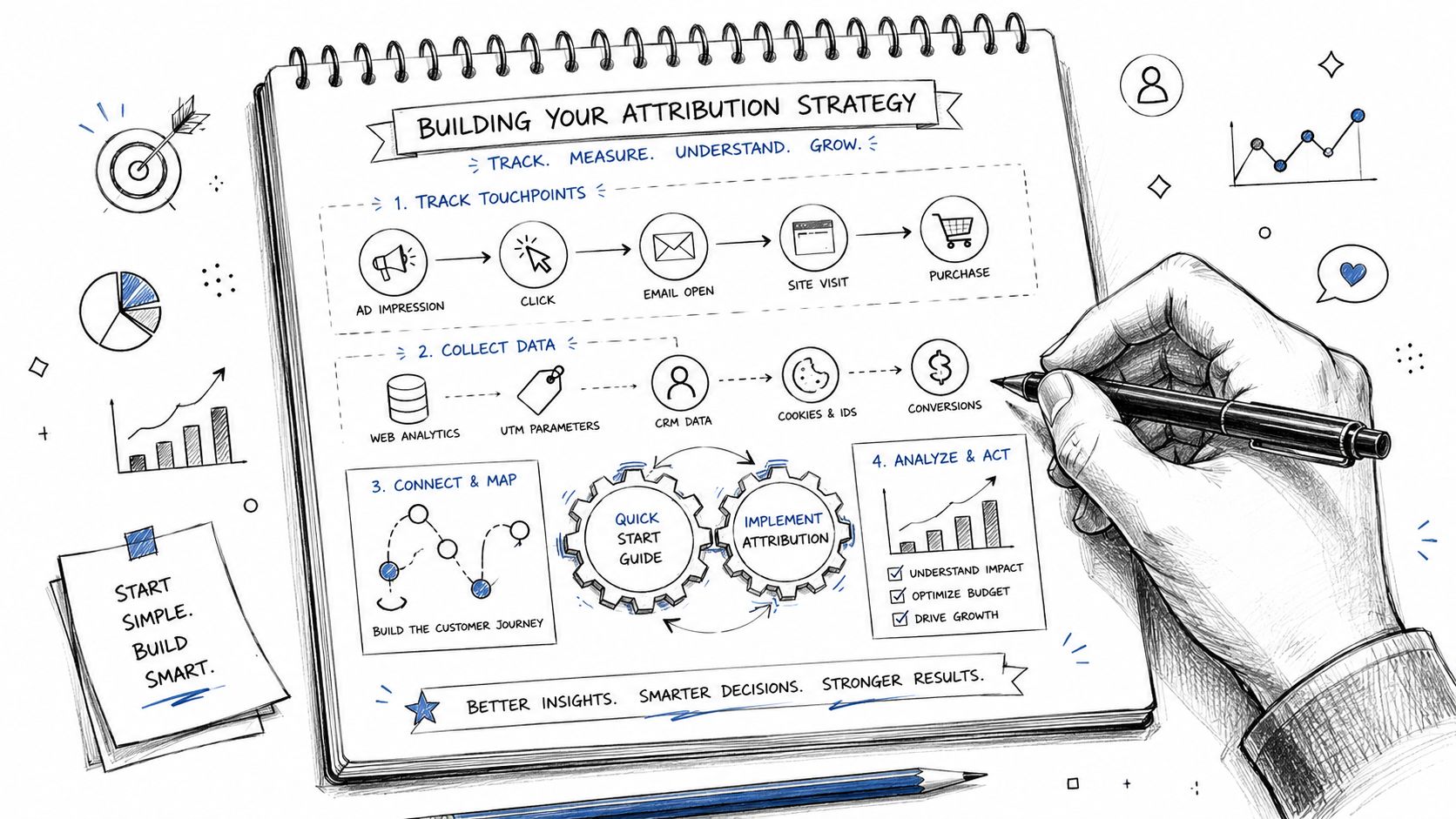
Most companies can avoid that with a simple setup they can trust. Start with clean traffic tagging, accurate conversion tracking, and one reporting view your team agrees to use.
Start with UTM discipline
UTM parameters are the foundation of usable attribution. If campaign links are tagged inconsistently, your reports split one channel into three versions and your model assigns credit to the wrong places.
Use a naming system your team can follow without guessing:
- utm_source = where the visit came from
- utm_medium = the channel type
- utm_campaign = the campaign name
- utm_content = the ad, creative, or variation when needed
Example structure:
yourdomain.com/page?utm_source=facebook&utm_medium=paid-social&utm_campaign=spring-launch&utm_content=video-a
Keep the taxonomy plain. Pick one format and stick to it. “facebook,” “paid-social,” and “spring-launch” will beat clever naming every time because they hold up once you have months of campaigns in the system.
Make sure key events reflect real business actions
Attribution only works if the conversion events are trustworthy. For an ecommerce brand, that usually means purchase, add to cart, and begin checkout. For a lead generation business, it may be form submission, booked call, or qualified lead.
Check the basics before you compare models:
- A purchase or lead event fires once: duplicate events inflate channel performance
- Revenue or lead value passes correctly: bad values distort ROI calculations
- UTMs persist across the visit: if tracking gets overwritten, earlier touchpoints disappear
- Test conversions match what happened on the site: reports should mirror real customer actions
If your setup is messy, fix implementation before debating models. A clean basic model is more useful than a complex model running on broken tracking. If you need help tightening that setup, using Google Tag Manager and enhanced ecommerce is a practical next step.
Know how credit is being assigned
Attribution works like a basketball team assist chart. One player may score, but the possession often depends on the inbound pass, the screen, and the extra pass that created the open shot. Marketing channels work the same way. Search might finish the play, but paid social, content, or email may have created the opportunity.
That is why teams get in trouble when they only look at the final touch. The closer gets all the praise, while the channels that introduced the customer or kept them engaged look weaker than they really are.
You do not need to memorize every platform setting. You do need to know the rule behind the report you are using, and whether that rule fits how people buy from you.
A short walkthrough helps if GA4 still feels abstract:
Set a conversion window that matches your sales cycle
The conversion window decides how far back your system looks when giving credit. If a customer usually buys on the first or second visit, a shorter window can work. If they compare options for weeks, a short window cuts out early touches that mattered.
This is one of the easiest places to fool yourself.
A local emergency plumber and a B2B software company should not use attribution the same way. One has a short path to purchase. The other may need multiple visits, remarketing, email follow-up, and branded search before a decision happens. Match the window to the actual buying cycle, not the default setting in the platform.
Start simple. Audit the tracking. Confirm the events. Then choose a model your business can support with the data you have.
How to Choose the Right Attribution Model
A founder looks at the dashboard on Monday, sees paid search closing sales, and shifts more budget there by Friday. Two weeks later, revenue is flat. The problem was not the decision speed. The problem was giving all the credit to the player who scored, while ignoring the teammate who made the assist.
The right attribution model works the same way a good basketball coach reviews a scoring play. One player takes the shot, but other players created the opening. Your job is to choose a model that gives enough credit to the assist without making reporting so complex that nobody trusts it.
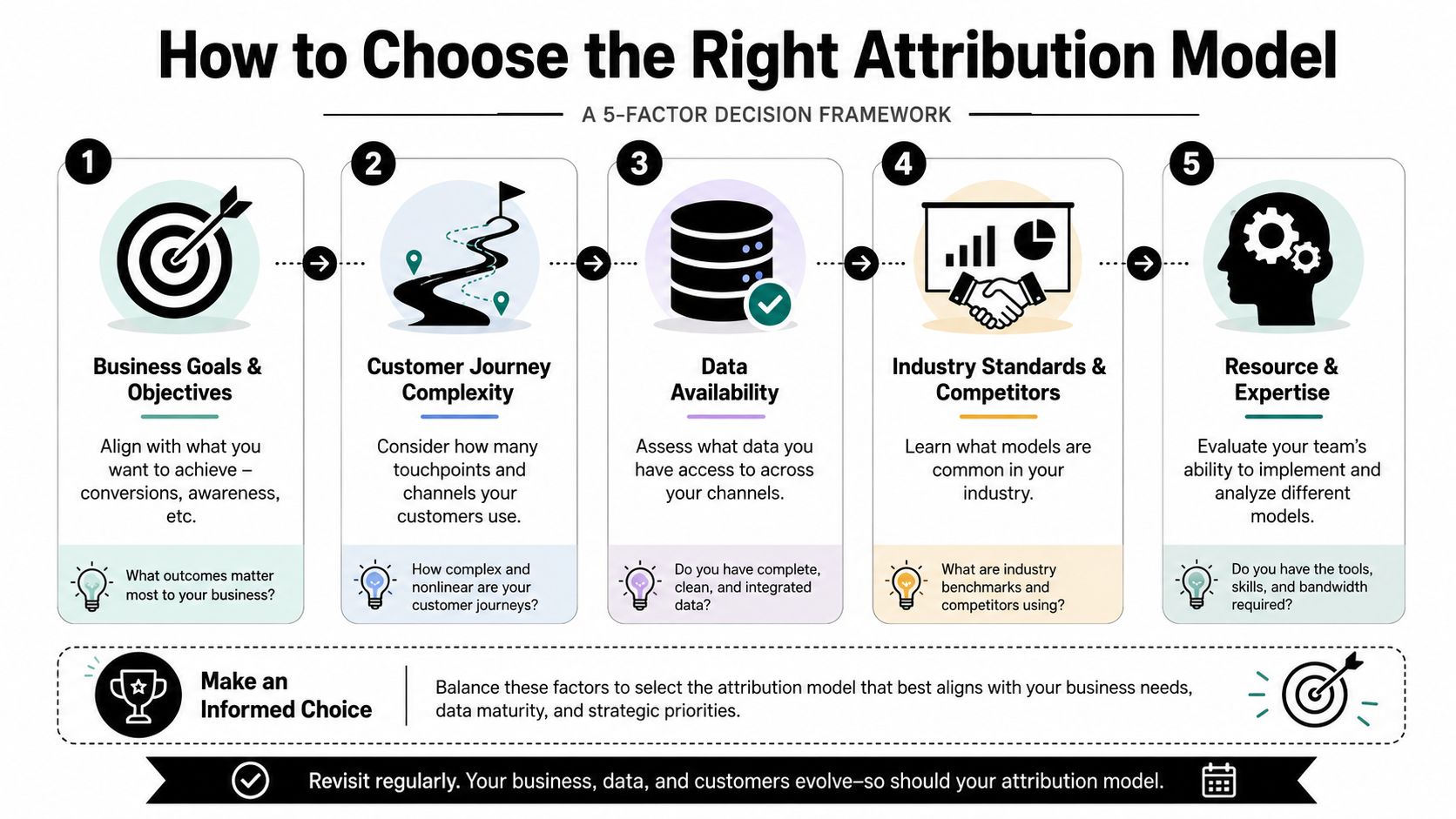
Ask these five questions
How long is the buying journey?
Short buying cycles can work with simpler models. Longer paths usually need more than one touchpoint to explain why someone bought.
How many channels influence the sale?
A business driven mostly by branded search and direct traffic does not need the same setup as a business mixing SEO, paid social, email, retargeting, affiliates, and partnerships. More players on the court usually means you need a model that shows assists, not just the final shot.
Is the tracking clean enough to support the model? A lot of small businesses get misled regarding this. If events fire twice, UTMs are inconsistent, or conversions are missing from key channels, a more advanced model will not save you. It will just make bad data look smarter.
Do you have enough volume for a more complex model?
Low conversion volume limits what your system can infer with confidence. In that case, a simpler rule-based model is often more useful because the assumptions are visible and easier to challenge.
Can your team explain the output in plain English?
If nobody can say why email got 18 percent of the credit and paid social got 12 percent, the report will not help budget decisions. Clarity matters because attribution is a decision tool, not a trophy for having advanced analytics.
A practical selection framework
Use the simplest model that matches how customers buy from you.
- Choose last-click if your sales cycle is short and you need a practical report on which channels close demand.
- Choose first-click if your main question is which channels start qualified interest.
- Choose linear if several touchpoints matter and you want a straightforward baseline.
- Choose position-based if opening and closing touches both deserve extra weight.
- Choose data-driven if your tracking is reliable, your conversion volume is healthy, and your team is comfortable pressure-testing the output.
For many growing businesses, position-based or linear is the honest middle ground. It gives a better read than last-click alone without asking thin data to do too much.
Validate before you trust
Do not ask which model sounds smartest. Ask which model helps you waste less money.
I usually sanity-check attribution in three ways. First, compare two models side by side and look for major swings in channel value. Second, match the report against what you see in campaign behavior, landing page engagement, and sales feedback. Third, watch what happens after budget shifts. If a model tells you to cut top-of-funnel spend, but branded search and direct traffic weaken a few weeks later, that model is probably under-crediting the assist.
Good attribution does not remove judgment. It sharpens it.
Playbooks and Pitfalls for Smart Entrepreneurs
Attribution becomes useful when it changes how you act, not when it gives you a prettier dashboard.
Two practical playbooks
For a new e-commerce store
Start simple. Use a straightforward closer-focused model for operational reporting, but keep watching the earlier touches in your path reports. If paid social introduces buyers and email helps recover them, don't judge those channels only by who got final credit.
For a content-heavy affiliate or media site
Use a model that values both discovery and conversion influence. Content businesses often have long paths, and a last-click-only view can undervalue the article, review, or comparison page that started trust. Position-based logic is often a practical fit because it recognizes opening and closing contributions.
Three mistakes that waste money
- Ignoring cross-device behavior: Buyers research on one device and purchase on another. If your identity stitching is weak, attribution can miss important touches.
- Trusting one platform too much: A growing challenge is the tension between single-platform attribution and broader measurement. Google Ads only distributes credit across interactions inside its own conversion paths, and attribution is increasingly better treated as a decision support tool than a source of absolute truth, as discussed in Adobe's marketing attribution overview.
- Changing models constantly: If you switch models every time a report makes a channel look weak, you're not analyzing. You're shopping for validation.
The smartest way to use attribution is to treat it like a coaching tool. It helps you see who scored, who assisted, and who helped create the play. It does not replace judgment.
Attribution modeling won't give you perfect truth. It can give you better decisions. For most growing businesses, that's more than enough.
If you want more practical breakdowns like this, plus tactical resources for building and scaling internet businesses, explore EntreResource.