

Why do some blogs grow steadily from search while others publish for months and stay invisible?
The difference usually is not effort. It is system design. Generic advice tells bloggers to write helpful posts, add keywords, and build a few links. In practice, that rarely works on its own. Search growth comes from how the pieces fit together: topic selection, intent match, site structure, technical performance, refresh cycles, and distribution through channels you control.
Search still shapes how blogs get discovered. People use Google to solve problems, compare options, and find trusted creators. That is why SEO should influence more than a headline or meta description. It should guide what you publish, how you organize it, and how you keep it useful after the first draft goes live.
Competition is high, and publishing more posts is not enough. I have seen smaller blogs outrank larger ones by building tighter topic clusters, updating aging content before rankings slip, and using email to send early engagement signals to strong new posts. That integrated approach is essential here. SEO is not a checklist sitting apart from the business. It works best as part of the engine that grows traffic, subscribers, and revenue together.
If you need a starting point for keyword selection before building that system, this guide to Ahrefs keyword research for bloggers is a practical place to begin.
After years of building and auditing content sites, I trust the same pattern. Blogs that win are not always the ones with the most articles. They are the ones with a clearer operating model. These eight blogger SEO tips work best together, and that is how this guide approaches them.
1. Master Keyword Research and Intent Alignment
Most bloggers don't have a keyword problem. They have an intent problem.
They pick a phrase that looks attractive, write the article they wanted to write, and then wonder why search won't reward it. If the results page is full of comparisons, your how-to guide won't fit. If the results page is full of beginner tutorials, your sales-heavy page won't either. Google usually tells you the right format up front. You just have to pay attention.

Read the SERP before you write
Start with four buckets: informational, commercial, transactional, and navigational. Then search the phrase and study what's already ranking. Look at the page type, not just the words used in the title.
If someone searches “affiliate marketing for beginners,” they usually want a clear guide. If they search “best
A lot of bloggers stop at keyword gap analysis. The better move is intent gap analysis. Surfer's content gap analysis guide makes an important point: modern SEO isn't just about finding terms you haven't covered. It's also about finding user questions, formats, and subtopics your site still serves poorly.
Practical rule: If the current SERP wants a guide, don't publish a thin list. If it wants a comparison, don't publish a homepage-style pitch.
Find the missing angles on your own site
Many blogger SEO tips stay too shallow. They tell you to “target keywords” but not how to spot weak intent coverage across your archive.
Use a simple audit process:
- Check People Also Ask: Pull recurring questions and see whether your draft answers them clearly.
- Review related searches: These often reveal subtopics that should become H2s or separate cluster posts.
- Compare formats: Ask whether your site has enough guides, comparisons, FAQs, templates, or calculators for your niche.
- Avoid intent mismatch: Don't force affiliate content into an informational query if searchers are still learning.
If you need a process for sourcing topics and filtering them by realistic opportunity, this walkthrough on Ahrefs keyword research is a useful starting point.
The blogs that grow steadily usually nail this first. They don't just pick keywords. They publish the format the searcher wanted all along.
2. Create Comprehensive, Pillar-Based Content Structure
Why do some blogs keep gaining traffic while others publish for years and still look random to Google?
The difference is usually structure. Strong blogs are built as systems. Each core topic has a main page, supporting articles, internal links, update paths, and a clear role in the business. That setup helps rankings, but it also helps readers find the next step, join the email list, and return when you update the topic later.
Build around pillars and clusters
Start with a few topics that matter to your site's revenue and authority. Then create one pillar page for each topic and support it with narrower articles that answer related questions, objections, and use cases.
Longer posts often attract more links and shares than short ones, according to Backlinko's analysis of blog post length and performance. The trade-off is time. A pillar page takes more planning, editing, and upkeep, so it should cover a topic broad enough to earn links and support several related articles. If the topic is too narrow, a long page becomes filler.
A practical way to handle this is to use your pillar page as the hub, then publish cluster posts that rank for specific subtopics and send authority back to the hub. If you want a tool-driven workflow for planning those relationships, this Surfer SEO review shows how content planning tools can help map supporting pages without guessing.
What a practical cluster looks like
For an affiliate marketing blog, the structure might look like this:
- Pillar page: Complete guide to affiliate marketing
- Cluster post: How affiliate commissions work
- Cluster post: Best affiliate programs for beginners
- Cluster post: Affiliate disclosure rules
- Cluster post: SEO for affiliate blog posts
- Cluster post: Email funnels for affiliate offers
Each supporting article links back to the pillar where it makes sense. The pillar links out to the supporting pieces at the exact points where readers need more detail. That creates a cleaner path for users and gives your archive a logic that holds up as the site grows.
A good pillar page does not try to rank for every variation. It becomes the central asset that related posts strengthen over time.
Why this structure works beyond rankings
Pillar architecture reduces waste.
It cuts down on overlap, makes content refreshes easier, and gives every new post a defined place in the site instead of adding another loose page to the archive. It also connects directly to the rest of your SEO system. A refreshed pillar can lift cluster posts. An email campaign can send traffic into the hub. New backlinks often land on the main guide first, then flow through internal links across the topic.
I have seen bloggers skip this planning stage and pay for it later with cannibalization, duplicate angles, and messy internal linking. A smaller, well-mapped cluster usually performs better than a larger archive built one disconnected post at a time.
3. Optimize On-Page SEO Elements Systematically
Why do two posts targeting the same keyword often perform very differently?
In practice, the gap usually comes from execution. One page is easy to scan, clear in its promise, fast enough to use, and structured so search engines can understand the topic without guessing. The other has a weak title, generic subheads, bloated images, and no clear hierarchy. On-page SEO is the system that closes that gap.
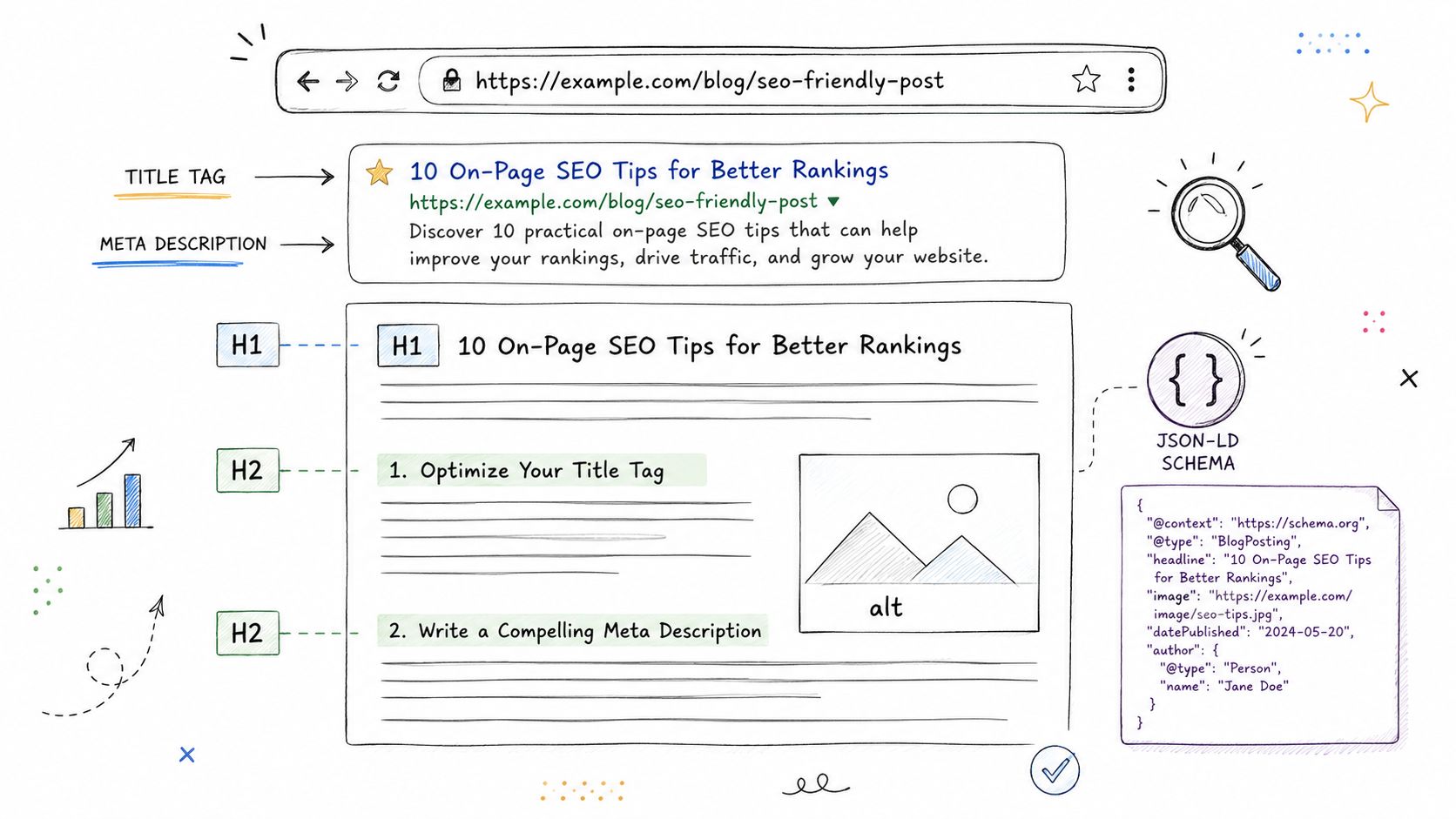
Build a repeatable publishing checklist
Every post should go through the same review before it goes live. That discipline matters more than chasing isolated tricks, because small improvements stack across dozens of articles.
Check these elements every time:
- Title tag: State the topic clearly and match the search intent.
- Meta description: Earn the click with a specific benefit or outcome.
- Headers: Use H2s and H3s that reflect the questions the article answers.
- URL slug: Keep it short, readable, and tied to the main topic.
- Images: Compress files, name them properly, and add alt text that describes the image in context.
- Schema: Add article, FAQ, or product schema when it fits the page.
Images deserve attention because they affect more than appearance. They improve readability, create scan breaks, and can support image search visibility when filenames, dimensions, and alt text are handled well.
Write for rankings and clicks at the same time
A post does not win because it contains a keyword. It wins because the search result earns the click and the page quickly confirms that the reader chose the right result.
Compare these titles:
- “Blog Post About Affiliate Marketing”
- “How to Start Affiliate Marketing for Beginners”
The second title sets expectations fast. It tells the reader who the page is for and what problem it solves. That kind of clarity improves click-through rate and reduces mismatched traffic.
I also recommend checking whether your headers cover the subtopics already ranking on page one. Tools can speed this up, but the primary goal is editorial judgment. This Surfer SEO review shows one practical workflow bloggers use to spot missing terms, heading gaps, and weak on-page coverage.
Treat on-page SEO as part of a larger growth system
On-page work gets stronger when it connects to the rest of your blog strategy. Clean headers make refreshes easier later. Better internal structure gives outreach targets a stronger page to reference. Clear intros and better formatting increase the odds that email subscribers stay on the page and share it.
That is why I do not treat title tags, schema, and image optimization as one-off tasks. They support the entire system.
If you want your articles to attract links after publication, study how on-page quality affects citation potential alongside outreach in NameSnag's guide to link building.
Good on-page SEO makes the page easier to choose in search results, easier to understand once clicked, and easier to build on as the blog grows.
4. Build High-Quality Backlinks Through Strategic Outreach
Backlinks still matter, but the wrong approach wastes time fast.
Mass outreach templates, cheap link packages, and random directory submissions usually create noise, not authority. If you want links that help rankings and send qualified traffic, you need pages worth citing and a reason for another publisher to care.
Create linkable assets first
The easiest outreach campaign is the one built on a useful page. That could be original analysis, a calculator, a detailed comparison, a template, or a resource page that saves people time. Bloggers often struggle with outreach because they're pitching a standard article with nothing distinctive.
Good examples include:
- Tools: A calculator for a niche workflow
- Resource pages: Curated lists that solve a recurring problem
- Comparison content: Side-by-side breakdowns people cite in reviews
- Original synthesis: A page that gathers hard-to-find information into one useful reference
If your site only contains generic advice, link building becomes much harder. The content has to earn the ask.
Outreach works better when it's narrow
Build a short prospect list of relevant sites, newsletters, and resource pages in your niche. Read what they publish. Then pitch the page that helps their audience.
The best outreach emails are short and specific. They reference the exact page, explain why your asset adds value, and don't sound like they were blasted to two hundred strangers before breakfast.
A practical framework:
- Lead with relevance: Mention the article or page you read.
- Name the fit: Explain where your resource supports or updates that topic.
- Keep the ask simple: Don't write a novel.
- Follow up politely: Many good opportunities are won on the second note, not the first.
If you want more outreach angles, NameSnag's guide to link building offers a useful set of tactics.
What doesn't work well
Low-quality guest posting on irrelevant sites rarely pays off. Neither does obsessing over volume while ignoring fit. I'd rather see a blogger earn a handful of clean, relevant editorial links to their best asset than spend weeks collecting weak ones that never move the needle.
The pages that attract links most consistently are usually the ones with the clearest utility. Build those first. Outreach gets easier after that.
5. Optimize for Core Web Vitals and Technical SEO
Why publish strong content if your site makes it hard to load, read, or crawl?
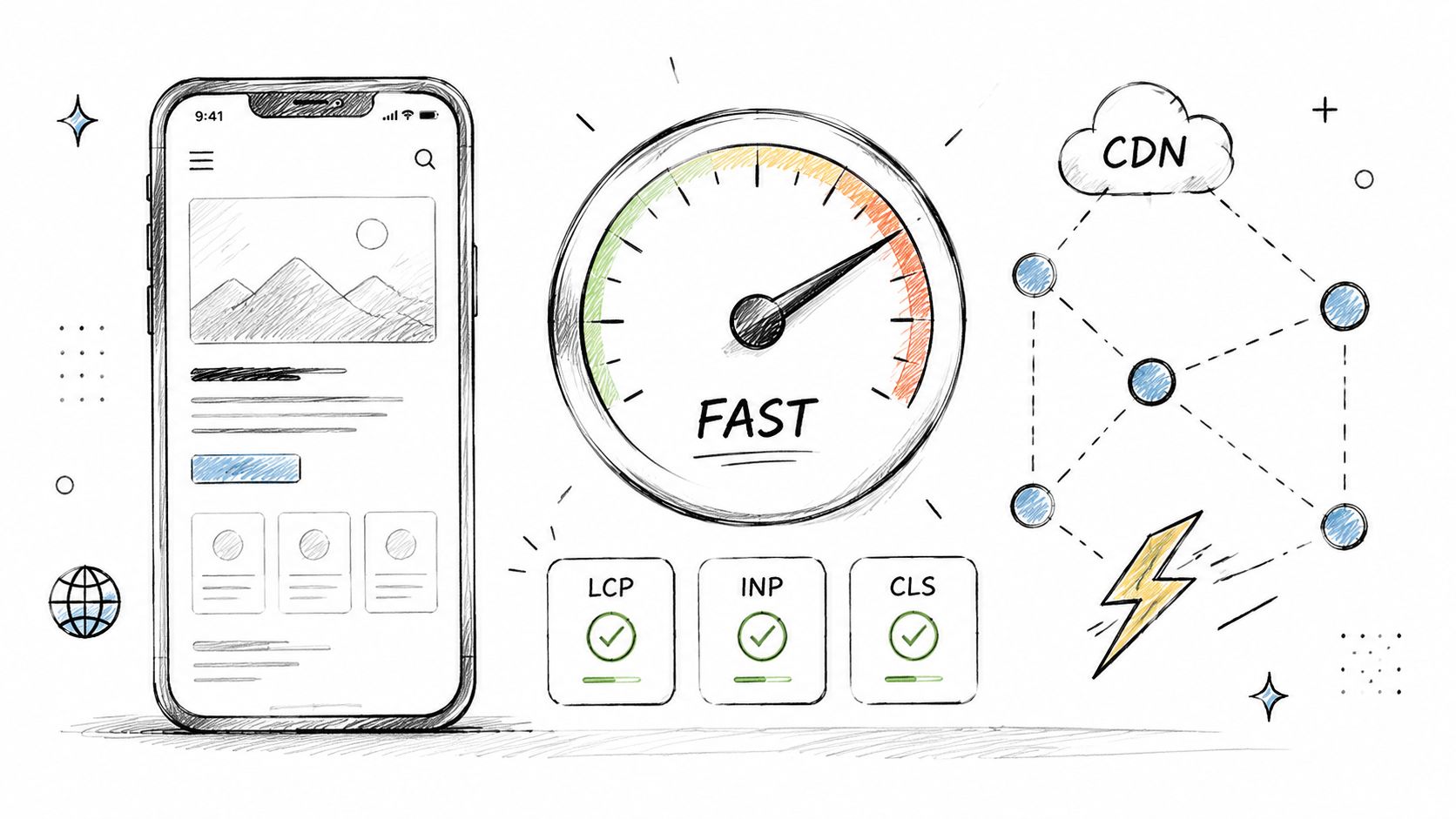
Technical SEO is not a side task. It is the delivery system for everything else in your SEO plan. Strong keyword targeting, useful content, backlinks, refreshes, and email promotion all lose force when pages are slow, layouts break on mobile, or Google struggles to index the right URLs.
Fix the issues that weaken the whole site
The highest-return technical work usually sits in a short list of recurring problems:
- Choose hosting that can handle traffic spikes: Cheap hosting often creates slow response times before any on-page optimization even starts.
- Compress and resize images before upload: Oversized images slow every post template that uses them.
- Use clean, descriptive URLs: Clear slugs help search engines crawl pages and help readers trust what they clicked.
- Review the mobile version of key templates: Homepage, blog post, category, and comparison pages often break differently on phones.
- Remove plugin and script bloat: Every extra tool has a cost in scripts, CSS, conflicts, and maintenance.
- Submit a sitemap and monitor index coverage: Publishing a page does not guarantee that Google will crawl or keep it indexed.
Google explains in its Core Web Vitals documentation that page experience signals focus on loading performance, interactivity, and visual stability, which matches what bloggers see in practice when slow or jumpy pages underperform in search and conversions (Google Search Central on Core Web Vitals).
Treat technical SEO as a system, not a cleanup project
I see bloggers make the same mistake over and over. They fix one slow post, run one PageSpeed test, then move on as if the job is done. The better approach is to build a repeatable maintenance cycle across the site.
Use PageSpeed Insights and Google Search Console on a schedule. Test after theme updates, plugin installs, ad changes, and design edits. Check category pages, archive pages, and opt-in forms, not just blog posts. A single oversized hero image, bad redirect chain, or accidental noindex tag can drag down far more than one URL.
This work also supports the business side of SEO. Faster pages keep more visitors engaged, give email sign-up forms a better chance to convert, and help refreshed content perform the way it should. That is the bigger point. Technical SEO is not isolated from growth. It supports every channel that depends on your site working properly.
Most blogs do not need a complex stack. They need fewer technical mistakes, better template discipline, and a maintenance habit that catches problems before they spread.
6. Develop a Content Calendar with Strategic Keyword Distribution
How often does a blog stall because the problem is not writing quality, but publishing without a plan?
A content calendar gives SEO structure. It prevents three expensive mistakes at once: chasing the same keyword from multiple angles, missing demand that spikes on a schedule, and publishing posts that never support each other. For bloggers who want search to drive a real business, that planning layer matters as much as the writing itself.
The calendar should connect SEO, monetization, and distribution.
Before a draft starts, assign each topic a clear job on the site. Some posts bring in new readers. Some support a pillar page. Some attract commercial-intent searches. Some exist because they give you something useful to send to your email list later. That is the system. One article should strengthen the next, not compete with it.
I use simple planning tools because simple systems get maintained. A spreadsheet, Airtable base, or Asana board works if it tracks the fields that affect performance:
- Primary keyword or topic
- Search intent
- Content type
- Related cluster or pillar
- Internal links to add
- Promotion channel
- Refresh date
That last point gets missed a lot.
If the calendar only tracks publish dates, it turns into an editorial checklist. If it tracks keyword targets, supporting relationships, promotion plans, and update timing, it becomes an SEO operating system. That is a better fit for a business-minded blog.
Google's SEO starter guidance recommends creating helpful, reliable, people-first content and organizing a site so users and search engines can understand how pages relate to each other (Google Search Central SEO Starter Guide). A calendar helps enforce that structure over time, especially once a blog passes the stage where you can manage topics from memory.
Publishing rhythm matters, but pattern matters more. A smart schedule might pair one pillar or revenue-focused post with two or three supporting articles across the next few weeks. That approach gives internal linking a purpose, builds topical depth without stuffing the site with near-duplicates, and makes promotion easier because each new piece has context.
I have seen bloggers publish five loosely related posts in a month, then wonder why none of them broke through. The issue was not effort. The issue was distribution of effort. Search growth usually comes faster when topics are spaced and grouped intentionally.
Leave room for maintenance, too.
A full calendar packed only with new ideas usually looks productive and performs poorly. Strong blogs reserve publishing capacity for updating posts that are already ranking, tightening internal links across clusters, and improving articles that can support email growth or affiliate revenue with modest revisions. That is where SEO starts acting like a business system instead of a content treadmill.
7. Implement Ongoing Content Updates and Refresh Strategy
What happens after a post is published and the rankings stall six months later?
On a healthy blog, publishing is only half the job. Search performance improves when posts are treated like working assets, not one-time projects. Older articles often carry the signals a new post has not earned yet: impressions, links, internal link equity, and some level of topic relevance. If those pages drift out of date, the whole system gets weaker.
A refresh strategy fixes that.
Refreshes usually produce faster returns than net-new posts
A page that already ranks in positions 5 through 20 is often a better growth opportunity than a brand-new article targeting the same topic. You are improving an asset that already has search history instead of waiting for Google to trust a fresh URL.
I usually prioritize updates when a post shows one of these patterns:
- Near-miss rankings: The page gets impressions and some clicks, but it is stuck below stronger competitors.
- A changed SERP: Search results now favor comparisons, step-by-step advice, updated examples, or clearer commercial intent.
- Outdated proof: Tools, screenshots, workflows, pricing, or recommendations no longer match reality.
- Thin coverage: The article answers the core question but skips subtopics readers now expect.
As noted earlier, average post length has increased over time. The useful takeaway is not to make every post longer. It is to make important posts more complete, more current, and more aligned with what readers want now.
Update the parts that change performance
Changing the publish date alone rarely does much. Useful refreshes improve the page in ways that affect clicks, engagement, and topical coverage.
Focus on edits like these:
- Rewrite the opening: Match the search intent in the first few lines and make the value clear fast.
- Restructure headers: Use subheads that reflect the questions showing up in the current SERP.
- Add missing sections: Include examples, comparisons, objections, FAQs, or tools if competing pages cover them better.
- Strengthen internal links: Point the post to related cluster content and add links from newer posts back into it.
- Replace stale visuals: Old screenshots and outdated interfaces lower trust.
- Trim weak copy: Remove filler, repeated points, and vague claims.
One practical rule helps here. Refresh the posts that already have traction before spending another month chasing untouched keywords.
Build refreshes into the operating system
This works best on a schedule, not as a cleanup project you remember once a year. Review top posts every quarter. Check rankings, click-through rate, conversions, and whether the article still supports the business goal behind the keyword. Some posts should be expanded. Some should be merged. Some should be redirected so authority is not split across similar URLs.
That business filter matters. A traffic post that no longer supports offers, affiliate revenue, or subscriber growth should not get the same attention as a post that can still drive results. If you plan to redistribute refreshed content through email, line up the workflow ahead of time with your email marketing software stack.
Treat a refreshed post like a relaunch
Once the update is meaningful, promote it again. Add it to relevant internal links. Include it in your newsletter. Reference it in newer articles. If the page has external links or outreach potential, use that angle too.
That is how content updates stop being a maintenance chore and start acting like part of the SEO system. Rankings improve from better content, stronger internal support, and repeat distribution working together.
8. Build an Email List and Leverage It for SEO Amplification
SEO and email are often treated as separate channels. For bloggers, that's a mistake.
Search brings discovery. Email creates repeat attention. When you combine them, your best content gets immediate readers, faster feedback, more natural shares, and a stronger chance to pick up the signals that keep a page alive after publishing.
Use email to support your SEO system
A new article that gets read, clicked, and shared by an existing audience has a better launch than a page that just sits and waits for Google. Email doesn't replace SEO. It amplifies it.
This matters even more because content operations are getting faster and more competitive. Typeface reports that 94% of marketers plan to use AI for content creation, including blog content, and that 61% increased SEO and content budgets in 2026, which makes workflow efficiency and owned distribution more important, not less (Typeface content marketing statistics).
That's why I'd build an email list early, even on a small site. It gives you a distribution channel you control.
Turn readers into subscribers with clear offers
The best opt-ins usually solve a specific problem connected to your niche. Generic “join my newsletter” boxes rarely do much.
Better examples include:
- Templates: Outreach emails, content briefs, blog refresh worksheets
- Tools: Checklists, calculators, planning sheets
- Mini-guides: A concise framework tied to a high-value topic
- Curated recommendations: Software stacks or niche resource bundles
If you're comparing platforms or building your list stack, this guide to email marketing software options can help you sort through the common choices.
Email gives your content a first audience. That first audience often determines whether a post gets momentum or gets ignored.
Keep the relationship useful
Don't use your list only when you want traffic. Send helpful curation, practical notes, and links that fit what the subscriber expected when they signed up.
EntreResource's Weekly 5 newsletter is one example of how a content-first email product can support a broader publishing system. Used well, email doesn't sit beside your SEO strategy. It strengthens the whole engine by helping your best pages get seen quickly and repeatedly.
8-Point Blogger SEO Strategy Comparison
| Strategy | Implementation complexity 🔄 | Resource requirements ⚡ | Expected outcomes 📊⭐ | Ideal use cases 💡 | Key advantages ⭐ |
|---|---|---|---|---|---|
| Master Keyword Research & Intent Alignment | Moderate, ongoing analysis and testing | Moderate, SEO tools (paid) + analyst time | 📊 Targets high-intent traffic and improves conversions (⭐⭐⭐⭐) | New content planning, conversion-focused pages, long-tail targeting | ✅ Better relevance, less wasted effort, clear content direction |
| Create Comprehensive, Pillar-Based Content Structure | High, requires planning, long-form writing, architecture | High, many long-form pieces and editorial coordination | 📊 Builds topical authority and broad keyword coverage (⭐⭐⭐⭐) | Sites aiming for thought leadership, resource hubs, niche authority | ✅ Strong internal linking, sustained rankings across clusters |
| Optimize On-Page SEO Elements Systematically | Low–Moderate, repeatable checklist-based work | Low, editor tools/plugins; occasional dev help for schema | 📊 Improves CTR, readability, and snippet eligibility (⭐⭐⭐) | Every published page, especially conversion and evergreen posts | ✅ Quick wins, better UX, easier indexing |
| Build High-Quality Backlinks Through Strategic Outreach | High, time-intensive outreach and relationship building | High, outreach effort, content creation, possible PR costs | 📊 Significant ranking and referral impact when successful (⭐⭐⭐⭐⭐) | Competitive niches, authority scaling, promoting unique resources/tools | ✅ Major authority boost and long-term ROI |
| Optimize for Core Web Vitals & Technical SEO | High, technical audits and developer fixes | Medium–High, hosting, dev time, monitoring tools | 📊 Faster pages, improved UX, compliance with ranking signals (⭐⭐⭐⭐) | Mobile-first sites, high-traffic properties, conversion-critical pages | ✅ Better conversions, lower bounce, reliable crawl/indexing |
| Develop a Content Calendar with Strategic Keyword Distribution | Moderate, initial setup plus ongoing maintenance | Moderate, planning tools and editorial time | 📊 Ensures consistent publishing and avoids cannibalization (⭐⭐⭐) | Multi-author teams, steady publishing cadence, seasonal planning | ✅ Predictability, gap identification, efficient batching |
| Implement Ongoing Content Updates & Refresh Strategy | Low–Moderate, analytics-driven refresh cycles | Low, update time per article (less than new content) | 📊 Cost-effective traffic and ranking boosts for existing pages (⭐⭐⭐⭐) | Mature sites with aging content or limited resources | ✅ Fast ROI, leverages existing authority, easier promotion |
| Build an Email List & Leverage it for SEO Amplification | Moderate, setup, segmentation, and sequencing | Moderate, email platform + lead magnets and content promotion | 📊 Drives immediate traffic spikes and engagement (indirect SEO) (⭐⭐⭐) | Sites wanting owned audience, repeat visits, product/news launches | ✅ Owned traffic source, repeat engagement, aids indexing/shareability |
Your Blogger SEO Playbook From Plan to Profit
What turns a blog into a real traffic asset instead of a pile of posts that never compound?
It is rarely one tactic. Blogs grow when keyword targeting, site structure, technical health, refresh cycles, and distribution support each other. Treat SEO as a set of isolated chores and results stay inconsistent. Run it as a system and each piece makes the next one stronger.
That system matters because every weakness shows up somewhere else. Strong keyword research can still fail if the page does not match search intent. Good pillar pages lose value if supporting articles are thin or disconnected. New posts fade fast if older winners are left outdated. And if every visit depends on Google alone, growth becomes fragile.
A practical plan is easier than a full rebuild. Start with one move that can produce evidence fast, then expand from there. For many bloggers, the best first step is one of these:
- Tighten keyword and intent alignment on your next three posts.
- Update your top five articles that already rank or attract links.
- Publish one pillar page and three supporting posts around a topic tied to revenue.
That work compounds because it improves both discoverability and business performance. Consistent publishing creates more entry points into search. Regular updates protect rankings you already earned. Email promotion sends early traffic and engagement to new and refreshed content, which helps you get more value from every article you publish. SEO is not just about attracting clicks. It is about building a content engine that keeps producing traffic, subscribers, and revenue from the same library of assets.
Search has also changed. Your content now needs to be clear enough for search engines, useful enough for readers, and structured enough to surface in AI-assisted results. If you want a forward-looking view of that shift, this 2026 playbook for AI search adds useful context to a standard SEO process.
The blogs that win usually follow a disciplined operating model. They publish around defined topic clusters. They refresh aging posts before rankings slip. They use email to drive repeat traffic instead of waiting for a social spike. They build pages worth citing, then promote them hard enough to earn links. I have seen this work best when content decisions are tied to business goals, not vanity publishing.
That is the actual playbook from plan to profit. Build the right topics. Improve the pages that already have momentum. Use distribution channels you control. Keep tightening the system.
Do that long enough and your blog starts acting like a business asset, not a publishing habit. EntreResource reflects that approach across blogging, SEO, affiliate marketing, and email content built for operators who care about results.