
You know the feeling. One SKU takes off, sales look great for a week, then you run out of stock. Or inventory finally lands at Amazon and the storage bill is worse than the freight bill. Or your supplier gives you a clean unit cost, then your margins get chewed up by rush shipping, carton splits, and returns because the wrong variant got packed.
That’s what supply chain optimization looks like in real life for an online business. It isn’t some corporate initiative built for giant retailers with planning teams and custom software. It’s the daily work of deciding what to buy, when to buy it, where to store it, who should fulfill it, and how much risk you can afford to carry.
For small and mid-sized sellers, supply chain optimization is one of the fastest ways to protect cash and reduce chaos. The businesses that treat it seriously usually don’t look “fancier” from the outside. They just make fewer bad bets.
Why Supply Chain Optimization Is Not Just for Big Corporations
If you sell on Amazon, Shopify, Walmart Marketplace, or a mix of channels, your supply chain already decides whether you grow cleanly or stay stuck reacting. It decides if your best seller stays available. It decides whether ad spend converts profitably. It decides whether you can launch new products without choking your cash flow.
That’s why I don’t treat supply chain optimization as a big-company term. I treat it as operating discipline.
A useful benchmark makes that clear. Businesses with optimal supply chains have 15% lower supply chain costs than peers, and the U.S. Bureau of Labor Statistics projects 18% growth in supply chain manager roles from 2022 to 2032, according to Massachusetts Technology University’s supply chain statistics summary. For an online seller, that doesn’t mean buying enterprise software first. It means getting better at forecasting, purchasing, replenishment timing, and logistics choices before waste becomes normal.
What optimization actually means for an online seller
For a lean e-commerce brand, optimization usually comes down to a handful of decisions:
- Inventory timing: Order too early and you tie up cash. Order too late and you lose sales.
- Supplier selection: Chase the cheapest quote and you often buy inconsistency.
- Fulfillment design: Use the wrong model and fees pile up in places you didn’t expect.
- Data visibility: If your inventory numbers live in three different systems, you’ll make slow decisions and expensive ones.
None of this requires a fleet, a port contract, or a planning department. It requires a scoreboard and a repeatable process.
Practical rule: If stockouts, excess inventory, or shipping surprises keep repeating, you don’t have a random problem. You have a supply chain design problem.
Why small brands feel the pain faster
A large company can absorb a bad purchase order or a poor freight decision for longer than you can. Small brands can’t. One delayed production run can stall a launch. One overbuy can freeze the cash you needed for the next PO. One fulfillment mismatch can turn a healthy SKU into a marginal one.
That’s why I like practical resources on optimizing your merch logistics when I’m pressure-testing a fulfillment setup or thinking through handling costs. For smaller operators, the win usually comes from reducing friction in the current system, not rebuilding everything.
The biggest mistake is assuming optimization starts later, when the business is bigger. It starts the moment your operations become too complex to manage by instinct alone.
Setting Your Goals and Defining Key Performance Indicators
If you can’t see the bottleneck, you’ll probably spend money fixing the wrong thing.
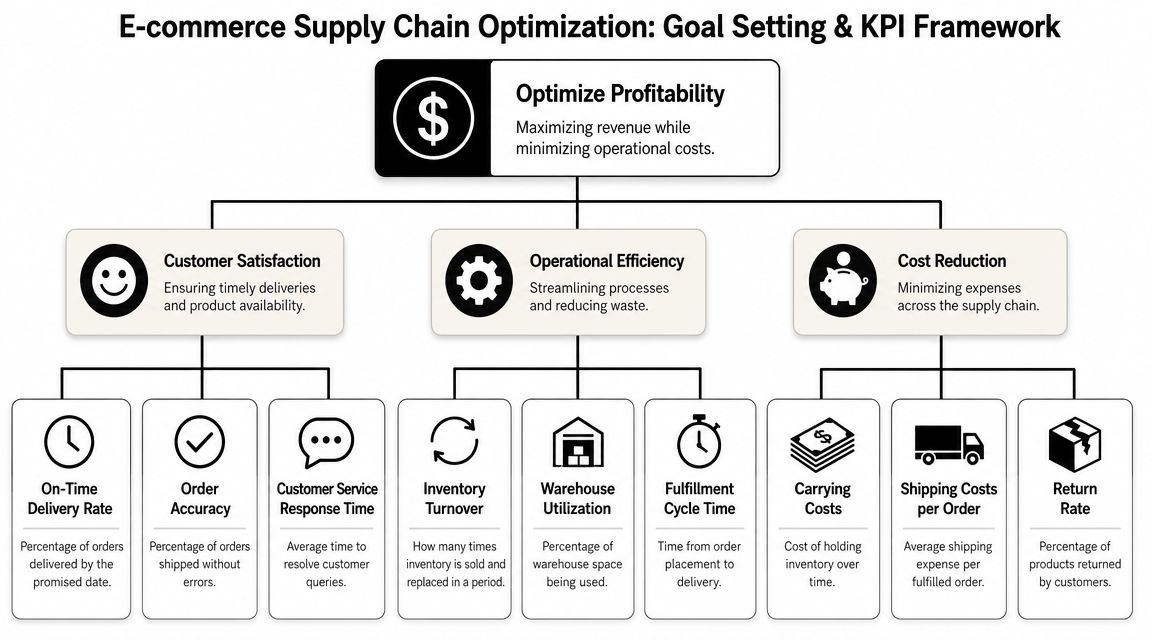
Most e-commerce operators say they want to “improve margins” or “run leaner.” That’s too vague to manage. You need a small KPI set that tells you whether your inventory, fulfillment, and purchasing decisions are improving the business.
A solid benchmark-oriented approach tracks fill rate, inventory turnover, supply-chain cycle time, cash-to-cash time, perfect order rate, and GMROI, according to Teradata’s supply chain optimization guidance. Those metrics sound enterprise-heavy, but they’re useful for small brands too if you define them appropriately.
Start with one financial metric and two operational metrics
If your dashboard is crowded, nobody uses it. I’d start with three metrics:
| KPI | What it tells you | Why it matters |
|---|---|---|
| Cash-to-cash time | How long cash stays tied up from paying suppliers to getting paid by customers | Shows whether growth is helping or straining the business |
| Fill rate | How often you can fulfill demand without missing the sale | Exposes stockout risk and planning gaps |
| Inventory turnover | How quickly inventory sells and gets replenished | Reveals whether you’re overbuying or moving cleanly |
These three work together. A decent fill rate with terrible cash-to-cash time often means you’re carrying too much inventory. Strong turnover with weak fill rate can mean you’re cutting stock too close and sacrificing service.
The KPI definitions that matter in practice
Here’s how I’d translate the common metrics for an Amazon or Shopify operator:
- Fill rate: Can you satisfy customer demand from available stock? If this slips, your forecast or reorder timing is off.
- Inventory turnover: How often your inventory sells through and refreshes. Slow turns often hide weak SKUs, over-ordering, or poor assortment discipline.
- Supply-chain cycle time: How long it takes for product to move from sourcing through delivery readiness. Long cycle times create fragility.
- Cash-to-cash time: The bridge between operations and finance. This tells you how long your money is trapped inside inventory and fulfillment.
- Perfect order rate: Did the customer get the right item, on time, with no fulfillment error? This catches operational sloppiness quickly.
- GMROI: Gross margin return on inventory investment. It forces you to ask whether a product deserves the cash it consumes.
Most operators don’t need more metrics. They need fewer metrics tied to real decisions.
Build a scoreboard you’ll actually maintain
A spreadsheet is enough at first. Pull data weekly from Amazon Seller Central, Shopify, your 3PL portal, and your purchasing sheet. Then review the same questions every week:
- Which SKUs are at risk of stocking out?
- Which SKUs are tying up too much cash?
- Which orders or channels are producing avoidable fulfillment errors?
- Where are lead times drifting?
If you want a useful companion framework for operational measurement, Peak Transport has a good piece on improving middle-mile logistics efficiency that fits well when your problems start showing up between inbound freight and final fulfillment.
The main point is simple. KPIs are not reporting theater. They’re the scoreboard for your next purchase order, replenishment decision, and fulfillment change.
Smart Forecasting and Inventory Strategies
Inventory is where most online sellers either gain an advantage or create slow financial damage.
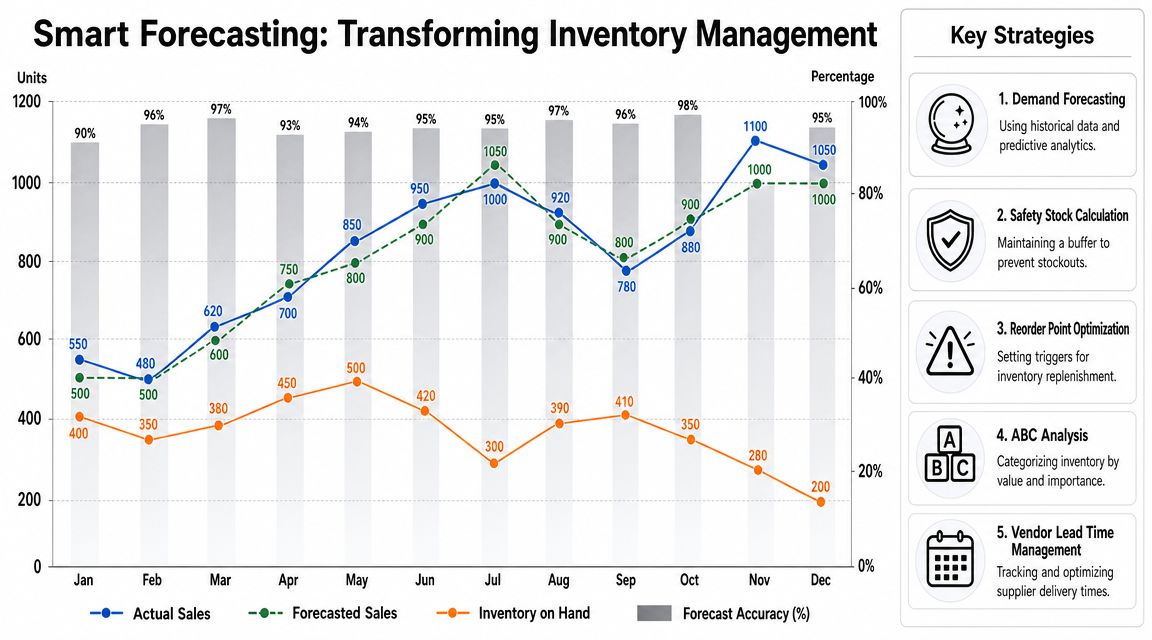
A lot of brands still buy on gut feel. They look at recent sales, add a buffer, and place the order. That works until lead times move, a promotion hits harder than expected, or one channel starts pulling inventory faster than the others. Then the same simple system starts producing stockouts and expensive rush decisions.
Modern supply chain optimization treats inventory as a trade-off problem. It balances cost, resilience, and service, not just unit economics. Molex frames optimization as a network-design choice that balances cost with resilience and service, which is the right way to think about inventory too. The question isn’t just “How little can I hold?” It’s “How much risk can my business handle?” You can read that framing in Molex’s discussion of supply chain network optimization.
Forecast the next order, not the whole universe
Small brands don’t need a giant forecasting stack. They need a disciplined reorder process for their most important SKUs.
Use a simple review rhythm:
- Look at recent sales patterns: Separate baseline demand from promo spikes.
- Track supplier lead time: Use actual delivered timing, not what the supplier promised.
- Review channel mix: Amazon, Shopify, wholesale, and retail each pull inventory differently.
- Flag event-driven demand: Product launches, influencer mentions, holidays, and restocks change demand shape.
If you sell on Amazon, a practical walkthrough on Amazon inventory management can help tie forecasting logic to how marketplace replenishment works.
The core trade-offs you need to manage
A lot of inventory advice is too absolute. “Carry more stock” and “stay lean” are both bad advice without context.
Here’s the trade-off table:
| Decision | Upside | Downside |
|---|---|---|
| Order larger quantities | Fewer stockouts, fewer reorder events | More cash tied up, higher storage exposure |
| Order more frequently | Leaner inventory, less dead stock risk | More administrative work, more freight variability |
| Hold extra safety stock | Better service during delays or demand spikes | More capital trapped in inventory |
| Run inventory tight | Better short-term cash efficiency | Higher stockout risk and more rush shipping |
A practical inventory playbook
For most online brands, I’d use these rules:
- Classify your SKUs: Your top sellers deserve tighter monitoring than low-volume long-tail products.
- Set reorder points by lead time reality: If a supplier says one thing but consistently delivers later, plan from the actual pattern.
- Use safety stock selectively: Protect core SKUs and proven winners first.
- Review forecast accuracy every cycle: Bad forecasts aren’t a reason to give up. They’re feedback on where your assumptions failed.
- Don’t solve every stockout with bigger buys: Sometimes the root problem is supplier reliability or slow inbound routing.
When a seller says inventory is “just hard,” I usually find one of two issues underneath it: they don’t trust their lead times, or they don’t separate important SKUs from mediocre ones.
The brands that get this right don’t eliminate uncertainty. They decide in advance which uncertainty they’re willing to pay for.
Sourcing and Managing Your Suppliers for Resilience
The cheapest supplier on paper can become the most expensive partner in your business.
A lot of sellers learn this after a delayed production run, a quality slip, or a packaging error that wrecks a launch window. By then, the problem isn’t just unit cost. It’s missed revenue, support tickets, poor reviews, emergency freight, and a planning mess that spills into the next cycle.
That’s why supplier management has to go beyond quote comparison.
According to SAP’s supply chain optimization guidance, effective optimization now includes risk assessment, contingency planning, and sustainability considerations in supplier choices. That matters for e-commerce brands because supplier failure rarely announces itself neatly. It shows up as delayed inventory, inconsistent quality, compliance headaches, or sudden cost pressure you can’t easily pass along.
How to vet a supplier beyond price
Before I’d trust a supplier with a meaningful SKU, I’d want answers to a few operational questions:
- Capacity reliability: Can they support your reorder pattern, or only your first trial order?
- Quality controls: What do they check before shipment, and how do they handle defects?
- Communication speed: Do they answer clearly and consistently when timelines change?
- Packaging accuracy: Can they meet marketplace and fulfillment requirements without improvising? Are they using durable, standard-compliant brown box packaging that protects your goods through international freight and automated sorting hubs?
- Backup options: If raw materials or labor get tight, what happens to your order?
A polished quote sheet won’t tell you much about those points. Your conversations, sample rounds, and production updates will.
Score suppliers like operators, not shoppers
Most small brands should keep a lightweight supplier scorecard. Nothing fancy. A shared sheet works.
Track suppliers across categories like these:
| Category | What to watch |
|---|---|
| Lead time reliability | Do actual delivery patterns match commitments? |
| Product quality | Are defects, packaging issues, or inconsistencies recurring? |
| Communication | Do they respond early when problems appear? |
| Flexibility | Can they handle changes in mix, packaging, or order cadence? |
| Risk exposure | Are you too dependent on one factory, region, or material source? |
This changes how you negotiate. Instead of arguing only over price, you can push for better payment terms, clearer production milestones, stronger packaging controls, or better visibility during manufacturing.
A resilient supplier relationship doesn’t mean being nice to vendors. It means making expectations explicit before the pressure hits.
Don’t confuse loyalty with concentration risk
Good supplier relationships matter. Overdependence doesn’t.
If one supplier handles a critical SKU, build a backup path before you need it. That might mean qualifying a secondary source, pre-approving substitute materials, or documenting exact packaging and labeling specs so you can transition faster if needed.
Sustainability matters here too, not as branding language but as operational discipline. If regulations shift or customer expectations tighten, suppliers with weak processes can create avoidable risk. For a growing brand, resilience often comes from selecting partners who can operate consistently under pressure, not just cheaply when things are calm.
Choosing Your Logistics and Fulfillment Model
Fulfillment is where a lot of margin erodes.
The product may be profitable in a spreadsheet, but once storage, prep, pick and pack, returns handling, inbound placement, and customer service friction enter the picture, the economics can change fast. This is why logistics decisions deserve the same scrutiny as product sourcing.
That pressure is getting harder to ignore. U.S. business logistics costs reached $2.58 trillion, equal to 8.8% of U.S. GDP, and 73% of supply chain leaders expected to hit their tariff absorption wall by the end of 2026, according to Tradeverifyd’s supply chain statistics roundup. For a smaller seller, you don’t need macroeconomics to feel this. You feel it when fulfillment costs start outrunning your assumptions.
Amazon FBA, 3PL, and self-fulfillment are different bets
Here’s the short version:
| Model | Best when | Watch out for |
|---|---|---|
| Amazon FBA | You want Prime access and marketplace scale | Storage exposure, fee complexity, lower brand control |
| 3PL | You sell across channels and need flexibility | Service quality varies, integrations matter |
| Self-fulfillment | You need direct control or have special handling needs | Harder to scale, more labor and operational overhead |
If you’re early and deciding between marketplace-first models, this comparison of Amazon FBA vs dropshipping can help frame where FBA fits in a broader e-commerce strategy.
When FBA wins
FBA is strong when speed and marketplace conversion matter most. It removes a lot of operational burden and gives small brands infrastructure they couldn’t build alone.
It’s weaker when your catalog turns slowly, packaging needs custom handling, or storage costs punish the wrong inventory mix. Sellers often blame FBA itself when the deeper problem is poor inventory planning.
When a 3PL wins
A 3PL often makes sense once you sell beyond Amazon or need more control over packaging, kitting, channel routing, or returns. A good 3PL can make your business look more advanced than it is.
But the partner matters more than the label. One 3PL can be an extension of your team. Another can create lag, errors, and visibility problems that make forecasting harder.
When self-fulfillment still makes sense
Self-fulfillment isn’t automatically amateur. For some brands, it’s the best option early on. If you have low order volume, customized products, or need hands-on quality control, doing it yourself can be rational.
The trap is staying there too long because it feels cheaper. Once your team spends too much time packing boxes, answering fulfillment issues, or managing carrier friction, the opportunity cost starts climbing.
Your fulfillment model should match your current constraint. If the constraint is control, self-fulfillment may fit. If the constraint is scale, it usually won’t.
The right answer isn’t permanent. Good supply chain optimization treats fulfillment as a model you revisit when your SKU mix, order volume, channel mix, and brand priorities change.
Leveraging Tools and Automation for a Lean Operation
Most supply chain mistakes don’t come from a lack of effort. They come from fragmented information.
One inventory count lives in Seller Central. Another is in Shopify. Open POs sit in email. Freight updates are in a forwarder portal. Returns data is somewhere else. Then the founder tries to make a replenishment decision from half the picture.
That’s why even small brands need a usable operating stack. Not an expensive one. A usable one.
The tool categories that actually help
I’d think in layers, not in one giant software purchase.
- Inventory and order management tools: Systems like Cin7, Sellbrite, Linnworks, or Extensiv can help sync stock across channels and reduce overselling.
- Procurement and PO tracking: Even a clean Airtable, Notion database, or Google Sheet with status fields is better than scattered email threads.
- Freight and shipping visibility: Freight marketplaces, forwarder dashboards, and carrier reporting tools help compare routes and spot delays earlier.
- Automation connectors: Zapier or Make can push order, inventory, and accounting updates across systems without manual re-entry.
- Reporting layer: A simple Looker Studio dashboard or spreadsheet summary can keep weekly reviews grounded in the same numbers.
What to automate first
Don’t start with complicated workflows. Start where repetitive admin creates delay or mistakes.
Good first automations include:
- Low-stock alerts that trigger before a reorder crisis.
- PO status updates shared automatically with the team.
- Channel sync rules to reduce overselling risk.
- Order tagging for special handling, bundles, or urgent routing.
- Accounting handoff so operations and finance are looking at the same order flow.
A lot of small operators hit a point where spreadsheets stop being enough, but they’re not ready for a heavyweight ERP. That’s where understanding how custom ERP solutions help small business owners be more efficient becomes useful. The lesson isn’t that everyone needs custom software. It’s that your systems should match your process complexity, not lag far behind it.
What doesn’t work
A few patterns usually waste time:
- Buying enterprise software too early: The tool won’t fix weak process discipline.
- Automating broken workflows: You just create faster confusion.
- Letting each channel run its own inventory truth: That almost always creates bad purchasing decisions.
- Ignoring supplier and freight data: Forecasts get weaker when inbound visibility is poor.
The best lean operations don’t necessarily use more software. They use fewer systems with cleaner handoffs. Everyone knows where the truth lives, and routine work doesn’t depend on memory.
Your Implementation Checklist with a Mini Case Study
Most supply chain projects fail because the team tries to “transform” too much at once or never gets specific enough to execute. OpsDesign notes that supply chain projects are reported to fail at rates of about 50% to 70%, with common causes including poor planning, weak stakeholder alignment, data integration problems, and inadequate risk management. Their recommended pattern is a staged one: start with a health check, build a KPI structure, then drill into cost elements. That guidance comes from OpsDesign’s discussion of supply chain projects, and it matches what works for smaller brands.
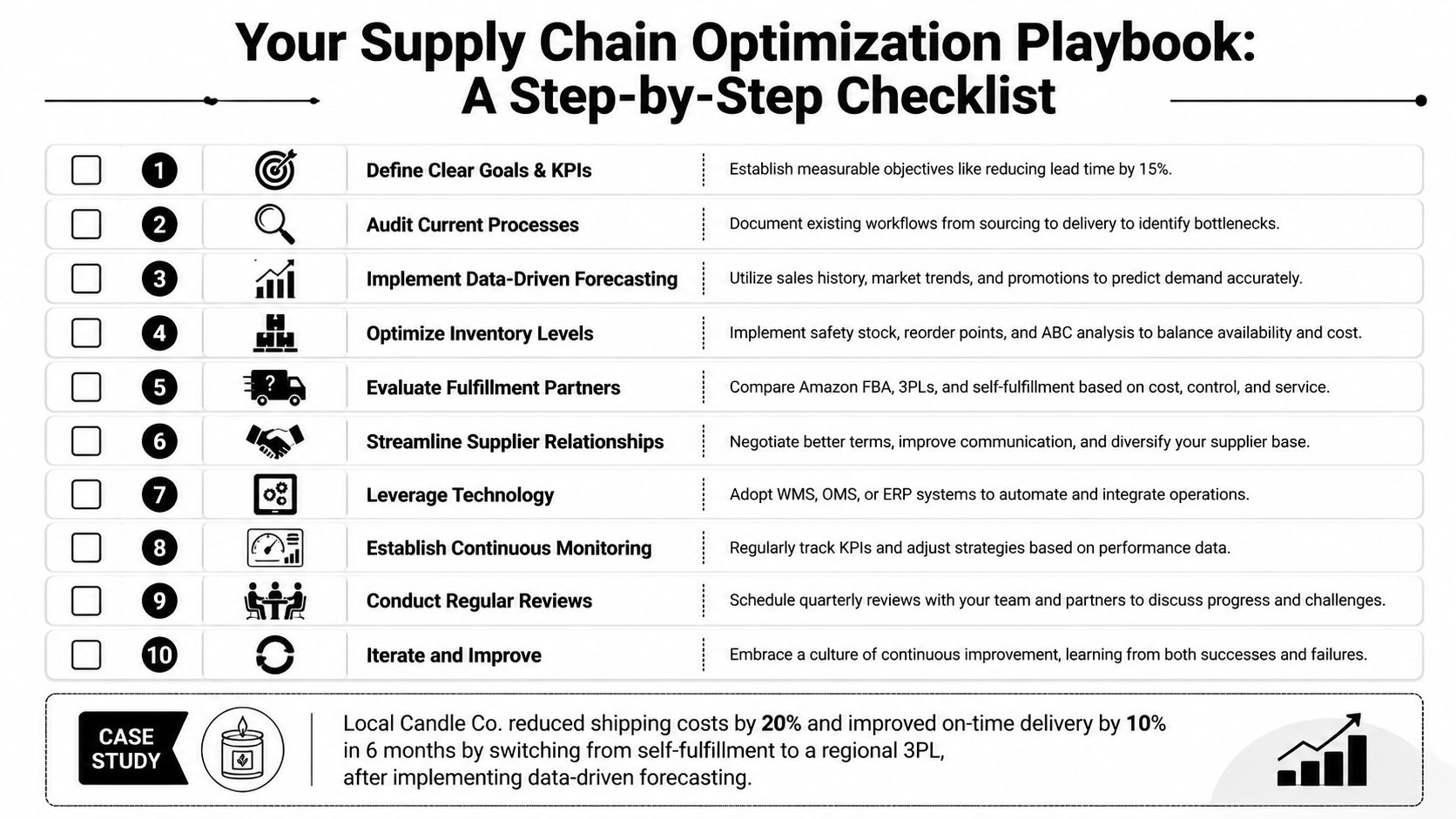
You do not need a transformation program. You need a short list of moves you can complete and review.
The practical checklist
Use this as a live operating checklist, not a one-time exercise.
-
Pick three core KPIs
Choose one financial metric and two operational ones. Keep them visible every week. -
Map your current flow
Write down how a product moves from supplier PO to customer delivery. Include handoffs, approvals, prep, and storage decisions. -
Identify your top five SKUs
Don’t optimize the whole catalog at once. Start with the products that drive most of your sales or cash exposure. -
Review actual lead times
Use delivered reality, not supplier promises. Your reorder timing is only as good as this number. -
Set a reorder rule for each key SKU
It can be simple. The point is to stop ordering from instinct alone. -
Score your main supplier
Rate reliability, communication, quality, and flexibility. If one category is weak, address it now. -
Cost out your fulfillment options
Compare what you’re paying today against at least one credible alternative. -
Create one source of inventory truth
Decide which system or sheet is authoritative. Everything else should feed into it. -
Automate one repetitive task
Low-stock alerts, PO updates, or order tagging are good first candidates. -
Run a monthly review
Check what changed, what slipped, and what decision needs to change next.
The best implementation plans are boring. They assign owners, define review dates, and remove guesswork.
A mini case study without the fantasy math
Take a simple example. Jane sells private label t-shirts through Amazon and Shopify. She doesn’t have a huge catalog. Her problems are familiar: one top-selling size-color variant stocks out regularly, another variant sits too long, and her team can’t tell whether FBA is still the best home for every SKU.
Here’s how Jane applies the checklist:
| Step | What Jane does |
|---|---|
| KPIs | Tracks fill rate, inventory turnover, and cash-to-cash time |
| SKU focus | Picks her five highest-impact variants instead of reviewing everything |
| Lead times | Replaces supplier-estimated lead times with delivered lead times from recent orders |
| Supplier review | Flags that communication is decent but packaging consistency is weak |
| Fulfillment review | Compares FBA against a 3PL option for slower-moving variants |
| Automation | Sets low-stock alerts and centralizes PO status in one sheet |
The key change isn’t that Jane suddenly predicts demand perfectly. It’s that she stops treating every inventory issue as a surprise. She starts seeing patterns.
What a realistic rollout looks like
For a small team, I’d stagger the work:
- Week one: Define KPIs and map the current process.
- Week two: Review top SKUs and true lead times.
- Week three: Score suppliers and compare fulfillment economics.
- Week four: Clean up reporting and automate one workflow.
That’s enough to create traction. Once those basics are in place, your decisions improve because your visibility improves.
A lot of sellers want optimization to feel dramatic. Usually it doesn’t. It feels like fewer emergencies, cleaner reorders, better use of cash, and less time spent untangling preventable mistakes.
That’s the win.
If you’re building an online business and want more practical breakdowns like this, EntreResource publishes playbooks, comparisons, and operator-focused guides for Amazon sellers, private label brands, and digital entrepreneurs.