
Most advice on how to make passive income on Amazon gets the core idea wrong. It treats Amazon like a vending machine. Upload a product, publish a book, drop a few links, then wait.
That's not how this works in practice.
The useful frame is scalable income. You build an asset once, or build it upfront with a lot of effort, then Amazon's marketplace, logistics, and traffic engine help that asset keep earning with lighter maintenance. That can mean a product catalog through FBA, a portfolio of books through KDP, or content that sends buyers into Amazon through Associates.
Amazon itself positions several of these as real monetization paths, including affiliate marketing, influencer storefronts, Merch on Demand, KDP, and selling products through its marketplace in its guide to ways to make money on Amazon. That matters because it confirms this isn't a fringe side hustle. It's part of Amazon's ecosystem.
The catch is simple. None of these models are fully hands-off. Some become efficient. Some become stable. A few become semi-passive. But each one still rewards people who review data, refresh listings, improve conversion, and protect what they've built.
Practical rule: If a method sounds effortless before launch, it usually fails after launch.
The good news is that there are several legitimate ways to make this work, and they fit very different people. If you're strong at operations, FBA can fit. If you're better at writing or productized information, KDP is often cleaner. If you already know how to attract attention online, Associates and Influencer are the lowest-friction entry point.
The Reality of Passive Income on Amazon
“Passive income on Amazon” is a useful marketing phrase, but a poor operating model. Amazon can remove a lot of repetitive work. It does not remove the need to make good decisions.
That distinction matters because sellers get in trouble when they expect autopilot. In practice, Amazon income works best as asset-based income. You build something that can keep selling, then you maintain it often enough to protect rankings, conversion, and margins.
For FBA sellers, Amazon can handle fulfillment and much of the customer-facing logistics. For KDP authors, it handles distribution and royalty payments. For affiliates and influencers, it handles checkout and the retail experience. The workload shifts. It does not disappear.
What passive usually means in practice
Across FBA, KDP, and Amazon affiliate models, the pattern is pretty consistent:
- Front-loaded work: research, setup, production, and launch take real time
- Platform support: Amazon handles fulfillment, distribution, payments, or checkout depending on the model
- Ongoing maintenance: listings drift, ads get less efficient, competitors copy offers, and content ages
I've built income streams on Amazon in more than one category, and the same lesson keeps showing up. The money feels most passive only after the hard parts are already done well. A weak product, thin book, or low-trust content asset does not become passive later. It just becomes easier to ignore while it underperforms.
The real trade-off
Low-maintenance Amazon income usually comes from one of two assets:
- A product asset
- A content asset
Product assets can scale well, but they bring operational risk. Inventory can sit too long, fees can rise, and a listing can lose rank faster than many new sellers expect.
Content assets usually cost less to start, but they are slower to build and easier to underestimate. A book still needs positioning. An affiliate article still needs traffic. An influencer storefront still depends on audience trust and consistent publishing.
Gelato makes a useful point in its discussion of whether passive income is actually passive after launch. The income can continue after the initial build, but the owner still needs to update, optimize, and monitor the asset.
That is the practical frame for this guide. Amazon offers real ways to build income that becomes lighter over time. “Set it and forget it” is still the part that usually breaks.
Choosing Your Amazon Income Stream
The first decision isn't how hard you'll work. It's where your effort compounds best.
Some people are naturally better at merchandising and supplier negotiation. Others should never touch inventory and should stick to books, design files, or audience-building. If you pick the wrong model, even good execution feels heavy.
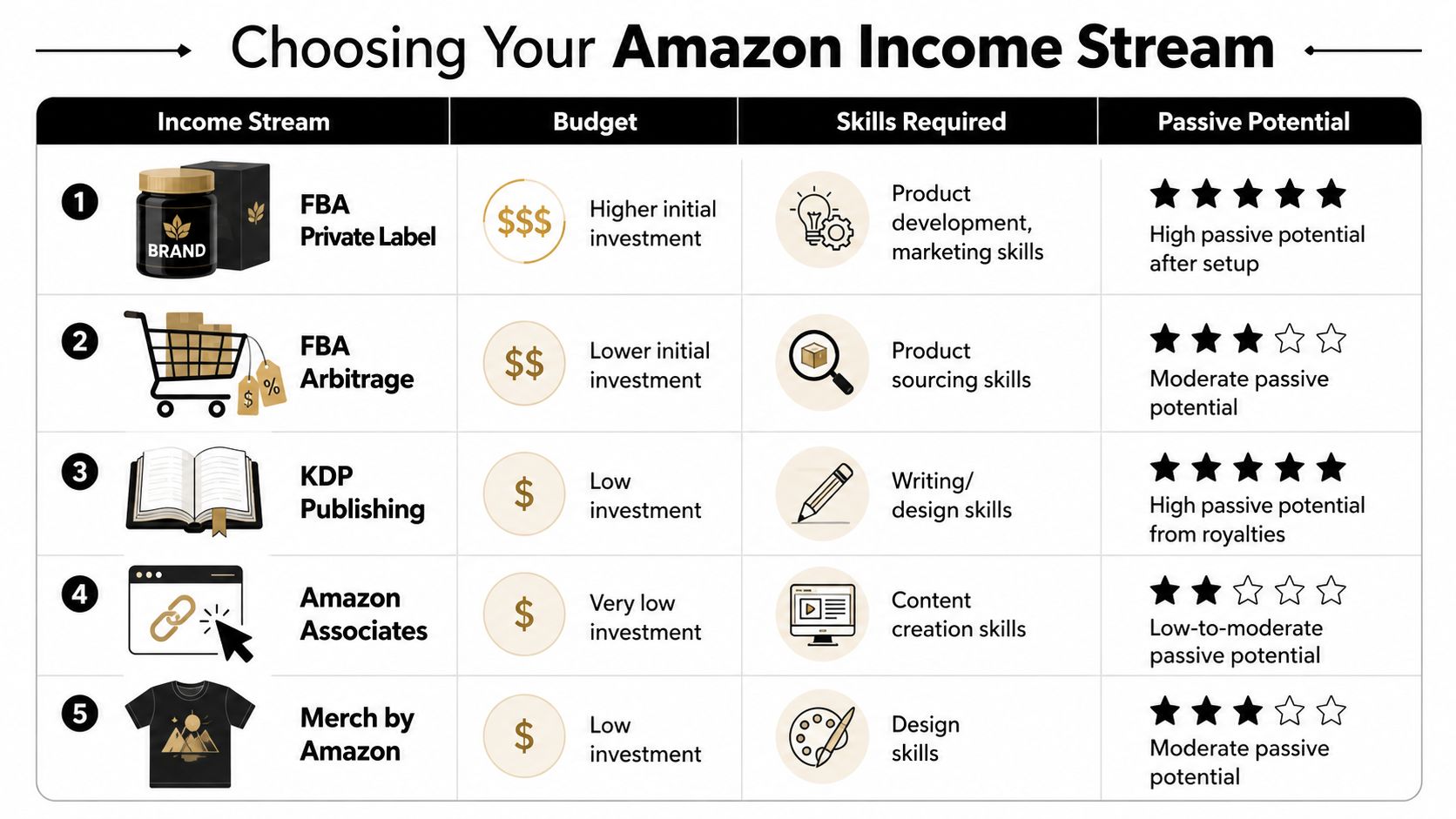
Amazon passive income models at a glance
| Method | Startup Cost | Time to First ~$100 | Passivity Level (1-5) | Best For |
|---|---|---|---|---|
| FBA Private Label | High | Medium to slow | 4 | Sellers who want to build a brand |
| FBA Arbitrage | Low to medium | Faster | 2 | Operators who like sourcing and flipping |
| KDP Publishing | Low | Medium | 4 | Writers, researchers, and niche publishers |
| Amazon Associates | Very low | Slow to medium | 3 | Bloggers, YouTubers, and SEO-focused creators |
| Merch by Amazon | Low | Medium | 3 | Designers and trend-driven creators |
That table is directional, not a guarantee. The same model can feel easy for one person and miserable for another.
Five models, five very different skill sets
FBA private label works best for people who like building assets. You create or improve a product, brand it, launch it, and rely on Amazon's fulfillment network to handle operations once orders start coming in. This can become efficient, but it demands stronger judgment up front.
FBA arbitrage is less about brand-building and more about deal flow. You find underpriced products and resell them. It's a practical model if you want faster market feedback, but it often feels less passive because sourcing never really disappears.
KDP publishing is a strong fit if you can identify demand and package information clearly. Many beginners treat KDP like a single-book game. The better approach is usually portfolio-based. One good title helps. A catalog changes the economics.
The lowest-friction entry points
Two paths need less capital than product selling.
- Amazon Associates: You publish buying guides, review content, gift lists, or comparison content and earn commissions when readers buy.
- Merch by Amazon: You upload designs and let the platform handle the print-on-demand side.
Associates is excellent if you already understand SEO, YouTube, Pinterest, or social distribution. Merch is better if you're design-oriented and can create a large volume of commercially relevant artwork.
The best model is the one that matches your current advantage. Don't force an inventory business if your real edge is content.
How I'd choose today
If someone asked me how to make passive income on Amazon with the least wasted motion, I'd use this filter:
- Choose FBA private label if you can tolerate operational complexity and want a brand you can improve over time.
- Choose arbitrage if you want to learn the marketplace quickly and don't mind active sourcing.
- Choose KDP if you can research niches and produce useful content consistently.
- Choose Associates if you'd rather build traffic than manage products.
- Choose Merch if your creative output is your strongest asset.
One warning. Don't start two hard models at once. Running FBA while learning KDP and trying to build an affiliate site sounds ambitious. Usually it just splits attention.
The Seller Playbook for FBA Private Label and Arbitrage
Amazon FBA looks passive only after the hard parts are already working. Before that, it is a capital allocation and decision-making business. Pick the wrong product, buy too much inventory, or misread your margins, and Amazon will store your mistake for a fee.

Private label and arbitrage solve different problems
I treat private label as a brand-building model and arbitrage as a cash-flow model.
With private label, you control the listing, the offer, the packaging, and usually the supplier relationship. That gives you more upside if the product gains traction. It also means you absorb the cost of bad research, weak creative, stockouts, and slow-moving inventory.
Arbitrage is more straightforward. You buy proven products at a discount and resell them into existing demand. You do not need to invent a brand story. You need to source consistently, avoid restricted products, and protect your margin after fees, prep, and shipping.
The choice usually comes down to the kind of work you want to keep doing six months from now. Private label rewards sellers who like product development, listing optimization, and ranking strategy. Arbitrage rewards sellers who can build a repeatable sourcing process and stay disciplined.
For a more detailed breakdown of setup, sourcing, and launch steps, EntreResource has a practical guide to Amazon FBA private label.
What FBA actually removes, and what it does not
FBA takes logistics off your plate. Amazon stores units, ships orders, handles a big share of customer service, and processes returns. That matters because fulfillment complexity crushes small sellers fast.
The management work stays with you.
In a stable phase, sellers still spend time checking ad spend, watching inventory levels, reviewing fees, improving conversion, and dealing with listing issues. I have never seen a healthy FBA business stay healthy on autopilot for long. The businesses that look passive from the outside usually have tight systems behind them and someone checking the numbers every week.
That distinction matters. FBA can reduce manual labor. It does not remove the need for judgment.
The parts of a private label launch that decide the outcome
Private label usually wins or loses before the first unit arrives at the warehouse. Four decisions do most of the work.
Choose a product with a clear reason to exist
A listing needs a practical angle, not just a supplier catalog item with a new logo. Better materials, better bundle logic, better packaging, clearer sizing, or cleaner positioning all count. If the only advantage is “mine too,” expect a price war.Order with caution
New sellers often overbuy to get a lower unit cost. That sounds rational until demand comes in slower than expected and storage fees start eating the margin. A smaller first order with room to reorder is usually the better trade-off.Build the listing for conversion
Search traffic matters, but conversion decides whether the product holds rank. Main image quality, review profile, price position, and offer clarity usually matter more than squeezing in one more keyword variation.Treat PPC as ongoing operating work
Sponsored Products can help a launch get traction, but ads also expose weak listings fast. If clicks come in and sales do not, the problem is often the offer, not the bid.
A simple rule helps here. Fix the product page before forcing more traffic into it.
Arbitrage works best as a system
Arbitrage gets framed as side-hustle sourcing, but the sellers who keep it profitable run it like operations. They know which stores, categories, and price bands produce workable inventory. They move quickly on replenishable items and stay skeptical of one-off “deals” that look good only because the current Buy Box is temporarily inflated.
If you are evaluating categories, this list of profitable reselling niches is a useful starting point for thinking through resale demand.
My filter for arbitrage is simple:
- Can I sell it? Check category and brand restrictions first.
- Is the margin real? Include Amazon fees, shipping, prep supplies, and sales tax if it applies.
- Is demand steady? A product with a short price spike is not the same as a dependable seller.
- Can I buy it again? Replenishable inventory builds a business. One-off clearance finds create occasional profit.
That last point separates income from noise.
Where sellers usually get hurt
Private label sellers usually get into trouble by trusting supplier suggestions, copying competitors too closely, or assuming reviews and ads will fix a weak offer. Arbitrage sellers usually get into trouble by buying too deep, skipping restriction checks, or using spreadsheet margins that ignore real-world prep and shipping costs.
Amazon rewards clean execution. It punishes sloppy math.
If the goal is passive income, this is the honest version. Private label can become semi-passive after the product, listing, inventory flow, and ad structure are stable. Arbitrage can produce cash flow quickly, but it stays more hands-on because sourcing is the business. Both can work. Neither is easy money.
The Creator Playbook for Kindle Direct Publishing
KDP is one of the cleanest ways to build Amazon income without touching inventory. It's also one of the most misunderstood.
Many people assume you need one breakthrough title. In practice, KDP usually works better as a portfolio business. A single book can earn. A small catalog gives you multiple entry points, more keyword coverage, and better odds that one title subsidizes the testing behind the others.

The portfolio approach is the real play
One creator interview cited by an Amazon-focused publisher said that a portfolio of 5 to 10 high-quality books in the right niches can produce meaningful recurring royalties, with an initial goal of $1,000 per month in 2 to 3 months and a realistic $5,000 to $10,000 per month within the first year if execution is strong, based on the interview at this YouTube source. I like this benchmark because it matches how KDP behaves in practice. Strong titles stack.
That doesn't mean churning junk. It means creating books that answer a clear search intent, then building related titles around the same audience.
If you need a practical primer on setup, formatting, and the publishing flow, this guide on how to publish a book on Amazon is a useful companion resource. For a platform overview, EntreResource also has a walkthrough of what KDP is and how Kindle Direct Publishing works.
Niche selection decides almost everything
The biggest KDP mistake is writing first and validating later. The more durable approach is the opposite.
Look for niches where readers are already searching for help, templates, entertainment, or guided outcomes. Then decide whether the opportunity is better served by:
- High-content books: Guides, explainers, educational books, practical how-to titles.
- Low-content books: Journals, logbooks, trackers, planners, and structured notebooks.
- Repurposed formats: An ebook expanded into paperback and hardcover versions.
That last point matters. The creator guidance in the interview emphasizes publishing an ebook first, then repurposing it into paperback and hardcover editions. One content asset can support multiple royalty streams when the market is there.
Good KDP publishers don't ask, “What book do I want to write?” They ask, “What problem are readers already searching to solve?”
The production workflow that keeps quality high
KDP doesn't require you to do every task yourself. It requires you to control the standards.
A solid workflow looks like this:
- Validate demand before drafting: Use keyword research or product research tools to confirm the topic has search interest.
- Create a strong title and subtitle: Clarity beats cleverness on Amazon.
- Invest in the cover: Covers don't just attract clicks. They signal genre, utility, and quality.
- Write the product description like sales copy: It should explain the outcome, not just the contents.
This is a good point to watch a broader publishing walkthrough before building your workflow:
What actually compounds
KDP becomes more passive when each new title improves the economics of the catalog.
A small portfolio can share research, design conventions, audience insight, and cross-purchase behavior. If one niche starts converting, don't immediately jump to a completely different category. Stay close to what the buyer already wants.
What doesn't work is uploading generic low-quality books and hoping Amazon search does the rest. KDP rewards relevance, packaging, and consistency. The royalty stream is attractive because the asset can keep selling, not because the creation process is effortless.
The Publisher Playbook for Amazon Associates and Influencers
Affiliate income on Amazon gets sold as the easy option because you do not buy inventory, prep shipments, or deal with returns. That part is true. The hard part is getting attention and turning that attention into clicks from buyers who trust your recommendation.
I have seen this model work well for people who treat it like a publishing business. I have also seen it go nowhere for months because the content was generic, the niche was too broad, or every post looked like a thin excuse to drop links. Amazon Associates and the Influencer Program reward useful product guidance, not volume for its own sake.
Publish buying help, not recycled opinions
The strongest affiliate content does one job well. It helps someone decide.
That usually means creating content in formats like these:
- Comparison posts: Product A vs. Product B for a specific buyer
- Buyer guides: Best options for a clear use case, budget, or skill level
- Hands-on reviews: Pros, cons, limitations, and who should skip the product
- Demonstrations: Short videos or social posts showing setup, use, and real results
The Influencer side adds another angle because your storefront, idea lists, and on-Amazon videos can catch shoppers who are already close to buying. If that route fits your audience, this guide to the Amazon Influencer Program explains how the model works.
Niche focus usually beats broad traffic
A focused niche converts better because the audience understands why you are talking about the product in the first place.
A site or channel about home espresso gear can build momentum. So can one focused on trail running, classroom organization, or beginner woodworking tools. A mixed feed that jumps from office chairs to dog toys to camping stoves usually struggles. The content may get clicks, but trust stays shallow and repeat visits are weak.
That focus improves three parts of the business:
Trust
The recommendation fits a recognizable point of view.Conversion
The visitor is closer to a purchase decision.Repeatability
New content can build on the same audience instead of starting over each time.
If you want affiliate income to feel more passive later, publish assets that keep answering buying questions after they go live.
A practical starting plan
Start with evergreen commercial content in a niche you can cover for a year without forcing it. Roundups, practical reviews, tutorials with product recommendations, and “best for” articles usually give you the clearest path.
Then build around search intent and product cycles. A post like “best label makers for teachers” has clearer intent than a broad article about classroom supplies. A video showing how a milk frother performs in a small kitchen can outperform a generic unboxing because it solves a real buying objection. Specificity helps.
Two mistakes show up constantly:
- Weak content with lots of links. It rarely ranks, and it rarely persuades.
- Overreliance on one traffic source. Search updates can cut traffic. Social reach can disappear overnight. Email, YouTube, a niche site, and short-form content give you more stability.
Associates is the lowest-cost way to start earning from Amazon traffic, but it is not passive on day one. Content has to be researched, published, refreshed, and sometimes rebuilt when products go out of stock, reviews turn, or commission rates change. The durable asset is not the affiliate link. It is the library of content and audience trust behind it.
Automating and Scaling Your Amazon Income Streams
The shift from side hustle to semi-passive income happens when recurring work becomes a process instead of a memory. That's where many either scale or stall.

The first job is documentation
Before you outsource anything, document the tasks you repeat. If you can't explain your listing update process, sourcing workflow, book production checklist, or content refresh routine, nobody else can run it well.
Start with simple operating documents:
- Recurring checklists: Weekly ad review, monthly catalog audit, content refresh SOP
- Templates: Outreach messages, book briefs, listing copy frameworks
- Decision rules: Minimum margin thresholds, keyword qualification rules, creative review criteria
Match the person to the task
Different Amazon models have different delegation points.
For FBA, common outsourced tasks include customer messages, reimbursement follow-up, listing edits, and parts of inventory management. For KDP, you can outsource proofreading, cover design, formatting, and research assistance. For affiliate publishing, writers, editors, thumbnail designers, and upload assistants can remove the repetitive load.
The mistake is outsourcing judgment too early. Keep niche selection, offer strategy, and positioning close to you until the pattern is stable.
Use software where the decision is repeatable
Automation works best when the rule is clear.
- Repricing tools help product sellers react faster than manual checks.
- Keyword trackers help sellers and publishers catch ranking changes early.
- Scheduling tools help creators keep content moving without daily intervention.
- Project management tools keep outsourced production from turning chaotic.
You don't need a giant stack. You need a stack that reduces repeated low-value actions.
Operating principle: Automate the repeatable, outsource the trainable, keep the strategic.
Scale width only after you control depth
A lot of sellers try to add more products, more books, more content, and more channels before the first system is clean. That usually multiplies mess, not income.
Scale the version that already works. Add adjacent products to a working catalog. Add related books to a responsive niche. Expand affiliate content around a topic where your audience already converts. That's how Amazon income starts feeling lighter over time.
Common Questions About Amazon Passive Income
Which method is best for a complete beginner with a small budget
Usually, Amazon Associates or KDP. Associates is the lowest-friction option if you can write, film, or build traffic. KDP is strong if you're better at packaging information into books than building an audience from scratch. FBA can work for beginners, but the margin for error is smaller because inventory mistakes cost real cash.
Can you pursue multiple Amazon income streams at once
Yes, but don't start multiple complex models on day one. A practical pairing is one content model and one product model, or one primary model with a lighter secondary one. For example, someone publishing KDP books might also build affiliate content around the same niche. The overlap in research makes that more manageable than juggling unrelated businesses.
Do you need to live in the United States
No. Amazon's ecosystem is relevant across major storefronts, and creator-driven models such as Associates can work wherever Amazon has a meaningful retail presence, as reflected in Amazon's own broader creator monetization materials referenced earlier. The bigger issue isn't your location. It's whether your chosen model fits the storefront, audience, and operational setup available to you.
Is Amazon passive income really passive after setup
Not fully. It can become semi-passive. That means the asset keeps earning while you spend limited time maintaining it. Product sellers still monitor listings and ads. Publishers still refresh metadata and covers. Affiliates still update content and protect traffic. If you want something with no maintenance at all, Amazon isn't the right place to look.
What about taxes and compliance
Treat every Amazon income stream like a business. Keep records, separate expenses, and get advice from a qualified tax professional in your country or state. Sales tax, royalties, affiliate income reporting, and business entity questions vary too much to handle casually.
If you're serious about learning how to make passive income on Amazon, pick one model, build one real asset, and stay with it long enough to see where the greatest advantage arises. That's where the business starts.