

Over the years, I've seen countless entrepreneurs get tangled up trying to build an online business. They have a great idea, but they get overwhelmed by the sheer number of things they could be doing and end up doing nothing at all.
It's not about having one genius idea. Success is about executing a proven sequence of steps. With an estimated 32.5 million small businesses in the U.S., many of them online, there's a well-worn path you can follow.
Your Framework for Building a Real Online Business
Think of it like building a house. You don't just start nailing boards together and hope for the best; you start with a blueprint. This framework is your blueprint. It breaks the entire process down into four core pillars that you can tackle one at a time.

This isn't just theory—it's the exact sequence I use to build and scale my own ventures. By focusing on one pillar at a time, you build real momentum instead of getting stuck in analysis paralysis.
The Four Pillars of Success
Every profitable online business I've ever built, bought, or studied stands on these four pillars. Let's break down what they are and why the order matters.
To give you a high-level view of the journey ahead, here’s how these four pillars fit together.
The Four Pillars of an Online Business
| Pillar | Primary Focus | Key Actions |
|---|---|---|
| Model | Deciding how you'll make money. | Choose and validate a business model (e.g., Affiliate, SaaS, FBA, Info Product). |
| System | Building the machine that makes sales. | Create a Minimum Viable System: website, sales funnel, or product listing. |
| Traffic | Getting customers to your system. | Drive targeted visitors via SEO, email, paid ads, YouTube, or social media. |
| Scale | Growing without breaking everything. | Optimize conversions, streamline workflows, and expand your marketing efforts. |
Understanding this sequence is half the battle. Now let's look at what each one actually involves.
Pillar 1: Model
This is where it all begins. It’s the fundamental question: how are you going to get paid? We’ll dig into the real-world pros and cons of popular models like affiliate marketing, Amazon FBA, SaaS, and info products. The goal is to pick one that fits your skills and goals.Pillar 2: System
Once you know how you’ll make money, you need the actual machinery to collect it. This could be a simple website, a sales funnel, or an Amazon product listing. We're not aiming for perfection here. The key is to build a Minimum Viable System—just enough to get operational and start validating your model with real customers.Pillar 3: Traffic
Your system is built, but a business without customers is just an expensive hobby. This pillar is all about getting eyeballs on your offer. We'll cover how to attract your ideal audience through channels like search engine optimization (SEO), email marketing, paid ads, and content on platforms like YouTube.Pillar 4: Scale
With a working system and a predictable flow of traffic, it's time to hit the accelerator. This is where you optimize what's working. You'll streamline your operations, use data to improve conversion rates, and expand your reach to turn a small income stream into a sustainable business.
According to a study by Campaign Monitor, the most common mistake entrepreneurs admit to is wishing they had started building their email list—a key part of your System and Traffic pillars—much sooner.
I can't stress this enough: follow the order. Don't worry about scaling before you have traffic. Don't obsess over traffic before you have a system to convert it. And don't build a system until you're clear on your model.
In the next sections, we're going to dive deep into each pillar, giving you the actionable steps and real-world examples you need to execute your own blueprint.
Choosing and Validating Your Business Model
The very first place most aspiring entrepreneurs trip up is right here: choosing their business model. This isn’t just a small detail; it’s the engine of your entire operation. Picking a model that clicks with your skills and what you actually enjoy doing creates a natural path to making money. A bad fit? It's like trying to win a race with the parking brake on.
Your choice here dictates literally everything that comes next. We're talking startup costs, what you do every day, how much you profit, and how big you can even get. Let's cut through the noise and look at the most common models from an in-the-trenches perspective so you can make a smart call.
Analyzing the Top Online Business Models
Let's be real—not all business models are created equal. Some require a boatload of cash, while others you can get off the ground for less than $500. Some are high-margin but low-volume, and others are a game of pennies at massive scale. You have to know what you're signing up for.
Here’s my breakdown of the usual suspects:
Affiliate Marketing: This is where you promote someone else's products and get a commission when people buy through your special link. It's the lowest-risk way to get your feet wet because you don't handle inventory or customer service. The catch? You're completely at the mercy of the company whose products you promote, and your success hinges entirely on your ability to build an audience that trusts you.
E-commerce (including Amazon FBA): Here, you're selling physical stuff directly to people. You can do this on your own turf with a Shopify store or jump into a massive marketplace like Amazon and use their FBA program, where they handle the boxes and shipping. The revenue potential is huge, but so is the inventory risk and logistical headache. Expect profit margins in the 15-30% range if you're lucky.
Software as a Service (SaaS): You build software and charge people a subscription to use it. This is the holy grail for many because it's wildly scalable with insane 80%+ profit margins and recurring revenue. The big "but" is that you either need serious coding skills or deep pockets to hire developers, plus a long-term stomach for endless updates and customer support.
Digital Products & Info Products: Think online courses, ebooks, or templates. Like SaaS, you create the asset once and can sell it forever, leading to fantastic profit margins. It's my personal favorite for a reason. But success here is all about building a personal brand and becoming a trusted authority in your niche. If people don't know and trust you, they won't buy.
The biggest mistake I see people make is chasing a model just because it looks profitable on paper. They ignore their own skills, interests, and how much risk they can handle. The best model isn't the one with the highest potential—it's the one you can actually execute day in and day out without burning out.
The Practical Validation Process
An idea without validation is just a hobby. Before you pour your time and money into something, you absolutely have to prove that real people will actually pay for it. This is where you stop guessing and start getting data.
Let's say you want to sell sustainable yoga mats. Your validation isn't about asking your friends if they like the idea. It's about finding cold, hard answers. Is anyone actually searching for this? Who are the top dogs in the space? Can you realistically find a way to stand out on quality, price, or brand?
Using Data to De-Risk Your Idea
You don't need a fancy market research firm. You can get started right now with free tools to see if you're onto something or just chasing a ghost.
Here’s my simple, go-to validation checklist:
Gauge Search Demand with Google Trends: This is your first stop. Is interest in your idea growing, shrinking, or just a seasonal fad? A steady upward trend for "eco-friendly yoga mats" is a great sign. A nosedive is a massive red flag telling you to pivot.
Analyze Keyword Volume and Competition: Next, fire up a tool like Ahrefs or SEMrush. See how many people are actually searching for terms related to your idea. You're looking for keywords with decent search volume but beatable competition. Finding a gem like "cork yoga mat for hot yoga" could show you an underserved corner of the market you can own.
Scout Your Competitors: Go find the top 3-5 players in your niche. Tear their businesses apart. What are they doing right? More importantly, where are the gaps? Is their website a clunky mess from 2010? Are their customer reviews full of complaints about slow shipping? These weaknesses are your opportunities.
Don't skip this research. I'm serious. A CB Insights analysis found that the #1 reason startups die (34% of the time) is that they built something nobody wanted. By proving people want your thing before you build it, you stack the deck in your favor.
Building Your Minimum Viable System
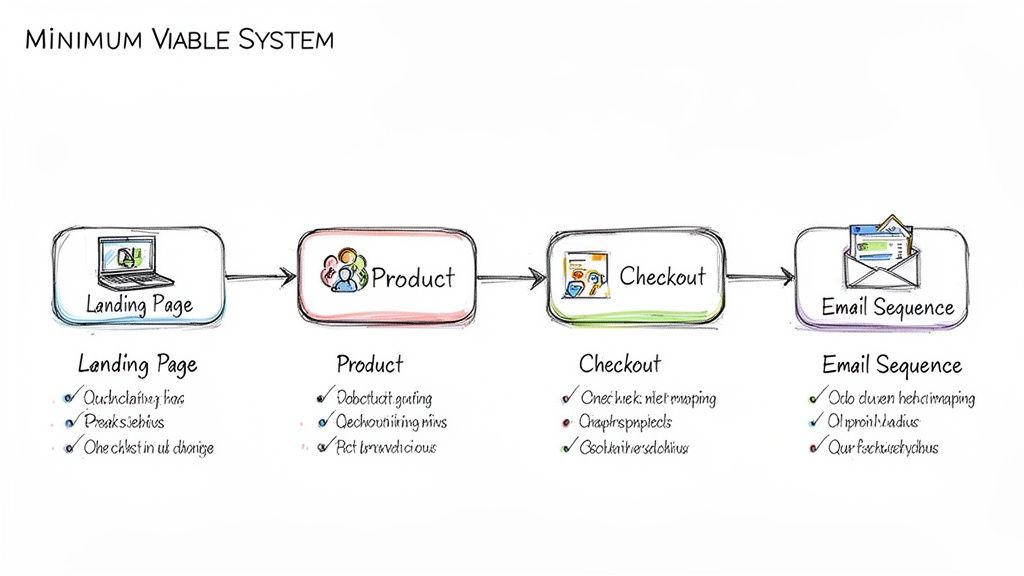
Alright, you've picked a business model and you've confirmed people actually want what you're selling. This is where so many aspiring entrepreneurs get completely stuck. They fall into the perfectionism trap, trying to build the ultimate website or a flawless sales funnel before they’ve even made their first dollar.
Here's the hard truth: your first version will be clunky. It won't be perfect. And it absolutely doesn't need to be.
The secret to breaking through this inertia is to launch a Minimum Viable System (MVS). This is the bare-bones, no-fluff setup you need to make a sale and start seeing how real customers behave. It's all about taking messy, imperfect action to get the doors open.
The "Good Enough to Get Going" Mindset
You can't learn without data, and you can't get data until you launch. An MVS is your shortcut to that critical information. I've seen countless founders burn out while polishing something no one has ever seen. In fact, a study published in the Journal of Business Venturing found that 73% of entrepreneurs who fail point to problems that could have been spotted and fixed much earlier with a faster, simpler launch.
Your MVS answers one question and one question only: can I get someone to pay me for this?
"If you're not embarrassed by the first version of your product, you’ve launched too late." – Reid Hoffman, Co-Founder of LinkedIn
This is the core of the MVS philosophy. Your job today isn't to build a business that will stand for a decade. Your job is to build a system that can make a sale this week.
What an MVS Looks Like in the Wild
The nuts and bolts of your MVS will obviously depend on the business model you've chosen. But the principle is always the same: find the most direct path from a curious visitor to a paying customer.
Here are a few real-world examples of what a lean MVS looks like for different businesses:
- For an Affiliate Marketer: A single landing page (built on any simple platform), an opt-in form to grab emails with a service like ConvertKit, and a basic 5-day automated email sequence that explains the problem and pitches the affiliate product as the solution.
- For an E-commerce Brand (Dropshipping): A Shopify store using a free theme. You don't need 50 products; start with just three to five well-researched items and a Stripe integration to take payments. The product page and checkout are your entire "system."
- For an Amazon FBA Seller: Your MVS is even simpler. It’s a professionally crafted product listing on Amazon, your first batch of inventory shipped to an FBA warehouse, and a basic "automatic" PPC campaign to get your first eyeballs on the listing.
- For a Digital Product Creator: A one-page site that sells the value of your ebook or template, a "Buy Now" button linked straight to a payment gateway, and an automated email that sends the file after purchase.
See the common thread? Every one of these is a straight line to revenue. There's no complex blog, no fancy branding, and no elaborate social media strategy. That all comes later, after you’ve proven the core offer actually works.
Choosing Your Core Platform
One of the first real decisions in building your MVS is picking your platform. This can feel like a huge deal, but it really boils down to a classic trade-off: simplicity vs. control.
For 99% of beginners, an all-in-one platform is the right call.
| Platform Type | Key Characteristics | Best For… |
|---|---|---|
| All-in-One (e.g., Shopify, Squarespace) | Easy drag-and-drop builders, integrated payments, and reliable hosting. Very low technical barrier. | Beginners who want to launch fast without messing with code, security, or plugins. Ideal for e-commerce and simple service sites. |
| Self-Hosted (e.g., WordPress.org) | Complete control and customization over every pixel of your site. Comes with a steeper learning curve and more hands-on maintenance. | Entrepreneurs with some tech skills or those planning complex, content-heavy sites who need maximum flexibility right away. |
My advice? Start simple. You can always migrate to something more complex like WordPress down the road. The name of the game right now is speed. Platforms like Shopify or Squarespace are built to get a professional-looking, payment-ready website live in a weekend. That's the momentum you need. Think of your MVS as the launchpad, not the final destination.
Mastering Traffic and Customer Acquisition
You’ve got your model validated and your minimum viable system is built. Now for the hard part: getting actual human beings to see it.
Let's be real, a business without a steady stream of customers is just a very expensive hobby. This is your playbook for getting those people in the door.
Forget trying to be everywhere at once. Seriously. The only way to win at customer acquisition is to pick one or two channels that actually make sense for your business and go all-in on mastering them. Chasing every shiny new trend is a fast track to burnout. Disciplined focus is how you build something real.
SEO Fundamentals You Can Act on Today
Search Engine Optimization (SEO) is just a fancy way of saying "getting Google to show your website to people searching for stuff you sell." It can feel overwhelming, but the basics are surprisingly straightforward and insanely powerful for long-term growth.
Unlike paid ads, traffic from SEO is "free." More importantly, it can become a sustainable, predictable source of new customers.
The entire journey starts with keyword research. You have to get inside your customer's head and figure out the exact phrases they're typing into Google. A good way to start is just by brainstorming the questions they might have.
- Problem-Aware Keywords: What's keeping them up at night? (e.g., "how to stop slicing my driver")
- Solution-Aware Keywords: What are they looking for to solve that problem? (e.g., "best golf swing training aids")
- Brand-Aware Keywords: What specific products or competitors do they already know about? (e.g., "the stack system vs super speed golf")
Once you have a brainstormed list, pop those ideas into a tool like Ahrefs or SEMrush to check out search volume and difficulty. Your goal is to find "long-tail" keywords—those longer, more specific phrases. They have less competition but much higher purchase intent.
Trust me, ranking for "best cork yoga mat for hot yoga" is way more achievable (and valuable) than trying to take on a term like "yoga."
The core of on-page SEO is simple: create the single best piece of content on the internet for your target keyword. That's it. Answer every possible question, offer unique insights, and make it incredibly easy to read.
The Art of Building and Nurturing an Email List
Your email list is the single most valuable asset you will ever own in your online business. It's a direct line to your biggest fans, and you're not at the mercy of some social media algorithm deciding who sees your stuff.
A study by Litmus found that email marketing generates an average return of $36 for every $1 spent. That’s one of the highest ROIs you'll find anywhere.
Building your list kicks off with a compelling "opt-in" or "lead magnet." This is just a freebie you offer in exchange for an email address.
Lead Magnets That Actually Work:
- A super-detailed PDF checklist
- A short video tutorial that solves one specific, nagging problem
- A handy spreadsheet or template they can use immediately
- Access to a free library of resources
Once they're on your list, the real work begins: nurturing the relationship. Don't just spam them with sales pitches. Your job is to build trust by consistently delivering value. A simple welcome sequence can introduce your brand, point them to your best content, and gently lead them toward your main offer.
Profitable Paid Advertising Frameworks
While SEO is your long game for organic traffic, paid advertising on platforms like Meta (Facebook and Instagram) and Google is like turning on a faucet. You get immediate traffic and, even better, fast data on what's working.
Success with paid ads isn't about having a monster budget; it’s about having a repeatable framework.
A Simple Paid Traffic Framework:
- Define Your Objective: What do you actually want to happen? Leads? Sales? Brand awareness?
- Target Precisely: Use Meta's interest targeting or Google's keyword targeting to get in front of your ideal customer.
- Craft a Compelling Ad: Your ad needs a scroll-stopping image or video, a headline that grabs them by the collar, and copy that speaks directly to their pain point.
- Send to a Dedicated Landing Page: Never, ever send ad traffic to your homepage. Create a specific page that matches the promise of the ad and has one clear call to action.
- Test and Measure: Start small. A budget of $10-20 per day is plenty to test your ads and targeting. Track your key metrics—like Cost Per Click (CPC) and Conversion Rate—and pour more fuel on what’s working.
For a much deeper dive into launching successful campaigns right from the start, check out our guide on paid traffic mastery.
Driving Growth with Content and YouTube
Content-driven channels like a blog or a YouTube channel are absolute powerhouses for building authority and attracting an audience organically.
People don't just buy products; they buy from people and brands they know, like, and trust. Publishing consistent, valuable content is the fastest way to build that relationship with thousands of people at once.
YouTube, being the world's second-largest search engine, is a massive, untapped opportunity for most. Creating helpful, "how-to" style videos in your niche can pull in highly engaged viewers who are actively looking for solutions. This doesn't just drive traffic; it positions you as the go-to expert, which makes the eventual sale feel natural instead of forced.
Optimizing Operations With the Right Tool Stack
So your business is finally picking up steam. Customers are rolling in, sales are happening, and then… a new problem hits you.
All those manual tasks you handled yourself in the beginning—like personally answering every single customer email or fiddling with sales spreadsheets—are suddenly swallowing your entire day. It’s a great problem to have, don't get me wrong, but it means you've hit a growth wall. Trying to do it all yourself is a fast-track to burnout.
The only way to push through this phase is to systematize your operations. That means building repeatable processes for everything from customer service to content creation, and then using the right tech to automate as much as you can.
Building Your Core Technology Stack
The goal isn't to chase every shiny new tool that promises to change your life. That's a classic rookie mistake and a total money pit. Instead, you need to build a lean, powerful, and cost-effective tool stack. Only invest in software that gives you a clear and immediate return.
I see so many entrepreneurs get overwhelmed by the sheer number of options out there. The truth is, you only need a handful of key tools to run the most critical parts of your business.
The biggest mistake I see entrepreneurs make is over-investing in complex tools too early. Your initial tool stack should be lean, focused, and solve your biggest operational headaches right now, not problems you might have in two years.
Let's break down the must-have categories and my personal recommendations.
Curated Tools for Essential Business Functions
A smart tool stack doesn't have to break the bank. For most core business functions, there are fantastic budget-friendly options that get the job done, plus more powerful premium tools you can upgrade to as your business grows. This way, you're only paying for what you actually need, when you need it.
This is just a starting point. For a complete deep dive, you can check out our full list of the business tools we use and recommend to run our own operations.
Essential SaaS Tool Stack for a New Online Business
Here’s a quick-glance table of the essential tools that I believe every new online business should have in their back pocket.
| Business Function | Budget-Friendly Tool | Premium/Scaling Tool | Primary Use Case |
|---|---|---|---|
| Email Marketing | ConvertKit | ActiveCampaign | Building your email list, sending newsletters, and creating automated sales sequences. |
| Project Management | Trello | Asana | Organizing tasks, managing content calendars, and collaborating with team members. |
| Website Analytics | Google Analytics | Hotjar | Tracking website traffic, understanding user behavior, and identifying conversion opportunities. |
| Customer Service | Gmail Filters/Labels | Help Scout | Managing customer inquiries efficiently and creating a knowledge base of common questions. |
The key is to start simple. For instance, Trello's visual card system is more than enough to organize your first content calendar. As your team and projects get more complex, graduating to a platform like Asana will feel like a natural next step, not a forced upgrade.
Using Data to Make Smarter Decisions
Once your tools are in place, you can finally stop relying on gut feelings and start tracking the numbers that actually matter. Data is what lets you make consistent, profitable decisions. The two most critical metrics you absolutely have to get a handle on are Customer Acquisition Cost (CAC) and Customer Lifetime Value (LTV).
Customer Acquisition Cost (CAC): This is just a fancy way of saying: "How much does it cost me to get one new customer?" To figure it out, just divide your total marketing spend over a certain time by the number of new customers you got in that same period. Spend $500 on Facebook ads and get 25 new customers? Your CAC is $20. Simple.
Customer Lifetime Value (LTV): This metric predicts the total amount of money you can expect to make from a single customer over their entire relationship with your business. A back-of-the-napkin way to estimate this is to multiply your average order value by the average number of times a customer buys from you.
Understanding the relationship between these two numbers is everything. A healthy business model demands that your LTV is way higher than your CAC. Studies from sources like HubSpot suggest a solid LTV to CAC ratio is 3:1 or better.
If you're spending $20 to get a customer who only ever spends $25 with you, your business is on fire in a bad way. But if that same $20 customer goes on to spend $150 over their lifetime? Now you've got a profitable, scalable engine for growth.
Your 90, 180, and 365 Day Action Plan
An idea without a solid plan is just a daydream. Let's turn all the concepts we've talked about into a real, time-bound roadmap for your first year in business.
Think of this as your playbook. It’s designed to give you structure, breaking down the massive goal of "building an online business" into phases you can actually manage.
Instead of getting overwhelmed by everything you could do, just focus on one phase at a time. Each one has a specific mission, making sure you're working on the right things at the right time.
The First 90 Days: Launch And Validation
The mission for your first quarter is simple: get your business off the ground and make your first sale. This phase is all about speed and collecting data, not chasing perfection. Success here means proving, with real-world feedback, that your idea actually has legs.
Your main focus is launching your Minimum Viable System (MVS). As we've covered, this is the absolute bare-bones version of your business needed to start making money. For a service provider, your MVS might just be a one-page website with a way to book and pay for a session. That's it.
Key Tasks for Days 1-90:
- Lock In Your Business Idea: Get crystal clear on your niche, who your ideal customer is, and how you’ll actually make money.
- Launch Your MVS: Build out that core system. This could be a basic Shopify store with just three products or a simple landing page for your affiliate offer.
- Start Your Email List: Set up an email marketing tool and create a simple opt-in freebie to start capturing leads from day one. This is a critical asset, and most successful founders I know wish they'd started it sooner.
- Land Your First Customer: Drive some initial traffic to validate your offer. Don't overthink it—personal outreach or a few small, targeted ads are all you need to get the ball rolling.
The First 180 Days: Traction And Growth
Now that your business is live and you’ve made a few sales, the next three months are all about getting traction. The goal is to build a consistent flow of traffic and dial in your sales process. You need to move from random, one-off sales to a predictable system for bringing in new customers.
The secret to this phase is focus. Don't try to be everywhere at once. Your goal is to master one primary traffic channel. Whether it's SEO, YouTube, or paid ads, go deep on that single platform until it's producing reliable results for you.
This is also the time to start refining your sales funnel based on that early data. Look at what’s working and what isn’t, then start tweaking things to improve performance. For a deeper dive, check out our article on 6 things that will accelerate your business growth.
The First Year: Scale And Optimization
As you get closer to the 365-day mark, your focus will naturally shift toward scaling and making everything more efficient. You have a validated model and a traffic channel that works. Now it's time to build systems, expand your reach, and optimize for pure profitability.
This visual timeline breaks down what that optimization process looks like.
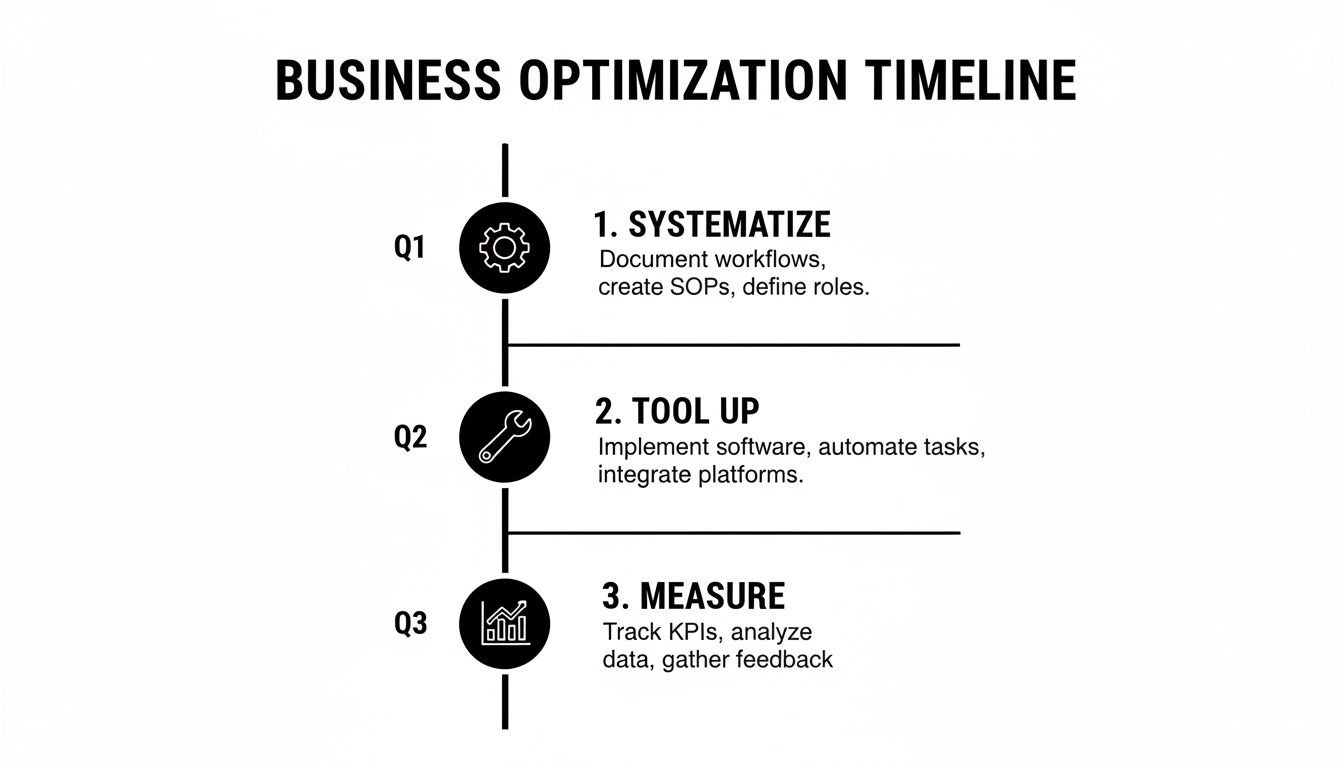
As you can see, scaling isn't a random sprint. It’s a deliberate process of systematizing your operations, upgrading your tools, and obsessively measuring your key metrics. This is what creates a rock-solid foundation for a business that can grow for years to come.
Frequently Asked Questions
When you're first getting into the world of online business, a million questions will pop into your head. It's totally normal. I've put together some straight-to-the-point answers for the most common questions I get from entrepreneurs just starting out.
How Much Money Do I Need to Start?
This is the big one, and the honest answer is: it completely depends on the path you choose. You definitely don't always need a huge bankroll.
If you’re going the affiliate marketing or dropshipping route, you can realistically get off the ground for under $500. That'll cover the essentials like website hosting, a decent theme, and some initial software to get you started.
On the other hand, some models are more capital-intensive. Launching a private label brand with Amazon FBA, for example, usually means you’ll need $3,000 to $5,000 just for your first inventory order, branding, and those crucial first ad campaigns. The trick is to start lean with a Minimum Viable System to keep those early costs in check.
What Is the Most Profitable Online Business?
Profitability is far more about how well you execute your plan than the business model itself. That said, some models definitely have better built-in margins than others.
SaaS (Software as a Service) and digital products—think online courses or ebooks—often have the highest profit margins, sometimes hitting 80-90% or even more. That’s because you have no physical inventory or shipping costs eating into your revenue.
Compare that to e-commerce or Amazon FBA, where margins are typically tighter, often in the 15-30% range. The trade-off is that those models can generate much higher overall revenue. As Gillian Perkins breaks down in her guide, the best model for you is one that matches your skills and what you're willing to risk, not just what looks good on paper.
How Long Until I Make Consistent Money?
You need to be patient. Seriously. It’s realistic to plan for a 6 to 12-month runway before you start seeing a steady, predictable income. Don't believe anyone who tells you otherwise.
Sure, some strategies can get you profitable faster. Running paid ads to a hot affiliate offer can work quickly, but it also comes with a much higher financial risk. If the ads don't convert, that money is just gone.
Models that rely on SEO, like blogging, take longer to build momentum. But the payoff is a much more sustainable, long-term asset that can pay you for years. The 90/180/365-day plan in this guide is designed to give you a realistic timeline and keep your expectations grounded.