

Most advice on high demand products with low competition is lazy. It gives you a recycled list of “winning” products, then leaves you holding the bag after everybody else piles in.
That approach fails because low competition is rarely a permanent market condition. It's usually a short window. Shopify puts it plainly: these products often show “significant spikes in interest while supply lags,” which makes them timing advantages, not durable monopolies in waiting (Shopify's guide to high-demand products with low competition).
If you want to build a real business, stop asking, “What's the hot product right now?” Ask a better question: What system can I use to spot underserved demand before the listing page gets crowded?
That's the whole game.
I've seen too many sellers chase trend screenshots, viral hashtags, and broad product categories like “wellness” or “eco-friendly.” Those labels are useless on their own. You don't make money selling “wellness.” You make money finding a specific product inside a niche where buyers already want it, competitors haven't built strong listings yet, and the economics still work after ads, shipping, and returns.
The sellers who keep winning don't rely on guesses. They run the same process over and over. They scan demand signals, measure competition, score the opportunity, then validate the ugly operational stuff others overlook.
That's what this article is about. Not a product list. A working framework.
Stop Hunting for Unicorns Start Building a System
Beginners waste months looking for a product with perfect numbers. Huge demand. Weak competition. Fat margins. No returns. Easy sourcing. Cheap shipping. That search usually ends with a crowded listing and a thin profit margin.
Profitable sellers work differently. They build a repeatable system for spotting short-lived openings, scoring them fast, and rejecting weak ideas before they cost money.
That shift matters.
“High demand products with low competition” is a useful keyword. It is a misleading starting point for sellers. Demand and competition are not labels you slap on a niche. They are measurable conditions inside a specific product market, at a specific moment, on a specific channel.
So stop searching for a miracle item. Search for asymmetric opportunities you can measure. A narrow product variation with clear buyer intent, weak listing quality, low review depth, and economics that still work after fulfillment, ad spend, and returns.
Here's the framework I use:
- Start with evidence of demand: search trend stability, keyword volume, marketplace sales clues, and buyer intent in reviews
- Check whether competition is weak: low review counts, poor images, bad bundles, thin descriptions, and weak differentiation
- Score the business model: landed cost, contribution margin, shipping complexity, compliance risk, breakage risk, and supplier consistency
- Move only when the numbers justify it: good ideas are common, good economics are not
This is why broad category hunting is a dead end. “Eco-friendly,” “fitness,” or “pet products” tells you nothing useful. “Refillable dog paw cleaner for muddy hikes” is useful. It gives you something you can test with keyword tools, review counts, listing quality, and margin math.
A simple market research habit helps here. Use the Wand Websites market research guide to separate surface-level trend chasing from actual customer research, then narrow your product ideas until you can evaluate one SKU, not a vague category.
I also want one marketplace metric in the mix early. If you sell on Amazon, learn how to read Amazon Best Sellers Rank (BSR) as a demand signal before you waste time on products that look promising in search tools but barely move units.
A key advantage is not finding one winner. This advantage comes from being able to screen fifty ideas, cut forty-five fast, test five, and know exactly why one deserves your money. That is the skill this article is built to teach.
Decoding the Demand vs Competition Equation
The phrase "high demand, low competition" is too vague to guide a buying decision. Treat it like an equation. If you cannot score both sides with visible market signals, you do not have an opportunity. You have a guess.

What high demand looks like
Demand is not hype. Demand is repeated buyer intent showing up across search, marketplace activity, and product-specific queries.
Start with three signals:
- Search volume with product intent
- Marketplace movement
- Demand stability over time
Search volume matters only when the keywords are specific enough to suggest a buyer is close to purchase. "Dog accessories" is noise. "Portable dog paw cleaner cup" is useful. It tells you what to check next.
Marketplace movement matters just as much. On Amazon, I want rank movement in a product type that has enough turnover to support a new entrant. If you need a better handle on how to read Amazon Best Sellers Rank as a demand signal, use this guide: Amazon Best Sellers Rank or BSR.
Stability is the filter that saves you from trend bait. One spike is not a business. A steady pattern, or a seasonal pattern you can plan around, is far more useful. If you want a cleaner way to separate surface trends from buyer research, the Wand Websites market research guide lays out the difference well.
What low competition means
Low competition means weak execution from current sellers, not an empty market.
A product can have plenty of listings and still be wide open if the top results are mediocre. Look for crowded shelves with poor operators. That is where new sellers win. The signs are easy to spot: thin images, lazy titles, generic copy, weak bundles, scattered positioning, and review counts that do not create a moat.
I use four checks:
- Review density: Can products rank without a huge wall of reviews?
- Seller concentration: Are a few brands controlling the whole page, or is the market fragmented?
- Listing quality: Do the top listings look built by professionals or by resellers copying each other?
- Price behavior: Are sellers competing on value, or racing each other to the bottom?
Low competition also has a time component. Some niches stay open because incumbents are sloppy. Others stay open for a short window because demand moved faster than supply. Your job is to tell the difference and move only when you can improve the offer fast.
Read the market like an operator
Do not ask, "Is this niche good?" Ask, "Can I enter this niche with a better offer and still hit my margin target?"
This table is the fast screen I use before a product goes into the scorecard.
| Signal | Good sign | Bad sign |
|---|---|---|
| Search trend | Stable or rising product-specific interest | Short-lived spike with no follow-through |
| Marketplace demand | Consistent movement in relevant listings | Stale listings with weak turnover |
| Reviews | Ranking products with manageable review counts | Top results buried behind heavy review walls |
| Seller mix | Fragmented sellers with no clear dominant brand | A few entrenched brands controlling visibility |
| Listing quality | Obvious gaps in images, copy, bundles, or positioning | Strong listings with clear differentiation |
| Pricing | Room for margin without matching the lowest seller | Constant discounting and thin margin room |
A product is interesting only when demand is visible and competition is beatable. Miss either side and the economics fall apart. This is why random lists of "hot products" are a waste of time. A repeatable business comes from evaluating the same signals, the same way, every time.
The Product Research Toolkit You Actually Need
Product research gets messy when sellers pile on tools without assigning each one a job. Cut the stack down. Use a small set of tools, pull a specific signal from each, and ignore everything else.
Use each tool for one job
My core stack is simple.
- Google Trends for direction. I check whether interest is steady, rising, seasonal, or fading.
- Ahrefs or Semrush for keyword demand and difficulty. I want a fast read on how hard discovery will be.
- Amazon, Etsy, or eBay search results for review density, listing quality, seller concentration, and pricing behavior.
- A marketplace research suite if you sell on Amazon. Helium 10 is a common choice, and this guide to the best Amazon keyword research tools is useful if you want to compare options.
That stack is enough to build a repeatable screening process. You do not need ten tabs open to decide whether a niche deserves a scorecard slot.
What to pull from each source
Google Trends answers one question. Is demand building, holding, or fading?
I care more about consistency than hype. A stable five-year trend with predictable seasonal bumps is easier to buy, price, and restock than a product that jumped last month because of one viral post.
Ahrefs and Semrush answer a different question. How competitive is search traffic, and what language do buyers use when they are close to purchase?
Start with the obvious product term, then branch into longer queries. Long-tail keywords often expose cleaner intent, weaker competition, and product angles you can build into the listing itself. If the broad term is crowded but specific use-case terms are still open, that is useful. It gives you positioning.
Marketplace search is where weak offers get exposed. Open the first page manually and inspect it like a buyer with standards.
Look for:
- Review spread: Several relevant listings with manageable review counts, not a page dominated by legacy winners.
- Weak merchandising: Poor photos, generic titles, thin bullets, weak benefit framing.
- Offer gaps: Missing bundles, missing size or color variants, unclear gifting angle, sloppy packaging, weak use-case targeting.
- Price discipline: Enough room to make margin without joining a race to the bottom.
Here's a decent walkthrough to pair with that manual review once you're in the weeds:
The research mistake that kills good product ideas
A common trap is relying on one signal and calling it validation.
A trending hashtag can vanish. A keyword with healthy volume can hide brutal competition. A revenue estimate can look great while the listings are stuck in discount wars.
Use overlap to make decisions. Trends show whether interest has legs. Keyword tools show whether discovery is crowded. Marketplace results show whether current sellers are lazy, sharp, fragmented, or impossible to displace.
That is the framework. Each tool checks one part of the opportunity, and the product only moves forward when the signals agree. That discipline is what makes the scorecard useful instead of cosmetic.
Building Your Opportunity Scorecard
A product idea does not deserve inventory until it survives a scoring system.
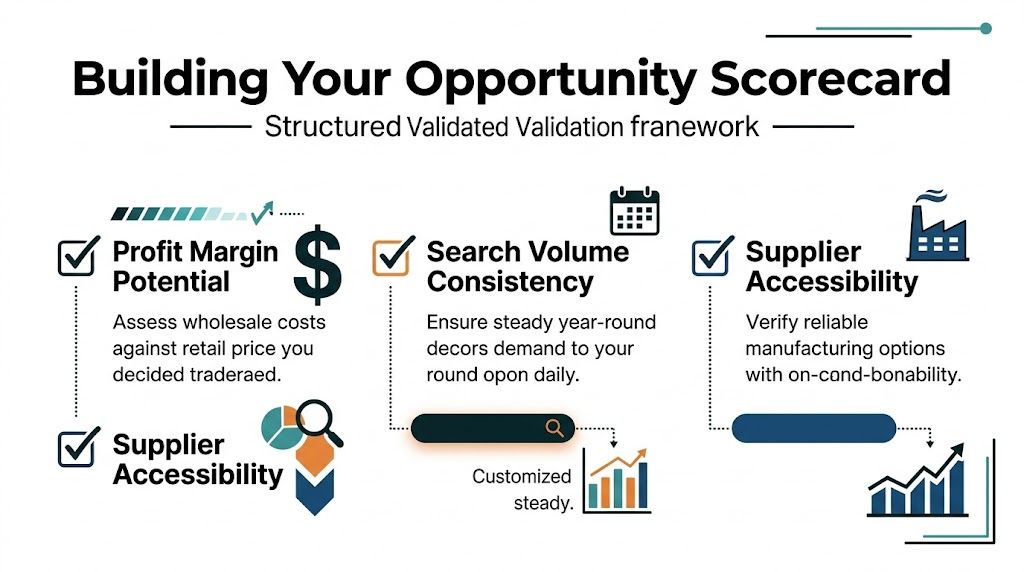
I use an Opportunity Scorecard to force a clear decision: pursue it, park it, or kill it. That matters because product research breaks down when every idea feels “promising.” A scorecard fixes that. It turns scattered signals into one repeatable framework you can use every week, across any category.
This is the skill that matters. Generic lists of hot products expire fast. A scorecard helps you spot your own opportunities before everyone else piles in.
The scorecard categories I use
I score each product idea across five buckets, then compare totals side by side.
Demand quality
Start with buyer intent, not noise.
A product scores high when search interest looks steady or rising, the keywords sound like someone ready to buy, and the use case is obvious in one sentence. If interest is driven by social hype and the search terms look vague, I mark it down. Curiosity traffic is cheap. Buyer intent is what pays.
Competition density
This bucket decides whether the niche is open or fake-open.
I want to see page-one listings that can be beaten with better execution. That means manageable review counts, weak images, lazy copy, poor bundling, thin branding, and no obvious seller controlling the whole page. If the niche is packed with polished listings and aggressive discounting, the score drops fast.
Margin potential
A product with weak economics is not an opportunity. It is a future cash-flow problem.
Use this practical reference when setting target pricing logic: how to price anything.
I want enough room for ad spend, fulfillment, packaging, returns, and a launch offer without choking margin. I also want some pricing power. If the only way to compete is matching the lowest seller, I pass.
Operational simplicity
Simple products give you fewer ways to lose.
I score down anything bulky, fragile, regulated, hard to pack, easy to return, or dependent on inconsistent manufacturing. A boring product with clean operations will beat a flashy product with headaches attached.
Differentiation path
If your plan is to copy the current bestseller with a different logo, the score should be low.
A product gets a strong score when I can improve the offer in a way customers will notice. Better materials, smarter bundles, clearer instructions, tighter positioning, better packaging, audience-specific branding, or a variant the current sellers ignored all count. If I cannot explain the upgrade clearly, I do not keep the idea.
You can also pressure-test this part with customer language and retention signals. Formbricks has a useful breakdown of how to measure product market fit, and the same thinking helps here. You are checking whether the product solves a real job for a specific buyer, not whether it looks good in a spreadsheet.
A simple decision table
You do not need fancy tooling to start. A plain sheet works fine if the criteria stay consistent.
| Scorecard area | What you're checking | Decision lens |
|---|---|---|
| Demand quality | Search trend, keyword intent, use case clarity | Is buyer interest durable enough to matter? |
| Competition density | Reviews, seller count, listing quality, price pressure | Can you realistically break into page one? |
| Margin potential | Retail price versus total cost structure | Is there enough room after ads and fulfillment? |
| Operational simplicity | Shipping, breakage, returns, compliance | Will this product punish you after launch? |
| Differentiation path | Bundles, branding, positioning, variants | Can you win without copying? |
My rule for choosing between two good ideas
Pick the product with the cleaner execution path.
If one idea has stronger trend data but messy logistics, weak margins, or no clear offer improvement, I skip it. If another idea looks slightly smaller on paper but gives me cleaner unit economics, easier sourcing, and a sharper differentiation angle, I take that one. Execution beats theoretical upside over and over again.
That is the whole point of the scorecard. It keeps you from buying into a screenshot instead of building a business.
Validating Your Shortlist Beyond the Data
Most bad product launches don't fail in the research tool. They fail after the order is placed.

A product can score well on demand and competition and still be a terrible business. That's why I never treat spreadsheet validation as enough.
Product Led Alliance makes the key point most sellers learn too late: the strongest opportunities are often problem-solving products, but post-ad margin, size and weight, seasonality, and compliance risk can wipe out profitability even when demand looks strong (Product Led Alliance on validating unit economics and operational constraints).
The checks that actually matter
Before I commit, I want answers to a few ugly questions.
- What is the true landed cost? Not just unit price. Packaging, freight, duties, prep, storage, and expected discounting matter.
- How likely is the product to get returned? Apparel-like fit issues, fragility, or confusing usage can poison the economics.
- Can the supplier repeat quality reliably? One good sample proves almost nothing.
- Does this product trigger compliance or liability concerns? If yes, the bar gets much higher.
- Will seasonality trap my cash? A product with uneven demand can leave you with dead inventory if your timing is off.
Talking to multiple suppliers helps. You learn fast which factories answer clearly, which ones dodge specs, and which ones understand your product details.
Samples are not optional
If you skip samples, you're not validating. You're hoping.
Get the product in your hands. Open it like a customer. Test the instructions. Look at the seams, finish, packaging, smell, and durability. Compare competing samples side by side. Weakness becomes obvious when the products are on the same table.
Hard truth: A product that looks profitable in software can still feel cheap, break fast, or create support headaches that destroy your margin.
The same logic applies to market fit. Research tells you people search. Validation tells you whether they'll stay happy after buying. If you want a clean framework for thinking about that side of the equation, this guide on how to measure product market fit is a useful complement to marketplace research.
What usually gets ignored
Sellers get excited by demand and downplay friction.
They ignore:
- Bulky packaging
- Supplier delays
- Replacement rates
- Instruction clarity
- Customer expectations in the niche
That's how “good products” become bad launches.
The shortlist stage should eliminate products that create operational drag. Not because they can't work, but because better options usually exist. When two products have similar upside, choose the one that won't punish you after the sale.
From Winning Product to Your First Sale
Once you've validated a product, speed matters.
Nformed's criteria are useful at this stage because the opening usually looks the same: consistent sales, fewer than 5–10 active sellers, weak listings, and little recent price-cutting pressure are signals that the market still has room before launch (Nformed's launch-window criteria).
Don't waste that window by launching with an average listing.
Build the listing to beat the current market
If the niche is open, the existing listings often give you an easy path to out-execute.
Focus on:
- Better images: Show use cases, scale, packaging, and what makes your version different.
- Sharper copy: Write to the actual buyer problem, not generic feature lists.
- Cleaner offer design: Bundles, inserts, variants, or clearer positioning can separate you fast.
- Tighter keyword targeting: Align your title, bullets, and backend terms with what your research already showed.
The goal isn't to look “nice.” The goal is to look like the most credible option on the page.
Keep the launch simple
A lot of sellers overcomplicate launch strategy and under-execute the basics.
Do three things well:
- Start with a listing that converts
- Use controlled PPC to learn search terms and buyer behavior
- Fix weak points fast based on real clicks, conversion, and customer questions
Early reviews matter, but don't obsess over hacks. Focus on delivering a product that matches the promise in the listing. If customers feel the product solved the problem they expected it to solve, the review base grows more naturally.
The real advantage is discipline
This entire process works because it keeps you from making emotional product decisions.
You're screening for demand. Measuring competition. Scoring opportunities. Validating real-world economics. Then launching with a clear point of difference.
That's how you find high demand products with low competition without relying on luck.
If you want to turn this into something you can use every week, grab EntreResource's printable scorecard and launch checklist, then run every product idea through the same filter before you spend a dollar.