

Trying to figure out your Fulfillment by Amazon price isn't as simple as looking at a single number. It’s more like a utility bill—you’ve got different charges for different services, all bundled together. The main costs you'll see are fulfillment fees (shipping), monthly storage fees (warehousing), and referral fees (Amazon's cut). Getting a handle on these three is the first step to understanding your real costs.
Breaking Down Your Fulfillment by Amazon Price
When you look at your FBA statement, it’s easy to get overwhelmed. But each line item covers a specific part of the service Amazon provides. And with independent sellers like us now making up over 60% of sales on Amazon, knowing exactly what you're paying for is non-negotiable for running a profitable business, according to Amazon's own 2023 small business report.
Your total cost is built from a few core pieces. It’s also incredibly important to know that Amazon has strict rules about how you price your products. Falling out of line with Amazon's Fair Pricing Policy for sellers can put your account health at risk, so make sure you understand it.
The Three Pillars of FBA Pricing
To really get it, let's break down the main fee categories. Think of these as the three legs of the FBA pricing stool.
- Fulfillment Fees (Pick, Pack & Ship): This is the fee you pay for every single unit Amazon ships. It covers the cost of an Amazon employee walking over to a shelf, grabbing your product, putting it in a box, and sending it to the customer. It's the most direct "service" fee.
- Storage Fees (Inventory Housing): You're essentially renting shelf space in Amazon's massive warehouse network. This cost is charged monthly and is based on how much physical space your inventory takes up, measured in cubic feet.
- Referral Fees (Marketplace Commission): This is what Amazon charges for access to its millions of customers. It’s a commission, plain and simple, taken as a percentage of your product's total selling price.
It's important to remember these fees aren't set in stone. For example, Amazon announced that in 2026, FBA fees are expected to go up by an average of $0.08 per unit sold. They point out this is well below inflation and what other shipping carriers are charging, but it's still a cost increase you need to plan for.
This table gives you a quick overview of how these main fees come together to create your total Fulfillment by Amazon price.
| Fee Category | What It Covers | How It's Charged |
|---|---|---|
| Fulfillment Fees | The labor and materials for picking, packing, and shipping orders. | Per unit, based on product size and weight. |
| Storage Fees | Housing your inventory in Amazon's fulfillment centers. | Per cubic foot, billed on a monthly basis. |
| Referral Fees | The commission for selling on the Amazon marketplace. | A percentage of the product's total sale price. |
Breaking Down Your Core Fulfillment Fees
After getting the high-level view, it's time to zero in on the single biggest variable in your Fulfillment by Amazon price: the core fulfillment fee. This is the direct, per-unit cost you pay Amazon's team to pick an item off a warehouse shelf, pack it snugly in a box, and ship it out to your customer.
Think of it as hiring a personal assistant for every single sale you make. The cost for that assistant changes based on how tough the job is. Handing over a small, feather-light item is a breeze. Lugging a massive, heavy one? That takes more time, effort, and resources. Amazon's fee structure works the exact same way.
The Power of Product Size and Weight
Your product's dimensions and weight are, without a doubt, the most critical factors that determine your fulfillment fee. Amazon is meticulous about this, slotting every single item into specific size tiers. The financial jump between these tiers is no joke—a fraction of an inch or a single ounce can be the difference that completely changes your profit margin on every sale.
This is a classic tripwire for new sellers. It's easy to get laser-focused on your selling price and sourcing cost, completely forgetting how the physical reality of your product eats into your bottom line through FBA fees.
The core principle is simple: the smaller and lighter your product, the less you pay in fulfillment fees. This makes product selection and even packaging design a critical part of managing your overall Fulfillment by Amazon price.
This diagram breaks down how the main components of your FBA price, including those all-important fulfillment fees, fit together.
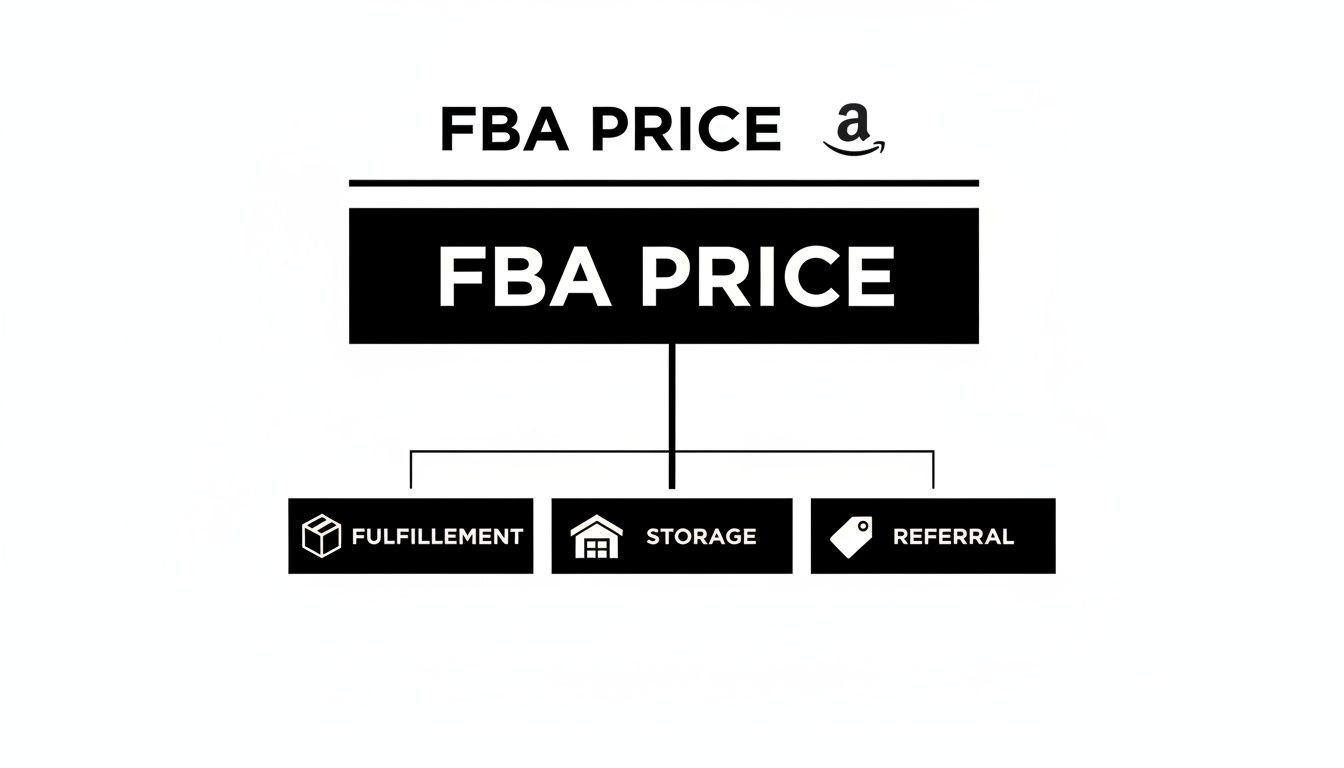
As you can see, fulfillment, storage, and referral fees are the three pillars. But on a per-unit basis, the fulfillment fee is almost always the heaviest operational cost you'll face.
Real-World Fee Comparisons
Let's make this tangible. Imagine you're selling two very different products:
- Product A: A sleek smartphone case. It's tiny, weighs next to nothing, and easily fits into Amazon's "Small Standard" size tier.
- Product B: A countertop kitchen blender. It’s bulky, has some heft to it, and will land in a "Large Standard" or possibly even a "Large Bulky" tier.
The fulfillment fee for that phone case might only be a few dollars. The blender, on the other hand, could easily cost you double or triple that amount simply because it takes up more space and is harder to handle. This is where the numbers really start to matter.
This table gives a few examples of how fees can vary for items priced over $10 based on Amazon's 2026 fee schedule.
2026 FBA Fulfillment Fee Tiers (Examples for Items $10+)
| Product Size Tier | Unit Weight | Example Fulfillment Fee Range |
|---|---|---|
| Small Standard | Under 1 lb | $3.06 – $3.87 |
| Large Standard | Under 3 lb | $3.68 – $5.11 |
| Large Standard | 3+ to 20 lb | $5.38 – $7.46+ |
| Large Bulky | Under 70 lb | Starts at $9.61 and goes up |
This is just a snapshot, but it shows how quickly costs can climb. Experts often find that FBA fees take a 15-20% slice of the final sales price. You can get a more detailed look by reviewing a full breakdown of Amazon's FBA fee schedule.
Special Categories and Earning Discounts
Just when you think you've got it figured out, there are more layers. Certain product categories come with their own unique fee schedules because they require special handling.
- Apparel: Selling clothing often means paying a small surcharge on top of the standard fulfillment fee.
- Dangerous Goods (Hazmat): If your product has flammable or pressurized materials (think aerosols or items with lithium batteries), it needs special handling and gets its own separate, higher fee schedule.
But it’s not all about extra costs. Amazon also gives you a way to earn a discount through its Ships in Product Packaging (SIPP) program.
If your product's own packaging is sturdy enough to be shipped directly to the customer without needing an extra Amazon box, you can get a break on your fulfillment fee. This is a huge win-win: it saves you money and cuts down on packaging waste. As detailed by Amazon, that discount can be anywhere from $0.04 to $1.32 per unit, which goes directly back into your pocket on every single sale.
Beyond the fee for shipping each item, a big chunk of your fulfillment by amazon price comes from what happens before a sale: storing your products. I like to think of Amazon's fulfillment centers as high-tech, super-efficient rental units for my business. You're paying for shelf space, and those costs can swing wildly depending on the time of year and, more importantly, how long your stuff sits around.
Getting a handle on these storage fees isn't just an accounting task; it's a core part of protecting your profit margins. I've seen firsthand how poor inventory management can turn a hot-selling product into a financial nightmare. Let's break down the different storage costs you absolutely need to have on your radar.
Monthly Inventory Storage Fees
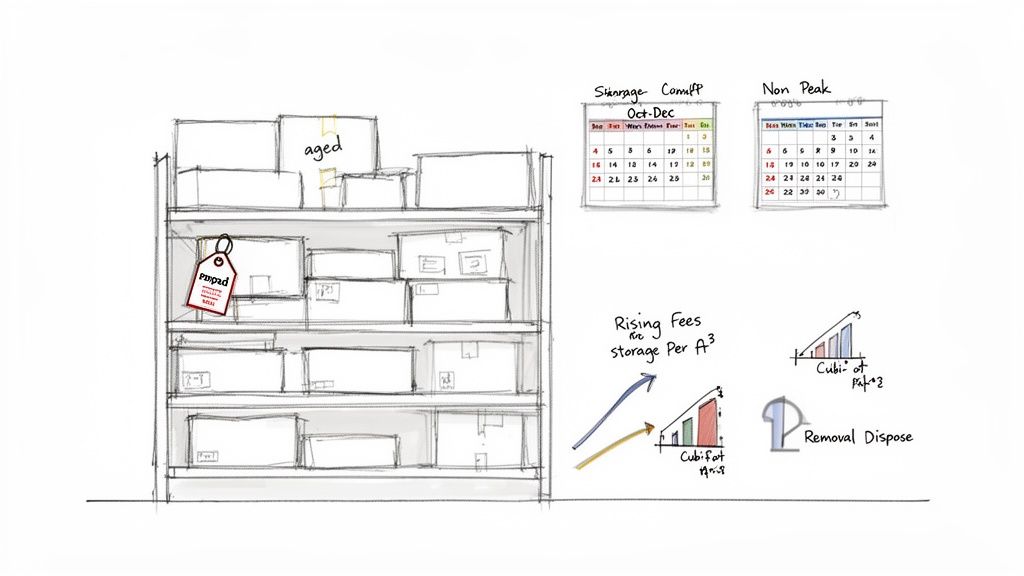
The most predictable cost you'll face is the monthly inventory storage fee. Amazon charges this for every single item you have sitting in their fulfillment centers. It's calculated based on the daily average volume of space your inventory takes up, measured in cubic feet. This means your product's size and even its packaging are just as crucial here as they are for shipping fees.
These fees also change with the seasons, reflecting the retail calendar:
- Non-Peak Season (January – September): This is when you'll pay the standard, baseline rate for holding your inventory.
- Peak Season (October – December): To prepare for the holiday madness, Amazon jacks up its storage fees. This is their way of pushing sellers to only send in stock they're confident will sell fast, freeing up warehouse space for the big rush.
For us sellers, this seasonal shift makes forecasting and timing everything. Sending way too much inventory right before Q4 can leave you with shocking storage bills that chew right through your holiday profits.
The Profit Killer: Aged Inventory Surcharges
While monthly fees are manageable, the real threat to your bottom line is the aged inventory surcharge (what we used to call long-term storage fees). This is a penalty Amazon hits you with for inventory that has been sitting in a fulfillment center for too long without selling.
Think of it as a ticking clock on every unit you own. The longer an item sits collecting dust on a warehouse shelf, the more expensive it becomes to keep it there. This fee exists to stop sellers from using Amazon's warehouses as a permanent graveyard for unsuccessful products.
These surcharges are no joke and are designed to force you to take action. Stagnant stock doesn't just tie up your capital; it racks up escalating fees that can completely wipe out your profit margin. According to Amazon's fee schedule, these fees can cost a staggering $6.90 per cubic foot or $0.15 per unit (whichever is greater) for inventory that sits for more than 365 days. To explore more about FBA costs, check out this detailed guide on Amazon FBA fees.
Removal, Disposal, and Returns Processing Fees
So, what do you do when you realize a product is a dud? Letting it sit and pile up aged inventory surcharges is not an option. This is where removal and disposal fees come into the picture. You have two main choices:
- Removal Order: You can pay a per-item fee to have Amazon ship your unsold inventory back to you. This is a good move if you think you can sell the items through another channel or liquidate them yourself.
- Disposal Order: Alternatively, you can pay a per-item fee and have Amazon get rid of the inventory for you. This is often the simplest path for items that just aren't worth salvaging.
Finally, there's one more related cost: the returns processing fee. When a customer returns an item you offered free shipping on, Amazon charges a fee to process that return. This fee is usually the same as the original fulfillment fee for that item. Keeping your return rate low, therefore, is another key piece of the puzzle. Effective Amazon inventory management is absolutely essential for keeping all these storage-related costs to a minimum.
Understanding Referral Fees and Seller Account Costs
Before a single box ever gets packed or stored, Amazon takes its cut. These are the costs you pay just for the privilege of listing your products on their massive marketplace. Let's break down the two main components: referral fees and your seller account plan.
Think of the referral fee as Amazon's commission. It’s the price you pay for instant access to their millions of customers—people who are already logged in and ready to buy. Instead of pouring a ton of cash into marketing to build your own traffic, you get to piggyback on theirs. This fee is a percentage of the total price the customer pays, which includes the item price, shipping, and even any gift-wrapping charges.
How Referral Fees Vary by Category
This commission isn't a flat rate. The percentage Amazon takes depends heavily on your product's category, and this is a critical detail for any seller. A small difference in fees can make or break a product's profitability. A high-margin item in a low-fee category is a dream, but a low-margin product in a high-fee category can quickly become a nightmare.
For instance, some Consumer Electronics have a referral fee as low as 8%. On the other hand, categories like Amazon Device Accessories can command a much higher percentage. You have to know this number to accurately project your net profit before you invest a dime in inventory.
The table below gives you a feel for how much these fees can swing between popular categories.
| Product Category | Typical Referral Fee Percentage | Minimum Referral Fee |
|---|---|---|
| Appliances | 15% for portion of price ≤ $300; 8% for portion > $300 | $0.30 |
| Books | 15% | $0.30 |
| Consumer Electronics | 8% | $0.30 |
| Home & Kitchen | 15% | $0.30 |
| Clothing & Accessories | 17% | $0.30 |
| Jewelry | 20% for portion of price ≤ $250; 5% for portion > $250 | $0.30 |
Heads up: These percentages can change. Always, always check the official Amazon Seller Central documentation for the most current rates.
Choosing Your Seller Account Plan
On top of the per-item commission, you also have a monthly account cost. Amazon gives you two options, and picking the right one boils down to how much you plan to sell.
- Individual Plan: This is the pay-as-you-go option. There’s no monthly subscription fee, but you’ll pay a flat $0.99 fee for every single item you sell. This is perfect if you're just dipping your toes in the water or plan on selling only a handful of items each month.
- Professional Plan: This plan runs $39.99 per month, but it gets rid of that $0.99 per-item fee entirely. It also unlocks a ton of essential features, like the ability to run ads, access advanced selling reports, and sell in restricted product categories.
The choice really just comes down to simple math. The break-even point is 40 sales per month. If you sell more than 40 units, the Professional plan is a no-brainer—it saves you money. Sell fewer than 40, and the Individual plan is the cheaper route.
Picking the right plan is one of the first and most important decisions you'll make. It sets the foundation for your cost structure and ensures you're not leaving money on the table before you even get started. Getting this right is just as crucial as managing your shipping and storage fees down the road.
How to Calculate Your True Profit Margin
Knowing the individual fees is one thing, but the real magic happens when you put them all together to see what’s actually left in your pocket. Calculating your true profit margin isn't just some boring accounting exercise; it's the single most important check you can run to decide if a product is even worth selling in the first place.
This is where theory gets real. The goal is to painstakingly add up every single cost tied to selling one unit of your product. Subtract that total from your sale price, and what's left is your real profit. This simple math shows you just how dramatically the fulfillment by amazon price can eat into your bottom line.
Assembling the Cost Puzzle
Imagine your product's sale price is a whole pizza. The referral fee immediately takes the first slice. Then, the FBA fulfillment fee swoops in and takes another, often much larger, piece. After that, monthly storage fees start nibbling away at the edges.
What's left over is your profit—and sometimes, it's a much smaller slice than you thought.
To figure out your actual profit, you absolutely have to account for all of these costs:
- Product Sourcing Cost: What you paid to acquire or manufacture a single unit.
- FBA Fulfillment Fee: The per-unit charge for Amazon to pick, pack, and ship your item.
- Referral Fee: Amazon's commission, which is a percentage of your total sale price.
- Monthly Storage Fee: Your best estimate for the monthly cost of storing one unit in a fulfillment center.
Once you have a handle on these fees, the next step is learning how to calculate profit margins for your business to make sure you're building a sustainable operation. This is a foundational skill for any serious e-commerce seller.
Real-World Calculation Examples
Let's walk through three different scenarios to see how these numbers play out depending on a product's size, weight, and price. For these examples, we’ll assume a standard 15% referral fee and a $0.05 per unit monthly storage cost to keep things simple.
Example 1: The Lightweight Paperback Book
A small, light book is often a fantastic entry-level product because its FBA fees are low and predictable.
- Sale Price: $15.00
- Sourcing Cost: -$3.00
- FBA Fulfillment Fee (Small Standard): -$3.22
- Referral Fee (15% of $15.00): -$2.25
- Estimated Storage Fee: -$0.05
- Total Costs: -$8.52
Net Profit: $15.00 – $8.52 = $6.48
Profit Margin: ($6.48 / $15.00) = 43.2%
This is an amazing margin, and it's all thanks to that low fulfillment fee. The product's tiny size and light weight keep the biggest FBA cost under control.
Example 2: The Standard-Size Kitchen Gadget
Now for a classic FBA product: a kitchen gadget like a garlic press or a small digital scale. It’s bigger and heavier than the book, which bumps it into a more expensive fee tier.
- Sale Price: $25.00
- Sourcing Cost: -$6.00
- FBA Fulfillment Fee (Large Standard): -$4.29
- Referral Fee (15% of $25.00): -$3.75
- Estimated Storage Fee: -$0.05
- Total Costs: -$14.09
Net Profit: $25.00 – $14.09 = $10.91
Profit Margin: ($10.91 / $25.00) = 43.6%
Even with higher costs, the stronger sale price helps maintain a very healthy margin. You can see, however, how that fulfillment fee is starting to take a bigger bite.
Example 3: The Large Home Decor Item
Finally, let's look at something larger and heavier, like a decorative vase. This is where FBA fees can escalate fast and turn what looks like a winner into a money-loser.
- Sale Price: $60.00
- Sourcing Cost: -$20.00
- FBA Fulfillment Fee (Large Bulky): -$9.73 (and this could easily be higher)
- Referral Fee (15% of $60.00): -$9.00
- Estimated Storage Fee: -$0.25 (larger items cost more to store)
- Total Costs: -$38.98
Net Profit: $60.00 – $38.98 = $21.02
Profit Margin: ($21.02 / $60.00) = 35.0%
The profit margin is still respectable, but look at how the fulfillment and referral fees now gobble up over 31% of your total revenue. For big items, managing the fulfillment by amazon price becomes a constant battle.
Using Calculators for Accuracy
Doing these calculations by hand is a great way to understand the moving parts, but for day-to-day speed and precision, you need to use dedicated tools. Amazon provides its own official FBA Revenue Calculator, which should be your first stop.
For a deeper dive, you can check out our guide on how to best use the Amazon FBA calculator to develop more detailed strategies.
To be profitable, you have to know your total landed cost. For instance, if you source a product for $5 and FBA fees are $4, after factoring in a 15% referral fee on a hypothetical sale price, your breakeven point could be around $10.50.
Smart sellers use this math to ensure they hit a 30-35% unit profit margin or a 3x+ ROI after all fees. This disciplined approach is what separates the successful sellers from everyone else.
Actionable Strategies to Reduce Your FBA Fees
Knowing your FBA costs is half the battle. Actively cutting them down is how you actually win the profitability game.
Lowering your Fulfillment by Amazon price isn't about finding some secret loophole. It's about making a series of smart, strategic decisions that consistently chip away at your biggest expenses. These are the moves that separate the top-tier sellers from everyone else.
The fight against high fees starts way before your product ever sees the inside of an Amazon warehouse. By thinking ahead from the very beginning, you can set your business up for much healthier margins on every single sale you make.
Optimize Your Product Packaging
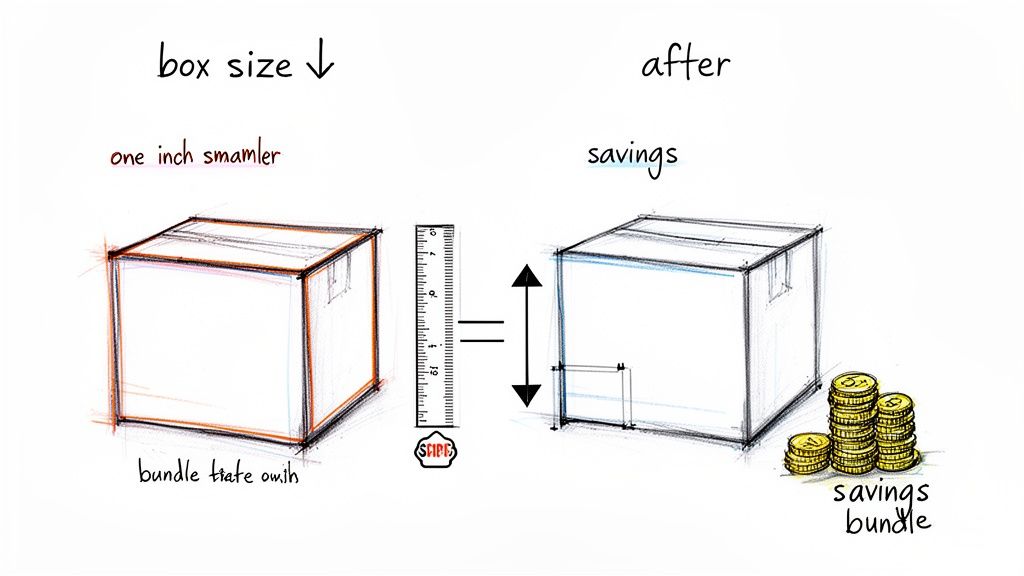
Your product's final dimensions and weight are the two factors that directly control your FBA fulfillment fee. A change that seems tiny—like shaving just one inch off your product's box—can be the difference between getting stuck in the "Large Standard" tier and slipping into the cheaper "Small Standard" tier.
This isn't a small adjustment; it's a foundational cost-saving strategy. A product that qualifies for a lower fee tier saves you money on every single unit sold, which can add up to thousands of dollars in savings over time.
Work with your supplier to design packaging that is as compact and lightweight as possible without risking damage. This simple conversation is one of the most powerful levers you can pull to manage your FBA costs.
You should also look into Amazon's Ships in Product Packaging (SIPP) program. If your product's own box is tough enough to ship without needing one of Amazon's brown overboxes, you can earn a straight-up discount on your fulfillment fee. It's a clear win-win, cutting your costs and reducing packaging waste.
Master Your Inventory Management
Slow-moving inventory is an absolute profit killer. As we've gone over, aged inventory surcharges (what we used to call long-term storage fees) can quickly turn a winning product into a money pit. The only way to avoid these penalties is through disciplined inventory management.
Here are a few best practices to live by:
- Forecast Your Demand: Use your sales history and seasonal trends to get a real sense of how much inventory you'll actually need. Never send in huge quantities based on a gut feeling, especially right before the Q4 peak season when storage fees skyrocket.
- Don't Be Afraid of Removal Orders: If a product just isn't selling, don't let it sit there collecting dust and fees. Create a removal order to have the inventory sent back to you. You can always try to sell it on another channel or liquidate it.
- Run Promotions to Clear Stock: Got too much of something? Use Amazon's built-in tools to run sales, create coupons, or set up a lightning deal to move that inventory before those long-term fees kick in.
Outsourcing some of these tedious tasks can free you up to focus on growing your business. For any seller looking to scale, exploring whether an Amazon prep company can save you time and money is a very smart move.
Leverage Bundling and Data-Driven Pricing
Another tactic I've seen work really well is product bundling. If you sell a few items that naturally go together, think about creating a bundle. Instead of paying two or three separate fulfillment fees, you'll pay just a single FBA fee for the whole package. This move lowers your total fulfillment cost per order and often boosts your average order value at the same time.
Finally, you need good data to price your products competitively without destroying your profits. By monitoring a product's price history, you can make much more informed decisions. For example, if the data shows a product averages $15 over 12 months and rarely drops below its current price, that signals a stable opportunity for a 30-35% profit per unit. This data-driven approach keeps you from overpaying for inventory and helps you confirm a product is actually viable for FBA in the first place.
Common Questions About FBA Pricing
Once you start digging into FBA, a few questions always seem to come up. Getting your head around the Fulfillment by Amazon price structure is make-or-break for your business, so let’s tackle the big ones I hear all the time.
Is FBA More Profitable Than FBM?
Ah, the classic FBA vs. Fulfillment by Merchant (FBM) debate. It really comes down to a trade-off. Sure, FBA fees are higher, but you get the all-powerful Prime badge, which can send your sales into another orbit.
A 2024 Baymard Institute survey found that 23% of shoppers ditch their carts because of slow shipping—a problem FBA was born to solve. With FBM, you get more control and avoid some fees, but you’re on the hook for everything: storage, packing, shipping, and customer service. For most sellers, the sheer sales velocity that comes with being Prime-eligible makes FBA the more profitable play, even with the higher costs.
How Often Does Amazon Change FBA Fees?
Amazon usually tweaks its fees once a year. They've already announced, for example, that FBA fees will see a small bump in 2026. You absolutely have to stay on top of this, because every little change hits your profit margins directly.
Make it a habit to check Seller Central for the latest fee schedule at the end of every year. This is the only way to accurately forecast your costs for the year ahead and avoid nasty surprises.
The biggest mistake you can make as a seller is assuming your costs are set in stone. Annual fee adjustments are just part of doing business with Amazon. The pros build these changes into their financial plans to ensure they stay profitable long-term.
What Are the Biggest Hidden Costs of FBA?
From my experience, the most painful "hidden" costs are almost always self-inflicted wounds from bad inventory management. The two biggest offenders are, without a doubt:
- Aged Inventory Surcharges: These are penalties for stock that just sits there. They can quickly turn a winning product into a money pit.
- Removal and Disposal Fees: The cost to either destroy your unsold inventory or have it shipped back to you can add up shockingly fast.
Dodging these surprise costs really boils down to one thing: smart forecasting. You have to know your numbers and be ready to act fast on products that just aren't moving.