

You probably already know what you want to sell.
Maybe it's women's basics, plus-size fashion, premium activewear, or a tighter niche like adaptive clothing. The sticking point is usually the same: you don't trust the suppliers you're finding. Every catalog looks polished. Every app promises automation. Every vendor says shipping is fast and quality is solid.
That's where most new clothing stores go wrong.
In apparel, your supplier isn't just a source of products. They control the parts of the customer experience that trigger refunds, chargebacks, bad reviews, and repeat purchases: sizing consistency, stitching quality, packaging, delivery speed, and returns handling. In other words, choosing dropship suppliers for clothing is less about browsing inventory and more about controlling risk.
That matters because clothing is already one of the most crowded product categories in dropshipping. Market.us News reports that clothing was the most popular dropshipped category with 532,185 products being dropshipped, while the global dropshipping market reached $286.4 billion in 2023 and is projected to reach $7,385 billion by 2025. Big market. Big opportunity. Also a lot of noise and a lot of weak operators.
Starting Your Search for Clothing Suppliers
If you're comparing random supplier lists and hoping one of them works out, slow down. The first pass should filter for fit, not excitement.

Start with your store model
Clothing suppliers make sense only in the context of the store you're building. A trend-heavy boutique needs different partners than a niche apparel brand built around fit, sizing confidence, and lower return risk.
I like to sort stores into three buckets before looking at suppliers:
- Catalog-first stores build around variety. They need broad selection, frequent product updates, and strong inventory sync.
- Brand-first stores care more about presentation. They need clean packaging, better photography, and tighter quality control.
- Niche-first stores win on clarity. They need suppliers that are reliable inside one segment, not average across everything.
If you skip this step, you end up judging suppliers by the wrong criteria. A vendor with a huge catalog can still be a bad fit if your whole business depends on consistent sizing and low return friction.
Use a risk filter before a product filter
Most beginners start with “What products can I list?” I think that's backward.
Start with these questions instead:
- Where do I want to ship?
- What shipping times can my customer tolerate?
- What kind of returns process can I realistically support?
- Can this supplier keep product data, variants, and stock levels clean?
- Can they support the customer experience I'm promising on-site?
Practical rule: If a supplier would make you nervous after your first 20 orders, they're the wrong supplier now.
That's one reason clothing dropshipping feels harder than other models. You're not just comparing prices. You're outsourcing fulfillment, quality control, and a piece of your reputation.
If you're still deciding which model fits your business, this comparison of Amazon FBA vs dropshipping is useful because it highlights the control trade-offs that show up fast in apparel.
What actually works
The stores that hold up usually do a few things early:
- They narrow the offer fast. Fewer SKUs make quality control easier.
- They choose suppliers by geography first. Shipping promises need to match warehouse reality.
- They think like operators. Fabric, labeling, packaging, and support matter as much as margin.
- They avoid generic fashion at the start. Broad catalogs look easy, but they create support headaches.
That's the mindset I'd use from day one. Treat dropship suppliers clothing as a supply chain decision, not a product hunt.
Where to Find Your First Clothing Supplier
There are three practical ways to find your first supplier. None is perfect. The right one depends on whether you value speed, uniqueness, or control.
The three sourcing channels
| Channel Type | Pros | Cons | Best For |
|---|---|---|---|
| Supplier directories | Easier discovery, organized supplier databases, useful for early research | Fees can add up, quality still needs independent vetting, many listings feel similar | Beginners who need a starting pool |
| Integrated apps | Fast setup, inventory sync, simpler order routing, easier catalog import | Product selection may be narrower, differentiation can be harder, platform dependence | Store owners who want operational simplicity |
| Independent suppliers | More unique products, better chance at niche positioning, stronger long-term relationships | More outreach, more manual setup, slower onboarding | Operators building a differentiated brand |
Directories are good for market mapping
Directories help when you need a structured list instead of a blank screen. They're useful for building a shortlist, comparing categories, and identifying suppliers that already understand dropshipping.
The downside is that directories don't remove the hard part. They just make discovery easier. You still have to vet communication quality, shipping consistency, and return handling yourself.
If you're considering that route, this SaleHoo review gives a clear look at how one directory model works and where it fits.
Integrated apps are easier, but they compress your edge
Apps connected to Shopify or WooCommerce can save a lot of time. Product import is cleaner. Inventory updates are simpler. Order routing is more predictable.
That convenience comes with a trade-off. When lots of stores pull from the same ecosystems, the product layer gets commoditized fast. You can still build a good business this way, but your offer has to stand on something other than “we sell cute clothes.”
Independent suppliers take more work and usually produce better businesses
Independent sourcing is slower. You'll spend more time on email, calls, sample orders, and spreadsheet cleanup. But if you want a store that doesn't look interchangeable, this path is often stronger.
Places to look include:
- Trade shows: Good for meeting apparel reps and testing professionalism in person.
- B2B marketplaces: Useful for finding manufacturers and distributors outside app ecosystems.
- Social platforms: Brand owners and smaller wholesalers often showcase product lines there before they show up in mainstream directories.
- Direct brand outreach: Sometimes the best “supplier” is a brand open to retail partnership.
Generic catalogs create generic stores. In clothing, that usually means more price competition and more returns.
That's why I'd bias toward niche suppliers early. Minea notes that successful dropshippers often target higher-margin niches like adaptive clothing, premium sportswear, or plus-size fashion, and that sourcing from specialized brands instead of commodity marketplaces can reduce return risk and build trust.
Pick the channel that matches your strategy
If you want the fastest path to launching, use an app. If you want a broad research base, use a directory. If you want a stronger moat, do direct outreach and build supplier relationships the slower way.
For most clothing stores, I'd rather launch with fewer products from a tighter niche supplier than import a giant catalog I can't defend.
The Ultimate Supplier Vetting Playbook
Finding suppliers is easy. Rejecting most of them is the key skill.

The reason this part matters so much is simple. GetCarro cites that 84% of e-commerce entrepreneurs say finding a reliable supplier is their biggest challenge, and it recommends a multi-step QA process that includes shortlisting by automation, ordering samples, testing shipping against stated SLAs, and clarifying return policies before committing.
I agree with that completely. In clothing, supplier vetting is quality assurance.
Build a scorecard before you contact anyone
Don't evaluate suppliers from memory. Use a sheet.
Mine would include columns for:
- Response speed
- Response clarity
- Integration method
- Warehouse location
- Declared ship time
- Actual sample delivery time
- Product quality notes
- Sizing consistency
- Packaging quality
- Return terms
- Damaged item process
- Tracking quality
- Documentation availability
This does two things. It forces apples-to-apples comparison, and it stops polished sales reps from winning on vibe alone.
What to ask in first contact
The first message should be short and operational. Don't ask generic questions like “Do you do dropshipping?” Ask things that expose process quality.
Here's the kind of info I want immediately:
- Fulfillment workflow for new orders
- How inventory updates are shared
- Average handling time
- What happens if an item is out of stock after purchase
- Return and damaged-item policy
- Whether they provide tracking automatically
- Whether they can share fabric composition, care details, and size charts
A strong supplier usually answers directly. A weak one gives vague marketing language.
Watch for this: If you have to ask the same question twice before you've even placed an order, support will get worse after you start sending customers.
For an additional starting list of supplier options and beginner context, Skup's guide for dropship beginners is worth scanning before you begin outreach.
Order samples like a skeptical customer
Most bad suppliers fail at this point.
Don't order one sample and call it done. Order multiple products if the supplier offers multiple categories. If possible, send them to different addresses so you can observe shipping reliability from more than one angle.
Check the sample in layers:
- Fabric feel: Does the product match the positioning you want?
- Stitching and finish: Loose threads and inconsistent seams usually predict complaint volume.
- Sizing: Compare actual garment measurements to the published chart.
- Color accuracy: Listing photos can hide major mismatches.
- Packaging: The unboxing experience affects perceived quality.
- Labeling: Missing or sloppy tags are a red flag.
This video gives a helpful visual overview of supplier evaluation in practice.
Test what they say against what they do
A supplier can claim almost anything. Your job is to verify it.
I'd run at least these checks:
- Shipping test: Compare promised handling and delivery against the actual timeline.
- Support test: Send a pre-sales question and a post-order question. See whether both get answered well.
- Returns test: Ask for the exact workflow. Don't accept vague wording.
- Variant test: Confirm that size and color data are clean and consistent.
- Stock test: Ask how they handle inventory mismatches and oversells.
Red flags that usually don't improve
Some problems get better with onboarding. These usually don't:
- Inconsistent answers from different reps
- No clear SLA language
- Missing size charts or poor product specs
- Weak tracking communication
- Complicated or punitive return handling
- Slow responses before you've sent them revenue
My rule is simple. If I already need to create workarounds for a supplier before launch, I move on.
Managing Pricing Margins and Integrations
A lot of new store owners think supplier selection ends once the sample looks good. It doesn't. The next failure point is math.
Clothing can sell well and still leave you with very little profit if your landed cost is off by a few dollars, if returns are underestimated, or if your supplier creates manual work in the backend.
Know your real margin
That's why I treat pricing as an operations problem, not a branding exercise.
Your price has to cover more than product cost. For clothing, I'd calculate margin from:
- Supplier item cost
- Shipping cost
- Platform fees
- Payment processing
- Ad spend
- Refund and return leakage
- Discounting
- Support time if the supplier creates extra tickets
If you ignore even one of those, your “good” margin can disappear fast.
Stores don't usually fail because the product margin looked terrible on paper. They fail because the owner priced off supplier cost and forgot the rest of the stack.
Build the backend before you scale traffic
A lot of stores push ads before their catalog and order flow are stable. That's backwards.
I want three operational basics locked down before I spend harder on acquisition:
- Inventory sync that's reliable
- Automatic order forwarding
- Tracking updates that reach the customer without manual chasing
How you set that up depends on the supplier. Usually it falls into one of three buckets.
Three common integration setups
App-based integration
This is the simplest route. Supplier apps usually handle product import, stock sync, order transmission, and tracking updates inside the same workflow.
It's convenient, but you still need to audit listings after import. Variant names, sizing labels, and image order often need cleanup.
CSV or feed-based integration
Some suppliers send spreadsheets or feed files instead of offering native apps. This gives you more control, but it creates more room for mistakes.
This model can work well for tighter catalogs. It's less ideal if the supplier updates styles frequently and your team can't manage product data closely.
API or custom connection
This is the cleanest setup when the supplier is strong and your store is growing. It takes more technical work up front, but it gives you more control over inventory, order routing, and data consistency.
I wouldn't force this early unless the supplier relationship clearly justifies it.
What I'd check after connecting a supplier
Before going live, run a mini preflight:
- Place a test order: Confirm it reaches the supplier correctly.
- Verify tracking flow: Make sure the customer receives updates.
- Audit variant mapping: Sizes and colors need to display exactly right.
- Review out-of-stock behavior: Check what happens when inventory changes.
- Inspect product pages: Fabric details, care notes, and fit guidance should be accurate.
If you need tool options for that stack, EntreResource's roundup of dropshipping software covers platforms that connect stores with suppliers and handle syncing, routing, and related workflows.
Pricing decisions that hold up better
For clothing, I'd rather sell a smaller line with cleaner economics than chase volume through thin-margin catalog sprawl.
That often means:
- Cutting weak SKUs fast
- Avoiding products with unclear fit
- Favoring niches where product descriptions can reduce return friction
- Passing on suppliers that add hidden operational cost
Good integrations save time. Good margin discipline keeps the store alive.
Navigating Legal and Compliance Requirements
Most apparel sellers spend more time picking homepage colors than checking whether their supplier can support compliant labeling. That's backwards.
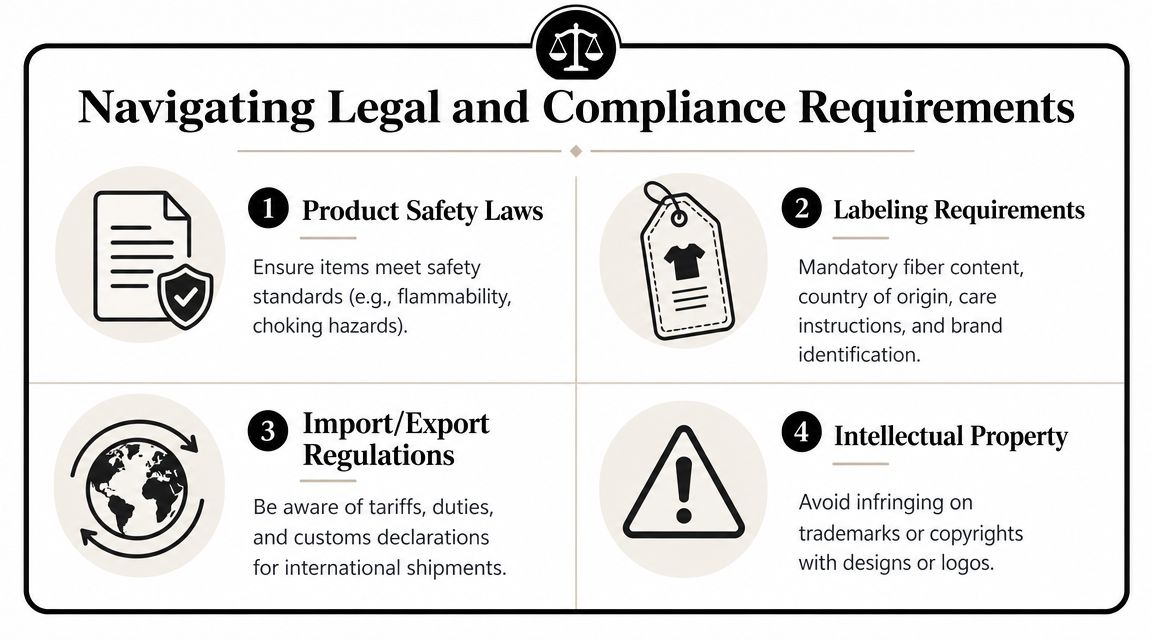
Clothing isn't just a merchandising category. It's a regulated one. If you're selling across borders, this becomes a core business risk, not a legal footnote.
The seller usually carries the risk
That last part is the one people miss.
If your supplier can't provide clean documentation, you're the one exposed. Marketplaces can suspend listings. Customers can file complaints. Regulators won't care that a factory rep told you everything was fine.
What to request from suppliers
I wouldn't onboard a clothing supplier without asking for documentation support around:
- Fiber composition details
- Care instructions
- Country-of-origin information
- Product safety and traceability records where relevant
- Consistent labeling practices across variants
- Clarity on who acts as the economic operator where required
This is especially important if you plan to sell into the EU, UK, and US at the same time. Requirements differ, and “we've sold internationally before” is not a compliance process.
Compliance is part of supplier quality. If a supplier can't support labeling and traceability, they are not operationally reliable for apparel.
The practical compliance filter
I like a simple test. Ask yourself whether the supplier helps you answer these questions quickly:
| Compliance Check | What you need to know |
|---|---|
| Product identity | Can you clearly identify the exact item and variant being sold? |
| Labeling support | Can the supplier provide the information needed for fiber, origin, and care disclosures? |
| Traceability | Can you trace where the item came from if there's a safety issue or complaint? |
| IP risk | Are you certain the product, branding, and designs don't create obvious infringement problems? |
If the answer is fuzzy, the supplier isn't ready.
Don't bolt compliance on later
In apparel, listing pages, labels, packaging, and documentation all connect. If you try to fix compliance after you've already uploaded hundreds of products, you create expensive cleanup work.
I'd rather reject a supplier early than rebuild a store around missing documentation later.
Scaling Your Business and Managing Supplier Relationships
Once orders start coming in, the job changes. You're not just sourcing anymore. You're managing a supply network.
That shift matters because the stores that last don't scale by adding more random suppliers. They scale by tightening the parts that create resilience: backup sourcing, cleaner communication, stronger margins, and better customer retention.
Add depth before you add breadth
Your first scaling move usually shouldn't be doubling the catalog. It should be reducing dependency.
If one supplier handles your bestselling category, I'd start looking for a backup before you urgently need one. A second supplier can protect you from stockouts, shipping disruptions, and sudden policy changes. You don't need to split volume evenly. You need optionality.
Good supplier relationships also get easier when you behave like a serious operator:
- Share clean forecasts: Even rough expectations help suppliers plan.
- Document recurring issues: Specific examples lead to faster fixes.
- Consolidate communication: One point of contact reduces confusion.
- Review performance regularly: Look at returns, delays, and product complaints by supplier.
Negotiate when your data supports it
Don't ask for better terms just because you've placed a few orders. Ask when you can show that your store sends consistent volume and low-friction business.
At that point, it's reasonable to discuss:
- Better unit pricing
- Priority handling
- Improved packaging
- Expanded access to inventory
- Faster issue resolution channels
The best conversations are operational, not emotional. Show order consistency, support data, and where process improvements would help both sides.
A strong supplier relationship feels boring in the best way. Orders flow, issues get resolved fast, and nobody needs drama to keep things moving.
Know when to evolve beyond pure dropshipping
Some apparel stores hit a ceiling with standard dropshipping. That's normal.
A few paths tend to make sense:
- Print-on-demand for branded designs if custom identity matters more than broad catalog depth.
- Hybrid inventory for your proven winners if you want more control over margins and shipping.
- Brand partnerships if your niche responds better to trust and curation than endless product volume.
I usually see the best long-term results from stores that start lean, validate demand, then move their top performers into a model with more control.
Retention matters as much as sourcing
A resilient clothing business doesn't depend only on the supplier. It also depends on keeping the customers you've already paid to acquire.
That means reducing friction across the whole buying journey, especially checkout and post-purchase communication. If you want practical ideas there, these strategies for abandoned carts are a useful complement to supplier-side improvements.
In the end, good dropship suppliers for clothing don't build the business by themselves. But bad ones can break it fast. Pick suppliers like a risk manager, not a catalog browser, and you'll make better decisions from day one.
If you're building a clothing store now, keep the first version tight. Choose a niche that's easier to describe, easier to support, and easier to source well. Vet suppliers like they're part of your team. In apparel, they are.