

You’re probably in one of two places right now. You spotted something cheap at Target or Walmart and wondered if it sells for more on Amazon, or you’ve already watched a few arbitrage videos and realized most of them skip the part that matters: the math, the restrictions, and the operational grind.
That’s where most beginners get hurt.
Arbitrage on amazon isn’t hard because the concept is complicated. It’s hard because the easy story, buy low and sell high, leaves out the details that decide whether a deal makes money or drains your cash. Fees get missed. Restrictions get ignored. A product looks profitable at the shelf and turns mediocre once returns, prep, and price competition hit.
I’ve always looked at arbitrage as a system, not a hustle. The people who last treat sourcing, analysis, prep, and replenishment like a repeatable workflow. The people who fail usually shop on instinct, chase random clearance tags, and only discover the actual costs after inventory lands at FBA.
Your Guide to Amazon Arbitrage
You scan a clearance item at $12, open the Amazon listing, and see a $34.99 buy box. New sellers often stop there and call it profit. Experienced sellers keep going.
I treat arbitrage on amazon as a margin business built on fast decisions and clean math. The buy price matters, but it is only the first line on the spreadsheet. A product can look great in the aisle and still turn into a weak buy once referral fees, fulfillment fees, storage, prep, returns, and price drops hit the listing.
That board game example is a good illustration. A $12 cost against a $34.99 sale price can work if the fees stay in line and the listing has healthy turnover. It can also fail if the buy box drops, if the item sits too long, or if the ASIN is crowded with sellers racing each other down. The spread gets beginners excited. Net profit and sell-through decide whether the buy deserves capital.
What arbitrage actually means in practice
Arbitrage usually runs through two sourcing models:
- Retail arbitrage: buying from physical stores such as Target, Walmart, Walgreens, and local chains
- Online arbitrage: buying from retail websites, then routing inventory to your home, a prep center, or Amazon
The model is simple. The operation is not.
If you want a clean primer on the model itself, Million Dollar Sellers has a solid explanation of how retail arbitrage works that matches how serious sellers approach sourcing.
The hard part is not finding a lower price somewhere else. The hard part is validating the full deal before cash leaves your account. I want clear answers on five points before I buy anything: can I sell the brand, does the listing have steady demand, how many FBA sellers are already on it, what does the price history look like, and what margin is left after every cost I can reasonably expect?
That filter saves money.
A cheap product is only cheap. A real arbitrage buy has demand, room after fees, and a listing structure you can compete in.
Beginners usually lose in one of two ways. They buy on excitement and ignore restrictions, or they buy on spread and ignore operating costs. Both mistakes lead to inventory that ties up cash, gets repriced into nothing, or never gets listed at all. The sellers who last build a repeatable process around validation first, purchase second.
The Arbitrage Landscape in 2026
You scan a product in a clearance aisle, see a healthy spread, buy 20 units, and get home feeling good. Then the listing goes restricted, three more FBA sellers jump on at a lower price, and the profit disappears before the shipment is even built.
That is what trips up beginners in 2026. The model still works. Sloppy buying does not.
A lot of sellers still talk about arbitrage on amazon as if the whole business comes down to finding low prices. In practice, the market rewards operators who can validate fast, buy selectively, and protect margin after fees, prep, shipping, storage, and repricing pressure. As noted earlier, seller competition has shifted since the 2021 peak. That creates room, but only for sellers with a tighter process than the average scanner-and-hope approach.
Retail arbitrage versus online arbitrage
I treat retail arbitrage and online arbitrage as separate operating systems because the failure points are different.
| Model | How it works | Best use case | Main drawback |
|---|---|---|---|
| Retail arbitrage | Buy in physical stores and scan shelves in person | Local markdowns, store-specific clearance, low-competition test buys | Time-heavy and hard to repeat at scale |
| Online arbitrage | Buy from retail websites and resell on Amazon | Repeatable sourcing, wider reach, easier replenishment | Faster competition and thinner margins on obvious deals |
Retail arbitrage is useful because local stores produce imperfect pricing. One Walmart can be dead. Another 20 minutes away can have profitable clearance nobody else touched. Online arbitrage is better once you care about repeat buys, cleaner records, and larger purchase volume.
I still use both. Retail helps me find overlooked one-off deals. Online is better for building a buying routine that does not depend on driving store to store. If you want a practical overview of the software side, this guide to online arbitrage sourcing tools and programs is a helpful reference.
What is legal versus what gets sellers suspended
New sellers often ask the wrong question. They ask whether arbitrage is legal. The better question is whether a specific product is safe to sell on Amazon under the current rules.
Buying genuine products from legitimate retailers and reselling them is a common business model. The bigger risk sits inside Amazon’s system. Brand gating, category restrictions, invoice standards, authenticity complaints, and listing condition issues can all turn a profitable buy into stranded inventory.
This is why I separate “can I buy it?” from “can I hold it without trouble?” A product can be authentic, profitable on paper, and still be a bad decision if the brand is aggressive with complaints or the listing has a history of sellers getting pushed off.
One useful perspective, especially for founders building broader retail operations outside the US, is to understand how the selling stack fits together across regions. If you’re comparing marketplaces and infrastructure options, Founder Connects has a practical roundup of essential e-commerce solutions for UAE startups that helps frame the wider picture.
Key policy risks in 2026
The operational risk in 2026 is simple. Amazon expects cleaner documentation and tighter compliance than a lot of beginner content suggests.
I have seen new sellers lose money in three predictable ways. They buy first and check gating later. They source products from retailers whose receipts will not help if a complaint hits. Or they chase a high ROI number without checking price stability and seller count.
The trade-off looks like this:
- Ungated listings are easier to enter, but they usually fill up fast with sellers who found the same deal.
- Restricted brands or categories can show strong margins, but approvals and documentation decide whether those margins are usable.
- Brand-sensitive listings carry higher friction even with genuine inventory, because complaints and listing removals tie up cash and time.
That is why experienced sellers focus on sellable margin, not spreadsheet margin. I care less about the headline spread and more about what is left after every predictable cost, plus the probability that I can list, sell, and get paid without an account health problem.
Your Startup Checklist and Tool Stack
A new seller usually loses money before the first payout for a simple reason. The setup looks cheap, so they treat the process casually.
They open an account, scan a few clearance items, and assume profit will sort itself out later. Then the hidden costs show up. Bad buys. Missing prep supplies. Time lost on listings they cannot sell. Cash tied up in inventory that looked good on the shelf and weak in Seller Central.
A workable arbitrage setup does not need much. It does need discipline. I would rather see a beginner start with a tight system and a modest budget than spend aggressively with no process.
The core setup I’d build first
Start with enough capital to test several SKUs, absorb mistakes, and keep cash available for replenishment. If the budget is too small, every buy feels high pressure, and that is when beginners force marginal deals. I prefer a starting budget that covers inventory, prep supplies, shipping, and a reserve for returns or stranded stock.
The account setup is straightforward. The workflow is what matters.
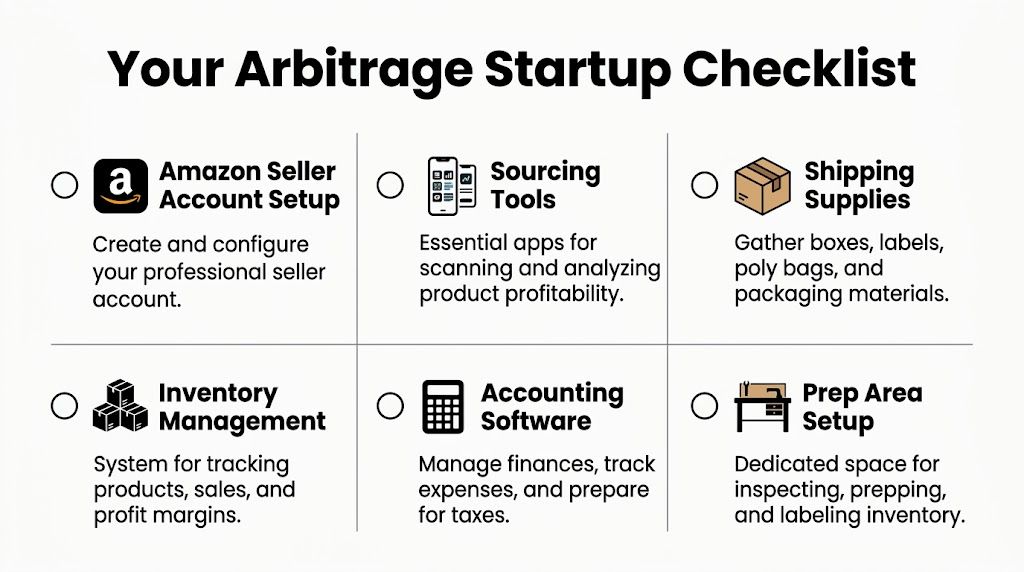
Build around five basics:
- Seller account access. A professional seller account makes sense if you plan to list consistently and want clean reporting.
- A mobile scanning workflow. You need fast checks for eligibility, fees, and listing quality while standing in the aisle.
- Price history software. Current price alone is not enough to judge a buy.
- Prep supplies. If inventory is not labeled and packed correctly, you pay for the mistake in delays, fees, or removals.
- Basic bookkeeping. Margin on paper and cash in the bank are often two different stories.
Tools that actually matter
I keep the stack simple at first because tools only help if they answer a buying question fast.
Amazon Seller App
This is the first filter. I use it to check whether I can sell the item, review fee estimates, and confirm I am looking at the correct ASIN. That alone prevents a lot of bad buys.
Scoutify or a similar scanning app
A dedicated scanner matters when you are moving through a store quickly. Speed is not about scanning everything. Speed is about rejecting weak deals before you waste ten minutes trying to justify them.
Keepa
Keepa is the tool that separates shelf excitement from real analysis. I check price stability, seller count, Buy Box behavior, and whether Amazon has a habit of jumping onto the listing. If the chart is unstable, the spread on today’s scan can disappear by the time the shipment checks in.
If you want a broader breakdown of software options, EntreResource has a useful guide to online arbitrage sourcing tools and programs.
What works: checking the chart before buying quantity.
What fails: treating the current Buy Box as a reliable future selling price.
Repricer
A repricer is not my first software purchase, but it moves up the list once inventory starts turning. Manual repricing gets sloppy fast. It also wastes time you should spend sourcing and reviewing replenishment leads.
Physical supplies sellers forget until they need them
Software gets attention because it feels like the business. The prep table is where bad organization starts costing money.
Keep these on hand from day one:
- Poly bags for products that need protection or bundle containment
- Labels for FNSKU placement
- Boxes in a few practical sizes
- Tape and dunnage to protect shipments in transit
- A reliable printer setup so labeling does not slow down the whole batch
I also like a dedicated work surface and a simple intake routine. Purchased items go in one spot. Unlisted inventory goes in another. Ship-ready units go in a third. That sounds basic, but it cuts down on mislabels, duplicate buys, and inventory that sits for a week because it disappeared into a corner.
Restriction checks belong in the buying process
Restriction checks are not a side task. They are part of the sourcing system.
My sequence is simple:
- Scan the product.
- Confirm I am eligible to sell it.
- Review the listing for obvious brand, condition, or compliance issues.
- Check fees, price history, and seller count.
- Decide quantity last.
Beginners often reverse that order because the discount tag creates urgency. That is how capital gets trapped in inventory they cannot list, cannot replenish safely, or should never have bought in the first place.
The right startup stack does one job well. It helps you reject bad inventory early and protect cash while you learn. That is the part beginners miss. Arbitrage is not hard because the concept is hard. It is hard because the math and the workflow punish sloppy decisions.
The Sourcing Workflow Finding Profitable Products
You are in a clearance aisle with a full cart, the stickers look great, and the math still fails. That is the part new sellers underestimate. The spread on the shelf is not the profit in your bank account.
I source with one question in mind. Does this ASIN deserve cash and prep time? A product can look cheap and still be a bad buy because the listing is unstable, the seller count is ugly, the price history is weak, or the margin disappears after fees and returns.
My retail sourcing pass
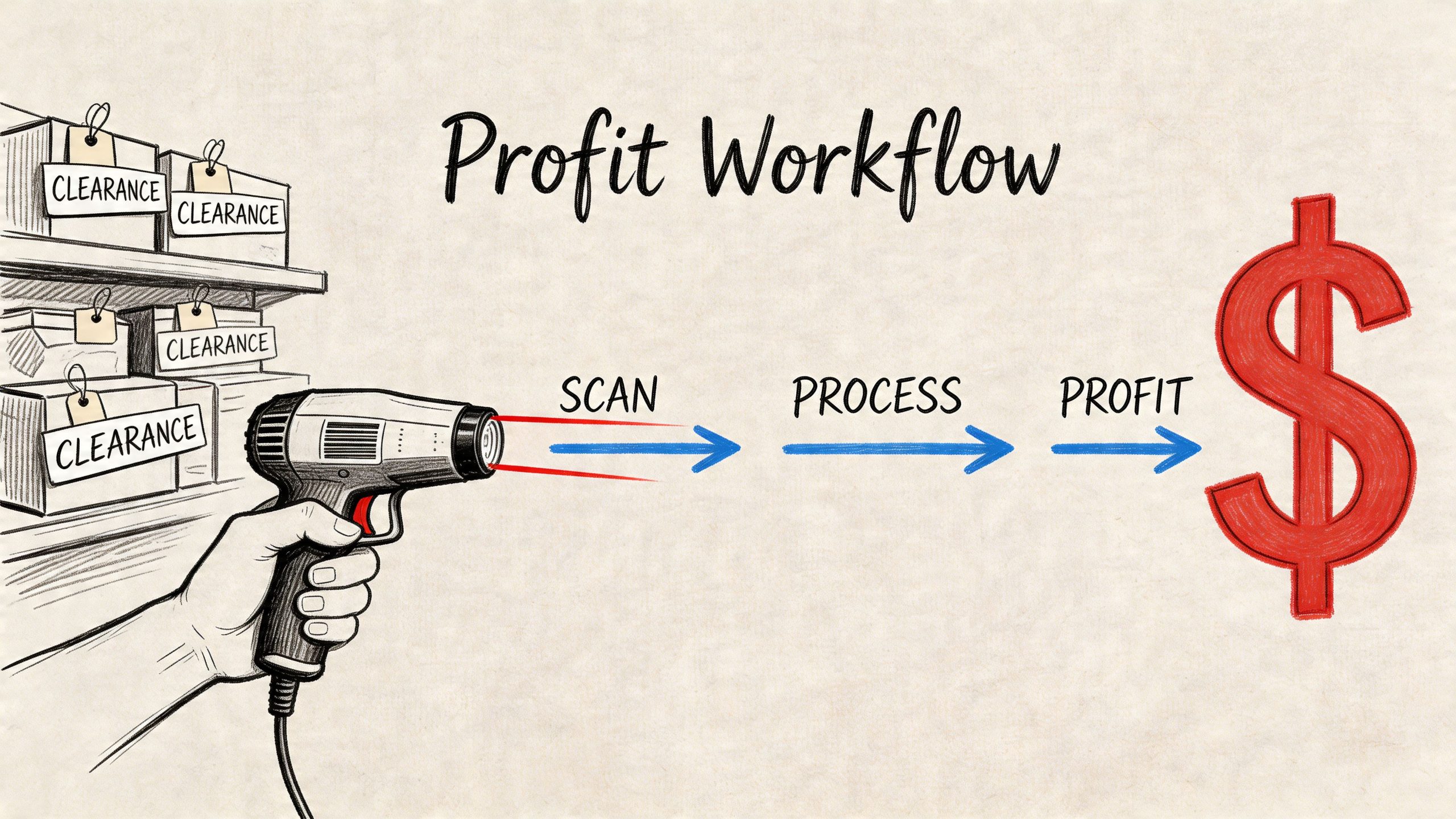
In a store, I want a fast first pass and a strict second pass.
The first pass is simple. I scan categories that regularly produce markdowns and replenishable demand, such as toys, games, seasonal, home, beauty, and some office products. I am not trying to prove a product is great. I am trying to reject weak leads fast.
My first screen is practical:
- Am I approved to sell it?
- Does the listing show signs of real demand?
- Is there enough margin left after fees to justify a closer review?
If a product survives that screen, I run full unit economics. I subtract buy cost, referral fees, FBA fees, storage, prep costs, and a return allowance. That last line gets skipped all the time, and it makes weak buys look profitable.
A simple board game example shows why this matters. A unit bought for $12 and sold for $34.99 does not leave a $22.99 profit spread. After fees and storage, the remaining profit is much smaller.
The board game example done the right way
This is the math I want before I buy depth:
| Item | Amount |
|---|---|
| Buy cost | $12 |
| Amazon sale price | $34.99 |
| Referral fee | $5.25 |
| FBA fee | $5.92 |
| Storage fee | $0.32 |
| Net profit | $11.50 |
That is business math. Shelf math gets sellers in trouble.
I also want margin buffer. If the listing drops a few dollars after I ship, I still need a profit worth the labor and the risk. In practice, that means I pass on a lot of items other sellers get excited about. The items I leave behind are often the reason my cash stays liquid.
If you want more store-first tactics, this guide to Amazon retail arbitrage lines up well with the sourcing standards I use.
Calculate profit after friction, not before it.
Reading demand without guessing
Margin alone is not enough. Slow inventory ties up cash, increases storage exposure, and creates more chances for the price to slide before you sell.
I use BSR as a filter, not a decision. Lower rank can indicate stronger sales velocity, but I still want to see the listing history in Keepa before I buy. A common beginner mistake is to stop at the current Buy Box and assume the offer will hold.
On Keepa, I look for four things:
- A price history that is reasonably stable
- Clear signs of regular sales activity
- Seller count that I can live with
- No obvious pattern of Amazon jumping in and crushing the price
That review changes buying decisions fast. A product with a decent spread and a bad chart is still a bad buy.
Here’s a useful visual walkthrough before going further:
My online arbitrage workflow
Online arbitrage removes the travel, but it adds matching errors, stock issues, canceled orders, and a bigger temptation to buy too much because the cart fills quickly.
My workflow is straightforward:
- Start with a retailer or category that produces frequent discounts.
- Match the product to the correct Amazon listing with care.
- Check Keepa before spending time on detailed analysis.
- Run full profit math.
- Place a small test order unless the listing is unusually clean.
I also use reverse sourcing. I study sellers who stay active in categories I understand, then track the types of products and retailers that show up in their storefronts. It does not replace analysis. It shortens the search and helps me avoid random product hunting.
What beginners get wrong most often
The same mistakes show up over and over because the hype around arbitrage is too simple. Buy low, sell high sounds easy. The core of the business is listing quality, fee control, inventory turn, and disciplined quantity decisions.
These are the errors that usually hurt profit first:
- Trusting the current Buy Box without checking price history
- Buying too many units on the first order
- Ignoring seller count because the gross spread looks good
- Skipping return allowance and overstating margin
- Making quantity decisions while standing in an emotional buying environment
My rule is consistent. Check eligibility first, then demand, then competition, then real profit, and only then decide quantity. That order protects cash. It also turns sourcing from bargain hunting into a repeatable system.
From Purchase to Payout Logistics and Listing
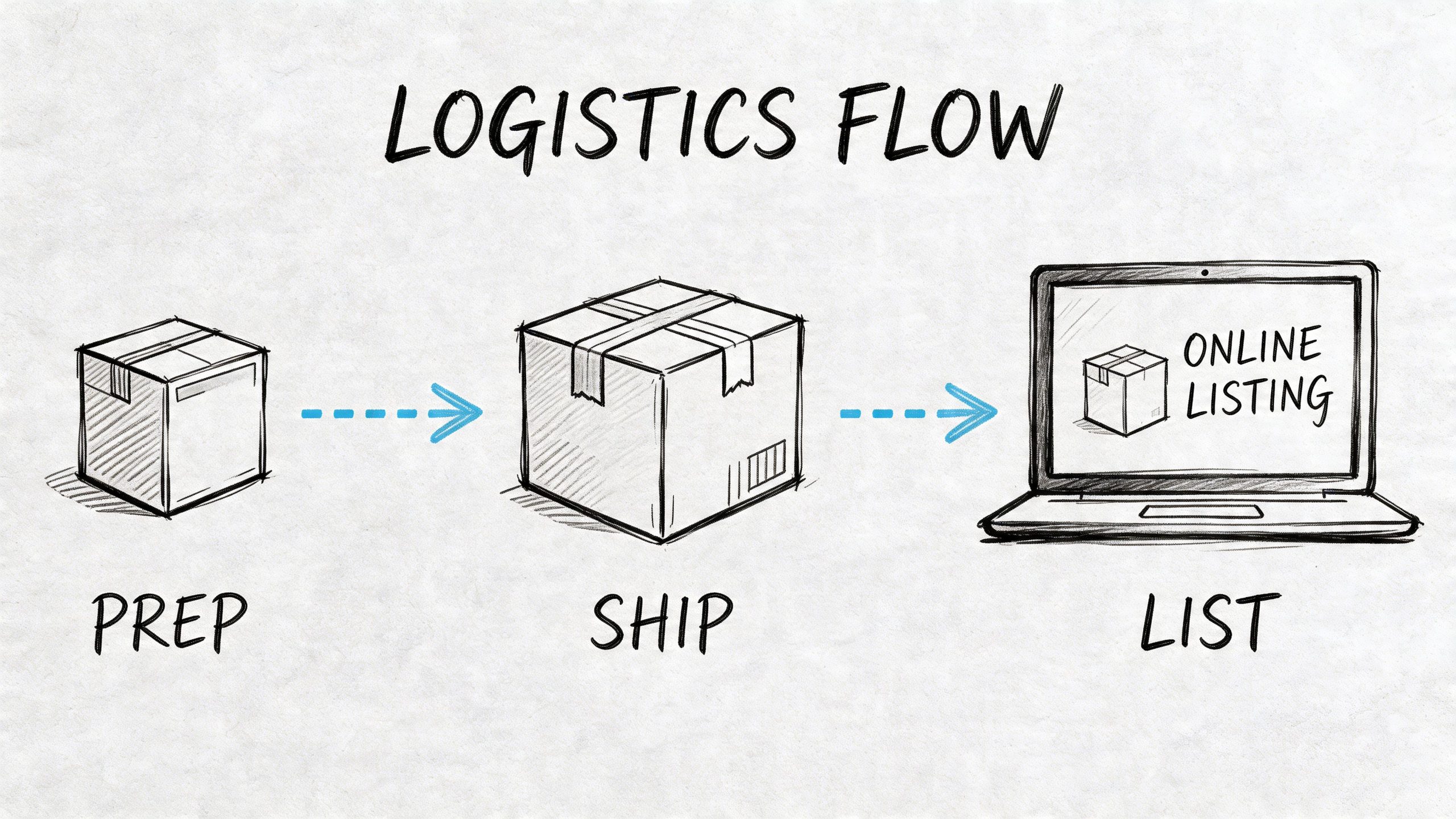
A profitable buy isn’t finished when you tap “purchase” or load a cart. It’s finished when inventory is prepped correctly, received cleanly by Amazon, priced well, and sold without avoidable friction.
That’s why logistics matters more than most new sellers expect.
Why I prefer FBA for arbitrage
You can sell arbitrage products through FBM or FBA. For most standard products, I prefer FBA because it handles fulfillment, keeps the operation cleaner, and matters heavily for conversion.
Verified guidance from The Selling Guys notes that proper prep plus Amazon’s partnered UPS rates can save 30% to 50% on shipping costs, and that shipping to FBA is critical because it is a key factor in winning the Buy Box, which accounts for over 70% of sales on a given product in their online retail arbitrage analysis.
That Buy Box point is the one that changes the economics. On many listings, you’re not just trying to be listed. You’re trying to be the offer customers buy.
Prep is where sloppiness gets expensive
Amazon doesn’t care that you found a good deal. It cares that the item arrives in the required condition and format.
My prep routine is simple:
- Inspect every unit for damage, sticker residue, crushed corners, or missing components.
- Apply the correct label if the inventory requires it.
- Poly-bag when the item needs protection or containment.
- Pack tightly enough to prevent movement without creating a mess on receipt.
What doesn’t work is rushing prep because the sourcing trip felt like the hard part. Prep errors create delayed check-in, customer complaints, or stranded inventory.
Field note: The cheapest inventory can become the most expensive inventory if prep mistakes create returns or condition complaints.
Listing and pricing with discipline
Most arbitrage sellers join existing listings, so the listing work isn’t usually about copywriting. It’s about accuracy and pricing.
I price with these priorities in mind:
- Stay competitive enough to rotate inventory
- Protect the minimum margin threshold
- Avoid racing to the bottom with reactive manual cuts
If a listing only works when you undercut aggressively, I usually pass. Thin-margin arbitrage creates too many chances for a small fee shift, return, or seller influx to erase the profit.
A clean shipment workflow in Seller Central also matters. Build the shipment, confirm prep requirements, label correctly, box inventory by plan, then send through the partnered carrier. Once units are live, monitor whether your price is competitive and whether the listing still behaves the way your pre-buy analysis suggested.
Scaling Your Arbitrage Business
A small arbitrage operation usually hits the same ceiling. One person can source, prep, and ship for a while. Then the owner becomes the bottleneck.
Scaling means removing yourself from the repetitive parts without removing yourself from the buying standards.
Reinvest before you get fancy
The first growth lever is still capital discipline. Arbitrage compounds when profits go back into inventory that turns cleanly.
I’d rather see a seller grow with tighter buying rules than force growth with bigger, weaker orders. The sellers who last usually get boring before they get big. They buy proven patterns again and again.
Add automation where it saves decisions
The first software upgrade I care about is a good repricer. If you’re live on enough listings, manual pricing turns into lag. Lag costs sales.
The second upgrade is deeper sourcing software. Tools that scan retail websites at scale can surface leads faster than a human can. They don’t replace judgment, but they reduce the time spent hunting. If you’re evaluating that route, EntreResource’s review of Tactical Arbitrage is a useful place to compare what the software helps with.
Delegate tasks, not standards
A lot of sellers hire too early and then blame the VA. The problem usually isn’t the VA. It’s that the owner never created a clear sourcing standard.
The right order is:
- Build your own buying framework first
- Write down what a good deal looks like
- Show examples of accepted and rejected listings
- Then hand off parts of the process
That’s how VAs become force multipliers instead of noise generators.
Prep centers work the same way. They’re useful when local receiving and shipping starts eating too much time. But a prep center doesn’t fix bad sourcing. It only removes the physical handling step.
Scale doesn’t come from touching more inventory yourself. It comes from making fewer decisions that only you can make.
What a scalable arbitrage business actually looks like
A scalable operation usually has these traits:
- A sourcing filter that rejects weak deals fast
- A repeatable prep process that another person can follow
- A pricing system that doesn’t depend on constant manual changes
- A replenishment list of products worth checking again
- Clear cash discipline so inventory growth doesn’t outpace liquidity
The biggest shift is mental. You stop asking how many products you can find today and start asking which workflows keep producing profitable inventory without your full attention every hour.
Frequently Asked Questions about Amazon Arbitrage
What is a realistic profit margin for arbitrage on amazon
A beginner buys a product for $20, sees it selling for $35, and assumes there is plenty of room. Then Amazon fees, inbound shipping, prep costs, and a price drop take most of the spread. That is where new sellers get burned.
The target I use is simple. I want enough room after every real cost, not just a pretty gap between buy price and current sale price. For a standard arbitrage buy, many sellers use a floor of 30% ROI and $5 net profit per unit. That keeps small mistakes from turning a winning-looking deal into dead inventory.
The online arbitrage example in Seller Assistant’s OA guide illustrates the correct approach: a Lego Star Wars set bought for $30 and resold for $60 can still net $20 profit per unit after about $10 in fees and shipping. The lesson is not “find items that double.” The lesson is “run the full math before you buy.”
Can I do it without FBA
Yes, you can run FBM, and some sellers build good businesses that way.
I still treat FBA as the default for most arbitrage inventory because it removes a lot of operational drag. Amazon handles fulfillment, the offer usually competes better, and the workflow is easier to repeat at scale. FBM fits better when products are oversized, slow-moving, meltable, fragile, or likely to rack up storage costs that ruin the margin.
If you are new, simpler usually wins.
What gets new sellers suspended most often
Suspensions and account health problems usually start with buying first and checking later. The common triggers are:
- Restricted categories or brands
- Inauthenticity complaints
- IP complaints from brands
I handle this with a boring system, because boring systems protect accounts. Check eligibility before purchase. Keep clean receipts and invoices. Avoid listings with obvious red flags like brand conflict, messy detail pages, or a history of seller complaints. A skipped check can cost far more than the profit on the deal.
How much money should I start with
Start with enough cash to test several products, make a few mistakes, and still have money left to reorder winners. The right amount depends on your buy costs, prep method, and how fast your inventory turns.
What matters more than the starting number is cash discipline. New sellers often tie up too much money in one “great” find, then cannot restock the products that were proven. I would rather see a smaller bankroll spread across careful test buys than a larger bankroll burned on overconfident volume. That is the operational side beginners miss. Arbitrage works best when inventory decisions and cash decisions follow the same rules.