

You open Helium 10 or Jungle Scout, type in a product idea, and within ten minutes you’ve got a spreadsheet full of “opportunities.” Resistance bands. Drawer organizers. Car trash cans. Silicone anything. Everything looks viable until you look closer, and then nothing feels safe enough to buy.
That’s where most sellers stall.
Good amazon fba product research isn’t a list of random filters. It’s a risk-reduction system. You’re not trying to find a magical product no one else has seen. You’re trying to move one product from “interesting” to “validated” without lying to yourself about demand, competition, margins, or operational headaches.
I’ve seen the same pattern over and over. New sellers chase products that look hot on a dashboard, skip the ugly work underneath, and place inventory on hope. Experienced sellers do the opposite. They kill weak ideas quickly, pressure-test the survivors, and only source products that still look solid after every assumption gets challenged.
Why Your Amazon FBA Success Hinges on Product Research
The hardest part of starting on Amazon isn’t opening a seller account. It’s trusting a product enough to wire money for inventory.
That decision used to be easier. The marketplace had more slack in it. A decent listing and average sourcing could still carry a mediocre product for a while. That window has narrowed.
The Amazon marketplace is maturing, with new U.S. seller registrations dropping to under 170,000 in 2025 from roughly 300,000 in 2024, according to the Amazon 2025 annual data report from SellerSprite. That’s a useful signal. Fewer people are jumping in because the easy phase is fading and shallow research doesn’t hold up anymore.

The old way fails fast
A lot of bad advice still circles around Amazon. Find a “trending” item. Check that it sells. Copy the listing style. Launch with coupons and ads. Hope reviews come in before cash flow gets tight.
That approach breaks because each stage hides risk.
A product can have visible demand and still be a terrible buy. Competition can look light until you notice the top sellers have stronger bundles, better photography, deeper ad budgets, or supply chain advantages you can’t match. A niche can seem profitable until shipping, returns, and PPC start taking chunks out of every sale.
Practical rule: If your research process makes weak products look good, the process is the problem.
Product research is your control point
This is the one stage where you still have control. Once inventory lands, your options shrink. Before that, you can reject products with bad economics, avoid categories you can’t defend, and focus on niches where execution matters.
That’s why I treat amazon fba product research like an operating system, not a brainstorming session.
The product doesn’t need to be exciting. It needs to clear a series of hard checks:
- Demand that repeats: Not a spike. Not a novelty.
- Competition you can attack: Weak listings, fragmented offers, or obvious customer complaints.
- Margins that survive reality: Not calculator fantasy.
- Operational simplicity: Fewer ways to get hit by fees, damage, delays, or compliance issues.
If you’re still at the “what should I even sell?” stage, this guide on what to sell on Amazon is a good companion before you start filtering specific products.
Laying the Foundation Your Product Selection Framework
Most sellers start with products. I start with search behavior.
That shift matters because customers don’t think in categories. They type problems, use cases, room types, gift intent, style preferences, and oddly specific phrases into Amazon. When you start there, you stop hunting for products everyone already sees and start hunting for demand that isn’t being served well.
Start with keywords, not catalogs
A keyword-first discovery approach treats Amazon like a search engine. The goal is to find searches with clear buyer intent and weak current supply. One cited approach highlights high-volume searches of 5K+ monthly with low-supply ASINs, and notes case studies that generated over $1M in sales from that style of product discovery in the source material from this YouTube research tutorial.
That doesn’t mean every keyword with volume is a winner. It means the market is speaking before the product list is.
I like this method because product-led research usually pushes you into the same obvious lanes. You pull up bestseller charts, see what’s moving, and join a crowd that’s already there. Keyword-led research can expose pockets of demand where listings are weak, variants are missing, or the intent is more specific than the current offers.
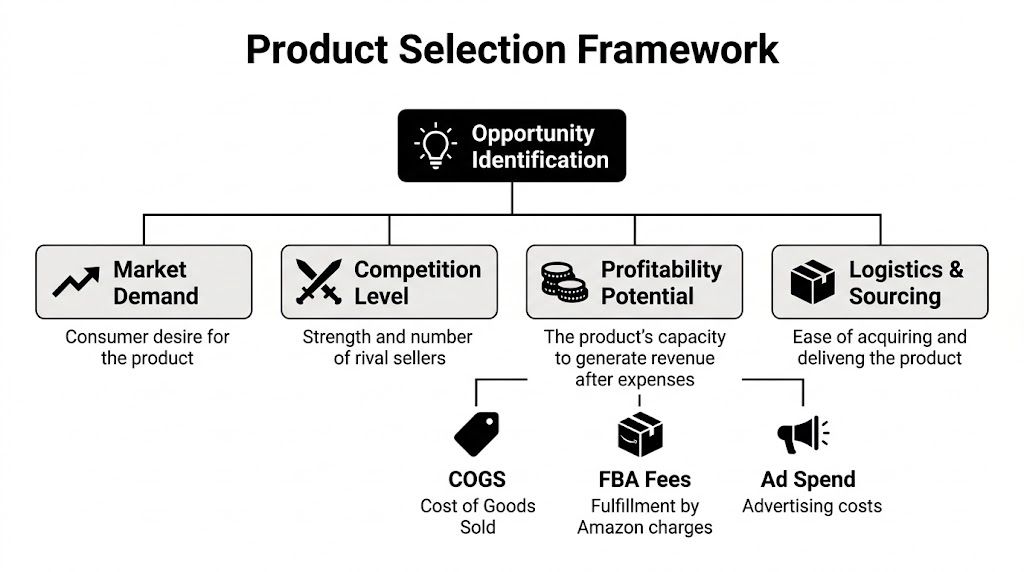
The four filters I use before I care about tools
I pressure-test every idea through four lenses. If a product fails one badly enough, I drop it.
Demand
I want demand that feels stable, boring, and easy to explain.
The strongest ideas usually have clear utility. They solve an ongoing need, fit a recurring use case, or support a hobby people keep spending on. Trendy products can work, but they shorten your margin for error because your timing has to be right.
What works:
- Problem-solving items: Products tied to routine use.
- Clear search intent: Phrases that sound like a buyer knows what they want.
- Evergreen behavior: Niches that don’t rely on one season or one viral moment.
What doesn’t:
- Novelty-first products: They attract curiosity, not durable sales.
- Broad generic terms: High search interest with fuzzy intent often leads to cluttered competition.
- Products people browse but don’t urgently buy: Interest without urgency is weak fuel.
Competition
I don’t avoid competition. I avoid locked markets.
A niche can have plenty of sellers and still be workable if no one owns it. I’m looking for page-one results where the offers feel replaceable. Bad images. Thin bullets. No bundle logic. Weak branding. Review complaints that repeat. Those are openings.
A niche is less attractive when the top listings feel coordinated and deliberate. Strong images. Smart packaging. tight copy. Variations that cover the obvious use cases. Those sellers are harder to dislodge.
Amazon rewards better execution, but only if the gap is real enough for customers to notice.
Profitability
Unrealistic product expectations fail.
A product can pass demand and competition checks and still be a bad business because the economics are too thin. You’re not buying revenue. You’re buying margin after fees, shipping, and ad spend.
I want room for mistakes. If a product only works when every cost estimate is optimistic, it doesn’t work.
Simplicity
This one gets ignored because it’s less exciting than market data.
Simple products are easier to source, inspect, ship, package, and replenish. They usually create fewer support tickets and fewer ugly surprises. Products that are fragile, regulated, meltable, oversized, or quality-sensitive force you to manage more risk before you’ve earned the right to do that.
A good product usually looks a little boring
That’s normal.
Some of the best private label products are unimpressive at first glance. They win because the keyword is there, the market is fragmented, the offer can be improved, and the numbers hold after you model the ugly parts.
If you only chase products that feel clever, you’ll skip a lot of workable opportunities. The point of amazon fba product research is not to feel inspired. It’s to find products you can launch and defend.
Gauging Demand and Competition with Hard Data
A product idea looks promising at 10 p.m. Then page one tells the truth.
I’ve had products die in ten minutes once I pulled up the main keyword, checked the top listings, and saw the same pattern: one serious brand, polished images across the board, review velocity that would take months to catch, and no clear weakness to exploit. That is time well spent. Good Amazon FBA product research is a filtering system. The job here is to kill weak ideas early and keep capital for the few that survive real scrutiny.
Tools help with speed. Judgment decides whether the niche is winnable.

The first demand check
My first screen is simple. I want enough sales activity to matter, enough room on page one to enter, and a market structure that does not force a reckless launch budget.
One framework I respect starts with practical thresholds: stable demand around 200+ units per month, roughly 3 to 15 FBA offers, no brand that clearly owns the niche, and enough margin potential to justify the work, based on Dragon Dealz’s product research framework.
I use those numbers as triage, not law.
A product below that demand level usually does not deserve more time unless the offer has an obvious premium angle. A page crowded with entrenched FBA sellers usually means slower ranking, more aggressive PPC, and less room to fix mistakes. If the niche already looks tight before I even start supplier outreach, I pass.
What I actually inspect in Helium 10 or Jungle Scout
I start with the main keyword, open the top listings, and keep the extension data visible while I review the market manually.
I want alignment across several signals. One attractive metric is how sellers talk themselves into bad inventory.
Search demand
Search volume matters, but buying intent matters more. A keyword with steady intent over time beats a term that spikes from a temporary trend, a social media mention, or seasonal noise.
I do not need a giant keyword. I need a keyword cluster that shows consistent shopper intent and enough breadth to support a launch. If the niche depends on one inflated term, it is fragile.
Sales history and rank behavior
Then I check whether multiple listings are making sales consistently.
A niche is healthier when demand is distributed across several sellers instead of flowing into one listing that absorbs most of the revenue. BSR helps, but only if you understand what you are looking at. This guide to Amazon Best Sellers Rank and what it means is a useful refresher before you trust any rank chart too much.
I want to see movement across the page, not one hero ASIN and a graveyard underneath it.
Offer count and brand concentration
Review count is one input. It is not the market.
I count active FBA sellers on page one, look for brand repetition, and check whether the niche is fragmented or just looks fragmented at first glance. Some pages show ten listings but three operators control most of them through variations, brand extensions, or adjacent products. That changes the risk profile fast.
If one brand has the best images, strongest reviews, widest variation coverage, and obvious ad presence, assume the market is more expensive than it looks.
Listing quality
Weak listings create openings. Strong listings raise the cost of entry.
I look for bad photography, vague copy, clumsy packaging, poor infographics, unanswered objections, and obvious missed use cases. If page one already looks coordinated and deliberate, the niche may still work, but the burden shifts. The launch will need better creative, sharper positioning, and more capital to get attention.
Product Viability Metrics Checklist
| Metric | Ideal Target | Acceptable | Avoid |
|---|---|---|---|
| Demand signal | Stable sales history and repeat buyer intent | Some fluctuation but still consistent | Sharp spikes or obvious dead periods |
| Monthly unit movement | 200+ units/month | Borderline but steady | Too low to justify deeper work |
| Primary keyword demand | Moderate volume with clear intent | Niche but understandable intent | Broad, noisy, or trend-spike traffic |
| FBA seller count | 3 to 15 offers | Slightly outside range if listings are weak | Crowded pages with no clear gap |
| Brand presence | No dominant brand | One strong seller but fragmented rest | Obvious brand lock-in |
| Listing quality | Several weak incumbents | Mixed quality | Page one looks optimized end to end |
| Margin outlook | 20%+ net after full costs | Thin but potentially fixable | Doesn’t survive fees and ads |
The manual page-one review many new sellers skip
After the tool check, I read the market like an operator.
That means reading listings, reviews, and Q&A together. I am looking for proof that the product can be improved in ways customers will notice and operations can support.
I ask:
- What are buyers complaining about? Quality issues, poor fit, weak packaging, sizing confusion, smell, missing parts, bad instructions.
- What are sellers failing to explain? Materials, dimensions, compatibility, cleaning, setup, storage, durability.
- Where does the offer feel lazy? Generic images, no bundle logic, no visual proof, no attempt to answer buyer objections.
- Can the product be improved without adding ugly operational risk? Better insert, better packaging, a sensible accessory, clearer sizing, more useful instructions.
If the only path to conversion is being cheaper, the niche is usually not worth my time.
My filter: If the differentiation does not show up clearly in the listing, customers will not pay for it.
Use outside category context, but keep the final call in-house
Sometimes I sanity-check broader buying patterns with roundups like what products sell best on Amazon. That can help with category context and shopper behavior.
It does not validate a product.
A hot category can still be a bad buy if page one is controlled, reviews expose quality headaches you do not want, or the niche only works with an ad budget that crushes margin.
Here’s a video walkthrough that complements the workflow above and helps if you prefer seeing tool logic in action before building your own SOP.
What good data looks like
The best opportunities usually look balanced, not flashy.
Demand is steady. Competition is active but not suffocating. Several listings are making sales. Page one has visible weaknesses. No single brand has locked the niche down. There is a believable way to improve the offer without turning the product into an operations problem.
That is the standard I use. Enough evidence to justify the next layer of validation. Not hype. Not a pretty dashboard. A market a disciplined seller can enter with eyes open.
From Potential to Profit Sourcing and Margin Validation
A product can look great on page one and still turn into a bad buy the minute you price out freight, packaging, PPC, and returns.
This is the stage where I try to kill the idea.
Earlier data in this article already established how common margin pressure is for FBA sellers, especially around shipping and product costs. That matches what happens in real sourcing work. The supplier quote is rarely the final number. The true cost shows up after carton dimensions change, prep requirements get added, and the launch needs more ad spend than the spreadsheet assumed.
Build the margin model before you request samples
I want a rough profit and loss sheet before I spend time negotiating with factories. If the economics are weak with conservative assumptions, the product does not deserve sample money.
My baseline inputs are simple:
- Target sale price: Based on the current page-one range, not the price I hope to charge later
- Factory cost: Quoted by multiple suppliers, not one
- Packaging cost: Box, insert, poly bag, barcode label, master carton impact
- Freight and duties: Estimated with buffer, because these numbers drift
- Amazon fees: Checked with an Amazon FBA fee calculator for margin planning
- PPC spend: Enough to account for a real launch, not an ideal one
- Returns and defects: A cushion for quality issues, replacements, and refund leakage
I do not need perfect numbers here. I need honest ones.
If a product only works with optimistic freight, below-market CPCs, and a premium price no one else in the niche is getting, it fails the screen.
Supplier quotes are only useful if you pressure-test them
A cheap quote can hide a lot. Thin materials. Bad packaging assumptions. A supplier who says yes to every customization request and sorts it out later, usually at your expense.
I care about quote quality as much as quote level. Good suppliers answer direct questions with direct numbers. They explain MOQ trade-offs, sample timelines, packaging options, and what changes the price. Weak suppliers stay vague and push for the order.
A few questions expose problems fast:
- What exactly is included in the quoted unit cost?
- Does the packaging in the quote match my target size and materials?
- What breaks if I lower the order quantity?
- How stable is lead time during busy periods?
- Can they send revised pricing after product changes, not just verbal estimates?
If the answers are sloppy now, operations will be worse later.
One framework that helps here is cost plus import pricing. It forces you to treat the factory quote as one input, not the finished cost structure.
Margin gets destroyed in predictable ways
The killers are rarely dramatic. They are usually small misses stacked together.
A box that is half an inch too large can push storage and fulfillment fees up. A product that ships fine in a sample can require stronger packaging at scale. A niche with decent demand can still become unusable if conversion is weak and PPC carries too much of the load.
I see the same failure points over and over:
- Oversized packaging: Fee brackets change fast, and small dimensional mistakes are expensive
- Weak conversion economics: If the listing needs constant ad support to stay alive, net margin shrinks fast
- Commodity sourcing: Factories can produce the same item for everyone, so price pressure starts early
- Unnecessary packaging upgrades: Premium presentation only makes sense if it helps conversion or reduces damage
- Low defect tolerance: Products with moving parts, coatings, or sizing issues often look profitable until returns hit
Here is the rule I use. Margin has to survive the full stack, not the best-case version of it.
What I need to see before a product advances
I am not looking for a perfect product. I am looking for a product with enough room for mistakes.
That means the numbers still hold up after conservative freight, realistic PPC, normal defect rates, and supplier variance. It also means the supplier appears capable of repeating the same quality at scale, not just mailing one good sample.
A product moves forward when all of these are true:
- The landed cost leaves real profit after Amazon fees and ads
- The supplier can explain the quote and execute the spec
- The packaging fits the economics, not just the branding idea
- The niche does not require heroic PPC to stay visible
- There is enough buffer to absorb errors without turning the launch into a salvage job
That is the handoff point. The idea stops being interesting and starts earning due diligence.
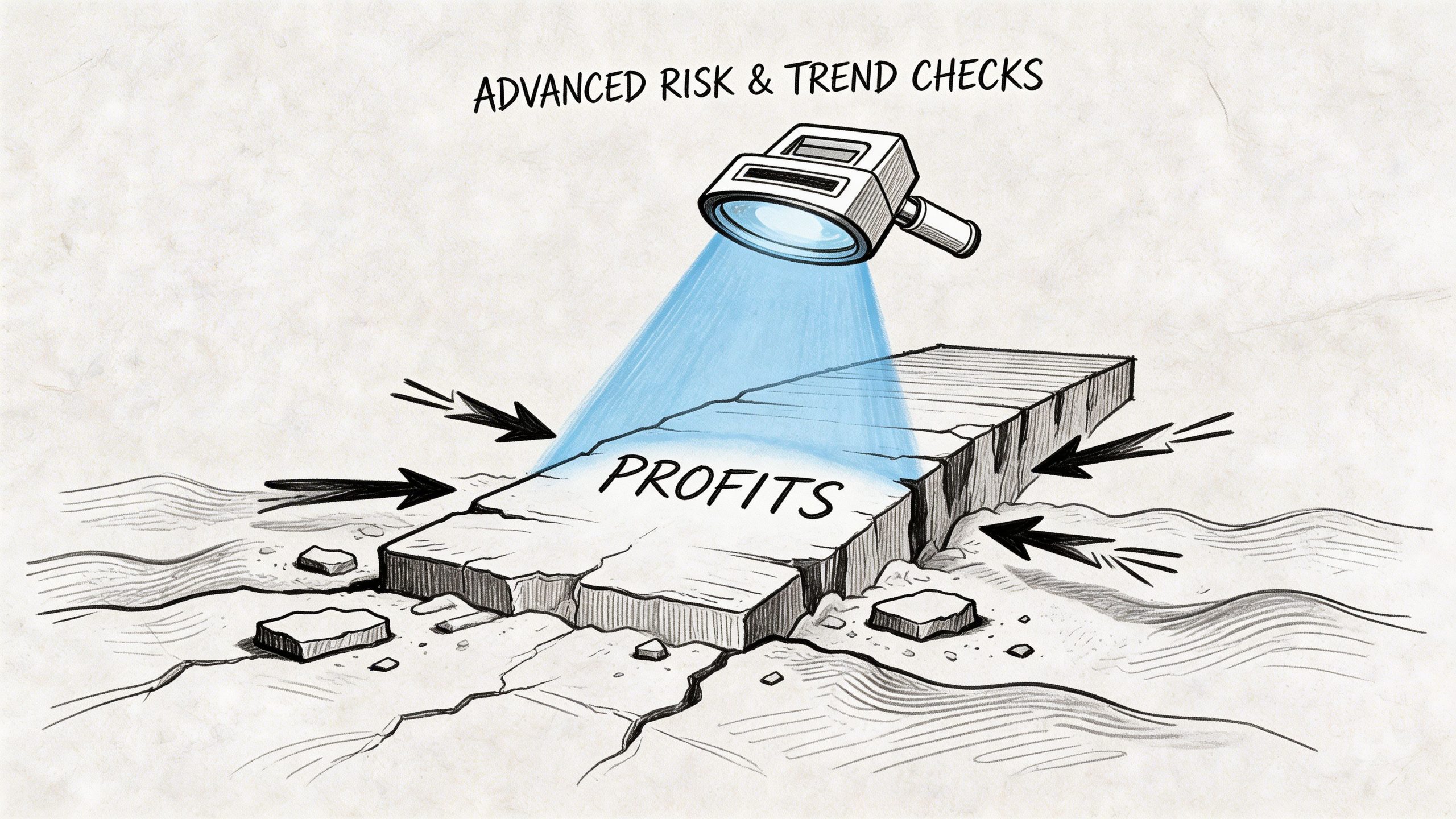
The Final Gauntlet Advanced Risk and Trend Checks
Most losses don’t come from products that looked awful. They come from products that looked good enough, then degraded after launch.
That’s why the last checks matter. You stop asking, “Can I launch this?” and start asking, “Will this still be worth selling after competitors react?”
Historical margins tell the truth current revenue hides
One of the most overlooked checks in amazon fba product research is historical margin analysis.
Verified data on this point notes that niches such as seasonal gadgets can lose 20% to 30% in margins within months of entry as copycats erode profitability, based on the discussion at Kenji ROI’s product research article. That matters because current revenue snapshots can make a deteriorating niche look healthy.
If I can access historical price trends and estimate where margins are drifting, I do it. Falling prices across several top listings usually mean one of two things. Either the niche is commoditizing, or sellers are struggling to maintain rank without discounting. Both are bad for a new entrant.
Three checks I refuse to skip
Seasonality
I want to know whether demand is stable or just concentrated in short windows.
A seasonal product isn’t automatically bad. The problem is that many sellers mistake a strong recent period for a stable market. When demand drops, they’re left holding inventory, paying storage, and cutting price.
IP and compliance risk
Some products are profitable right up until they become unsellable.
Before I move forward, I look for obvious patent conflicts, trademark-heavy language, restricted-use claims, and category-specific issues that could create listing suppression or legal headaches. If the niche depends on language or designs I can’t safely use, I’d rather walk than gamble.
Trend saturation
This is different from seasonality.
A trend can still have demand while becoming a worse business. You’ll often see this when copycat sellers flood the niche, average prices slide, and every listing starts to look the same. If your only edge is “I’ll market it better,” you’re late.
A niche with stable demand and collapsing margins is not a healthy niche. It’s a crowded one.
What I want to see before final approval
I’m much more comfortable moving forward when:
- Prices look stable enough to support your target margin
- Demand doesn’t disappear outside a short buying window
- No obvious IP or gating issue stands in the way
- Competitors haven’t already flattened the niche into a commodity
A product doesn’t need zero risk. That doesn’t exist. It needs risk you understand and can manage.
From Theory to Reality A Product Research Case Study
Let’s run a product through the process. I’ll use ergonomic kneeling pads for gardening because it’s the kind of product sellers often overlook. It isn’t flashy, but it has practical use, room for differentiation, and a customer base that buys based on comfort and durability.
Step one, the idea starts with search intent
This product doesn’t begin with “gardening is popular.” That’s too broad.
It starts with problem-driven search behavior. Buyers aren’t just shopping for outdoor accessories. They want relief while kneeling, usually for gardening, household tasks, or workshop use. That kind of intent is useful because it naturally opens the door to positioning around thickness, water resistance, handle design, portability, and material quality.
At this stage, I’d look for related search phrases, review the current results page, and ask whether the listings solve the buyer’s need well.
Step two, I judge the niche, not the idea
Now I’d open Helium 10 or Jungle Scout and look at the market shape.
I’m checking for steady movement, fragmented offers, and listing weakness. If page one is full of plain foam pads with weak branding and repetitive complaints about flattening, tearing, or poor comfort, that’s promising. If the page is dominated by polished brands with better materials, bundles, and strong visual proof, the burden goes up.
I’d also compare whether the offers are interchangeable or whether a seller could reasonably win with a better pad thickness, improved waterproofing, stronger handle cutout, or a two-pack variation.
Step three, the product has to survive sourcing math
A kneeling pad can look easy until the dimensions and material density create freight pain.
At this stage, I’d request supplier quotes, estimate packaging, and model realistic fees. If the product only works at a fragile price point, I’d kill it. If a slightly upgraded version can still maintain margin after freight and ads, it stays alive.
For a product like this, I’d pay close attention to whether differentiation adds value or just cost. Better foam density and more durable outer material can help. Oversized packaging that pushes the fee structure the wrong way can ruin the whole play.
Step four, I run the final risk checks
This product probably avoids some of the nastier issues that hit electronics or highly regulated categories, but it still needs the final pass.
I’d review:
- Seasonality risk: Gardening creates some obvious demand swings.
- Margin stability: Are top sellers discounting aggressively over time?
- Copycat risk: Is the niche already becoming visually identical?
- Claim risk: Are sellers making material or ergonomic claims that invite trouble?
If historical pricing suggests the category is sliding into a commodity race, I won’t touch it. If the niche still shows pricing discipline and the product can be improved without complexity, it becomes a legitimate candidate.
The final decision
A product like ergonomic kneeling pads doesn’t win because it’s exciting. It wins if the offer can be made visibly better, the economics survive launch, and the market still has room for another seller who executes well.
That’s the point of the playbook. Not to “find trends.” To take a simple product and interrogate it until the answer is either a confident yes or a fast no.
Your Amazon Product Research Questions Answered
Do I need expensive software to do amazon fba product research
No, but software saves time and reduces blind spots.
You can do some manual validation directly on Amazon, through autocomplete, listings, reviews, and bestseller patterns. The problem is speed and consistency. Tools like Helium 10, Jungle Scout, and AMZScout make it easier to compare niches and reject bad ideas faster.
How long should product research take
Long enough to kill weak ideas before they cost you money.
A rushed decision usually looks efficient right up until inventory lands. If a product needs more checks because the niche is ambiguous, do the checks. If the product already fails on competition or margin, stop early and move on.
What’s the biggest mistake new sellers make
Chasing visible revenue without validating margin.
A product can look active on Amazon and still be a poor buy because fees, shipping, PPC, and copycat pressure make the economics too thin. That mistake shows up constantly.
Should I start with product-first or keyword-first research
Keyword-first is usually sharper.
Starting from search intent helps you find buyer demand before you fall in love with a product. It also helps you spot mismatches between what buyers want and what current listings provide.
Can I still find good products in a mature marketplace
Yes, but the edge doesn’t come from having software. It comes from using a better process.
Most sellers still rush. They still skip historical trend checks. They still trust surface-level demand. A disciplined playbook is still an advantage because so many sellers don’t follow one.
If you want more hands-on breakdowns like this, plus calculators, tool reviews, and practical Amazon workflows, check out EntreResource and Nate McCallister’s newsletter for execution-focused guidance without the fluff.