

You're probably seeing the same advice everywhere. Post every day. Copy trends. Add a hook. Hope one clip pops.
That approach can work for a week. It's a bad way to build an affiliate business.
Affiliate marketing on TikTok pays when you treat TikTok like a traffic source, not a slot machine. The creators who last aren't the ones waiting for a viral hit. They build a system: product selection, content angles, link routing, tracking, follow-up, and a clean path from video view to purchase.
I've seen too many affiliates burn out because they confuse attention with revenue. A video can get views and still make no money. A smaller video with the right product, the right CTA, and the right bridge page can outperform it where it matters.
The Real TikTok Affiliate Opportunity in 2026
TikTok is no longer just an awareness platform. It's a real commerce channel, and the data backs that up. One industry roundup reports that 29.6% of affiliate marketing now happens on TikTok, 78% of TikTok users say they purchased a product after seeing it in creator content, and affiliate links on TikTok get a 5.2% engagement rate, which that source says is 160% higher than Instagram according to WeCanTrack's TikTok affiliate marketing statistics roundup.
That changes the conversation. You're not posting into a platform where buyers only browse. You're posting into a platform where people discover products and buy from creator recommendations.
Most beginners still approach TikTok the wrong way. They chase reach first, then try to monetize whatever attention shows up. That's backwards. A better model is to start with buyer intent, choose products that fit TikTok's short-form format, and build content around conversion.
Practical rule: Don't ask, “Could this go viral?” Ask, “Can a cold viewer understand the problem, see the product, and know what to do next in under a minute?”
That's why niche fit matters so much on TikTok. Fast-moving short videos reward products that can be shown quickly, explained clearly, and trusted almost immediately. If your offer needs too much setup, too much education, or too much technical context, it usually struggles.
If you're weighing monetization models, this is also where it helps to compare ecosystems directly. EntreResource's breakdown of the TikTok affiliate vs. Amazon Influencer Program is useful if you're deciding whether to lean into creator-led discovery or a more storefront-style setup.
Setting Up Your TikTok Account for Conversions
Most accounts are set up for vanity. Profile photo, random bio line, maybe a few videos, and no clear path to click.
That's fine for casual posting. It's weak for affiliate marketing on TikTok.
The account needs to answer three questions fast: what niche you cover, why someone should trust your recommendations, and where they should go next.

Start with the affiliate workflow
The standard workflow is straightforward. Creators typically use TikTok Shop Seller Center or the Affiliate Center to register, browse products, get approved where needed, generate links or codes, and monitor clicks, conversions, and commissions. Because TikTok restricts clickable links inside regular post captions, many creators route traffic through a link-in-bio page instead, as outlined in this guide to becoming a TikTok Shop affiliate.
That last part matters most. Your bio link is not an afterthought. It's the hub of the business.
Build the profile like a landing page
Use your profile to pre-qualify visitors.
- Pick one niche first: Beauty, gadgets, home organization, supplements, creator tools, or another tight category. Mixed-topic accounts confuse buyers.
- Write a bio with intent: Say what you review or help with. Keep it direct. “Daily creator gear finds” works better than something vague.
- Use a clear profile image: Face-based brands often convert well, but product-led pages can also work if the visual identity is clean and consistent.
- Pin your best conversion assets: Not your funniest videos. Pin the clips that explain your niche, show your most useful recommendations, or answer the most common objection.
If you need to segment niches, test different identities, or separate content workflows, some marketers choose to create multiple TikTok accounts rather than force unrelated offers through one profile. That's useful when each account serves a distinct audience and offer set.
A good TikTok profile should feel like a storefront window. A viewer should know within seconds what you recommend and where to click.
Use one link hub, not a pile of raw offers
A rookie mistake is dumping people straight onto a merchant page with no context. That can work, but it's fragile. If the offer changes, the page breaks, or the product underperforms, your whole setup gets messy.
A cleaner move is to use a link hub or bridge page. That gives you one controlled destination where you can place featured products, lead magnets, email capture, promo code instructions, and category buckets. If you're sorting through tools, this roundup of link-in-bio tools that creators and brands can't ignore in 2025 is a useful starting point.
A simple conversion-focused profile setup looks like this:
- Niche-first username and bio
- Pinned intro video
- Pinned best seller or best explainer
- Link-in-bio page with limited choices
- Consistent CTA language across videos
Too many choices kill clicks. Keep the path obvious.
Finding Profitable Affiliate Offers for TikTok
The easiest way to waste time on TikTok is to promote products that look fine on paper but don't fit the platform. Good affiliate marketing on TikTok starts with offer selection, not content volume.
The product has to earn attention on video. It also needs enough margin or commission to justify the production effort.
What the economics say
A 2026 benchmark report says TikTok Shop global GMV hit $64.3 billion in 2025 and is projected to pass $112 billion in 2026. The same report says affiliate creator content drives 42% of US TikTok Shop GMV, with a 13.02% average US affiliate commission rate, ranging from 5% in electronics to 30% in beauty according to Hamster Garage's TikTok Shop affiliate statistics and benchmark report.
That tells you two things.
First, creator-driven selling is central to TikTok Shop, not a side feature. Second, category selection has real consequences. Electronics may get attention, but beauty often gives creators more room to win on commission. That doesn't mean everyone should rush into beauty. It means you should understand the payout structure before you commit your content calendar.
The three offer buckets that matter
Some offers are built for TikTok. Others fight the platform.
| Source | Best For | Avg. Commission | Link Type |
|---|---|---|---|
| TikTok Shop Affiliate | Physical products with strong demo potential | 13.02% average in the US, with category variation | In-platform product links, codes, Shop integration |
| Traditional affiliate networks | Broader catalog access and non-Shop merchants | Varies by network and merchant | External affiliate links through bio page |
| Direct brand partnerships | Creators with proof of conversions and a defined niche | Negotiated directly | Custom links, codes, landing pages |
What usually converts well
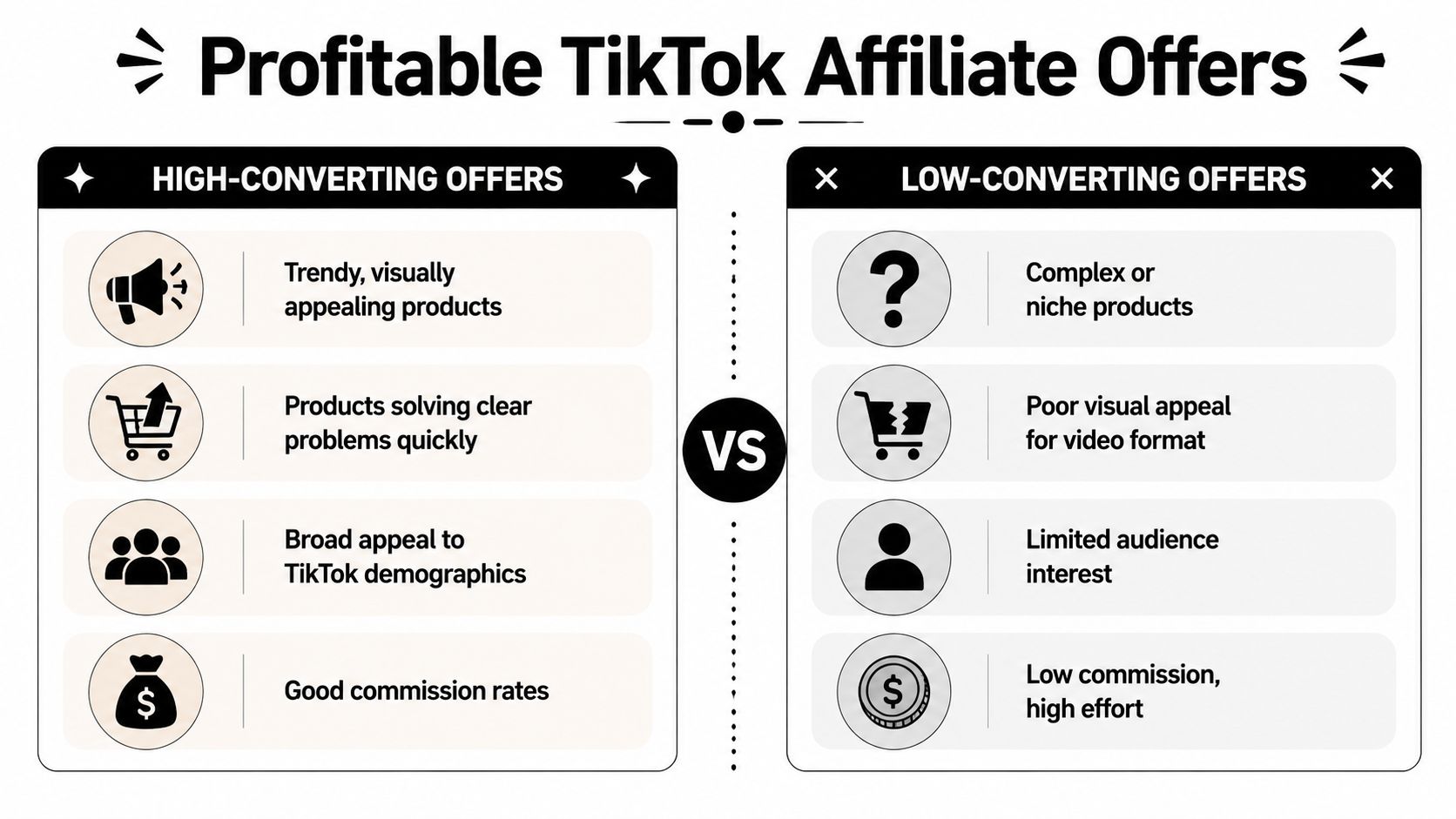
The strongest TikTok offers tend to share a few traits:
- Immediate visual payoff: Products people can understand fast. Beauty tools, home gadgets, desk accessories, kitchen helpers, and organization products often fit this.
- Clear problem-solution angle: “This fixes X” is stronger than “This exists.”
- Low explanation burden: If you need a three-minute tutorial just to explain the value, it's harder to sell in short form.
- Native demo opportunities: Unboxings, before-and-after clips, side-by-side comparisons, and reaction-style reveals all work better when the product gives you something visible to show.
Products that usually struggle are the opposite. Complex B2B software, highly technical education products, or very narrow hobby items can still sell, but they need stronger audience trust and better off-platform nurturing.
If the offer can't survive a simple on-camera demo or screen recording, it probably needs a different channel or a longer funnel.
How I evaluate an offer before I post
I use a simple filter.
- Can I show the result quickly
- Can a new viewer understand the value without extra context
- Is the commission worth making multiple creatives
- Does the merchant page help me close the sale, or does it create friction
- Can I make at least several distinct angles from one product
If the answer is no on most of those, I skip it.
TikTok rewards repetition with variation. The right offer gives you room to make discovery videos, objection-handling videos, comparison videos, and testimonial-style videos without forcing it. That's the kind of product that turns into a repeatable content machine.
Creating TikTok Videos That Actually Convert
A lot of TikTok affiliate content fails for one reason. It tries to entertain before it sells.
You don't need boring videos. You need useful videos with a sales structure. The cleanest framework is hook → explanation or demo → call to action, which shows up in creator playbooks that also recommend posting at least 1 post per day for 90 days, while some suggest 1 to 3 videos per day to maximize reach and traffic in this TikTok Shop affiliate tutorial on YouTube.

Use a structure that respects short attention spans
The hook has one job. Stop the scroll.
The middle has a second job. Make the product feel relevant and easy to understand.
The CTA has the final job. Tell the viewer what to do next.
That's it. Not every clip needs a skit. Not every clip needs trend-chasing edits. Most revenue content is simpler than people think.
Three formats I'd use first
Problem and solution
Start with a frustration people already recognize.
Example flow:
- Hook: “If your cables always look like this, fix that.”
- Demo: Show the mess, show the organizer, show the result.
- CTA: “It's linked in my bio.”
This works because the viewer self-identifies before the pitch lands.
Unboxing and first impression
This format works when novelty matters.
Open the package, show what's included, test one feature, then state who it's for. Keep the pacing tight. If the product has texture, sound, transformation, or surprise, even better.
Product discovery
This is the “I found this and didn't expect it to be useful” angle. It works well for impulse-buy categories.
Lead with curiosity, but don't drag it out. TikTok viewers punish slow setups.
Working standard: Every second in the video should either build desire, remove doubt, or direct the click.
A lot of creators overcomplicate editing too early. Basic cuts, tight captions, clear framing, and a readable CTA beat flashy effects most of the time. If you want cleaner short-form edits without spending forever in post, this guide on how to use CapCut's coolest features with examples is a practical resource.
Here's a useful reference example to study for pacing and presentation:
Script templates that keep production moving
You don't need a fresh creative philosophy every day. You need repeatable prompts.
The fix template
“I kept dealing with [problem], so I tried .”
Then show the product working immediately.The unexpected use template
“I thought this was gimmicky until I used it for [specific use].”
Great for gadgets and organization products.The comparison template
“I used [old method] before. This is easier.”
Side-by-side visuals do the heavy lifting.The shortlist template
“Three TikTok Shop finds I'd buy again.”
Good for batching and testing multiple products in one post.
What doesn't work nearly as well
- Slow intros: If you spend several seconds on setup, people leave.
- Feature dumping: Specs aren't the same as benefits.
- Weak CTAs: “Check it out maybe” doesn't move anyone.
- Random posting: High-frequency publishing only works when each post tests a clear angle.
Consistency matters, but volume without learning is just noise. Post often, review what gets clicks and sales, then make more versions of the winners.
Building a Sustainable System Beyond Viral Hits
A single post can sell. A business needs a system.
TikTok traffic is volatile by nature. That's normal. What hurts creators is building a monetization setup that only works when one post catches a wave. The better play is to move viewers from TikTok into an environment you control.

Recent creator-focused guidance has stressed that affiliates need an off-platform funnel using bio links and bridge pages so they can capture emails, retarget, and track performance more reliably, as discussed in this article on TikTok Shop affiliate marketing strategies to succeed in 2025.
What a simple system looks like
Most creators don't need a complicated funnel. They need a clean one.
A workable setup looks like this:
- TikTok video: One angle, one problem, one CTA
- Bio link or bridge page: Short product context, maybe a comparison, maybe a code
- Optional email capture: Useful if the niche supports repeated recommendations
- Offer page: The merchant or product destination
- Follow-up content: More videos answering objections and reinforcing trust
TikTok doesn't give you much flexibility inside the feed itself. The bridge page addresses this limitation. It lets you sort traffic, test copy, rotate offers, and avoid rebuilding links every time something changes.
Why bridge pages outperform direct linking in real use
Direct links can work when the product is obvious and impulse-driven. But they're weak when the viewer needs a little more confidence.
A bridge page gives you room to do four things:
Pre-sell the click
Add a short explanation, best-for notes, or a “start here” layout.Track intent more clearly
You can see which products attract interest, not just final conversions.Capture traffic you'd otherwise lose
If someone isn't ready to buy now, email is still on the table.Spread one content asset across channels
The same bridge can serve TikTok, Instagram Reels, YouTube Shorts, and Stories.
Traffic you don't own can disappear. A bridge page and email list turn short-form attention into an asset you keep.
The mindset shift that makes TikTok work long term
The creators who struggle usually think in posts. The ones who grow think in flows.
Instead of asking whether Video 17 performed, ask whether the system improved. Did the hook attract the right people? Did the CTA get clicks? Did the bridge page move them to the offer? Did some of them join your list?
That's the primary edge in affiliate marketing on TikTok. Not virality. Measurement.
If I were starting from scratch, I'd keep the funnel lean:
- one niche
- one link hub
- one email capture angle
- a handful of products
- multiple videos per product
- a weekly review of clicks and sales
That's boring compared with chasing trends. It also has a much better chance of compounding.
Scaling Your Reach and Staying Compliant
Once a few offers and formats start working, the next step isn't “make everything more complicated.” It's to scale carefully without breaking trust.
That means two things. Push more traffic into proven assets, and keep your content clean enough that the business can last.
Scale winners, not experiments
If a video is already pulling clicks or sales, that's the asset worth leaning into. Recut it. Rewrite the hook. Change the first three seconds. Test a different CTA. Turn one winner into a family of related creatives.
You can also use paid amplification selectively. Many creators boost strong organic posts instead of gambling on weak ones. That approach tends to make more sense because the market has already told you what resonates.
I like this scaling order:
- First, duplicate the angle: Same product, new hook.
- Then, duplicate the format: Same format, new product.
- Then, expand the channel mix: Reuse the concept on Reels, Shorts, and email.
- Only after that, consider paid support: Put budget behind proven content, not assumptions.
Compliance isn't optional
Affiliate disclosures are part of the job. They also help trust.
If you're recommending a product and earning from the sale, say so clearly in the video, caption, or both. Simple disclosures like #ad or #affiliate are common ways to make the relationship visible. Keep the language obvious. Don't hide it in a wall of hashtags.
There's also a platform safety angle here. If you publish often, especially across multiple creators or accounts, content review becomes an operational issue. For a practical overview of moderation risks and review workflows, AI Video Detector's content moderation guide is worth reading.
Clear disclosure does more than reduce risk. It filters for buyers who are comfortable with creator recommendations, which usually improves trust instead of hurting it.
Protect the business while it grows
Three habits matter more than flashy scaling tactics:
- Keep claims grounded: Don't promise results the product can't support.
- Document your links and offers: Merchants change pages, availability, and terms.
- Review old posts regularly: A dead link or outdated code kills revenue.
A legitimate TikTok affiliate business looks a lot less glamorous than the hype videos suggest. It's product selection, repeatable creative, measured routing, and disciplined compliance.
That's why it works. Viral spikes are nice. A system is better.
If you're serious about affiliate marketing on TikTok, build the funnel first, then feed it with content. That one decision will do more for revenue than chasing the next trend ever will.