

You probably have a niche idea already.
Maybe you've bought a domain, opened Ahrefs or Semrush, and started a spreadsheet with article ideas like “best X,” “X review,” and “how to choose X.” Then the usual thing happens. You publish a few posts, traffic crawls, affiliate clicks barely register, and the project starts feeling like unpaid homework.
That pattern has less to do with effort than with planning. Most affiliate sites fail because the owner starts with content production and hopes the business model will sort itself out later. It usually doesn’t. An affiliate marketing business plan fixes that by forcing you to answer the harder questions first: What am I selling? Why this niche? How does traffic turn into revenue? How much cash and time am I willing to commit before this site earns on its own?
Why Your Affiliate Site Needs a Real Business Plan
A hobby site asks, “What should I write next?” A business asks, “What result should this asset produce, and by when?”
That difference matters because the upside is real. The global affiliate marketing industry is projected to reach $27.78 billion by 2027, and merchants achieve an average $15 return for every $1 invested, according to affiliate marketing industry statistics compiled by Electro IQ. If you're building content assets, that's not a side note. That's a strong signal that affiliate marketing belongs inside a serious digital business model.
The common failure pattern
Most new affiliates do some version of this:
- Pick a niche too fast: They choose something broad or trendy without checking buyer intent, offer depth, or competition.
- Publish disconnected content: Articles go live, but they don’t connect to a sales path, an email list, or a monetization sequence.
- Ignore financial reality: Costs show up immediately. Hosting, tools, writers, designers, and sometimes paid traffic. Revenue shows up later, if at all.
- Quit before compounding starts: SEO and trust both take time, so weak planning creates a motivation problem long before traffic becomes useful.
I’ve seen this over and over. People think they need better headlines, more content, or a different theme. Usually they need a cleaner business model.
Practical rule: If you can't explain how one article leads to one click, one subscriber, or one sale, you don't have a content strategy. You have publishing activity.
What a real plan changes
A proper affiliate marketing business plan gives you operating constraints. That’s good. Constraints stop you from building a site that looks productive while losing money.
At minimum, your plan should define:
- Your niche and angle
- Your offer mix
- Your traffic model
- Your financial assumptions
- Your operating cadence
- Your milestones and kill criteria
The point isn’t to predict everything perfectly. The point is to stop guessing blindly.
A useful plan also keeps you from treating traffic as the main KPI. Traffic is only valuable if it reaches the right visitor, at the right stage, with the right recommendation. Plenty of affiliates learn that too late.
Laying the Foundation Your Niche and Competitive Edge
The niche decision is where most affiliate businesses are won or subtly crippled.
“Follow your passion” is weak advice if the niche has poor offers, low buyer intent, or a trust problem you can't solve. I prefer a simpler filter. Pick a market where buyers already spend money, where affiliate programs exist across multiple merchants, and where you can publish recommendations without sounding fake.

Validate the niche before you brand it
Before I care about logos, I want answers to a few operational questions:
- Are there enough products or services to compare? One thin program is a fragile business.
- Do buyers research before purchasing? Research-heavy categories give content more room to influence decisions.
- Can I publish from experience or close study? Trust is easier when your reviews sound like they came from actual use.
- Is there room to specialize? Broad niches bury new sites. Sub-niches create openings.
Ahrefs and Semrush are useful here, but not just for keywords. Use them to inspect competitor pages, backlink profiles, and traffic mix. I care less about their headline rankings and more about questions like these:
| Check | What to look for | Why it matters |
|---|---|---|
| SERP makeup | Review sites, ecommerce pages, forums, YouTube videos | Tells you what content format wins |
| Domain strength | Are all top results giant brands, or are smaller sites ranking? | Reveals whether a newer site has a path |
| Monetization style | Comparisons, reviews, calculators, email capture | Shows how competitors turn attention into revenue |
| Content gaps | Outdated reviews, weak testing, no buyer-stage segmentation | Gives you an angle, not just a topic |
If you need help narrowing the market, this guide on finding an affiliate niche is a solid companion to the research phase.
Trust beats raw commission chasing
One of the biggest strategic mistakes in affiliate marketing is choosing a niche only because the payout looks attractive. That creates a long-term trust problem.
The better model is to choose products you can promote without twisting your voice or audience expectations. As WGU’s affiliate marketing discussion notes, successful affiliates build trust by staying authentic within promotional guidelines. That stands in sharp contrast to high-velocity affiliate arbitrage that leans on “emotion, shock, and pseudo-insights.”
That tension matters more than most affiliates admit.
What works
- Promoting tools that solve a visible pain point
- Reviewing products with real trade-offs
- Using comparison content to help buyers decide
- Recommending fewer offers, more deliberately
What usually backfires
- Stuffing every article with links
- Promoting products you wouldn’t use
- Writing “best” lists with no testing logic
- Switching offers constantly because one payout looks richer
If your audience can feel the commission first and the recommendation second, your conversion rate might survive for a while. Your brand usually won’t.
Build a right to win
A niche isn’t enough. You need an edge.
That edge usually comes from one of four places:
Experience edge
You’ve used the tools, built the workflows, or solved the problem yourself.Format edge
Competitors publish generic posts. You publish detailed comparisons, checklists, templates, calculators, or teardown-style tutorials.Distribution edge
You already have an email list, social presence, YouTube channel, or paid traffic skill.Positioning edge
You speak to a narrower segment with clearer needs. Beginners, agencies, creators, sellers, local operators, and technical buyers all respond to different framing.
A real affiliate marketing business plan starts with a niche where trust is possible and an angle that competitors haven’t owned completely. Without that, execution gets expensive fast.
Designing Your Content and Traffic Engine
A niche becomes a business only when you can attract the right visitor repeatedly.
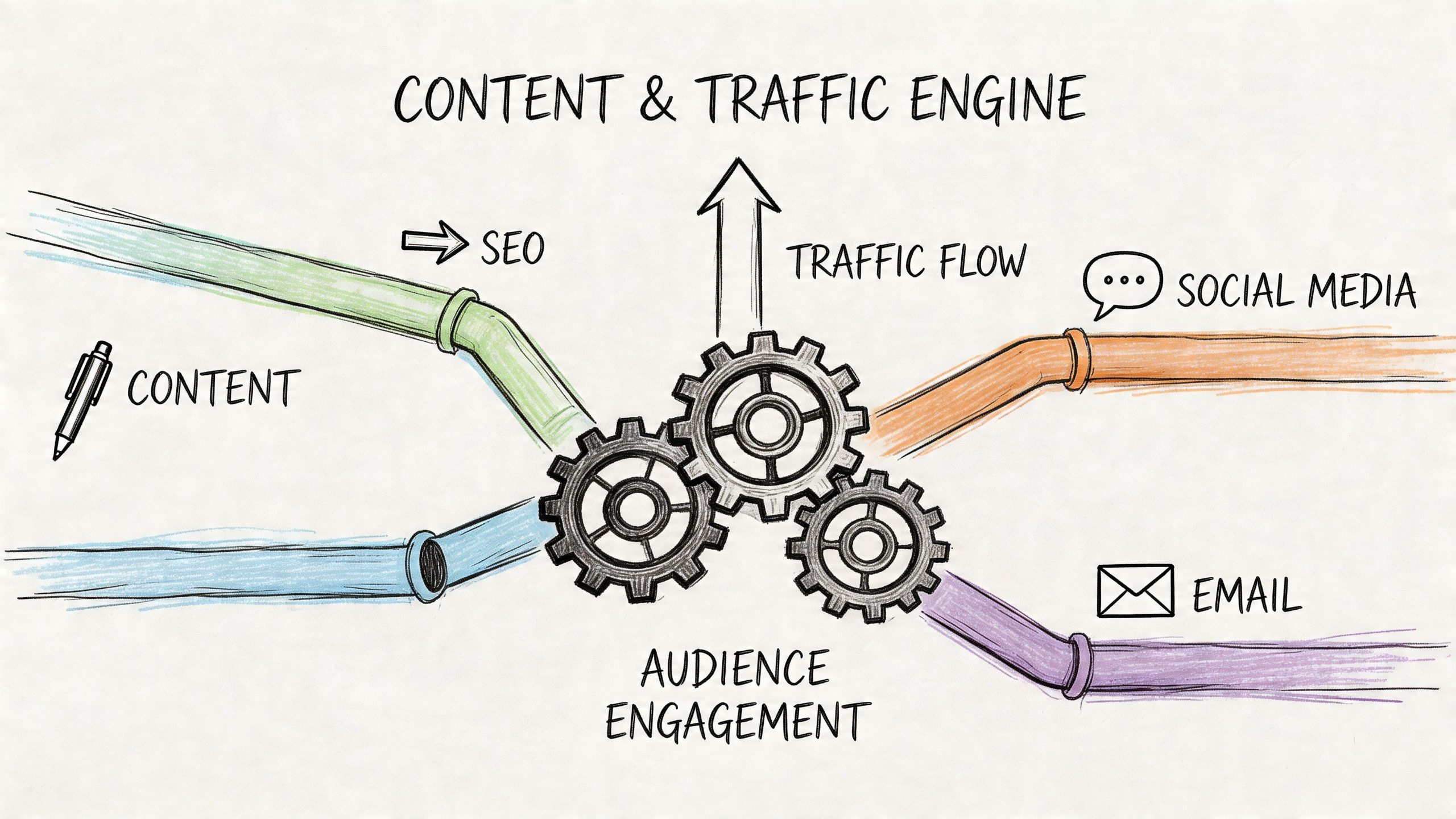
For most affiliate sites, SEO is still the foundation because it compounds, attracts intent-driven traffic, and keeps acquisition costs lower than relying purely on ads or rented audiences. But SEO alone isn't enough. I want a content engine that can capture demand, build trust, and bring readers back without depending on a single platform.
Start with keyword intent, not just keyword volume
A weak content plan starts with random topics. A stronger one maps content to buyer stages.
I break affiliate content into three buckets:
| Content type | Reader state | Monetization role |
|---|---|---|
| Educational content | Problem aware | Builds trust and topical relevance |
| Commercial investigation | Solution aware | Compares options and pre-sells offers |
| Conversion content | Product aware | Captures late-stage demand |
That means your content calendar should include articles like:
- Problem-first guides: explain the issue and introduce decision criteria
- Comparison posts: product A vs product B
- Best-of roundups: for buyers ready to shortlist options
- Single-product reviews: for branded search and late-stage intent
- Implementation tutorials: show buyers what happens after the purchase
A lot of affiliates overproduce educational content because it feels safer. The site grows traffic but struggles to earn. The fix is balance. You need educational content for authority, but the money usually comes from posts closer to a purchase decision.
For search-driven planning, I still use Ahrefs, Semrush, Google Search Console, and manual SERP checks. If you want a practical refresher on ranking the right pages, these SEO tips for affiliate marketing are worth reviewing.
Build clusters, not isolated posts
Publishing single articles at random slows authority growth. Clusters work better.
Pick one core topic and support it with related content. For example, if your niche is email software for creators, the cluster might include:
- a beginner guide to choosing an email platform
- a comparison between two major tools
- individual tool reviews
- setup tutorials
- deliverability troubleshooting
- segmentation strategies
- automation examples
This does two things. It helps search engines understand your topical depth, and it gives readers multiple entry points into the same monetization path.
A simple six-month build approach
Month by month, I’d organize the early build like this:
Month one
Publish foundation pages, category structure, and your first commercial pieces.Month two and three
Add educational support content that answers pre-purchase questions.Month four
Expand branded reviews and comparison pages based on Search Console data.Month five and six
Refresh pages that are getting impressions but weak clicks, then layer in email capture and social repurposing.
The best affiliate content engine doesn't just attract readers. It moves them from confusion to decision without making the sales process feel forced.
Add channels that support SEO
Once the search foundation is in place, add one or two accelerators.
Email is the obvious one because it gives you a distribution channel you control. A simple newsletter can recycle new posts, send comparison guides, and bring subscribers back to pages that already convert. If email is part of your plan, this guide on how affiliate marketers can use email effectively can help shape that layer.
Social should be chosen by niche, not habit. Pinterest fits visual and consumer product categories. YouTube works well when products need demos, walkthroughs, or side-by-side comparisons. X and LinkedIn can work for B2B or creator tools if you already know how to write short, sharp distribution posts.
Paid traffic can help too, but only selectively. I don't send ads to thin review pages. I’d rather send paid clicks to a strong comparison, a lead magnet, or a newsletter signup tied to a monetization sequence.
This walkthrough is worth watching if you want another angle on building the engine:
Match content to what buyers need next
The simplest traffic mistake is assuming every visitor wants the same thing. They don’t.
A first-time reader may need education. A returning visitor may want a comparison chart. A branded-search visitor may only need confirmation, pricing context, or a quick explanation of who the product is for.
That’s why the strongest affiliate sites feel like systems. The blog post, email, review page, and comparison chart all support one another. When you build that deliberately, traffic quality improves and monetization gets a lot less random.
Building Your Financial Projections and Monetization Model
A site can rank, get clicks, and still lose money for a year.
I’ve seen that happen with affiliate projects that looked healthy on the surface. Traffic was climbing, content was publishing on schedule, and affiliate links were getting tapped. The problem was underneath the dashboard. No one had mapped payback period, content cost per page, break-even targets, or how long the business could operate before commissions caught up to spend.
That’s why I treat this section as the operating model, not a spreadsheet exercise.
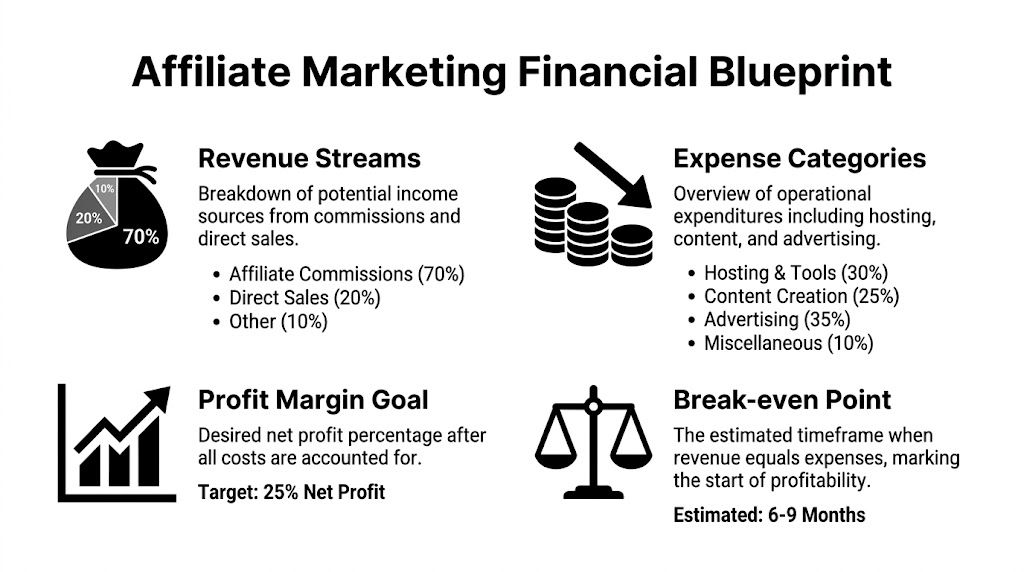
As Affiverse points out in its discussion of affiliate planning, plenty of affiliate advice frames the business as low-risk while skipping financial modeling and ROI projections. That omission gets expensive fast. Affiliate sites still require upfront investment in tools, content, email software, and sometimes traffic acquisition, while revenue usually arrives on a delay.
Start with costs you can control
Forecasting revenue before you understand cost structure leads to sloppy decisions.
My baseline cost model usually includes six buckets:
Core site costs
Domain, hosting, theme, plugins, uptime tools, and maintenance.Research and analytics
Ahrefs, Semrush, LowFruits, Google Analytics, Search Console, and a reporting sheet or Looker Studio dashboard.Email stack
Kit, MailerLite, or another ESP, plus forms, landing pages, and automation tools.Production costs
Writing, editing, formatting, images, video support, and comparison table tools.Promotion spend
Paid distribution, sponsored placements, and controlled testing budgets.Admin and ops
Bookkeeping, affiliate link management, SOPs, contractor coordination, and basic compliance tasks.
The trade-off is simple. A lean setup protects cash, but it often slows output. A heavier setup can speed production and testing, but your break-even point moves higher. Neither approach is wrong. The mistake is pretending overhead doesn’t exist.
Build the revenue model from the bottom up
Revenue targets should come from mechanics, not optimism.
I use a simple chain:
Traffic → affiliate clicks → merchant conversions → commissions
That model forces pressure-testing. If a page gets traffic but weak click-through rates, the issue is packaging, placement, or offer match. If clicks are healthy but commissions lag, the offer, landing page, or audience intent is off. That matters because each problem requires a different fix, and each fix has a different cost.
Paid traffic needs an extra layer of discipline. If you plan to buy visitors for newsletter signups, comparison pages, or pre-sell pages, understanding your Cost Per Click (CPC) helps frame whether the model has room for profit before you light up campaigns.
I also separate projections into three cases: conservative, expected, and aggressive. The conservative case is the one I use for budgeting. If the business only works under aggressive assumptions, it is not ready.
A financial model should stop bad bets early. That’s its real job.
Build a year-one dashboard that tracks profit, not busyness
Early on, Google Sheets is enough. Fancy reporting can wait.
What matters is tracking the numbers that show whether the site is turning effort into margin.
| Metric | Month 1 | Month 6 | Month 12 |
|---|---|---|---|
| Monthly Traffic | Low, mostly baseline and early indexing | Growing from core content and initial rankings | Larger share from commercial and comparison pages |
| Affiliate Clicks | Limited, driven by early commercial posts | Rising as rankings and internal links improve | More stable and diversified across top pages |
| Gross Revenue | Minimal or inconsistent | Early meaningful commissions from winning pages | Revenue concentrated around proven content clusters |
| Total Expenses | Highest relative to revenue | Still elevated if content production continues | More efficient if refreshes outperform net-new content |
| Net Profit | Usually negative | Approaching break-even in stronger niches | Positive if conversion paths and offer fit are sound |
That table stays qualitative on purpose. Exact numbers vary too much by niche, commission structure, content velocity, and whether the operator is investing cash, time, or both. The useful part is the framework. It shows whether the business is getting more efficient over time.
KPIs I track first
- Commercial page impressions
- Affiliate link clicks by page
- Revenue by merchant
- Revenue by content type
- Email opt-ins by traffic source
- Content production cost by page
- Time to first commission by cluster
- Pages sitting just below page one
- Net profit by month
I don’t put vanity metrics in the core model. If a social platform drives sales, it earns a spot. If it only produces likes and noise, it stays outside the financial dashboard.
Design the monetization mix before revenue gets concentrated
A lot of affiliate sites look diversified until you inspect the numbers. Then you find one merchant carrying most of the business.
I’d rather map monetization in layers from the start:
Primary affiliate offers
Core products with the strongest fit and the clearest buyer intent.Secondary offers
Adjacent tools, add-ons, or lower-priced options that catch readers who won’t buy the main recommendation.Email monetization
Follow-up sequences, recurring newsletters, and segmented recommendations. A practical guide to using email effectively as an affiliate marketer helps when you’re building that revenue layer.Owned assets later
Templates, mini-products, consulting, or services. I only add these when the audience has proven demand. They can improve margin, but they also add delivery and support overhead.
A practical resource stack like EntreResource can help here. It publishes tool reviews, comparisons, calculators, and affiliate marketing tutorials that are useful when you’re evaluating software, workflows, and operational trade-offs.
Stress-test the model before launch
I ask ugly questions before I publish the first batch of money pages.
- If rankings take six months longer than planned, can the budget hold?
- If the top affiliate program cuts commission rates, what replaces it?
- If pages get clicks but poor conversion rates, do you change the CTA, the offer, or the page type?
- If paid traffic misses target, can email and organic search carry the plan?
- If production costs rise, which content formats still make financial sense?
That process changes how you build the business. You stop chasing traffic for its own sake and start funding pages, channels, and offers that have a path to profit. That’s the difference between an affiliate site and an affiliate business.
Your Launch Plan and Growth Milestones
Most affiliate projects don’t fail in planning. They fail in execution drift.
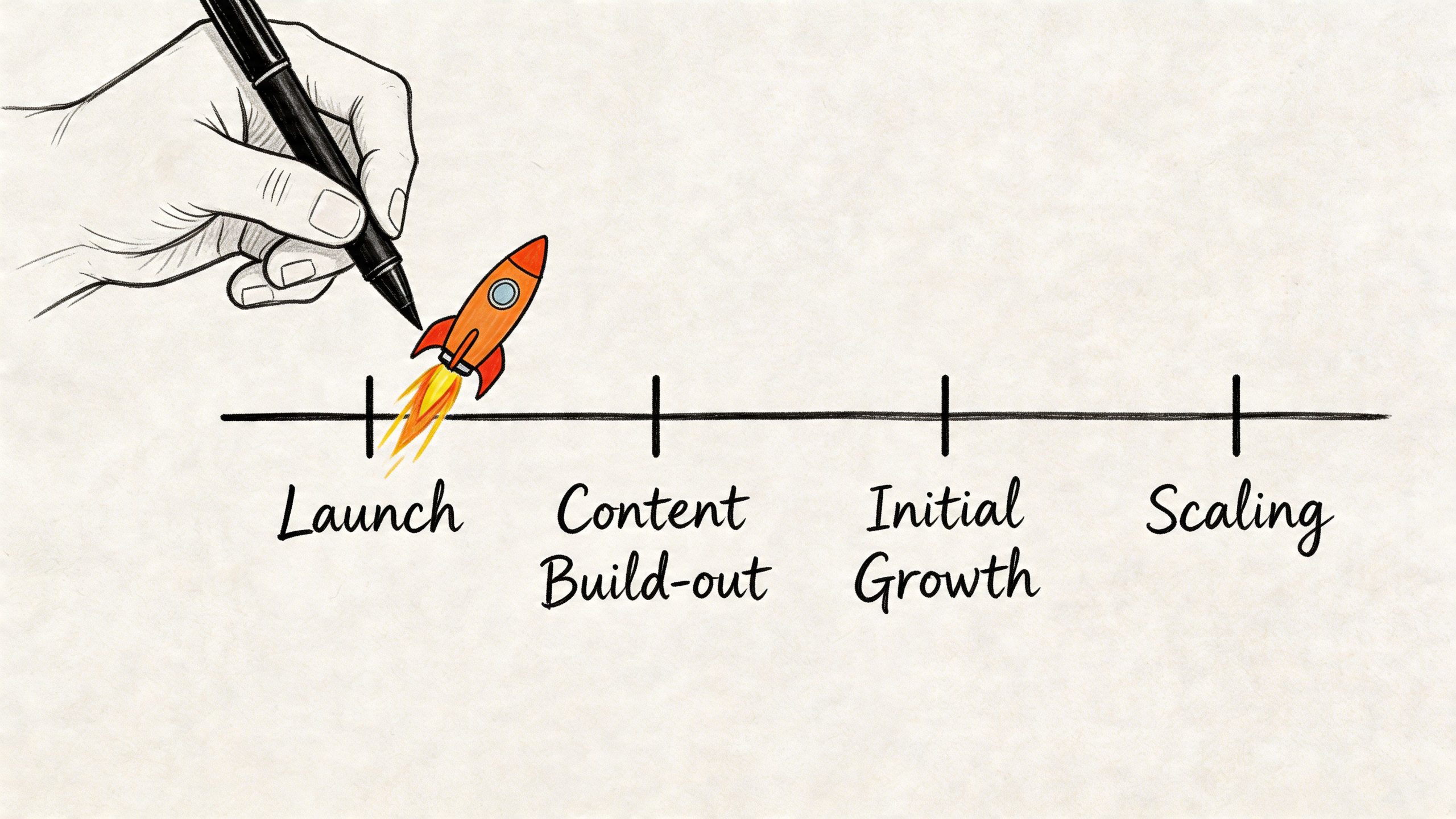
The owner starts focused, then gets pulled into redesigns, random keyword ideas, new offers, and tool hopping. Three months later, the site has activity but no momentum. The fix is a launch sequence with milestones that tell you whether the business is moving or stalling.
First 90 days
The first phase is about publishing enough useful material for search engines and readers to understand what your site does.
Your early checklist should include:
- Site setup finished: Core pages, affiliate disclosures, analytics, link tracking, and clean site structure
- Foundation content live: A batch of commercial pages plus supporting educational articles
- Tracking in place: Google Analytics, Search Console, affiliate dashboard reporting, and a simple KPI sheet
- Email capture active: Even if it’s one lead magnet and one welcome sequence
At this stage, I care about operational consistency more than revenue. Are posts going live on schedule? Are internal links in place? Are pages indexed? Are clicks starting to show up from commercial content?
Days 90 to 180
At this stage, many site owners get impatient and make bad decisions.
Instead of changing the niche or blowing up the content strategy, use this period to inspect what the market is telling you. Search Console will show queries, impressions, and weak CTR pages. Affiliate dashboards will show which content gets clicks. Heatmaps and on-page tools can help you see whether readers reach the comparison tables and call-to-action blocks.
A few good milestone checks:
| Timeframe | What to review | What action follows |
|---|---|---|
| Around day 90 | Indexation, impressions, early clicks | Improve weak titles and internal linking |
| Around day 120 | Which pages attract commercial-intent queries | Expand those clusters |
| Around day 150 | Which offers get clicks but weak conversions | Rework copy, position, and merchant fit |
| Around day 180 | Whether email captures and return visits are rising | Invest more in retention and newsletter flows |
Weekly review beats heroic guessing. Small corrections made consistently are what keep affiliate sites alive long enough to compound.
The tracking discipline most people skip
This isn’t optional. One report cited by Post Affiliate Pro’s discussion of affiliate marketing pitfalls says 76% of marketers neglect proper data tracking and optimization. The same analysis notes that teams with clear goals and weekly reviews can see 2-3x performance lifts by identifying and scaling stronger channels.
That lines up with what happens in practice. The operators who survive are usually not the loudest or the most creative. They’re the ones who review performance every week and make boring, useful adjustments.
Metrics that deserve a standing weekly review
- Organic rankings for money pages
- Affiliate clicks by page and link placement
- Email subscriber growth by source
- Top entry pages and exit pages
- Revenue by merchant
- Pages with impressions but poor click-through
- Content refresh candidates
What doesn’t deserve weekly obsession: logo changes, homepage redesigns, and speculative platform expansion.
The 365-day checkpoint
By the one-year mark, your affiliate marketing business plan should produce evidence. Not necessarily huge revenue, but evidence.
You should know:
- Which content formats attract buyers
- Which affiliate programs fit your audience
- Which channels send returning visitors
- Which pages deserve more investment
- Which experiments you should stop
If you don't know those five things after a year, the problem usually isn’t effort. It’s weak measurement.
That’s why I prefer milestone-based planning over motivation-based planning. Motivation fades. Measured execution holds up better.
Pro Tips for Scaling Without Losing Your Mind
Monday starts with a rankings check. By noon, two affiliate offers have changed terms, a writer is waiting on a brief, three older posts need updates, and your inbox is full of pitches for the next traffic channel you supposedly need to test. That is the point where an affiliate site stops feeling like a side project and starts acting like an operating business.
Scaling gets messy when the system depends on you touching everything. The fix is not more hustle. The fix is tighter operations, clearer financial thresholds, and a hard line between work that grows revenue and work that just fills the week.
Keep your tool stack lean
I like a small stack for the first phase because every extra tool adds cost, setup time, and another dashboard to check. If the site is still proving its traffic and monetization model, the stack should help you publish faster, track what matters, and update pages without friction.
Worth paying for early:
- One serious SEO platform: Ahrefs or Semrush
- One email platform: Kit or MailerLite
- One link management solution: something clean enough to track and update offers
- One project management system: Notion, Trello, or Asana
What I usually delay:
- premium design extras
- advanced CRO suites
- too many AI writing apps
- expensive dashboard software before the site has meaningful data
The trade-off is simple. A thin stack forces discipline, but it can feel limiting. A bloated stack gives you more features and usually worse execution. In practice, the lean version wins until revenue gives you a reason to add complexity.
Build SOPs before hiring exposes the gaps
The first SOPs I write are usually for article briefs, formatting rules, affiliate link insertion, image specs, update checks, and publishing. If a task happens more than once a month, it gets documented. Otherwise you end up answering the same questions, fixing the same mistakes, and paying for work twice.
A lot of founders burn out because they hire before the process is clear, then spend their time cleaning up output instead of reviewing performance.
If admin work, publishing tasks, and content coordination are eating your day, bring in support for the repeatable work. For founder-led sites that need remote operational help across content and admin, Hire LatAm Virtual Assistants is one practical option.
Scale comes from reducing friction in repeatable tasks.
Protect your attention like it affects profit, because it does
Smart affiliates usually do not fail from lack of ideas. They fail because they keep interrupting a system that was starting to work.
A new AI workflow appears. A social platform gets hot. A merchant offers a higher commission. None of that matters if your current pages have not been refreshed, your best-performing emails are half-built, and your top traffic cluster still has obvious gaps.
The work that usually pays off fastest looks like this:
- refresh pages that already rank and convert
- expand topic clusters that have traction
- improve email follow-up around offers that already produce clicks
- replace weak merchants when EPC or conversion quality drops
- outsource repetitive production work, not offer selection or content strategy
That last point matters. I will happily outsource formatting, uploads, internal QA, and image prep. I do not outsource niche selection, monetization decisions, or the judgment call on which pages deserve another round of investment. Those decisions affect margin.
A real affiliate marketing business plan helps here because it gives every task a financial context. If a project does not support revenue, retention, or a KPI tied to profit, it can wait. That is how you scale without turning the business into a pile of half-finished experiments.
If you're building an affiliate site right now, treat the next step like an operator, not a hobbyist. Write the plan, model the costs, define the KPIs, and publish with a clear monetization path. That's how an idea turns into an asset.