
Finding the right wholesale suppliers for Amazon is what separates the businesses that scale from the ones that fizzle out. This isn't about reinventing the wheel; it's about selling established brands people are already searching for, sidestepping the massive risks of launching a new product from the ground up.
Why Wholesale Is Still a Beast on Amazon in 2026
Let's take a breath from the high-stakes gamble of private label. The wholesale model offers a much more durable—and often faster—path to making real money on Amazon. It's less about product invention and all about operational excellence. The whole game is sourcing popular, existing products directly from brands or their authorized distributors and then reselling them on the Amazon marketplace.
This strategy completely dodges one of the biggest hurdles for new sellers: manufacturing demand. Instead of burning thousands on ads just to get customers to notice your unknown product, you get to tap into the traffic and brand trust that's already built-in. Your job isn't to create the wave; it's to learn how to ride it.
The Unfair Advantage of Existing Brands
The beauty of wholesale is that you're piggybacking on someone else's hard work. A brand has already poured money into R&D, quality control, and marketing to create a product that sells. Your job description changes from "creator" to "curator and operator."
This shift to operations has a real impact on your bank account. A 2025 analysis showed that Amazon sellers focused on wholesale hit profitability 60% faster than private label sellers. According to the report, the reasons include "lower startup marketing costs and the simple fact that they were selling products people were already looking for." You can dig into the full report from this in-depth study on Amazon seller models yourself.
Key Insight: The wholesale model isn't about finding a "secret" product. It's about building a repeatable system for sourcing, supplying, and selling products that people already want to buy.
Building a Scalable and Resilient Business
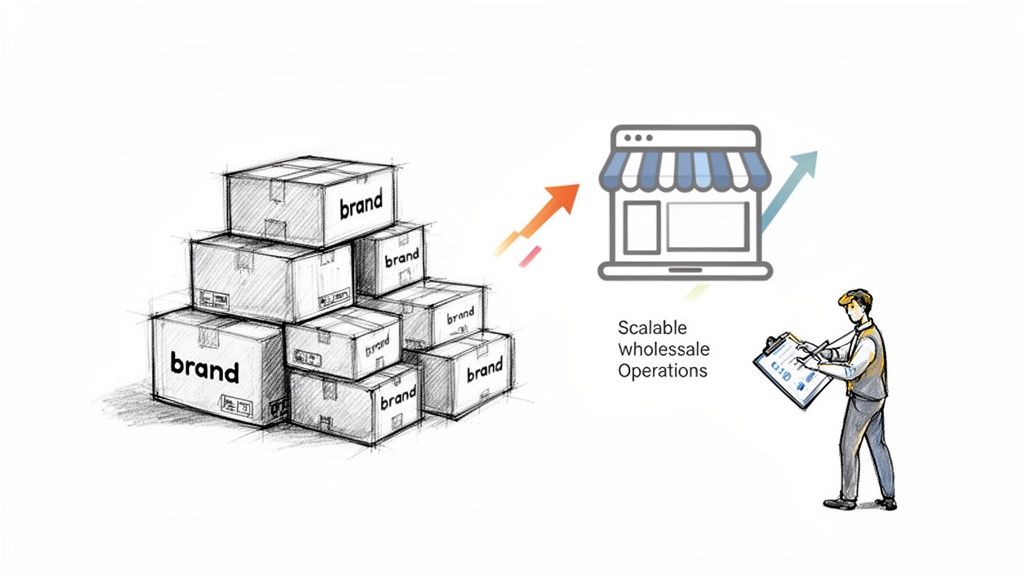
Unlike retail arbitrage, which feels like a constant scavenger hunt for clearance deals, wholesale is about building stable, long-term relationships with your suppliers. This gives you a predictable and scalable source of inventory. Once you land an account with a supplier, you can place repeat orders, start forecasting your demand, and grow your operation methodically.
This model lets you build a business that can weather the ups and downs of e-commerce, with a few major perks:
- Scalability: Growth comes from adding more brands and suppliers to your roster, not by launching more risky products.
- Predictability: Having a consistent supply of inventory makes managing cash flow and avoiding stockouts so much easier.
- Efficiency: Your energy goes into optimizing logistics, pricing, and supplier relationships—the actual nuts and bolts of a real retail operation.
In this playbook, I’m giving you the complete roadmap to get this model dialed in. We'll go from finding the best wholesale suppliers for Amazon to negotiating killer terms and getting your logistics streamlined for FBA success.
Where to Uncover Profitable Wholesale Suppliers
If you want to build a real wholesale business on Amazon, you have to stop Googling "wholesale suppliers" and praying for a lucky break. That’s what everyone else does. The real money is made by digging deeper and finding legitimate partners that aren't plastered all over the first page of search results.
This means hitting up specialized directories, networking like you mean it, and even putting on your detective hat.
It's a well-known secret in the wholesale world that sellers who diversify their sourcing find way more exclusive relationships—we're talking about a 75% increase in exclusive deals. The payoff? An average profit margin boost of 20%, according to a recent industry analysis. The takeaway is simple: the more strategic your search, the better your bottom line. You can see more on how different channels impact success in this in-depth e-commerce sourcing report.
Go Straight to the Source
This is one of the most effective tricks in the book, yet so many sellers overlook it: contact the brand manufacturer directly. Now, don't ask them for a wholesale account. Most major brands won't sell directly to you. Your real goal is to get their list of authorized distributors.
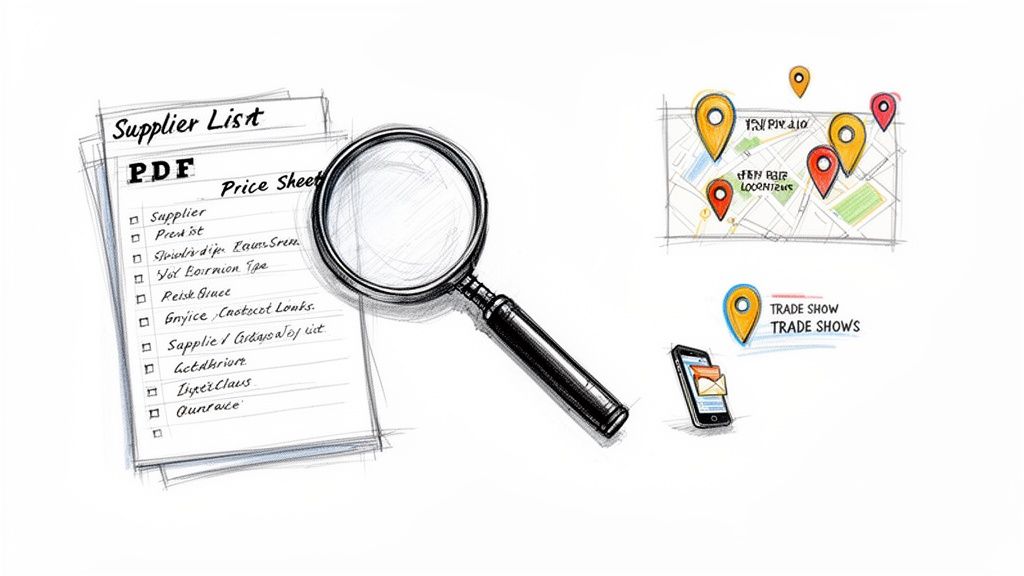
A simple phone call or a quick email is all it takes. Introduce your business and just ask, "Could you please provide me with a list of your authorized distributors who work with online sellers?" This one question is pure gold. It cuts through all the noise and hands you a pre-vetted list of legitimate wholesale suppliers for Amazon.
Leverage Online Wholesale Directories
Online directories can be a solid starting point, but you have to know how to use them. Think of them as a giant phone book for suppliers—not everyone listed will be a good fit, but it's an excellent way to generate some initial leads.
- Wholesale Central: This is one of the old-school directories, and I love that it's completely free with no registration required. The key is to find suppliers in your niche and then vet them heavily yourself.
- Faire: This one leans more toward independent and boutique brands. I've found Faire to be a goldmine for unique products that have way less competition on Amazon. It has a modern feel and the terms are always clear.
- TopTenWholesale: A solid B2B platform for connecting with suppliers across tons of categories. It’s especially good for stumbling upon new brands you've never heard of.
Pro Tip: Never, ever rely on a directory's vetting process alone. Always do your own homework. Check out the supplier's website, hunt for reviews, and verify their business credentials before you even think about placing an order.
Master Advanced Search Techniques
A simple Google search is weak. A strategic Google search is a superpower. By using specific search commands, you can dig up documents and supplier info that isn't meant for the public to easily find.
Try plugging these into Google, just swap out "Brand Name" with the brand you're digging into:
"Brand Name" wholesale application"Brand Name" authorized distributor form"Brand Name" catalog filetype:pdf
That last one is my absolute favorite. It often uncovers wholesale catalogs and price sheets that aren't even linked on the supplier's public site, giving you a backdoor pass to product and pricing info. If this is new to you, our guide on how to buy in bulk for resale offers more foundational tips.
Reverse Source from Amazon Itself
This method flips the whole process on its head. Instead of starting with a supplier, you start with a product that's already crushing it on Amazon. Find a popular product in your niche that has multiple FBA sellers, and then your mission is to figure out who their supplier is.
Fire up a tool like Keepa and look at the listing's history. Find the sellers who consistently own the Buy Box. Next, you Google those seller storefront names. You'd be surprised how often their storefront name is the same as their legal business name, which you can use to find their website. It’s a bit of reverse-engineering that leads you straight to proven, profitable sources.
Vetting Suppliers and Dodging Costly Red Flags
So you've got a promising list of potential suppliers. That's the easy part. The real work—the part that separates successful Amazon sellers from the ones who get burned—is figuring out who's legit.
Skipping this step is the fastest way I know to lose a ton of money, get your Amazon account in hot water, or, worst of all, end up with a garage full of stuff you can’t sell.
A genuine wholesale supplier is a B2B business, period. They expect you to be one, too. If a "wholesaler" is ready to sell you products without asking for any business paperwork, they aren't a wholesaler. They're just a retailer in disguise, and that’s a massive problem for you.
Your Essential Vetting Toolkit
Before you even think about placing an order, you have to get your own house in order. Any supplier worth their salt will ask you to prove you're a real business. Get these two documents ready right now:
- Business License: This shows you’re a legally registered entity (like an LLC). It’s not optional.
- Resale Certificate (Sales Tax ID): This document proves you’re exempt from paying sales tax on inventory you’re buying to resell. A real supplier has to ask for this.
If a supplier doesn’t request these documents, it’s not a lucky break—it's your first major red flag. It means they don't know (or care about) the legal difference between a business and a regular customer, which can create huge headaches for you later, especially with Amazon. You can learn more about this in this guide to properly validating suppliers for Amazon.
A supplier that doesn't ask for a resale certificate isn't doing you a favor; they are revealing their own lack of legitimacy. Real wholesalers are legally required to collect this documentation to avoid charging you sales tax.
Critical Red Flags to Watch Out For
Over the years, I've developed a sixth sense for spotting bad partners from a mile away. It’s saved me from countless headaches and financial black holes.
Keep a sharp eye out for suppliers with these warning signs:
- Prices Too Close to Retail: A real wholesale price has to give you enough room to cover Amazon’s fees, shipping costs, and still turn a profit. If their "wholesale" price is only 10-15% below what the product sells for on Amazon, you need to walk away. The math just doesn't work.
- An Unprofessional Online Presence: A busted website from 2005, a Gmail address for their business contact, or no clear phone number or address are all tell-tale signs of a shoestring operation you don't want to get involved with.
- No Clear MAP Policy: A Minimum Advertised Price (MAP) policy is what stops a product from becoming a race to the bottom on Amazon. Suppliers who don't have one—or admit they don't enforce it—are basically inviting chaos and guaranteeing your profit margins will get crushed.
These aren't just minor quirks. They are clear indicators of a disorganized or shady business that will eventually make their problems your problems.
The Supplier Vetting Checklist
To keep yourself honest and objective, use a checklist for every single supplier you evaluate. This helps you move past your gut feelings and ensures you don't miss a critical detail before you commit thousands of dollars to an order.
I've put together a quick checklist that I run through. It helps me quickly separate the real partners from the pretenders.
Supplier Vetting Checklist
| Verification Point | What to Look For | Red Flag |
|---|---|---|
| Business Verification | They require a wholesale application, business license, and resale certificate. | Willingness to sell without any legal business documentation. |
| Pricing & Margins | Clear wholesale pricing that allows for at least a 10-15% net margin after fees. | Prices are very close to what you see on Amazon or other retail sites. |
| Amazon FBA Experience | They understand Amazon’s packaging, labeling, and shipping requirements. | They have no idea what FBA is or refuse to ship to Amazon prep centers. |
| MAP Policy | A clearly stated and enforced Minimum Advertised Price (MAP) policy. | No MAP policy, or they admit they don't enforce it with other sellers. |
| Payment Terms | Professional options like credit card, ACH, or Net terms (after a relationship is built). | They only accept PayPal "Friends & Family," Zelle, or other untraceable methods. |
This structured approach is your best defense. It forces you to be disciplined and helps you quickly tell a true wholesale partner from a middleman who's just going to siphon off your profits.
Stick to your guns and never, ever make exceptions on these core requirements. Trust me on this: a bad supplier is far more damaging to your business than no supplier at all.
Mastering Outreach and Negotiation for Better Margins
Finding a list of potential suppliers is only half the battle. The real money in the wholesale game is made in how you approach them and what kind of deal you can strike. This is where you shift from being a researcher to a real business partner, turning a name on a spreadsheet into a profitable relationship.
Your first interaction sets the tone for everything that follows. You need to come across as a professional, confident retail partner, not just some random person trying to get a price list. From the very first email, your goal is to show you're serious and in it for the long haul.
Nailing Your First Impression
Suppliers are busy people who get dozens of these inquiries every single day. A vague, sloppy, or unprofessional email gets deleted instantly. You have to be concise, professional, and get straight to the point.
I've tested countless outreach emails over the years, and the simple template below has consistently opened more doors than any other. It's designed to show you're a serious operator who has already done their homework.
Example Outreach Email
Subject: Wholesale Account Inquiry – [Your Business Name]
Hello [Supplier Contact Name],
My name is [Your Name], and I'm the owner of [Your Business Name], an e-commerce retail business specializing in [Your Niche, e.g., high-quality kitchen goods].
We are very impressed with the [Brand Name] line and believe your products would be an excellent fit for our customer base on Amazon. We are interested in opening a wholesale account.
Could you please send over your wholesale catalog, pricing, and the requirements to become an authorized retailer? Our reseller permit is attached for your review.
Thank you for your time, and I look forward to the possibility of working together.
Best regards,
[Your Name]
[Your Business Name]
[Your Website]
[Your Phone Number]
Why does this work so well? It's direct, it gives them everything they need (especially your reseller permit), and it immediately establishes you as a legitimate business, not just another tire-kicker.
Negotiating Beyond the Unit Price
New sellers almost always make the same mistake: they fixate only on the per-unit cost. While that's obviously important, your real profitability is often hidden in the terms surrounding the purchase itself.
Focusing on the bigger picture pays off—big time. Data from over 10,000 supplier negotiations has shown that sellers who focus on building a relationship can lock in up to 15% better terms on their second order compared to those who just haggle on price. You can dive deeper into how relationships transform deals in this comprehensive negotiation analysis.
Expert Tip: Your first order is an audition. Pay on time, communicate clearly, and be easy to work with. That builds the trust you'll need to ask for better terms on your next order.
Once you’ve built that initial trust, the door opens to negotiate on the things that can really move the needle on your cash flow and margins.
- Minimum Order Quantity (MOQ): On your first order, it's completely reasonable to ask if they'd be willing to lower the MOQ. Frame it as a way for you to test their products with your audience. You could say, "To get our partnership started, would you consider an initial test order of 50 units instead of the standard 100? This would let us gather sales data fast and come back for a much larger second order."
- Payment Terms: Almost every supplier will want you to prepay (proforma) for your first few orders. After one or two smooth, prepaid orders, ask to move to Net 30 terms. This gives you 30 days to pay the invoice after they ship the goods, which is an absolute game-changer for your cash flow.
- Tiered Pricing: Always ask about volume discounts. Knowing the price breaks in advance helps you plan for growth. A simple question like, "What are your price breaks at 250, 500, and 1,000 units? We want to scale our orders as quickly as possible," shows you're thinking long-term.
- Shipping and Logistics: Dig into their shipping policies. Can they ship directly to an Amazon FBA prep center for you? Will they cover freight costs if you hit a certain order value? This is a common perk. Streamlining logistics saves you a ton of time and money.
Remember, negotiation isn't about winning or losing. It's about finding that win-win scenario where both of you make money. When you position yourself as a partner who's invested in growing their brand on Amazon, you'll find that the best wholesale suppliers for Amazon are more than happy to work with you.
Streamlining Logistics from Supplier to Amazon FBA
You've done the hard work of finding a supplier, negotiating terms, and opening your first wholesale account. That's a huge win. But now comes the part that can make or break your profitability: getting those products from your supplier's warehouse to an Amazon fulfillment center.
This isn't just about shipping. Every single decision you make from here on out—from where the inventory is sent to how it's labeled—directly impacts your costs, your speed to market, and your ability to keep your Amazon listing live and selling.
The Two Core Logistical Paths
Your first big decision is where the supplier will ship your inventory. You really have two main options, and the one you choose will have a massive impact on your time, money, and control over the process.
- Ship to Yourself First: In this scenario, the supplier sends the entire order directly to your home, office, or a small warehouse you operate. You're then on the hook for inspecting every single unit, applying Amazon's FNSKU labels, and building the final shipment to send off to FBA. This path gives you total control over quality, which is great when you're starting out.
- Ship to a Prep Center (3PL): The alternative is to have your supplier ship your order to a third-party logistics (3PL) company, often just called a "prep center." These specialists will inspect, label, and forward your inventory to Amazon for you. This is a much more hands-off approach that lets you trade a little bit of control for massive time savings and the ability to scale.
Figuring out which path to take is a critical early decision. If you're on a tight budget and have more time than money, prepping inventory yourself can definitely save some cash. But as you grow, it will quickly become your biggest bottleneck.
Why Prep Centers Are a Scalable Choice
For any seller serious about growing their wholesale suppliers for Amazon business, using a prep center is almost always the smarter long-term move. These facilities are designed for one thing: getting inventory ready for Amazon according to their notoriously strict rules.
In fact, Amazon’s own data shows that sellers using a 3PL prep center reduce their inbound shipping defect rate by an average of 40%. That means fewer costly delays and rejections at the fulfillment center.
Key Takeaway: A good prep center isn't just a service; it's a growth partner. They're equipped to handle pallet-sized freight shipments, manage complex orders, and make sure your products never get turned away by Amazon for a simple labeling mistake.
The logistics are just one part of the bigger picture. This visual helps show how it all fits together, from the initial outreach to building a lasting partnership.
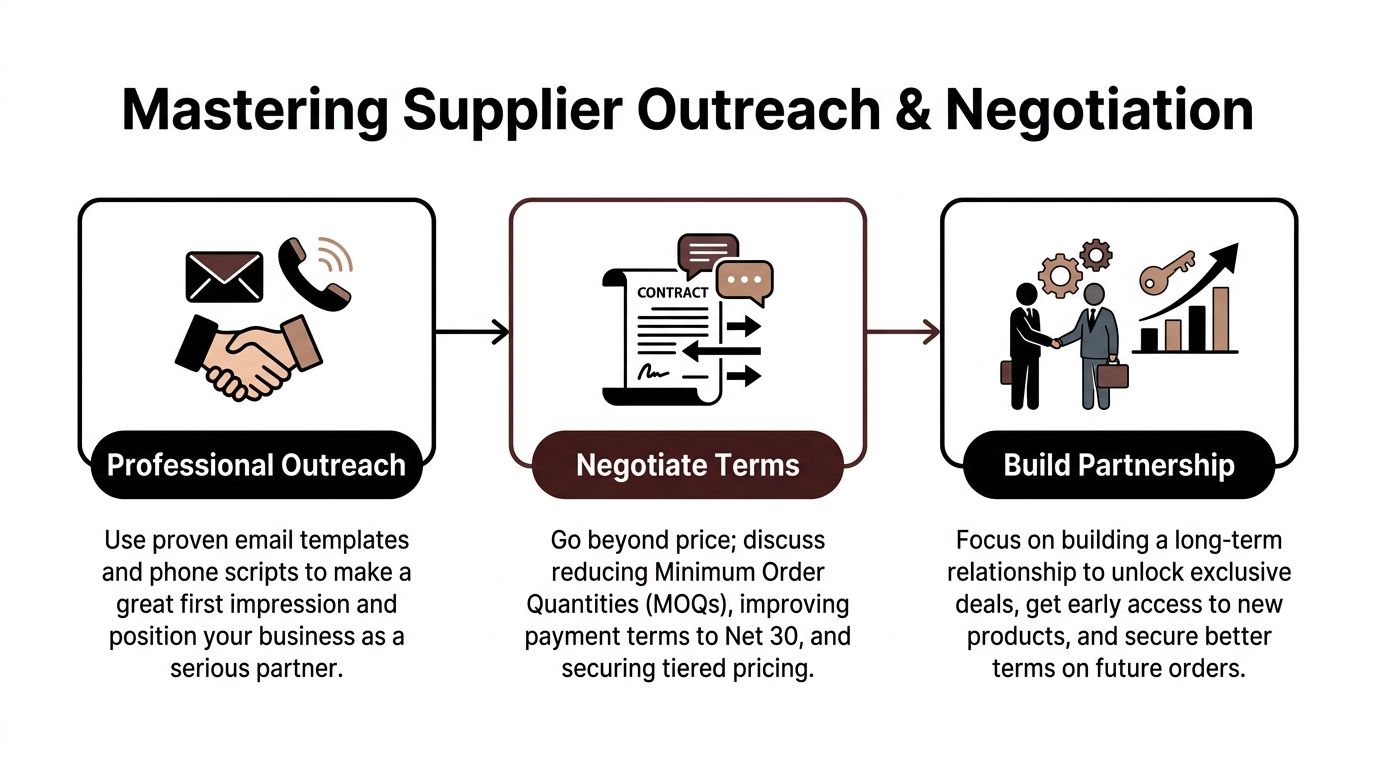
As you can see, building the partnership is the final piece of the puzzle. Seamless logistics are a huge part of keeping that relationship strong. If you want to learn more about how these services work, check out our guide on how an Amazon prep company can save you time and money.
The Non-Negotiables of an FBA Shipment
Whether you do it yourself or hire a prep center, a few things are absolutely mandatory for every single inbound shipment.
First, you have to create a shipping plan in Amazon Seller Central. This is how you tell Amazon exactly what you’re sending, how many units of each product, and how it’s all packaged.
During this process, Amazon will generate unique FNSKU (Fulfillment Network Stock Keeping Unit) labels for your items. Think of this as your product's specific ID within Amazon's system. This barcode is critical—it has to be placed on every single item, completely covering any other barcode from the manufacturer.
For bigger orders, which are common in wholesale, you'll likely be dealing with a Less-Than-Truckload (LTL) freight shipment. This means your inventory will be stacked and wrapped on pallets. For anything heavy or bulky, this is way more cost-effective than using small parcel carriers like UPS. Both your supplier and your prep center should know exactly how to prep and schedule LTL freight pickups. Mastering this flow is the key to keeping your products in stock without racking up expensive long-term storage fees.
Your Top Amazon Wholesale Questions, Answered
When you're first diving into the wholesale model, it feels like a million questions pop up at once. I've been there. Even after years in the game, some of the same core questions come up again and again from sellers trying to get their footing.
Let's cut through the noise and get you some straight answers to the most common sticking points.
How Much Money Do I Actually Need to Start?
There’s no magic number, but let’s be realistic. You should aim to have somewhere between $2,000 and $5,000 in starting capital. This isn't just for inventory; it's the full picture.
That budget needs to cover your first big inventory order (which has to meet the supplier's Minimum Order Quantity, or MOQ), business licenses, the essential software you can't work without, and maybe some fees for a prep center if you aren't handling that yourself.
Sure, you could try to start with less. I've seen people attempt it. But it makes things incredibly difficult. A smaller budget makes it tough to land accounts with better suppliers and leaves you with zero room to absorb the inevitable startup costs.
Can I Get Away with Not Having a Business License?
In a word: no. Not if you want to work with real, legitimate wholesale suppliers. Any distributor worth your time is going to ask for a business license (like an LLC) and a resale certificate before they even think about opening an account with you.
This isn't just a supplier being difficult; it's how they vet legitimate resellers from retail buyers. When a supplier asks for this paperwork, it's a huge green flag. It tells you you're dealing with a professional B2B operation that plays by the rules.
What’s a Good Profit Margin for Wholesale?
A healthy, sustainable net profit margin on Amazon wholesale products usually lands somewhere between 8% and 15%. That’s the money you pocket after Amazon takes its cut, you pay for shipping, and you subtract your cost for the product.
You'll occasionally find a rockstar product that hits a higher margin, but banking on that is a rookie mistake. Focusing on that 8-15% range is a much more realistic and stable strategy.
And remember, sales velocity is king. A 10% margin on a product that flies off the shelves every day is way more valuable than a 30% margin on an item you only sell once a month.
How Do I Deal with Gated Brands on Amazon?
Sooner or later, you'll run into a brand that's "gated," meaning you need Amazon's permission to sell it. This is a super common hurdle. To get ungated, you have to apply directly through Seller Central.
The process typically boils down to providing one of two things:
- Wholesale Invoices: You’ll need to submit invoices from an authorized distributor that meet Amazon’s strict criteria. This means they need to be dated within the last 180 days and clearly show your business name and address, among other details.
- A Letter of Authorization (LOA): This is a formal document directly from the brand owner giving you their blessing to sell their products on the Amazon marketplace.
When you're vetting a new wholesale supplier for Amazon, one of your first questions should be whether they can provide invoices that meet Amazon's ungating requirements. This is a non-negotiable. If you need more granular details, the Amazon seller forums are full of sellers who have navigated this exact process.