
Most advice about a wholesale business on Amazon is too shallow to be useful.
It tells beginners to “find a supplier,” “run the numbers,” and “send inventory to FBA.” That’s enough to place an order. It’s not enough to build a durable operation that survives pricing pressure, documentation reviews, stock problems, and account risk.
Wholesale works when you treat it like an operating business, not a product hunt. The sellers who last usually do three things better than everyone else. They control buy decisions with hard data, they keep invoices and supplier relationships clean enough to survive scrutiny, and they manage inventory with discipline instead of optimism.
That is the playbook. Not flashy replens. Not random distributor catalogs. Not buying any branded item with a spread on a calculator.
The Wholesale Model on Amazon Explained
Wholesale on Amazon means buying branded products in case packs or larger quantities from brands or authorized distributors, then selling against listings that already have demand. The appeal is obvious. You are not paying to create awareness, generate reviews from zero, or guess whether the market wants the product.
That does not make wholesale easy. It makes the job different.
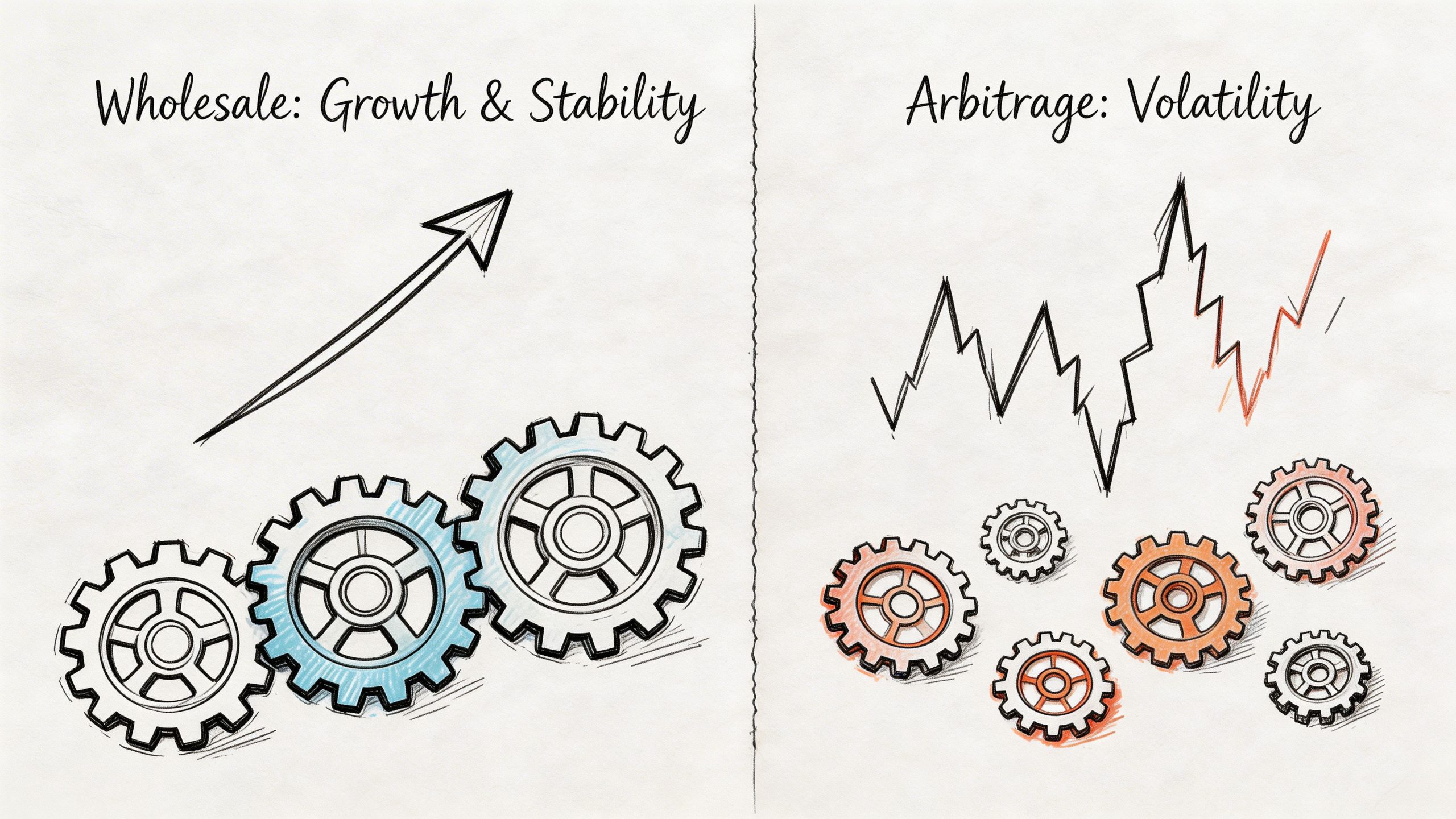
A key advantage is repeatability. A good wholesale account can produce reorderable ASINs for months or years. Retail arbitrage usually depends on short-lived price gaps and store-by-store sourcing, and those deals often yield minimal net profit after mistakes, mileage, and time are accounted for. Private label can produce higher upside, but it also brings launch costs, ranking risk, and more capital tied up in one bet. Wholesale usually lands in the middle, with margins that are commonly in a moderate range when the account is run well and buy costs stay controlled.
The wholesale model is a popular choice for Amazon sellers because it can be scaled with systems instead of constant product hunting. But the part beginners miss is that Amazon does not reward wholesale sellers just for finding inventory. It rewards sellers who can prove chain of supply, protect account health, and keep products in stock without flooding FBA.
Why branded products matter
Branded wholesale products give you three things up front: existing search demand, listing history, and visible price behavior. That shortens the validation cycle. You can study rank consistency, seller count, Buy Box rotation, and review velocity before placing a serious order.
It also creates a different kind of risk.
You are stepping into a listing shared with other sellers, and sometimes with the brand itself. That means the decision is not just “Can I make a spread?” The better question is whether the ASIN is stable enough to support repeated buys after fees, price compression, returns, and storage. A product can look profitable on a calculator and still turn into a bad wholesale SKU if seller count spikes every time the distributor runs a promo.
Documentation matters just as much as margin. If Amazon questions authenticity or supply chain legitimacy, weak invoices can shut down a profitable catalog fast. Sellers who want a durable operation should understand how to properly validate suppliers and invoices for Amazon reviews before they scale orders.
What wholesale is really good at
Wholesale works best for sellers who want an operation they can standardize.
| Goal | Why wholesale fits |
|---|---|
| Predictable replenishment | Strong ASINs can be reordered instead of replaced every week |
| Faster validation | Existing listings show demand, pricing history, and competition patterns |
| Lower creative workload | You are selling established products, not building a brand from zero |
| Scalable processes | Purchasing, prep, shipment creation, repricing, and reorder timing can be documented |
The trade-off is simple. Wholesale removes some marketing work and adds more operational discipline. Sellers who last handle boring but profitable tasks well: clean invoices, strict buy criteria, warehouse-level receiving accuracy, and inventory decisions based on real sell-through instead of hope.
That is what separates a real wholesale business from a fragile side hustle.
Building Your Business and Amazon Account
Before you contact a single supplier, get your business identity straight. Most legitimate wholesale accounts won’t approve you if your paperwork looks casual, inconsistent, or incomplete.
A lot of new sellers rush into product research first. That’s backward. Suppliers judge your business before they judge your order volume.
Set up a real business footprint
At minimum, build a structure that looks and operates like a business:
- Choose your entity carefully. Many sellers prefer an LLC because it separates personal and business activity more cleanly than operating as an individual.
- Get an EIN. Suppliers often ask for it, and it keeps you from using personal tax identifiers on every form.
- Apply for a resale certificate or seller’s permit. Wholesalers usually expect tax-exempt resale documentation.
- Use a business bank account. Mixing Amazon payouts, supplier payments, and personal spending creates accounting problems and weakens your paper trail.
- Create a domain email. A buyer using Gmail can still get approved, but a branded email usually signals that you’re serious.
None of that is fancy. It just removes friction.
Match your documents exactly
Amazon account reviews and wholesale account applications both punish sloppy mismatches.
Your business name should appear the same way across:
- Seller Central registration
- EIN paperwork
- Resale certificate
- Banking records
- Supplier invoices
- Utility or address documentation if requested
If one document includes an LLC suffix and another doesn’t, clean it up now. If your suite number appears on one document but not another, fix it. Tiny inconsistencies become big problems once compliance enters the conversation.
The easiest account issues to avoid are the ones you create yourself by submitting documents that don’t match.
Open Seller Central like an operator
When you create your Amazon seller account, slow down and verify every field before submission. Don’t “figure it out later.” Later is when Amazon asks you to prove what you entered months ago.
A clean setup usually means:
- Business legal name first
- Business address that can receive mail
- Bank account in the business name
- Charge method you control and monitor
- Identity documents that are current and readable
If you’re planning wholesale from day one, keep digital records of every supplier communication and invoice from the start. That matters more than many realize. If you need a practical walkthrough on documentation issues, this EntreResource guide on Amazon not accepting invoices and how to properly validate suppliers is worth reviewing before you place your first serious order.
Build for approval, not just access
A new seller account isn’t the business. It’s the container.
What suppliers want to see is simple:
| What they check | What it signals |
|---|---|
| Business registration | You’re operating legitimately |
| Resale documentation | You understand wholesale basics |
| Professional contact info | You’re likely to reorder |
| Clear product focus | You’re not randomly mass-applying |
| Consistent records | You’re less likely to become a support problem |
That last point matters. Good suppliers don’t just sell inventory. They manage risk. If your documents are clean and your communication is sharp, you’re easier to approve.
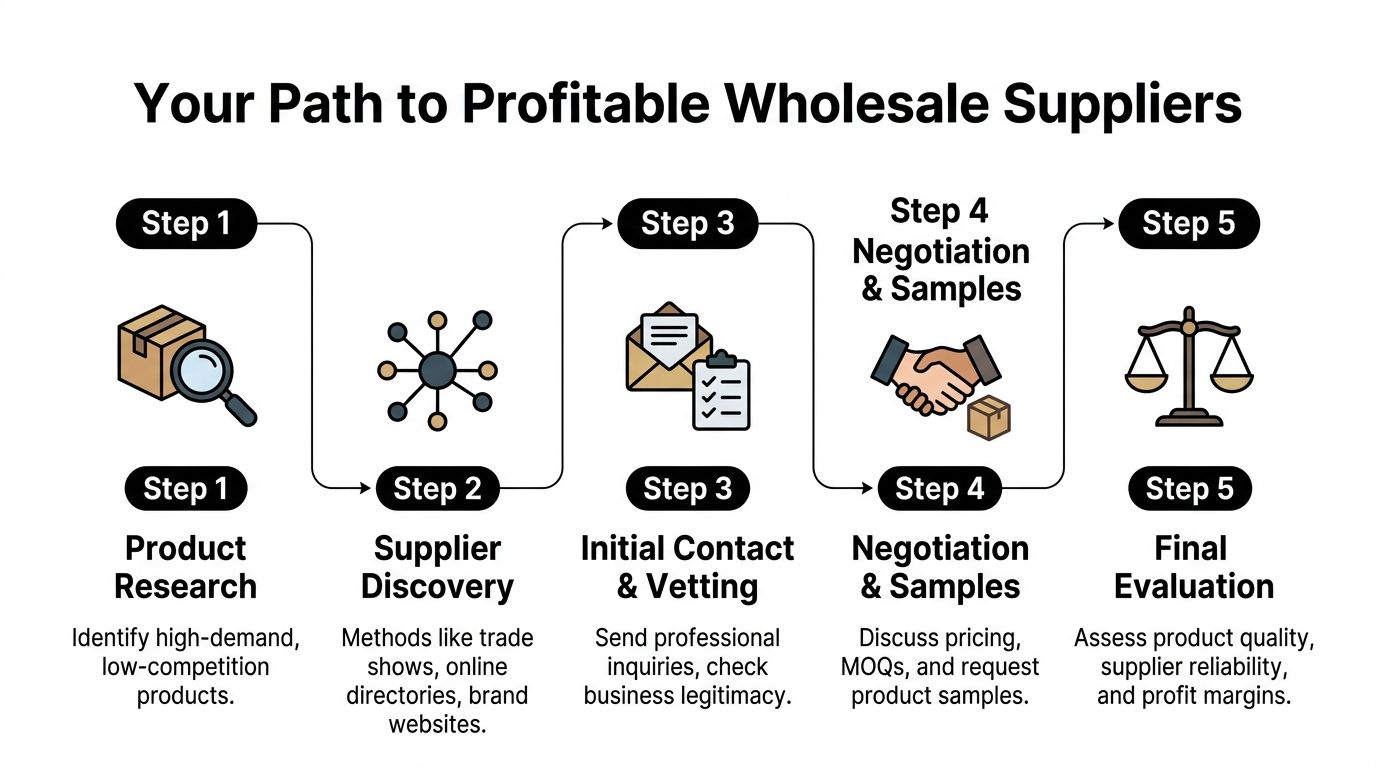
How to Find and Vet Profitable Wholesale Suppliers
The biggest mistake in a wholesale business on Amazon is treating supplier discovery like a contact collection game.
A giant spreadsheet of distributors means nothing if they can’t provide clean invoices, if their pricing leaves no margin, or if they only offer products on listings crowded with aggressive sellers. Good sourcing is narrower than commonly believed. You’re looking for the overlap between valid supply chain, healthy listing conditions, and repeatable replenishment.
Start with products, not supplier catalogs
Reverse sourcing is usually more efficient than blasting outreach to random wholesalers.
Look for products that already show signs of stable opportunity. Data from Panda Boom notes that sellers improve their odds of winning the Buy Box by targeting products with fewer than five sellers and no Prime sellers, and that stronger wholesalers often avoid trendy gadgets in favor of boring, everyday consumables with consistent demand (Panda Boom on Amazon FBA success patterns).
That lines up with what works in practice. A dull replenishable item with stable sales history often beats a “hot” item that attracts copycat sellers and price collapses.
What I look at before contacting a supplier
Use tools like Keepa, SellerAmp, and Amazon’s own listing data to filter aggressively.
A useful pre-sourcing screen includes:
- Price stability: If the chart swings wildly, your margin probably isn’t real.
- Seller count: Fewer sellers usually means a cleaner field.
- Prime presence: If there’s no Prime offer, you may have room to improve the listing’s fulfillment quality.
- Brand behavior: Some brands tolerate marketplace sellers. Others constantly clean house.
- Variation clutter: Listings with too many child variations can hide weak economics.
I’d rather analyze ten steady ASINs thoroughly than skim a hundred “possible” ones.
Where good suppliers come from
The best supplier sources depend on how direct you want your supply chain to be.
Brand websites
Go to the brand first. Look for wholesale, dealer, distributor, or retail partner pages. If the site doesn’t show it clearly, email and ask who their authorized distributors are.
That gives you two advantages. You may get a direct account, or you may get routed to approved distribution channels with better documentation.
Trade show directories and exhibitor lists
Industry trade shows are still one of the cleanest ways to find real brands and established distributors. Even if you don’t attend in person, exhibitor directories can reveal who operates in the category.
LinkedIn works well for finding sales managers, channel managers, and distributor reps. Short, specific messages perform better than broad pitches.
Distributor search terms
Google still works if you search like a buyer instead of a blogger. Use combinations of brand name, distributor, wholesale, dealer application, catalog, and region.
If you need a broader operational primer on bulk purchasing before outreach, EntreResource has a practical guide on how to buy in bulk for resale.
Vet suppliers before you ask for pricing
Don’t get seduced by a catalog.
Check whether the supplier appears to be a real operator:
- Legal business identity
- Commercial address
- Working phone support
- Brand authorization when relevant
- Invoice quality
- Return policy
- Payment terms that make sense
- MAP clarity if the brand enforces it
If a supplier can’t explain where their inventory comes from, skip them. If they resist basic documentation questions, skip them faster.
A cheap supplier with weak paperwork is expensive inventory waiting to happen.
Outreach that gets responses
Most first emails fail because they sound either desperate or vague. Keep yours short and commercial.
Here’s a simple template:
Hello [Name],
My company is a registered online retailer focused on branded products in [category]. We’re interested in opening a wholesale account and reviewing your catalog for potential recurring purchases.
Please let me know your application process, resale requirements, and whether you work with Amazon sellers. If approved, I’d also like to review your current price list and ordering terms.
Business details are below. I’m happy to provide resale documentation and any additional information you need.
Thank you,
[Name]
[Business Name]
[Phone]
[Website]
[Resale certificate / EIN available upon request]
That works because it tells them who you are, what you want, and what kind of buyer you intend to be.
The first order should answer questions
Your initial order is a test, not a victory lap.
Use it to judge:
| What to test | What you’re really evaluating |
|---|---|
| Invoice accuracy | Will this hold up if Amazon asks questions? |
| Packing quality | Will units arrive FBA-ready or prep-heavy? |
| Lead times | Can this supplier support replenishment? |
| Catalog depth | Is this a one-product account or a real relationship? |
| Communication | Do they fix issues fast or disappear? |
If the first order creates confusion, don’t scale the relationship just because the spreadsheet says the margin looks good.
Mastering Negotiation and Calculating True Profitability
Most wholesale sellers don’t have a sourcing problem. They have a math problem.
They negotiate too late, buy too early, and use optimistic margins that ignore the costs that matter. A product only becomes “good” after every real expense is accounted for.

Negotiate for structure, not just price
Price matters, but it isn’t the only lever.
Useful negotiation points include:
- Lower MOQ: Helps you test without trapping cash in inventory.
- Tiered pricing: Lets you earn better cost basis once reorder volume is proven.
- Freight terms: Shipping concessions can change the deal more than a small unit discount.
- Damage allowances or return handling: Important for fragile or regulated categories.
- Catalog access: Sometimes the true win is getting a broader line sheet, not one item.
When I negotiate, I don’t lead with “Can you do better?” I lead with a business case. I’ll explain the SKUs I’m testing, the reorder intent if sell-through holds, and the conditions that would justify larger volume. Serious suppliers respond better to planned buyers than to hagglers.
Use the 3x rule as a gate, not a guarantee
Bellavix describes the 3x rule as a baseline benchmark: your selling price should be at least three times your product cost, and after Amazon referral fees, FBA costs, and shipping, sellers should target 15% to 30% net profit margins (Bellavix on Amazon wholesale profitability).
That’s a solid first filter. It is not the final answer.
A product can pass a quick multiplier test and still be weak because of:
- returns
- prep labor
- slow turnover
- storage drag
- price compression
- coupon pressure from other sellers
Build a detailed landed-cost model
Before placing a larger order, calculate:
| Cost layer | Questions to answer |
|---|---|
| Unit cost | What are you paying after discounts? |
| Inbound shipping | Supplier to prep center or Amazon |
| Prep and labeling | Case unpacking, labeling, bundling, poly bagging |
| Amazon referral fee | Category-based fee impact |
| FBA fulfillment fee | Size and weight sensitivity |
| Storage exposure | How long will the units realistically sit? |
| Returns and defects | What happens when customers send them back? |
If you need stronger financial controls as your catalog grows, it can help to have Financial Analysts review margin assumptions, reorder timing, and cash conversion issues. Wholesale gets messy fast once you carry multiple suppliers and replenishment cycles.
A quick FBA calculator run is useful. A full landed-cost worksheet is better. The calculator tells you whether an item might work. The worksheet tells you whether it still works after reality hits.
What decent negotiation sounds like
Try language like this:
We’re testing a small opening order on a focused SKU set. If the first cycle performs as expected, I’d like to discuss reorder pricing and broader catalog access. Is there a volume break structure I should plan around now?
That sounds like a buyer worth keeping.
A practical explainer on wholesale deal math can also help if you want to see another seller walk through the logic step by step:
Don’t buy on hope
The worst inventory is inventory that looked profitable only at the first order stage.
Watch for these traps:
- A margin that only works at today’s Buy Box
- An MOQ that assumes perfect sell-through
- A product whose chart hides repeated tanking
- A “deal” that depends on no one else joining the listing
Good wholesale buyers protect the downside first. Profit comes after that.
Inventory Management and Logistics Workflows
Inventory control decides whether a wholesale business stays scalable or turns into an expensive guessing game.
Sourcing gets the attention. Replenishment, receiving, shipment routing, and sell-through tracking decide whether the business keeps cash.
FBA versus FBM for wholesale
FBA is still the default for many wholesale sellers because Prime eligibility and Amazon-handled fulfillment usually improve conversion and Buy Box stability. FBM still has a place, especially when a supplier is inconsistent, inbound appointments are backed up, or you want to test a SKU before sending deeper inventory into FBA.
The right answer is usually operational, not ideological.
| Model | Works best when | Main weakness |
|—|—|
| FBA | You want Prime coverage, better conversion, and less daily fulfillment work | Storage fees, stranded inventory risk, and less flexibility after inventory is checked in |
| FBM | You need tighter control, slower test buys, or backup coverage during FBA delays | Lower conversion on many listings and more hands-on execution |
Good wholesale operators often run both on purpose. FBA carries the proven replenishable ASINs. FBM covers edge cases, short tests, and listings where Amazon check-in delays would cost too much revenue.
Build the workflow before you place larger POs
A workable inventory flow usually follows one of three paths:
- Supplier to prep center to Amazon
- Supplier direct to Amazon, when case packs, labels, and carton specs are consistently right
- Supplier to your own warehouse, when you need inspection, relabeling, bundling, reserve storage, or multichannel options
The decision comes down to error rate.
If a supplier misses labels, ships mixed cartons, or ignores carton dimensions, direct-to-Amazon gets expensive fast. You end up paying in receiving delays, reconciliation issues, and stranded units. A prep center or small warehouse layer adds cost, but it also catches mistakes before Amazon turns them into lost time and support cases.
Stock discipline beats aggressive buying
Wholesale sellers usually fail inventory in one of two ways. They under-order and lose rank, or they over-order and let fees and dead stock drain the account.
The better approach is boring. Set reorder points by lead time, average weekly sales, and a safety buffer. Review those numbers every week. Change them when demand changes. Do not reorder based on gut feel after a good seven-day run.
If your current process lives across scattered notes and supplier emails, this guide on how to track inventory in Excel is a practical place to start. For Amazon-specific process cleanup, EntreResource has a useful guide on Amazon inventory management systems and workflows.
Keep fewer weak ASINs. Buy deeper on the ones that keep earning shelf space.
What to review every week
A real wholesale inventory review answers four operational questions:
- Which SKUs will stock out before the next supplier lead-time window closes
- Which SKUs have slowed enough that the next reorder should be reduced or skipped
- Which inbound shipments are late, split, or at risk of check-in delays
- Which ASINs no longer deserve FBA space because fees, sell-through, or competition changed
Add one more check if you want a business that holds up under pressure. Compare warehouse on-hand, units in transit, units at prep, and Amazon available quantities every week. Those numbers drift more often than sellers expect, especially when suppliers short-ship or Amazon receives inventory inaccurately.
That review is more valuable than another hour of random catalog browsing. Sellers who last in wholesale treat inventory like an operating system, not a pile of POs.
Advanced Strategies for Scaling and Risk Management
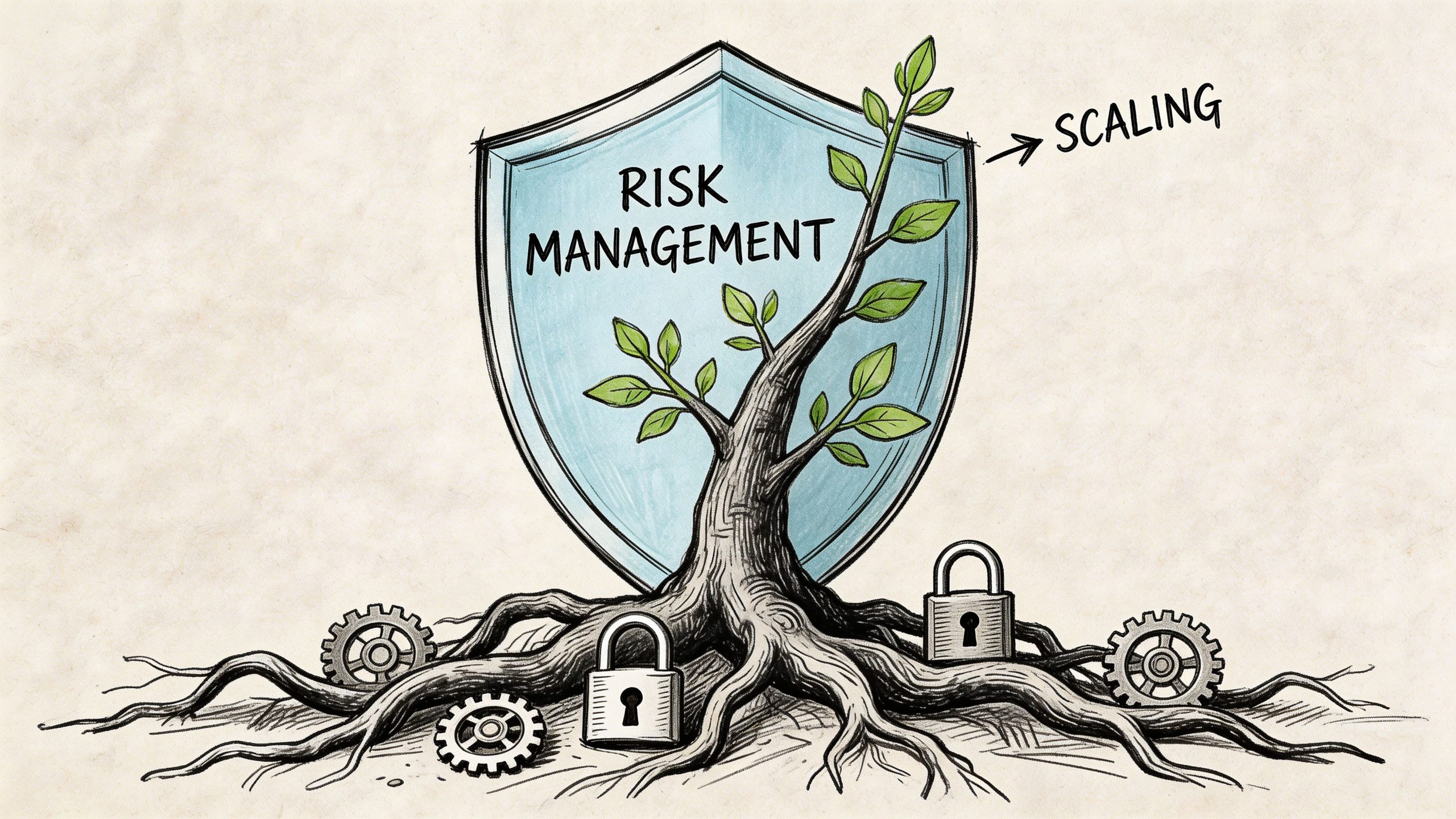
Most wholesale content treats risk like an afterthought. That’s a mistake.
Once your catalog grows, your weak point usually isn’t product research. It’s the part of the business that breaks under pressure: bad invoices, weak supplier chains, undocumented decisions, and account exposure from listings you never should have touched.
Section 3 risk is operational, not random
A lot of sellers talk about suspensions as if they happen out of nowhere. Usually they don’t.
They happen because the seller bought from a supplier they didn’t verify well enough, kept incomplete invoice records, sold into brands with messy channel control, or couldn’t clearly prove the supply chain when Amazon asked.
If you want a wholesale operation that survives, set stricter rules than you think you need:
- Only buy from suppliers who issue clean, complete invoices
- Store invoice files in an organized system by supplier and order
- Match business details across Amazon, supplier records, and tax documents
- Avoid brands with obvious seller conflict unless you understand the channel
- Document any authorization emails or resale approvals
I also recommend writing internal SOPs for invoice intake, catalog approval, and order filing. That sounds boring until Amazon asks for documentation and you need it in minutes, not after three days of inbox searching.
The warehouse-level angle most sellers ignore
One of the more interesting advanced tactics is warehouse-specific underserved shelf space. The assigned source describes a strategy of finding understocked, fast-moving ASINs in specific Amazon warehouses, instead of relying only on broad national trend data. It also notes that this can yield 30% to 50% margins, compared with an average 20% in saturated wholesale categories, and ties the tactic to a climate where AI audits for Section 3 compliance and invoice authenticity have intensified (YouTube source on warehouse-level wholesale opportunities and compliance pressure).
That’s the kind of edge most public wholesale advice misses.
At a practical level, the idea is simple. National demand can look crowded while local FBA coverage is still weak. If you can identify ASINs moving quickly without enough consistent FBA presence in certain fulfillment regions, you may step into cleaner velocity than the top-line seller count suggests.
How to apply that without overcomplicating it
Use your existing research stack more carefully.
A workable process looks like this:
- Start with ASINs that already move consistently
- Check whether FBA coverage appears thin relative to demand
- Ignore listings crowded with entrenched Prime sellers
- Prioritize items where your supplier can replenish reliably
- Test small, then watch sales velocity and restock timing closely
This is not magic. It’s just more precise inventory placement thinking.
Scaling needs SOPs before it needs staff
Sellers often hire too early and document too late.
Before bringing in a VA or operations help, write repeatable procedures for:
| Process | What the SOP should define |
|---|---|
| Supplier outreach | Qualification rules and follow-up timing |
| Deal analysis | Required checks before purchase approval |
| Invoice filing | Naming convention and storage location |
| Repricing limits | Floors, ceilings, and review triggers |
| Restock decisions | When to reorder and when to let a SKU die |
The goal isn’t more SKUs. The goal is a catalog you can defend, restock, and explain.
That’s what turns wholesale from a hustle into an asset.
Your Wholesale Business on Amazon FAQ
How much money do you need to start?
Start with enough capital to set up the business correctly, place test orders, and absorb mistakes without forcing bad decisions on the next reorder.
There is no single number because minimum order quantities, prep costs, category requirements, and supplier payment terms change the math fast. The mistake I see most often is putting too much money into a first buy before the seller has proven they can read a listing, manage replenishment, and keep paperwork clean.
Early capital should buy learning and control. A smaller order from a legitimate supplier usually teaches more than a large order spread across weak SKUs.
What if a brand rejects your wholesale application?
Expect rejection. It is part of the model.
A rejected application does not mean the opportunity is dead. It usually means the brand is protecting distribution, the timing is wrong, or your account is still too new to get approved directly.
Use the next move that keeps you in a clean supply chain:
- Ask whether the brand has authorized distributors
- Tighten your resale certificate, website, and business presentation
- Reapply later after building purchase history with similar brands
- Shift to smaller brands in the same category that still have room for another seller
The key is staying selective. Chasing every brand wastes time. Building a base of approved, reorder-friendly accounts matters more.
How do you handle gated brands or restricted categories?
Check restrictions before you spend time sourcing. Do not assume an invoice will solve the problem after inventory arrives.
Amazon cares about document quality, supplier legitimacy, and whether your paperwork matches what you are trying to list. That becomes even more important if your account ever faces a Section 3 review. Sellers who treat invoices casually usually regret it when Amazon asks for proof at the worst possible time.
A safer approach looks like this:
- Buy from suppliers that issue clear, verifiable invoices
- Store invoices so they are easy to retrieve by supplier and date
- Match product details on the invoice to the listing as closely as possible
- Skip inventory that depends on gray-area sourcing or weak authorization
Some fights are not worth taking. Protecting the account matters more than forcing one ASIN through.
What software matters most?
The most useful software stack is usually small.
| Need | Tool type |
|---|---|
| Price and sales history | Keepa |
| Quick product evaluation | SellerAmp |
| Repricing | A repricer with floor controls |
| Accounting and margin review | Spreadsheet or accounting system with landed-cost tracking |
| Documentation and workflows | Shared cloud storage plus SOPs |
Software should support decisions, not replace them. Keepa helps with buy decisions. A repricer protects margin. Landed-cost tracking shows whether a SKU is making money after freight, prep, storage, and returns. If a tool does not improve one of those jobs, it is probably extra overhead.
Is wholesale still worth it if competition is tougher?
Yes, for sellers who run it like an operating business instead of a side hustle.
The sellers who struggle usually make the same mistakes. They buy crowded ASINs, trust weak suppliers, ignore regional stock patterns, and overorder before they understand sell-through. That version of wholesale is fragile, and Amazon is not forgiving when the paperwork breaks or a listing turns.
The sellers who last do a few things better. They choose suppliers they can defend, keep invoices organized, track true margins, and restock with discipline. They also accept that some SKUs are not worth saving. Cutting a shaky item early is often smarter than trying to force profitability out of it.
If you want this model to hold up under scale, start narrower than you want to. Fewer suppliers. Fewer SKUs. Better records. Better purchase decisions. That is how a wholesale business becomes durable.