

Online arbitrage is one of the most straightforward ways to start an e-commerce business. At its heart, the idea is simple: you buy products from one online store and then resell them for a higher price on another, like Amazon.
Think of it as a digital treasure hunt. You're capitalizing on price differences between retailers, snapping up clearance deals on sites like Walmart.com and flipping them for a profit where demand is higher.
How Does This Actually Work?
The entire business is built on the classic "buy low, sell high" principle, but it's all done from your computer. You become a professional online shopper, sniffing out hidden bargains that you can connect with buyers willing to pay more for the convenience. No more driving from store to store.
This model works because the online market isn't perfectly efficient. One major retailer might be clearing out overstocked inventory at a steep discount, while that same exact product is in high demand (and selling for much more) on Amazon. By spotting these gaps, you can create a steady stream of income.
If you've ever heard of people scanning clearance aisles at stores to flip items online, you're already familiar with the core concept. Online arbitrage is just the digital evolution of What Is Retail Arbitrage.
The Fundamental Steps
Success in online arbitrage really boils down to mastering a few key activities that all work together. Get these right, and you can build a surprisingly scalable business.
- Sourcing Profitable Products: This is the hunt. You're scanning online stores for discounts, sales, and special promotions to find items priced well below what they’re selling for on Amazon.
- Analyzing the Deal: Before you ever click "buy," you have to run the numbers. You'll calculate your potential profit after factoring in everything—Amazon's fees, shipping costs, and any taxes—to make sure the flip is actually worth your time.
- Listing and Selling: Once you've got the inventory, you list it for sale. The majority of sellers use Fulfillment by Amazon (FBA), which is a game-changer. You ship your products to an Amazon warehouse, and they handle all the storage, packing, shipping, and even customer service for you.
To give you a better feel for the business model, here's a quick overview.
Online Arbitrage at a Glance
This table breaks down the essential components of online arbitrage to give you a clear picture of what's involved.
| Core Concept | Primary Marketplace | Initial Investment | Key Skill |
|---|---|---|---|
| Buy low, sell high—entirely online. | Amazon (typically) | Low to moderate | Identifying and analyzing profitable deals. |
This combination of low startup costs and a straightforward process makes it a fantastic entry point into the world of e-commerce.
It's a proven model with real potential. By 2023, according to industry reports, over 50% of online arbitrage sellers were bringing in around $5,000 per month, with an average profit margin of 16%. That's a solid business, especially considering it requires far less upfront cash than creating your own private label brand.
Online arbitrage isn't about getting lucky. It's about using data to find and confirm profitable opportunities over and over again. The real skill is turning all the noise of the internet into clear, actionable buying decisions.
When you get down to it, this model turns your everyday online shopping habits into a legitimate income-generating machine. You’re not inventing a new product or building a brand from scratch. Instead, you're the savvy middleman who bridges the gap between a great deal and a ready-to-buy customer.
The Four Pillars of Online Arbitrage
Every successful online arbitrage business runs on a simple, repeatable cycle. Think of it as a four-step process that you’ll run over and over again. Once you get the hang of it, this becomes the engine that drives your entire business, turning your efforts into a scalable, profitable machine.
Getting these four pillars right turns the whole idea of "online arbitrage" from an abstract concept into a concrete game plan you can actually follow.
The entire system builds on itself, with each step feeding into the next.
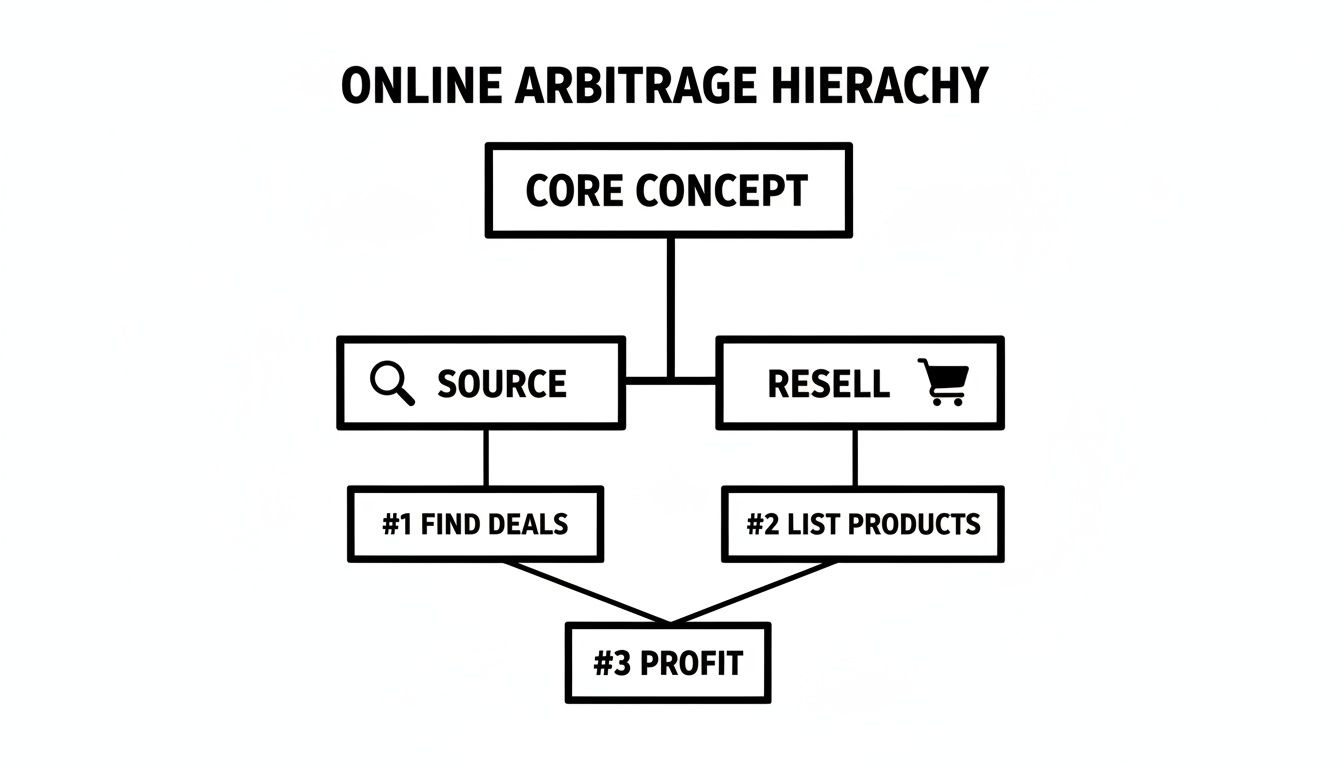
This simple diagram shows the core engine: you find products online and flip them for a profit. The four pillars below are the specific stages that make that engine run smoothly.
Pillar 1: Product Sourcing
First up, and honestly the most important part, is product sourcing. This is the art of finding profitable products to sell. Think of yourself as a digital treasure hunter, digging through online stores to find hidden gems—items priced way lower than what they’re selling for on Amazon. That price gap is your profit.
But sourcing isn't just about grabbing any cheap item you find. It requires some real research. Smart sellers use specialized tools to check a product's sales history, how much competition it has, and if its price is stable before they even think about buying. You're hunting for products with steady demand and a healthy profit margin after all the fees. This first step sets the stage for everything else.
Pillar 2: Smart Listing
Once you've got your products, it's time for a smart listing. This is where you add your offer to a product page on Amazon. Since you’re not creating a new brand from scratch, you'll almost always be piggybacking on a listing that already exists in Amazon's massive catalog.
The name of the game here is accuracy and being competitive. Your product has to perfectly match the existing listing—we're talking color, size, packaging, everything. Then, you set a competitive price that gives you a shot at winning the "Buy Box," which, as Amazon states, is where the vast majority of sales happen. A smart listing gets your product seen and sold fast.
Pillar 3: Seamless Fulfillment
The third pillar is seamless fulfillment, which is just a fancy way of saying "how you get your stuff to the customer." The overwhelming majority of us in the online arbitrage world use a service called Fulfillment by Amazon (FBA). This program is an absolute game-changer.
Instead of your garage turning into a warehouse and you spending your nights taping up boxes, you just ship your products in bulk to an Amazon fulfillment center. From that point on, Amazon handles everything:
- Storage: They hold onto your inventory for you.
- Packing & Shipping: When an order comes in, Amazon's team picks, packs, and ships it directly to the customer.
- Customer Service: They also take care of all the customer questions and returns.
Using FBA lets you focus on the activities that actually make you money—like finding more products—while Amazon does all the heavy lifting.
The power of FBA is that it allows a one-person operation to function with the logistical might of a global corporation. It's the key to making online arbitrage a truly scalable business model without needing a physical warehouse or employees.
Pillar 4: Strategic Scaling
The final pillar is strategic scaling. This is where you take your early profits and turn them into some serious growth. The whole idea is to reinvest your earnings back into buying more inventory. As your capital grows, you can start buying a wider variety of products or just go deeper on your proven winners.
This creates a powerful compounding effect. A small starting investment of a few hundred dollars can grow into thousands, which can then grow into tens of thousands. Strategic scaling is all about being disciplined with your reinvestment to turn this from a side hustle into a real business, boosting your revenue month after month.
In the world of online arbitrage, if you don't nail product sourcing, nothing else matters. It's the entire foundation of your business. Here’s a hard-won lesson: profit is made when you buy, not when you sell. This makes product sourcing the single most critical skill you can develop. It’s about turning what feels like a guessing game into a repeatable, data-driven process.
Successful sourcing really just boils down to one thing: finding items online that are priced way lower than what they’re currently selling for on a marketplace like Amazon. That price difference, or "spread," is where all your profit lives. Think of it like a digital treasure hunt, but instead of a dusty old map, you're using data to find the gold.

There are two main ways to go about this hunt. Each has its own rhythm and advantages, and honestly, most sellers I know who are crushing it blend both methods into their strategy.
Two Core Sourcing Strategies
First up is manual sourcing. This is the hands-on, roll-up-your-sleeves approach where you’re actively digging through online retail websites—scouring clearance sections, combing through promotional emails, and jumping on daily deal pages. It’s all about developing an instinct for what a good deal feels like and learning which product categories are goldmines.
This method takes time and a lot of persistence, but it gives you total control. You become a true expert at spotting trends and understanding how different retailers price their products. If you want to expand your hunting grounds, you should check out our massive list of websites for online arbitrage product sourcing to find some untapped spots.
The second method is automated sourcing. This is where you bring in the robots. Specialized software scans thousands of products across hundreds of retail sites in just minutes, comparing prices against Amazon listings and flagging potential deals for you. It saves an unbelievable amount of time.
Automated tools don't replace your judgment; they superpower it. They do the heavy lifting of finding potential deals, but you still have to do the final analysis to decide if a product is a smart buy.
This leads us to the most important part of sourcing: making your decisions based on cold, hard data, not just a low price tag.
Your Most Powerful Tool: Keepa
No matter how you find your products, one tool is absolutely non-negotiable for any serious online arbitrage seller: Keepa. This browser extension is your crystal ball, providing historical data for pretty much every product on Amazon in a simple chart. I mean this in all seriousness—I wouldn't even try to do this business without it.
Learning to read a Keepa chart is like learning to read the stock market for a specific product. It tells you everything you need to know before you risk a single dollar of your own capital.
Here’s a quick rundown of what a Keepa chart shows you:
- Price History: You can see how the price has moved over months or even years. This is how you spot stable products and dodge ones with crazy, unpredictable pricing.
- Sales Rank (BSR): The Best Sellers Rank tells you how often an item sells. A lower rank means more sales. Keepa shows you the BSR history, so you can confirm a product has consistent demand and isn't just a one-hit wonder.
- Offer Count: This number shows how many other sellers are on the listing. If you see a sudden spike in the offer count, it's a huge red flag that prices are about to tank as competition floods in.
- Buy Box Data: It tracks who has owned the Buy Box and at what price. This is critical for figuring out if you can actually compete and win sales at your target price.
By looking at all these data points together, you can confidently answer the most important questions before you buy inventory. Is there real demand? Is the price stable? Is the competition manageable?
Making Data-Driven Decisions
When you find a potential deal, your analysis needs to be systematic. You’re not just looking for a cheap price; you're looking for a profitable opportunity that is backed up by historical data.
To help you vet products, here are the key metrics I always check. Think of this as your pre-flight checklist before spending any money.
Key Metrics for Vetting Online Arbitrage Products
| Metric | Good Target | What It Indicates |
|---|---|---|
| Sales Rank (BSR) | Top 1%–3% of its category | Consistent and strong sales velocity. A low, stable BSR means it sells often. |
| Price Stability | Minimal sharp drops in the last 90-180 days | A stable price history suggests you can sell at your target price without a sudden crash. |
| Offer Count | Steady or slowly declining | A low and stable number of sellers means less competition and less pressure on pricing. |
| Buy Box Price | Historically held by third-party sellers | Shows that you don't have to compete directly with Amazon to win sales. |
| Amazon's Presence | Amazon is out of stock >75% of the time | If Amazon is consistently on the listing, it's nearly impossible for a third-party seller to compete. |
This data helps you avoid the classic sourcing mistakes that can sink your business, even when a deal looks great on the surface:
- Buying into a "Race to the Bottom": If the Keepa chart shows a climbing offer count and a falling price, run the other way.
- Investing in Slow-Moving Products: A huge profit margin is worthless if the item only sells once every three months. Use the Sales Rank history to confirm it moves consistently.
- Ignoring Amazon's Presence: If Amazon is a frequent seller on the listing, you will have a very hard time getting the Buy Box. It’s a fight you’ll probably lose.
Ultimately, mastering product sourcing is about building a repeatable system. When you combine smart sourcing strategies with deep data analysis using tools like Keepa, you transform online arbitrage from a risky gamble into a calculated and profitable business.
Calculating Your True Profitability
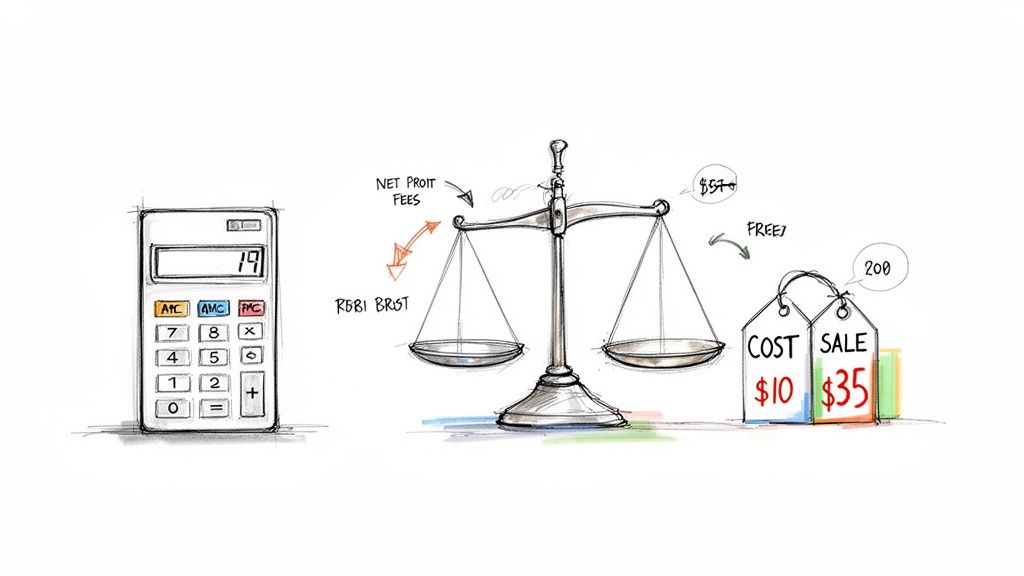
Spotting a massive price gap between two websites feels like hitting the jackpot. But here's the reality check every new seller needs: a high selling price is not the same as a high profit.
The single biggest mistake I see beginners make is underestimating all the little costs that chip away at their earnings. Getting a handle on these numbers is what turns this from a fun hobby into a legitimate, money-making business.
Think of your selling price as just the starting line. Your actual profit is what’s left in your pocket after Amazon and all the other operational costs take their cut.
Deconstructing the Costs
Before you can figure out what you'll actually make, you need a crystal-clear picture of every single fee involved. It might seem like a lot, but they generally fall into a few main buckets.
- Cost of Goods (COG): This one's easy. It's what you paid for the product, plus any sales tax.
- Amazon Referral Fees: Think of this as Amazon's commission. For every sale, they take a slice of the total price, usually between 8% and 15%, depending on the product category.
- Fulfillment by Amazon (FBA) Fees: If you're using FBA, this fee covers all the heavy lifting—Amazon picking, packing, and shipping the item, plus handling customer service. It changes based on the item's size and weight.
- Inbound Shipping Costs: This is what it costs to send your products in a big box to an Amazon warehouse. You get to use Amazon's discounted shipping rates, which helps, but it’s still a number you have to account for.
- Monthly Storage Fees: Amazon charges you to keep your inventory in their warehouses. This fee is based on how much space your products take up.
The real secret to online arbitrage isn't just finding deals; it's finding deals that stay deals after every single fee has taken its cut. A great-looking margin can vanish in a second if you overlook a high FBA fee.
A Practical Profit Calculation Example
Let's walk through a real-world scenario to see how this all shakes out. Say you find a popular coffee maker on sale for $10 and you know it consistently sells on Amazon for $35.
Here’s how we'd break down the math, step by step:
- Start with the Sale Price: $35.00
- Subtract Amazon's Referral Fee: For this category, we'll use a 15% fee. ($35.00 x 0.15 = -$5.25)
- Subtract FBA Fulfillment Fee: Based on its size and weight, let's say the FBA fee is -$6.85.
- Subtract Your Cost of Goods (COG): This is the -$10.00 you paid for the item.
- Estimate Inbound Shipping & Storage: A good rule of thumb is to budget about -$1.00 per unit for these costs.
Add it all up, and the final calculation looks like this: $35.00 – $5.25 – $6.85 – $10.00 – $1.00 = $11.90.
So, your actual net profit on that one sale is $11.90. Not bad at all.
Mastering Key Profitability Metrics
Net profit is the first thing to look at, but pro sellers live and die by two other metrics: Profit Margin and Return on Investment (ROI). They tell you just how good a deal really is.
- Profit Margin: This shows you what percentage of the sale price was pure profit. You calculate it like this: (Net Profit / Revenue) x 100. For our coffee maker: ($11.90 / $35.00) x 100 = 34%.
- Return on Investment (ROI): This is the big one. It tells you how much you earned compared to what you spent. The formula is (Net Profit / Cost of Goods) x 100. For our example: ($11.90 / $10.00) x 100 = 119%.
An ROI of 119% is fantastic—you more than doubled your money on that single item. As you get more experience, you'll find that many solid, everyday deals in this business land in the 10-15% profit margin range. The real magic happens when you get smart with your sourcing and start finding those higher-margin products that let you scale your business faster.
To make life easier, you don't have to do this math on a napkin every time. You can learn how to use an Amazon FBA Calculator in our guide to quickly see if a product is a winner before you spend a single penny.
Navigating Common Risks and Challenges
Like any business, online arbitrage isn't all smooth sailing. You're going to hit some bumps. But knowing what’s ahead turns potential business-killers into manageable, everyday tasks.
Success in this game isn't just about finding profitable deals; it's about anticipating and handling the inevitable challenges. From brand restrictions to razor-thin margins, here are the common hurdles you'll need to clear.
Managing Brand and Category Restrictions
One of the first brick walls new sellers run into is gating. This is just Amazon’s term for brand and category restrictions. They require you to get official approval before you can sell certain big-name brands (think Nike or Lego) or list products in entire categories like Fine Jewelry. As noted in Amazon's own seller policies, it’s their way of protecting customers and brands from fakes and shady sellers.
Getting "ungated" usually means showing invoices from authorized distributors, which is tough when you're buying from regular retail sites. My advice? Don't fight it at first. Start with brands and categories that are wide open. Build up your sales history and keep your account health metrics pristine. A solid track record makes it much easier to get approval for the more restrictive stuff later on.
Don't even think about ignoring these restrictions. Trying to sell a gated product without permission is a fast-track ticket to getting your inventory stranded or, even worse, your entire account shut down. Always, always check if you're approved to sell something before you buy it.
The Race to the Bottom on Pricing
Because online arbitrage has a low barrier to entry, you’re never going to be the only one selling a product. When a bunch of sellers find the same hot deal, it almost always triggers a "race to the bottom" on price. Everyone starts undercutting each other by a penny to win the Buy Box, and just like that, your juicy profit margin vanishes.
Smarter sellers have a few tricks to sidestep this:
- They find less obvious deals. Instead of chasing the same products everyone else finds on deal sites, they use data to dig for hidden gems with way less competition.
- They use automated repricers. These tools are essential. They automatically adjust your prices to stay competitive, but they do it strategically so you aren't just giving away your profits.
- They know when to be patient. Sometimes the smartest move is to just hold your price and wait. Let the other sellers sell out their stock, and often the price will bounce right back up.
Handling Returns and Slow-Moving Inventory
Returns are just a cost of doing business in retail. If you use FBA, Amazon handles all the customer service and logistics, but you still eat the cost of the returned product. You absolutely have to bake a small percentage for returns into your profit calculations for every item.
The real killer, though, is slow-moving inventory. A product that just sits in an Amazon warehouse is a double-whammy. It ties up your capital so you can't buy new products, and it racks up monthly storage fees that get really expensive after six months. Your best defense is doing solid, data-driven research with a tool like Keepa before you buy anything.
If you do get stuck with a dud, it’s often better to cut your losses and liquidate it—even for a small loss—just to get your cash back. Learning how to manage these duds is a critical skill; making too many bad buys can put your account in jeopardy. You can learn more about protecting yourself in our guide on avoiding Amazon account suspensions.
Despite these hurdles, this business model is far from dead. A lot of people panicked and claimed OA was over after Amazon raised fees in 2023, but sellers who adapted are still crushing it. Today, success is built on consistent sourcing and smart cash management, not just a few lucky flips. As experts like Bryan Guerra point out, there are still plenty of inefficiencies in the market for savvy sellers to exploit. The ones winning are those using data to steer clear of saturated listings. You can hear more of his thoughts on the current state of online arbitrage on YouTube.
Your Step-By-Step Launch Checklist
Alright, enough theory. It's time to turn what you've learned into a real, money-making business. This checklist is your game plan, designed to get you from zero to launch without any fluff.
Follow these steps, and you'll build a solid foundation from day one.
1. Establish Your Business Foundation
Before you even think about buying a single product, get your business structure in place. You could start as a a sole proprietor, but I strongly recommend forming an LLC (Limited Liability Company) right away. As legal experts often advise, it’s a simple move that keeps your personal assets safe if anything goes wrong.
Next, open a dedicated business bank account. Seriously, do not skip this. Mixing business and personal funds is a recipe for a massive headache when it comes to bookkeeping and taxes. Keep it clean from the start.
2. Assemble Your Core Toolkit
You wouldn't build a house without a hammer, and you can't build an online arbitrage business without the right software. The first tool you need, no questions asked, is Keepa. It’s the non-negotiable data tool for knowing if a product is a winner or a dud.
Then, sign up for your Amazon Professional Seller Account. Yes, it costs $39.99 per month, but it’s absolutely essential. This is your key to unlocking critical sales data, competing for the Buy Box, and actually scaling your store.
Think of these tools as investments, not expenses. The data they provide will save you from making costly purchasing mistakes that could easily exceed the subscription fees in a single bad buy.
3. Allocate Your Starting Capital
You need to decide how much money you're willing to put into inventory. You can technically get started with as little as $500, but a starting pot of $1,000 to $2,000 will give you a lot more breathing room to test products and absorb a few early mistakes.
Getting your launch capital sorted is a crucial step. It’s worth taking some time to explore different options for e-commerce business funding to make sure you start on solid ground. This money is the lifeblood of your operation—it’s what you’ll use to buy products and, more importantly, reinvest to grow.
4. Find Your First Five Products
Now for the fun part—the treasure hunt. It’s time to put your sourcing and analysis skills to the test. Your first goal is simple: find and buy five products that you’ve confirmed are profitable.
- Source: Start by manually scanning the clearance and sales sections of major online retail websites.
- Analyze: Run every single potential product through Keepa. Check its sales history, see how stable the price has been, and look at the number of other sellers.
- Calculate: Use an FBA calculator to make absolutely sure you have a healthy profit margin and ROI after all of Amazon’s fees.
5. List and Ship Your First FBA Box
Once you have those first few products in hand, it's time to get them live on Amazon. You'll create your listings, making sure to match them perfectly to the existing product pages.
From there, you’ll pack up your very first FBA shipment. This just means labeling your items to Amazon’s standards, boxing them securely, and sending them off to a fulfillment center using Amazon's cheap shipping rates. The moment that box is checked in, you're officially in business.
Frequently Asked Questions About Online Arbitrage
Alright, let's tackle the big questions that are probably on your mind before you jump in. Getting these cleared up will help you start with a solid game plan and the right expectations.
How Much Money Do I Need to Start
This is one of the best parts about online arbitrage: you don't need a fortune to start. You could technically get off the ground with as little as $500. That'll cover your Amazon Professional Seller account, a must-have tool like Keepa, and your first small batch of products.
But if you want my honest advice? Aim for a starting bankroll between $1,000 to $2,000. Having that extra cushion makes a world of difference. It lets you buy more diverse inventory, absorb a few rookie mistakes without panicking, and start snowballing your profits back into the business much faster.
How Much Time Does Online Arbitrage Take
Your time commitment is completely up to you and what you want to get out of this. When you're first learning the ropes, I'd block out at least 5-10 hours a week. That time will be eaten up by sourcing products, analyzing deals, and packing your first shipments.
The good news is that you get way more efficient over time. Once you get your systems down and start using tools to speed things up, you can run a pretty significant business in just 10-15 hours a week. Many successful sellers do just that.
The beginning is the most time-intensive part. You're investing hours to learn skills that will later take you minutes. Once you get good at spotting deals and using your tools, the whole process gets incredibly fast.
Is the Market Too Saturated in 2026
I hear this one a lot. It's true that OA is more popular than it was ten years ago, but it's nowhere near saturated. As confirmed by Statista, e-commerce is a behemoth that just keeps growing, which means new opportunities and pricing gaps are popping up literally every single day.
Success in 2026 isn't about stumbling upon easy, obvious flips anymore. It's about working smarter. The sellers who are crushing it today are the ones who:
- Use data tools religiously to make every buying decision.
- Dig for unique sourcing spots that aren't the first ones everyone checks.
- Master their cash flow so they always have capital ready for great deals.
The opportunity is absolutely still there for anyone willing to treat this like a real business. The core principle of buying low and selling high is timeless.