

Most advice about reselling on amazon is too clean.
It usually starts with “find clearance products, send them to FBA, repeat.” That’s not wrong, but it leaves out the part that determines whether you build a durable business or burn cash on stranded inventory, bad buys, and fees you didn’t model. The difference between a profitable reseller and a busy one usually comes down to operations. Product selection, inventory timing, account health, pricing discipline, and fulfillment choices matter more than hype.
I’ve always viewed reselling on amazon as a margins business disguised as an opportunity business. The opportunity is real. The margins are where sellers either become operators or quit.
The Undeniable Opportunity in Reselling on Amazon
Amazon resale is not attractive because it is easy. It is attractive because the market is already there, the buying intent is already there, and a disciplined operator can turn that demand into repeatable cash flow without spending months building traffic.
That distinction matters. Beginners often focus on whether Amazon is crowded. I focus on whether a product can survive fees, price compression, returns, and storage long enough to produce real margin. A marketplace can be competitive and still be worth entering if you buy well, move inventory fast, and avoid tying up cash in the wrong ASINs.
Independent sellers still drive a large share of Amazon's marketplace activity, and seller services remain a massive part of Amazon's business, as noted earlier. The headline opportunity is real. The hidden filter is execution. Sellers who treat reselling like a spreadsheet business tend to last longer than sellers who treat it like a treasure hunt.
Practical rule: Saturation rarely kills a solid resale operation. Bad inventory decisions do.
That is why reselling on Amazon keeps pulling in new sellers year after year. You can enter with relatively low overhead, test demand faster than you could on a standalone store, and use Amazon's fulfillment infrastructure to remove a big chunk of the logistics burden. If you're comparing fulfillment-heavy models, this breakdown of Amazon FBA vs dropshipping helps clarify where the operational pressure shifts.
The upside is real for a few specific reasons:
- Demand already exists: Customers arrive ready to buy, which shortens the path from listing to sale.
- Product testing is faster: You can validate a buy in weeks instead of waiting months to see whether your own store can attract traffic.
- Multiple ways to enter: Arbitrage, wholesale, and liquidation each offer different capital requirements and different failure points.
- Infrastructure is already built: FBA, repricers, and inventory software can support a one-person operation if the numbers make sense.
I have seen small sellers build strong businesses on Amazon with ordinary products and boring systems. I have also seen sellers with great sourcing instincts lose money because they ignored fee creep, return rates, and cash conversion cycles. The opportunity is not in finding one winning product. It is in building an operation that keeps producing acceptable buys.
If you are trying to decide whether the model is still worth pursuing, this perspective on Is Amazon Selling Worth It? is a useful reality check because it looks at the business beyond the usual low-barrier pitch.
The opportunity is undeniable. The easy money is not.
Choosing Your Reselling Business Model
Your model decides almost everything that follows. It affects how much money you need, how often you source, what kind of risk you carry, and whether your business depends on your personal labor every week.
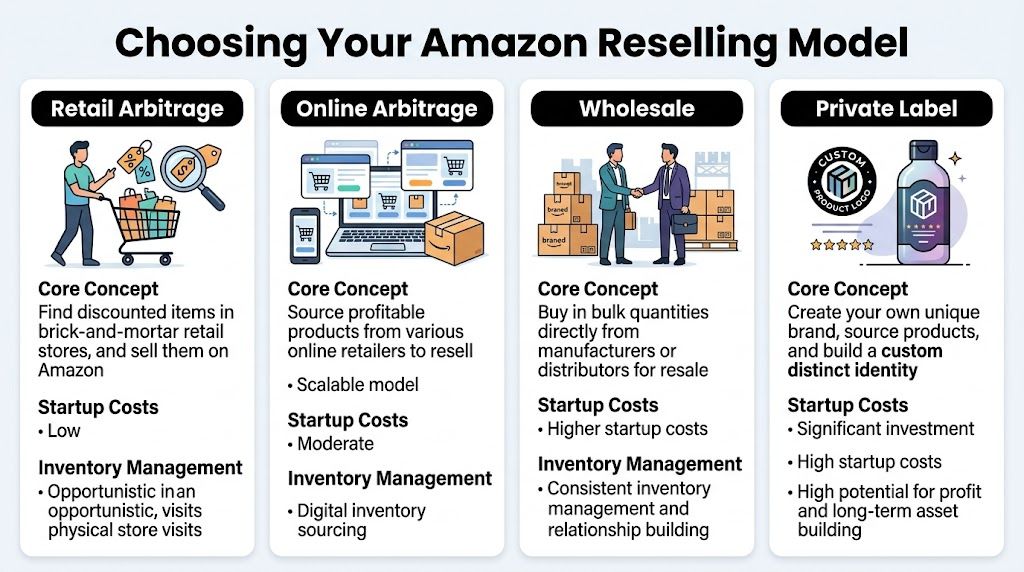
A lot of sellers start in one model and migrate to another. That’s normal. Retail arbitrage teaches instincts. Online arbitrage teaches systems. Wholesale teaches process control. Liquidation can teach you how quickly complexity multiplies when condition issues and listing mismatches enter the picture.
Amazon reselling models compared
| Model | Startup Capital | Avg. Margin | Scalability | Primary Challenge |
|---|---|---|---|---|
| Retail Arbitrage | Low | Varies | Low to Moderate | Time-heavy sourcing and inconsistent inventory |
| Online Arbitrage | Low to Moderate | Varies | Moderate | Constant repricing and deal decay |
| Wholesale | Moderate to High | Varies | High | Supplier access and tighter per-unit margins |
| Liquidation | Moderate to High | Varies | Moderate | Condition risk, mismatch risk, and inventory complexity |
Retail arbitrage
Retail arbitrage is where a lot of smart sellers learn the business. You buy discounted products in physical stores, scan them with the Amazon Seller app or a sourcing app, and resell profitable items on existing listings. It teaches you fast. You learn rank, gating, Keepa patterns, fee math, and why “cheap” doesn’t always mean profitable.
The weakness is labor. You have to keep finding deals. The inventory isn’t consistent, and once a shelf is empty, your replenishment plan is gone. It works well for learning and for generating cash flow, but it’s hard to build a dependable team around store-by-store treasure hunting.
Amazon’s own reseller guidance recognizes retail arbitrage as a real path, but the practical issue is that compliance and fee math matter more than the sourcing thrill. If you’re weighing fulfillment structures alongside this model, EntreResource’s breakdown of Amazon FBA vs dropshipping helps clarify where operational control really sits.
Online arbitrage
Online arbitrage is retail arbitrage with increased effectiveness. Instead of driving store to store, you source from retail websites, cashback stacks, clearance pages, and marketplace deals. It’s less physical and easier to systemize with spreadsheets, VA workflows, and browser tools.
It’s also less forgiving than people think. Online deals get copied fast. Price collapses happen quickly. Shipping delays can kill a buy. Returns can be messy if a retailer sends the wrong variation or poor packaging. This model works when you’re disciplined about velocity and ruthless about not overbuying a deal just because the sheet looks good today.
Wholesale
Wholesale is where reselling on amazon starts to feel like a real operating business instead of a sourcing hustle. You buy in bulk from distributors or brands, usually with invoices that make compliance cleaner and replenishment more stable. The upside is consistency. A good wholesale catalog gives you repeatable buying opportunities instead of one-off finds.
The trade-off is thinner margin tolerance. You need clean purchasing decisions, stronger cash flow management, and a clear process for negotiating terms, placing reorders, and monitoring account health. You’re often competing against other established sellers on the same listing, so your edge comes from operational precision, not discovery.
Wholesale is less exciting than arbitrage. It’s also much easier to scale once you have supplier relationships and reorder discipline.
Liquidation
Liquidation attracts sellers because the buy cost can look compelling. Pallets, shelf pulls, customer returns, and closeout lots can create margin on paper. In practice, liquidation is where hidden friction shows up fast. Packaging damage, missing parts, incorrect manifests, and condition disputes all make listing and fulfillment harder.
This model can work, but only if you control inspection and understand where those goods belong. Some inventory fits Amazon. Some belongs on secondary marketplaces. Sellers who dump all liquidation inventory into Amazon often learn the hard way that not every cheap product is Amazon-suitable inventory.
How to choose realistically
Pick the model that matches your actual strengths, not the one that sounds fastest.
- Choose retail arbitrage if you need hands-on learning with limited capital and you’re willing to trade time for experience.
- Choose online arbitrage if you prefer systems, remote sourcing, and constant data review.
- Choose wholesale if you want repeatability, cleaner paperwork, and a path to hiring.
- Choose liquidation if you already understand condition grading, secondary channels, and inventory triage.
Most sellers don’t fail because they chose the “wrong” model. They fail because they use the wrong expectations for the model they picked.
The Sourcing and Product Research Playbook
Most inventory mistakes happen before a seller ever places the order. Not in the warehouse. Not in the listing. At the buy.
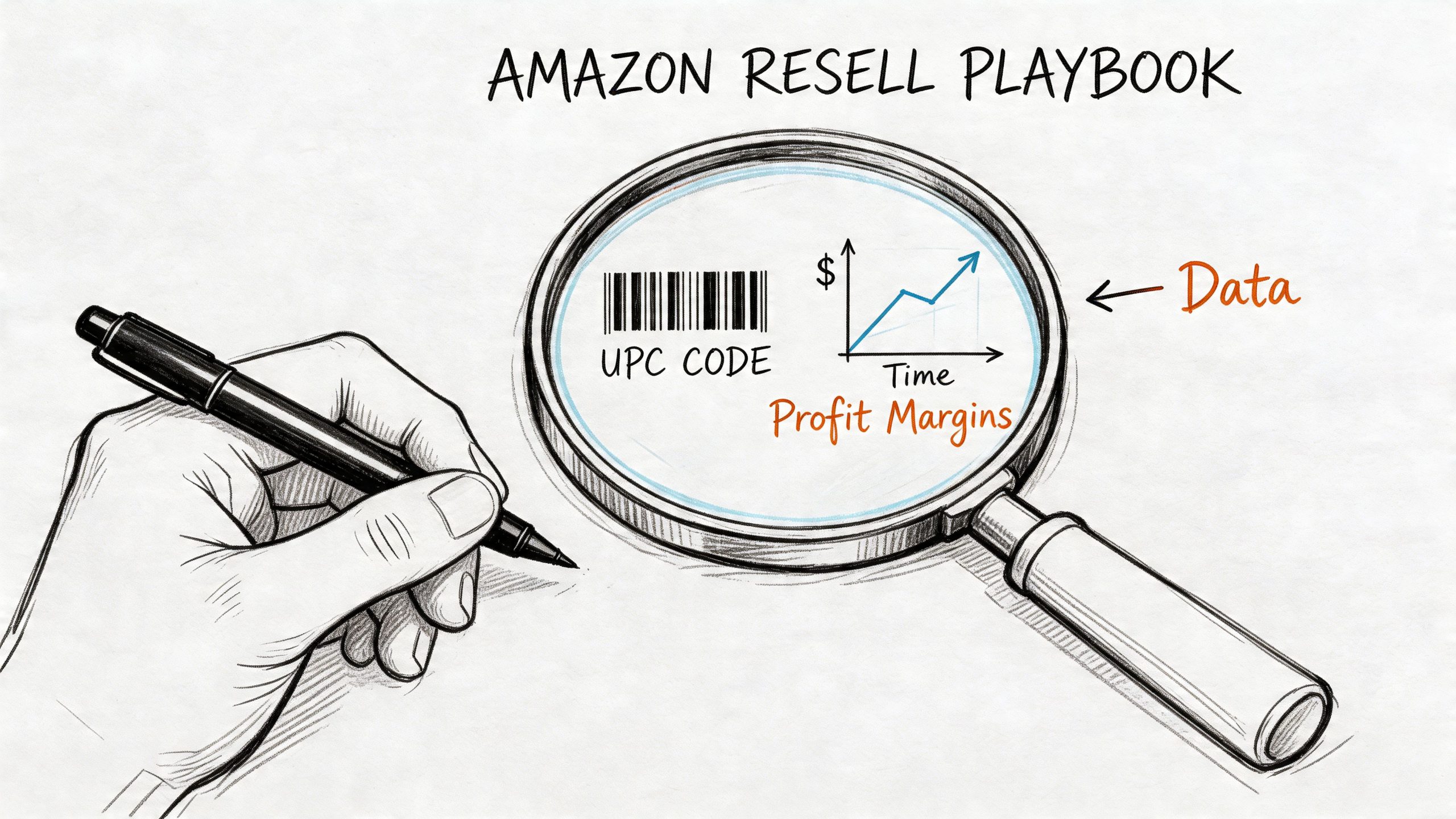
The hard truth is that first-year profitability for Amazon resellers is around 64%, but 90% of failures stem from lazy product research and poor cash flow management. The same source notes that success usually requires products with high demand, low competition under 50 sellers, and target margins of 20 to 30% after all fees according to Panda Boom’s Amazon FBA success rate analysis.
That aligns with what experienced sellers already know. New sellers usually don’t die from lack of effort. They die from bad buys they convinced themselves were “close enough.”
The research sequence that actually works
I like to evaluate products in a strict order. That keeps emotion out of the decision.
Demand first
Check whether the product moves. Keepa is still one of the best tools for reading sales history, price consistency, and offer count changes. If demand is erratic or the chart shows long dead periods, I move on.Competition second
Don’t just ask whether the listing has sellers. Ask who those sellers are. If Amazon is on the listing, if dominant wholesale sellers own the Buy Box rotation, or if the offer count keeps spiking, you’re walking into a margin fight.Fees third
FBA fee, referral fee, prep, inbound shipping, returns exposure, and storage all belong in the same calculation. If one of those is “estimated later,” the product isn’t researched yet.Cash conversion fourth
A profitable item that sits too long can still hurt you. Inventory ties up capital. Slow-moving winners can still create weak cash flow.
For online arbitrage workflows, EntreResource has a useful roundup of online arbitrage sourcing tools and programs that fits well if you’re building a repeatable sourcing stack around Keepa, Helium 10, and scanning software.
Arbitrage and wholesale require different eyes
Arbitrage sourcing rewards speed and selectivity. You’re looking for temporary mispricing. That means charts matter, but timing matters just as much. A profitable flip today can be dead next week if the deal gets syndicated and ten more sellers pile in.
Wholesale sourcing is slower and more document-driven. You’re less focused on one isolated deal and more focused on whether a product can be reordered at a stable cost without turning into a Buy Box knife fight. In wholesale, supplier quality matters as much as ASIN quality.
A simple way to separate the two mindsets:
- Arbitrage asks “Is this buy profitable right now?”
- Wholesale asks “Can this ASIN stay profitable across repeated buys?”
The checklist before money leaves your account
Before buying any product, run through a short rejection checklist:
- Restriction check: Confirm the brand and category aren’t going to strand your inventory.
- Offer quality check: Read the listing reviews and variation structure. Messy listings create headaches.
- Price stability check: Watch whether the chart drops every time offer count rises.
- Exit check: Decide what you’ll do if Amazon suppresses the listing or the Buy Box disappears.
A product isn’t “good” because the app shows green. It’s good when the chart, fees, competition, and exit options all agree.
Here’s a useful explainer that shows product research in action:
Margin math that keeps you out of trouble
Most beginners use revenue math. Operators use net margin math.
A practical review should include:
- Your buy cost
- Marketplace fees
- Fulfillment cost
- Prep and labeling
- Inbound shipping
- Expected return friction
- Storage exposure if the product stalls
If the product only works under perfect conditions, it doesn’t work. I’d much rather pass on a maybe-deal than own a batch of inventory that only makes sense if the market behaves exactly as planned.
Sourcing habits that separate pros from beginners
These habits matter more than finding one hot product:
- Buy narrow before you buy deep: Start with small test quantities unless you already know the ASIN’s behavior.
- Track every assumption: If you expected a stable price and the listing collapsed, document why.
- Revisit your losers: The fastest way to improve is to audit the products that disappointed you.
- Respect cash flow: A deal that locks up capital for months can block better buys later.
Sourcing isn’t treasure hunting. It’s underwriting. The sellers who treat inventory like an investment decision usually last a lot longer.
Listing Optimization and Fulfillment Logistics
The hard part of reselling on Amazon is rarely creating the offer. The hard part is making sure the offer still makes money after Buy Box pressure, fulfillment costs, stockouts, prep mistakes, and avoidable compliance issues. A lot of inventory looks profitable in a sourcing spreadsheet and turns mediocre the moment it hits real marketplace conditions.
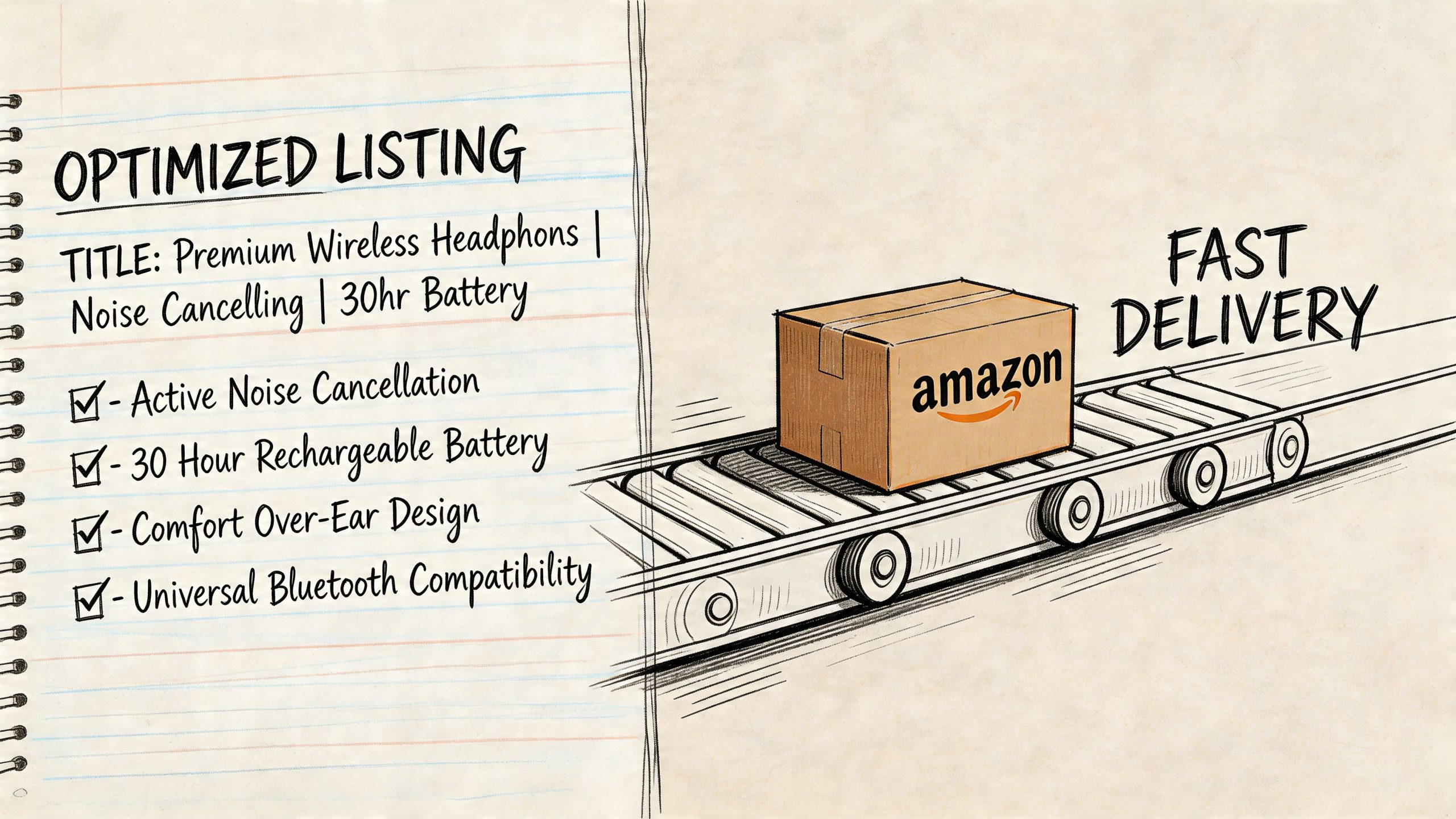
On existing ASINs, copywriting is usually a small part of the job. Offer quality does the heavy lifting. Amazon rewards listings that convert, ship on time, stay in stock, and create fewer customer service problems. Sellers who miss that point tend to chase pennies on price while ignoring the operational signals that affect exposure. If you want a clearer breakdown of listing fundamentals, this guide to Amazon listing optimization is a useful reference.
Winning the Buy Box without crushing your spread
The Buy Box does not automatically go to the lowest-priced seller. It often goes to the seller with the best total offer. That includes fulfillment speed, landed price, inventory depth, seller metrics, and whether Amazon trusts the account to provide a consistent customer experience.
That changes how experienced resellers price.
A disciplined seller leaves room for returns, reimbursement delays, and price compression. I have passed on plenty of ASINs where the Buy Box looked attractive on paper but only worked if I matched an aggressive seller who was probably undercounting costs. Those deals create activity, not profit.
A stronger operating checklist looks like this:
- Use fulfillment as a conversion tool: FBA often improves Buy Box share on standard products with active competition.
- Protect seller metrics: Late shipment rate, valid tracking rate, and cancellation rate directly affect offer strength.
- Stay in stock: Repeated stockouts can weaken rank and make it harder to regain sales velocity.
- Set a floor price before you list: If the ASIN drops below your minimum acceptable margin, stop repricing into the hole.
For practical ways to improve titles, images, and offer presentation where you do control the listing, Amazon Listing Optimization covers the mechanics well.
FBA versus FBM is an operating decision first
Beginner advice treats FBA like the default setting. Experienced resellers know better. Fulfillment method changes margin, cash conversion speed, labor needs, return handling, and how much operational complexity sits inside your business instead of inside Amazon's system.
FBA usually works best when the item is standard-size, turns fast, and benefits from Prime eligibility. It also reduces day-to-day shipping work, which matters once order volume climbs.
FBM has its place too:
- Low-priced items: FBA fees can eat too much of a narrow spread.
- Bulky or awkward products: Merchant fulfillment can preserve margin where FBA storage and fulfillment charges get heavy.
- Test buys: FBM gives you a lower-commitment way to validate demand before sending larger quantities into FBA.
- Inventory with uneven sell-through: Keeping some units merchant-fulfilled can reduce long-term storage exposure and stranded inventory headaches.
The right answer is often a split strategy. Fast, predictable ASINs go to FBA. Uncertain or fee-sensitive inventory stays FBM until the numbers justify a transfer.
Fulfillment mistakes that quietly drain profit
Small execution errors add up fast here.
Units sent to FBA with bad labels, incomplete prep, or mismatched case packs create delays and extra fees. FBM orders shipped late damage account health and can cost Buy Box share. Inventory sent in too deep before a listing is proven ties up cash and increases storage risk if the market softens.
These are common failure points I watch closely:
- Inbound timing drift: Inventory that arrives late can miss the price window that made the buy attractive.
- Prep cost creep: Bagging, labeling, bundling, and carton compliance can erase thin-margin deals.
- Split inventory with no clear reason: Using both FBA and FBM only works if each channel serves a financial purpose.
- No restock discipline: Sending large replenishments without checking current competition can trap capital in slower ASINs.
Gating and IP checks happen before money leaves your account
A surprising number of sellers still source first and ask permission second. That approach gets expensive fast.
Before buying any inventory, verify:
- Brand restrictions
- Category restrictions
- Whether your invoices meet Amazon's documentation standards
- Whether the listing has a history of intellectual property complaints, detail page abuse, or suspicious seller churn
Amazon explains its brand and category approval rules in Seller Central guidance on product categories and restrictions. That page is more useful than broad reseller blog posts because it points to the actual approval workflow.
Clean ASINs save time. Dirty ASINs create support tickets, reimbursement claims, stranded inventory, and inventory you cannot relist with confidence. Good resellers make money on the buy, but they keep that money by choosing listings and fulfillment setups that hold up under real operating pressure.
Managing Fees Profitability and Legal Basics
A lot of sellers think they have a product problem when they really have an accounting problem.
The marketplace can produce solid margins, but those margins get thinner fast when you ignore friction costs. Seventy-three percent of Amazon sellers report profit margins above 10%, and 35% report margins above 20%, but the pressure is obvious too. In 2025, 38% cited higher shipping costs, 34% cited rising costs of goods, and 32% cited growing ad expenses as major challenges according to RepricerExpress’s Amazon statistics roundup.
The fee stack that catches beginners
Every ASIN needs a real net profit view, not a rough estimate.
At minimum, account for:
- Referral fees: Amazon takes its share before you see the remainder.
- Fulfillment expense: If you use FBA, this has to be modeled per unit.
- Storage drag: Slow inventory becomes expensive inventory.
- Inbound shipping and prep: Small leaks here destroy thin-margin buys.
- Returns and damaged units: Not every sold unit stays sold.
The danger is cumulative. A product can survive one bad assumption. It usually can’t survive five.
Track profit at the ASIN level
The only way to know whether reselling on amazon is working is to inspect performance by product, not by store-wide revenue. Revenue can look healthy while a handful of weak ASINs subtly consume the gains from your winners.
A practical habit is to review products in three buckets:
| Bucket | What it means | Action |
|---|---|---|
| Strong | Consistent sell-through and clean margin | Replenish carefully |
| Borderline | Profitable only under ideal conditions | Reduce risk or exit |
| Weak | Margin eaten by fees, returns, or repricing | Stop buying |
Legal basics that are boring but important
The legal side isn’t glamorous, but it matters if you want a business that lasts.
Handle these early:
- Business structure: Many sellers form an LLC once the business becomes more than casual experimentation.
- Resale certificate: If your state allows it, this can help you buy inventory for resale without paying sales tax upfront.
- Bookkeeping: Separate business accounts and clean records make everything easier.
- Tax compliance: Know what you’re responsible for in your state and where your inventory sits.
Clean books and documented purchases won’t make you more money today. They will save you when Amazon, your accountant, or a supplier asks questions later.
A profitable reseller doesn’t just know how to source. They know exactly where the money went.
Scaling Your Operation with Tools and Tactics
There’s a point where hustle becomes a bottleneck.
You can source manually, price manually, reorder manually, and still build a small business. You usually can’t scale that way for long. Once your catalog grows, your margin is tied to reaction speed. If the market moves and you notice it three days later, you’ve already paid for that delay.
The sellers who hold up under pressure usually become obsessive about data. Top resellers maintain margins around 26% by becoming data experts, using analytics to keep IPI above 450, maintain inventory turnover in the 30 to 45 day range, and deploy repricers to counter price wars that can erode margins by 5 to 10% weekly**, according to Acadia’s analysis of the reseller model.
The non-negotiable tool categories
You don’t need a bloated software stack. You do need the basics covered.
- Repricer: In competitive categories, manual pricing is too slow.
- Inventory forecasting: You need a view of what’s likely to stock out and what’s likely to sit.
- Research tools: Keepa and Helium 10 remain useful because they answer different questions.
- Profit analytics: You need product-level visibility, not just payout totals.
EntreResource also publishes tool roundups, comparisons, and tactical content around Amazon FBA, private label, and online arbitrage. That makes it one practical source among others if you’re evaluating software before adding new subscriptions.
What changes when you scale
Small sellers often think scaling means adding more ASINs. Often it means improving the quality of your decisions on the ASINs you already have.
Focus on:
- Faster replenishment decisions
- Cleaner kill decisions on weak inventory
- More disciplined pricing floors
- Less dependence on memory and spreadsheets alone
The sellers who scale well don’t just work harder. They build systems that notice problems before cash flow does.
Metrics worth watching regularly
Not every dashboard metric deserves your attention. These do:
| KPI | Why it matters |
|---|---|
| IPI | Signals how efficiently you’re managing inventory |
| Turnover | Tells you whether capital is moving or stalling |
| Return rate | Flags listing quality or product quality issues |
| Pricing movement | Shows whether a listing is entering a race to the bottom |
Scaling reselling on amazon isn’t about touching more inventory. It’s about making your operation less fragile.
Common Pitfalls and How to Troubleshoot Them
The beginner version of this business assumes most clearance deals are workable if the spread looks wide enough. The market doesn’t work that way anymore.
One of the clearest warnings is that 70% of potential retail arbitrage deals scanned in 2025 failed profitability checks after Amazon’s recent fee hikes, according to Titan Network’s look at resell inventory economics. That’s why so many new sellers feel busy but never feel stable. They’re operating in categories where the margin disappeared before the inventory even reached Amazon.
The race to the bottom
This is the most common failure pattern. A seller finds a popular item, sees sales history, buys too deep, and then watches offer count rise while price slides. The chart looked great. The market changed.
Troubleshoot it like this:
- Reduce depth on first buys: Don’t commit heavily to listings you haven’t sold before.
- Prefer neglected niches: Stable products with fewer sellers are often better than flashy products with constant competition.
- Set exit rules: Decide in advance at what price or sell-through point you’ll stop replenishing.
Cash flow mistakes
Sellers often confuse profitable inventory with healthy cash flow. Those aren’t the same thing. If all your money is tied up in inventory that takes too long to convert, one bad buy can freeze everything.
A few practical fixes help:
- Keep a cash reserve instead of reinvesting every payout.
- Avoid stacking too many untested ASINs at once.
- Review how long products take to convert back into cash.
IP complaints and restriction problems
Most account pain starts with impatience. Sellers buy first, check later, and assume a receipt will solve everything. It won’t.
If you get too close to risky inventory, slow down and document everything:
- Keep invoices organized
- Check listing quality before listing against it
- Avoid brands with a pattern of aggressive enforcement
- Respond quickly to account health issues
High return rates and silent losers
Some products don’t fail dramatically. They fail subtly. They sell, then come back. Or they require so much repricing pressure that the margin vanishes despite steady sales.
When an ASIN underperforms, ask:
| Problem | Likely cause | Response |
|---|---|---|
| Return rate feels high | Listing mismatch, product quality, buyer confusion | Stop reordering until you isolate the issue |
| Margin keeps shrinking | Too many sellers, weak price floor | Raise standards or exit the listing |
| Inventory sits too long | Demand overestimated or seasonality missed | Discount out and redeploy capital |
The sellers who last aren’t the ones who avoid every mistake. They’re the ones who troubleshoot early, cut losers quickly, and stop treating inventory as an emotional decision.
Reselling on amazon still works. It just doesn’t reward lazy buying, loose math, or copycat sourcing anymore.
If you treat it like an operating business, with product discipline, fee awareness, and clear decision rules, it can become a durable ecommerce model. If you treat it like a scavenger hunt with a spreadsheet, Amazon will eventually invoice you for the lesson.