

Can radio ads still drive sales for online businesses?
Radio is often sorted into the “brand channel” bucket and performance channels are left to search, email, and paid social. That's a mistake. Radio remains a large commercial medium, with North American radio advertising revenue reaching about $16.2 billion in 2023 according to Veritone. That matters because a channel of that size doesn't survive on nostalgia alone. Advertisers keep spending when a medium can still deliver reach, recall, and response.
For digital entrepreneurs, the more useful question isn't whether radio is old. It's whether radio can be measured. In many cases, it can. Dedicated URLs, station-specific promo codes, call tracking, branded search lift, and email opt-ins make radio far more trackable than is commonly believed. Radio also still owns a meaningful share of listener attention. AdResults Media cites Edison Research's Share of Ear data showing that in Q3 2025, AM/FM radio held 64% of ad-supported audio listening, compared with 20% for podcasts. If you need broad awareness with enough scale to move demand, that's hard to ignore.
The smarter way to look at radio advertising examples is not as creative inspiration alone, but as campaign models. Some formats are built for immediate response. Others are better for trust, frequency, launches, or local demand capture. The difference between a radio ad that wastes budget and one that drives revenue usually comes down to format choice, message discipline, and how tightly you connect the audio to a digital action.
1. The Direct Response Radio Ad
Dollar Shave Club is the right mental model here. Not because every founder should copy its tone, but because it treated audio like conversion media. Short spot. Clear offer. Memorable brand line. One action to take next.
That approach works because radio listeners usually won't remember three claims, two bonuses, and a long feature list. They'll remember one pain point, one promise, and one easy next step. If you're selling an Amazon FBA tool, a newsletter subscription, a software trial, or a low-friction starter offer, direct response is usually the first format worth testing.
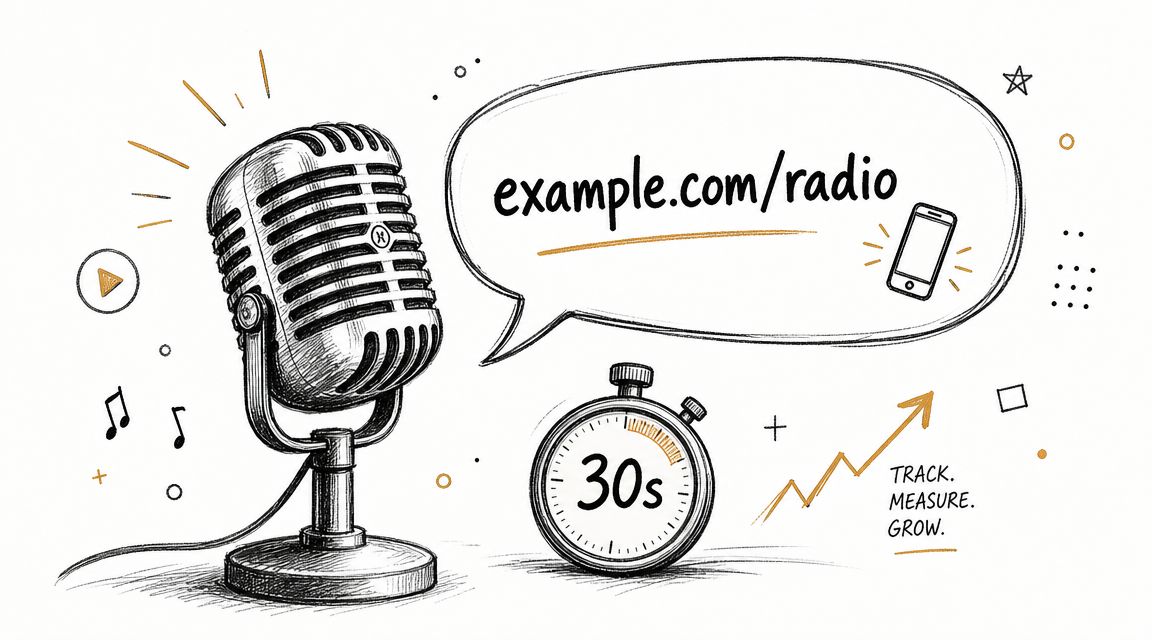
What this sounds like in practice
A good direct-response script sounds closer to a paid social ad than a cinematic brand spot. It opens fast, names the problem fast, and lands on a trackable CTA fast.
A local e-commerce seller might run a spot like this: “Still overpaying for replacement kitchen tools? Visit BrandName.com/radio and get our starter bundle with a radio-only bonus.” That's simple enough to remember and specific enough to track.
Practical rule: If the listener can't repeat the offer and the URL after one pass, the script is too crowded.
The execution matters more than cleverness. AdResults Media's guidance on radio formats points out that effectiveness depends heavily on operational choices such as host reads, produced spots, sponsorships, and mentions, plus keeping copy simple and the brand name clear in the message, as discussed in its piece on radio advertising types and examples.
What works and what usually fails
- Use one conversion action: Send traffic to one dedicated page, not your homepage.
- Repeat the brand clearly: People often remember the category but forget the advertiser.
- Match the offer to intent: Free trial, starter bundle, quiz, and email opt-in are easier radio asks than a complex enterprise demo.
What fails is familiar. Founders try to cram in every feature. They use vanity taglines with no action attached. Or they send listeners to a generic homepage and then wonder why attribution is fuzzy.
If you sell into the Amazon space, the same principles show up in strong direct-response creative used for product positioning and offer clarity. EntreResource's breakdown of Amazon breakthrough advertising is worth reading with a radio lens. Strong messaging usually starts with a sharp promise, not with more copy.
2. The Authority Educational Radio Ad
Some products shouldn't open with a hard sell. If your audience needs trust before they buy, an authority ad usually outperforms a discount ad. That's especially true for B2B services, financial products, coaching, education, and software that solves a non-obvious problem.
This format trades immediate checkout pressure for lead capture. The offer is a guide, calculator, framework, workshop, or short training. The radio ad doesn't push the full sale. It positions the brand as the useful expert and moves the listener into email.
Why this format fits radio so well
Radio is strong when the voice sounds credible and the message feels conversational. One of the clearest examples of voice-led trust building comes from Nationwide Building Society's UK “Voices” campaign, highlighted by Media.co.uk for relying on authentic narration rather than hard-sell copy. That case is useful because it aligns with radio's strength in trust-building and brand association, especially in categories that need reassurance, as described in Media.co.uk's roundup of successful radio campaign examples.
For online entrepreneurs, the playbook is simple. Offer something narrow and immediately useful. “Get the checklist to launch your first private-label product.” “Download the calculator that shows your actual margin after fees.” “Grab the keyword framework for your first niche site.” Those offers are stronger than “visit our site to learn more.”
A weak authority ad sounds like content marketing jargon on the radio. A strong one sounds like a shortcut.
How to make it measurable
- Lead with specificity: “Get the Amazon FBA Launch Checklist” beats “download our free guide.”
- Build the follow-up before the campaign: The email sequence matters as much as the ad.
- Use a landing page built for radio listeners: Minimal fields, clear headline, no navigation clutter.
One caution. Don't fake authority by stuffing in invented numbers or generic “research shows” language. On radio, that often sounds forced anyway. Real authority usually comes from clarity, not from pseudo-data.
3. The Story-Driven Radio Ad
Story ads work when the buyer needs to see themselves in someone else's before-and-after. They're less useful for commodity offers and much more useful when your product changes behavior, confidence, or business momentum.
Many radio advertising examples get romanticized. Storytelling is not the same thing as drifting into vague inspiration. The story still needs a selling structure. Problem. Friction. Discovery. Outcome. Action.
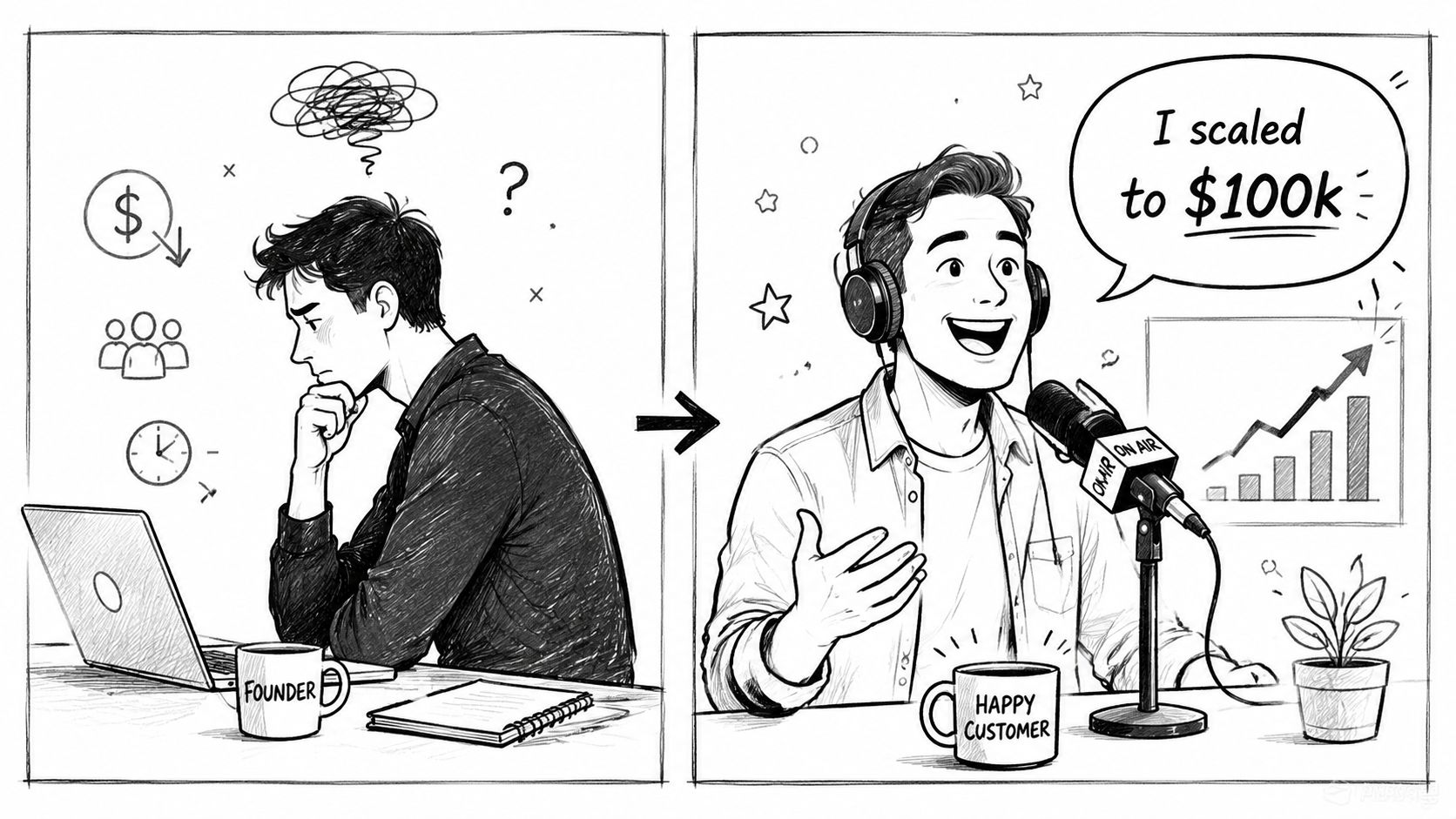
The right way to use customer narrative
A course creator could feature a student who went from scattered product research to a repeatable sourcing system. A blogging tool could feature a publisher who stopped chasing random topics and built a focused content pipeline. A self-publishing service could spotlight an author who finally moved from draft chaos to a finished launch.
The mistake is using an unbelievable hero story. If the person sounds like an outlier, listeners tune it out. If the person sounds familiar, they lean in. Slight imperfections in delivery often help. Radio doesn't need polished perfection as much as it needs credibility.
The listener should hear a real person, not a brochure with a pulse.
A persuasion frame helps here. Strong story ads often work because they move the listener emotionally before they ask for the click. EntreResource's review of Thank You for Arguing is useful background if you want sharper thinking about voice, framing, and how people decide.
Trade-offs to understand
- Better for trust than for instant action: Story ads often warm demand before direct-response ads close it.
- Stronger in founder-led brands: The more personal the business, the more naturally this format fits.
- Harder to write well: Bad story ads meander and hide the offer too long.
If you use this format, keep the CTA simple. Don't make the listener process a dramatic arc and a complicated next step. Finish with one memorable action such as a short URL, branded search prompt, or free resource.
4. The Frequency-Driven Radio Campaign
Some offers don't need more explanation. They need more repetition.
That's the logic behind jingles, sonic logos, and recurring one-message spots. This isn't complex copywriting. It's disciplined recall building. If your audience buys later, not now, frequency matters more than elegance.
When repetition beats novelty
Newsletter brands, recurring events, marketplaces, and tools with broad utility often benefit from repetition. The listener may not need a detailed explanation every time. They need to remember your name when the need appears.
That's why old-school formats like jingles and sonic signatures still survive. They reduce cognitive load. The listener doesn't have to “figure out” the ad every time.
If you're building top-of-mind awareness, don't rewrite the core message every week. Keep the main phrase, benefit, and sound consistent. Change supporting lines if needed, but keep the memory trigger intact. That's how you build lasting brand memory with ad repetition.
What to keep stable
- Brand name placement: Put it early and late.
- One claim only: “Fast bookkeeping for freelancers” is enough. Don't add five extra promises.
- Audio identity: The same voice, music cue, or sign-off helps memory form faster.
The downside is obvious. Frequency campaigns are easier to dismiss if the core message is weak. Repeating a muddled offer only burns budget faster. Before you buy repetition, make sure the line is clean enough to survive hearing it again and again.
5. The Urgency Limited-Time Offer Radio Ad
Urgency is one of the most practical radio formats because audio is immediate. People hear it in motion, often while deciding what to do next. That makes launches, flash sales, event pushes, and countdown offers a natural fit.
The best urgency ads are operationally tight. They don't just say “limited time.” They reflect the actual state of the offer. If tickets are on sale now, the script should say that. If inventory is almost gone, the script should say that. If the event has shifted from teaser mode to final push, the creative should change with it.
Fast updates are the advantage
Global's local-radio guidance gives a useful execution example. It recommends using pre-sale spots to tease an event with the date, venue, and on-sale timing, then swapping those messages in real time to “tickets now on sale” and “last few remaining” creative as availability changes. That's a strong reminder that radio's value isn't just reach. It's speed, as shown in Global's advice on powerful local radio advertising that drives results.
For digital entrepreneurs, this maps neatly to webinar registrations, cart-close promotions, live workshops, software launches, and limited bundles. A Teachable creator with enrollment closing soon can run a short countdown message. An AppSumo-style deal site can use radio to push listeners to a short URL while the offer is live.
The line between urgency and hype
- Real deadline: Use actual dates or genuine closing windows.
- Matching backend: The landing page, code, and offer must reflect the same message.
- Clean terms: If there are exclusions, make them easy to understand.
Watch-out: Urgency works when operations support it. If the ad says “last chance” for days after the promotion should've ended, trust disappears.
What doesn't work is fake scarcity. Listeners can smell manufactured pressure. If your brand needs long-term trust, don't train the audience to doubt your deadlines.
6. The Niche Targeted Radio Ad
Traditional AM/FM isn't your only option. A targeted audio placement inside a niche show can outperform a broader buy when the audience is tightly aligned and the host has real credibility.
This format is often less about scriptwriting and more about fit. A host-read endorsement on a business, side hustle, personal finance, or e-commerce program can sound closer to a recommendation than an ad. That difference matters when you're selling software, education, or services that need trust before trial.
Why host reads often win
Listeners borrow trust from the person they already spend time with. A host who explains how they use your product, why they recommend it, or what kind of listener it's right for can compress the credibility gap faster than a polished produced spot.
That doesn't mean every host read performs well. Some reads sound mailed in. Others wander and bury the call to action. Give the host room to sound natural, but don't skip the guardrails. They still need the brand name, the problem solved, and one memorable next step.
A smart starting point for digital brands is a smaller business or entrepreneurship show with a loyal audience. The downloads may be lower than a big-name show, but alignment often matters more than broad reach when budgets are tight.
What to negotiate before you commit
- Host-read or produced spot: Host-read usually feels more native if the host knows the product.
- Dedicated landing page: Make the destination specific to that show.
- Post-campaign review: Compare code use, branded search lift, and lead quality, not just raw traffic.
This model is especially strong for newsletter sponsors, creator tools, online education, and software with a clear niche use case. It's weaker for products that need heavy visual explanation or broad impulse demand.
7. The Hybrid Radio Digital Integration Ad
If you want radio to behave like a performance channel, this is the format to focus on. The ad doesn't stand alone. It sends the listener into a digital path you can measure.
That path might be a dedicated landing page, a branded search prompt, a show-specific offer page, an email opt-in, or a promo code. The point is simple. Radio creates intent. Digital captures and converts it.
The attribution mindset that changes everything
A founder running radio without a digital bridge is making life harder than it needs to be. Use a landing page built for listeners, not for existing site navigation. Keep the page narrow. Match the audio message to the headline. Capture email if the offer needs longer consideration.
This is also where radio helps channels you're already running. A listener hears the ad, searches the brand later, clicks a paid search ad, joins the email list, and converts from a follow-up sequence. That's not a tracking failure. That's how multi-touch demand often works.
The strategic idea is the same one behind integration marketing for small businesses. Channels perform better when they're designed to support each other, not compete for credit.
How to keep this setup clean
- Use one radio-specific destination: Don't send audio traffic into a generic campaign page.
- Sync message and search: If the ad says “search Brand + Amazon FBA,” own that search experience.
- Build remarketing from the landing page: Many listeners won't convert on first visit.
This is one of the best radio advertising examples for skeptical digital operators because it treats radio like assisted acquisition, not like mystical brand spend.
8. The Local Hyperlocal Radio Ad
Hyperlocal radio is still one of the easiest ways to test audio without committing to a broad market buy. It works for local services, workshops, events, regional e-commerce offers, and any business that can win by sounding rooted in a place.
That local angle is more powerful than many online-first founders expect. A local reference instantly sharpens relevance. If the listener recognizes the town, neighborhood, venue, or nearby landmark, the message feels less generic and more credible.
Why local still matters
A coach promoting an in-person workshop, an author pushing a local signing, a consultant with a regional client base, or an e-commerce brand with local pickup can all benefit from place-specific messaging. The radio spot can mention the area directly, connect the offer to a local need, and point listeners to a local number or page.
This format also gives you room to test radio cheaply and learn fast. You can compare one station against another, one message against another, or one local offer against another before expanding outward.
What to localize beyond the copy
- Use local references listeners know: A nearby district, event, or community cue helps.
- Match the landing page to geography: The page should feel local too.
- Coordinate with local search and email: If people hear the ad and look you up later, the digital trail should confirm what they heard.
For many smaller brands, local radio is the safest entry point. It won't solve every growth problem, but it can tell you quickly whether your offer has audio legs.
8 Radio Advertising Examples Compared
| Approach | Implementation 🔄 | Resources & Speed ⚡ | Expected outcomes 📊 | Ideal use cases | Key advantages & tips ⭐💡 |
|---|---|---|---|---|---|
| The Direct Response Radio Ad (Dollar Shave Club) | Moderate, script + tracking setup and repeat buys | Low production cost; requires ad spend for frequency; quick to launch | Direct, measurable conversions and CPA visibility | Affiliate marketers, Amazon FBA tests, short sales funnels | Highly measurable; use unique URLs/promo codes; keep spots ~30s |
| The Authority / Educational Radio Ad | Moderate–high, build lead magnet + email funnel | Higher content development time; slower revenue ramp | Warm leads, list growth, higher lifetime value over time | Course creators, email marketers, niche publishers | Builds trust via value; send to landing page with email capture |
| The Story-Driven Radio Ad | High, source testimonials, legal releases, longer script | Moderate production; longer ad length; more prep time | Strong credibility and emotional engagement; brand lift | Course creators, service businesses, products needing social proof | Use authentic voices and specific results; get written permission |
| The Frequency-Driven Radio Campaign (Jingle) | Low creative complexity but high scheduling discipline | High media spend over time; cost-effective per impression | Brand awareness and top-of-mind recall after weeks | Subscription services, newsletters, consumer brands | Memorable jingles work; commit 8–12 weeks and monitor ad fatigue |
| The Urgency / Limited-Time Offer Ad | Low, simple message with tracking code | Fast to drive action; needs inventory/fulfillment readiness | Immediate conversions and clear ROI when well-tracked | Product launches, flash sales, affiliate promos | Use explicit deadlines and unique codes; ensure capacity and FTC compliance |
| The Niche / Targeted (Podcast Host) | Moderate, research and negotiate host-read spots | Higher CPM but high engagement; booking lead time | High trust-driven conversions and strong audience fit | B2B, SaaS, niche tools, course sponsors | Host endorsement boosts credibility; provide product access and unique promos |
| The Hybrid Radio / Digital Integration Ad | High, landing pages, UTMs, analytics and retargeting | Requires analytics setup and cross-channel coordination; not instant | Measurable multi-touch attribution and optimized CPA | Performance marketers, e‑commerce, data-driven campaigns | Use dedicated landing pages, UTM tagging, and remarketing audiences |
| The Local / Hyperlocal Radio Ad | Low, localized script and station buys | Lowest cost; quick testability; fast local response | Foot traffic, local calls, strong community engagement (limited scale) | Local services, regional events, hyperlocal e‑commerce | Start single station tests; include local phone/address and track calls |
Your Next Steps Turning Radio into a Revenue Channel
Radio works best when you stop treating it like a mysterious awareness play and start treating it like media with a job. That job might be lead capture, launch momentum, local demand, branded search lift, or direct conversion. The format has to match the job.
For most online businesses, the easiest place to start is the direct-response model or the hybrid radio-digital model. Both give you a cleaner read on what happened after the ad aired. Use a short, memorable URL. Use a radio-specific landing page. Use one call to action. If the page underperforms, fix the page before you blame the channel.
Creative discipline matters more on radio than many founders expect. A good script sounds simple because it has been simplified. The listener should hear the brand clearly, understand the problem you solve, and know exactly what to do next. If your ad sounds like a website paragraph read out loud, rewrite it.
The other big lesson from strong radio advertising examples is that format choice changes outcomes. Story-led ads can build trust, but they're rarely the best first test when you need immediate attribution. Frequency campaigns can build memory, but only if the core line is sharp. Urgency ads can spike response, but only if the backend operations are ready. Host reads can outperform polished spots, but only when the host fits the offer.
That's why I'd start narrow. Pick one market, one format, and one KPI. Track visits to the radio page, email sign-ups, promo code use, call quality, branded search behavior, and downstream purchases. Then compare that against your other acquisition channels. You're not trying to prove that radio is magical. You're trying to determine whether it earns a place in your media mix.
If you want the right mindset, think less about “running radio” and more about achieving measurable revenue impact. Test an offer. Measure response. Tighten the script. Improve the landing page. Keep what pays. Drop what doesn't.
That's how radio becomes useful for modern entrepreneurs. Not as legacy media. As another lever you can pull with intent, discipline, and real accountability.