
In 2026, link building is no longer just a numbers game; it's a measure of authority, trust, and brand relevance. While Google's algorithms evolve, the core principle remains: high-quality backlinks from authoritative sources are a top-tier ranking factor. A citation from Search Engine Land confirms that links are one of the most critical signals Google uses to rank websites. For entrepreneurs and site owners, mastering this discipline is not optional—it's essential for sustainable growth.
However, many guides offer generic advice that fails to move the needle. This article cuts through the noise. We will provide a thorough roundup of 10 proven link building best practices, complete with actionable steps, outreach templates, and real-world examples. From content-led strategies like the Skyscraper Technique to building brand authority through Digital PR, this plan is your playbook for acquiring links that drive rankings, traffic, and revenue.
This guide is designed to be direct and practical, focusing on methods that deliver tangible results. For a different perspective and to further expand your knowledge on effective methods, you can explore these 10 best backlink building strategies.
We'll move beyond theory to cover the specific tactics you can implement today, including:
- Content-Led Tactics: Skyscraper Technique, data-driven content, and expert roundups.
- Outreach & PR: Broken link building, resource page outreach, and Digital PR.
- Brand-Centric Methods: Unlinked brand mentions and competitor backlink analysis.
We will also cover risk mitigation, scaling processes, and the KPIs you need to measure success, ensuring every effort contributes directly to your bottom line. Let's get started.
1. Skyscraper Technique
Popularized by Brian Dean of Backlinko, the Skyscraper Technique is one of the most effective and widely discussed content-led link building best practices. The core idea is simple: find top-ranking content for a keyword you want to target, identify its weaknesses or gaps, and create a significantly better version. The final step involves reaching out to everyone who linked to the original, inferior piece and asking them to link to your superior resource instead.

The name comes from the analogy of seeing the tallest building in a city and deciding to build one just a little bit taller. This method works because it taps into a pre-vetted audience of linkers. These websites have already demonstrated an interest in the topic by linking to a similar article; your job is to give them a compelling reason to update that link to your new, improved asset. Backlinko's original case study on the technique reported a 110% increase in organic traffic in just 14 days, demonstrating its potential effectiveness.
How to Implement the Skyscraper Technique
Executing this strategy requires a methodical approach, moving from research to creation and finally to outreach.
- Identify Opportunities: Use an SEO tool like Ahrefs or Semrush to find content with a high number of referring domains for your target keywords. Look for articles that are outdated, lack depth, have a poor user experience, or are missing key information.
- Create Superior Content: Your new content must be demonstrably better. This doesn’t just mean longer; it means more valuable. Consider adding original data from a survey, updated statistics, custom graphics and charts, or an embedded video tutorial. For example, if the top article is "10 Ways to Start Affiliate Marketing," your skyscraper piece could be "The Ultimate Guide to Starting Affiliate Marketing in 2024 (25+ Actionable Steps & Expert Insights)."
- Conduct Strategic Outreach: After publishing your content, gather the backlink profile of the original articles you aimed to beat. Craft a personalized email for each site owner, mentioning the specific post where they linked to the competitor and explaining why your resource is a better fit for their audience.
Pro-Tip: In your outreach email, don't just say your article is "better." Point to specific value-adds. For instance: "I noticed you linked to [Competitor's Article]. I actually created a more current guide that includes a downloadable checklist and up-to-date case studies from this year, which I thought might be a great update for your readers." This makes the value proposition concrete and hard to ignore.
2. Digital PR and Earned Media
Digital PR moves beyond traditional link requesting and focuses on creating genuinely newsworthy stories to secure editorial backlinks from journalists, news outlets, and high-authority blogs. This earned media approach positions your brand as a credible industry authority, driving both referral traffic and powerful, contextually relevant links that search engines value. Pioneers like Ryan Holiday, in his book Trust Me, I'm Lying, have demonstrated its power in shaping public perception and search rankings.
Unlike direct outreach where you ask for a link, Digital PR makes journalists want to cover your story. By providing unique data, expert commentary, or compelling narratives, you become the source. This is a key link building best practice because the resulting links are editorially given, which Google's algorithms see as strong, natural endorsements. For example, an affiliate marketing tool might get featured in an entrepreneurship newsletter after releasing a study on creator economy trends.
How to Implement Digital PR
Executing a Digital PR campaign involves generating a newsworthy asset and strategically pitching it to the right people in the media.
- Create a Newsworthy Asset: Your foundation is a story worth telling. This can be original research from a customer survey, a report analyzing industry trends, a strong contrarian opinion on a popular topic, or exclusive data. For instance, Nate McAllister of EntreResource could secure coverage by publishing data on the fastest-growing business models for solo entrepreneurs.
- Build a Targeted Media List: Identify journalists, reporters, and bloggers who cover your niche. Use platforms like Twitter and LinkedIn to find relevant contacts, or consider tools like Muck Rack. Avoid generic lists; focus on individuals whose beat aligns perfectly with your story.
- Craft and Pitch Your Story: Write a concise, compelling pitch that highlights the "why" for the journalist’s audience. Explain the story angle clearly and offer your data or expert for comment. It's common to pitch your story 2-3 weeks before you hope for coverage to align with editorial calendars. A professional press kit with founder photos and a company backgrounder makes a journalist's job easier.
- Use Journalist Query Services: Platforms like HARO (Help a Reporter Out) send daily emails with queries from journalists looking for expert sources. Responding to relevant requests can position your team as go-to experts and land high-authority backlinks with minimal effort.
Pro-Tip: Don't be discouraged by low initial response rates. According to a BuzzStream study, response rates for PR outreach can be as low as 8.5%. Professional persistence is key. Follow up once or twice, offering a new angle or additional data point. Your goal is to be a helpful resource, not a nuisance. Frame your follow-up as an attempt to provide value, not just a reminder.
3. Broken Link Building
Broken link building is a highly efficient and value-driven strategy that involves finding links on other websites that point to dead pages (404 errors), creating content that serves as a suitable replacement, and then notifying the site owner of the broken link while suggesting your new page as the fix. It's a win-win: you help webmasters clean up their site and improve user experience, and in return, you acquire a valuable, contextually relevant backlink.

This method works so well because you are not asking for a favor out of the blue; you are providing a direct solution to a real problem on their website. As a link building best practice, it's effective because it removes the friction often found in cold outreach. For example, a business blogger might be linking to an outdated Amazon FBA course that no longer exists. By creating a superior, up-to-date guide, you give them an easy and beneficial reason to update the link.
How to Implement Broken Link Building
Success with this tactic depends on systematic prospecting, quality content creation, and helpful outreach.
- Find Broken Link Opportunities: Use an SEO tool's site explorer function (like in Ahrefs or Semrush) to scan competitor domains or high-authority resource pages for broken outbound links. You can also use browser extensions like "Check My Links" to manually inspect specific pages. Focus on resource lists, "best of" roundups, and older blog posts, as they are often rich with link rot.
- Create Replacement Content: Analyze the original, now-dead content using the Wayback Machine (archive.org) to understand its purpose and why it earned a link. Create a new piece of content that is not just a copy but a significant improvement. If the broken link was to an old SEO tool review, create a new one with current data, better screenshots, and a performance comparison.
- Conduct Helpful Outreach: Your email should be direct and helpful. Clearly state where you found the broken link on their site. Present your replacement content as a simple solution to their 404 error. For instance, an outreach email from EntreResource could identify broken links on e-commerce blogs that once pointed to affiliate marketing tools and offer their new comparison guide as the perfect fix.
Pro-Tip: Frame your outreach email as a helpful notification, not a demand. A simple, low-pressure subject line like "A broken link on your site" or "Quick question about [Their Website Name]" often works best. In the body, get straight to the point: "Hi [Name], I was looking for information on [Topic] and came across your excellent page: [Link to their page]. I noticed that the link to [Dead Resource] is no longer working. I recently published a guide on a similar topic here: [Your Link]. It might make a good replacement for your readers."
4. Resource Page Link Building
Resource page link building is a direct and effective strategy focused on getting your website included on pages that curate high-quality links for a specific audience. These pages, often titled "Best [Topic] Tools" or "[Industry] Resources," act as hubs of information and are prime targets for acquiring relevant, contextual backlinks. The approach involves creating a genuinely useful asset and then pitching it to the curators of these resource lists.
This method is one of the classic link building best practices because it aligns perfectly with a webmaster's goal: to provide the best possible information to their readers. You aren't asking for a favor; you're offering an improvement to their existing content. For example, getting your in-depth guide to Amazon FBA included on an "Entrepreneur Resources" compilation adds value for both the curator and their audience. According to an analysis by Authority Hacker, this method can achieve a success rate of over 8% when executed well.
How to Implement Resource Page Link Building
Success with this tactic relies on finding the right pages and crafting a compelling, personalized pitch.
- Find Resource Page Opportunities: Use targeted Google search queries to uncover potential link prospects. Search for terms like
"[your keyword] + resources","inurl:links [your keyword]", or"[your keyword] + recommended tools". For more authoritative pages, try appendingsite:.eduorsite:.govto your searches. You can also use SEO tools to find pages that link to your competitors' resource-style content. - Qualify Your Prospects: Before reaching out, vet each page. Is it well-maintained, or are there many broken links? Does it receive organic traffic? Ensure your resource matches the quality and depth of the other links on the page. A high-quality resource page will have a high bar for inclusion.
- Conduct Personalized Outreach: Generic emails rarely work. Your outreach should show you've reviewed their page and explain exactly why your resource is a good fit. Mention the page by name, briefly introduce your asset, and clarify the value it adds for their specific audience. Make the curator's job simple by providing a suggested 1-2 sentence description they can use.
Pro-Tip: In your outreach, frame your request as a helpful suggestion. Instead of saying, "Please add my link," try something like, "I was reviewing your excellent list of creator tools and noticed you didn't have a resource covering YouTube growth strategies. We recently published a comprehensive guide on this topic that might be a great addition for your audience." This positions you as a helpful peer, not a solicitor.
5. Guest Posting and Content Collaboration
Guest posting, also known as guest blogging, is the practice of writing and publishing an article on another website or blog. This established link building best practice allows you to earn a valuable backlink, typically within an author byline or contextually in the article body, while also tapping into a new, relevant audience and building your personal or brand authority.
This method is a powerful exchange of value. The publisher receives high-quality, free content that benefits their readers, and you receive exposure and a link. For entrepreneurs, it's an excellent way to establish thought leadership in a specific niche. For example, an Amazon FBA seller might write for an e-commerce publication, or a creator economy expert could contribute to a platform for YouTubers and influencers. In a 2021 poll by Aira, 60% of marketers stated that guest posting was their most effective link building tactic.
How to Implement Guest Posting and Content Collaboration
A successful guest posting campaign is built on strategic targeting, relationship building, and delivering exceptional value, not just mass outreach.
- Identify Target Publications: The goal isn't just to get a link from any high-authority site; it's to get a link from a site your target audience actually reads. Use SEO tools to find relevant blogs in your niche. For example, we at EntreResource frequently target publications covering entrepreneurship and affiliate marketing.
- Develop a Strategic Pitch: Don't send generic "I want to write for you" emails. Study the target blog's recently published articles and identify content gaps or topics you can expand upon. Propose 2-3 specific, compelling headlines that align with their style and audience's needs. To improve your pitch's effectiveness, it's a good idea to research the best cold outreach email templates and platforms available.
- Create High-Value Content: Once your pitch is accepted, focus on writing a deep, insightful article, often in the 1,500-2,500 word range. This depth provides ample opportunity to naturally include a contextual link back to one of your key resources. Our guest post about lessons learned from an Amazon arbitrage business is a great example of this in action.
Pro-Tip: Build a relationship before you pitch. Engage with the editor or site owner on social media, share their content, and leave thoughtful comments on their blog posts. When your name appears in their inbox, it will be familiar, significantly increasing the chances of your email being opened and considered.
6. Unlinked Brand Mentions and Brand Monitoring
One of the most efficient link building best practices involves finding where your brand, products, or founders are already mentioned online and simply asking for a link. This technique, known as reclaiming unlinked brand mentions, converts existing awareness and credibility into valuable backlinks with minimal effort and often boasts a high success rate. It's a low-friction strategy because the author has already found your brand worthy of a mention; you're just making it easier for their audience to find you.
The core principle is that if someone took the time to write about you, they likely see your value. The missing link is often an oversight rather than an intentional omission. By proactively monitoring the web for these mentions and politely requesting a link, you're not only gaining SEO value but also improving the user experience on the mentioning site. For instance, an e-commerce blog mentioning a specific Amazon FBA tool without a link misses an opportunity to help its readers.
How to Implement Unlinked Brand Mention Monitoring
A systematic process for finding and converting these mentions can turn this tactic into a consistent source of quality backlinks.
- Set Up Monitoring: Use tools to automatically find mentions of your brand. Set up Google Alerts for your brand name, product names, key personnel, and common misspellings. For more robust tracking, use a dedicated tool like Ahrefs' Content Explorer, Semrush's Brand Monitoring tool, or Mention.com. This is a foundational step in any modern link building plan.
- Identify Unlinked Opportunities: Regularly review your monitoring feeds. For each mention, check if the article includes a hyperlink back to your website. Filter out social media posts and focus on blogs, news articles, and resource pages. Prioritize mentions on high-authority websites, as these links carry more weight.
- Conduct Simple, Polite Outreach: Your outreach email for this tactic should be direct and helpful, not demanding. Thank the author for mentioning you, provide the context by linking to their article, and politely ask if they would consider adding a link to your homepage or a relevant internal page. Making it easy for them is key.
Pro-Tip: Make your request frictionless. Instead of just asking for a link, provide the exact HTML code they can copy and paste. For example: "Thanks so much for including EntreResource in your guide to affiliate marketing! If you're open to it, could you add a link so your readers can find us? Here’s the simple HTML:
<a href="https://yourwebsite.com/">Your Brand Name</a>". This small gesture drastically reduces their workload and increases your chances of success.
7. Expert Roundups and Contributor Posts
An expert roundup involves curating insights from multiple industry authorities on a specific, focused topic. You publish their collective wisdom in a single post, giving each contributor credit and a backlink. This strategy transforms a standard article into a valuable, multi-perspective resource that also serves as a powerful link building best practice, as contributors are highly motivated to share the final piece with their own audiences.
This method works because it's built on mutual benefit. You get high-quality, authoritative content for your site, and the experts receive exposure and a valuable backlink. For example, a post like "How 15 Top Affiliate Marketers Built Their First $10K/Month" becomes an instant magnet for shares and links because all 15 contributors have a vested interest in its success. This creates a built-in distribution network.
How to Implement Expert Roundups
A successful roundup requires careful planning, from selecting experts to crafting the final content and managing outreach.
- Identify a Compelling Topic and Experts: Choose a very specific, insightful question that experts will be eager to answer. Avoid generic queries. Use tools like Ahrefs' Content Explorer or Buzzsumo to find influencers and authors who have written on related topics and possess substantial audiences (aim for 10K+ social followers as a baseline).
- Conduct Personalized Outreach: Begin your outreach 6-8 weeks before your target publication date. Personalize each email, explaining why you've selected that specific expert and what value they bring. Make participation simple by clearly stating the question, deadline, and desired word count.
- Compile, Publish, and Promote: Assemble the responses into a coherent, well-structured article. Add an introduction, conclusion, and your own analysis to tie it all together. Once published, email every contributor with a direct link to the post and thank them. Encourage them to share it, providing pre-written social media copy to make it even easier.
Pro-Tip: Don't ask generic questions like "What's your best marketing tip?" Instead, get specific. For a roundup of e-commerce sellers, a better question is: "What was the single most effective product launch tactic you used on Amazon FBA that resulted in a measurable sales spike in the first 30 days?" This specificity elicits actionable, story-driven answers that are far more valuable to readers.
8. Data-Driven Content and Original Research
Publishing original research is a powerful link building best practice that positions your brand as a primary source of information. Instead of curating existing facts, you generate new ones through surveys, data analysis, or experiments. This creates a uniquely valuable asset that journalists, bloggers, and academics are compelled to cite and link to, building high-authority backlinks and long-term media attention.
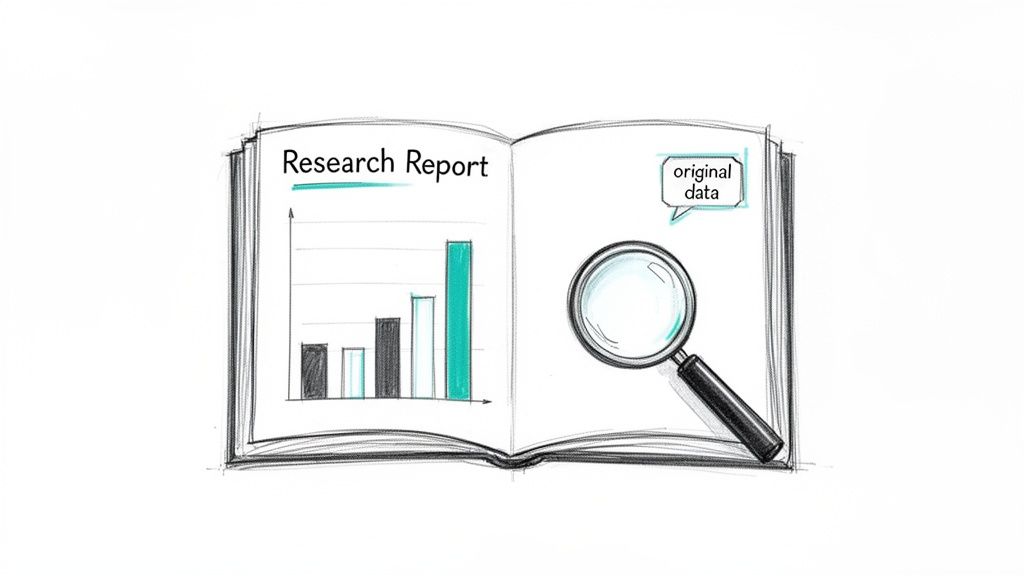
The core principle is simple: be the origin of the statistic. When another site wants to state a fact you discovered, they have to reference you as the source. For example, an e-commerce platform could release an "Amazon FBA Profitability Analysis" based on aggregated seller data, or a creator tool could publish a report on YouTube monetization trends. This approach answers the most pressing questions your audience has, turning your site into an essential resource. You can discover these questions by adopting the principles from Marcus Sheridan's They Ask, You Answer, which focuses on addressing customer curiosities.
How to Implement a Data-Driven Content Strategy
Executing a research project requires careful planning, from data collection and analysis to promotion.
- Identify a Knowledge Gap: Analyze existing industry research to find unanswered questions or outdated statistics. What data does your audience wish they had? Survey your email list or social media followers using tools like SurveyMonkey or Google Forms to gather firsthand insights. Aim for at least 100-500 responses for a credible sample size.
- Conduct and Package the Research: Once you collect the data, analyze it for interesting trends and key takeaways. Be transparent about your methodology. Package the findings in multiple formats, such as a detailed blog post, a downloadable PDF report, and shareable infographics or charts made with tools like Infogram or Flourish.
- Launch a Coordinated Promotion Campaign: Don't just publish your report and wait. Create a media kit and press release to send to industry journalists, podcasters, and bloggers who cover your niche. Actively promote the research for the first three to six months, as these types of assets often accumulate high-quality links slowly over time.
Pro-Tip: Your outreach should be precise and targeted. When pitching your research to a journalist, directly connect your findings to their beat. For example: "I saw you recently wrote about creator burnout. Our new survey of 500 YouTubers found that 68% experience monetization anxiety, a data point that could add strong evidence to your future articles on the topic."
9. Competitor Backlink Analysis and Relationship Outreach
Instead of reinventing the wheel, one of the most effective link building best practices involves learning from those who have already succeeded. Competitor backlink analysis is the process of reverse-engineering your competitors' link profiles to find high-value, replicable link opportunities. You identify which websites link to them, understand why they earned those links, and then create a strategy to earn similar links for yourself.
This approach works because your competitors have already done the hard work of vetting link prospects. If a high-authority site in your niche has linked to a direct competitor, it signals that they are open to linking to similar content. Your goal is to approach them with an asset that is either a significant improvement or offers a fresh, unique angle on the same topic.
How to Implement Competitor Backlink Analysis
This strategy is a systematic process of research, content creation, and targeted outreach that builds on proven success.
- Identify and Analyze Competitors: Select 3-5 direct competitors who target a similar audience. Use an SEO tool like Ahrefs or Semrush to export their backlink profiles. You can get a deep dive into using these tools by exploring a guide on Ahrefs for keyword research and applying those principles to backlink analysis.
- Filter and Organize Opportunities: Import the data into a spreadsheet. Filter the list to focus on high-quality domains, such as those with a Domain Rating (DR) of 30 or higher. Look for patterns: do they get a lot of links from resource pages, guest posts, or specific types of listicles? For example, an e-commerce brand might find their competitor is frequently featured in "best gift" roundups.
- Create and Pitch Superior Content: Once you identify a frequently linked-to competitor page, create your own version that is more current, in-depth, or visually appealing. Reach out to the sites that linked to the original, introducing your new resource and explaining its specific advantages.
Pro-Tip: Personalize your outreach by referencing the specific content they've already linked to. For instance: "I saw you linked to Competitor X's guide on Amazon FBA. I put together a more detailed guide for 2024 that includes a profit calculator and sourcing checklist, which I thought could be a valuable addition for your audience." This shows you've done your homework and makes the value exchange clear.
10. Community Engagement and Podcast & Audio Outreach
Beyond creating content and waiting for links, one of the most effective link building best practices involves embedding your brand within relevant online spaces. This strategy is centered on building authority and trust through genuine participation in communities like forums, Reddit, Slack groups, and Discord servers, as well as appearing as a guest on podcasts. Instead of directly asking for links, you earn them naturally by becoming a recognized, helpful voice.
This approach works because it shifts the focus from a transactional request to a value-driven relationship. When you consistently provide answers and insights in a community, members begin to see you as a credible expert. Similarly, a podcast appearance positions you as an authority in front of a dedicated, pre-built audience. The resulting backlinks from show notes, community threads, and user recommendations are often high-quality and come with the added benefits of referral traffic and brand recognition.
How to Implement Community and Podcast Outreach
Success with this method hinges on authenticity and a long-term commitment to providing value before asking for anything in return.
- Identify and Observe Communities: Find 3-5 active communities where your target audience congregates. This could be
r/Entrepreneuron Reddit for business owners or specialized Discord servers for creators. Spend at least two weeks observing the culture, rules, and key contributors before posting. - Become a Valuable Member: Start by answering questions thoroughly and engaging with others' posts. Your initial goal is to build a reputation, not to promote your website. For example, an Amazon FBA expert could help new sellers in a Facebook group with logistics questions long before ever mentioning their own guide.
- Target Relevant Podcasts: Identify podcasts your ideal customer listens to, aiming for those with engaged audiences. Before pitching, listen to several episodes to understand the host's style and the show's format. A personalized pitch is far more likely to succeed than a generic template.
- Craft a Compelling Pitch: When you reach out to a podcast host, suggest 2-3 specific, compelling topic angles that would benefit their audience. Explain what unique perspective or data you bring to the table. According to a study by Buzzsprout, 43% of podcast listeners have purchased a product after hearing about it on a show, highlighting the commercial value for hosts and guests alike.
Pro-Tip: In communities, frame your links as supplementary resources, not the main point of your comment. For instance, after providing a detailed answer, you might add, "I actually detailed this process with a few more examples in a case study here if you want to dig deeper." This makes the link a helpful addition rather than a self-serving promotion.
Top 10 Link Building Practices Comparison
| Strategy | Implementation Complexity 🔄 | Resource Requirements ⚡ | Expected Outcomes 📊 ⭐ | Ideal Use Cases 💡 | Key Advantages ⭐ |
|---|---|---|---|---|---|
| Skyscraper Technique | Medium–High — research, creation, targeted outreach | High content production time, SEO tools, outreach effort | Quality backlinks + improved engagement; outreach response ~5–15% 📊 ⭐⭐⭐ | Competitive niches; long-form guides, comparisons | Targets proven linkers; scalable; raises content quality |
| Digital PR and Earned Media | High — pitching, relationship building, timing-sensitive | PR expertise/agency, newsworthy assets, media lists, time | High-authority editorial links, referral traffic, brand credibility; variable timing 📊 ⭐⭐⭐⭐ | Founder-led brands, original research, newsworthy announcements | Strong authority signals and media pickup potential |
| Broken Link Building | Medium — discovery + replacement content + outreach | Broken-link tools, replacement pages, personalized outreach | Higher acceptance (15–30%), targeted contextual backlinks 📊 ⭐⭐⭐ | Resource pages, outdated tool/review links, niche sites | Win–win for webmasters; lower competition; solid acceptance |
| Resource Page Link Building | Low–Medium — find curators and pitch concise resource | Search tools, lightweight resource pages, brief outreach | Quick contextual links; acceptance ~20–40%; targeted visibility 📊 ⭐⭐⭐ | "Best tools/resources" lists, educational roundup pages | Curators expect suggestions; relatively fast, predictable wins |
| Guest Posting & Content Collaboration | Medium–High — pitching, editorial cycles, writing | Significant writing time (8–20h/article), pitching, relationship building | Byline/editorial links, audience exposure, authority; variable SEO value 📊 ⭐⭐⭐ | Thought leadership, audience growth, founder visibility | Builds authority, long-term presence, strong audience access |
| Unlinked Brand Mentions & Monitoring | Low — identify mentions and request link additions | Monitoring tools, minimal outreach templates | Very high acceptance (40–60%+); quick backlink conversions 📊 ⭐⭐⭐⭐ | Established brands with existing mentions, reputation management | Low friction, converts existing credibility into links |
| Expert Roundups & Contributor Posts | High — coordinate many contributors and edits | Heavy outreach, scheduling, curation, promotion | Contributor backlinks, large social amplification, authority transfer 📊 ⭐⭐⭐⭐ | Brands with networks to experts; authority-building campaigns | Virtually guaranteed contributor links; high shareability |
| Data-Driven Content & Original Research | High — design, collect, analyze, visualize, promote | Survey/data tools, analysis time, possible budget for sampling | Long-term citable assets, media pickup, sustained backlinks 📊 ⭐⭐⭐⭐ | Firms with data access or audiences to survey; thought leadership | Unique linkable assets; strong differentiation and media interest |
| Competitor Backlink Analysis & Outreach | Medium — analyze profiles, identify gaps, targeted outreach | SEO tools (Ahrefs/SEMrush), research time, outreach | Reveals proven link targets; strategic link opportunities; variable gain 📊 ⭐⭐⭐ | Competitive intelligence, content gap targeting, tactical outreach | Reduces guesswork; uncovers high-value, context-rich targets |
| Community Engagement & Podcast/Audio Outreach | Medium (ongoing) — community participation + podcast pitching | Daily engagement time, podcast outreach, repurposing resources | Slow-building natural backlinks, referral traffic, trust; podcast show-note links 📊 ⭐⭐⭐ | Audience-building, founder-led thought leadership, niche communities | Builds authentic relationships, voluntary promotion, direct audience access |
Executing Your Link Building Strategy: Scaling, Measurement, and Compliance
Throughout this guide, we've explored the most effective link building best practices, from the content-centric Skyscraper Technique and original data-driven assets to the outreach-heavy tactics of Broken Link Building and Resource Page outreach. We've seen how Digital PR can land high-authority placements and how simply reclaiming Unlinked Brand Mentions can yield quick, valuable wins. Each strategy, whether it involves guest collaborations, expert roundups, or competitor analysis, represents a powerful lever for growing your site's authority and organic traffic.
But understanding these tactics is only the starting point. The real differentiator between a stagnant site and a dominant one is the disciplined execution of a coherent strategy. It's about moving from theory to consistent, repeatable action.
From Tactics to a Sustainable System
The sheer number of available strategies can feel overwhelming. Instead of attempting to do everything at once, your first step is to choose a focused approach.
- Prioritize and Master: Select two or three tactics from this list that best match your current resources. If you have a strong writer, focus on data-driven content and guest posting. If you have a team member skilled in communication, task them with Digital PR and community engagement. Mastering a few methods is far more effective than dabbling in ten.
- Document Your Process: Create standard operating procedures (SOPs) for your chosen tactics. This includes developing outreach email templates, establishing criteria for what makes a good link prospect, and outlining the step-by-step workflow. This documentation is the foundation for scaling your efforts, allowing you to train new team members or delegate tasks effectively.
A systematic approach turns sporadic efforts into a predictable engine for growth. By building repeatable processes, you remove the guesswork and ensure a consistent output of high-quality outreach and content creation.
Measuring What Matters: Quality Over Quantity
As you scale, it's critical to measure your progress with the right metrics. The number of new backlinks is a superficial KPI; true success lies in the quality and impact of those links.
Your measurement framework should focus on Key Performance Indicators (KPIs) that directly reflect search engine value and business goals:
- Growth in Referring Domains: Track the total number of unique websites linking to you. A steady increase in this number signals growing authority to search engines.
- Authority of Linking Sites: Use tools like Ahrefs (Domain Rating) or Moz (Domain Authority) to assess the quality of your new links. A single link from a DR 80 site is often more valuable than dozens from DR 10 sites.
- Organic Traffic to Linked Pages: The ultimate goal of a link is often to drive traffic. Monitor the organic traffic trends for the specific pages you are building links to. A successful link building campaign should produce a clear upward trend.
- Keyword Ranking Improvements: Check the search engine rankings for the primary keywords targeted by your linked pages. Positive movement is a strong indicator that your efforts are paying off.
As Ahrefs' research has shown, there's a clear correlation between the number of referring domains a page has and the amount of organic traffic it receives. This data underscores the importance of not just link volume, but the diversity and quality of your link sources.
Staying Compliant and Building for the Long Term
Finally, every action you take must be viewed through the lens of Google's guidelines. The core principle is simple: earn your links, don't buy them. Practices that fall under the umbrella of "link schemes," such as excessive link exchanges or participation in private blog networks (PBNs), carry significant risk. A manual penalty from Google can erase years of hard work overnight.
Adhering to the link building best practices outlined in this article is your best defense. By focusing on creating genuine value, building real relationships, and promoting high-quality content, you align your strategy with what search engines want to reward. This approach isn't just about avoiding penalties; it's about building a durable, long-term asset. A strong, ethically-built backlink profile is a competitive moat that becomes increasingly difficult for others to replicate over time.
Your journey to mastering link building is a marathon, not a sprint. It requires patience, persistence, and a steadfast commitment to quality. By implementing these strategies, measuring your impact, and staying true to ethical guidelines, you are not just building links. You are building a trusted brand, a sustainable source of traffic, and a powerful engine for business growth.