
“Start a blog in 10 minutes” sells because setup is easy to package. Profit is not.
If your goal is income, treat the blog like a small media business from day one. That means choosing a niche with commercial intent, setting up a simple site that can publish fast, and building content around problems that connect to products, services, or ad revenue later. A blank WordPress install is not the hard part. The hard part is making sound decisions early enough that your first six months are not wasted.
The gap between publishing a site and building a profitable asset is where beginners lose time. They get pulled into theme tweaks, logos, homepage copy, and monetization ideas that show up before traffic or trust exist. I have seen that pattern over and over. The blogs that break through usually look plain at first, but they have a clear audience, a focused content plan, and a realistic path to revenue.
This distinction is critical because blogging rewards operators who think in systems. You need a traffic model, a monetization model, and an execution plan for the first 90 and 180 days. Without that, you are not building a business. You are posting online and hoping something clicks.
If you need a quick reset on execution basics, these best blog practices are worth reviewing because they bring the focus back to usability, consistency, and clarity.
This guide is built for readers who want a monetization-first playbook. Not inspiration. Not blogging mythology. A practical framework for starting lean, publishing the right content, and giving the site a real chance to earn.
Why Most Profitable Blogs Don't Start That Way
Most profitable blogs begin ugly, quiet, and underwhelming.
They do not start with viral traffic. They do not start with a polished brand deck. They do not start with passive income. They start with a sharp niche, a narrow audience, and a founder willing to publish useful content before the site looks impressive.
The worst advice in blogging is “follow your passion.” Passion helps you stay in the game. It does not create search demand, buyer intent, or affiliate revenue. If you want profit, you need to treat the blog like an asset from day one.
That means asking better questions:
- What does this audience already search for?
- What products or services fit naturally with those problems?
- Can I publish enough useful content to become trusted in this topic?
- Can this niche expand into affiliates, ads, products, or services later?
A lot of beginners get trapped in branding theater. They spend weeks choosing fonts, tweaking colors, and rewriting their homepage headline. Meanwhile, they still have no content engine. If you need a quick sanity check on execution fundamentals, these best blog practices are worth reviewing because they push you back toward what matters: usability, consistency, and clarity.
What distinguishes profitable blogs
The blogs that make money get three things right early:
- They pick a monetizable niche.
- They publish problem-solving content consistently.
- They delay vanity decisions until traffic starts moving.
Key takeaway: The profitable path is rarely glamorous at the start. It is operational. You build systems first, then momentum, then revenue.
The Foundation Niche Audience and Brand
A profitable blog sits at the intersection of interest, audience demand, and monetization. Miss one, and the whole thing gets shaky.
I call this the Niche Trinity.
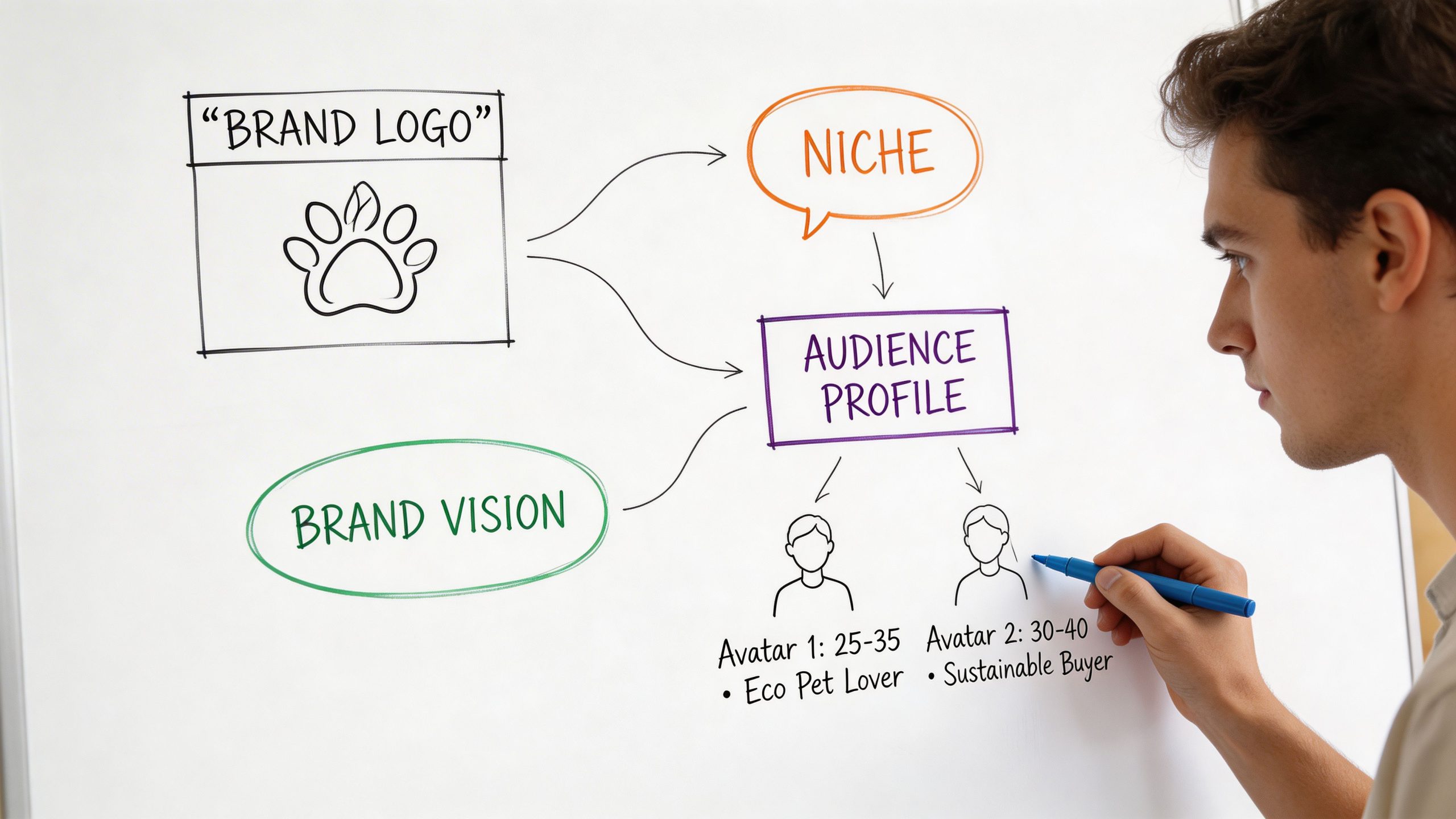
Start with the niche trinity
The first part is interest. You do not need lifelong passion. You do need enough curiosity to write on the topic for a long stretch without burning out.
The second part is audience demand. If nobody searches, shares, or asks questions about the topic, you are building in a vacuum.
The third part is profitability. Some niches attract traffic but weak monetization. Others attract smaller audiences with stronger buying intent. For a for-profit blog, that distinction matters a lot.
According to The She Approach, personal development, health and wellness, online business, and personal finance consistently perform because they combine evergreen demand with affiliate potential, and the smarter move is finding an underserved sub-topic instead of entering the niche at its broadest level (The She Approach on profitable blog niches).
That last part is where many beginners struggle. “Fitness” is broad. “Strength training for busy dads over 40” is a business angle. “Travel” is broad. “Budget student travel in Europe” is sharper. “Finance” is broad. “Debt payoff for self-employed couples” is sharper.
Validate before you buy the domain
Do not name the blog first. Validate first.
Use simple tools:
- Google Trends for directional interest
- Google Keyword Planner for search behavior
- Ahrefs or Semrush if you already have access
- Reddit, YouTube comments, and niche Facebook groups for audience language
- Competitor blogs for content gaps
Look for patterns, not perfection.
You want signs that people repeatedly ask the same questions, search for the same solutions, and buy related products. If the SERPs are full of giant brands and the content is already excellent, that is a warning. If the results are thin, outdated, or generic, that is an opening.
Build one reader profile, not five
Most new bloggers make the audience too vague. “Anyone interested in wellness” is not an audience. It is a category.
Build one working profile:
| Element | Example |
|---|---|
| Who they are | First-time online entrepreneur |
| What they want | Reliable side income from content |
| What frustrates them | Scattered advice, too many tools, slow growth |
| What they search | blog monetization, affiliate blog setup, SEO for beginners |
| What they buy | courses, software, templates, books, services |
This profile should drive your post ideas, your examples, your product recommendations, and even your tone.
If your audience is early-stage, write plainly. If your audience is technical, go deeper. If they are skeptical, show trade-offs instead of hype.
Brand matters, but not the way people think
A strong blog brand is not about design. It is about positioning.
Your brand should answer three questions fast:
- What is this site about?
- Who is it for?
- Why should this person trust it?
A good blog name is clear, memorable, and broad enough to grow with you. Avoid clever names that hide the topic. Avoid names that lock you into one micro-angle if you may expand later.
Voice matters too. Pick one lane and stay there. Direct. Analytical. Friendly. Tactical. You do not need to sound “professional.” You need to sound consistent.
A practical niche filter
Before moving forward, run every idea through this checklist:
- Search demand exists: People actively look for answers in this space.
- Commercial fit exists: There are relevant affiliate offers, products, services, or ad potential.
- Content depth exists: You can map at least a meaningful set of useful article ideas.
- Differentiation exists: You can serve a specific segment better than broad competitors.
- Staying power exists: You can keep publishing without forcing it.
Tip: The fastest way to ruin a blog is to choose a niche because it sounds profitable, then realize you hate writing about it by post five.
The right niche feels focused enough to rank, broad enough to scale, and commercial enough to matter.
The Tech Stack and Initial Launch Plan
Beginners waste significant amounts of time comparing platforms. Stop doing that.
If you want to know how to start a blog for profit, use self-hosted WordPress. Not because it is trendy. Because it gives you control over SEO, plugins, monetization, data, and site ownership.
Use a lean stack
My default setup is simple:
- Platform: WordPress
- Hosting: SiteGround or Bluehost
- Theme: Astra or another lightweight theme
- SEO plugin: Rank Math or Yoast
- Caching/performance: WP Rocket if you want a paid performance tool
- Analytics: Google Analytics and Google Search Console
- Link management: Pretty Links or ThirstyAffiliates if affiliate content is part of the model
The goal is a fast, clean site. Not a plugin museum.
One useful walkthrough if you want a practical setup process is this guide on launching a WordPress site: https://entreresource.com/how-to-launch-a-killer-income-generating-wordpress-blog-in-24-hours/
Match your niche to search opportunity
The blog does not become profitable because WordPress is installed. It becomes profitable because the niche can attract search traffic.
A useful benchmark from the referenced YouTube source is to target niches where keywords have 1,000-10,000 monthly searches and low competition, with KD under 30 on Ahrefs, since that combination is used as a path toward 10,000 monthly sessions in 90 days, which is also the benchmark for premium ad networks like Mediavine (YouTube source on niche validation and traffic benchmarks).
That does not mean every blog hits that mark. It means your content plan should point in that direction from the start.
What to launch with
Most bloggers launch too early with two posts and a home page. That is a weak signal to both users and search engines.
Launch with a small but serious content base:
- A homepage that clearly explains the site’s promise.
- Core pages like About, Contact, and Privacy Policy.
- A category structure that makes sense.
- Several cornerstone posts that define the topics you want to own.
A thin launch makes the site feel unfinished. A stronger launch creates relevance faster and gives internal links somewhere to point.
The first 90 days on the tech side
Your early technical priorities are intentionally unexciting:
- Keep the design minimal
- Set permalinks correctly
- Compress images
- Make the site mobile-friendly
- Submit your sitemap
- Track indexing and queries
- Avoid adding plugins that solve imaginary problems
Tip: Fancy themes hide weak strategy. A plain site with strong content beats a beautiful site with no search plan.
What works is simple. Build on WordPress. Keep the stack lean. Publish enough content that the site looks alive. Then improve from usage data, not from guesswork.
The Content and SEO Engine
Profitable blogs do not grow from a stream of disconnected posts. They grow from systems. Each article should do a job, support a larger topic, and move the site closer to traffic that can convert into revenue.
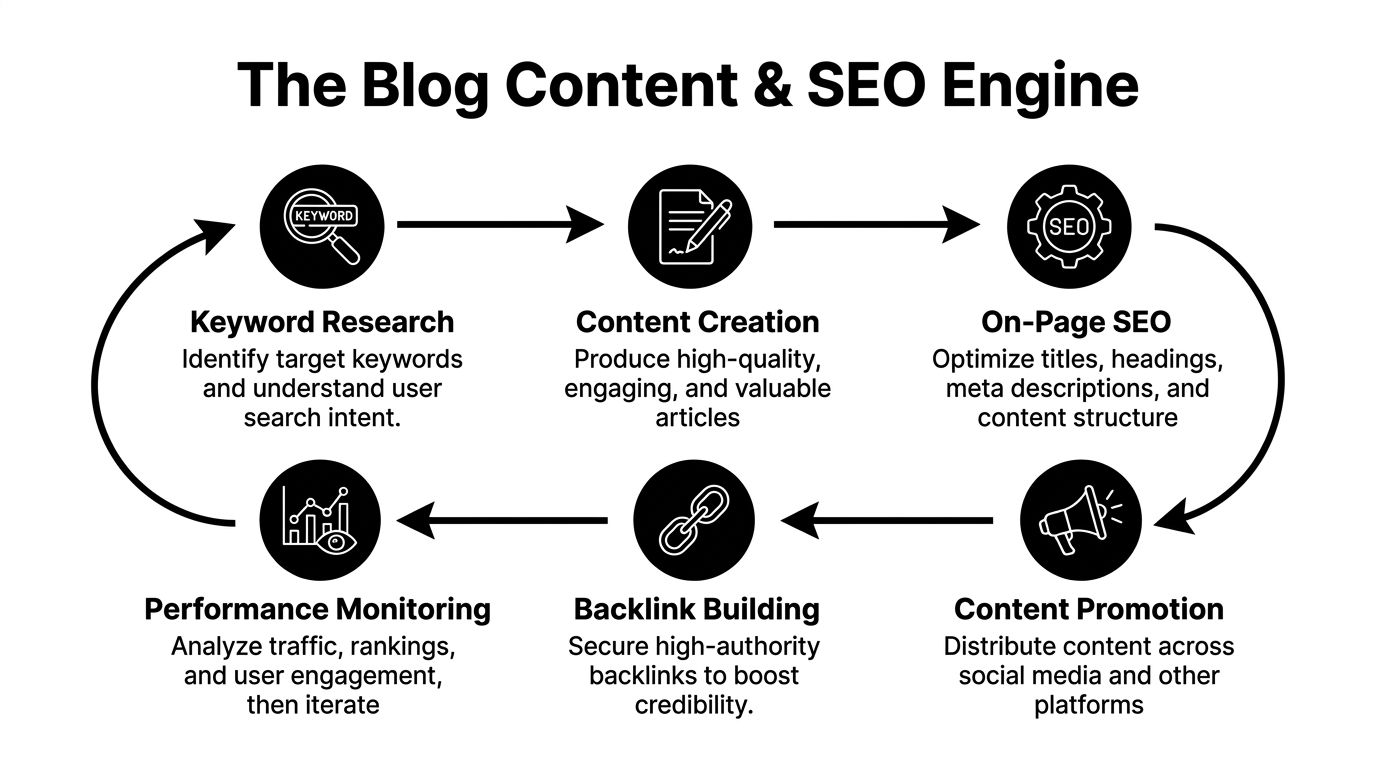
Build clusters that match buying intent
Random publishing creates random results.
If the niche is personal finance for freelancers, pick one commercial lane and build depth before chasing adjacent topics. A site that publishes five strong pieces on freelancer taxes has a better shot at earning traffic and affiliate revenue than a site that jumps between taxes, motivation, travel rewards, and productivity hacks.
A topic cluster can look like this:
| Cluster | Supporting topics |
|---|---|
| Freelancer taxes | write-offs, quarterly payments, bookkeeping tools, tax prep checklist |
| Freelancer budgeting | irregular income budgeting, emergency funds, monthly planning |
| Freelancer banking | business accounts, invoicing tools, payment systems |
This structure makes planning simpler. It also gives internal links a clear purpose. Supporting posts feed authority into the page you want to rank and monetize first.
Keyword research should lead to posts you can publish
Early keyword research does not need to be fancy. It needs to produce a realistic content queue.
Start with terms that reveal a problem, a comparison, or a buying decision:
- Questions with clear pain points
- Comparison keywords
- Best-of terms
- Beginner guides
- Tool-specific searches
- Workflow and setup phrases
This guide on how to find blog keywords is a useful reference if you need a repeatable process.
I care more about intent than raw volume. A post targeting “best email marketing platform for coaches” can be worth far more than a broad traffic term like “email marketing” because the reader is closer to taking action. That matters if the goal is profit, not vanity traffic.
Write pages that win the click and hold attention
A ranking is only the first checkpoint. Weak structure wastes the visit.
The posts that keep working usually share the same traits:
- A headline with a concrete promise
- An introduction that confirms the page matches the search
- Subheads that let readers scan fast
- Examples, screenshots, or numbers where they improve clarity
- Internal links to the next logical page
- A call to action that fits the intent
Many new bloggers write as if they are submitting a school assignment. That style performs poorly online. Readers want a fast answer, proof that you know the topic, and a clear path to the next step.
Short paragraphs help. So do bullets, comparison tables, screenshots, and examples from real use.
Make the article better than what already ranks
“Write quality content” is empty advice unless you define the standard.
A useful standard is simple. Publish something more useful than the current top results for that query.
That usually means improving one or more of these:
- Framing. Answer the core decision behind the search, not just the keyword.
- Specificity. Show actual setups, examples, mistakes, or tools.
- Usability. Make the page easier to scan and act on.
- Freshness. Remove outdated recommendations and stale screenshots.
- Credibility. Write from use, testing, or direct experience.
I rarely try to make a post longer just to look more authoritative. If the top results are bloated, a tighter page often wins. If they are generic, practical detail wins.
For on-page SEO, do the boring things well
For on-page SEO, the basics still carry most of the weight:
- Title tag: clear, relevant, and aligned with the query
- URL: short and descriptive
- H2 and H3 structure: organized around the reader’s questions
- Meta description: written to earn the click
- Internal links: pointed to related pages and money pages where appropriate
- Image optimization: compressed files with sensible names
- Schema: whatever your SEO plugin can add cleanly
That is enough for an early site. Beginners waste months chasing edge cases while ignoring titles, internal links, search intent, and article structure.
Distribution speeds up the feedback loop
Search traffic is slow at the start, so every post needs some form of distribution.
A practical workflow looks like this:
- Publish the article
- Add internal links from older relevant posts
- Send it to your email list
- Repurpose it for the channels that fit the niche
- Check Search Console for impressions and query shifts
- Update weak sections once real users hit the page
Cross-channel promotion works well because it gives new content a first wave of traffic and engagement before Google fully trusts the page. The right mix depends on the niche. Pinterest can work for visual categories. YouTube can work for tutorials and product-led niches. LinkedIn can work for B2B and career topics.
If you are also planning for AI-driven discovery, this breakdown of Chatgpt ranking factors is worth reading. It reinforces the same fundamentals that help in search. Clear structure, original information, and visible topical authority.
Key takeaway: Treat each post like a business asset. It should target one intent, strengthen one cluster, and create a clear path to traffic that can monetize within your first 90 to 180 days.
The Monetization Blueprint
Most blogs monetize too early in the wrong way.
They slap ads on a site with tiny traffic, add affiliate links to every paragraph, and wonder why earnings are weak. Monetization works better when it matches the blog’s stage.
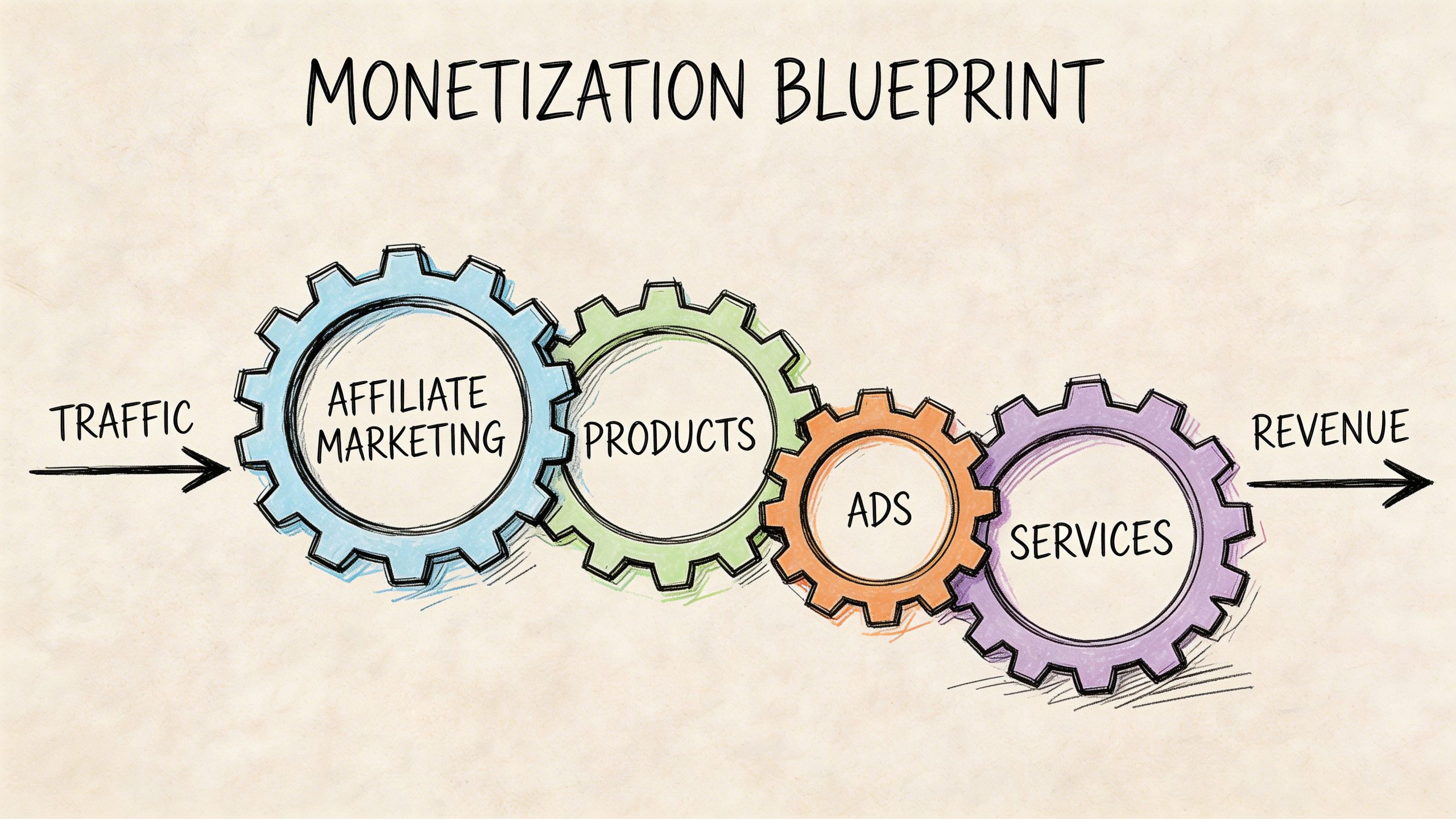
According to Success, you should target 10,000+ monthly visitors before expecting significant profit, and at that stage you can apply to premium ad networks like Mediavine, which can generate $15-35 RPM. The same source notes that top bloggers often diversify revenue across ads (40%), affiliates (30%), and their own products (20%) (Success on blog monetization strategy).
That is the right mental model. Staged monetization, not random monetization.
Affiliate marketing first for most blogs
Affiliate marketing is the cleanest early revenue stream because it does not require huge traffic if the intent is strong.
It works best when the post sits close to a buying decision:
- product comparisons
- tool roundups
- tutorials
- workflows
- reviews
- case-based recommendations
What does not work is stuffing affiliate links into informational posts with no commercial angle.
Write the post to solve the problem first. Then recommend the product that fits that problem. If you have used the tool, say how. If not, do not fake authority.
Ads later, not immediately
Display ads are easy to understand and easy to misuse.
On a new blog, low-value ads clutter the experience and pay very little. On a mature site with meaningful traffic, premium ad networks can become stable baseline income.
That is why I tell beginners not to obsess over ads in month one. Build traffic first. Ads make more sense when your content engine already works.
Products create advantage
Your own products give you margin and control.
That can mean:
- Digital products: ebooks, templates, checklists, swipe files
- Courses: useful once the audience trusts your process
- Services: consulting, audits, done-for-you work
- Membership or community: viable when people want ongoing access
The right product comes from repeated audience questions. If readers keep asking for the same framework, tool stack, checklist, or walkthrough, that is a product signal.
A simple monetization ladder
Here is the practical order I recommend for most new blogs:
| Stage | Primary monetization focus | Why it fits |
|---|---|---|
| Early traffic | Affiliate content | Fastest path when intent is strong |
| Growing traffic | Email capture plus affiliate offers | Builds asset ownership |
| Established traffic | Premium ads | Adds baseline revenue |
| Trusted audience | Digital products or services | Highest control and stronger margins |
This is also where email becomes important. A blog post gets the visit. An email list gives you repeated access to the reader.
After you have traffic coming in, add a simple lead magnet tied to your niche. Not a generic “join my newsletter.” Give them a checklist, template, quick-start guide, or resource pack that matches the post they just read.
A practical video breakdown can help if you want another angle on monetization mechanics:
What does not work
A few things kill monetization momentum early:
- Too many revenue streams at once
- Promoting junk offers for quick commissions
- Writing commercial content before building trust
- Ignoring email capture
- Relying only on one income source
Tip: If you can only focus on one monetization method in the beginning, choose the one that fits your content and audience intent most naturally. That is affiliate marketing.
The strongest blogs do not “make money from blogging” in the abstract. They build a business around traffic, trust, and well-timed offers.
Your First 180 Days A Scalable Growth Plan
Most blogging guides tell you how to install WordPress and publish a post. Then they disappear right when the hard part starts.
Ghost’s resource points out that most guides skip a realistic revenue ramp, even though new entrepreneurs need clearer expectations around what progress may look like at 6 months and 12 months so they can justify the work and investment (Ghost on the profitability timeline gap).
That gap is where people quit. Not because blogging cannot work, but because they expected traction faster than their execution supported.
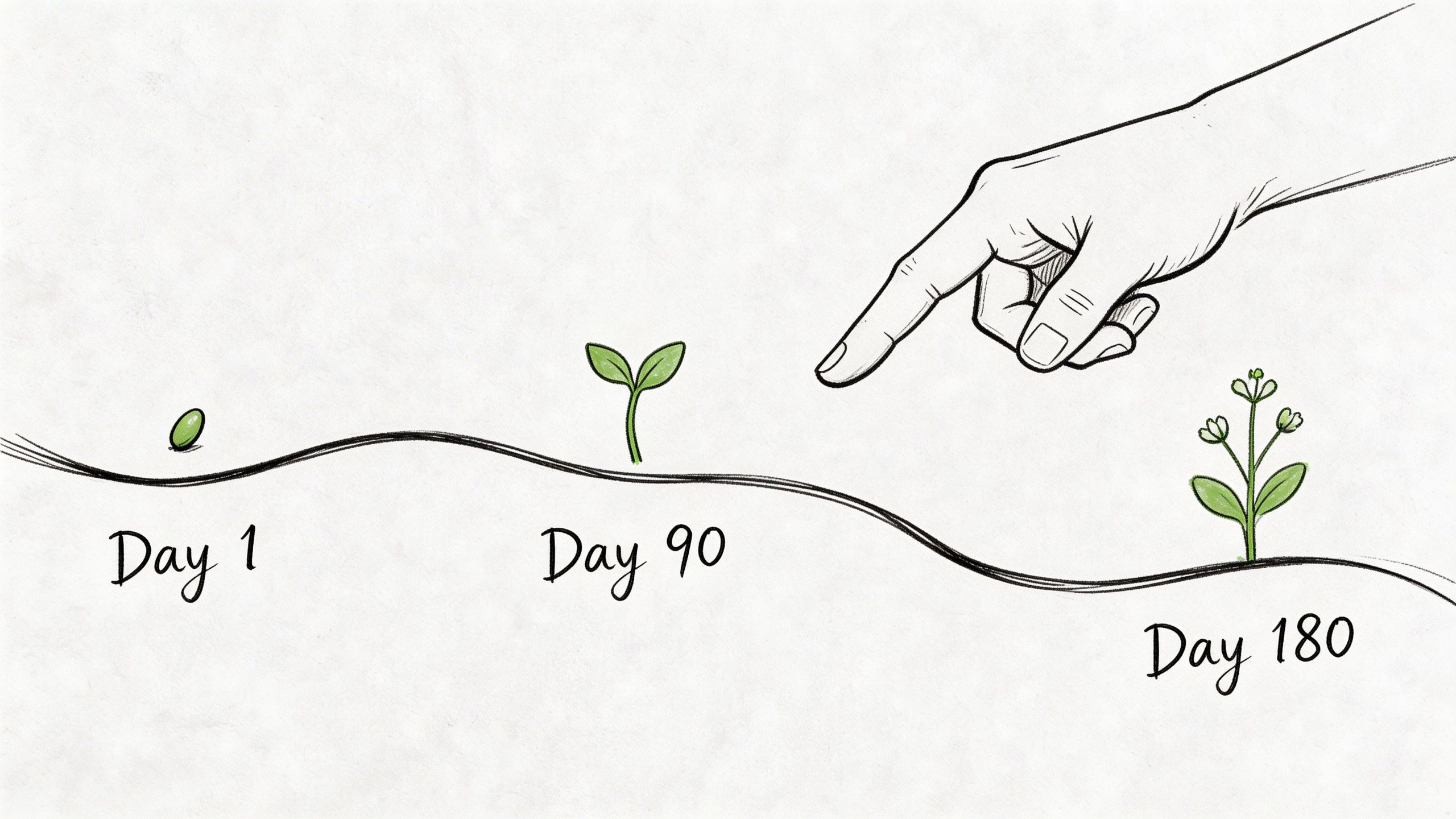
Days 1 through 90
Your first phase is about building assets.
The priorities are simple:
- Choose the niche and validate it
- Set up the site
- Publish cornerstone content
- Create your initial content clusters
- Set up analytics and search tracking
- Start collecting emails
This period is not for obsessing over income screenshots. It is for volume, quality, and structure.
A practical weekly rhythm looks like this:
- Research topics and map clusters
- Draft and publish useful articles
- Interlink related posts
- Watch search console data
- Improve weak intros, titles, and structure
- Create at least basic distribution assets
If writing is slowing you down, this guide on when and how to https://entreresource.com/outsource-blog-content/ can help once you are ready to add support without losing editorial quality.
Days 91 through 180
The second phase is where you tighten the system.
Now the work shifts toward:
- Updating early posts
- Strengthening internal links
- Promoting content on channels that fit the niche
- Publishing more commercial-intent content
- Adding lead magnets and email sequences
- Testing early affiliate placements
By this point, you should have enough published content to see patterns. Some posts will get impressions. A few may start pulling clicks. Some topics will clearly be stronger than others.
Use that signal.
Double down on what the audience and search data are validating. Do not cling to weak categories just because you liked the original idea.
A realistic operating mindset
Your first 180 days are messy.
Traffic may be slow. Revenue may be nonexistent or sporadic. That does not mean the model is broken. It means the compounding phase has not kicked in yet.
Here is the filter I use during this period:
| If this happens | Do this |
|---|---|
| No impressions | Recheck keyword targeting and indexing |
| Impressions but low clicks | Improve title and meta positioning |
| Clicks but poor engagement | Rewrite intro and tighten structure |
| Traffic but no earnings | Add better-aligned affiliate or email offers |
| No publishing consistency | Reduce scope and increase cadence reliability |
Key takeaway: In the first six months, consistency beats intensity. A blog grows faster from repeatable weekly execution than from one frantic content sprint followed by silence.
Profit follows proof. Proof comes from publishing enough content, tracking enough feedback, and adjusting without ego.
Frequently Asked Questions About Profitable Blogging
Can I start for free if my goal is profit
You can, but I would not.
Free platforms limit control, branding, monetization options, and long-term flexibility. If profit is the goal, use self-hosted WordPress and treat the site like a real business asset.
How many hours per week does this take
Enough to publish consistently and improve what you publish.
The exact number depends on whether you write yourself, outsource, or already know SEO. What matters more than hours is whether you can maintain a stable weekly cadence.
When will I earn my first dollar
Sooner from affiliate commissions than from ads, but there is no honest universal timeline.
A blog can stay quiet for a while, then start compounding once content ranks and the monetization setup matches search intent. Expect a ramp, not a switch.
Should I focus on ads or affiliates first
For most new blogs, affiliates first makes more sense.
Ads become more meaningful once traffic is substantial. Affiliate content can monetize earlier if the topic and offer fit naturally.
Do I need social media to make blogging work
Not always, but distribution helps.
SEO is powerful, yet cross-promotion can speed up feedback, reach, and list growth. Use the channels that fit your niche instead of trying to be everywhere.
If you want to know how to start a blog for profit, the answer is not “publish whatever you feel like and hope it works.” Pick a monetizable niche. Build on WordPress. Create useful content in tight clusters. Monetize in stages. Give it a real 180-day run before judging the model.