
To really make it on Amazon, you need more than just a good product. You need a rock-solid game plan that covers everything from validating your idea and figuring out logistics to crafting a listing that actually converts and launching with a bang. This is how you stop guessing and start making data-backed decisions that build momentum from day one.
Your Blueprint for Amazon Success
Diving into the Amazon marketplace can feel like jumping into the deep end of the ocean, but the potential upside is just staggering. Imagine this: in 2024 alone, a record-breaking 55,000+ entrepreneurs each pulled in over $1 million in sales. That’s not a typo. The opportunity is massive for sellers who learn to navigate the platform correctly. You can check out more wild stats on Amazon seller success yourself.
But success on Amazon isn't about luck—it's about following a proven playbook. Forget the generic, fluffy advice you see everywhere else. This guide is your practical, step-by-step roadmap, built on the core principles that separate the thriving seven-figure businesses from the ones that fizzle out before they even get started.
The Pillars of a Winning Launch
Your entire Amazon journey really comes down to four key pillars. If you can master each one, you're setting yourself up for sustainable growth and real profits. It's so important, in fact, that you should have a firm grip on these fundamentals before even thinking about going all-in. For a deeper look, you can explore our guide on full-time Amazon selling considerations.
Here are the non-negotiables:
- Product Validation and Research: This is the most critical first step. You have to find a product with actual, verifiable demand and competition you can realistically take on. It’s about digging deep into the market data, not just chasing a hot trend.
- Sourcing and Fulfillment: How you get your product manufactured and into your customers' hands affects everything—your profit margins, your reviews, your sanity. We’ll break down the pros and cons of Fulfillment by Amazon (FBA) vs. Fulfillment by Merchant (FBM) to help you make the right call.
- Listing Optimization: Think of your product page as your 24/7 digital salesperson. Writing compelling copy, using high-quality images, and building out your A+ Content aren't just "nice-to-haves"; they are absolutely essential for turning casual browsers into paying customers.
- Launch and Promotion: That initial burst of sales and reviews is what gets the Amazon flywheel spinning. A strategic launch that uses Amazon's own tools, especially PPC ads, is how you kickstart your momentum and get the algorithm to notice you.
A data-driven approach is the only reliable path to scaling on Amazon. Every single decision, from the product you choose to how much you spend on ads, has to be backed by numbers, not just a gut feeling. This guide is all about showing you how to find and use that data.
If you skip or half-heartedly attempt any of these pillars, you're just stalling your own progress. I've seen it a thousand times: a fantastic product with a terrible, un-optimized listing goes completely unseen. On the flip side, a perfectly polished listing for a product nobody wants is just as useless. This playbook is designed to make sure you hit every single one of these points methodically, building a solid foundation for the actionable strategies we're about to get into.
Finding a Winning Product to Sell
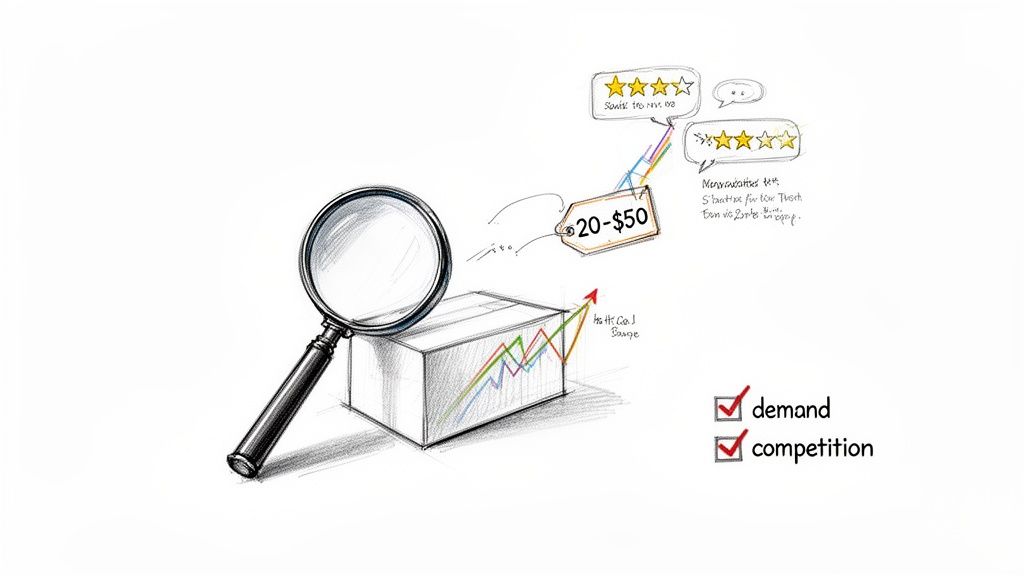
Before you even think about how to sell on Amazon, you’ve got to find the right product. This is, hands down, where most new sellers trip up and fail. Your product choice is the foundation of your entire business. It's the one decision that carries more weight than any other.
Get it right, and you're setting yourself up for growth. Get it wrong, and you'll be fighting an uphill battle no matter how great your marketing is.
You have to move past gut feelings. Thinking you've got a killer idea is not enough. You need cold, hard proof from Amazon's own data.
I’ve seen it time and again: the sellers who crush it aren’t inventing something from scratch. They find products with proven demand and then figure out how to make them just a little bit better.
Decoding Demand with Amazon's Data
Your first mission is to find product niches with high demand but competition you can actually handle. Luckily, Amazon gives you some powerful tools right inside Seller Central to do this systematically. We're on the hunt for data that signals a healthy, profitable market.
A fantastic place to start is Amazon’s Best Sellers lists. These are updated hourly and show you exactly what’s selling like crazy in every single category and sub-category. Don’t just glance at the top 10. You need to dig deeper into the sub-categories (think "Kitchen & Dining" -> "Coffee, Tea & Espresso" -> "Espresso Machine Accessories"). This is where you find the real, less-obvious gold.
The Product Opportunity Explorer is also a total game-changer. It gives you direct access to customer search trends, sales history, and pricing data. I truly believe picking the right product is 80% of the battle. The data shows that new sellers find success with items projected to sell 100-200+ units per month at a $20+ price point—that’s the sweet spot for healthy margins (Source: Marketplace Pulse, 2025). Just in 2026, the tool has highlighted surges in niches like specialized fitness gear and sustainable home goods, where demand has been outpacing supply by 20-30%. You can explore the tool and its insights on Amazon's website.
Pro Tip: Keep a close eye on the Best Seller Rank (BSR). A product holding a consistent BSR of 5,000 or less in a major category like "Home & Kitchen" is likely moving hundreds of units every month. That’s a massive green light for steady demand.
To help you size up opportunities quickly, I've put together a simple checklist. Run your ideas through this before you get too attached to any single product.
Product Viability Checklist
Use this checklist to quickly assess the potential of a product idea based on key metrics for success on Amazon.
| Metric | Ideal Target | Why It Matters |
|---|---|---|
| Monthly Sales | 100-300+ units | Confirms steady, existing demand without being overly saturated. You're not guessing if people will buy it. |
| Average Price | $20 – $50 | Ensures enough margin to cover fees and ads while keeping initial inventory costs manageable. |
| Review Count | Under 500 reviews | Lower review counts on top sellers mean it's easier for a new product to compete and stand out. |
| BSR (Best Seller Rank) | Under 5,000 (main category) | A low, stable BSR is a direct indicator of consistent daily sales. Volatility can be a red flag. |
| Differentiation Angle | Clear weakness in reviews | Finding a common complaint (quality, size, bundle) gives you a built-in marketing angle and a reason for customers to choose you. |
This isn't a magic formula, but if a product checks most of these boxes, you're looking at a much higher chance of success. It's about making informed bets, not just throwing things at the wall.
Mining Reviews for Your Competitive Edge
Once you find a product with solid sales, it's time to become a detective. Your goal isn't to create a cheap knockoff; it's to find what customers dislike about the current options and create a superior version. The best place to find these clues is in their customer reviews.
Seriously, go read the 3-star and 4-star reviews. These are written by people who were this close to loving the product but were let down by one or two specific things. This is your goldmine.
You'll start to see patterns in the feedback:
- Material Quality: Do people constantly say a product feels cheap or breaks easily? That's your cue to source a version made from more durable materials.
- Missing Features: Are customers wishing a set of tools included one more specific piece? You can create a more complete bundle that solves that problem.
- Sizing or Color Issues: For clothing or home goods, are buyers complaining that a color looks different in person or the sizing chart is wrong? You can fix this with better quality control and a more accurate listing.
- Poor Packaging: Do items show up broken all the time? You can design better, frustration-free packaging that protects the product.
For instance, if you're looking at a popular yoga mat and see a dozen reviews saying, "I love the grip, but it's way too short for me," you've just struck gold. Your product can be the "Extra-Long Premium Yoga Mat" that directly solves that exact pain point. This is how you differentiate, build a brand, and justify a higher price.
Hitting the Pricing Sweet Spot
The final piece of this product validation puzzle is price. You have to sell your item for enough to cover Amazon's fees, your ad spend, and the cost of goods, all while leaving a healthy profit margin for yourself.
For most new sellers, the ideal price range is $20 to $50.
- Below $20: After FBA fees and advertising, it's incredibly tough to make any real money. The margins are just razor-thin. It’s a race to the bottom I don't recommend running.
- Above $50: This usually means a much higher upfront investment in inventory. It can also attract pickier customers and lead to more time-consuming customer service issues.
Aiming for that sweet spot gives your business breathing room. A $35 product leaves you enough margin to run ads, handle the occasional return, and still walk away with a respectable profit on every sale. That's how you build a scalable, sustainable business on Amazon.
Sourcing Your Product and Choosing a Fulfillment Strategy
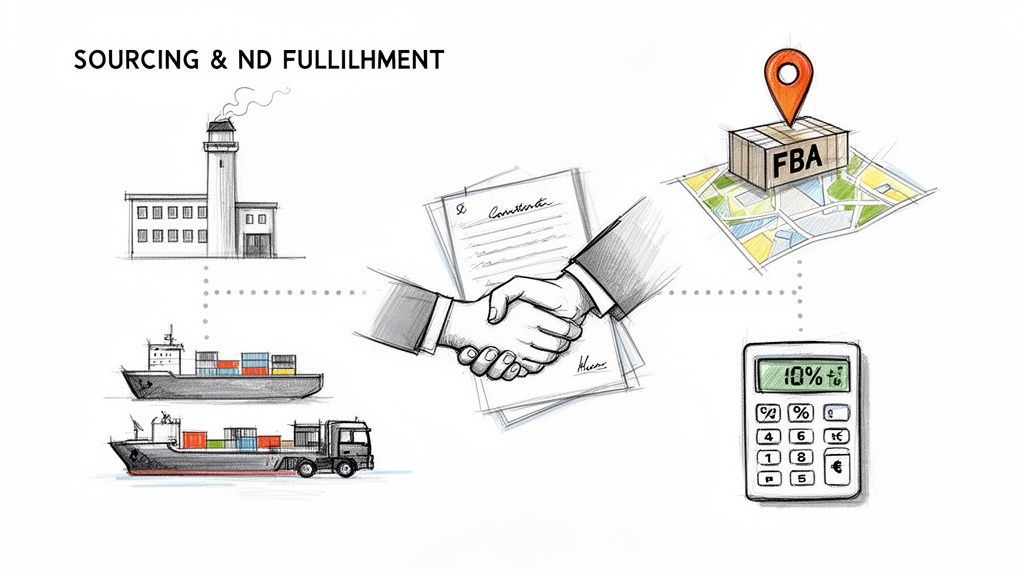
You’ve got a product idea that you’ve confirmed has real potential. Now comes the part where the rubber meets the road. You need to figure out how to actually get your product made and then how to get it into your customers' hands.
This is the operational core of your Amazon business. Every decision you make here—from manufacturing partners to shipping methods—directly hits your profit margins, customer happiness, and your ability to grow. It all breaks down into two big pieces: sourcing your product and choosing your fulfillment strategy.
Finding a Reliable Manufacturer
When it comes to getting your product made, you generally have two options: sourcing domestically or going overseas.
Domestic suppliers are often easier to communicate with and offer much faster shipping. The quality can sometimes be higher, too. But that convenience usually comes with a significantly higher price tag.
Most private label sellers, myself included, end up sourcing from overseas, especially from factories in Asia. The cost savings are just too big to ignore. Alibaba is the massive B2B marketplace where you'll start your search. If you want to streamline the process of finding and vetting factories, working with reputable sourcing agents in China is a massive shortcut. Think of them as your boots on the ground, handling everything from negotiations to quality control.
No matter where you find your supplier, stick to these rules:
- Always Order Samples: Never, ever place a bulk order without getting a physical sample first. This is non-negotiable. You need to touch, test, and feel the quality for yourself.
- Negotiate Everything: The price per unit, the Minimum Order Quantity (MOQ)—it's all on the table. Don't be shy about negotiating, especially after you start building a relationship.
- Get Clear Timelines: Understand exactly how long production will take. You need this information to plan your inventory and avoid running out of stock.
If there's one lesson I’ve learned from years of sourcing, it’s to always have a backup supplier. Delays, quality issues, and sudden price hikes are not just possibilities; they're eventualities. A second factory you've already vetted can literally save your business.
The Critical Fulfillment Decision FBA vs FBM
Okay, you know who's making your product. Now, how does it get to the customer? Amazon gives you two main paths: Fulfillment by Amazon (FBA) and Fulfillment by Merchant (FBM).
Fulfillment by Amazon (FBA) is where you ship your inventory to Amazon's warehouses. When an order comes in, Amazon’s team picks, packs, and ships it for you. They also handle the customer service and returns for those orders. It's the hands-off approach.
Fulfillment by Merchant (FBM) means you do all that yourself. You store the inventory, you pack the boxes, and you ship every single order. You’re also on the hook for all customer service and returns. It’s the hands-on approach.
Over 60% of sales on the Amazon marketplace now come from independent sellers like us, and the vast majority lean on FBA to make it all work (Source: Amazon 2025 Small Business Empowerment Report). For almost any new seller, I recommend starting with FBA. The biggest reason? Your products instantly become Amazon Prime eligible. That little Prime badge is a massive driver of sales because it promises millions of members free, fast shipping.
Choosing between FBA and FBM is a crucial decision for your business. Here’s a simple table to help you see the key differences at a glance.
FBA vs FBM Key Differences
| Feature | Fulfillment by Amazon (FBA) | Fulfillment by Merchant (FBM) |
|---|---|---|
| Prime Badge | Automatic eligibility | Must qualify for Seller Fulfilled Prime (very difficult) |
| Logistics | Amazon handles storage, picking, packing, and shipping | You handle all logistics yourself or with a 3PL |
| Customer Service | Amazon manages customer service and returns | You are responsible for all customer interactions |
| Fees | FBA fees (per unit) and monthly storage fees apply | No FBA fees, but you pay for your own shipping and storage |
| Control | Less control over inventory and packaging | Full control over your stock and branding experience |
While FBA gives you incredible leverage, it's not a free ride. Amazon charges fulfillment and storage fees, which you have to bake into your pricing. Don't guess here. Use Amazon's official FBA Revenue Calculator to get a clear picture of your net profit on every sale. This is the financial homework you have to do to build a profitable brand.
As you weigh your options, it's also smart to see how Amazon FBA compares to dropshipping to get a complete view of the different e-commerce models out there.
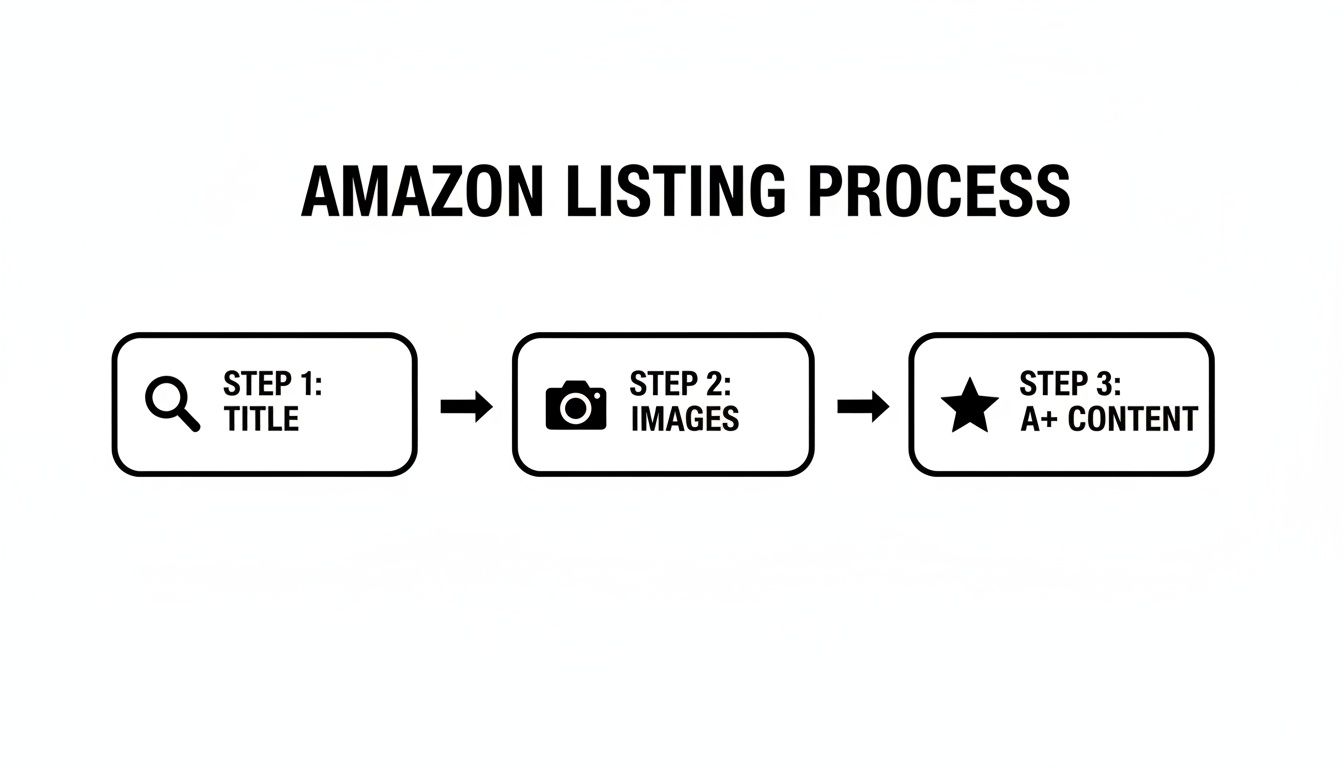
Your product listing isn't just another page on Amazon. Think of it as your digital storefront, your 24/7 salesperson, and your brand's first impression all rolled into one. On a platform as packed as Amazon, just having a listing isn't enough. You have to build a high-performance asset that’s engineered to turn casual browsers into loyal customers.
All the time and money you poured into product research and sourcing leads directly to this one moment. A poorly put-together listing is like building an incredible brick-and-mortar store but boarding up the windows and forgetting to put up a sign. It makes all that earlier work completely worthless.
Let's break down how to build a listing that actively sells for you around the clock.
Start with an SEO-Driven Title
Your product title is the single most important piece of on-page SEO you have. It’s what Amazon’s A10 algorithm reads, and it’s the first thing your potential customers see. A great title does two jobs at once: it tells Amazon what your product is using the right keywords, and it convinces shoppers to actually click.
I always start with the main keyword, then layer in secondary keywords and the most important benefits.
- Bad Title: Premium Yoga Mat
- Good Title: Extra Thick Yoga Mat for Women and Men – 72" Non-Slip TPE Material for Hot Yoga, Pilates, and Floor Exercises – Includes Carry Strap
That second title is a workhorse. It’s loaded with keywords real people are typing into the search bar ("extra thick yoga mat," "non-slip," "hot yoga") and it immediately highlights the key features and uses. It answers a shopper's questions before they've even clicked.
Write Bullet Points That Scream Benefits
Once a shopper lands on your page, you have five bullet points to make your primary sales pitch. The biggest mistake I see sellers make here is just listing dry, boring features. Nobody buys features; they buy the benefits those features give them. They're looking for solutions to their problems.
You need to translate every single feature into a direct customer benefit.
- Feature: "Made with TPE material."
- Benefit: "Unmatched Grip for Any Workout: Our proprietary TPE material ensures a non-slip surface, so you can hold your poses with confidence during intense hot yoga or pilates sessions without worrying about dangerous slips."
See the difference? The benefit-driven bullet point paints a picture. It taps into a core customer fear (slipping) and solves it. It tells them why the material matters to their workout. As you craft your Amazon listing, remember that optimizing for sales is the name of the game. You can discover more actionable strategies on how to improve ecommerce conversion rates to really dial in your approach.
The Power of High-Quality Visuals
We're all visual creatures. On Amazon, your images do the heavy lifting of demonstrating your product’s quality and value before anyone reads a single word. Professional, high-resolution photos aren't a "nice-to-have"—they're a non-negotiable requirement for building trust.
Your image stack should tell a complete story:
- A Main Image: A crystal-clear shot of your product on a pure white background. This is a strict Amazon requirement, so get it right.
- Lifestyle Images: Show your product being used by your target customer in a real-world setting. Help them picture it in their own life.
- Infographics: Use text overlays to call out key features, dimensions, or benefits. This makes your value proposition scannable and easy to absorb at a glance.
- Comparison Charts: Show how your product stacks up against the competition, highlighting your unique selling points.
Your images need to answer questions and overcome objections before a shopper even has a chance to think them.
Leverage A+ Content for Maximum Impact
If you’re a brand-registered seller, A+ Content (what used to be called Enhanced Brand Content) is your secret weapon. It lets you replace the boring, plain-text product description with a beautiful, magazine-style layout packed with rich visuals and branded storytelling.
Amazon's own data shows that using A+ Content effectively can boost conversion rates by up to 10%. That's a massive lift that goes straight to your sales velocity and bottom line.
This is your space to go deeper into your brand's story, use detailed images to explain complex features, and even cross-promote your full product line. It’s your chance to look like a serious, professional brand instead of just another random seller. A well-designed A+ Content section signals quality and builds incredible trust with customers.
Ultimately, every one of these pieces works together toward a single, critical goal: winning the Buy Box. Securing the Buy Box is the golden ticket on Amazon, as it's responsible for a staggering 82% of all sales, according to recent analyses (Source: Statista, 2025). If you don't have it, you're practically invisible. This coveted spot rotates between sellers based on the strength of their offer—think lowest price, FBA for fast shipping, and stellar seller ratings. Every optimization you make, from your title to your A+ Content, improves your conversion rate, which directly strengthens your odds of capturing this essential sales driver.
Getting Your Product Off the Ground: Launch, PPC, and Reviews
So, you’ve built a killer Amazon listing. That’s great. But a perfect listing with no traffic is like a fancy car with no gas—it looks good but isn't going anywhere. To get moving, you need to create momentum, and your first 90 days on Amazon are absolutely critical for this.
The goal is to kickstart the Amazon "flywheel." This is a concept you’ll hear a lot, and for good reason. It’s a powerful feedback loop: ads drive traffic, traffic leads to sales, sales open the door for reviews, and those reviews boost your organic ranking, which brings in even more traffic.
This whole process really comes down to mastering two things: paid ads and social proof. Get these right, and you’ll go from being an unknown new product to a real contender in your category.
Your First PPC Campaigns: An Investment in Data
Your main tool for getting instant visibility is Amazon Pay-Per-Click (PPC). Don't look at it as an expense. Seriously. Think of it as an investment in data and sales velocity. In the beginning, your goal isn't profit—it's to get clicks, make sales, and learn which keywords actually convert.
I always suggest starting with two core Sponsored Products campaigns:
- Automatic Campaigns: This is where you hand the keys to Amazon. You set a budget, and its algorithm shows your ad to shoppers using keywords and products it thinks are relevant. Think of this as your keyword discovery tool. Let it run for a couple of weeks, and I guarantee you'll find search terms you never would have thought of on your own.
- Manual Campaigns: This is where you take control. You'll grab the best-performing keywords from your automatic campaign and target them directly. This lets you bid more aggressively on the search terms you know are making you money.
Budgeting is everything here. I like to start with a 70/30 split: put 70% of your ad budget into manual campaigns to double down on proven keywords, and leave the other 30% in the auto campaign to keep finding new keyword gold.
The metric you’ll live and die by is Advertising Cost of Sale (ACoS). It's just your ad spend divided by the ad revenue. Lower is better. A "good" ACoS depends on the category, but during a launch, a smart goal is a "break-even" ACoS—one that matches your product's profit margin. If you want a deep dive into how to watch what your competition is doing, check out our guide on PPC ad spying tools.
Getting Early Reviews the Right Way
Reviews are the lifeblood of an Amazon product. They give new shoppers the confidence to click "Add to Cart" on a brand they've never heard of. Getting those first few reviews feels like a massive hurdle, but you have to do it while staying 100% compliant with Amazon's rules. I can't stress this enough: never, ever offer money or freebies in exchange for reviews. It's the fastest way to get your account suspended.
So, what’s the best way to get legit reviews? Hands down, it's the Amazon Vine program.
Vine is a program where you give free units of your product to Amazon's most trusted reviewers, called Vine Voices. In exchange, they are invited to leave their honest, unbiased opinion.
It’s pretty simple. Once you're Brand Registered, you just enroll your product. You offer up to 30 units for free. Vine Voices can then claim your product, test it out, and leave a review. These reviews get a special "Vine Voice" badge, which adds a ton of credibility.
This is the fastest and safest method I know for getting high-quality reviews on a new listing. You won't get a review for every unit you give away, but it's common to get 15-20 reviews within a few weeks (Source: Amazon Seller Central data, 2025). That’s more than enough to build that crucial initial trust.
Beyond Vine, make these a habit:
- Hit the "Request a Review" Button: Inside Seller Central, on every order's detail page, there's a button you can click. This sends a standardized, totally compliant email from Amazon to the customer, asking for both a product review and seller feedback. It's a no-brainer.
- Sell an Incredible Product: Honestly, this is the real secret. The easiest way to get glowing reviews is to have a product that genuinely exceeds expectations. Quality always speaks for itself.
That flywheel effect is very real. Your PPC ads will drive those first crucial sales. Those sales then allow you to use the "Request a Review" button and get the ball rolling with Vine. The reviews you get will increase your conversion rate, which in turn makes your PPC ads more profitable and boosts your organic ranking. It’s a beautiful, self-reinforcing cycle, and it's exactly how you scale.
Frequently Asked Questions About Selling on Amazon
Diving into the Amazon marketplace for the first time brings up a lot of questions. I get it. Here are straight-shooting, actionable answers to some of the most common ones I hear from entrepreneurs just starting out, all based on my own experience in the trenches.
How Much Money Do I Need to Start Selling on Amazon?
There’s no single magic number, but let's get real. For a private label product, you should plan for a starting budget somewhere between $3,500 and $10,000. That range covers what you need for a strong launch.
The biggest chunk of that cash will go straight to your first inventory order. After that, you've got to budget for professional product photography, the $39.99 per month Professional Seller account fee, and an ad budget for your launch PPC campaigns. My advice? Never, ever skimp on your photos or your launch ads. They are absolutely critical for getting that early momentum and your first sales.
If you want to keep those initial costs down, a great strategy is to pick a product that’s small and lightweight. It’s a simple move that directly cuts both your manufacturing and shipping costs, giving you a lot more breathing room with your budget.
Can I Sell on Amazon Without Using FBA?
Yes, you absolutely can. The alternative is called Fulfillment by Merchant (FBM). This just means you're on the hook for storing your inventory, packing up orders, and shipping them out to customers yourself. You can either handle it from your garage or hire a third-party logistics (3PL) company to do it for you.
FBM gives you way more control over your inventory and can actually be cheaper for really big or heavy items that would rack up huge FBA storage fees. But there's a massive trade-off. With FBM, you don't automatically get the Amazon Prime badge on your listing, and that badge is a huge driver for conversions. It also makes winning the coveted Buy Box much, much harder.
For most new sellers, the benefits of FBA—like instant Prime eligibility and completely hands-off logistics—are well worth the fees. The data doesn't lie; Prime eligibility can make your sales explode. In fact, over 60% of all sales in the Amazon store now come from independent sellers just like you, and a huge number of them lean on FBA to scale. You can dig into more selling strategies over at the official Amazon seller portal.
How Long Does It Take to Become Profitable on Amazon?
Profitability on Amazon is a marathon, not a sprint. You will not be profitable overnight, and it's so important to set realistic expectations from day one. Your first one to three months are pure investment. You’re spending money on PPC ads to get data, driving early sales to get on the algorithm's radar, and grinding to get your first handful of reviews.
Based on my own journey and data from thousands of other sellers, most brands start seeing consistent, month-over-month profit somewhere between months four and six. This usually happens right when your ad costs start to get optimized and your organic sales begin to pick up steam from better rankings and social proof.
The real key to hitting profitability is disciplined cash flow management. You have to see your launch costs not as a loss, but as a strategic investment in building a valuable, long-term asset.
Do I Need a Registered Business to Sell on Amazon?
Technically, you can get started as a sole proprietor, just using your personal info to set up your seller account. However, I strongly—and I mean strongly—advise you to form a legal business entity, like an LLC (Limited Liability Company), as soon as you can.
Setting up an LLC is a non-negotiable step for protecting yourself. It creates a legal wall between your personal assets and your business assets. What that means is if your business ever faces legal issues or liabilities, your personal stuff—like your house or your car—is safe.
An LLC also makes your life way easier when it comes to managing finances, tracking expenses, and filing taxes. While you can start without it, creating a formal business structure is a foundational move for anyone who's serious about building a real, scalable brand. As always, talk to a legal or tax professional to figure out the best move for your specific situation.