
Learning how to self-publish a book boils down to three big moves: getting your manuscript professionally polished, setting it up on the right platforms like Amazon KDP, and rolling out a smart launch plan. When you get these right, your book stops being just a creative project and becomes a real business asset.
Why Self-Publishing Is a Powerful Business Move
Thinking of your book as just a passion project is only seeing half the picture. In 2026, it's way more accurate to see self-publishing as one of the most scalable online businesses you can start. It gives you a direct line to turn your knowledge or story into a profitable asset for the long haul, with almost no gatekeepers.
The numbers don't lie. The global market for self-publishing services is on track to hit USD 311.46 million in 2026, growing at a steady 6.07% each year. This isn't some fluke; it's because the tools we have now let anyone with a finished manuscript reach a global audience without asking for permission.
And with the number of ebook readers expected to reach a staggering 1.1 billion by 2028, the digital route offers a low-cost, high-reward path to a massive audience. You can see the full breakdown in this self-publishing market research.
Self-Publishing vs. Traditional Publishing At a Glance
To really get why this is a big deal for entrepreneurs, it helps to see the two paths side-by-side. The differences are pretty stark.
| Attribute | Self-Publishing | Traditional Publishing |
|---|---|---|
| Control | You have 100% creative control over content, design, and pricing. | The publisher has the final say on most creative decisions. |
| Royalties | Up to 70% on platforms like Amazon KDP. | Typically 5% to 15% of the net price. |
| Time to Market | As fast as a few weeks. | 18 to 24 months on average, after securing a deal. |
| Ownership | You retain all rights to your work. | You often sign away rights for a specific term. |
| Upfront Cost | You cover editing, design, and marketing costs. | The publisher covers these costs (but takes a larger cut). |
| Marketing | You are fully responsible for all marketing efforts. | The publisher provides some marketing, but the author is still expected to do a lot. |
As you can see, self-publishing puts you in the driver's seat. It's more work, sure, but the trade-off is total ownership and a much bigger slice of the revenue.
The Modern Author-Entrepreneur
With traditional publishing, you’re an author. With self-publishing, you’re the CEO of your book. You're not just writing; you're running a business.
This means you call the shots on everything: the final edits, the cover design that will grab readers, the price you set, and every single marketing tactic you use.
The big shift here is moving from asking for permission to publish to building a business that sells directly to your audience. You own the product, you own the customer relationship, and you own the revenue. That's the core of being a modern author-entrepreneur.
If you're ready to start, a great first step is reading a full guide on how to self publish a book and succeed for more foundational advice.
The whole process can be broken down into three main stages, which is what this playbook is all about.
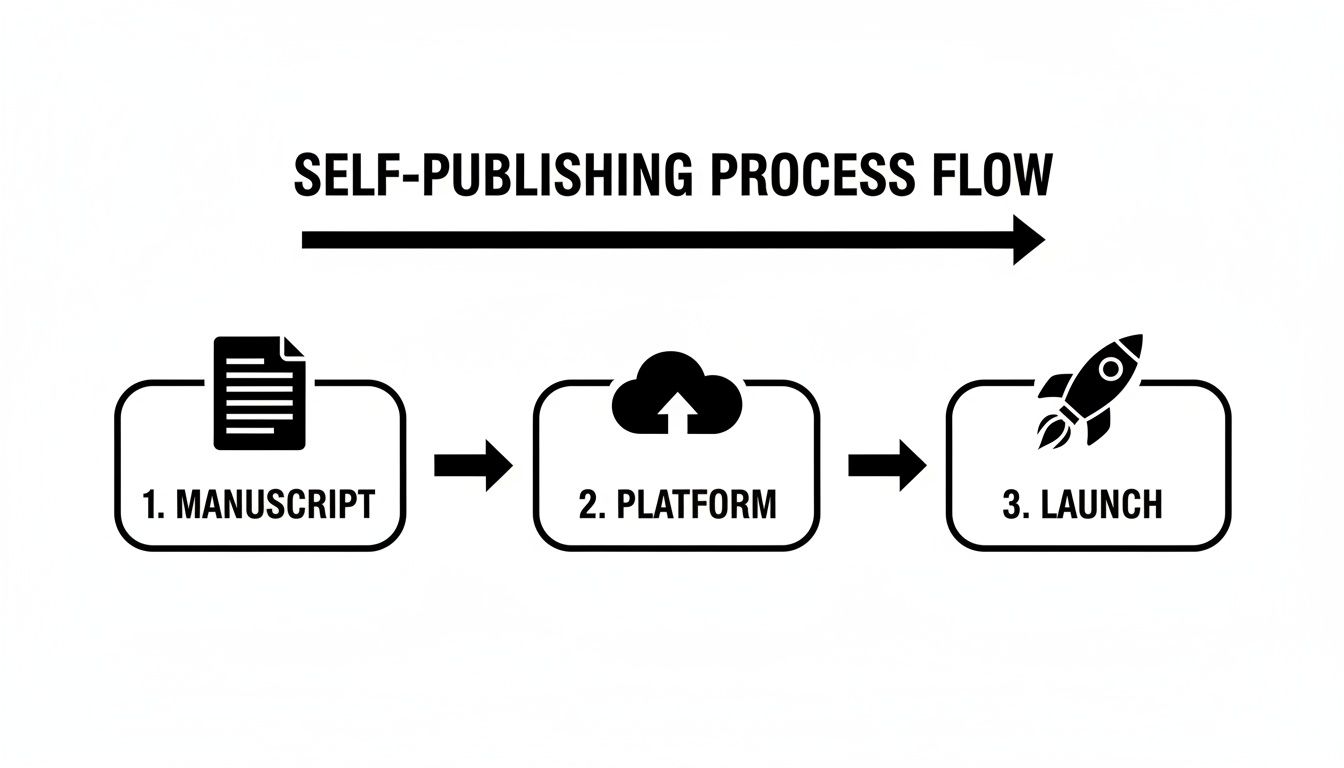
This just hammers home the point that success isn't only about the writing. It's a structured business process, from finishing the manuscript all the way through distribution and a killer launch.
Preparing Your Manuscript for Publication
Hitting "The End" on your draft is a massive accomplishment, but let's be real—it's not a finished book. Not even close. What comes next is where the magic really happens, turning that raw manuscript into a professional, polished product that can actually compete in the market.
This is a critical part of self-publishing, and I've seen too many new authors try to cut corners here. It's one of the most expensive mistakes you can make.
A book that hasn't been properly edited and formatted screams "amateur." It can kill your sales before they even start and rack up a pile of brutal reviews. If you want to play in the same league as traditionally published books, you have to meet the same quality standards. Period.
The Essential Layers of Professional Editing
Professional editing isn't a one-and-done deal. It's a series of steps, and each one is designed to tackle a different part of your manuscript. I've learned from experience that trying to skip a stage just makes the whole thing weaker.
You'll need to think about three main types of editing:
- Developmental Editing: This is the big-picture stuff. A developmental editor looks at the bones of your book—the structure, plot, character arcs, and pacing. For non-fiction writers, they're the ones who make sure your arguments are solid, organized, and actually land with the reader.
- Copy Editing: Once the structure is locked in, a copy editor goes through your manuscript with a fine-tooth comb. They're not just fixing grammar and spelling; they're refining your sentences, catching inconsistencies, and making sure the whole thing flows smoothly.
- Proofreading: This is your final quality check. The last line of defense before you hit publish. A proofreader hunts down any sneaky typos or formatting glitches that everyone else missed, ensuring a clean reading experience.
Skipping professional editing is like building a house on a shaky foundation. Your cover might be beautiful, but the whole structure is weak and won't hold up. Think of it as an investment, not an expense.
Finding the right editor is everything. You need someone who gets your genre. I've had good luck using marketplaces like Reedsy, where you can browse portfolios of vetted pros and find someone who fits your style and budget.
Formatting Your Book for Digital and Print Readers
After the editing gauntlet, it's time for formatting. This is the technical step of making your manuscript look like a real book, both as an ebook and in print. Bad formatting—like weird spacing or a table of contents that doesn't work—is a surefire way to annoy readers and get slapped with negative reviews.
For ebooks, the gold standard is the EPUB format. It's "reflowable," which just means the text automatically adjusts to whatever screen size your reader is using, from a tiny phone to a big e-reader.
For print books, you'll be creating a PDF file. This format is fixed, with specific page sizes, margins, and all the other details needed for a print-on-demand service like Amazon KDP or IngramSpark.
Tools and Choices for Formatting
You've basically got two options here: do it yourself or hire someone who knows what they're doing.
DIY formatting has gotten way easier thanks to some great software. The tool I see most often is Vellum (it's Mac-only, unfortunately), which is famous for its simple interface and ability to spit out gorgeous, professional files with minimal fuss. If you're on a PC or just want a free option, the Reedsy Book Editor is a surprisingly powerful tool that runs right in your web browser.
If all that technical stuff makes your head spin, just hire a book formatting specialist. It's a great way to save yourself a ton of time and avoid the headaches of meeting all the picky technical requirements from the publishing platforms. While you can try to wrestle with a word processor, dedicated tools almost always give you a cleaner, more professional result. You can get a better feel for the editing process by reading a review of a handy self-editing tool, the Hemingway App, which helps with self-editing clarity.
Choosing Your Publishing and Distribution Channels

Alright, your manuscript is polished and ready to go. Now for the million-dollar question: where are people actually going to buy this thing? This isn't just a technical step; it's a strategic decision that will define your book's reach, your royalty checks, and how you market it. Get this right, and you're building a business. Get it wrong, and you're just shouting into the void.
For most self-published authors, the world boils down to two titans: Amazon KDP and IngramSpark. I've used both extensively, and the smartest authors I know use them in tandem. Let's break down why you need to understand both to build your author empire.
Amazon KDP: The Starting Point for Most Authors
Amazon KDP is the 800-pound gorilla of the ebook world. For nearly every new author, it’s the non-negotiable first step. It’s completely free to upload your book, and within a day or two, your ebook and print-on-demand (POD) paperback can be live for sale to millions of Amazon shoppers. It’s that simple.
But once you're on KDP, you hit your first major fork in the road. You have to decide whether to enroll your ebook in KDP Select or to "go wide."
- KDP Select (Exclusivity): When you enroll in KDP Select, you’re agreeing to sell your ebook only on Amazon for 90-day renewable terms. The trade-off? You get access to Amazon's powerful marketing tools. Your book goes into Kindle Unlimited (KU), where subscribers read voraciously, and you get paid for every page they read.
- Going Wide (Non-Exclusivity): Opting out of KDP Select means you’re free to sell your ebook everywhere else—Apple Books, Kobo, Barnes & Noble (Nook), you name it. This “wide” strategy diversifies your income and gets your book in front of readers who, believe it or not, don’t live on Amazon.
The choice between KDP Select and going wide is all about your genre and your goals. A romance or thriller author might use KDP Select to tap into the massive KU audience for a huge launch. On the other hand, a non-fiction author building a brand might go wide to establish their authority across every possible retail channel.
If you’re just getting your feet wet, our detailed guide on what is KDP Amazon Kindle Direct Publishing is a great place to dig deeper.
IngramSpark: Expanding Your Reach to Bookstores and Libraries
While Amazon owns the online space, IngramSpark is your secret key to the rest of the book world. They are the biggest book distributor in the United States, and their customers aren’t readers—they’re bookstores, libraries, and universities.
When you publish your print book through IngramSpark, it appears in their massive catalog. This means any physical bookstore can order your book. No, it doesn't guarantee your book will be sitting on a shelf at Barnes & Noble, but it makes it possible. If someone walks into their local shop and asks for your book, the store can get it.
This is a huge deal for non-fiction authors, children's book writers, or anyone who dreams of seeing their book in a library. IngramSpark also offers high-quality hardcover printing, something KDP doesn't, which gives your book that premium, professional feel.
Diversifying Your Formats and Sales Channels
The most successful authors I know don't just have one product; they have multiple income streams from a single manuscript. The market appetite for different formats is exploding. The number of global ebook readers is projected to hit 1.1 billion by 2028, and the audiobook market is growing at an insane 26.4% every year.
A smart strategy looks something like this: launch your ebook on KDP to grab up to 70% royalties, use IngramSpark for your print book to get bookstore access, and create an audiobook. You should also explore the best platforms for selling digital products and consider selling directly from your own website, where you can keep a much larger slice of the pie.
ISBNs and Copyright: What You Need to Own
Last but definitely not least, let's talk about ownership. When you self-publish, you are the publisher. Act like one.
ISBN (International Standard Book Number): This is the 13-digit barcode that identifies your book. KDP will offer you a "free" one, but here's the catch: if you take it, Amazon is listed as the publisher of record. I always recommend buying your own ISBNs from Bowker (the official U.S. agency). This puts you or your publishing company in control, giving you the freedom to sell your book anywhere, anytime.
Copyright: In the U.S., your work is technically copyrighted the moment you write it down. But that’s not enough. You need to formally register your copyright with the U.S. Copyright Office. It's a simple, low-cost process that creates a public record of your ownership. If you ever have to defend your work from infringement, this registration is what gives you legal teeth. Don't skip it.
Designing Your Book’s Market Presence
Long before anyone actually reads your book, they've already judged it. It happens in a fraction of a second on a crowded Amazon page, and that judgment is based entirely on how you present your work to the world. Your cover, your book description, and all the behind-the-scenes metadata are doing the heavy lifting to turn a casual browser into a paying reader.
These aren't just decorative afterthoughts; they are your most critical sales assets. I've learned from experience that a book's success often has less to do with the quality of the writing and more to do with the quality of its packaging. Getting this right is a fundamental part of self-publishing a book that actually sells.
The Psychology of an Effective Book Cover
Your book cover is your single most important marketing asset. Period. I've seen studies suggesting a great cover can double your sales, and frankly, that feels about right. It’s the first thing anyone sees, and it has to instantly telegraph your book’s genre, tone, and level of professionalism.
A killer cover does more than just look good. It acts as a powerful signal to your ideal reader, screaming, "This book is for you."
- Genre Conventions Are Your Friend: A thriller cover needs dark, high-contrast imagery and sharp, bold fonts. A contemporary romance might use illustrated characters and a warm, inviting color palette. If you ignore these visual cues, you’ll confuse potential readers and they'll just scroll right past.
- Typography is Everything: The font choice and arrangement of your title and author name can absolutely make or break a cover. Good typography guides the eye, establishes a mood, and creates a clear visual hierarchy.
- The Thumbnail Test is Crucial: Your cover has to pop as a tiny image on a smartphone. If you can't immediately tell what the book is about and feel drawn to it at that size, you've already lost a massive chunk of your audience.
When you're setting your budget, a professional cover designer should be a non-negotiable line item. You can find fantastic designers on platforms like Reedsy or 99designs, with costs ranging from a few hundred bucks for a solid pre-made cover to over $1,000 for a fully custom design from a top-tier artist. It’s an investment that pays for itself, often in the first few months.
Writing Book Descriptions That Convert
If the cover earns the click, the book description (also called the blurb) is what closes the deal. This little 150- to 300-word pitch is your chance to hook the reader and get them to smash that "Buy Now" button. It’s pure sales copy, and you need to treat it that way.
A great description usually follows a proven pattern:
- Lead with a Killer Hook: Start with a question, a shocking statement, or an irresistible premise that immediately pulls the reader into the story.
- Introduce the Stakes: What’s the core conflict? What does the protagonist stand to lose? For a non-fiction book, what problem are you going to solve for the reader?
- End with a Cliffhanger or a Promise: Leave them hanging. For fiction, this means ending on a note of high suspense. For non-fiction, it's about promising a tangible, valuable outcome.
Don't be afraid to use formatting like bold text and bullet points. They break up the wall of text and make your description way more scannable on a busy product page.
Mastering Metadata for Book SEO
Metadata is all the data you feed into stores like Amazon to help them categorize your book and show it to the right people. Think of it as Search Engine Optimization (SEO) for your book. Getting this right is absolutely critical for discoverability.
The two most important pieces of the metadata puzzle are your categories and keywords.
- Amazon Categories: You get to pick up to three main BISAC categories, which are like the aisles in a physical bookstore. But the real magic happens when you drill down into niche sub-categories where it's much easier to rank. Instead of just "Science Fiction," you might target something hyper-specific like "Science Fiction & Fantasy > Science Fiction > Colonization."
- Keywords: On KDP, you get seven keyword slots. These aren't just single words; they are the actual search phrases that readers are typing into the Amazon search bar. A smart strategy is to use a mix of broad terms ("military sci-fi") and more specific, long-tail phrases ("first contact with aliens novel") to cover all your bases.
Tools like Publisher Rocket are invaluable for this kind of research. They help you find profitable, low-competition categories and the exact keywords real shoppers are using. And if you're looking for ways to create bonus content or lead magnets, our Designrr review is helpful for creating ebooks and more.
Launching and Marketing Your Book Like a Pro
The moment you hit "publish" isn't the finish line—it's the starting gun. A successful book launch doesn't just happen. It's the result of a deliberate, well-executed marketing plan that begins long before your book is even available for sale.
So many authors make the mistake of believing a great book sells itself. In today's crowded market, that's a fantasy. Your marketing is what separates a book that gets discovered from one that gets buried.
Building Your Author Platform
Before you even think about running ads or begging for reviews, you need to build assets that you actually own. Your two most valuable marketing tools are your author platform—your personal brand and reach—and your email list. While social media is great for engagement, your email list is the only direct line to your readers that you completely control.
A publisher’s primary question to a new author is no longer just "What is your book about?" but "Do you have an audience?" They need authors who bring their own crowd because they've lost their direct connection to readers. This is your biggest advantage as a self-publisher: you can build that relationship from day one.
You can start small. Put up a simple author website and add a signup form for your newsletter. Offer a free short story or a helpful checklist—what we call a "reader magnet"—to give people a reason to sign up. This list becomes your launch team in waiting.
Assembling Your Advance Reader Team
Early reviews are the lifeblood of a new book on Amazon. They provide the social proof that convinces other readers to take a chance on you, and they signal to Amazon's algorithm that your book is worth showing to more people. This is where an Advance Reader Copy (ARC) team comes in.
An ARC team is simply a group of dedicated readers who agree to receive a free, early copy of your book in exchange for leaving an honest review right around launch day.
- Recruit from Your Email List: These are your most engaged fans and the perfect candidates.
- Use Social Media: Put out a call for volunteers in genre-specific Facebook groups or on your author page.
- Utilize specialized services: Platforms like Booksprout or StoryOrigin can help you find and manage ARC readers, which saves a ton of administrative headache.
Your goal should be to assemble at least 20-30 reliable team members. Their early reviews will give your book the initial momentum it desperately needs to start climbing the sales ranks.
Executing a High-Impact Launch
A launch isn't a single day; it's a strategic sequence of events designed to maximize sales and visibility in the first few weeks. The speed of self-publishing is a huge asset here. While traditional publishing can take 18-24 months, you can get a book out in 3-6 months, which lets you execute your marketing plan while it's still fresh. You can find more details on these timelines and what to expect by exploring the trends in publishing for 2026.
Here’s a look at a few powerful tactics that actually work.
H3 – Dynamic Pricing Strategy
This is a classic for a reason. Launch your ebook at a discounted price—think $0.99 or $1.99—for a limited time. This encourages impulse buys from new readers and drives up your sales volume, which Amazon's algorithm loves. After the initial launch window (usually 3-7 days), you can raise the price to its regular, full-value level.
H3 – Leveraging Promotional Sites
Once your book has a handful of positive reviews, it’s time to pour some fuel on the fire with paid promotions. These are sites with massive email lists of readers who are hungry for book deals.
| Promotion Site | Est. Reach & Cost | Best For |
|---|---|---|
| BookBub | Millions of readers; $$$$ | The holy grail. Highly competitive but can make a career. |
| Bargain Booksy | Hundreds of thousands; $$ | Great for genre fiction, especially with a discount. |
| The Fussy Librarian | Tens of thousands; $ | Cost-effective option for reaching targeted genre readers. |
Landing a coveted BookBub Featured Deal is notoriously difficult, but it can result in thousands of sales in a single day. Don't get discouraged if you're rejected; just keep applying as you gather more reviews and build your audience.
H3 – Mastering Amazon Ads on a Budget
Amazon Ads are an incredibly powerful tool for putting your book directly in front of shoppers who are looking for titles just like yours. You can start small with a daily budget of just $5-$10 and focus on "Sponsored Products" ads. My advice? Target the authors and specific books that are most similar to yours. This is a long-term game of testing and tweaking, so be patient and track your results carefully.
Finally, don't underestimate the power of organic reach. Engaging with readers on platforms like TikTok's #BookTok community can create viral moments that traditional marketing can't buy. It's all part of learning how to self publish a book like a true professional.
Common Questions About Self Publishing
As you get closer to the finish line, the big, practical questions start to bubble up. This is totally normal. Getting clear on the real-world details like costs, potential income, and what not to do is the final piece of the puzzle. It’s where the theory of how to self publish a book meets the pavement.
Think of this as the FAQ section I wish I’d had when I started. Let’s tackle the questions every author has.
How Much Does It Really Cost to Self Publish a Book?
You can technically upload a manuscript to a platform like KDP for free, but let's be real: launching a professional book that actually sells requires a bit of an upfront investment. I look at it as a startup cost.
For a quality launch that gives your book a fighting chance, a realistic budget usually lands somewhere between $500 and $2,500.
So, where does that money go? It goes toward the non-negotiables that readers have come to expect:
- Professional Editing: This is your single most important expense. Depending on your book's length and the editor's experience, this can range from $300 to $1,500 or more. Don't skip this.
- Cover Design: Your cover is your #1 marketing tool, period. A pro cover that fits your genre can run anywhere from $150 to $800.
- Book Formatting: To ensure a clean, professional look on every device, expect to pay $50 to $300 for an expert to create your EPUB and PDF files.
If you’re on a tight budget, sink every penny you can into a fantastic editor and a killer cover. You can always reinvest your first royalties into marketing like Amazon Ads. The key is to avoid the "free" trap if you're serious about this, a point driven home by authors like Kevin Kelly in his excellent breakdown of the publishing process.
How Much Money Can I Realistically Make?
Author income is all over the map, but it’s ultimately a numbers game. It comes down to the quality of your book, the demand in your genre, and how consistently you market it.
For a quick example, on Amazon KDP, you earn 70% royalties on ebooks priced between $2.99 and $9.99. If you price your ebook at $4.99, that’s about $3.50 in your pocket for every sale. A solid debut author might pull in a few hundred to a few thousand dollars a month.
The real money, though, is in building a backlist—a library of books that all sell consistently.
Top indie authors with deep backlists are often earning six or even seven figures a year. Your first book is just the foundation. The life-changing income is built by publishing consistently and marketing relentlessly.
What Is the Biggest Mistake to Avoid?
I’ve seen this happen a thousand times. The single most damaging mistake you can make is treating your book like a side project by skimping on professional editing and cover design.
An unpolished manuscript and a homemade cover scream "amateur" to potential readers. It’s an instant turn-off that kills sales before they even have a chance to happen and practically begs for one-star reviews.
Remember, your book isn’t just competing with other indie authors. It's sitting on the same digital shelf as books from the biggest publishers in New York. To even stand a chance, it absolutely has to look and read like a professional product. As this comprehensive guide on Reedsy points out, investing in a good editor and a genre-specific cover designer is the price of admission if you want to be taken seriously.