

You’re probably in one of two spots right now.
Either sales look decent, but your bank account doesn’t. Or you’re still evaluating products and trying to avoid the classic Amazon mistake of confusing revenue with profit.
That mistake wrecks more sellers than competition ever does. A product can move units, rank well, and still be a bad business. I’ve seen plenty of catalogs that looked healthy in Seller Central but turned ugly once you layered in storage, returns, ad spend, and all the little operational leaks nobody wants to talk about.
On Amazon, profit margin is the truth serum. It tells you whether your pricing holds up, whether your sourcing is good enough, and whether your ad strategy is disciplined or just expensive.
What Are Amazon Profit Margins Really
A lot of sellers learn this lesson the hard way. They hit a milestone month, feel great about top-line sales, then open the P&L and realize the business barely kept any of it.
That’s what amazon profit margins really measure. Not activity. Not momentum. Not “we’re growing.” They measure what’s left after the business pays for the right to exist.
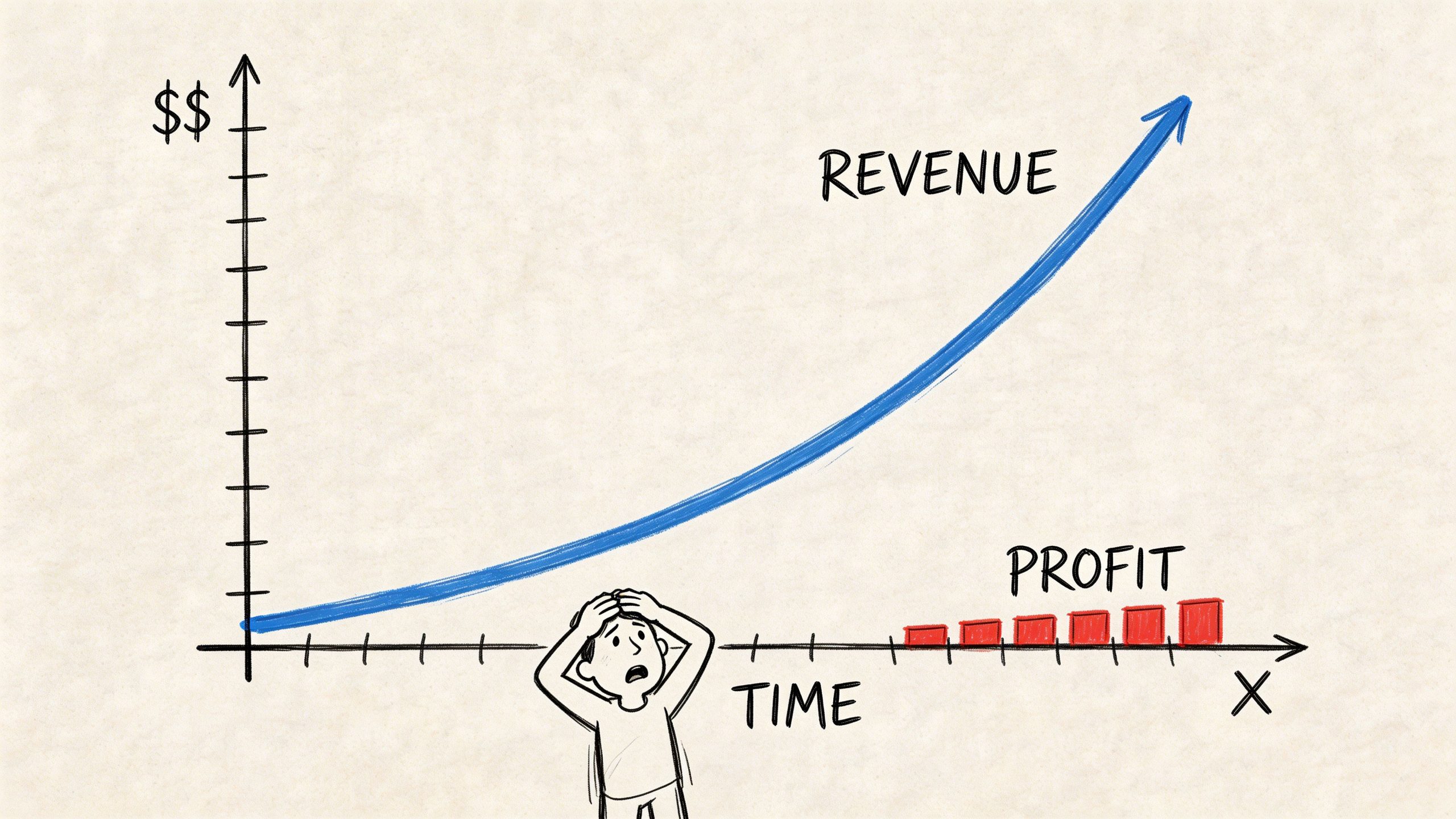
Amazon itself is a good reminder that margin is a journey, not a fixed trait. Amazon’s net profit margin rose from 0.56% in 2015 to 10.83% for the fiscal year ending December 31, 2025, reflecting a shift from a low-margin e-commerce retailer to a more diversified company powered by higher-margin segments like AWS, according to AlphaQuery’s Amazon profit margin history.
That matters because sellers often assume thin margins are just part of the game forever. They’re not. But you only improve them when you start tracking the business correctly.
Profit margin beats revenue every time
A six-figure revenue month can still be fragile.
If one fee change, one bad reorder, or one spike in ad costs can wipe out the month, the business isn’t healthy. It’s just busy.
Practical rule: If you can’t explain where each dollar goes after a sale, you don’t know your margin.
This is also why basic bookkeeping confusion hurts sellers. If you’re mixing up profitability with cash position, clean up that distinction first. A simple refresher on Understanding the Difference Between P&L and Balance Sheet helps because Amazon operators often mistake payout timing for actual profit.
What a seller should watch
At minimum, track these on a product level:
- Sale price: The amount the customer pays.
- Landed product cost: Your unit cost plus freight, prep, and inbound logistics.
- Amazon charges: Every fee tied to that unit.
- Advertising spend: Especially branded versus non-branded spend.
- Net profit per unit: The only number that tells you whether scale helps or hurts.
If you don’t know your per-unit net, scaling usually magnifies bad math.
The Two Amazons Why Corporate Profit Hides Retail Reality
Many sellers look at Amazon’s corporate profit numbers and assume the marketplace must be loaded with fat margins.
It isn’t.
The biggest misunderstanding in this space is thinking Amazon wins because retail margins are huge. In reality, Amazon’s overall profitability can hide how thin the actual retail engine is.
The profit story most sellers miss
Amazon’s aggregate profitability in Q3 2025 was 11.8% net TTM, but that masks much thinner retail segments, with North America at 4.5% and international below 4.5%, while AWS and advertising operate at 24% to 50% margins according to CrispIdea’s analysis of Amazon retail margins and scale profitability. The same analysis notes that Amazon deliberately runs retail at roughly 3% to 6% to prioritize lifetime customer value over per-transaction profit.
That changes how you should think about selling on the platform.
If Amazon’s own retail side often operates with razor-thin economics, then third-party sellers can’t assume volume alone will save them. The environment is built for pressure. Fees are real. Price competition is real. Customer acquisition through ads gets expensive fast.
What that means for sellers
Amazon has multiple businesses under one logo. Sellers usually interact with the retail machine, but the parent company reports blended results.
That blend creates false confidence.
A seller sees strong corporate margin headlines and concludes:
- Scale must solve profit problems
- Amazon probably has room to keep retail easy for sellers
- Low margins are okay if volume is high enough
All three can be dangerous assumptions.
Retail on Amazon is often a game of operational discipline, not margin abundance. The businesses that survive don’t rely on wishful thinking. They know where contribution profit comes from, and they don’t let ad spend or inventory carrying costs erase it.
Amazon can tolerate thin retail margins because it has higher-margin engines elsewhere. Most sellers don’t.
Why a profit-first mindset matters more in this environment
If you’re a seller, you don’t have AWS subsidizing your mistakes.
You have one catalog. Maybe a few products. Maybe one hero SKU carrying the whole account. That means your business needs to behave differently than Amazon corporate.
A practical approach looks like this:
| Business mindset | What usually happens |
|---|---|
| Revenue-first | More units sold, more complexity, more hidden leakage |
| Profit-first | Fewer bad SKUs, tighter pricing, cleaner ad decisions |
| Scale-first | You grow costs before systems are ready |
| Unit-economics-first | You know which products deserve more capital |
The sellers who stay in the game the longest usually accept one uncomfortable truth early. Amazon is a fantastic channel, but it is not a forgiving one.
Every Cost Component That Erodes Your Margin
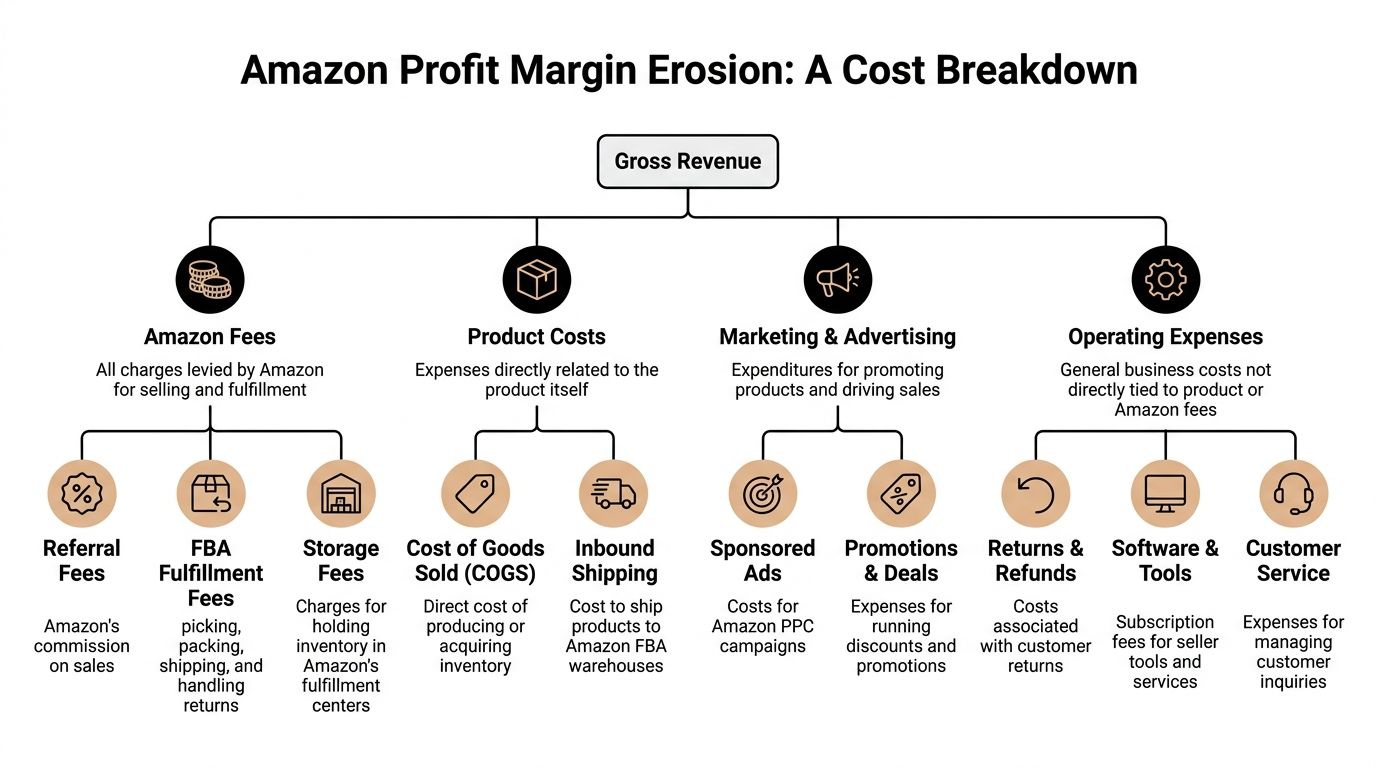
Amazon margin erosion works like peeling an onion. Every layer looks manageable by itself. Stack them together and the product that looked profitable on paper starts gasping for air.
Sellers often get fooled by gross margin at this point. A product can look strong before operating costs and still turn into a weak net business after everything else hits.
Amazon’s gross profit margin of 50.29% versus its net profit margin of 10.83% shows a 39.46 percentage point gap consumed by operating expenses, and that same dynamic is exactly why sellers need to model overhead carefully. A 67% gross margin on a product can still shrink to 5% net profit if indirect costs are ignored, based on MLQ.ai’s breakdown of Amazon margins.
Start with product cost
This is the cleanest cost bucket, and a lot of sellers still miscalculate it.
Your real product cost isn’t just what the supplier charges for the unit. It includes the pieces required to get sellable inventory into Amazon’s system.
That usually includes:
- Unit cost: What you pay the factory, distributor, or brand.
- Packaging and prep: Labels, inserts, poly bags, bundling, and prep-center work.
- Inbound freight: Factory to port, port to warehouse, warehouse to FBA, or direct routing depending on your setup.
- Customs and related import charges: If you import, these belong in landed cost, not in a separate mental bucket.
If you understate landed cost, every decision after that gets distorted.
Amazon fees are obvious, but still under-modeled
Sellers know Amazon takes fees. They just don’t always model them tightly enough before launch.
The big ones are familiar:
- Referral fees: The marketplace commission tied to the sale.
- FBA fulfillment fees: Pick, pack, ship, and parts of the return flow.
- Storage fees: Regular storage plus the pain that comes from slow-moving inventory.
- Other account-level charges: Depending on the model, these can add drag even if they don’t show up in the product concept sheet.
The trap is using rough estimates instead of current, product-specific numbers. A small packaging change can shift fee economics enough to matter. So can poor inventory rotation.
If you need help tightening inventory turns and reducing avoidable storage drag, this guide on Amazon inventory management is useful because most margin leaks start long before the sale happens.
Advertising can save a listing or ruin it
PPC is where many sellers lose discipline.
Ads are necessary for a lot of products, especially newer listings or competitive categories. But sellers often treat ad spend like a growth expense without checking whether the product economics can support it.
What usually happens:
- You launch with heavy spend.
- Sales increase.
- Organic rank improves a bit.
- You assume the product is working.
- Net margin says otherwise.
That’s why I separate visibility from viability. A visible product isn’t automatically a profitable product.
Margin check: If turning ads on makes sales look better but owner earnings look worse, the offer needs work before the campaign gets more budget.
Returns, refunds, and damaged units
This cost bucket is always uglier in practice than in spreadsheets.
A return doesn’t just reverse revenue. It often creates multiple hits:
| Cost area | How it hurts margin |
|---|---|
| Lost sale value | The original revenue may disappear |
| Return handling | Processing and condition issues add friction |
| Damaged or unsellable inventory | You may not recover the unit at full value |
| Customer support time | Small individually, painful in aggregate |
Products with sizing confusion, fragile packaging, misleading imagery, or unclear instructions usually pay for those mistakes through returns.
Overhead is where phantom profit dies
The final layer is operating overhead. Sellers ignore this because the costs feel indirect.
They aren’t indirect to your bank account.
Common examples include:
- Software subscriptions: Repricers, keyword tools, inventory software, reimbursement tools, analytics dashboards.
- Agency or freelancer costs: PPC managers, creatives, copywriters, listing help.
- Team costs: Virtual assistants, admin labor, support labor.
- Financing costs: Cash flow pressure can make margin look better on paper than in reality.
One tool by itself may seem harmless. A stack of tools plus a few outsourced functions can turn a decent SKU into a weak one.
Key Takeaway
Most margin problems don’t come from one catastrophic issue.
They come from five or six “small” costs that nobody gave enough respect. That’s why smart sellers audit by SKU, not just by account.
Calculating Your Per-Unit Profitability Step by Step
A lot of sellers don’t have a margin problem. They have a calculation problem.
They’re using simplified math. They subtract product cost and the obvious Amazon fee, then assume the leftover number is profit. It isn’t. Per-unit profitability only becomes useful when every predictable cost is attached to the unit.
The simplest formula that still tells the truth
Use this sequence on every SKU:
- Start with selling price
- Subtract landed product cost
- Subtract Amazon fees
- Subtract ad cost per sale
- Subtract expected return and operational overhead per unit
- What remains is net profit per unit
- Divide net profit per unit by selling price to get net margin
That’s the number worth managing.
A worked example without fake benchmarks
Here’s a practical structure using a hypothetical product, without inventing category data.
| Line item | What to include |
|---|---|
| Selling price | The actual amount paid by the customer |
| Landed cost | Product cost, prep, freight, and inbound logistics |
| Amazon fees | Referral, fulfillment, storage, and related selling costs |
| Advertising | Average ad spend tied to each conversion |
| Returns and overhead | Expected support, software, refund, and operational drag |
| Net profit per unit | Selling price minus all of the above |
A strong process is more important than a pretty spreadsheet. If you want a faster way to pressure-test product economics before you commit capital, use an Amazon FBA calculator and then add your own overhead assumptions on top. The calculator gets you part of the way. Your internal cost model finishes the job.
Why sourcing efficiency matters so much
The margin improvement game often starts before the inventory ships.
Amazon’s gross profit margin expanded from 33.04% in 2015 to 47.29% in 2024, a useful benchmark for how much supply chain optimization and cost control matter over time, according to MLQ.ai’s Amazon profit margin data.
For sellers, that translates into a simple rule. If you can improve sourcing, packaging, freight routing, or supplier terms without damaging the offer, you create room for everything else. Better pricing flexibility. More ad tolerance. Healthier net margin.
A practical review cadence
Don’t calculate profit only at launch.
Review unit economics when any of these happen:
- Supplier cost changes
- Packaging changes
- Ad mix shifts
- Return patterns worsen
- Storage starts building up
- Price competition heats up
That review should happen at the SKU level, not as a blended account average. Blended averages hide weak products.
The bestseller in your catalog is sometimes the SKU doing the most damage. It just hides behind volume.
Amazon Profit Margin Benchmarks by Category 2026 Estimates
Use broad category comparisons carefully. They’re directional, not a substitute for your own numbers.
| Category | Average Net Profit Margin Range |
|---|---|
| Home & Kitchen | Varies by product, competition, ad dependence, and return profile |
| Electronics | Often tighter because of competition, returns, and price compression |
| Beauty | Can be stronger when branding and repeat demand hold up |
| Toys & Games | Can swing hard with seasonality and storage exposure |
| Sports & Outdoors | Depends heavily on product differentiation and calendar timing |
| Books | Typically requires disciplined sourcing and lean operations |
Because reliable category-by-category numeric benchmarks were not provided in the verified data, treat any precise public benchmark table with caution unless you can validate every input.
What to compare instead of generic averages
If you want something more useful than a loose industry benchmark, compare each SKU against itself over time:
- Net profit per unit this month versus last month
- Ad cost per conversion trend
- Return pattern after listing or packaging changes
- Storage burden as inventory ages
- Price elasticity when you test modest increases
That tells you whether the business is improving, not just whether it fits a generic market narrative.
Actionable Strategies to Increase Your Amazon Margins
The easiest way to improve margins is to stop trying to fix everything at once.
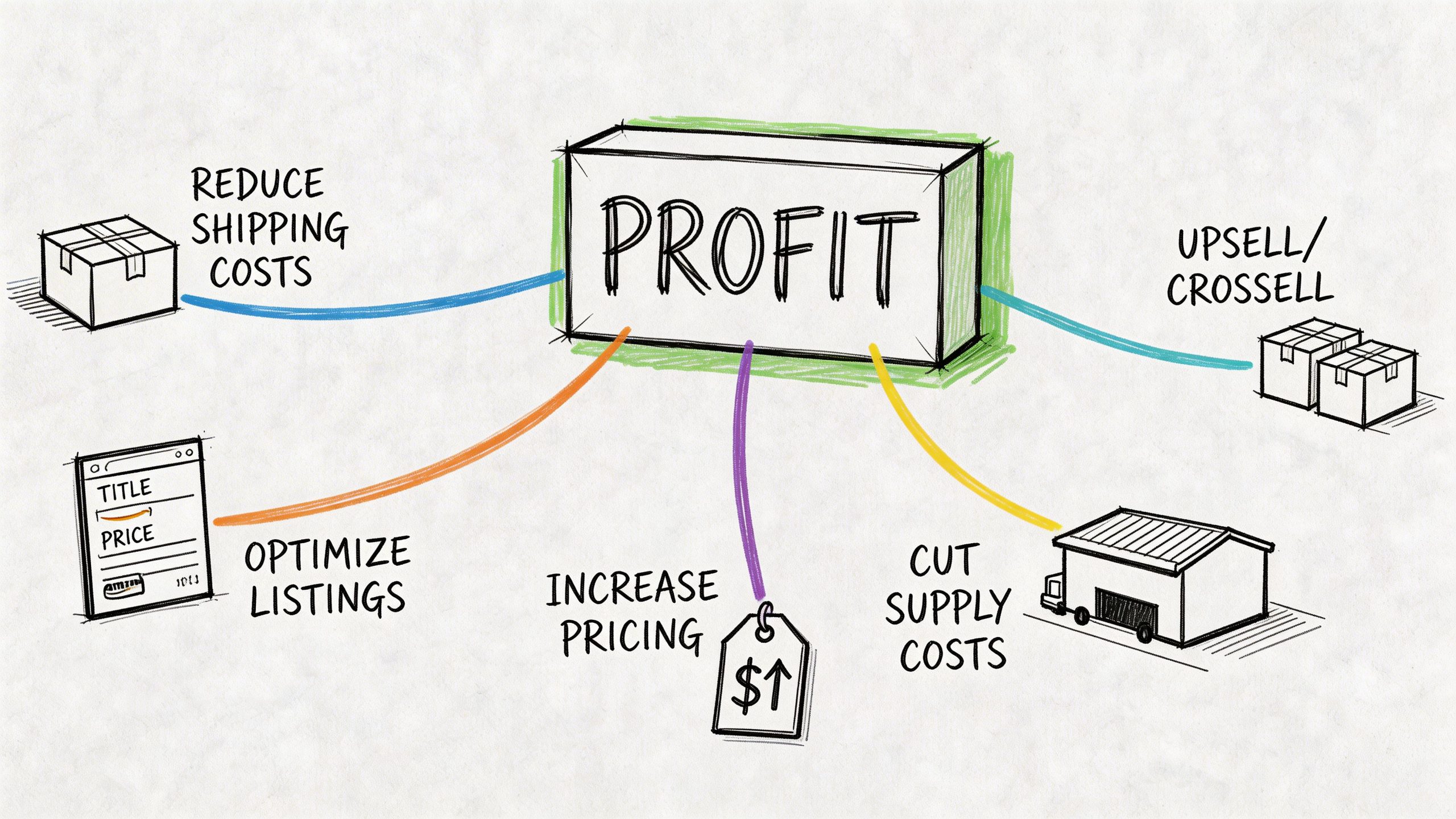
Most sellers need to pull a small number of impactful levers. Pricing. COGS. ad efficiency. Inventory quality. Packaging and offer design. Those move the needle. Busywork doesn’t.
Raise prices carefully, not emotionally
A lot of sellers underprice out of fear.
If your listing has strong reviews, a clear value proposition, and stable conversion, test pricing rather than assuming the current number is sacred. Margin often improves faster from a disciplined pricing test than from months of tinkering inside ad accounts.
Good pricing work usually looks like this:
- Test in small steps: Don’t shock conversion if you can avoid it.
- Watch unit economics, not just sessions: Higher price with slightly lower volume can still be a better business.
- Support the price with the listing: Images, copy, packaging, and positioning need to justify it.
For a broader finance-side perspective, these strategies to improve profit margins are useful because the core logic applies well to Amazon too. Margin usually improves when you either charge more intelligently, lower cost, or do both without damaging demand.
Reduce COGS before you chase hacks
COGS work is unglamorous. It also compounds.
Negotiate with suppliers after you have proof of velocity. Review carton dimensions. Revisit inserts and packaging materials. Look at whether your current prep flow is more expensive than it needs to be. Sellers often waste time optimizing tiny ad settings while ignoring bigger savings in sourcing and packaging.
A few practical areas to review:
| Lever | What to check |
|---|---|
| Supplier terms | Unit price, MOQs, payment timing, packaging options |
| Packaging | Unnecessary bulk, fragile design, inefficient dimensions |
| Freight flow | Routing, shipment batching, prep-center decisions |
| Bundle design | Whether a kit creates better economics than a single item |
Fix PPC with break-even math
Too many campaigns are run with soft goals like “keep traffic flowing” or “stay aggressive.”
That’s not enough. Every SKU needs a break-even advertising threshold based on its actual economics. If a product can’t support the ad cost required to sell it, the issue usually isn’t the campaign. It’s the product margin, the listing, or the market.
Focus on:
- Search term quality: Cut waste first.
- Match type discipline: Don’t leave broad campaigns unattended.
- Budget allocation: Fund what converts profitably, not what merely spends.
- Brand versus non-brand separation: They behave differently and should be judged differently.
If you need a system for price response while protecting buy box competitiveness, a guide to Amazon repricing strategies and automated repricer software can help. Repricing isn’t just about winning more sales. Used correctly, it’s about defending margin while staying competitive.
Inventory discipline protects margin better than most sellers realize
Inventory mistakes hit margins from both directions.
Order too much and you get storage drag, stale stock, and eventual liquidation pressure. Order too little and you lose rank, burn launch momentum, or force rushed replenishment decisions that cost more.
The strongest operators don’t treat inventory as a warehouse problem. They treat it as a profit problem.
That means:
- Forecast by SKU, not by gut feel
- Cull weak SKUs before they age badly
- Watch sell-through alongside ad dependence
- Treat slow inventory as a pricing and capital allocation issue
This kind of operational review is where tools can help if used with discipline. EntreResource also covers Product Opportunity Explorer workflows for evaluating search trends, sales history, and pricing behavior before product selection, which is useful when you want to avoid margin-poor products before launch rather than trying to rescue them later.
A short tactical breakdown is worth watching here:
Improve the offer, not just the spreadsheet
Sometimes margin improves because the product gets better.
That can mean clearer instructions, better packaging, a more compelling bundle, stronger images, fewer return-triggering misunderstandings, or a positioning shift that lets you charge what the product is worth.
Better margins often come from reducing friction. Fewer confused buyers, fewer weak clicks, fewer returns, fewer rushed discounts.
This is the part many sellers skip because it feels less measurable than ad reports. In practice, offer quality is often what gives you the right to hold price and spend less to convert.
Common Margin-Killing Mistakes Amazon Sellers Make
Most margin damage doesn’t come from one dramatic blunder.
It comes from repeated habits that look normal inside Seller Central. A seller keeps ordering, keeps advertising, keeps running promotions, and never notices the account is working harder without getting healthier.
Mistake one: trusting blended account averages
Blended margin reporting hides weak SKUs.
One strong product can cover for several bad ones, at least for a while. The result is false confidence. You think the account is stable because the overall number looks acceptable, but a chunk of the catalog is draining cash.
The fix is simple. Review contribution and net profitability by SKU, then by variation if the economics differ meaningfully.
Mistake two: underestimating ad dependence
Some products aren’t profitable. They’re just heavily advertised.
That distinction matters. A SKU that only survives with aggressive PPC is fragile, especially if pricing pressure increases or conversion slips. Sellers often celebrate sales velocity without noticing the product has become dependent on paid traffic to stay alive.
Mistake three: ignoring hidden vendor deductions and scale traps
This issue gets more serious when sellers move into larger vendor relationships.
A commonly overlooked problem is Vendor Central CoOp agreements and low Purchase Order volumes. New brands often need to allocate up to 30% of revenue to advertising, and if those hidden costs aren’t audited, margins can plateau around 12% to 15% even at multi-million dollar sales volume, according to Wake Commerce’s guide to Amazon profit optimisation for vendors.
That’s an important lesson even for smaller operators. Scale doesn’t automatically clean up bad economics. Sometimes it just spreads them across more units.
Mistake four: treating storage as a minor expense
Storage usually starts as background noise.
Then a reorder runs late, a seasonal product slows down, or a listing loses momentum. Suddenly you’re carrying inventory that looked smart when you bought it and expensive when you house it.
A slow SKU creates three problems at once:
- Capital gets trapped
- Storage costs build
- Discount pressure increases
Sellers often react too late because they treat storage as an operations detail instead of a profitability signal.
Mistake five: failing to account for returns before launch
Returns shouldn’t be an afterthought.
A product with ambiguous sizing, weak packaging, or unclear instructions can produce customer behavior that destroys net profit. If you only model the happy-path sale, you’ll overestimate margin from day one.
The right time to think about returns is before the first unit goes live, not after a pattern shows up in account health.
Mistake six: chasing revenue milestones
This one is emotional, and that’s why it sticks around.
Revenue is visible. Margin takes work. It’s easier to celebrate sales screenshots than to admit a product line isn’t earning enough. Sellers hold onto low-quality revenue because it feels like progress.
It isn’t. Healthy amazon profit margins create options. Weak margins create stress.
From Revenue Chaser to Profit Optimizer
The sellers who last on Amazon usually stop asking, “How do I sell more?” and start asking, “Which sales are worth keeping?”
That’s the shift that matters.
Amazon is an incredible platform, but it rewards discipline more than hype. Corporate profit headlines can make the ecosystem look richer than it is. The retail reality is tighter. Your business has to be built for that reality.
Track per-unit net profit. Respect hidden costs. Cut weak SKUs faster. Don’t let PPC, storage, or sloppy landed-cost math eat the business alive.
A smaller catalog with clean economics beats a bigger catalog full of excuses.
Profit margin isn’t a restrictive metric. It’s the number that gives you breathing room, better decisions, and a business you can scale without regretting it.
Frequently Asked Questions About Amazon Profitability
What is a good profit margin on Amazon
There isn’t one universal answer.
A good margin depends on category, return behavior, ad dependence, pricing pressure, and selling model. In practice, the better question is whether a SKU leaves enough room for ads, returns, inventory mistakes, and still produces healthy owner earnings. If the margin only works under perfect conditions, it isn’t good enough.
How do returns affect my final net margin
Returns lower margin in more than one way.
They can reverse revenue, trigger handling costs, create damaged inventory, and increase support burden. A product with frequent returns can look acceptable on paper before returns are added, then weak once the full picture is included. That’s why return assumptions need to be built into unit economics before launch.
Can a business survive on a low profit margin
It can, but it becomes fragile.
Low-margin businesses have less room for ad volatility, supplier cost increases, fee pressure, and inventory mistakes. They also require tighter operations because small problems hit harder. Some sellers can operate that way, but it demands strong systems and clear reasons for staying in the category.
Should I focus more on gross margin or net margin
Net margin matters more for decision-making.
Gross margin is useful because it tells you whether the product has enough room before overhead. But net margin tells you what the business keeps after ads, storage, returns, and operating expenses. Gross margin can look healthy while the SKU still underperforms.
How often should I review amazon profit margins
Review them whenever the economics change.
That includes supplier changes, price tests, new ad behavior, packaging changes, return issues, or inventory aging. At a minimum, make profit review part of your regular SKU management process so weak products don’t hide behind blended account performance.