

You’re probably in one of two spots right now.
Either you’ve been circling the idea of building an amazon affiliate marketing website for months and still haven’t picked a niche, or you already started one and it feels like you’re publishing into a void. Both are normal. Most new affiliate site owners don’t fail because the model is broken. They fail because they treat it like a side project instead of a system.
Amazon is still the easiest on-ramp for a lot of site builders because the buying intent is already there. You don’t have to convince someone to trust a random store. You just have to help them choose the right product and then send them to a platform they already use.
Your Blueprint for a Profitable Online Asset
A real affiliate site isn’t a stack of random reviews. It’s a digital asset built on three things: search intent, buyer trust, and clean execution.
That’s why Amazon Associates remains such a practical entry point. It holds 46.27% market share and has over 900,000 affiliates worldwide, which tells you this isn’t some fringe monetization model. For top brands, affiliate channels account for 5% to 25% of online sales and deliver an average ROI of $15 for every $1 spent, according to affiliate marketing statistics from Electro IQ.
The opportunity is large, but the playbook matters more than the headline numbers. Newcomers often think they need a flashy site, a perfect logo, or a giant content plan. They don’t. They need a site structure that matches how people shop.
Practical rule: Build for decisions, not for pageviews. Informational traffic helps, but buyer-intent pages pay the bills.
A profitable amazon affiliate marketing website usually starts with a narrow topic and expands later. That’s the opposite of what beginners do. Beginners go broad because broad feels safe. In practice, broad makes it harder to rank, harder to build topical authority, and harder to write content that sounds credible.
If you want a smart companion resource on the marketplace side, this guide to Amazon SEO and sales is useful because it helps you understand how products get discovered and purchased inside Amazon itself. That context makes you better at pre-selling products from your own site.
Treat the business like you’re acquiring a property, not starting a hobby. The domain is the lot. The content is the building. Internal links are the hallways. The money pages are the storefront.
That mindset changes everything.
Finding Your Profitable Niche and Keywords
Here, most affiliate sites are won or lost.
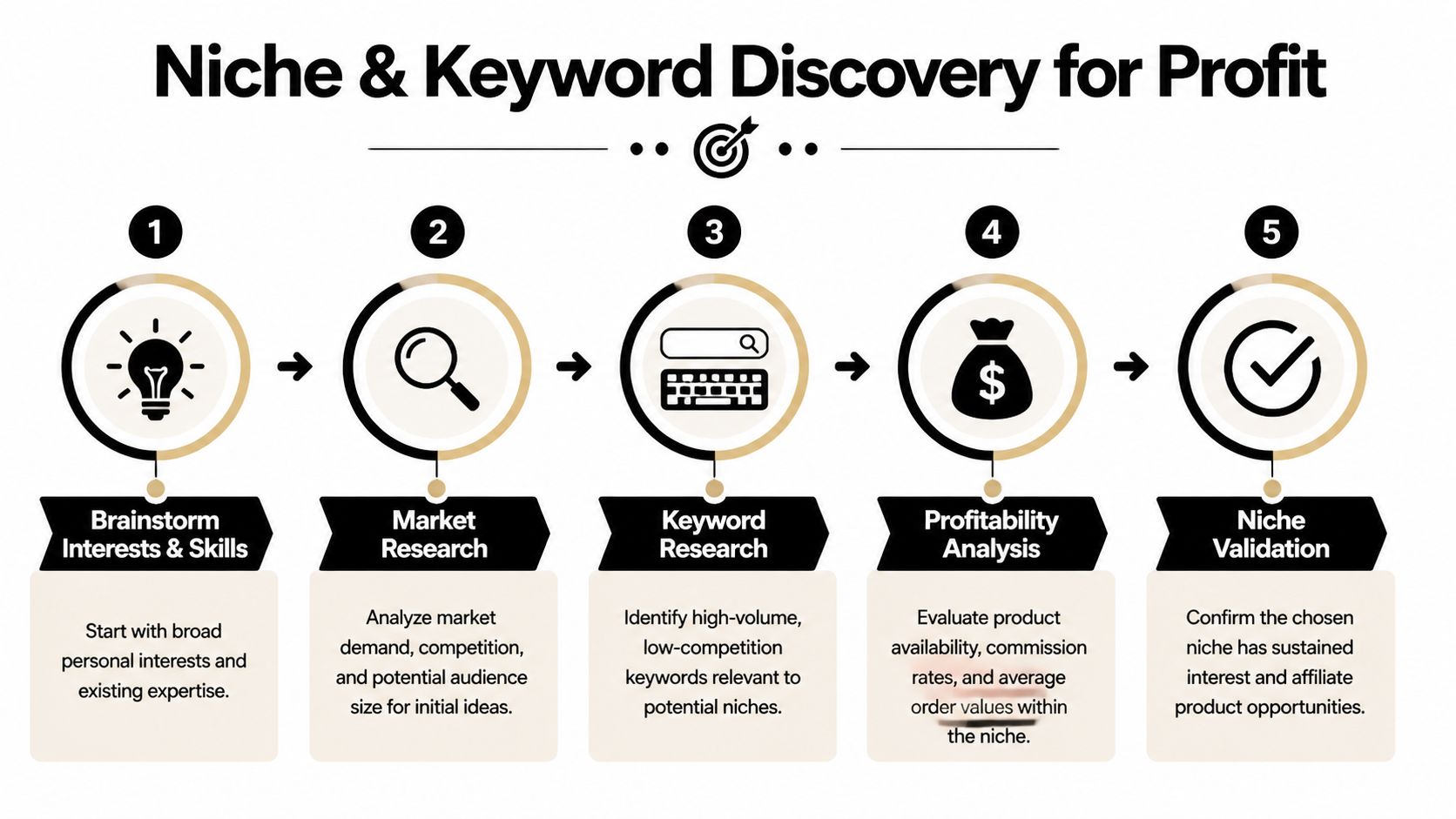
People love saying “pick your passion.” I don’t buy that as a primary filter. Passion helps you stay interested, but commercial structure matters more. You need products people already search for, enough variation to create comparison content, and a category where commissions aren’t fighting you from day one.
Start with commission logic, not just topic ideas
Amazon’s category structure tells you a lot about where monetization pressure exists. In 2025, Amazon Games pays 20%, Luxury Beauty and Amazon Explore pay 10%, and Digital Music, Handmade, and Digital Video pay 5%, based on Envision Horizons’ breakdown of Amazon affiliate commission categories.
That doesn’t mean you should blindly chase the highest commission category. It means you should compare commission rate with product depth and search behavior.
Here’s the trade-off I usually look for:
| Niche type | What works | What usually fails |
|---|---|---|
| High commission, narrow catalog | Strong if buyers are focused and repeat topics exist | Weak if you run out of article angles fast |
| Mid commission, broad catalog | Good for scaling content hubs and comparison posts | Easy to drift into generic content |
| Low commission, massive demand | Can work with volume and strong internal linking | Frustrating if traffic quality is weak |
A beauty niche can outperform a gadget niche for one site builder and flop for another. The difference is usually how well the content lines up with purchase questions.
Use keyword research to validate buying intent
I look for keywords that signal a person is close to making a decision. That includes phrases like:
- Comparison intent such as “best espresso grinder for French press”
- Problem-solving intent like “quiet air purifier for bedroom”
- Single-product validation such as “ review”
- Feature-specific intent like “waterproof trail running watch”
These are better than broad vanity topics because they reflect friction. Friction creates clicks. Someone typing “best standing desk for small apartment” is easier to help than someone typing “office setup ideas.”
For beginners, the simplest useful move is to build a spreadsheet with three columns:
- Topic cluster
- Product opportunity
- Buyer intent level
If a keyword doesn’t map clearly to a product or product category, I usually don’t treat it as a core money keyword.
For a deeper framework on narrowing site ideas, EntreResource’s guide on finding an affiliate niche is worth reviewing before you buy a domain.
Reverse-engineer competitors before you commit
A common method for “competitor research” is googling a keyword and eyeballing the results. That’s too shallow.
A stronger approach is building a list of actual Amazon affiliate websites in the niche so you can inspect titles, content angles, and positioning patterns at scale. One execution gap in the market is that few guides explain how useful structured affiliate site datasets can be for niche validation and outreach. The gap is especially obvious when you can work from 34,000+ verified Amazon affiliate domains and even access a free 3,400-site sample, as noted in this discussion of successful Amazon affiliate websites and market gaps.
Don’t pick a niche until you’ve seen what the existing affiliate sites actually look like. The SERP alone won’t tell you enough.
Once I have a niche candidate, I ask a few blunt questions:
- Can I publish at least 30 strong article angles without forcing it?
- Do products change often enough to create updates and comparisons?
- Can I write with conviction, or will everything sound paraphrased?
- Are there obvious weak competitors ranking with thin content?
If the answers are soft, I move on.
A short video walkthrough can help if you’re still trying to connect niche selection with actual site structure:
What a good niche feels like
A good niche doesn’t feel trendy. It feels expandable.
You should be able to cover buyer guides, single reviews, alternatives, maintenance questions, accessories, and common mistakes. If all you can come up with is “top 10” posts, the niche is probably too thin or your research is too shallow.
That’s the difference between a site that becomes an asset and one that stalls after ten articles.
Building Your Digital Real Estate
A lot of people get stuck here because they think they need to become a web developer first. You don’t.
Your site only needs to do a few things well in the beginning. It needs to load cleanly, look trustworthy on mobile, make content easy to publish, and give you enough control to organize your articles properly.

Pick a domain that leaves room to grow
I prefer domain names that are brandable but still suggest the niche. Not exact-match spam. Not something so broad it could mean anything.
A few practical rules help:
- Keep it pronounceable so it’s easy to remember and mention
- Avoid year-based branding because it ages badly
- Don’t lock yourself into one product unless the whole business is built around that product type
- Skip clever spelling if it creates friction
The mistake I see all the time is naming the site after one narrow keyword, then realizing six months later the site should expand into adjacent subtopics. Rebranding later is annoying and often avoidable.
Choose setup speed over technical vanity
You can build with WordPress, and plenty of experienced affiliates still do. But if your main bottleneck is getting live quickly, an AI-assisted build is a valid option.
According to Hostinger’s AI site-building methodology video, you can use Hostinger’s AI Website Builder to generate a mobile-optimized site and then use its AI Blog Generator to create 1,500 to 3,000 word SEO-optimized review articles. That same methodology says sites following the process have achieved 10% to 15% conversion rates within 6 months.
I wouldn’t treat AI-generated output as publish-ready by default. But I do think it’s useful for first drafts, structural outlines, comparison frameworks, and speeding up repetitive article formatting.
Field note: AI is great at scaffolding. It’s weak at conviction. The money comes from adding real judgment, not publishing machine-shaped filler.
Build the site like a storefront
When I set up an amazon affiliate marketing website, I want the architecture to reflect search behavior.
That usually means starting with:
| Page type | Purpose |
|---|---|
| Homepage | Clarifies the niche and directs users to core categories |
| Category pages | Group related buyer guides and reviews |
| Money pages | “Best of,” comparisons, and commercial-intent content |
| Support content | Tutorials, FAQs, and maintenance articles |
| Trust pages | About, contact, and affiliate disclosure |
This matters more than a fancy design.
A cluttered theme, too many sidebar widgets, and a homepage full of random recent posts makes a site feel amateur. Clean navigation wins. Readers should know where to click next without thinking about it.
What I’d skip on day one
New site owners waste time on cosmetic tasks because they feel productive. I’d skip most of these early:
- Complex logos that take hours to tweak
- Heavy plugins you don’t need
- Custom page builders if they slow editing down
- Advanced popups before you even have traffic
Get the domain live. Publish core pages. Make the site readable on mobile. Then start filling the shelves.
That’s real progress.
Creating Content That Actually Makes Money
Affiliate content isn’t about writing more. It’s about writing pages that match how buyers make decisions.
The two formats that consistently do the heavy lifting are the roundup post and the single product review. Everything else supports those pages.
The roundup post that earns the first clicks
Let’s say the keyword is “best coffee grinder for French press.”
A weak affiliate site writes a generic intro, lists products with copied specs, and hopes readers click. A profitable site handles that query like a buyer advisor.
The page should do three jobs fast:
- Confirm the reader is in the right place
- Segment products by use case
- Reduce uncertainty before the click
Here’s the structure I like:
- Opening summary that explains what matters for this use case
- Quick comparison table so scanners can shortlist fast
- Individual mini-reviews with pros, cons, and ideal buyer fit
- Buyer guidance for grind consistency, cleaning, noise, or size
- Simple recommendation wrap-up for different user types
The key is specificity. Don’t say a grinder is “great for coffee lovers.” Say who it’s for. Small kitchens. Daily use. Manual brewing. Budget-conscious buyers. That’s how people recognize themselves in a recommendation.
The single review that closes the gap
Single-product reviews work when someone already knows the item and needs reassurance.
A query like “ review” is a very different reader from “best X for Y.” They’re often deciding between buying now, buying an alternative, or walking away.
That means your review has to answer practical questions quickly:
- Who is this product for
- What gets annoying after repeated use
- Where does it beat cheaper options
- What kind of buyer should skip it
I’ve seen too many affiliates write reviews that are just feature summaries. Features don’t convert by themselves. Buyers want translation.
If a product has a removable water tank, say why that matters. Easier refills, easier cleaning, less mess on a crowded counter. That’s what turns specs into buying logic.
Content needs judgment, not just coverage
One of the biggest reasons blogs stop making affiliate sales is that the content sounds noncommittal. Every product is “solid.” Every option is “great.” Every review ends with “it depends.”
That kills trust.
If you want a practical breakdown of why monetized content often stalls, this EntreResource article on why your blog isn’t making affiliate sales is worth reading. It lines up with what I’ve seen repeatedly. Sites underperform when the writer avoids taking a real position.
A simple content mix that works
You don’t need dozens of post types. You need a content mix that moves readers through a decision path.
| Content type | Best use |
|---|---|
| Best-of roundup | Captures broad commercial intent |
| Single product review | Converts readers near a purchase decision |
| Versus post | Helps with shortlist comparisons |
| Problem-solving guide | Attracts readers who need a product to solve a specific issue |
| Accessory or add-on article | Increases relevance around main product clusters |
The mistake is publishing only one layer. If you only write broad “best” posts, you miss people deeper in the funnel. If you only write reviews, you miss discovery traffic.
What actually improves affiliate content
The pages that make money usually have a few shared traits:
- Strong intros that state the buying situation clearly
- Clear verdicts instead of endless hedging
- Scannable formatting with tables, bullets, and short paragraphs
- Visible affiliate links near moments of decision
- Original synthesis instead of reworded manufacturer copy
I also like adding small decision prompts inside the article. Not hype. Just useful direction. “Choose this if you need quiet operation.” “Skip this if counter space is tight.” “Worth paying more if you brew daily.”
That style feels like a real recommendation because it is one.
Optimizing for Clicks and Compliance
Launching the site is the easy part. The actual work starts when traffic shows up and you realize visitors aren’t clicking, or they’re clicking without buying, or your disclosure setup is sloppy.
That’s why I treat conversion and compliance as day-one work, not cleanup work.
Track pages like a marketer, not a hobbyist
Most beginners use one tracking ID for everything. That leaves them blind.
According to GR0’s Amazon affiliate marketing performance guide, top affiliates create 50 to 100 unique tracking IDs so they can segment performance by page and product. That gives you visibility into CTR targets of 2% to 5% and conversion rate benchmarks of 3% to 8%.
That level of segmentation matters because not all clicks are equal. A homepage widget click behaves differently from a click inside a comparison table. A single-product review may convert differently from a roundup page. If you don’t separate them, you can’t improve them.
Where more clicks usually come from
Most gains come from layout, not persuasion tricks.
Here are the placements I pay attention to first:
- Above-the-fold comparison elements so readers can act early
- Mid-article buttons placed after key buying objections are addressed
- Short verdict boxes that summarize who the product is for
- Internal links from informational articles into money pages
For a broader framework on page-level improvements, this conversion rate optimization playbook is a useful companion resource. It helps sharpen the thinking around friction, page clarity, and user flow.
Operational habit: Every money page should have a reason for each affiliate link placement. If you can’t explain why it’s there, it probably shouldn’t be there.
Compliance isn’t optional
Many affiliate site owners become careless, focusing so hard on content and clicks that they treat legal pages and disclosures like background tasks.
That’s a mistake.
The same GR0 source notes that 65% of account suspensions stem from non-compliance with disclosure rules. That’s enough to make disclosure placement and wording an essential part of your publishing checklist.
A few rules matter in practice:
| Compliance area | What to do |
|---|---|
| Affiliate disclosure | Place it where readers will actually see it |
| Amazon link handling | Use approved methods and avoid sketchy workarounds |
| Product claims | Don’t overstate what a product can do |
| Content updates | Check old money pages for outdated references |
If you need a primer on the risk side, EntreResource has a practical overview of legal issues in affiliate marketing.
Build a review routine
The fastest way to waste traffic is to publish and never inspect.
I like a simple recurring review process:
- Check which pages get clicks but weak earnings
- Look for articles with traffic but low outbound engagement
- Revise buttons, tables, and verdict language
- Confirm disclosures and affiliate link placements are still compliant
- Update product selections when market options shift
That routine sounds basic because it is basic. But basic done repeatedly beats complicated neglected systems every time.
Scaling Your Site and Avoiding Common Pitfalls
Once the site has traction, your job changes. You’re no longer just publishing articles. You’re managing an asset.
The first thing I look for is pattern recognition. Which content themes keep attracting qualified readers? Which articles pull readers into product pages? Which subtopics deserve their own mini-cluster? Your analytics answer those questions if you review them.
Scale by deepening what already works
A lot of site owners scale sideways too early. They jump into unrelated categories because they want more traffic. That usually dilutes relevance.
A better move is to expand around proven winners:
- Build adjacent buyer guides around the products already getting traction
- Add informational support content that naturally links into your money pages
- Create email capture opportunities for readers who aren’t ready to buy yet
- Test additional affiliate programs where they fit, especially if Amazon’s category payout is weak
You can also layer in tools that speed up execution. For example, EntreResource offers a Google Sheet workbook that generates Amazon affiliate URLs in bulk from lists of standard Amazon product URLs or ASINs after you paste in your Associate ID. That’s useful when you’re updating large comparison tables or migrating older content.
The mistakes that quietly sink sites
Most failed affiliate sites don’t die from one dramatic mistake. They erode.
Here’s the short list of what I see most often:
- Choosing a niche with weak commercial depth so the content runs out fast
- Publishing generic articles that never take a clear position
- Ignoring on-page UX even when the writing is decent
- Skipping regular updates on product-driven content
- Treating compliance as an afterthought
- Giving up before the site compounds
A good amazon affiliate marketing website often looks boring from the outside. Clean structure, useful content, regular updates. That’s usually the one that wins.
A practical long-term mindset
The strongest affiliate sites aren’t built on motivation. They’re built on repeatable decisions.
Pick a niche with room to expand. Build a site that feels trustworthy. Publish money pages with real judgment. Track what earns clicks and what earns commissions. Keep the business compliant. Then keep improving the winners.
That’s the playbook.
It’s not flashy, but it’s how small sites turn into durable online assets.
If you’re serious about building an amazon affiliate marketing website, start smaller than you want, write more decisively than feels comfortable, and review performance more often than you think you need to. That combination beats most of the market.