

You log in to Amazon expecting a normal day. Instead, checkout is blocked, Seller Central access is limited, or your disbursement is frozen. For a buyer, that is frustrating. For a seller, it can stop cash flow, inventory planning, and customer service in one hit.
The mistake I see over and over is speed without diagnosis. People open three support cases, resend the same files, write long emotional explanations, and still miss the actual issue. Amazon uses the same broad phrase, account on hold, for very different problems. A payment review, identity check, security flag, and seller performance action do not follow the same path.
Start by identifying what kind of hold you are dealing with before you touch support. That is the difference between a useful response and wasted time. The account message, the related email, and the area of Amazon that is blocked usually tell you whether this is a buyer hold or a seller hold, and whether the trigger is payment, verification, or enforcement. I use that decision-tree approach because it shortens the path to the right fix and cuts down on bad appeals.
That distinction matters outside Amazon too. Policy shifts and enforcement changes can hit marketplace sellers fast, which is part of why platform risk matters so much, according to Four Eyes.
One more point before you act. A hold is not one generic problem with one generic solution. Treat it like a classification problem first. Then respond with the documents, explanation, or appeal that fits the specific hold type.
That Sinking Feeling When Your Amazon Account Is on Hold
That moment feels personal, but Amazon usually isn't making a personal judgment. It's applying a control. The system sees risk, inconsistency, missing verification, or a policy issue, and it limits account access until the issue is resolved.
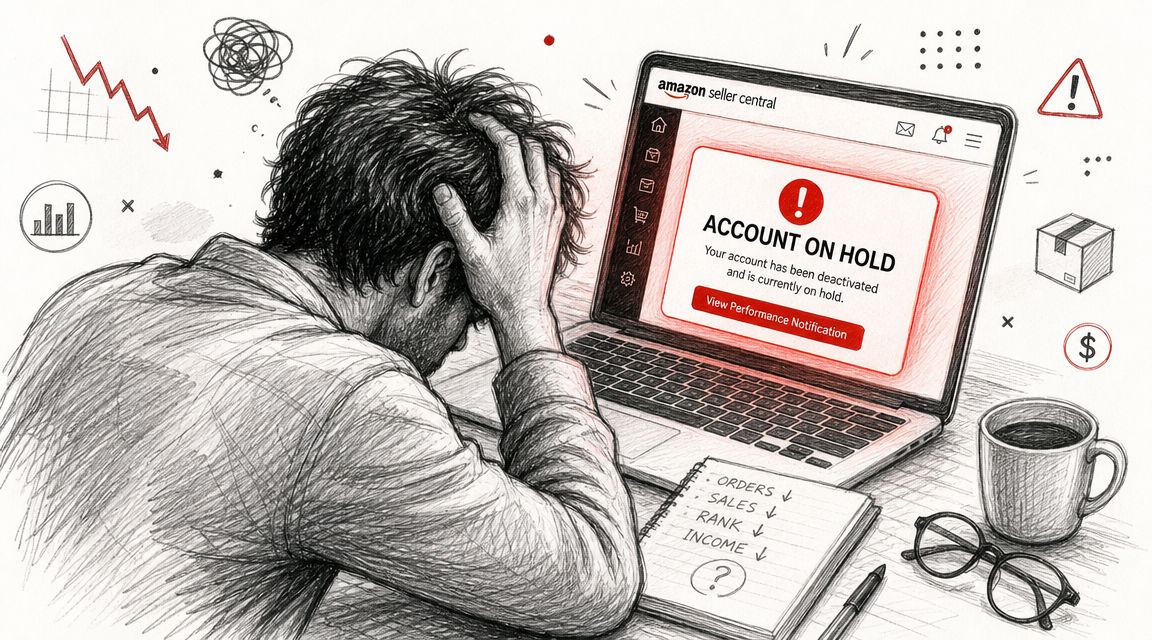
That distinction matters because it changes how you respond. If you treat an Amazon hold like a customer service annoyance, you'll usually get nowhere. If you treat it like a documentation and compliance problem, your odds improve.
Why panic creates bad appeals
The fastest way to make a messy situation worse is to act before you know what Amazon is asking for. Sellers often submit broad explanations when Amazon wanted a document. Buyers often call support when the message already pointed to a verification step. In both cases, the issue isn't effort. It's misdiagnosis.
Practical rule: Read the on-screen notice and every related email first. The exact wording usually tells you whether you're dealing with security, verification, payment, or a seller enforcement issue.
Amazon holds also vary in severity. Some accounts remain partly usable while sales or disbursements are blocked. Others lose access more completely. That's one reason hold resolution often runs through Account Health rather than general support for sellers, and why generic advice usually misses the mark.
What works better than rushing support
A calm response usually beats a fast response. Start by identifying the account type, the trigger category, and what Amazon is asking you to prove. That's the backbone of a good reinstatement process.
Use this article like a triage sheet, not a motivational speech. For those concerned about an account on hold Amazon, the core need is to distinguish between a simple hold and a serious policy event, then determine the appropriate next step.
First Step Diagnose the Type of Account Hold
Diagnosis comes before action. If you misread the hold, you usually send the wrong documents, open the wrong case, or write an appeal Amazon did not ask for.
The fastest way to get oriented is to sort the problem into the right branch first. There are two big splits that matter: buyer account versus seller account, and access problem versus compliance problem. Once those are clear, the next step usually becomes obvious.
Start with the first split
Is the hold tied to a buyer account or a seller account?
That sounds basic, but it saves time. Buyer holds usually show up during login, checkout, payment updates, or account verification. Seller holds usually show up inside Seller Central and affect selling privileges, listings, disbursements, or account health.
If the message appears in Performance Notifications, Account Health, or a disbursement banner, treat it as a seller-side issue until proven otherwise. If it appears while placing an order or signing in to a retail account, start on the buyer side.
Read the notice like a diagnosis tool
Amazon's wording is rarely random. Repeated words usually point to the category of hold.
| Account Type | Likely Trigger | Common Language in the Notice | What It Usually Means |
|---|---|---|---|
| Buyer | Payment issue | payment revision, card problem, billing address, charge failed | Amazon wants the payment method or billing details corrected |
| Buyer | Identity check | verify identity, confirm address, submit documents | Amazon needs matching personal information |
| Buyer | Security review | unusual activity, suspicious sign-in, temporary restriction | Access is limited until Amazon is satisfied the account is secure |
| Seller | Performance issue | late shipment, order defect, customer complaints, account health | Selling risk is tied to operational performance |
| Seller | Verification or KYC | business verification, identity verification, bank account, utility bill | Amazon is checking legal entity and ownership details |
| Seller | Product compliance or authenticity | inauthentic, restricted product, compliance request, safety documents | Amazon wants proof tied to the product or supply chain |
| Seller | Selling privileges removed | deactivated, suspended, removed | You are in formal enforcement and need a structured response |
This is the point where a lot of sellers lose ground. They treat every hold like a suspension. In practice, some holds are document-driven, some are payment-driven, and some are performance-driven. Those are different problems with different evidence standards.
Use a simple decision tree
Work through these questions in order:
Where did the message appear?
Buyer-facing screens usually mean payment, identity, or security. Seller Central usually means verification, performance, compliance, or disbursement controls.Can you still sign in?
If access itself is blocked, focus first on security or verification. If you can sign in but cannot sell, edit listings, or receive funds, focus on seller enforcement or reserve-related restrictions.What nouns keep repeating?
Words like verification, billing, security, performance, compliance, and inauthentic point you toward the right evidence.What is Amazon asking you to provide?
A document request means document quality matters more than a long explanation. A performance notice means Amazon expects root cause, corrective action, and prevention. An authenticity notice usually lives or dies on invoice quality and supplier legitimacy. If your invoices have been rejected before, review this guide to properly validate suppliers for Amazon before you submit anything.
That sequence sounds simple because it is. It also works. The goal here is not to solve the hold yet. The goal is to avoid solving the wrong problem.
Common diagnosis mistakes
Three mistakes show up over and over.
The first is mixing buyer-account logic with seller-account logic. Calling retail customer support about a Seller Central enforcement issue usually wastes time. The second is treating a verification hold like an appeal case. If Amazon asked for ID, bank proof, or business records, a polished narrative will not make up for mismatched documents. The third is sending a full document dump. Amazon reviewers look for specific proof that matches the notice, the account details, and the legal entity on file.
A clean diagnosis gives you a narrower task. That is what you want. Narrow problems are easier to document, easier to submit, and easier for Amazon to review.
Immediate Triage What to Do Right Now
Once you've identified the hold type, the next job is containment. The goal is simple. Stop making the case worse, collect the right proof, and protect the parts of the account that are still under your control.
Speed matters, but random action hurts. I have seen sellers lose extra days because they changed bank details, edited listings, opened duplicate cases, and sent long explanations before they understood what Amazon was reviewing.
Secure the account first
Start with account security if the notice mentions unusual activity, failed sign-ins, unknown changes, or suspicious access.
- Change your password if you still have access.
- Turn on Two-Step Verification if it isn't already active.
- Check recent account changes such as card updates, address edits, bank changes, or new users added to the account.
- Review Amazon messages instead of relying on memory. If you're a seller, this Amazon Message Center walkthrough helps you find the notices Amazon already sent.
For buyer accounts, that review may surface a payment check or identity request right away. For seller accounts, security steps usually do not clear the hold by themselves, but they reduce the risk signals Amazon is already watching.
Gather evidence before you write anything
A rushed explanation is one of the fastest ways to waste a review cycle.
Match your evidence to the hold type:
For verification holds
Government ID, business registration, utility bill, bank statement, address proof, or anything else Amazon specifically requested. The legal name, address, and entity details need to match your account exactly.For performance holds
The affected ASINs, complaint details, shipment reports, buyer messages, return reasons, and internal notes that show what happened and when.For compliance holds
Supplier invoices, authorization records, product packaging photos, safety documents, or listing edits tied to the affected products.
Keep the file tight. If Amazon asked for three documents, send the three cleanest documents that directly answer the notice. A giant folder of unrelated files makes review slower and creates more chances for mismatch.
Gather first. Explain second.
Sellers need to think about cash immediately
Seller holds become operational fast, not just administrative. Amazon can place an account-level reserve on payouts as a buffer against expected returns and claims, according to Slope's explanation of Amazon account-level reserve. Even if the account is not fully deactivated, disbursements can tighten with very little warning.
Plan around that possibility early. Pause optional spending, review upcoming inventory commitments, and avoid assuming the next payout will land on schedule. The exact reserve amount varies by account history, category risk, return patterns, and the reason for the hold, so build your short-term plan around reduced cash access rather than a best-case estimate.
The practical triage checklist
Use one pass through the account, not ten scattered fixes.
Freeze unnecessary changes
Do not edit listings, addresses, payment methods, and user permissions all at once unless the hold specifically requires one of those updates.Create a case file
Save screenshots of the hold notice, every email, submission confirmations, and every document you may need.Isolate the problem products
If the hold is tied to specific ASINs, treat those ASINs as the center of the case instead of assuming the whole catalog is involved.Protect working capital
If disbursements are restricted, cut optional spend and assume the reserve may stay in place until Amazon is satisfied that the risk has been addressed.
One more practical point. If your account is under strain and you are trying to reconcile missing reimbursements, return deductions, or inventory discrepancies, sellers sometimes use audit tools such as Refully to review inventory, returns, fees, and reimbursement cases connected to a Seller Account. That will not help with reinstatement, but it can help you get a cleaner picture of cash exposure while the hold is active.
How to Write a Winning Plan of Action for Amazon
Most seller appeals fail because they read like personal letters. Amazon doesn't need emotion. It needs a business explanation that shows three things: you understand the problem, you fixed it, and you built a process to stop it happening again.
Place this visual beside your draft as you write.
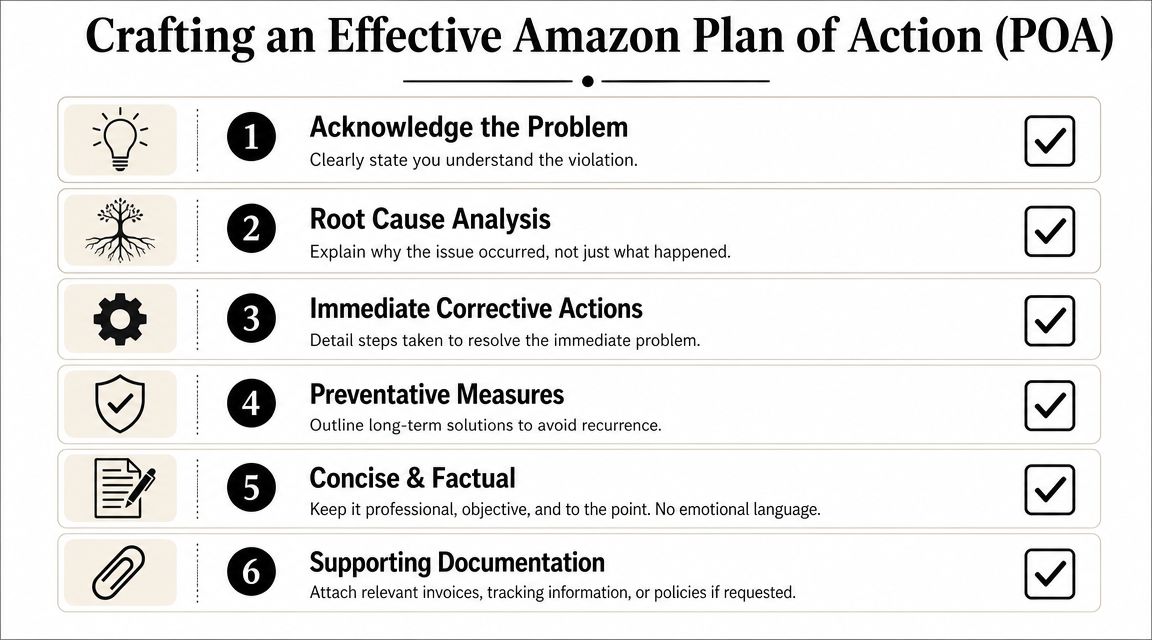
A strong workflow is a one-page Plan of Action, specific and evidence-based, with only the documents Amazon requested submitted through its secure channel. Repeated duplicate submissions can delay review, and reported review times range from roughly 24 to 48 hours to longer depending on case complexity, according to WeMarket's guide to Amazon holds and deactivations.
The structure Amazon usually responds to
Use three parts. Keep them clean.
Root cause
State exactly what went wrong and why it happened.
Bad version: "We always try our best and didn't mean to violate policy."
Better version: "We failed to verify supplier documentation for the affected ASIN before listing it, which led to an authenticity complaint."
This part matters because Amazon wants diagnosis, not denial.
Corrective actions already taken
Describe what you have already done. Not what you plan to do someday.
Examples:
- Removed the affected listing
- Stopped sales on the impacted ASIN
- Reviewed open orders tied to the issue
- Refunded buyers where appropriate
- Replaced a supplier or paused purchasing
- Corrected account information or verification records
Preventive measures
Many sellers remain too vague. "We will be more careful" doesn't help. Build actual controls.
Examples:
- Added invoice verification before listing new inventory
- Assigned one person to review compliance documents
- Required matching legal details across ID, bank, and utility records
- Implemented a pre-listing review for restricted or high-risk products
If your issue includes rights-owner complaints, these practical notes on suspected intellectual property violations can help you tighten the language and supporting material.
A simple POA template
Use something like this:
Root Cause
We identified that the issue occurred because [specific failure]. This affected [listing, order set, account area] and resulted in [complaint, hold, verification failure].Immediate Corrective Actions
We have already [action one], [action two], and [action three]. We also reviewed [relevant records or ASINs] to confirm the issue was contained.Long-Term Preventive Measures
Going forward, we will [system change], [control step], and [ongoing review process] so the issue doesn't recur.
Short, factual, and document-backed beats long and emotional almost every time.
Here's a useful video overview if you want another lens on appeal structure before submitting:
Common appeal mistakes that slow reinstatement
Some errors show up again and again:
Writing defensively
If Amazon says there was a problem, don't spend half the appeal arguing that there wasn't.Sending duplicate submissions
More tickets usually create more noise, not more clarity.Attaching everything
Unrequested files can bury the important evidence.Using generic promises
"We value customers" is not a control. "We now verify supplier invoices before listing" is a control.Ignoring the exact notice
A Plan of Action for performance won't fix a document mismatch in verification.
A good POA reads like an operator wrote it. Specific, restrained, and tied directly to the hold reason.
Navigating Review Timelines and Escalation Paths
Waiting is usually the hardest part. After submission, sellers often talk themselves into sabotaging the case. They reopen tickets, resend the same files, or rewrite the appeal before Amazon has even processed the first one.
That usually backfires.
What a normal wait looks like
Amazon review timing isn't uniform. Some holds get a quick pass because the issue is narrow and the documentation is clean. Others take much longer because the case touches performance, policy interpretation, or a backlog inside the review queue.
The key is to judge the process by the signals, not by your stress level. If Amazon has acknowledged receipt and hasn't asked for new information, silence doesn't automatically mean failure.
When to follow up
A good follow-up is controlled and useful. A bad follow-up is repetitive.
Use this standard:
- Follow up if Amazon requests clarification
Answer the specific request and only that request. - Follow up if you have new evidence
New means a corrected document, missing invoice, clarified bank record, or revised POA based on Amazon's denial reason. - Don't follow up just to ask for speed
That rarely changes anything and can clutter the case history.
If Amazon says your appeal was insufficient, treat that as feedback, not rejection theater. The missing piece is often hidden in the wording.
What denial messages usually mean
A denial doesn't always mean the entire strategy was wrong. Often it means one of three things:
- The root cause wasn't specific enough.
- The documents didn't match the story.
- The preventive measures sounded generic.
Read the response carefully. Amazon often tells you, indirectly, what it still doesn't believe.
When escalation makes sense
Escalation should be rare. It's not a shortcut for impatience.
A legitimate escalation case usually looks like this:
- You submitted through the correct channel.
- You responded to requests cleanly.
- You revised the appeal based on feedback.
- The case appears stuck, misunderstood, or trapped in a loop.
If you escalate, keep it concise, evidence-based, and respectful. Don't threaten. Don't dramatize. Don't dump your full history into a wall of text. The point of escalation is clarity, not volume.
For most sellers, the better move is still improving the original submission path. Escalation works best when the file is already strong.
Proactive Strategies to Prevent Future Account Holds
The cleanest reinstatement is the one you never need. Once you've been through an Amazon hold, you stop treating the account like a permanent asset and start treating it like a monitored operating environment.
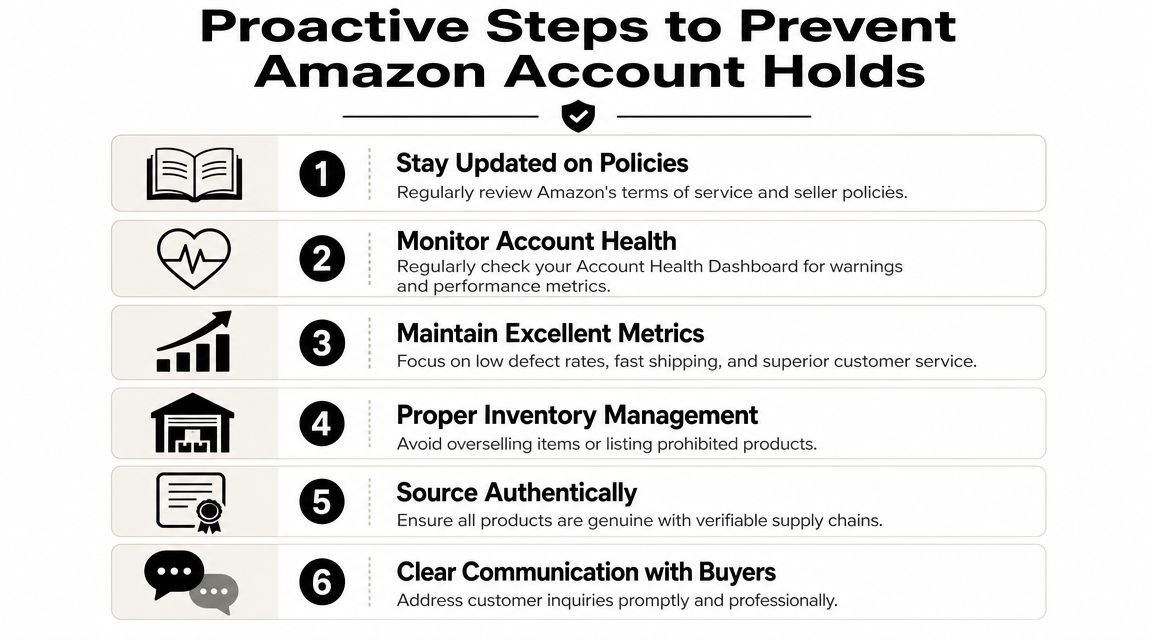
Build habits, not rescue plans
Most holds don't come from one dramatic mistake. They come from small weaknesses that pile up. A stale card. A document mismatch. A supplier shortcut. A complaint that sat too long.
The prevention playbook is boring, which is exactly why it works.
Keep identity records aligned
Your legal name, business details, address, and banking records should match across every place Amazon may check.Watch account health routinely
Sellers should review Account Health and performance notifications before problems harden into enforcement.Maintain clean sourcing records
If you sell products that could trigger authenticity or compliance review, keep invoices and supplier records organized before Amazon asks.Protect account access
Use strong credentials and keep login controls tight, especially when multiple team members touch the account.
The seller mindset that prevents repeats
Sellers who recover well usually change how they operate. They stop improvising. They document more. They tighten listings, suppliers, and review routines.
That doesn't mean becoming paranoid. It means respecting how Amazon evaluates risk. If you're looking for broader operational support around seller-side systems and compliance thinking, Mr. Green Marketing's Amazon guide is a useful outside reference.
Preventing the next hold usually comes down to one question: if Amazon challenged this part of your account today, could you prove it's clean by the end of the day?
For buyers, prevention is simpler. Keep payment methods current, avoid confusing account activity, and respond quickly when Amazon asks for verification. For sellers, prevention is a discipline. The account on hold Amazon problem becomes far less likely when your documents, supply chain, and performance controls are already in order.
If your Amazon account is on hold, don't start with panic and don't start with support. Start with diagnosis. Once you know the exact hold type, the path gets much clearer.