

You’ve probably had this happen already.
You find a product with demand. The listing looks healthy. The reviews are there. The sales rank suggests movement. You send inventory in, or you list merchant fulfilled, and then sales come in far slower than your spreadsheet said they should.
You check the listing again and notice the problem. Your offer exists, but it is buried under Other Sellers. Another seller sits next to the main purchase button and gets the easy clicks.
That gap is the whole game.
For a new seller, what is the buy box sounds like Amazon jargon. In practice, it is the main shelf in the biggest digital store on the planet. If your product offer is on that shelf, customers buy fast. If your offer is tucked in the back aisle, they usually do not bother looking for it.
Most early sellers think this is mainly a pricing problem. It is not. Price matters, but I have watched sellers lose the Buy Box with a lower price because their shipping promise was weaker, their inventory was shaky, or their account health slipped. I have also seen stronger operators hold it while charging a bit more because Amazon trusted them to deliver a smoother customer experience.
That is why the Buy Box deserves attention before almost anything else on a shared listing. Traffic matters. Listing quality matters. Reviews matter. But on a listing where multiple sellers compete, the Buy Box decides who gets the default sale.
Why Your Best-Selling Product Might Not Be Selling
A lot of sellers confuse product demand with offer visibility.
Those are not the same thing.
A product can be a proven winner on Amazon and still underperform badly for your business if Amazon is not featuring your offer. You can be selling the exact same item as the seller getting the bulk of the orders, yet your units sit because the page is effectively steering shoppers to someone else.
Think about the customer’s experience. They search, click a listing, and see a big purchase area with the seller Amazon has chosen as the default option. Most shoppers do not open extra menus, compare every merchant, or study seller names. They hit the obvious button and move on.
That creates a brutal reality for resellers and a hidden advantage for disciplined operators.
If you are not in the Buy Box, your listing can look alive from the outside while your own sales stay flat. New sellers often blame the wrong thing:
- They blame the niche: The niche may be fine.
- They blame the listing: The listing may already convert.
- They blame ads: Ads can send traffic, but traffic does not help much if another seller owns the default checkout path.
The issue is placement.
On Amazon, placement beats theory. A product that “should” sell does not pay the bills. The seller attached to the main purchase button does.
Tip: If sales on a shared listing feel strangely low, check whether you are being featured before changing ten other variables.
This is also why Buy Box problems feel so frustrating. You can do many things right and still miss the sale because Amazon rewards the seller with the strongest total offer, not just the lowest sticker price.
Decoding Amazon's Most Valuable Real Estate
The Amazon Buy Box is the prominent section on a product detail page where the default Add to Cart or Buy Now button appears. It is the main purchase area Amazon uses to feature one seller’s offer at a time. On desktop, it sits in the high-visibility purchase panel. On mobile, it becomes even more important because space is tighter and alternate sellers are less visible.
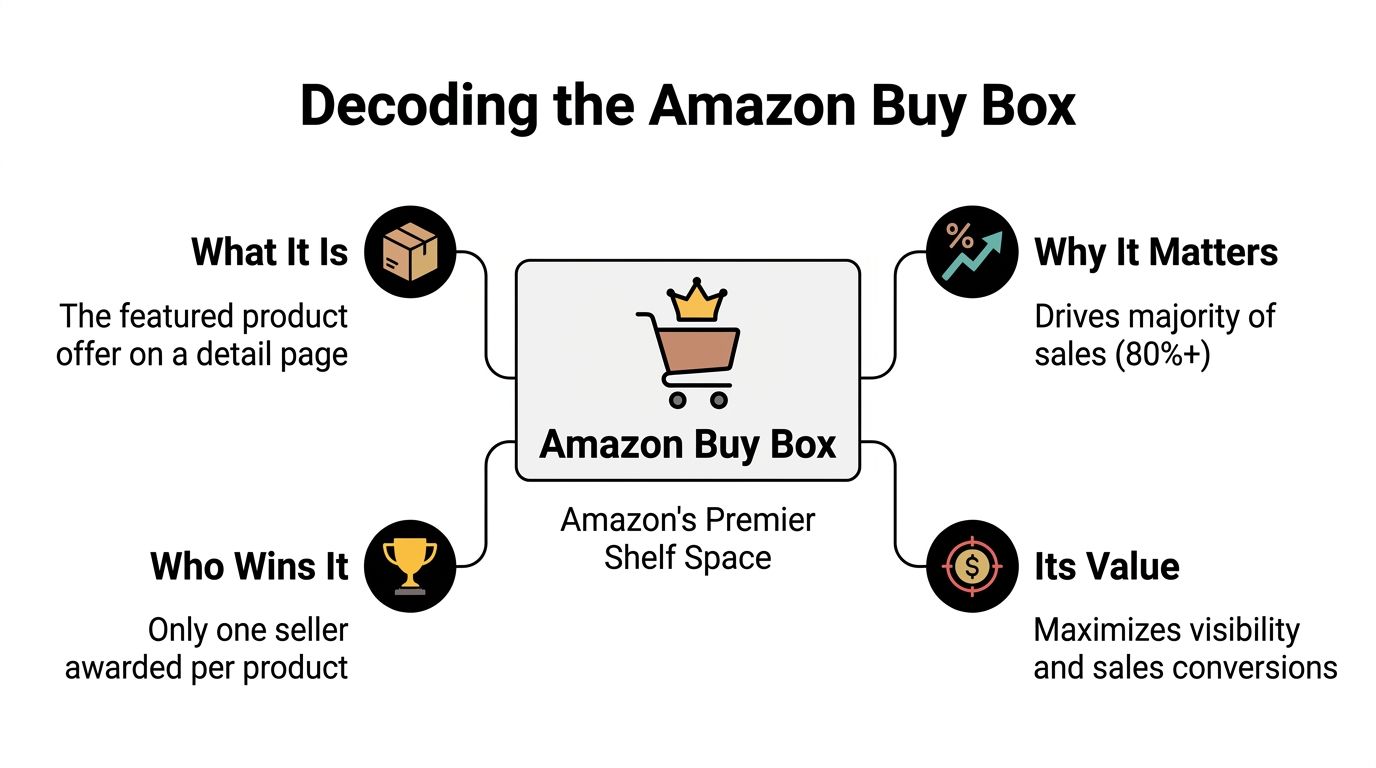
The reason sellers obsess over it is simple. Over 80% of desktop purchases and more than 90% of mobile purchases on Amazon are completed directly through the Buy Box, according to Panda Boom’s explanation of the Amazon Buy Box.
Why shoppers default to it
The Buy Box works because it reduces friction.
Amazon has trained buyers to trust the fastest path to checkout. Most customers assume the featured offer is the cleanest, safest, and fastest way to buy. They do not want to inspect every offer on a crowded listing. They want a confident default choice.
That is why I describe the Buy Box as prime shelf space with a cashier attached. It is not just visibility. It is visibility tied directly to action.
A shopper who sees your offer in that slot can buy in one quick step. A shopper who has to click into alternative offers now has work to do. Every extra click loses people.
What it shows
The Buy Box is not just a button. It presents the pieces Amazon thinks matter most to the purchase decision:
- Your displayed price: The buyer sees the offer Amazon selected.
- Shipping context: Delivery timing and shipping source affect trust.
- Purchase controls: The buyer gets the direct path to checkout.
- Seller preference signal: Amazon is telling the customer which offer it is willing to feature.
If you are selling private label and you are the only viable offer, the Buy Box often feels invisible because you tend to own it by default. The lesson becomes obvious on wholesale, online arbitrage, and replens listings where several sellers are on the same ASIN.
Why it changes your economics
The Buy Box changes more than conversion.
It affects how efficiently your inventory moves, how often your ads translate into orders, and how stable your pricing strategy can be. A seller with weak Buy Box share is often forced into reactive decisions, especially around price, because they are trying to buy back visibility they never earned.
Here is the practical takeaway:
| Position on the listing | Buyer behavior | Sales effect |
|---|---|---|
| In the Buy Box | Customer gets the default purchase path | Stronger order flow |
| In Other Sellers | Customer must take extra steps to find you | Lower conversion |
| No Buy Box on page | Customer sees buying options instead of a direct featured offer | More friction for everyone |
If you remember one thing, remember this. The Buy Box is not a cosmetic badge. It is the control point for most of the sales on a shared listing, as noted in the Panda Boom data above.
The Four Pillars of the Buy Box Algorithm
Amazon does not hand out the Buy Box randomly. The system is dynamic, but the logic is consistent. Amazon wants the offer that gives the customer the least risky purchase experience.
A useful way to think about it is four pillars: fulfillment, landed price, seller performance, and inventory availability.
Fulfillment is the muscle
Fulfillment carries serious weight because delivery speed and reliability shape the customer experience.
Key estimates place fulfillment method around 35% weight in Buy Box decisions, largely because Prime eligibility and shipping speed matter so much, according to WebFX’s analysis of the Amazon Buy Box algorithm.
That is why FBA has such an edge. Amazon controls the warehousing, shipping, and much of the service layer. From Amazon’s perspective, that lowers risk.
If you are FBM, you are not out of the game. But you need to act like an elite operator. Fast handling, reliable delivery promises, and clean tracking are not optional.
Landed price matters more than ego
Price is the pillar most sellers fixate on, and for good reason. Price competitiveness is estimated at 20% to 30% weight in Buy Box decisions in the same WebFX breakdown.
But the important phrase is landed price, not just item price.
Amazon looks at the total cost the buyer experiences. A seller with a lower listed item price can still lose if the overall offer feels worse once shipping speed and service confidence are considered, which often leads sellers to make bad decisions. They slash price manually, give away margin, and still do not win consistently.
A repricer helps because it reacts faster than a spreadsheet and does not panic. If you want a practical breakdown of approaches, this guide to Amazon repricing strategies and automated repricer software is useful for understanding when automation makes sense.
Key takeaway: A smart repricer should protect margin first and chase Buy Box share second. A race to the bottom is not a strategy.
Here is the section’s quick reality check:
| Pillar | What Amazon is evaluating | What sellers get wrong |
|---|---|---|
| Fulfillment | Speed, Prime eligibility, reliability | Assuming FBM can compete without elite operations |
| Landed price | Total buyer-facing offer | Dropping price blindly |
| Seller performance | Account health and execution | Ignoring small metric declines |
| Inventory | In-stock reliability | Letting replenishment lag |
A video walkthrough can help if you want to see these factors in action.
Seller performance is the gatekeeper
Some metrics are not soft advantages. They are pass-fail standards.
Core seller metrics like Order Defect Rate below 1% and Late Shipment Rate under 4% act as hard gates for eligibility, based on the same WebFX source above. If you drift outside the guardrails, pricing tricks will not save you.
This is why mature sellers treat customer service and shipping discipline as Buy Box work, not back-office work.
A late response, a preventable defect, or sloppy fulfillment can cost more than one order. It can weaken your ability to stay featured.
Inventory is the quiet pillar
Inventory rarely gets the same attention as price, but stockouts crush Buy Box momentum.
Amazon does not want to feature an offer that cannot support demand. If your inventory repeatedly goes thin or out of stock, Amazon has a reason to shift trust elsewhere. That trust is hard to win back quickly.
The operators who hold Buy Box share well are usually boring in the best way. They replenish on time, avoid preventable stock gaps, and do not leave fast movers exposed.
Are You Eligible The Buy Box Entry Requirements
A lot of sellers jump straight to tactics before checking whether they can even compete.
That wastes time.
Amazon first decides whether your offer is eligible for the Featured Offer. Only then do the competitive factors really matter.
The basic checklist
You need to clear the baseline before Amazon seriously considers your offer.
- Professional selling account: Only Professional Sellers are eligible to compete for the Buy Box. Individual Sellers are not.
- Healthy account metrics: Your Order Defect Rate must stay below 1% and your Late Shipment Rate must stay under 4%, according to GoAura’s guide to a good Amazon Buy Box Percentage.
- Inventory available: If your stock position is unstable, you make yourself harder to feature.
- Competitive offer: Amazon still expects your offer to make sense for the customer.
How to measure your share
Inside Seller Central, the most useful benchmark is Buy Box Percentage, also called your share of page views where you held the Featured Offer.
The same GoAura source notes that over 80% of sales come from the Buy Box, and that a “good” percentage depends on your model. 90%+ is excellent for private label, while 60% to 80% can be strong for a competitive reseller.
That distinction matters.
A private label seller should usually think in terms of dominance. A reseller should think in terms of defendable share. If you are on a crowded ASIN, you may not own the box all the time, but you still need enough share to make the SKU worth carrying.
A practical eligibility audit
If you are unsure where the leak is, run this audit once a week:
- Check account type: Make sure you are on the Professional plan.
- Review health metrics: Look for any drift before Amazon punishes it.
- Inspect in-stock status: Thin inventory often explains sudden drops.
- Watch Buy Box Percentage trends: Short-term dips matter less than repeat patterns.
- Fix operations before pricing: A broken backend makes repricing less effective.
For sellers who struggle with staying in stock, a tighter replenishment process matters as much as any pricing move. This guide to Amazon inventory management covers the operational side that often decides whether a seller can hold share once they win it.
Tip: Eligibility is not a trophy you earn once. It is a status you maintain.
The Tactical Playbook for Increasing Your Buy Box Share
The Buy Box usually moves when you improve operations, not when you refresh the listing every hour.
Most sellers need a playbook in four areas: pricing, fulfillment, inventory, and customer service. If one of those is weak, the others work harder and still may not carry the listing.
Use pricing to compete, not to panic
Manual repricing is fine when you have a handful of SKUs and low competition. It breaks down fast when the market starts moving.
What works better is a rules-based repricing setup built around floor prices, competitive bands, and clear reactions to FBA versus FBM competition. The goal is not to be the cheapest seller on every ASIN. The goal is to present an offer Amazon trusts enough to feature while keeping margin intact.
A few practical rules help:
- Set a real floor price: Protect contribution margin before you automate anything.
- Compete on the right reference point: Watch landed price, not just the listed item price.
- Treat Buy Box ownership differently: If you already hold it, do not keep cutting.
- Segment SKUs by role: A traffic SKU, a profit SKU, and a liquidation SKU should not use the same logic.
If your catalog is growing, automation is not a luxury. It is how you avoid reacting emotionally.
Lean into fulfillment advantages
FBA is usually the cleanest path because it aligns you with what Amazon already prefers: fast delivery, Prime eligibility, and standardized execution.
That does not mean FBA is always the answer for every SKU. Bulky, fragile, seasonal, or low-margin products can punish careless operators. In those cases, high-performance merchant fulfillment can still make sense if you can ship fast and consistently.
The hidden piece here is logistics discipline upstream from Amazon. Sellers spend hours on repricing and ignore inbound efficiency, carton planning, and replenishment timing. Those decisions affect whether inventory lands where and when it should. If you want a broader logistics framework, this resource on how to optimise transport choices in e-commerce is useful for thinking through shipping choices before they create stock problems.
Keep inventory boring
The best inventory system is usually the one that feels uneventful.
Buy Box share drops fast when Amazon sees instability. A SKU that goes out of stock, comes back, then runs thin again tells Amazon you are not the safest default choice. Good operators remove drama from replenishment.
That usually means:
- Forecasting from actual movement: Do not reorder off gut feel.
- Adding buffers for transit and receiving delays: A reorder that arrives “on time” can still land too late.
- Reviewing fast movers more often than slow movers: A single cadence for all SKUs creates blind spots.
- Avoiding overstock traps: Too much inventory can force desperate pricing later.
For sellers cleaning up underperforming ASINs, listing quality still matters too. Better images, cleaner copy, and stronger merchandising improve conversion once you do win the click. This guide to Amazon listing optimization is helpful for tightening the product page side of the equation.
Key takeaway: Winning the Buy Box without inventory discipline is temporary. The box often goes to the seller who can keep showing up.
Customer service still affects Buy Box share
Many sellers treat customer service as damage control. Amazon treats it as a trust signal.
If your messages are slow, your defects rise, or your post-purchase experience gets sloppy, your Buy Box position becomes more fragile. You do not need fancy scripts. You need tight execution.
Use a simple operating standard:
| Area | What good looks like | What weak execution causes |
|---|---|---|
| Messages | Fast, useful responses | Preventable complaints |
| Order handling | Clean processing and tracking | Metric erosion |
| Returns and issue handling | Clear, calm resolution | Trust loss |
| Catalog maintenance | Fewer preventable buyer surprises | Lower friction |
One tool category worth using is the all-in-one seller platform. Sellers often combine repricing, analytics, and profitability views in one place rather than jumping across disconnected tools. EntreResource covers that type of stack in its software guides, alongside niche tools like repricers and listing tools.
What usually does not work
Some habits feel productive but rarely move Buy Box share in a durable way:
- Constant manual price edits: Too slow and too emotional.
- Chasing the lowest visible price every time: This burns margin and often misses the core issue.
- Ignoring shipping promises: Fast delivery can beat a tiny price edge.
- Treating stockouts as normal: Every preventable stock gap weakens your position.
- Waiting for account health problems to become obvious: By then, the damage is already live.
If you want to dominate shared listings, think like an operator, not a bargain hunter. Amazon does not reward desperation. It rewards consistency.
Common Pitfalls and How to Avoid Them
The biggest Buy Box myth is simple: the lowest price always wins.
It does not.
A lower price can still lose if the offer comes with weaker shipping, shaky seller metrics, or unstable inventory. Sellers get trapped by this myth because price is the easiest lever to pull. It feels immediate. It also hides the underlying issue when the problem sits in fulfillment or account health.
Losing the Buy Box versus a suppressed Buy Box
These are different problems, and the fix is different too.
If you lose the Buy Box, another seller is being featured instead of you. The listing still has a default Add to Cart path. Amazon just chose someone else.
If the Buy Box is suppressed, Amazon removes that direct purchase box for everyone. Customers get pushed toward a buying options flow instead.
A suppressed Buy Box is often tied to external price conflicts. According to GoAura’s explanation of suppressed Buy Box issues, Amazon may suppress the Buy Box when the product appears cheaper on another website, and enforcement intensifies when off-Amazon prices undercut Amazon by more than 10% to 20% under its Marketplace Fair Pricing Policy.
Common mistakes sellers make
- Misdiagnosing suppression as competition: Lowering price against another Amazon seller will not solve an external parity issue.
- Running promos off Amazon without checking Amazon impact: Your Shopify, Walmart, or other marketplace pricing can create problems.
- Assuming the cheapest offer is safe: Amazon can still withhold the Buy Box if the market context looks off.
- Ignoring the “See All Buying Options” signal: That often tells you the issue is broader than one competitor beating you.
Tip: If no one has the main purchase box, stop repricing against Amazon offers first. Check whether the listing is suppressed before doing anything else.
Better diagnosis saves margin
The wrong fix costs money.
If you lower price because you think you lost the Buy Box to a competitor, but the page is suppressed due to off-Amazon pricing, you can cut margin and solve nothing. Good sellers diagnose first, then act.
Monitoring Your Performance and Advanced Tools
You cannot improve Buy Box share by checking the listing manually a few times a day.
Use Seller Central first. The most useful native measure is your Featured Offer Percentage or Buy Box Percentage by page views. That tells you whether Amazon is featuring your offer often enough to justify carrying the SKU.
What to watch inside your reports
Look for patterns, not just snapshots.
- Sustained drops on specific ASINs: Often tied to price changes, inventory issues, or stronger competitor fulfillment.
- Marketplace-wide dips: Sometimes your account health or a broad process issue is slipping.
- ASINs with strong conversion but weak share: These are often good candidates for tactical repricing or fulfillment upgrades.
Third-party tools help when you need faster reaction speed or more detail. Sellers commonly use repricers for price control, analytics suites for ASIN tracking, and broader platforms for profitability and catalog management. RepricerExpress, Helium 10, and Aura are examples of tool categories sellers look at for those jobs.
The advanced angle most guides miss
The Buy Box can vary by customer location.
That matters more than many sellers realize. A seller can be more competitive in one region than another because Amazon weighs local delivery speed and fulfillment proximity. As noted in Full-Time FBA’s discussion of Buy Box geography, the winner can differ by customer location, which challenges the idea that the cheapest offer always wins and creates openings for merchant-fulfilled sellers in specific zones.
What advanced sellers do differently
They stop treating the Buy Box as a single universal state.
Instead, they ask better questions:
- Where am I winning? Not just whether I am winning.
- Which fulfillment setup gives me regional strength?
- Are local stock positions changing my competitiveness?
- Is my repricing logic too blunt for a multi-region marketplace?
That is where tools earn their keep. Seller Central tells you the score. The right software helps you act on it faster and with more precision.
Frequently Asked Questions About the Amazon Buy Box
Why did I lose the Buy Box even though I had the lowest price
Because Amazon does not rank offers on sticker price alone.
If another seller has stronger fulfillment, cleaner account health, or better inventory stability, Amazon may still feature that offer. The lowest price is only one part of the decision.
Is it possible to win the Buy Box all the time
Yes, on some listings, especially if you control the listing or face weak competition.
On shared listings, complete control is harder. Most resellers should focus less on perfect ownership and more on stable, profitable share.
How long does it take for a new seller to become Buy Box eligible
There is no universal timeline.
A new seller needs the right account type, healthy metrics, competitive operations, and reliable inventory. Sellers who start clean and use strong fulfillment usually get there faster than sellers who try to patch weak operations later.
Does the Buy Box rotate between sellers
Yes, it can.
Amazon can rotate the Featured Offer among eligible sellers on the same listing. The rotation is not equal. Sellers with stronger offers usually get more share.
Can merchant-fulfilled sellers win the Buy Box
Yes.
They just need to overcome the natural advantage that fast, Prime-ready fulfillment tends to have. Merchant-fulfilled sellers do best when their shipping speed, tracking, and operational consistency are hard to beat.
What should I fix first if my Buy Box share is low
Start with diagnosis in this order:
- Eligibility and account health
- Inventory consistency
- Fulfillment speed
- Pricing logic
Most sellers reverse that order and cut price first. That is why they lose margin without solving the root problem.
If your sales on a shared listing feel off, do not assume demand disappeared. Check whether Amazon is giving your offer the shelf space that matters. On Amazon, the seller attached to the main button usually gets the business.