

Ever had someone visit your website, poke around a bit, and then just… leave? It happens all the time. Retargeting is your secret weapon to bring those people back.
Think of it as a second chance to make a first impression, but only with the people who have already raised their hand and shown some interest in what you're selling. It’s a game-changer for getting back lost sales and making your ad budget work a whole lot harder.
What Is Retargeting in Digital Marketing?
Imagine someone walks into your brick-and-mortar shop, picks up a cool jacket, tries it on, but decides to leave without buying. Bummer.
Retargeting is the digital version of your best salesperson catching up with them a few days later to say, "Hey, remember that awesome jacket you liked? It's still here, and it would look great on you." You're not talking to random strangers on the street; you're talking to someone who's already one step away from becoming a customer.
Instead of throwing money at ads hoping to find new people, retargeting focuses on this "warm" audience. It works using a tiny snippet of code on your site, usually called a "pixel". When someone visits, that pixel places an anonymous cookie on their browser, basically adding them to your retargeting list. Later, when they're scrolling through social media or reading a news site, your ad platform sees that cookie and shows them your ad. It's that simple.
Why Retargeting Is So Effective
The real magic of this strategy is its precision. Most business owners are shocked to learn that only 2% of website visitors convert on their very first visit, according to a study by Episerver. Even worse, a staggering 97% of first-time visitors leave and never come back, as noted in a Baymard Institute report.
Retargeting is the bridge over that gap. It gives you another shot—or several—to convince them. In fact, when people see a retargeting ad, they become 70% more likely to convert, according to research from Criteo. The performance difference compared to a standard ad campaign is night and day. You can dig into plenty of retargeting research to see just how powerful it is.
The average click-through rate (CTR) for a standard display ad is a measly 0.07%. For a retargeted ad? It's around 0.7%. That's a 10x improvement, as reported by WordStream. This focus can boost your total conversions by 30–50% and slash your cost per acquisition (CPA) by up to 42%.
Retargeting Ads vs. Standard Display Ads
To really get what retargeting is, it helps to see it side-by-side with old-school display advertising. Standard display ads are like billboards on a highway—you show them to a huge, general audience based on simple demographics, hoping someone notices. Retargeting is like a personal invitation sent directly to someone's mailbox.
Here’s a quick look at how they stack up.
Retargeting Ads vs Standard Display Ads At a Glance
This table breaks down the key differences between a retargeting campaign and a traditional display ad campaign. Notice how every aspect of retargeting is designed for one thing: getting a specific, interested person to take action.
| Attribute | Retargeting Ads | Standard Display Ads |
|---|---|---|
| Audience | Warm: People who have visited your site or engaged with your brand. | Cold: Broad audiences who likely have never heard of you. |
| Message | Specific: "Forgot something?" or shows the exact product they viewed. | General: "We sell great shoes!" Aims to build brand awareness. |
| Goal | Conversion: Driving sales, sign-ups, or leads. | Awareness: Reaching as many people as possible. |
| Performance | High CTR, high conversion rate, low CPA. | Low CTR, low conversion rate, high CPA. |
The differences are stark. Standard display has its place for building initial brand awareness, but retargeting is where you turn that awareness into actual revenue.
This behavior-based approach makes retargeting an absolute must-have for any serious digital marketer. It’s not just another buzzword; it’s a proven method for turning fleeting interest into real, measurable results.
How Retargeting Actually Works Step by Step
Ever get that weird feeling a brand is following you online? You check out a pair of shoes, click away, and suddenly, ads for those exact shoes are popping up in your social feed and on other websites for the next week.
That’s not a coincidence, and it’s definitely not magic. It's retargeting in action, and it’s all made possible by a tiny, powerful snippet of code called a retargeting pixel. Let’s break down exactly how this works.
I like to think of a pixel as a simple digital breadcrumb. When you install this little piece of code on your website, it anonymously drops a "breadcrumb" in the browser of everyone who visits. This tags them and adds them to a special audience list you can use for your ad campaigns.
Later, when that same person is scrolling through social media or reading a news article, your ad platform (think Google or Meta) recognizes that breadcrumb. This is the signal for the platform to show that person one of your ads, gently reminding them of what they were looking at on your site.
The Retargeting Journey From Visit to Ad
At its core, the retargeting process is a straightforward journey. It's designed to turn a one-time visitor who didn't buy anything into a potential customer by giving them a few more chances to connect with your brand.
Here’s a simple visual that shows how a website visitor who leaves can be brought back into the fold with a timely ad.
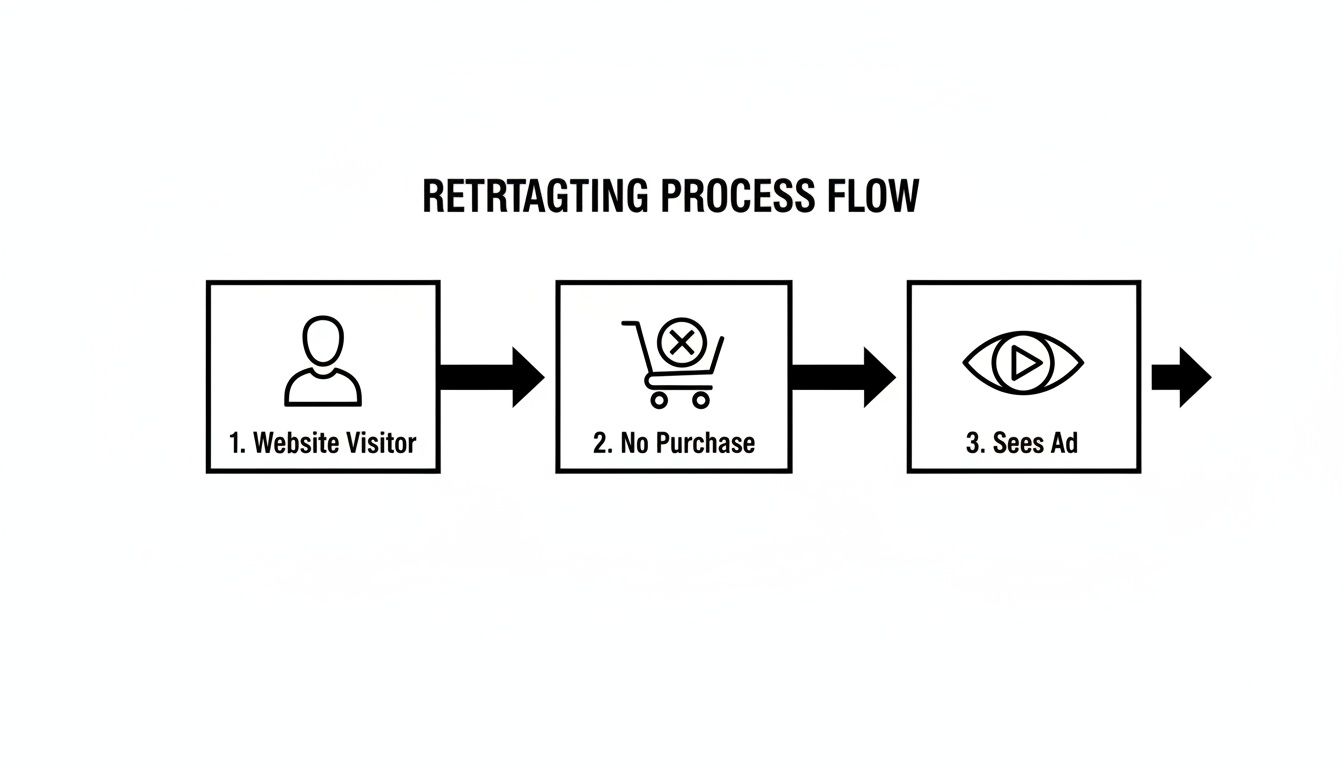
The flow is simple but incredibly effective: someone visits, they leave, and later on, they see a targeted ad. This is the fundamental loop that makes retargeting such a vital strategy for capturing sales that would have otherwise been lost for good.
At its heart, retargeting is about continuing the conversation. Instead of shouting into a void, you're speaking directly to people who have already shown interest, making your ad spend significantly more efficient.
The Role of Audience Lists and Campaigns
Once the pixel tags a visitor, they get added to an audience list. This is where the real strategy kicks in, because you’re not just building one massive list of everyone. You can, and should, create multiple lists based on what people actually did on your site.
For example, you can segment visitors into different buckets:
- People who visited your homepage but didn't click anywhere else.
- Users who viewed a specific product or category page.
- Shoppers who added an item to their cart but bailed before checking out.
- Prospects who spent more than three minutes looking at your pricing page.
With these hyper-specific lists, you can run incredibly relevant ad campaigns. The person who abandoned their cart might see an ad with a 10% discount to nudge them over the finish line. Meanwhile, the person who just read a blog post might see an ad for a related webinar. This is the kind of personalization that drives real results.
If you want to go deeper on the tech that makes this segmentation possible, check out our guide on tracking and analytics.
Behind the scenes, the ad platform is constantly scanning the websites and apps its users visit, looking for people from your audience lists. When it finds a match on a site within its ad network, your campaign is triggered, and your ad gets served—all in the blink of an eye. This whole automated process creates a seamless and persistent reminder of your brand.
Exploring Different Types of Retargeting
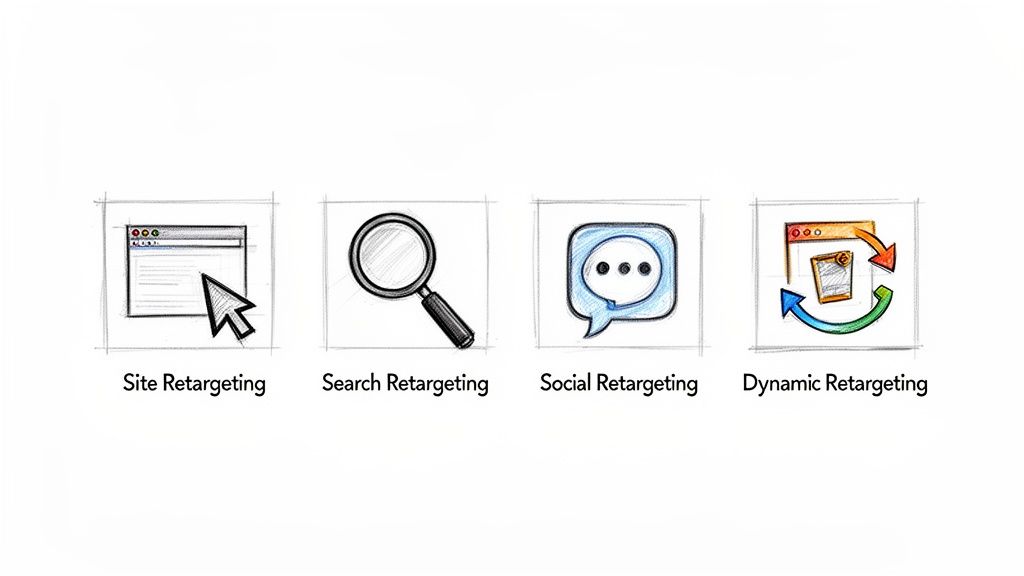
Retargeting is definitely not a one-size-fits-all game. Think about it: you wouldn't have the exact same conversation with a brand-new visitor and a loyal customer, right? Your ads need to be just as smart and adaptive.
This is where understanding the different types of retargeting becomes so important. Each flavor targets people based on different actions, letting you craft campaigns that feel less like an ad and more like a helpful reminder. When you match the right approach to the right audience, you're not just interrupting them—you're guiding them back.
Let's break down the most common and effective methods in any marketer's playbook.
Site Retargeting: Your Foundational Strategy
This is the classic, the one most people think of when they hear "retargeting." Site retargeting is all about showing ads to people who have already visited your website or even just specific pages. It’s a broad but incredibly effective way to stay on their radar.
For example, a consultant could retarget anyone who read a few blog posts with an ad for a free webinar. This keeps the conversation going with people who’ve already raised their hand and shown interest. It's the foundational layer that makes sure you don’t lose touch with a huge pool of warm prospects.
Retargeting isn't a single tactic but a playbook of strategies. The goal is to align your message with the user's last action, turning a generic reminder into a personalized and helpful nudge back toward your brand.
Search Retargeting: Capturing High Intent
Ever searched for something on Google, then felt like ads for it were following you around the internet? That’s search retargeting in action. This method lets you target users based on the keywords they’ve recently searched for, even if they've never been to your site before.
What makes this so powerful is that you're tapping directly into active intent. Someone Googling "best project management software" isn't just browsing; they're in the market for a solution. Showing them ads for your software right then and there lets you capture their attention at the absolute peak of their research. It's one of the best ways marketers reach users who are ready to buy.
Social Media Retargeting: Engaging Where People Scroll
With billions of people scrolling through platforms like Meta (Facebook and Instagram) and LinkedIn, it's prime real estate for retargeting. Social media retargeting lets you re-engage users who have interacted with your brand on those platforms or who have visited your website.
These channels are built for visual storytelling. An e-commerce brand, for instance, could run a carousel ad on Instagram showcasing the exact products a user browsed on their site. A B2B company could use LinkedIn to show a relevant case study to website visitors who work in a specific target industry. It's all about meeting them where they are.
Specialized Forms of Retargeting
Beyond the big three, a couple of specialized forms offer even more precision and can drive some seriously impressive results.
Email Retargeting: This tactic is exactly what it sounds like. You sync your email list with an ad platform and show targeted ads to specific segments. Think about reaching subscribers who haven't opened an email in 90 days, or those who clicked a link to a product but never bought. It's the perfect way to give your email campaigns an extra boost with paid ads.
Dynamic Retargeting: For any e-commerce business, this is the secret weapon. Dynamic retargeting automatically creates and shows ads featuring the exact products a user viewed, added to their cart, or almost purchased. Seeing that specific pair of shoes again is a potent, personalized reminder that does wonders for converting those abandoned carts.
Choosing the Right Retargeting Platforms
So you've wrapped your head around the different ways to retarget people. Now for the million-dollar question: where should you actually run these campaigns?
Picking the right platform is everything. Each one has its own playground, its own rules, and its own audience. Think of it like fishing. You wouldn't use the same lure to catch a trout in a river as you would a marlin in the deep sea. The platform that’s a cash cow for a visual ecommerce brand might be a total dud for a B2B software company.
Your choice will almost always boil down to two heavyweights: Google Ads and Meta Ads (which, of course, covers Facebook and Instagram). While plenty of other options exist, these two are the non-negotiable starting point for any business getting serious about its retargeting strategy.
Google Ads for High-Intent Audiences
Google Ads is your gateway to the Google Display Network (GDN), a sprawling web of millions of websites, blogs, and apps. This is where you go to find people who are practically waving their wallets at you—especially those who first found you through a search.
The magic of Google is its timing. It lets you capture people at the very moment they're actively hunting for a solution. For instance, you can get your ad back in front of someone just minutes after they visited a specific product page or searched for a keyword that screams, "I need what you're selling!"
This makes Google an absolute powerhouse for both e-commerce and lead generation. It’s all about turning those window shoppers into actual buyers with perfectly timed, highly relevant ads.
Meta Ads for Social Engagement
If Google is about capturing intent, Meta is about capturing attention. With billions of people mindlessly scrolling through Facebook and Instagram every single day, it’s simply unmatched for visual storytelling and building a genuine connection.
This is the sweet spot for any brand with a strong visual appeal—think apparel, home goods, or beauty products. Ad formats like carousels and videos let you slide your products right into a user’s feed in a way that feels native, not pushy. You can get a much deeper look into building a solid campaign in our Facebook Ad Campaign Overview.
When weighing your platform options, it's worth learning more about remarketing with Facebook to see how it can help you reconnect with users who have already shown they're interested.
For businesses that thrive on community and brand personality, Meta is often the best arena to build and nurture those audience relationships. Ultimately, it’s not a question of which platform is "better." It's about which one fits your brand, your audience's habits, and the exact action you want them to take next.
Advanced Retargeting Tactics to Boost Revenue
Alright, so you’ve got the basics of retargeting down. You’re showing ads to people who have visited your site. That's a great start, but it's really just scratching the surface.
If you want to turn retargeting into a serious revenue driver, you have to move past just reminding people you exist. The real money is in precision, timing, and telling the right story to your warmest leads at the exact right moment.
Let’s start with the most obvious goldmine: cart abandonment. A staggering 72% of shoppers will put something in their cart and then just walk away, according to the Baymard Institute. That's a massive pile of cash just sitting there. A simple retargeting ad can bring back a surprising number of them—some studies show 26% of those shoppers return just because of an ad.
When you get a bit more sophisticated and add automated emails to the mix, businesses can pull back 20–30% of that lost revenue, as cited by a study from Forrester Research. You can dig into more details on these retargeting statistics to see the full picture, but the takeaway is clear: this is a huge opportunity.
Sophisticated Audience Segmentation
This is where the magic really happens. The biggest mistake I see people make is showing the same generic ad to every single person who visited their site. Don't do this.
The power of retargeting comes from slicing and dicing your audience into hyper-specific lists based on what they actually did. This lets you craft a message that hits home because it’s incredibly relevant.
Think about creating lists based on triggers like these:
- Time on Site: Someone spent three minutes on your site but didn't buy? That’s not a casual browser; that's a highly interested prospect. They deserve a more compelling offer than someone who bounced in 10 seconds.
- Specific Pages Visited: Did someone linger on your pricing page but not sign up? Hit them with an ad that tackles a common objection, highlights a key feature they might have missed, or offers a limited-time trial.
- Video Views: A person who watched 75% of your product demo video is practically begging you to close the deal. They're invested. All they might need is a final nudge, like an ad featuring a powerful customer testimonial.
The most effective retargeting doesn't just remind—it resonates. By segmenting audiences based on their behavior, you can deliver a message that aligns perfectly with where they are in their buying journey, dramatically increasing the odds of conversion.
Sequential Retargeting for Nurturing Leads
Another killer tactic is sequential retargeting. Instead of hammering someone with the same ad over and over until they tune you out, you tell them a story. You deliver a series of different ads, in a specific order, to guide them from one stage to the next.
It's a way more sophisticated approach that builds trust and provides value before you ever ask for the sale.
Let’s say an online course creator wants to nurture leads who read a blog post. Here’s what a sequence might look like:
- Ad 1 (Days 1-3): A user reads a blog post about email marketing. The first retargeting ad they see isn't for the course—it's for a free webinar on the "Top 5 Email Marketing Mistakes." It’s a low-commitment, high-value offer.
- Ad 2 (Days 4-7): Once they've signed up for the webinar, the ad creative changes. Now they see a powerful testimonial from a former student who got incredible results after taking the full course. This builds social proof and desire.
- Ad 3 (Days 8-10): Finally, they get the direct pitch. This ad presents a clear offer for the full email marketing course, maybe sweetened with a small, time-sensitive bonus to create urgency.
See how that works? It’s a methodical process of warming people up. You're not just shouting "buy my stuff!"—you're guiding them on a journey, making the final sale feel like the next logical step.
Best Practices for Effective and Ethical Campaigns
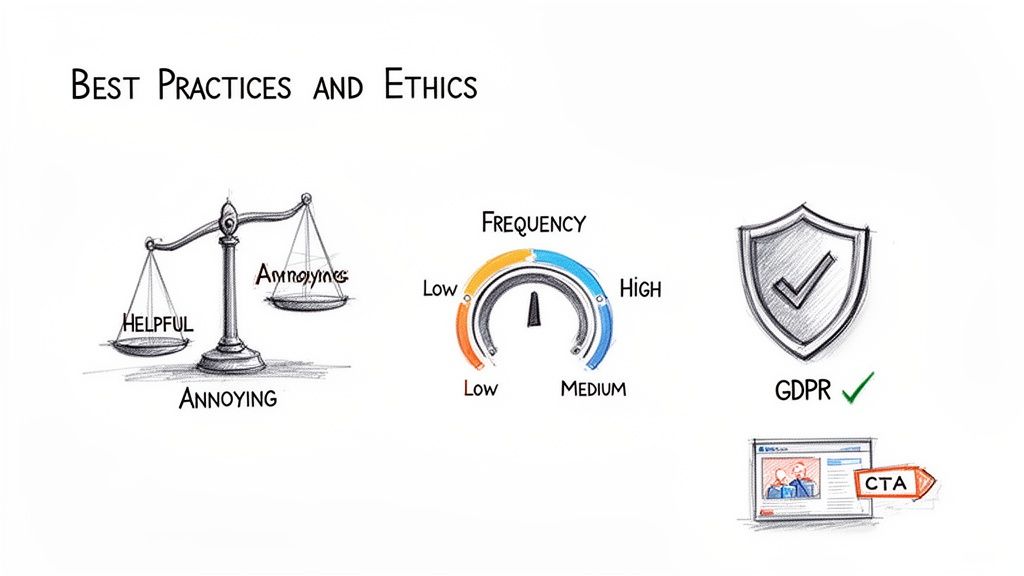
A great retargeting campaign walks a razor's edge. On one side, it’s a helpful reminder that brings people back. On the other, it’s an annoying pest that follows them across the internet.
Getting this balance right is what separates a strategy that actually drives revenue from one that just damages your brand. Truly effective—and ethical—campaigns are built on a foundation of respect for your user's attention and their privacy.
The first rule is simple: don’t be a stalker. Over-targeting is probably the most common mistake I see, and it leads directly to ad fatigue. This is where users get so sick of your ads that they start to actively ignore or even resent your brand, a phenomenon documented by research from Stanford University.
Setting a frequency cap—a hard limit on how many times one person sees your ad in a day or week—is non-negotiable. It's the key to maintaining a positive brand perception and not burning out your audience.
Designing Ads That Convert
Your ad creative has to connect directly to the user's last action. A generic, one-size-fits-all ad just won't cut it anymore. Someone who abandoned a shopping cart needs a completely different message than someone who just finished reading a blog post.
To make your ads genuinely effective, dial in these elements:
- A Clear Call-to-Action (CTA): Tell users exactly what you want them to do next. "Complete Your Order," "Download the Guide," or "Book a Demo" are direct and clear. Vague CTAs get ignored.
- Compelling Visuals and Copy: Use high-quality images or videos that actually grab attention. Your headline and text should be direct, relevant, and speak to the user's specific point of interest.
- Dynamic Creative: Whenever you can, use dynamic ads that automatically pull in the exact products a user was looking at. For e-commerce, this level of personalization is incredibly powerful.
An effective retargeting campaign doesn't just show an ad; it continues a conversation. By aligning your creative with the user's last interaction, you deliver a message that feels relevant and helpful, not intrusive.
Navigating Privacy and Compliance in 2026
The rules of digital advertising are always in motion, and the answer to "what is retargeting in digital marketing" has to evolve right along with them. By 2026, navigating privacy regulations isn't just a good idea—it's essential for survival.
Sweeping regulations like GDPR and the privacy-focused updates from tech giants are completely reshaping how we collect and use data.
This means you have to put transparency and consent front and center. Be crystal clear about your data practices in your privacy policy and use cookie banners that are actually compliant. As third-party cookies continue to be phased out, building your own first-party data lists from email subscribers and customers becomes more critical than ever.
You can learn more about this by creating segments from your own data. Adapting to this new reality now ensures your campaigns are both ethical and future-proof.
Frequently Asked Questions About Retargeting
If you're diving into the world of retargeting, you probably have some questions. I get it. It can feel a little complicated at first, but once you nail the basics, it's an incredibly powerful tool. Let's clear up some of the most common questions entrepreneurs run into.
What Is the Difference Between Retargeting and Remarketing?
People throw these two terms around like they're the same thing, and honestly, even I use them interchangeably sometimes. But there’s a small difference that’s good to know.
Retargeting is almost always about using paid ads to go after anonymous people who visited your site. Someone clicked on a product page but didn't buy? You can retarget them with an ad for that exact product on Facebook or across the web. It's all about bringing prospects back.
Remarketing, on the other hand, usually means re-engaging people you already have contact info for, typically through email. Sending a "we miss you" discount to a customer who hasn't bought in six months? That's classic remarketing. One uses paid ads for prospects, the other uses email for existing customers.
How Do I Avoid Ad Fatigue?
This is a big one. Ad fatigue is real, and it happens when people get so sick of seeing your ads that they start to tune them out or even get annoyed. The easiest way to fight this is with a frequency cap.
A frequency cap lets you limit how many times one person sees your ad in a given timeframe—say, no more than three times a day. You stay top-of-mind without becoming a nuisance.
A study from Decentriq once pointed out that over-targeting is a huge waste of ad spend and can actually hurt your brand. By putting a simple frequency cap in place, your ad feels like a helpful reminder, not a digital stalker.
Another pro tip is to switch up your ad creative every few weeks. A fresh image or a new headline can make all the difference.
Is Retargeting Still Effective With New Privacy Changes?
Yes, absolutely. But the game has changed, and you have to adapt your strategy. With third-party cookies slowly getting phased out by browsers, the old-school way of tracking users across the web is becoming less reliable.
So, what does that mean for us? It means first-party data is now king. This is the data customers give you directly—like their email address when they sign up for your newsletter.
Building your own email lists and using the native audience tools inside platforms like Google and Meta are more important than ever. The core idea of what is retargeting in digital marketing—showing relevant ads to interested people—is still incredibly effective. You just have to be smarter and more privacy-focused about how you do it.