
Let’s get one thing straight: a lead generation strategy isn't just a fancy term for "getting more traffic." It's your game plan for turning complete strangers into people who are actually interested in what you sell. It's the difference between blindly shouting into a crowd and having a real conversation with someone who wants to listen.
This is the system that ensures you’re not just getting random clicks, but attracting the right people who could become your future customers. For any entrepreneur, especially affiliate marketers or e-commerce sellers, this is what separates sustainable growth from just spinning your wheels.
Unpacking Your Lead Generation Blueprint
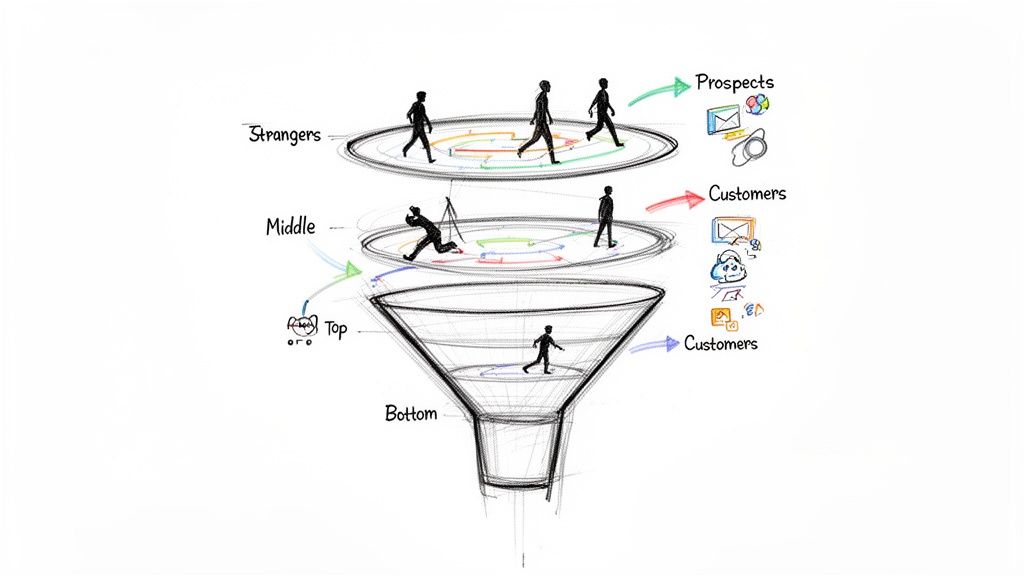
Think of your strategy as building a magnetic path directly to your front door. It’s a deliberate process. Without it, you’re just throwing random tactics at the wall and hoping something sticks.
This path is often pictured as a marketing funnel, a visual that shows how you guide someone from their first contact with your brand all the way to a potential sale. A solid strategy has a plan for every single step of that journey.
To make this crystal clear, I've broken down the key pieces of a modern strategy into a simple table. These are the pillars you need to have in place.
Core Components of a Modern Lead Generation Strategy
| Component | Description | Example for an Entrepreneur |
|---|---|---|
| Ideal Customer Profile (ICP) | A detailed definition of your perfect customer—their pain points, goals, and where they hang out online. | An e-commerce seller targeting new moms might define their ICP as women aged 28-40, active on Pinterest and Instagram, looking for organic baby products. |
| Lead Magnet | A valuable, free resource you offer in exchange for a prospect's email address. This is the hook. | An affiliate marketer could offer a free PDF guide titled "The Top 5 Tools I Use to Triple My Blog Traffic." |
| Traffic Channels | The specific platforms and methods you'll use to attract your ideal customers (e.g., SEO, social media ads, partnerships). | A SaaS founder might focus on LinkedIn content and Google Ads targeting specific job titles. |
| Nurture Sequence | An automated series of emails or communications designed to build trust and guide a lead toward making a purchase. | A course creator could send a 5-day email series sharing free tips and student success stories before pitching their main course. |
| Conversion Event | The specific action you want a lead to take, such as signing up for a trial, booking a demo, or making a purchase. | For a consultant, the conversion event might be a lead filling out a "Book a Free Consultation" form. |
Having these components is non-negotiable. They work together to create a predictable system for growth instead of leaving it all to chance.
The Stages of the Lead Generation Funnel
The funnel concept is simple: you start with a wide net and then guide the most qualified people toward becoming customers. Each stage needs a different touch.
Top of the Funnel (TOFU): Attracting Strangers
Your only job here is to get on their radar. You do this by creating helpful content that answers their questions or solves a surface-level problem. No hard selling. For an affiliate marketer, this might be a blog post like, "10 Best Vlogging Cameras for Beginners."Middle of the Funnel (MOFU): Converting Visitors
Okay, they're on your site. Now what? The goal is to get their contact info. You offer them something valuable—your lead magnet—in exchange for their email. An e-commerce store might offer a "15% Off Your First Order" coupon.Bottom of the Funnel (BOFU): Nurturing Leads
Just because you have their email doesn't mean they're ready to buy. This final stage is all about building a relationship and proving your value until they're convinced. This could be an email sequence with case studies, a special discount, or a webinar invitation.
Without a strategy that connects these stages, your efforts will feel disjointed and ineffective. Think about it: pouring tons of traffic to your site is useless if 98% of those visitors just leave forever. That’s the harsh reality for most businesses, with only about 2% of traffic converting into leads on average (Ruler Analytics, 2023).
This is why the old "spray-and-pray" approach is dead. You need an engineered system.
A lead generation strategy is the "why" behind every marketing action. It makes sure every blog post, ad, and email works together toward one single goal: turning strangers into paying customers.
Ultimately, a documented strategy turns random marketing activities into a predictable engine for growing your business. To see how all these pieces fit together in the real world, check out this fantastic playbook on how to get leads right now.
The Four Pillars of a Winning Strategy
A lot of people think lead generation is just about running a few ads or throwing a form on their website. That’s like trying to build a car by only buying the tires. A real, sustainable strategy has four key parts that all have to work together.
Think of these as the legs of a table. If one is wobbly or missing, the whole thing comes crashing down. Get all four right, and you'll build a machine that consistently brings in new leads for your business.
Pillar 1: Defining Your Ideal Customer
Before you spend a single dollar or write one line of copy, you absolutely must know who you're talking to. And I don’t just mean their age and location. A real Ideal Customer Profile (ICP) goes way deeper, into what they think, what frustrates them, and what they're trying to achieve.
You have to get answers to some critical questions:
- What problem is keeping them up at night? What's that one major headache you can solve for them?
- Where do they hang out online? Are they professionals on LinkedIn, DIYers on Pinterest, or hobbyists in a niche Facebook group?
- What kind of content do they actually pay attention to? Do they love quick-hit video tutorials, deep-dive articles, or podcasts they can listen to on their commute?
Knowing this is the difference between shouting into an empty room and having a real conversation. It means every ad you run and every piece of content you create is laser-focused on the people you actually want to serve. If your ICP is fuzzy, your marketing will be too.
A sharp customer profile is your compass. It guides every single decision in your strategy, from the offer you create to the ads you run, making sure you’re always heading in the right direction.
Pillar 2: Crafting Your Irresistible Offer
Okay, so you know who you're talking to. Now you need to give them a ridiculously good reason to give you their email address. This is your lead magnet. It’s not just some random freebie; it’s a specific, high-value piece of content they get in exchange for their contact info.
The trick is to create something that offers a quick win or a tangible solution to one of those problems you identified in Pillar 1. You want the offer to be so relevant and valuable that it’s a no-brainer for them. According to a study by GetResponse, personalizing your offers like this can dramatically increase sign-ups and engagement.
Here are a few ideas for different types of entrepreneurs:
- For an Amazon FBA seller: A simple PDF checklist like "Top 10 Profitable Product Niches for 2024."
- For an SEO blogger: An interactive tool, maybe something like a "Blog Post Title Generator."
- For an affiliate marketer: A compelling case study, like "How I Made My First $1,000 with Affiliate Marketing."
This offer is your first real value exchange. A great one instantly builds trust and shows them you know what you're talking about.
Pillar 3: Designing Your Conversion Path
You’ve got a fantastic offer. Now you need to build a smooth, easy path for people to actually get it. This is your conversion path—the step-by-step journey from seeing your ad or link to becoming a lead. If this path is clunky or confusing, people will just give up, no matter how good your lead magnet is.
This path usually has two main parts:
- A Call-to-Action (CTA): This is the button or link that gets them to your offer. It has to be impossible to miss and use clear, action-focused words (e.g., "Download Your Free Guide Now").
- A Landing Page: This is a super-focused page they land on after clicking the CTA. Its only job is to sell them on your offer and get them to fill out the form. No distractions.
Every step has to feel natural and frictionless. Any extra clicks, confusing layouts, or long forms will absolutely murder your conversion rates.
Pillar 4: Implementing Your Nurturing System
Getting the lead is a huge win, but it's not the end of the game. It’s barely the beginning. In fact, research from MarketingSherpa suggests an eye-watering 80% of new leads never turn into sales simply because they aren't nurtured properly. This final pillar is all about what you do after you get their email.
This is usually an automated email sequence designed to build a relationship. The goal isn't to hard-sell them right away. Instead, you want to provide even more value, educate them, handle their biggest objections, and keep your brand at the top of their mind. Without a solid nurture system, you're just lighting a huge pile of money on fire.
Alright, you've got the foundational concepts down. Now it’s time to get your hands dirty and actually build your lead generation strategy from the ground up.
Think of this less like a checklist and more like building an engine. Every piece needs to fit perfectly and be tuned just right for the whole machine to roar to life and start spitting out qualified leads.
I’ve broken down my own process into a five-step framework. Follow these steps, and you’ll have a repeatable system for growth that you can use over and over again.
Step 1: Set Goals You Can Actually Track
First things first. Before you write a single blog post or spend a dollar on ads, you have to know what you're aiming for. Goals like "get more leads" are completely useless. They don't give you any real direction.
You need to get specific. We're talking Specific, Measurable, Achievable, Relevant, and Time-bound (SMART) goals. These are your North Star. They keep you honest and ensure every decision you make has a purpose.
For example, here are some goals that actually mean something:
- Generate 150 Marketing Qualified Leads (MQLs) per month by the end of next quarter.
- Keep our average Cost Per Lead (CPL) under $25.
- Hit a 5% lead-to-customer conversion rate from our email welcome sequence.
When you have targets this precise, you know immediately if your strategy is working or if you're just burning cash. Without them, you’re flying blind.
Step 2: Pick Your Battleground (Your Core Channels)
Next up, you have to decide where you’re going to find these leads. The biggest mistake I see entrepreneurs make is trying to be everywhere at once. It’s a recipe for burnout and mediocre results.
Instead, pick just one or two channels where your ideal customers are already hanging out. Go back to that customer profile you built. Where do they spend their time?
- Selling to other businesses? LinkedIn is probably your best bet.
- Got a visually appealing product? Instagram or Pinterest could be goldmines.
- Solving complex problems for people actively searching for answers? Dominating Google with great content and SEO is a powerhouse move.
Choosing the right channels is everything. It’s how you make sure your message actually gets in front of the right people. As you start building, it's worth exploring different approaches. For a good look at some proven tactics, check out this guide on the Top 10 Golden Tactics To Secure Quality Leads.
Step 3: Create Your Bait (Lead Magnet) and Trap (Landing Page)
Now it’s time to build the actual mechanics of your conversion path. This all starts with an offer so good your ideal customer can't say no—your lead magnet. This isn't a 50-page ebook. It needs to be a free resource that gives a quick, powerful win for a problem they're facing right now. To get some ideas, check out our guide on creating lead magnets that convert.
Once you have your irresistible offer, you need a dedicated landing page. This is a simple web page with one job and one job only: to convince people to trade their email address for your lead magnet. A great landing page is clean, focused, and has a big, obvious button telling people what to do next.
This diagram breaks down how all the pieces of your strategy need to work together. It’s not just about one tactic; it’s a connected system.
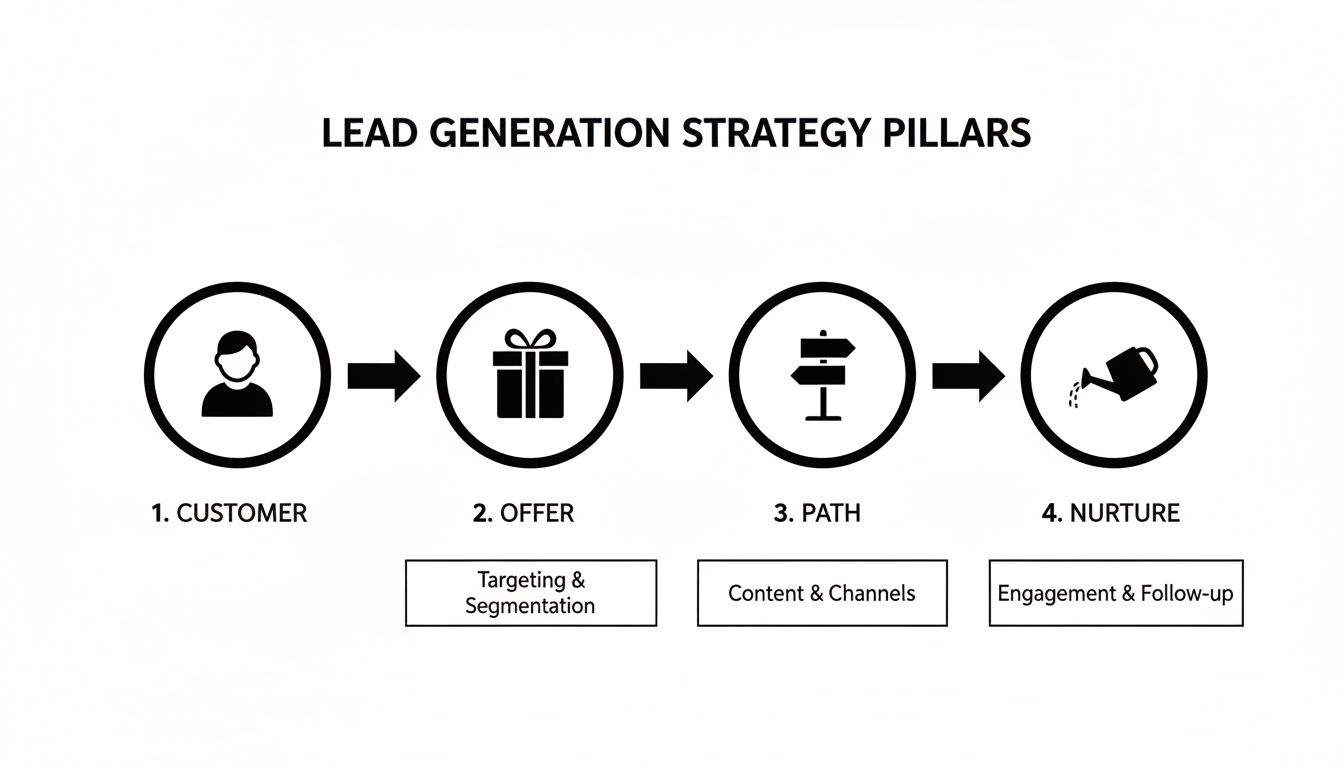
You can see how it flows from understanding the customer to making a great offer, creating a clear path, and then nurturing that new relationship. It's a full-funnel approach.
Step 4: Turn on the Faucet (Drive Targeted Traffic)
Your engine is built. Now it’s time to add the fuel. You need to start actively sending people from your chosen channels straight to your landing page. But this isn't a numbers game—it's not about getting thousands of random clicks. It's about getting the right clicks from people who are genuinely a good fit for what you offer.
Your tactics here will connect directly back to the channels you chose in Step 2.
- For SEO: You’ll be writing blog posts that answer questions your audience is typing into Google.
- For Paid Ads: You’ll craft sharp ad copy and eye-catching images for platforms like Facebook or Google, targeting your ideal customer's pain points.
- For Social Media: You might share your lead magnet in relevant online communities or promote it directly to your followers.
The real key here is consistency. Your message should feel the same on the social media post, in the ad, and on the landing page. It creates a smooth, trustworthy experience for the user.
Step 5: Tweak the Dials (Analyze and Optimize)
Listen, a lead generation strategy isn't a crockpot. You can’t just set it and forget it. The final—and most important—step is to constantly watch your numbers, figure out what's working, and relentlessly optimize for better results.
Always be looking at your key metrics. Is your Cost Per Lead creeping up? Maybe your ad targeting is getting stale. Is your landing page not converting? It might be time to test a new headline.
This cycle of measuring, analyzing, and tweaking is what separates the pros from the amateurs. It’s how you stop wasting money, improve your results, and build a lead generation machine that gets stronger and more efficient over time.
Choosing the Right Lead Generation Channels
Alright, you've got your strategy framework in place. Now for the million-dollar question: where are you actually going to find these leads? This is a critical decision. Picking the wrong marketing channels is like trying to fish in a bone-dry pond—it’s a ton of work for absolutely nothing.
Your success boils down to picking the battlegrounds where your ideal customers already hang out.
Think of your business like a specific type of vehicle. A high-performance race car belongs on a smooth track (like paid ads for quick results), while a rugged off-road truck thrives on tough terrain (like SEO and content for long-term growth). You have to match your vehicle to the right road.
Understanding Your Channel Options
The sheer number of marketing channels can feel paralyzing. To make it simple, I like to group them into four main categories. Each has its own strengths and is a better fit for different situations. Getting a handle on these is the first step to a smarter, more focused plan.
- Organic Channels: These methods attract leads naturally over time, usually by creating content people genuinely want to find.
- Paid Channels: This is where you pay for eyeballs, getting your message in front of a targeted audience fast.
- Relationship-Driven Channels: This is all about working with others in your space through collaborations and partnerships.
- Direct Channels: These are proactive, one-to-one outreach methods where you're the one starting the conversation.
Let’s break down what each of these looks like in the real world and who they're best for. This will help you figure out the perfect mix for your own business goals.
Organic Channels: The Long-Game Powerhouse
Organic channels like Search Engine Optimization (SEO) and content marketing are the foundation of any lead generation strategy that's built to last. The idea is to create high-quality, genuinely helpful content that earns attention over time. It’s a serious long-term investment, but it builds a powerful, self-sustaining asset for your business.
This approach is perfect for bloggers, affiliate marketers, and consultants who can use their expertise to answer their audience's burning questions. For example, a blogger can write super-detailed "how-to" articles that rank on Google, bringing in a steady flow of qualified visitors for months, or even years, to come.
Organic channels are like planting an orchard. It takes time and consistent work to get it going, but once it matures, you get a reliable and massive harvest of leads with very little ongoing cost.
Paid Channels: Speed and Scalability
When you need leads yesterday, paid channels are your best friend. Platforms like Google Ads (PPC) and social media ads on Facebook, Instagram, or LinkedIn let you put your offer right in front of a hyper-targeted audience, almost instantly. For many businesses, targeted ads are the primary engine driving their lead generation.
An e-commerce store launching a new product, for instance, can use Facebook ads to reach potential buyers in just a few hours. A really powerful move is using retargeting ads to show special offers to people who visited your site but didn't buy. According to Mailchimp, it's an effective way to bring back those lost opportunities and can significantly lift conversion rates.
The catch? The moment you stop paying, the leads dry up.
Lead Generation Channel Comparison for Entrepreneurs
Picking the right channel can feel like a high-stakes decision, especially when you're just starting out. This table is designed to give you a quick, at-a-glance comparison to see which channels might be the best fit for your budget, timeline, and business model.
| Channel | Best For | Typical Cost | Time to Results |
|---|---|---|---|
| Organic (SEO, Content) | Long-term asset building, establishing authority, high-trust leads. | Low-to-High (content creation, tools) | Slow (6-12+ months) |
| Paid (PPC, Social Ads) | Rapid results, scalability, testing offers, targeted campaigns. | Medium-to-High (ad spend, management) | Fast (Days to weeks) |
| Direct (Cold Email) | High-value B2B clients, targeted account-based marketing. | Low-to-Medium (tools, list building) | Medium (Weeks to months) |
| Partnerships (Affiliates) | Leveraging existing audiences, building credibility through trust. | Low-to-Medium (commissions, setup) | Medium (Weeks to months) |
While this table gives you a great starting point, remember that the most powerful strategies often combine multiple channels. You might use paid ads to get initial traction while your long-term organic strategy builds momentum in the background.
Relationship-Driven Channels: Building on Trust
Sometimes the smartest way to find new customers is through people who already have their trust. This is where affiliate marketing and strategic partnerships come in. You team up with other businesses or influencers who promote your product or service to their own audience.
This works incredibly well for SaaS companies and course creators. Just imagine partnering with a popular YouTuber in your niche who does a review of your software. Their endorsement acts as powerful social proof, sending high-quality leads your way who are already warmed up and ready to listen.
Direct Channels: Proactive and Personal
Last but not least, direct channels are all about you proactively reaching out. This covers tactics like cold email outreach and sending direct messages on platforms like LinkedIn. Unlike inbound methods where you wait for leads to come to you, here you're making the first move.
This is a go-to strategy for B2B service providers and consultants hunting for high-value clients. A single, well-written, and personalized email can slice through the noise and kickstart a valuable conversation. For anyone looking to get started with this, it's absolutely crucial to learn how to build a quality lead list for cold emailing to make sure your efforts actually pay off.
Using AI and Automation to Scale Your Efforts
As an entrepreneur, your time is your single most valuable asset. A solid lead generation strategy is great, but actually executing it day in and day out can feel like a full-time job in itself. This is where technology becomes your secret weapon, acting as a force multiplier to get more done with less of you.
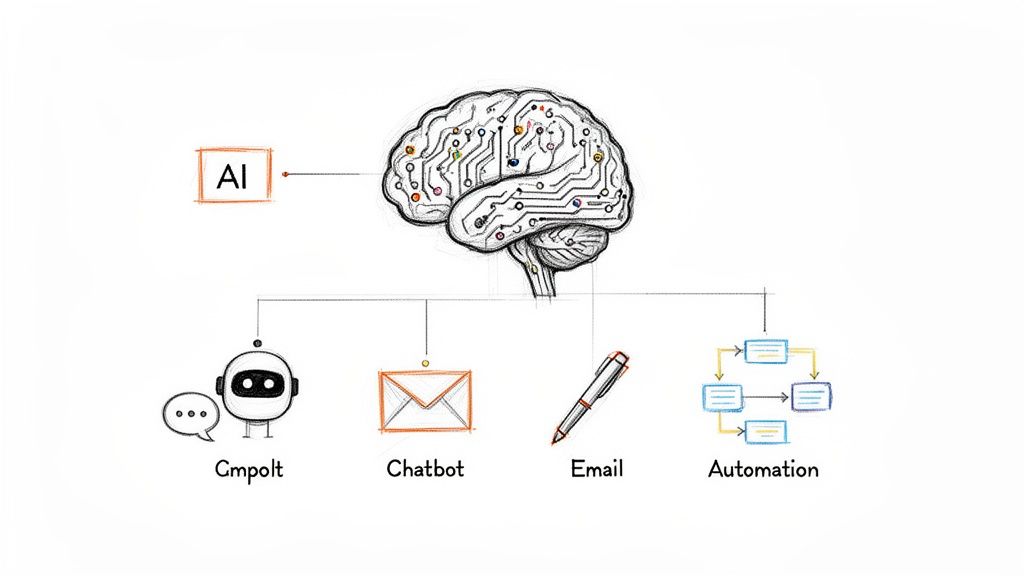
Think of Artificial Intelligence (AI) and automation as your tireless virtual team. They’re built to handle the repetitive, time-sucking tasks that are crucial for lead gen but drain your creative energy—freeing you up to focus on the things that actually move the needle, like building relationships and closing sales.
And let's be clear: this tech isn't just a luxury for big corporations anymore. For solo operators and small teams, it's become essential just to stay competitive and see any real growth.
How AI and Automation Supercharge Your Strategy
At its core, automation simply puts your manual processes on autopilot. AI then adds a layer of intelligence on top, letting these systems make smart decisions, personalize conversations, and even predict which leads are most likely to convert.
Here’s how they can work together to give your strategy a serious boost:
24/7 Lead Qualification: An AI-powered chatbot on your website can engage visitors around the clock. It can answer common questions, qualify leads based on their answers, and even book meetings on your calendar—all while you’re asleep.
Personalized Nurturing at Scale: Marketing automation lets you send super-relevant email sequences based on a lead’s behavior. Someone who downloaded your SEO guide gets completely different content than someone who just checked out your pricing page. This is personalization without the manual effort.
Efficient Content Creation: AI writing assistants can be a lifesaver for overcoming writer's block and scaling up your content. They can generate outlines, draft blog posts, and whip up social media updates, slashing your content creation time.
This isn't just about saving a few hours here and there; it’s about making your entire process more effective. By automating things like lead scoring and nurturing, these tools help turn lukewarm prospects into real revenue. The numbers don't lie.
The impact of AI on lead generation has been massive. Businesses using these tools report a 50% increase in sales-ready leads and 60% drops in acquisition costs. Marketing automation alone can increase qualified leads by an astounding 451%. You can learn more about these powerful findings on Martal.ca.
Practical Tools You Can Implement Today
Getting started with AI and automation doesn't have to be complicated or break the bank. Plenty of tools are designed specifically for entrepreneurs and offer free or low-cost plans to get you up and running.
Marketing and Email Automation: Platforms like Mailchimp or ConvertKit are fantastic for building automated email sequences. These tools are the backbone of any real nurturing system. For a deeper dive, check out our complete guide on email automation.
AI Chatbots: Tools like Tidio or Drift can be added to your website in minutes to start qualifying leads right away. They usually come with pre-built templates that make setup a breeze.
AI Content Assistants: Tools like Jasper or Copy.ai can help you write faster and more effectively, from ad copy to full-length articles.
By adding these tools to your lead generation strategy, you’re not just automating tasks—you’re building a more efficient, scalable, and intelligent business engine. You're giving yourself the leverage you need to compete and win.
Measuring the Metrics That Actually Matter
So you've built your strategy, picked your channels, and maybe even started using some cool tech to scale things up. But how do you know if any of it is actually working? Without clear measurement, your entire lead generation plan is just a shot in the dark.
It’s an old saying, but it’s true: if you can't measure it, you can't improve it. This means we have to look past the vanity metrics, like social media "likes" or "followers," and zero in on the numbers that directly impact your business's health. These are the key performance indicators (KPIs) that tell you if you’re building a real growth engine or just burning cash.
Key Metrics for a Healthy Strategy
To get a real sense of what’s driving growth, you need to track a few core metrics. These numbers cut through the noise and show you the true performance of your efforts, letting you make decisions based on data, not gut feelings.
- Cost Per Lead (CPL): This is your total campaign cost divided by the number of leads you generated. It tells you exactly what you’re paying to get one new person interested in what you offer.
- Lead-to-Customer Conversion Rate: This metric shows you what percentage of those leads actually pull out their credit cards and become paying customers. A low rate here could mean your sales process is broken or you're attracting the wrong kind of leads.
- Customer Lifetime Value (CLV): This is the total profit you can realistically expect from a single customer over their entire relationship with you. Knowing your CLV is a game-changer because it tells you how much you can actually afford to spend to get a new lead in the door.
By keeping an eye on these KPIs in a tool like Google Analytics 4, you get a crystal-clear picture of your return on investment. For instance, if you see a sky-high CPL from one channel, it’s a no-brainer to shift that budget over to one that’s actually making you money.
From MQLs to SQLs
Here’s something you learn quickly: not all leads are created equal. Understanding the difference between a Marketing Qualified Lead (MQL) and a Sales Qualified Lead (SQL) is absolutely critical for getting your marketing and sales teams on the same page.
An MQL is someone who has shown interest by engaging with your marketing, like downloading a guide. An SQL is a lead who’s been vetted and is ready for a direct sales conversation, maybe because they fit your ideal customer profile or requested a demo.
Making this distinction helps your sales team stop wasting time and focus their energy on the hottest opportunities. It’s a simple change that can dramatically boost their efficiency and, more importantly, their close rate.
Understanding Attribution Models
Last but not least, how do you figure out which channel gets the credit when a new lead comes in? That’s where attribution models come into play. Think of them as the rulebook for assigning value to the different touchpoints a customer interacts with on their journey.
Two of the most common models are:
- First-Touch Attribution: This model gives 100% of the credit to the very first channel a lead ever interacted with. It’s fantastic for understanding what initially brings people into your world.
- Last-Touch Attribution: This gives all the credit to the final touchpoint right before a lead converted. This tells you what’s most effective at closing the deal.
By analyzing both, you start to see which channels are best for building awareness versus which ones are your closers. This insight allows you to fine-tune your entire strategy and make every dollar you spend work harder.
Your Top Lead Generation Questions, Answered
Even with a killer plan, you're bound to have questions when you start rolling out a new lead generation strategy. It happens. Here are some quick, no-fluff answers to the questions I see pop up most often from entrepreneurs.
How Much Should I Budget for a Lead Generation Strategy?
There’s no magic number here. Your budget is going to hinge entirely on the channels you pick and what you're trying to achieve.
A strategy built around content and SEO might have low upfront cash costs, but it will eat up a significant amount of your time. On the flip side, paid channels like Google or Facebook Ads demand direct ad spend.
If you’re going the paid route, a typical starting point just to get enough data to know what's working is $500-$1000 per month. A solid rule of thumb for many businesses is to set aside 10-20% of your target revenue for marketing (Gartner, 2023). From there, you can tweak that number based on your actual Cost Per Lead (CPL) and conversion rates.
What Is the Difference Between Inbound and Outbound Lead Generation?
Getting this right is fundamental. It’s the core of building any real strategy.
I like to think of it this way:
- Inbound lead generation is like a magnet. You create valuable content and experiences that people are already searching for—think blog posts, YouTube videos, or getting your site ranked in Google. The leads come to you because you’re genuinely helping them.
- Outbound lead generation is like a megaphone. You're proactively shouting to reach potential customers who probably don't know you exist yet. This is your cold emailing, direct mail, or hitting up trade shows. You’re the one starting the conversation.
Most smart strategies today mix both. But for most online entrepreneurs, building a strong inbound foundation is way more scalable and cost-effective in the long run. It becomes a real, sustainable asset for your business.
How Long Does It Take to See Results From Lead Generation?
Your timeline for seeing results can vary wildly depending on your channels. Setting realistic expectations from day one is critical so you don't get discouraged and quit too early.
With paid advertising on platforms like Google or Facebook, you can start seeing leads roll in within hours or days of launching a campaign. You get immediate feedback and quick data.
On the other hand, organic strategies like content marketing and SEO are the long game. It often takes a solid 6-12 months of consistent work before you see a significant, predictable flow of leads. It just takes time for your content to build authority and start ranking in search engines.
A powerful approach is to use a mix of short-term and long-term tactics. Paid ads can bring in leads and revenue now, which can help fund the slower, asset-building work of your organic strategy.
How Do I Know if a Lead Is High Quality?
A high-quality lead isn't just a random email address. They are a perfect match for your Ideal Customer Profile (ICP). We often call them a Marketing Qualified Lead (MQL) or Sales Qualified Lead (SQL).
You can spot a high-quality lead by looking for a few key signals:
- They have the exact problem your product or service is built to solve.
- They fit your key demographics (like industry, company size, or job title).
- They show real interest through their actions—like downloading a detailed guide instead of just a simple checklist.
A great way to separate the hot prospects from the tire-kickers automatically is to use lead scoring, which is just a system that assigns points to leads based on who they are and what they do. Putting clear qualifying questions on your forms also filters for quality right from the start.
By focusing on quality, you make sure your sales team (even if it's just you) spends its time on the people most likely to become happy, paying customers.