
Private label dropshipping means selling products under your own brand while a manufacturer or supplier makes the item to your specifications and ships it straight to your customer. You never touch inventory. You do own the brand, the listing and the customer relationship. The tradeoff is a bigger upfront investment and slower launch than standard dropshipping.
Below we cover how the order flow works, how private label differs from white label, what the economics look like, and a step-by-step way to launch without betting the whole budget on an untested product.
TL;DR
- Private label dropshipping = your brand and your specifications, made and shipped by a supplier, with no warehouse on your side.
- White label puts your logo on a generic product that other sellers can sell too. Private label is meant to be exclusive to you.
- Expect higher upfront costs and longer production timelines than standard dropshipping, in exchange for brand control and better margins.
- Validate demand first, test samples, and price at a markup that covers advertising and platform fees.
- Selling under your own name can make you legally responsible as the manufacturer in some markets, so check compliance before you launch.
Table of Contents
- What private label dropshipping actually is
- How an order moves from checkout to doorstep
- Private label vs white label dropshipping
- Private label dropshipping vs standard dropshipping
- How to start, step by step
- What it costs and what you can earn
- Shipping, returns and legal basics
- Perspective: where we would start
- Want a faster route through the basics?
- FAQ
- Sources
What private label dropshipping actually is
In Shopify’s guide to the model, private label dropshipping is selling third-party products with your own branding or designs directly to customers. A manufacturer creates a product for you according to your specifications or design, then ships orders directly to your buyers.
Think of it as a hybrid. From standard dropshipping you keep the no-inventory, ship-on-demand structure. From traditional private labeling you take the custom product and the brand. A retailer that sells under its own name is called a private-label retailer, and it may source goods from outside suppliers that make them to its specifications, including ingredients, format, size and packaging, as a European retail industry briefing describes it.
That definition is the same whether you sell a supplement, a pet product or a phone case. What changes is how much you can customize, which depends on the supplier and on your order volume.
How an order moves from checkout to doorstep
The mechanics are simple once you see them in order. Shopify’s help documentation lays out the basic dropshipping chain: the retailer places the order with the wholesaler, who fulfills and ships it to the customer. Private label adds one thing: the item that arrives carries your branding.
Here is the typical sequence:
- A customer buys from your store and pays you the retail price.
- Your store sends the order details to your supplier, either manually or through automation.
- The supplier pulls or produces the branded item, packs it in your packaging and ships it to the customer.
- You pay the supplier your wholesale price and keep the difference after fees and ad spend.
- You handle customer service, and the supplier handles the physical goods.
If you work with more than one supplier, routing gets harder. Sellers can automate order routing with apps like Duoplane or with built-in store settings so each order lands with the right supplier. Once you outgrow off-the-shelf apps, custom e-commerce development is one way stores connect their checkout, supplier systems and order tracking into one workflow.
One detail from a 2024 explainer on product customization: the supplier ships the customized product directly to the customer, rather than the retailer handling fulfillment. That is the whole point. Your time goes into brand, marketing and customers, not packing boxes.
Private label vs white label dropshipping
These two terms get mixed up constantly, and the difference matters for how defensible your business is.
White label dropshipping involves a supplier putting your brand and logo on a generic product before shipping it. Unlike private labeling, white-label products may be sold by multiple retailers under different brand names. Another explainer describes white label as a ready-made product whose core design or function is unchanged, while private labeling gives the seller more control over specifications and aims at an exclusive product.
| White label | Private label | |
|---|---|---|
| Product | Ready-made, generic | Made to your specs or design |
| Exclusivity | Other sellers can sell the same item | Meant to be yours alone |
| Customization | Logo and packaging | Ingredients, materials, size, format, packaging |
| Speed to market | Faster | Slower |
| Upfront cost | Lower | Higher |
| Competition risk | Easy to copy | Harder to copy |
White label has a real appeal for small businesses. It is often chosen to bypass manufacturing tooling risks and speed up time to market. The catch is that quality control stays with the manufacturer, so you depend on the supplier’s consistency.
A fair way to decide: if you want to test an idea this month, white label is a reasonable first step. If you want something a competitor cannot list tomorrow, you need private label.
Private label dropshipping vs standard dropshipping
Compared to conventional dropshipping, private label offers full branding control and higher profit margins, at the cost of higher upfront investment and longer production timelines. Standard dropshipping has no branding and is lowest in cost.
The same source quotes an advisor who frames it as a balance between speed and cost: standard dropshipping is fastest, while private labeling gives the most brand control at a higher price.
| Factor | Standard dropshipping | Private label dropshipping |
|---|---|---|
| Branding | Supplier’s or none | Yours |
| Upfront cost | Lowest | Higher |
| Time to launch | Fastest | Longer |
| Product uniqueness | Anyone can sell it | Exclusive or close to it |
| Margin potential | Thin, price-driven | Higher, brand-driven |
| Supplier control | Limited | More, through specs and agreements |
If you are still weighing the standard route, our guide to Shopify dropshipping for beginners walks through vetting suppliers before you spend on ads. If you want the full-control version of private labeling with stock held in a marketplace warehouse, see our Amazon FBA private label guide. It is a different model, with inventory you buy upfront, but it helps to compare the two.
How to start, step by step
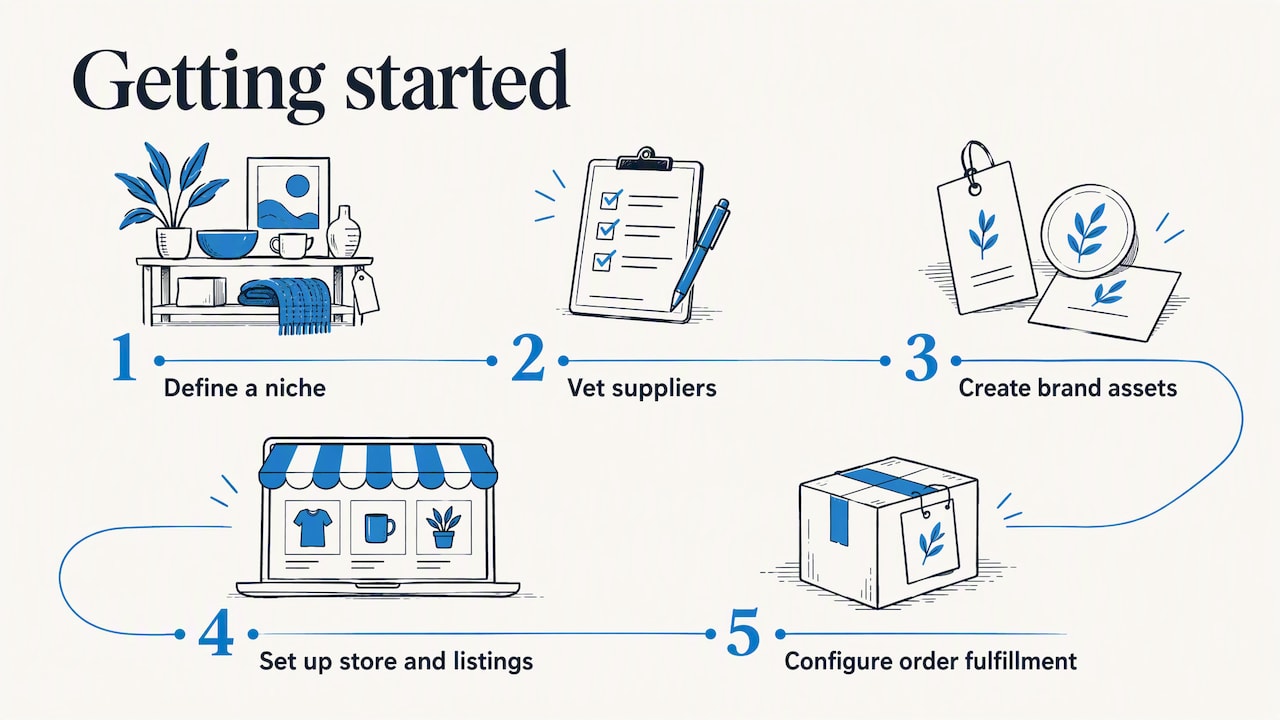
A practical path, based on the process Shopify outlines: define a niche, source and vet suppliers, create brand assets, set up your store and listings, then configure order routing and fulfillment.
1. Pick a niche with proof of demand
Expert advice in a branded dropshipping guide is to use market data rather than personal preference to find products with verifiable existing demand. Your own taste is a poor filter. Look for products that already sell steadily, then read the complaints in competitor reviews. Those complaints are your product brief.
The same guide mentions a “3% rule”: innovate on 3% of an existing concept and keep the 97% that already works. You do not need to reinvent a water bottle. You need a better lid, a clearer size range or sturdier packaging.
2. Validate before you commit to custom manufacturing
Branded dropshipping often starts with standard dropshipping to validate demand, then moves to custom manufacturing once sales are consistent. This is the lowest-risk route we know. Sell a near-identical item first, watch conversion and returns, and only then pay for a custom run.
3. Vet suppliers like you are hiring them
Sellers should compare suppliers’ products and lead times, read reviews on quality and support responsiveness, request product, packaging, shipping and certification details, and test samples for consistent quality. Another guide adds a few checks: verify supplier credentials, test communication, and agree quality, delivery and returns terms before committing.
A short checklist we would use:
- Order samples from at least two suppliers and compare them side by side.
- Send a question on a weekend and a weekday. Note how fast and how clearly they answer.
- Ask for written terms on lead time, defect handling and returns.
- Confirm they can ship packaging with your branding, not just the product.
- Ask for certification paperwork that applies to your product category.
For apparel specifically, we have a separate rundown of dropship suppliers for clothing.
4. Build the brand assets
You need a name, a logo, packaging artwork, product photography and a store that looks like it belongs to a real company. Packaging is where private label shows. A plain mailer with a branded insert already separates you from a generic reseller.
5. Set up the store and order routing
Connect your supplier to your store and test the entire flow with a real order to yourself. Check what the customer sees in the confirmation email, how tracking updates, and what happens when you request a return. Fix those gaps before you pay for traffic.
6. Launch small, then scale what converts
Start with one or two products. Private label punishes spreading thin, because each product may need its own samples, packaging and supplier relationship.
What it costs and what you can earn
Private label usually asks for more cash upfront than standard dropshipping, mostly for samples, design, packaging and any minimum order terms. Your supplier sets those terms, so get quotes in writing and do not assume a number from a blog post applies to your product.
On pricing, one guide recommends a markup of 2.5 to 3 times cost of goods sold to cover customer acquisition and platform costs. A quick worked example: if your branded item costs you $12 landed from the supplier, a 2.5x markup puts the retail price at $30, and 3x puts it at $36. That leaves $18 to $24 per sale before ads, payment processing and returns.
That range is a rule of thumb, not a promise. Your real margin depends on ad costs, return rates and shipping. We break down the math in our guide to realistic dropshipping profit margins, including how to calculate yours before you launch.
The search question “can I make $1,000 a month?” is fair, but we will not promise it. What we can say is that private label gives you levers standard dropshipping does not: price based on brand value, repeat purchases, and a product you can improve over time.
Shipping, returns and legal basics
This is where a lot of new sellers get caught. The Dutch Chamber of Commerce notes that overseas dropshipping carries risks around longer delivery, customs, communication and shipping costs. Its advice: define delivery, warranty and returns in your supplier contract, tell customers delivery times and return procedures, and confirm the products do not infringe intellectual property rights.
If you sell into the EU, the same page explains that the General Product Safety Regulation applies to non-food consumer products entering the EU, with special requirements for categories such as toys, cosmetics and electrical products.
Private label adds a further wrinkle. Under the EU’s Your Europe business guidance, an entity selling a product under its own name or trademark is treated as a manufacturer. That means maintaining traceability, technical documentation and an EU declaration of conformity for the required period. In practice, putting your brand on a product can move compliance duties onto you, not just your supplier.
We serve readers worldwide, so treat the EU rules above as one example, not a universal rule. If you sell in the US, the UK, Canada or Australia, check the product safety, labeling and tax rules of each destination country, and talk to a qualified adviser for your product category, especially anything ingested, applied to skin, or intended for children.

Perspective: where we would start
We talk to a lot of people who jump straight to custom manufacturing because it sounds like the real business. In our experience, that is backwards. The sellers who stay out of trouble treat private label as the second step, not the first.
Here is how we would approach it. Find a product that already has demand. Sell a close version through a standard supplier to learn who buys, what they complain about and what they will pay. Only then pay for a custom run with your own packaging. That sequence turns your first sales into research instead of a gamble.
We would also be blunt about the supplier relationship. A private label product is only as good as the factory behind it. Test samples twice, put terms in writing, and never launch ads to a product you have not held in your hands. Our whole approach at EntreResource is built on sharing what has held up in real businesses, including the mistakes, so you can skip the expensive ones.
— Nathaniel
Want a faster route through the basics?
If you would rather learn this with a structured walkthrough than piece it together from articles, our Instant Course Access for Life is a one-off $97 purchase. It is built for entrepreneurs who want practical, step-by-step training in building an online business.
FAQ
Is private label dropshipping the same as white label dropshipping?
No. White label puts your brand on a generic product that other retailers may also sell. Private label means the product is made to your specifications and is intended to be exclusive to you. White label is faster and cheaper to start, while private label is harder to copy.
How do I start branded dropshipping?
Choose a niche with verified demand, vet suppliers and test samples, then create your brand assets and set up your store. Many sellers validate demand with standard dropshipping first and move to custom manufacturing once sales are steady. Configure order routing and test a full order before running ads.
What is a private label product retailer?
It is a retailer that sells products under its own name, often made by third-party suppliers to the retailer’s specifications, such as ingredients, size and packaging. In dropshipping, you are that retailer, and the supplier ships to your customer.
Can I make $1,000 a month with private label dropshipping?
It is possible, but no source can guarantee it. Your result depends on your margin, ad costs, return rate and product demand. Work out your numbers first, using a markup of 2.5 to 3 times your product cost as a starting point, and test with a small budget.
Is private label dropshipping cheaper than standard dropshipping?
No, it usually costs more upfront and takes longer to launch. In return you get brand control and higher margin potential. Standard dropshipping is the lowest-cost way to start.
Sources
- Private Label Dropshipping guide
- Shopify Help Center: supply chain and fulfillment process
- Branded dropshipping guide
- Briefing on private labels in retail
- Dropshipping vs. private label explainer
- White label vs private label explainer
- White label benefits and examples
- Private label dropshipping: how to build a branded business
- Dutch Chamber of Commerce: dropshipping guidance
- Your Europe: product compliance