

Most dropshipping stores land at a net profit margin of roughly 10% to 30%, and that is before you find out what ads, fees and refunds do to the number. The margin you see on a supplier’s price sheet is not the margin you keep. Below, we show how to calculate both, walk through a real order line by line, and explain what to change when the math doesn’t work.
TL;DR
- Typical dropshipping stores land between 10% and 30% net, depending on niche, supplier reliability and pricing.
- Gross margin only subtracts product cost. Net margin also subtracts ads, payment fees, platform costs and refunds. Only net margin tells you if you have a business.
- If your cost to acquire a customer is higher than what the order earns before ads, every sale loses money.
- Fix margin from the top: pick products with room in the price, raise perceived value, and cut acquisition cost before you chase cheaper suppliers.
Table of Contents
- Gross margin vs. net margin: the difference that decides everything
- A worked example, order by order
- Contribution margin and break-even ROAS
- What counts as a good dropshipping profit margin?
- The costs that quietly eat your margin
- How to raise your dropshipping margin
- Our perspective
- Get the full system, not just the math
- FAQ
- Sources
Gross margin vs. net margin: the difference that decides everything
Gross profit margin is what’s left after the cost of goods sold (COGS), divided by revenue. For a dropshipper, COGS is what the supplier charges you for the product, plus any shipping the supplier bills you.
Net profit margin is what’s left after every cost tied to that order, divided by revenue. This is where beginners get hurt. As dropshipping margin guides point out, many new sellers fixate on gross margin, feel profitable, and miss that customer acquisition cost, payment processing, platform fees and refund losses sit between gross and net.
Two formulas to keep on a sticky note:
- Margin % = (selling price − total cost) ÷ selling price × 100
- Markup % = (selling price − cost) ÷ cost × 100
They are not the same number. A product that costs you $70 and sells for $100 has a 30% margin but a 42.9% markup. This trips people up when they set prices. If you want a 30% margin, multiplying your cost by 1.3 won’t get you there. Divide your cost by 0.70 instead.
That also answers a common question: a 30% margin on $100 is $30 of profit, with $70 of cost behind it.
A worked example, order by order
Let’s price a single product and follow the money. The figures below are illustrative, not a promise. The payment rate is the published Shopify Payments rate on the Basic plan (2.9% + 30¢ per online transaction). Everything else is an assumption you should replace with your own numbers.
| Line | Amount | Notes |
|---|---|---|
| Selling price | $40.00 | What the customer pays |
| Product cost from supplier | $14.00 | Assumed |
| Supplier shipping | $4.00 | Assumed |
| Gross profit | $22.00 | 55% gross margin |
| Payment processing | $1.46 | 2.9% of $40 plus $0.30 |
| Refund and chargeback allowance | $1.60 | Assumed 4% of revenue |
| Ad cost per order (CPA) | $10.00 | Assumed |
| Platform subscription share | $0.13 | $39 a month spread over 300 orders |
| Net profit | $8.81 | About 22% net margin |
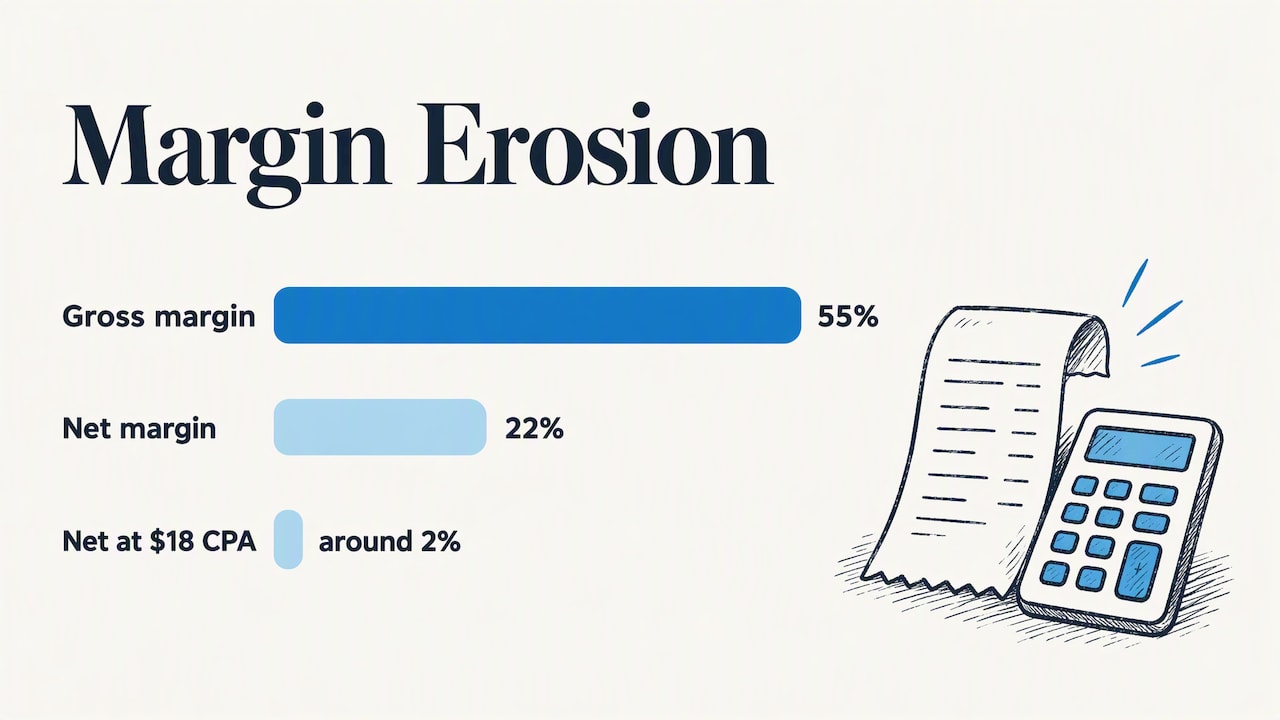
A 55% gross margin turned into a 22% net margin. That is a healthy result, and the order still gave up more than half its gross profit to costs that never show on a supplier’s price list.
Now change one input. If your CPA climbs from $10 to $18, net profit drops to $0.81, around 2%. One ad-cost swing erased almost the whole business. That is why we watch contribution margin, covered next.
Contribution margin and break-even ROAS
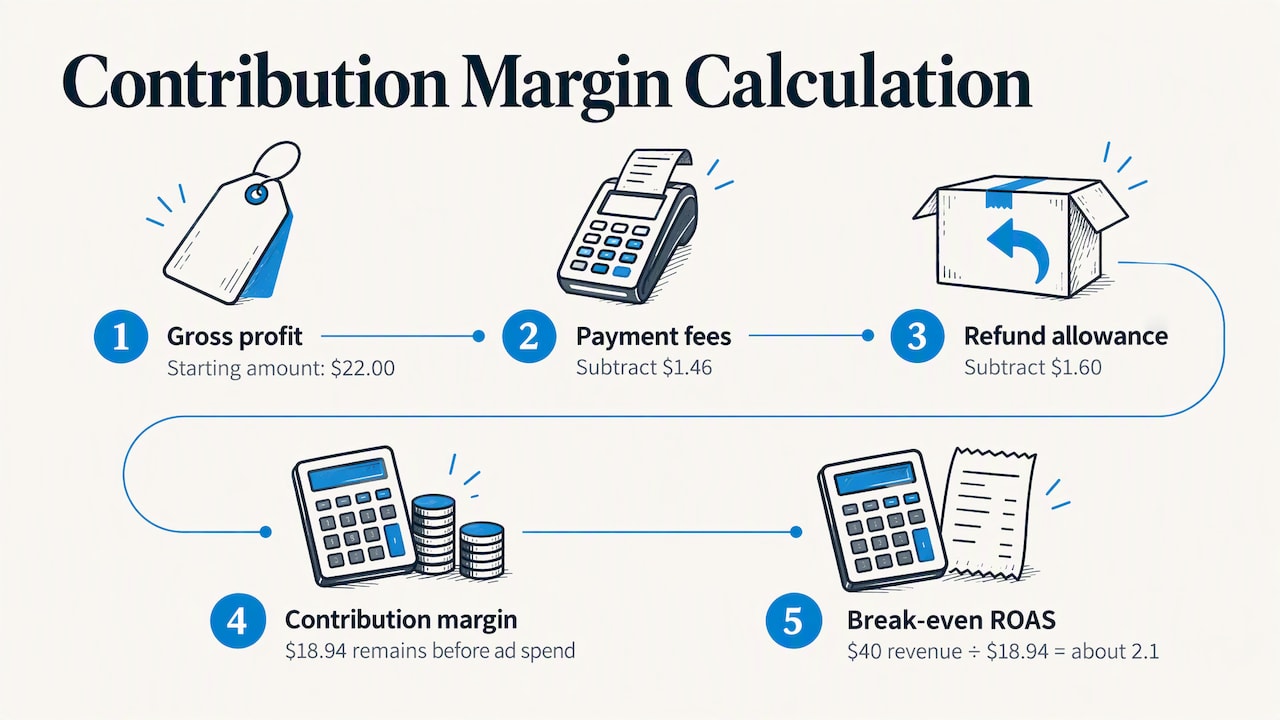
Contribution margin is what an order earns before ad spend. In the example: $22.00 gross profit minus $1.46 in payment fees minus $1.60 refund allowance leaves $18.94.
This number is your ceiling for ad cost. If your expected CPA exceeds it, the order is a loss-maker, however good the product looks.
Your break-even return on ad spend (ROAS) follows from it: $40 ÷ $18.94 = about 2.1. Every $1 in ads must bring back at least $2.11 in sales just to cover costs, before you earn anything. Most stores need a ROAS well above that to make the work worth doing.
Check this number before you launch a single ad. If your price leaves a contribution margin of $6 and you expect to pay $12 for a customer, no creative fix will rescue it.
What counts as a good dropshipping profit margin?
There is no single answer, and be wary of anyone who gives one. Here is what the sources we trust say, and how to read them.
- Overall range. Industry guides put the average for dropshipping stores between 10% and 30%, with large differences between sellers.
- Net margin for successful stores. One analysis says most successful dropshippers run 10% to 25% net, varying by category, experience and operations.
- Beginners. Another recent breakdown says experienced sellers often sit at 15% to 20% net, while beginners frequently run below 10%.
As a working rule, treat 15% net as a minimum for a store you plan to scale, and 20% or more as a sign the product and offer are strong. Below 10%, small changes in ad cost or refund rates will push you into the red.
Dollars matter as much as percentages. A 25% margin on a $12 item is $3 per order, and you need a lot of orders to pay yourself. Many sellers prefer to aim for at least $20 in profit per order before ads on a higher-priced item, because ad costs don’t shrink for cheap products.
Margins by niche
Margin depends heavily on what you sell. Printful’s breakdown gives these ranges:
| Niche | Typical margin |
|---|---|
| Fashion and apparel | 10% to 20% (intense competition) |
| Jewelry and accessories | 20% to 35% (higher perceived value, lower shipping cost) |
| Pet products | 15% to 30% |
| Home and garden | 15% to 30% |
If you are exploring apparel, read our guide to dropship suppliers for clothing before you commit. Thin margins make supplier quality and return rates matter even more.
The costs that quietly eat your margin
Customer acquisition
Ads are usually the largest line after product cost. Treat CPA as a variable cost on every order, never as a marketing “investment” outside the math.
Paid traffic isn’t the only route. Content that ranks and brings repeat visitors lowers your blended acquisition cost over time. If you want a place to start, this piece on content marketing for ecommerce covers how stores use content to grow sales.
Payment processing and platform fees
Processors typically charge around 1.5% to 3%, and the fixed per-transaction fee hurts most on low-priced items. On Shopify, using a third-party gateway adds an extra 2.0% on the Basic plan on top of what your gateway charges. Add app subscriptions and theme costs and your platform line can climb fast. Our Shopify dropshipping guide explains how to vet suppliers before you spend on ads, and our roundup of dropshipping software helps you judge which tools earn their monthly fee.
Refunds and chargebacks
Refunds cost more than the sale price you hand back. Many processors keep the original transaction fee even after you refund, and some add a fee per refund. In a high-return niche, that wears thin margins down quickly. Build a refund allowance into every price calculation, as we did in the example above.
Slow shipping and the law
If you sell to US customers, the FTC’s Mail, Internet, or Telephone Order Merchandise Rule requires you to have a reasonable basis to ship within the time you advertise, or within 30 days if you state none. If a shipment runs late, the rule sets a notice-and-consent-or-refund procedure, which the FTC lays out in its business guide.
This matters for margins because long supplier lead times turn into refunds. If your supplier takes three weeks and your store page promises one, you are paying for that gap. Check the rule yourself, and talk to an attorney who handles ecommerce if you are unsure how it applies to your store. Sellers outside the US should check the consumer rules where their customers live.
Supplier price changes
A supplier who raises costs by $2 on a $14 product takes more than 14% off your gross profit overnight. Keep a second supplier on file for your best sellers and re-run your margin sheet whenever a price changes.
How to raise your dropshipping margin
- Price from net margin, not from a markup rule. Set a target net margin, subtract your realistic costs, and see what price that requires. If the market won’t pay it, change the product.
- Move away from generic items. Printful’s analysts say the most profitable dropshippers in 2026 sell custom-designed or personalized products, which raises perceived value and sets them apart from competitors.
- Raise average order value. Bundles, add-ons and free-shipping thresholds spread your fixed costs (the $0.30 per transaction, the ad click) over a bigger order.
- Test acquisition before you scale. Find your real CPA at small budgets. Compare it to your break-even CPA before you add spend.
- Cut refund causes. Clear product photos, honest delivery times and sizing guides cost little and protect margin.
- Improve conversion. The same traffic with a better store means a lower CPA. Our piece on tactics to drive store conversions is a good place to start.
- Compare models. If dropshipping margins are too thin in your niche, look at alternatives. Our comparison of Amazon FBA and dropshipping lays out how the cost structures differ, and bulk buying to resell covers a model where you hold inventory in exchange for better unit costs.
Our perspective
We have watched a lot of beginners pick a product because the gross margin looked great. A $5 item that sells for $25 feels like a 400% win. Then the first ad campaign shows a $14 CPA, the processor takes its cut, two orders come back, and the store has made nothing.
Our advice is plain. Do the full order math before you build the store, and do it again with pessimistic numbers. Assume your CPA is 30% higher than you hope and your refund rate is double what a supplier tells you. If the product still clears 15% net, it is worth testing. If it only works in the best case, skip it.
We also don’t think dropshipping is a get-rich-quick model, and we’d rather you hear that from us than from a refund queue. The sellers who do well treat it like any retail business: they watch unit economics weekly, build something customers remember, and build traffic sources they own, such as email and search. That is the philosophy behind everything we publish.
— Nathaniel
Get the full system, not just the math
If you want to go deeper than one article, our Instant Course Access for Life is a one-off $97 payment. Prefer to start free? Our freebies page is the place to begin.
FAQ
What is a good profit margin for dropshipping?
For net margin, 15% to 20% is a solid target, and the common range for stores is 10% to 30%. Judge it in dollars too: you need enough profit per order to pay for your time at your realistic order volume.
Is a 30% profit margin too high?
Not as a gross-margin target, but it is hard to reach as a net margin in competitive niches like apparel. Jewelry, accessories and personalized products are more likely to support margins in the 20% to 35% range. If your price looks too high next to similar products, test it before you drop it.
How do I calculate my dropshipping profit margin?
Add every cost for one order: product, supplier shipping, payment fees, ad cost, refund allowance and a share of platform fees. Subtract that from the selling price, then divide by the selling price. Do it per product, since a single winner can hide several losers in your store total.
Is dropshipping still profitable in 2026?
Yes, but the easy margins are gone. Printful’s 2026 analysis says a profitable store is still within reach, and the winners are sellers who pick products carefully, keep acquisition costs in check and differentiate.
Sources
- How profitable is dropshipping in 2026?
- Dropshipping Profit Margin: What It Is and What Eats It
- Dropshipping Profit Margins: The Complete Guide
- What is the average dropshipping profit margin?
- Is Dropshipping Still Profitable in 2026? Real Margins
- Shopify Pricing (2026): Plans, Fees & Real Cost Breakdown
- Payment gateways guide | Stripe
- Mail, Internet, or Telephone Order Merchandise Rule | FTC
- Business Guide to the FTC’s Mail, Internet, or Telephone Order Merchandise Rule