
The dream of starting your own business no longer requires a hefty bank loan or a physical storefront. Thanks to the internet, a vast number of opportunities are just a click away. This guide is your definitive resource, designed to cut through the noise and present a curated list of the most viable and profitable online business ideas for beginners. We will move beyond generic advice, providing a detailed breakdown for each business model.
You will learn exactly what each business entails, who it's best suited for, and the realistic startup costs and time commitment needed to see your first income. Research from Statista shows that global e-commerce is projected to exceed $8 trillion by 2027, highlighting the immense potential for new digital entrepreneurs. This article is structured to help you claim a piece of that market. For each idea, we provide a step-by-step action plan, guiding you through your first 30, 60, and 90 days. As Nate McCallister, founder of EntreResource, notes, "The best time to start was yesterday. The second-best time is now, with a solid plan."
This article provides that plan. We’ll cover everything from affiliate marketing and YouTube channel creation to Amazon FBA and digital product sales. Each section is packed with actionable insights and real-world examples, empowering you to choose and build a business that aligns perfectly with your skills, budget, and long-term goals. Forget vague theories; this is your practical blueprint for launching a successful online venture. Let's get started.
1. Affiliate Marketing & Niche Websites
Affiliate marketing is a performance-based business model where you earn a commission for promoting another company's products or services. As an online business idea for beginners, it shines because it eliminates the need for inventory, customer service, or product development. You build a content-rich niche website, drive traffic (often through search engine optimization, or SEO), and earn revenue when a visitor clicks your unique affiliate link and makes a purchase.
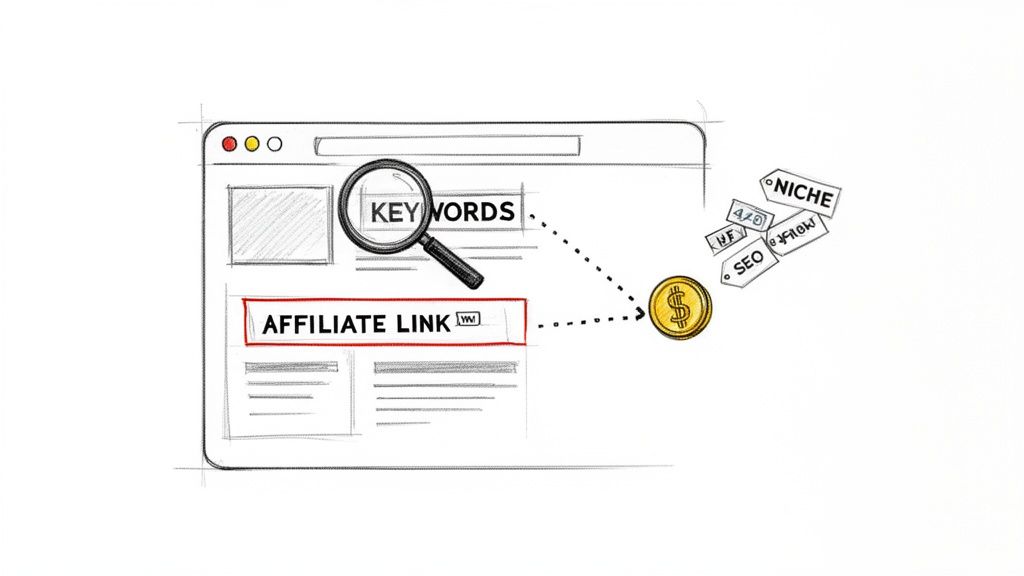
The core strategy involves identifying a specific audience with a problem and recommending solutions you can earn a commission on. This model's success is visible in diverse examples, from product review giants like Wirecutter (acquired by The New York Times) to specialized content hubs like Food Blogger Pro, which blends recipes with affiliate links for kitchen tools. Pat Flynn's Smart Passive Income popularized this method by openly documenting his niche site projects, showing how targeted content can generate passive income. To delve deeper into this business model, explore our detailed guide on Affiliate Marketing.
Key to Success: Niche Selection & Authority
Success hinges on choosing the right niche and building trust. Rather than targeting broad, competitive topics, focus on niches with clear buyer intent. For instance, instead of "fitness," you might target "best yoga mats for hot yoga." This specificity makes it easier to rank in search results and attract a motivated audience.
To build authority and meet Google's E-E-A-T (Experience, Expertise, Authoritativeness, Trustworthiness) guidelines, create content that genuinely helps the user.
- Content Strategy: Develop "content clusters" around a main topic. If your main topic is "home coffee brewing," create supporting articles on "best burr grinders," "how to froth milk," and "descaling your espresso machine." HubSpot's research confirms this model improves SEO performance.
- Authentic Reviews: Whenever possible, test products yourself. Authentic, hands-on reviews build immense trust and set you apart from competitors who just rephrase manufacturer specs.
- Keyword Research: Use tools like Ahrefs or SEMrush to find low-competition keywords that signal a user is ready to buy (e.g., "brand X vs. brand Y," "product Z review").
For those specifically interested in the world's largest affiliate program, Amazon Associates, you can find a complete beginner's roadmap to profit from Amazon affiliate marketing.
2. Blogging with Email List Building
Blogging combined with email list building is a classic online business idea for beginners that remains powerful because it creates a direct, owned communication channel with your audience. Instead of relying on unpredictable social media algorithms or search engine rankings, you build a community of subscribers who want to hear from you. The model involves creating valuable content on a blog to attract readers, then converting those readers into email subscribers, enabling long-term nurturing and monetization.
This strategy's value is proven by major media companies and individual creators alike. Newsletters like The Hustle and Morning Brew grew into multi-million dollar businesses by delivering daily insights to massive email lists. On an individual level, authors like James Clear used a focused email strategy to support the launch of Atomic Habits, creating a direct line to millions of readers. For bloggers, a key to long-term success involves understanding how to build email lists that actually grow your business, transforming readers into loyal customers.
Key to Success: Value Exchange & Consistency
The foundation of a successful email list is a simple value exchange: you offer consistently helpful content, and in return, a reader gives you their email address. Success depends on making this exchange irresistible and maintaining that value over time. Your blog attracts the audience, but your email list retains them.
To build an audience that trusts you, focus on delivering genuine value before asking for a sale.
- Lead Magnets: Offer a high-value, free resource like a checklist, template, or mini-guide in exchange for an email. This "lead magnet" should solve a specific problem for your target reader.
- Consistent Communication: Establish a predictable sending schedule, whether daily or weekly. Consistency builds anticipation and keeps your brand top-of-mind without overwhelming your subscribers.
- Email Nurture Sequences: Create an automated series of emails for new subscribers. This sequence can introduce you, share your best content, and gently guide them toward your core offers, building a relationship from day one.
- Strategic Monetization: Use your email list to promote affiliate products, sell your own digital products, or announce services. According to Litmus, email marketing ROI can be as high as $36 for every $1 spent, making the trust you've built far more effective than cold advertising.
3. YouTube Channel Creation & Monetization
Creating a YouTube channel is an excellent online business idea for beginners because it allows you to build a loyal audience around a topic you love. The business model involves producing consistent video content that attracts viewers, and then monetizing that audience through various streams like AdSense revenue, brand sponsorships, affiliate marketing, and selling your own products. With its powerful algorithm, YouTube can expose your content to a massive global audience, making it a prime platform for establishing authority in a niche.
This strategy's success is demonstrated by creators across countless niches. Ali Abdaal built a massive following discussing productivity and his medical school journey, while Graham Stephan educates millions on personal finance, earning substantial income from ad revenue and course sales. The model scales from niche hobbies to viral entertainment, as seen with MrBeast, whose high-production videos generate millions in annual revenue. This approach puts content at the center, allowing you to build a multifaceted business from a single platform.
Key to Success: Niche Consistency & Audience Engagement
Success on YouTube hinges on selecting a specific niche and consistently delivering value to that audience. Instead of creating videos about everything, focus on a defined area where you can become a go-to resource. For example, rather than a general "tech" channel, you could focus on "budget home office tech for remote workers." This focus helps the YouTube algorithm understand your channel and recommend it to the right viewers.
Building a community is just as important as producing videos. To grow a sustainable channel, you need to turn viewers into subscribers and subscribers into fans.
- Content Strategy: Plan your videos in series or playlists to increase watch time. If your topic is "vegan baking," create playlists for "vegan cookies," "vegan cakes," and "beginner vegan baking tips" to keep viewers engaged.
- Audience Interaction: Actively respond to comments to build a strong community. Use the community tab to post polls and updates, and ask viewers what content they want to see next. This direct feedback is invaluable for content planning.
- Optimization Fundamentals: Master the basics of YouTube SEO. Craft compelling, keyword-rich titles and design high-contrast thumbnails that encourage clicks (CTR). According to a YouTube Creator Academy study, 90% of the best-performing videos have custom thumbnails.
For those looking to turn their channel into a full-fledged business, building an email list from your YouTube audience is a critical step. Offering a free guide or resource (a lead magnet) is a proven way to convert viewers into email subscribers, giving you a direct line of communication with your most dedicated followers.
4. Amazon FBA (Fulfillment by Amazon)
Amazon FBA (Fulfillment by Amazon) allows you to sell physical products without handling storage, packing, or shipping yourself. This model is a powerful online business idea for beginners because it provides immediate access to Amazon's massive customer base and world-class logistics network. You simply source products, send them to an Amazon fulfillment center, and Amazon takes care of the rest, including customer service and returns.
The core strategy is to find profitable products through methods like retail arbitrage, wholesale, or private labeling, and then sell them on the Amazon marketplace. Success stories are widespread, from individual sellers achieving seven-figure incomes with niche products to software companies like Helium 10 and Jungle Scout, built entirely to support the FBA ecosystem. Pioneers like Greg Mercer and the case studies from Ecomcrew demonstrate that with methodical research and execution, significant revenue is attainable.
Key to Success: Product Research & Listing Optimization
Your success with FBA is almost entirely dependent on meticulous product research and a perfectly optimized product listing. Instead of guessing, use data-driven tools to find products with proven demand but manageable competition. A good starting point is finding products with a healthy number of reviews (e.g., 8-15), which indicates sales without being overly saturated.
To gain a competitive edge and build a sustainable business, focus on these critical actions:
- Profit Margin Analysis: Aim for a strong supplier margin, often a 3:1 ratio or better. If a product costs you $5 to source, it should ideally sell for at least $15 to cover Amazon's fees, advertising costs, and still leave a healthy profit.
- Listing Optimization: Treat your product listing like a high-conversion sales page. Use professional images, write keyword-rich titles and bullet points that address customer pain points, and fully utilize the A+ Content feature if you're brand registered. Amazon reports that A+ Content can increase sales by 3-10% on average.
- Strategic PPC Campaigns: Use Amazon's pay-per-click (PPC) advertising to drive initial sales and improve your organic ranking. Closely monitor your Advertising Cost of Sale (ACOS) to ensure your campaigns remain profitable.
- Inventory Management: Start with a small test shipment to validate a product's sales velocity before investing in a large inventory order. This minimizes risk while you learn the market.
For those ready to master the first and most critical step, our guide on how to find winning products for Amazon offers a complete beginner's walkthrough.
5. Digital Product Creation & Sales
Creating and selling digital products involves making assets like ebooks, online courses, templates, or presets that can be sold infinitely with zero marginal cost. This online business idea for beginners is exceptionally scalable because once a product is created, it can be distributed to a massive audience without inventory or shipping. You build an audience through content, email lists, or social media and then monetize that attention by selling a high-value digital solution.
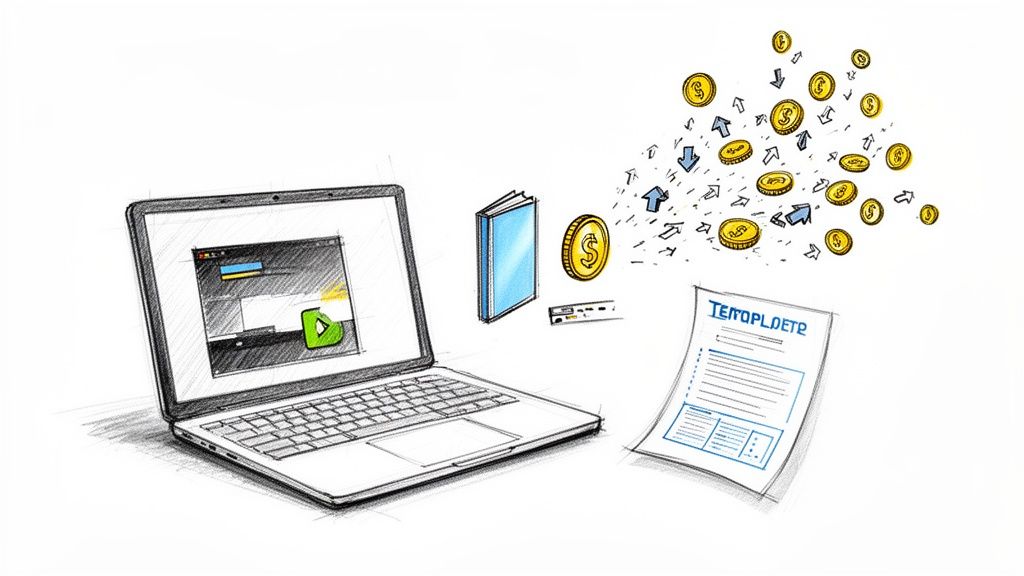
The power of this model is demonstrated by figures like Amy Porterfield, who built a multi-million dollar business teaching entrepreneurs how to create their own courses. Likewise, Ramit Sethi's premium course model at I Will Teach You To Be Rich shows how deep expertise can be packaged into high-ticket digital products. This approach works by transforming your knowledge into a tangible asset that generates revenue while you sleep. To learn more about this process from a top expert, consider exploring Amy Porterfield's resources on digital courses.
Key to Success: Validation & Value-Based Pricing
Success depends on validating your idea before investing hundreds of hours in creation. Avoid building a product nobody wants by first surveying your audience about their biggest challenges. Once you identify a painful problem, you can create a targeted solution.
Pricing should be based on the value and transformation your product delivers, not the time it took to create. A $47 ebook that saves someone 10 hours of work is an easy purchase.
- Pre-Launch Strategy: Before building the full product, create a simple outline or a free mini-course. Offer this as a lead magnet to build an email list of interested buyers, confirming demand. This aligns with the "lean startup" methodology of validating ideas early.
- Simple Tool Stack: You don't need expensive software to start. Use Loom or OBS Studio for screen recordings, Canva for creating professional-looking graphics and PDFs, and Gumroad or Podia for simple sales and delivery.
- Proven Launch Sequence: A common and effective launch method follows a clear sequence. Warm up your email list with valuable content, offer a free preview or webinar to showcase the product's benefits, and then open the cart with a time-sensitive offer to drive action.
For an in-depth look at how to price and package digital products for maximum impact, Ramit Sethi's blog offers powerful insights on premium product psychology.
6. Freelance Services (Writing, Design, Consulting)
Offering freelance services is one of the fastest ways to start an online business for beginners because it allows you to monetize skills you already possess. This model involves providing specialized services like copywriting, web design, or social media management to clients on a project or retainer basis. The barrier to entry is low, often requiring just a laptop, an internet connection, and expertise in a specific area, making it a powerful choice for those looking to generate income quickly.

The freelance-to-agency pipeline is a well-trodden path. Success stories include Copyblogger, which began with content services before evolving into a SaaS company, and Joanna Wiebe's Copy Hackers, which scaled from freelance copywriting into a multi-million dollar training and services business. Many individual freelancers build a personal brand, attracting clients who pay $5,000 to $10,000 per month on retainer. Jonathan Stark's advocacy for "value-based pricing" has also shown freelancers how to detach their income from hours worked, charging based on the results they deliver to a client's business. For guidance on this pricing strategy, his book Hourly Billing Is Nuts is a foundational resource.
Key to Success: Specialization & Client Acquisition
Your success as a freelancer depends on specializing and building a system to attract high-quality clients. Generalists compete on price, while specialists command premium rates by solving specific, high-value problems. Instead of being a "writer," become a "B2B SaaS email copywriter."
To build momentum and a portfolio, then scale your income, follow a clear progression.
- Build Your Portfolio: Start by creating 3-5 high-quality sample projects. If you have no clients, create spec work. A designer might redesign a popular app's landing page; a writer might rewrite a brand's email sequence.
- Initial Client Acquisition: Use platforms like Upwork or Fiverr to gain initial experience and testimonials. Upwork's own data shows that many freelancers use the platform to build a client base before going independent.
- Transition to Higher-Value Clients: Shift your focus to direct outreach and building a personal brand. Create content (e.g., on LinkedIn or a personal blog) that demonstrates your expertise. This attracts inbound leads who are already convinced of your value.
- Systemize and Scale: Package your services with clear deliverables and predictable pricing. Aim to move clients from one-off projects to monthly retainers, which provides stable, recurring revenue. Consistently raise your rates every 3-6 months as you gain experience and results.
7. Print-on-Demand & Dropshipping
Print-on-demand (POD) and dropshipping allow you to sell branded physical products without ever holding inventory. As an online business idea for beginners, this model is excellent because it removes the risk and cost of buying products upfront. You create designs for items like T-shirts, mugs, or hoodies, and a POD partner (like Printful) handles production and shipping only after a customer places an order. Your job is to focus on design and marketing, selling through platforms like Etsy, Shopify, or directly on social media.
This model's effectiveness is clear through the growth of platforms like Printful, which serves over 500,000 sellers, and the thousands of successful Etsy shops generating significant monthly income from custom designs. Many creators get their start on Merch by Amazon, a tier-based system where you earn royalties on designs sold through the Amazon marketplace. The rise of TikTok has also shown how trend-based designs can go viral, creating instant demand for specific POD products. For those ready to build a brand without inventory, our guide on selling with Shopify is a great starting point.
Key to Success: Niche Designs & Targeted Marketing
Your success depends on creating designs that resonate with a specific audience and getting those designs in front of them. Instead of generic slogans, target passionate communities, hobbies, or professions. For example, a design for "retired librarians" is far more likely to find a dedicated buyer than a generic "I love books" shirt.
To attract customers and build a sustainable brand, focus on high-quality designs and strategic marketing.
- Content Strategy: Create mockups of your products and share them on relevant social media channels like Pinterest, Instagram, and TikTok. Use hashtags related to your niche to improve discoverability. For seasonal items, create and promote your designs well in advance of the holiday.
- Platform Optimization: If selling on Etsy, use all 13 tags with relevant keywords to improve your product's visibility in search results. Research what competing shops in your niche are doing successfully and identify gaps. According to Etsy's Seller Handbook, relevant tags are crucial for being found.
- Test & Scale: Use a no-fee platform like Merch by Amazon to test design concepts. If a design sells well, expand it to other products (hoodies, phone cases) and list it on your own Shopify store or Etsy shop to build a direct customer relationship.
For a deep dive into the specific tools and platforms that make this business model possible, you can explore the features of a leading provider like Printful.
8. Self-Publishing & Kindle Direct Publishing
Self-publishing allows you to write, format, and sell books directly to a global audience, completely bypassing traditional publishing gatekeepers. As an online business idea for beginners, its strength lies in low startup costs and high royalty rates. Platforms like Amazon's Kindle Direct Publishing (KDP) empower you to publish ebooks and paperbacks, earning 35-70% royalties compared to the typical 10-15% from a traditional publisher. This model creates a path to passive income, establishes authority in a niche, and serves as a powerful tool for building an audience.
The success of this model is proven by authors across genres. Andy Weir's sci-fi novel The Martian began as a self-published series on his blog before becoming a KDP bestseller and a major motion picture. In the business world, entrepreneurs like Russell Brunson use books such as DotCom Secrets to build authority and drive customers to their core offerings. This strategy transforms a book from a simple product into a cornerstone of a larger business ecosystem. To learn the fundamentals, Amazon provides its own detailed guide on getting started with KDP.
Key to Success: Market Research & Professional Presentation
Success in self-publishing hinges on treating your book like a business product, not just a passion project. This means validating your idea and investing in a professional package that can compete in a crowded marketplace. Instead of writing into a void, research categories with a built-in audience and a clear demand.
To ensure your book stands out and attracts readers, focus on presentation and marketing from day one. Your book cover and description are your most important sales tools.
- Content Strategy: Target proven non-fiction categories like productivity, personal finance, or niche hobbies. Alternatively, write fiction in a popular series-friendly genre like romance or thriller, which encourages repeat purchases.
- Professional Design: A cheap-looking cover will kill sales. Invest in a professional cover designer (costs can range from $100 to over $500). BookBub data shows that cover design is a top factor for readers choosing a book.
- Keyword Optimization: Treat your book's title, subtitle, and KDP description like an SEO project. Use tools and research to find keywords that potential readers are searching for on Amazon.
- Launch Strategy: Use strategic pricing, such as a 99-cent launch price or a free promotion, to generate initial sales and reviews. According to a study on ebook pricing, lower prices can significantly increase download volume, which helps with visibility. Build an email list by offering a bonus resource inside your book to nurture a long-term author following.
9. Social media Content Creation & Influencer Marketing
Building an engaged audience on platforms like TikTok, Instagram, and YouTube Shorts is a powerful online business idea for beginners because it has low production barriers and high viral potential. You create short-form, algorithm-friendly content, grow a community around a specific interest, and then monetize your influence through brand sponsorships, affiliate commissions, or by selling your own products and services. The core business is your audience's attention, which you can direct toward revenue-generating opportunities.
The success of this model is highly visible, from mega-influencers like Charli D’Amelio, whose brand grew from TikTok trends, to niche creators in spaces like finance or crafting who earn substantial incomes. Ali Abdaal effectively uses YouTube Shorts to drive traffic to his long-form content and courses, showcasing a multi-channel monetization strategy. This path, popularized by figures like Gary Vaynerchuk, turns authentic content into a scalable business. To get started with a key monetization channel, explore our step-by-step guide to the TikTok Creator Rewards Program.
Key to Success: Consistency & Platform Strategy
Success hinges on consistent output and adapting your content to each platform's algorithm. Virality often comes from understanding what the platform wants to promote, such as high watch time, shares, and comments.
To build a sustainable presence, focus on a clear content strategy that resonates with a target audience.
- Content Pillars: Establish 3-5 core content themes. For a fitness creator, these could be "workout tutorials," "healthy recipes," "myth-busting," and "motivational talks." This provides structure and manages audience expectations.
- Trend-Spotting: Capitalize on trending sounds, formats, and challenges early. Being one of the first to adapt a trend can provide a significant visibility boost from the algorithm. As noted by TikTok's trend reports, early adopters often see the highest engagement.
- Community Engagement: Dedicate time daily to responding to comments and messages. This authentic interaction builds a loyal community that feels connected to you, increasing the value of your influence.
- Cross-Platform Strategy: Repurpose your best content across platforms. A successful TikTok video can become an Instagram Reel and a YouTube Short, maximizing the reach of each creative asset.
10. Email Marketing Services & Newsletter Sponsorships
Building a targeted email newsletter is a powerful online business idea for beginners because it gives you a direct line of communication with your audience, one that isn't controlled by unpredictable social media algorithms. The business model involves creating valuable content for a specific niche, attracting subscribers, and then monetizing that audience through sponsorships, paid subscriptions, or by offering your email marketing expertise as a service to other businesses. It's a model built on trust and direct relationships.
The success of this model is demonstrated by major media players and individual creators alike. Newsletters like Morning Brew, which sold a majority stake to Insider Inc. for a reported $75 million, and The Hustle, acquired by HubSpot for a reported $27 million, proved the immense value of a large, engaged email list. On a more accessible scale, creators on platforms like Substack, such as Lenny Rachitsky of Lenny's Newsletter, earn significant income from both subscriptions and high-ticket sponsorships. To learn more about creating content that people will pay for, check out this guide on premium content strategy.
Key to Success: Niche Focus & Consistent Value
Your newsletter's success depends on delivering consistent, high-value content to a well-defined audience. The goal is to become the go-to resource for your specific topic, making your emails a welcome arrival, not a piece of spam. Building this relationship is essential before you can effectively monetize.
- Content-First Approach: Adhere to an 80/20 rule. Dedicate 80% of your content to providing genuine value, insight, and entertainment, with only 20% focused on monetization efforts like sponsorships or product promotions. This principle is widely advocated in content marketing circles.
- Subscriber Growth: Create a compelling welcome sequence that hooks new readers and clearly states the value they'll receive. Use this to set expectations for sending frequency and content style.
- Monetization Strategy: Begin seeking sponsorships once you have an engaged audience, even if it's small. Early sponsors build credibility and provide case studies to attract higher-paying brands as your list grows, typically past the 5,000-subscriber mark. Offer tiered packages based on placement and reach.
For entrepreneurs looking to understand how to turn an audience into a business, Ash Maurya's principles, detailed in his work Running Lean, often emphasize building an audience first through channels like email.
10-Point Comparison: Online Business Ideas for Beginners
| Model | 🔄 Implementation Complexity | ⚡ Resource Requirements | 📊 Expected Outcomes | 💡 Ideal Use Cases | ⭐ Key Advantages |
|---|---|---|---|---|---|
| Affiliate Marketing & Niche Websites | 🔄 Moderate — ongoing SEO and content workflow | ⚡ Low capital; steady content time | 📊 Passive, variable revenue; 6–12 months to scale | 💡 Product review and comparison sites with buying intent | ⭐ Scalable, low upkeep, multiple revenue streams |
| Blogging with Email List Building | 🔄 Moderate — content + email funnels | ⚡ Low–moderate (hosting + email tools) | 📊 Reliable monetization; compound audience value (3–6 months) | 💡 Authority building, product launches, audience ownership | ⭐ Owned audience with high ROI and launch leverage |
| YouTube Channel Creation & Monetization | 🔄 High — video production and optimization | ⚡ Moderate (equipment + editing time) | 📊 High reach and CPM potential; slower path to monetization | 💡 Tutorials, reviews, personality-driven content | ⭐ Strong authority and algorithmic reach |
| Amazon FBA (Fulfillment by Amazon) | 🔄 High — sourcing, inventory and logistics | ⚡ High upfront capital for inventory | 📊 Fast sales potential but margin pressure and inventory risk | 💡 Physical product retail, private-label items | ⭐ Access to Amazon customers and Prime conversion lift |
| Digital Product Creation & Sales | 🔄 Moderate — content creation + launch systems | ⚡ Moderate upfront time; low marginal cost thereafter | 📊 High-margin scalable passive revenue | 💡 Online courses, ebooks, templates, software | ⭐ Very high profitability with no inventory |
| Freelance Services (Writing, Design, Consulting) | 🔄 Low — service delivery and client ops | ⚡ Minimal capital; high time/skill investment | 📊 Immediate income; limited scalability without productization | 💡 Short-term client projects, retainers, niche services | ⭐ Fast revenue start, low financial risk |
| Print-on-Demand & Dropshipping | 🔄 Low–Moderate — store setup and supplier coordination | ⚡ Low upfront capital; marketing-focused | 📊 Low margins; sales dependent on marketing and design | 💡 Niche merch, trend testing, low-risk product experiments | ⭐ No inventory risk and fast testing cycle |
| Self-Publishing & Kindle Direct Publishing | 🔄 Moderate — writing, editing, publishing | ⚡ Low–moderate (editing, design, marketing) | 📊 Evergreen sales and authority building; gradual growth | 💡 Nonfiction authority books, series to grow readership | ⭐ High royalties and instant global distribution |
| Social Media Content Creation & Influencer Marketing | 🔄 Moderate — rapid content cadence and trend management | ⚡ Low equipment cost; high consistency/time | 📊 Viral reach possible; income variable and platform-dependent | 💡 Trend-driven short-form content, personal branding | ⭐ Fast audience growth potential and sponsor opportunities |
| Email Marketing Services & Newsletter Sponsorships | 🔄 Moderate — content + sponsorship ops | ⚡ Low–moderate (email platform, list building) | 📊 Predictable recurring revenue with high ROI | 💡 Niche newsletters, B2B sponsorship sales, paid subscriptions | ⭐ Highest engagement and flexible monetization paths |
From Idea to Execution: Your Next Steps
We've journeyed through ten distinct online business ideas for beginners, from the content-driven world of affiliate marketing and blogging to the tangible product ecosystems of Amazon FBA and dropshipping. Each model presents a viable path toward building a source of income outside the traditional 9-to-5. The core message is not that one idea is definitively better than another, but that the 'best' idea is the one that aligns with your personal skills, financial runway, and genuine interests.
Analysis paralysis is the most common roadblock for aspiring entrepreneurs. Faced with a dozen options, many choose none. They spend weeks or months researching, endlessly comparing pros and cons, and waiting for the "perfect" opportunity to reveal itself. This is a trap. The true secret to success isn't finding a flawless business model; it’s choosing one and committing to imperfect, consistent action. As James Clear notes in Atomic Habits, "You do not rise to the level of your goals. You fall to the level of your systems." Your 30/60/90-day action plan for any chosen business is your system.
Distilling Action from Information
The common thread weaving through every successful online venture, whether it's a YouTube channel or a freelance writing career, is the principle of Audience First, Product Second.
- For Content Creators (Bloggers, YouTubers, Influencers): Your audience is your primary asset. You build trust by consistently providing value before asking for a sale. Monetization through ads, sponsorships, or affiliate links is a byproduct of an engaged community.
- For Service Providers (Freelancers): Your "audience" is your pool of potential clients. Building a portfolio and testimonials establishes your authority and provides social proof, making it easier to attract high-paying projects.
- For E-commerce Sellers (Amazon FBA, Dropshipping): Your audience consists of specific customer segments with unmet needs. Success hinges on deep market research to understand their pain points and desires, not just on finding a random product to sell.
The most critical step you can take right now is to move from passive learning to active building. The value is not in knowing all the online business ideas for beginners; it's in executing one of them with focus.
Your Immediate Action Plan
Don't let this article become another bookmark in a folder of forgotten ambitions. The momentum you feel right now is a valuable resource. To channel it effectively, follow these concrete steps:
- Choose Your Path: Review the ten business models. Which one genuinely excites you? Which one aligns with a skill you already have or are eager to learn? Pick one. You can always pivot later, but you must start somewhere.
- Commit to the First 30 Days: Pull up the 30/60/90-day plan for your chosen business. Ignore the later steps for now. Your only goal is to complete the tasks outlined for the first month. This might mean registering a domain, creating a social media profile, or writing your first three blog posts.
- Embrace the "Minimum Viable" Mindset: Your first YouTube video will not be perfect. Your first blog post will have flaws. Your first product listing might need optimization. That is not only acceptable; it is necessary. Reid Hoffman, the founder of LinkedIn, famously said, "If you are not embarrassed by the first version of your product, you've launched too late." Progress over perfection is the mantra of every successful online entrepreneur.
The journey from a promising idea to a profitable reality is built on a foundation of small, decisive actions. It’s about choosing a direction and taking the first, tangible step. The difference between those who succeed and those who only dream is the willingness to start building, learning, and adapting along the way. Your entrepreneurial journey doesn't have to be a giant leap; it can begin with a single, deliberate click. Make it count.