
A lot of creators hit the same wall. They post a video that takes off, the comments pile up, followers jump, and the bank account stays exactly the same.
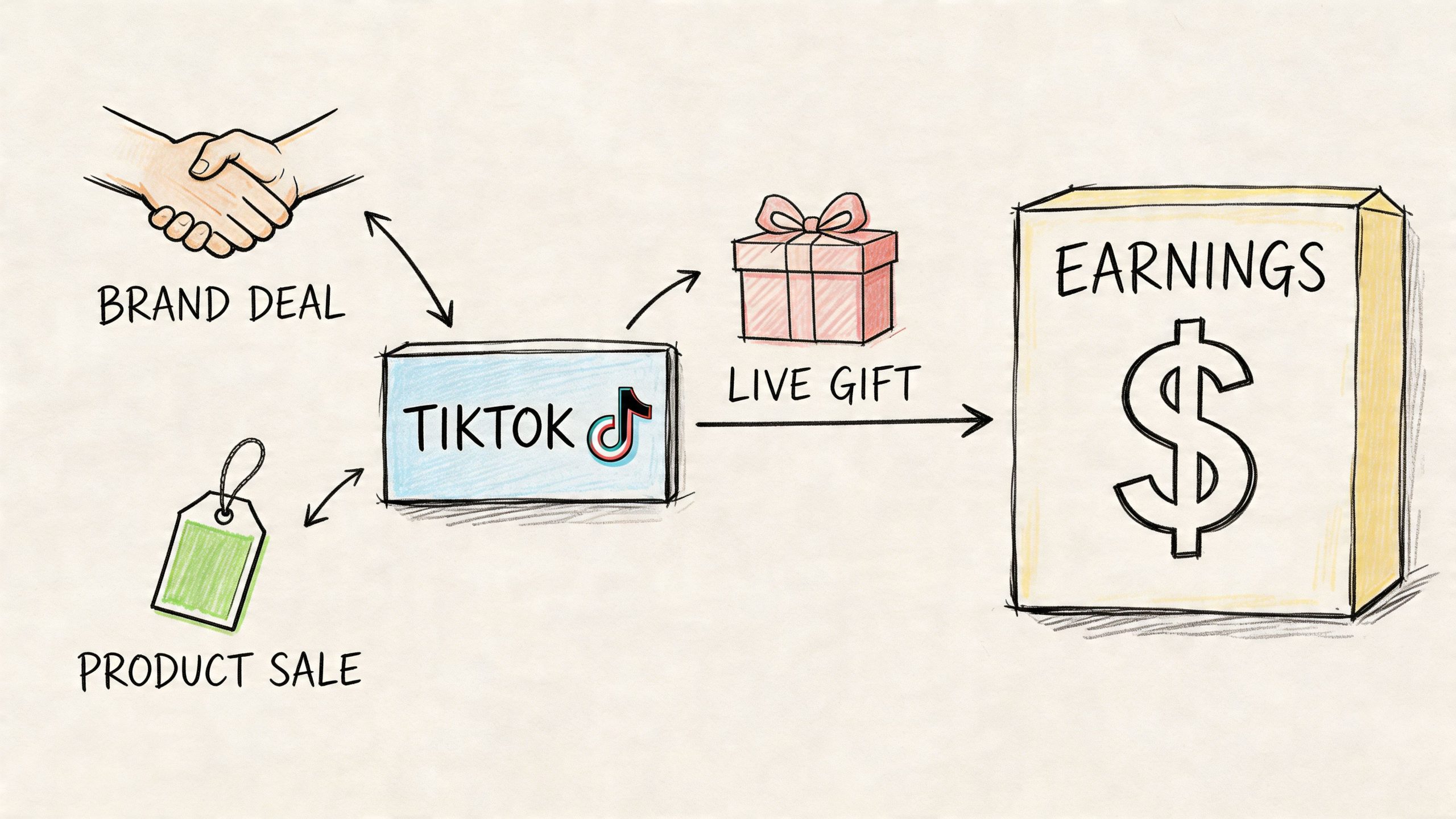
That gap is why most advice on how to get monetized on TikTok falls short. It treats monetization like a badge you achieve after hitting follower milestones. In practice, monetization works better when you treat TikTok like a revenue channel with multiple offers, multiple formats, and backup plans when one program isn’t available.
The platform is big enough now that this isn’t theoretical. TikTok creators worldwide earned more than $4.1 billion in 2024 through monetization tools and brand partnerships combined, with $5.7 billion projected for 2025, and TikTok Shop recorded $26.2 billion in global gross merchandise value in Q1 2025 (Browseract). That means there’s real money on the table, but it doesn’t flow evenly. The creators who build systems tend to keep earning. The ones who rely on random viral spikes usually don’t.
From Views to Revenue The TikTok Monetization Mindset
The creator who struggles most on TikTok usually isn’t the one with no views. It’s the one with views and no plan.
A common pattern looks like this. Someone posts short trend clips, one video pops, and they assume revenue will follow automatically. It rarely does. Viral reach can grow an audience, but unless that audience connects to an actual monetization path, the result is attention without income.
That’s the wrong frame. TikTok isn’t just a content platform. It’s a traffic source, a sales channel, a brand-building engine, and for some creators, a direct payout platform.
Stop treating virality as the business model
The shift that matters is simple. Don’t ask, “How do I go viral?” Ask, “What does this account sell?”
For one creator, that answer is long-form original videos that qualify for the Creator Rewards Program. For another, it’s product demos that move affiliate sales. For someone else, it’s niche authority that attracts sponsors. If you don’t know which lane you’re building for, you’ll keep posting content that performs but doesn’t compound.
Practical rule: Every TikTok account should have a primary revenue path and a secondary one. If one stalls, the account still earns.
This is also where influencer advice gets misunderstood. If your goal is income, you don’t need broad fame. You need a clear market position, trust, and content that leads somewhere. If you need help tightening that positioning, this guide on how to become an influencer is useful because it focuses on building influence deliberately, not just chasing exposure.
Think like an operator, not just a creator
Creators who earn consistently usually do a few things differently:
- They pick a monetization model early. They know whether they’re building for program payouts, brand deals, affiliate sales, or direct sales.
- They make content around buyer intent. Tutorials, comparisons, product-led videos, and niche education monetize better than random entertainment for most small accounts.
- They build for repeatability. One-off hits are nice. Repeatable formats pay the bills.
TikTok rewards creativity. It also rewards creators who understand the business underneath the feed.
Understanding TikTok's Monetization Ecosystem in 2026
A TikTok account can hit 500,000 views and still make very little. Another account in a tighter niche can do a fraction of that reach and turn content into steady monthly revenue. The difference is not luck. It is monetization design.
TikTok pays in several different ways, and each path rewards a different business model. For operators, the useful split is simple: platform payouts, commerce revenue, audience revenue, and brand revenue. Once you see the platform that way, bad strategy becomes easier to spot. A meme account built on repost energy will struggle with direct payouts. A product demo account with modest reach can outperform it on affiliate sales.
TikTok has matured into a real commercial channel, not just a discovery app. Creator payouts, brand budgets, and in-app commerce have all expanded over the last two years, which is why the winning approach in 2026 is usually stacked monetization rather than dependence on one feature.
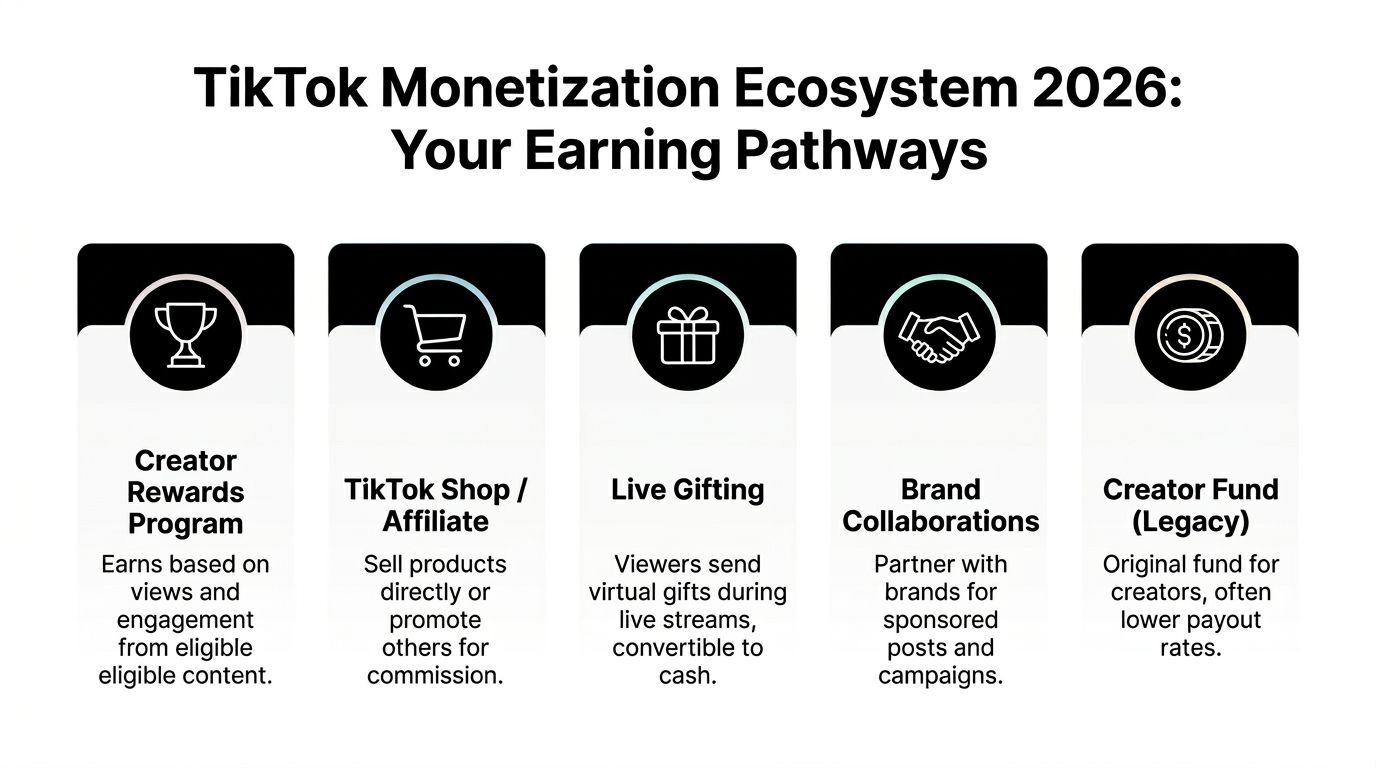
Creator Rewards Program
This is the most straightforward platform-paid option. TikTok pays eligible creators for original long-form videos that perform well.
It works best for accounts that can publish consistently, hold attention past the first few seconds, and produce content from experience rather than recycled clips. I like this model for educational niches, commentary with a clear angle, case-study content, and tutorial formats that can be repeated every week.
The trade-off is control versus speed. You do not need inventory, a storefront, or sponsor approvals. You do need qualifying metrics, policy compliance, and a content engine that keeps producing original one-minute-plus videos. If you want the exact mechanics, this step-by-step guide to the TikTok Creator Rewards Program covers the program itself in detail.
TikTok Shop and affiliate revenue
For many entrepreneurs, this is the highest-upside lane.
Shop and affiliate revenue reward buying intent, not just reach. A creator who reviews kitchen tools, tests supplements, compares software, or demonstrates beauty products can often earn faster here than through platform payouts alone. I have seen smaller niche accounts convert well because the audience showed up with a problem and the video offered a product-level solution.
The catch is operational. Product content has to persuade. Your hooks need to frame the problem quickly, your demonstrations need to remove buying friction, and your offers need to match the audience's budget and urgency. If the product is weak, refunds rise and repeat purchases disappear. If the niche is strong, one account can become a sales channel you can scale with more SKUs, more affiliates, or a private-label product later.
LIVE Gifts and subscriptions
LIVE monetization is relationship-driven.
Creators who answer questions, coach, react, teach, or host recurring sessions tend to do better here because viewers have a reason to show up in real time. This model fits personality-led brands, educators, and service businesses that want warmer leads. It is less predictable for faceless accounts unless the format itself creates strong participation.
The upside is cash flow and audience feedback. You learn objections, language, and buying triggers directly from viewers. The downside is time. Live income usually depends on consistent presence, and that limits scale unless you build systems around it.
Brand collaborations and Creator Marketplace
Brand deals usually produce the highest revenue per post once an account has clear positioning.
Brands are buying audience fit and conversion potential, not vague popularity. A niche creator with obvious expertise is easier to hire than a general account with mixed content. "Finance for medical residents" sells better than "money tips." "Warehouse gear tests for small e-commerce teams" is easier to package than "business content."
This category also has layers. Sponsored posts are only one piece. There is paid UGC, whitelisting, affiliate hybrids, monthly retainers, and long-term ambassador deals. For entrepreneurs, that matters because a TikTok account can become both a media asset and a client acquisition asset.
The old Creator Fund matters mostly as a warning
Older advice still talks about the Creator Fund as if platform payouts alone are the goal. That mindset is outdated.
TikTok monetization now works best as a portfolio. Platform revenue can smooth cash flow. Commerce can raise total earnings. Brand work can bring large jumps in revenue. A good account is built so one income stream can slow down without killing the business.
Which path fits which creator
Use the model that matches your content behavior and your niche economics.
| Monetization path | Best fit |
|---|---|
| Creator Rewards Program | Creators who publish original videos over one minute and can sustain strong engagement |
| TikTok Shop / Affiliate | Product reviewers, niche educators, Amazon and e-commerce operators, demo-style creators |
| LIVE Gifts / Subscriptions | Community-led creators, coaches, hosts, Q&A formats |
| Brand collaborations | Niche authorities with clear audience positioning |
| Hybrid model | Most serious entrepreneurs |
Hybrid wins for most business-minded creators because it gives you fallback options. If RPM drops, affiliate revenue can carry the account. If a product offer underperforms, brand deals or direct platform payouts can keep it profitable. That is a key advantage in 2026. TikTok is no longer just a place to get views. It is a revenue channel you can design.
How to Qualify for the Creator Rewards Program
If you want direct TikTok payouts, this is the gate you need to clear.
The mistake most creators make is assuming qualification is mostly about followers. It isn’t. TikTok is filtering for age, account type, view volume, and content quality. Hitting one requirement and missing the others still leaves you out.
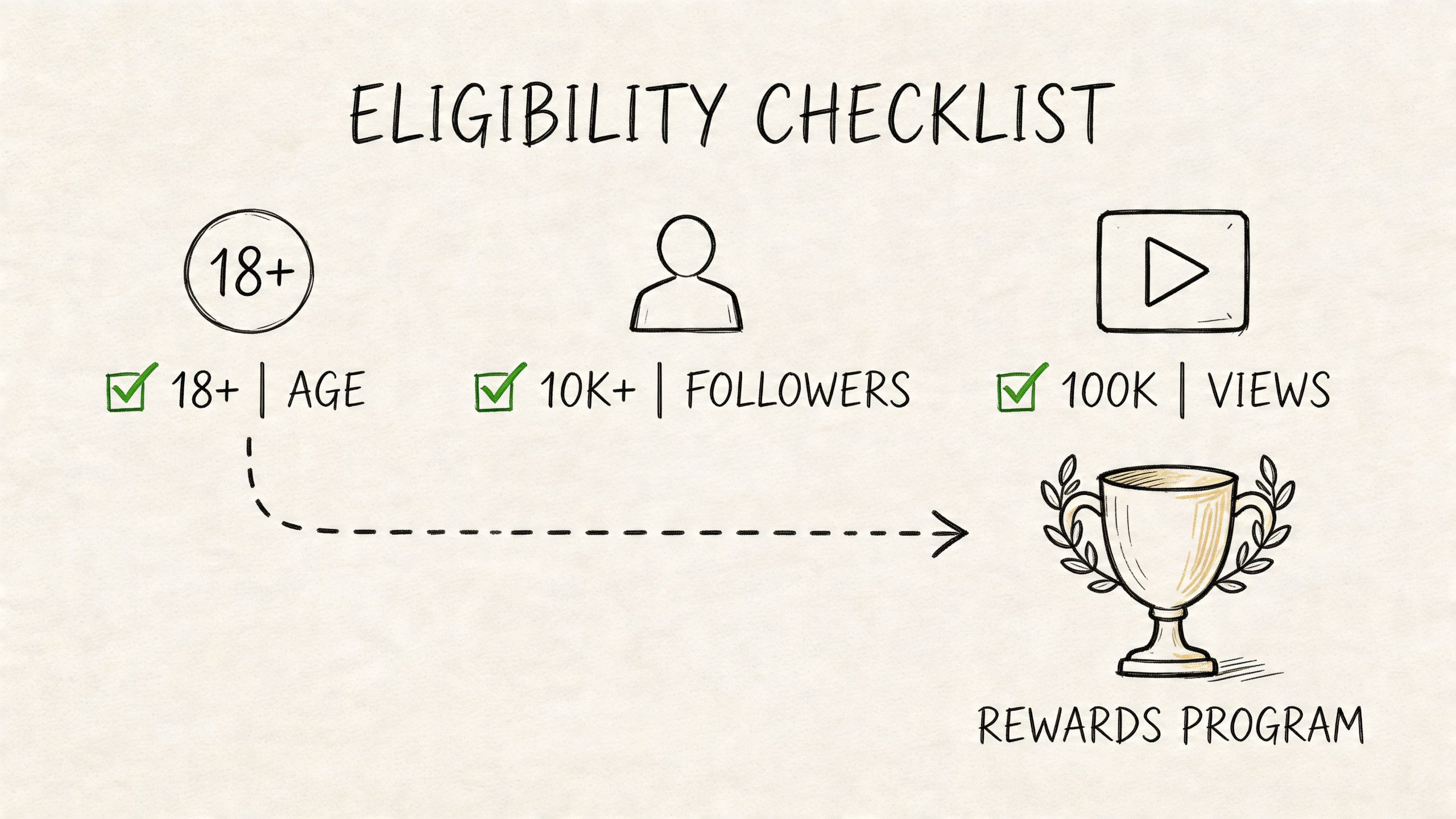
According to Metricool, to join the TikTok Creator Rewards Program, creators must be 18+, have 10,000+ followers, and achieve 100,000+ video views in the last 30 days. Common pitfalls leading to rejection in up to 70% of cases include reposted content and insufficient engagement, with a suggested target of a 15-20% view-to-like ratio for sustained eligibility (Metricool).
The requirements that actually matter
Here’s the short version.
| Requirement | Threshold |
|---|---|
| Age | 18+ |
| Followers | 10,000+ |
| Views | 100,000+ video views in the last 30 days |
There’s also an important content requirement tied to the program. Eligible content needs to be original and at least one minute long. TikTok also requires a Personal or Creator account, not a Business account, for this monetization path as outlined in the same Metricool breakdown.
The application flow inside TikTok
Once you meet the baseline, the actual application process is straightforward:
Check your account type
Make sure you’re using a Personal or Creator account.Open TikTok Studio
Go to your profile, open the menu, then go through Creator Tools to Monetization.Review eligibility status
TikTok will show whether your account currently qualifies.Submit the application
If eligible, apply directly inside the app.Wait for review
Metricool notes that approval often processes within days if the criteria are met.
If you want a walkthrough focused specifically on the platform flow, this step-by-step guide is useful: https://entreresource.com/earn-big-with-the-tiktok-creator-rewards-program-step-by-step-guide/
Why many creators get rejected
At this point, expectations need to be realistic.
A lot of rejected creators technically grew fast enough but built on shaky content. TikTok doesn’t just want views. It wants original videos that hold attention and fit the program’s standards. Reposts, low-effort remixes, and content with weak audience response often get filtered out.
Two failure points show up repeatedly in practice:
Reused content
If your account leans on reposts, duets used lazily, or recycled clips, approval gets harder.Weak engagement quality
A spike in views with poor response can still leave you short. That’s why the 15-20% view-to-like ratio benchmark from Metricool is useful as an operating target, not just a vanity metric.
Don’t apply the moment you barely qualify. Apply when your account clearly qualifies and your recent content is clean, original, and consistent.
What to fix before you reapply
If you get denied, don’t panic and don’t start deleting half your account blindly.
Instead, audit your last month of content:
- Remove obvious repost dependence
- Publish fresh one-minute originals
- Tighten hooks so viewers stay longer
- Double down on topics that already attract comments and saves
- Keep your account in good standing
The creators who get in fastest usually treat the application like a final checkpoint, not the start of the work. By the time they apply, the account already looks monetizable.
Content Strategies to Hit Monetization Thresholds Fast
Most creators don’t miss monetization because they lack effort. They miss it because their content strategy is too random.
If your goal is the Creator Rewards Program, your content has to do two things at the same time. It has to grow the account and it has to fit the monetization format, which means original videos that can hold attention past the short-scroll phase.
Build repeatable series, not random posts
A creator chasing trends often gets bursts. A creator building series gets momentum.
Series give viewers a reason to follow, not just watch once. They also make content production easier because you aren’t reinventing your format every day. Good examples include product breakdowns, myth-vs-reality clips, mistakes to avoid, side-by-side comparisons, and “part 1 / part 2” educational formats.
The strongest accounts usually have a few recurring buckets:
- Authority content that proves expertise
- Discovery content tied to trend energy or search demand
- Conversion content that naturally leads to products, offers, or future monetization
That mix works better than posting whatever seems popular that morning.
The first three seconds do heavy lifting
Metricool’s guidance on optimization includes A/B testing hooks in the first 3 seconds to improve retention, plus targeting stronger engagement patterns for eligibility sustainment, in the same monetization analysis cited earlier.
That lines up with what works on the platform. A weak opening kills a strong idea.
The easiest fix is to stop opening with introductions and start opening with tension. Don’t say who you are first. Start with the payoff, the mistake, the problem, or the claim.
Better openings tend to sound like this:
- “Most TikTok creators are monetizing too late.”
- “I tested three product angles and only one converted.”
- “If your account is stuck under the threshold, this is usually why.”
Specificity beats personality-first intros in most growth phases.
Make one-minute videos that deserve one minute
A lot of creators hear “post videos over one minute” and stretch short ideas. That doesn’t work.
A good one-minute TikTok needs structure. Open with the problem. Move into proof or explanation. End with a practical takeaway or next step. If the middle drags, viewers leave before the video can become useful for monetization.
A one-minute video isn’t long-form by YouTube standards. It’s short-form with enough room to develop one idea properly.
If you want better short-form execution generally, this resource on video creation tactics is worth reviewing: https://entreresource.com/influencer-video-tips/
Use trends carefully
Trends can help with reach, but they’re dangerous when they erase your positioning.
The right move is to bend trends toward your niche. A finance creator can use a trending audio to frame a money mistake. A product creator can use a trend to compare two tools. An Amazon seller can use trend momentum to talk through inventory errors or packaging wins.
The wrong move is abandoning your category every time a new sound starts circulating.
That kind of content may get views, but it usually attracts the wrong followers.
Here’s a useful example of format thinking in action:
What tends to work and what usually doesn’t
What works
- Clear niche repetition so TikTok and viewers know what the account is about
- Strong hooks that create immediate curiosity or relevance
- Original talking-point videos instead of recycled edits
- Content clusters around one problem set
- Longer clips with pace rather than filler
What usually doesn’t
- Trend-only posting with no business angle
- Faceless repost accounts trying to force eligibility
- Broad lifestyle content with no clear audience value
- Lengthening weak videos just to cross one minute
- Copying formats without adapting them to your niche
If you want to get monetized on TikTok faster, the shortcut isn’t luck. It’s making content that gives both the algorithm and the viewer a consistent reason to come back.
Maximizing Your Earnings Beyond the Creator Program
The Creator Rewards Program is useful. It’s not enough on its own for most entrepreneurs.
Real income on TikTok usually comes from stacking revenue streams around the same audience. That means using content to create multiple ways to earn from the same attention. One video can build authority, generate affiliate clicks, attract a brand, and strengthen future LIVE monetization.
A strong but underused strategy here is niche stacking. InfluenceFlow describes it as blending complementary niches, and reports that it can lead to 40-60% higher earnings by opening up broader partnership options and cross-industry deals (InfluenceFlow).
Why niche stacking changes your income ceiling
Single-niche accounts can work. But they often cap out fast if the niche has weak sponsor demand or limited product depth.
Niche stacking solves that by combining adjacent audiences. Think:
- Tech repair + sustainability
- ADHD productivity + blue-collar careers
- Amazon FBA + product sourcing tools
- Personal finance + minimalist living
A stacked niche creates more deal flow because multiple types of brands can justify sponsoring you. It also makes affiliate monetization easier because you’re not restricted to one narrow product category.
A creator who only fits one marketing budget has one set of buyers. A creator who bridges two markets is easier to monetize.
Brand deals work better when your angle is obvious
Brands don’t want to guess where you fit.
If your account clearly serves a specific type of buyer, you become easier to brief, easier to approve, and easier to renew. That matters more than trying to look “big.” A clear small creator often monetizes faster than a vague larger one.
A simple way to improve your odds:
- Define the audience in one sentence
- Make your last several videos obviously relevant to that audience
- Show product fluency without sounding like an ad account
- Keep a shortlist of products and brands you already use naturally
That last piece matters. Sponsored content converts better when it feels like a natural extension of the account.
TikTok Shop can become the fastest cash path
For many entrepreneurs, TikTok Shop is the shortest distance between content and revenue.
That’s especially true if you already understand product positioning, margins, demos, or direct response. Shop content doesn’t need celebrity energy. It needs believable use cases and clean framing of why someone should care now.
If you’re building the affiliate side specifically, this ultimate guide to affiliate marketing on TikTok Shop is a useful companion because it gets into the mechanics of how creators structure product promotion.
You can also support Shop content with paid amplification once you understand which creatives hold attention. For operators using paid media alongside organic, TikTok ad strategy becomes relevant too: https://entreresource.com/tiktok-advertising/
LIVE and creator-driven income fit different personalities
LIVE monetization is often underestimated by people who don’t enjoy direct audience interaction.
If you’re good in real time, LIVE can reinforce every other monetization stream. You answer objections, build trust, demo products, and deepen loyalty. If you hate live interaction, don’t force it just because it exists. Put that energy into product content or sponsor-friendly formats instead.
The larger point is diversification. TikTok should not pay you one way. It should pay you several.
Tracking Performance Navigating Payouts and Taxes
A lot of creators relax once the first dollars show up. That is usually where revenue stalls.
The operators who make TikTok meaningful as a business channel switch modes at this point. They stop judging the account by views alone and start managing it like a media asset with cash flow, margins, and reporting. That shift matters because two accounts with similar reach can produce very different income depending on retention, format mix, payout setup, and how cleanly the revenue is tracked outside the app.
Read analytics based on how TikTok makes money
TikTok rewards content that keeps users on-platform and keeps attention stable. Advertising is a major part of that business, so the platform has a clear incentive to favor videos that hold interest and support a strong user session.
That is why raw views can mislead you.
A post with lower reach but stronger retention often has more business value than a post that spikes fast and fades. I pay closest attention to watch time, retention curve, saves, shares, and comment quality. Those signals usually tell you whether a format has revenue potential or just novelty.
If a video gets attention but viewers leave early, I do not treat it as a win. It may help ego. It rarely helps earnings for long.
What to watch inside TikTok Studio
Inside TikTok Studio, focus on the metrics that help you make better decisions, not just nicer screenshots:
Estimated earnings
Check this at the video level, not only at the account level. One format usually carries a disproportionate share of revenue.RPM
Revenue per thousand qualified views tells you which content types earn efficiently. A story-based explainer, niche tutorial, or product-led breakdown can outperform broad entertainment content here.Retention by video
This is often the first place monetization problems show up. If viewers leave too early, revenue usually weakens even when reach looks healthy.Format spread
Compare categories against each other. Tutorials, commentary, case studies, product demos, founder clips, and stitched reactions do not monetize equally.Audience geography
If your monetization model includes brand deals, affiliate offers, or Shop, where your viewers live affects what traffic is worth.
The useful question is not “Which post got the most views?” It is “Which post type creates the best revenue per hour of effort?”
That is how entrepreneurs scale TikTok. They build around profitable formats, then use broad-reach content as a feeder, not the core business.
Handle payouts early
Do not wait until there is a meaningful balance sitting in the account.
Set up withdrawals as soon as you are eligible, confirm your payment details, and test that the payout process works. TikTok changes features by region and program, so I always verify the current withdrawal options inside the app before relying on a cash-flow schedule.
Then track every payment outside TikTok.
A simple spreadsheet is enough at first. Log payout date, source, amount, account, and related content type. If you run more than one revenue stream, keep them separate:
- Creator program payouts
- TikTok Shop earnings
- Affiliate commissions
- Sponsorship revenue
- UGC or client work tied to TikTok
- Paid media spend tied to content promotion
This matters for two reasons. First, platform dashboards are not your accounting system. Second, revenue concentration is a real risk. If 80 percent of your TikTok income comes from one stream, you need a fallback plan before that stream weakens.
Track earnings like a business, not a creator hobby
The simplest reporting setup is a weekly review and a monthly close.
Each week, review which videos earned, which formats held retention, and whether revenue is getting concentrated in one topic or one monetization source. Each month, total payouts, compare them against expenses, and calculate what the account produced in profit.
I also recommend tracking one metric that a lot of creators ignore. Revenue per video published.
That number forces discipline. If you publish 30 videos to make the same money another format makes in 10, the issue is not effort. The issue is format efficiency. That is where niche stacking becomes valuable. An account that sits at the intersection of buyer intent, a clear problem, and monetizable offers usually earns more than a broader account with higher vanity reach.
Taxes get harder if you delay the setup
TikTok income is business income. Treat it that way from the first payout.
Keep records for payouts, invoices, affiliate payments, software, props, editing costs, contractor payments, ad spend, and any product samples or inventory tied to content. Use a separate bank account if the income is material. It makes reconciliation easier and prevents personal spending from muddying the books.
The exact tax treatment depends on where you live, so use an accountant who works with creator or digital business income. That cost is small compared with the mess created by missing records, mixed accounts, or underreported revenue.
Creators who scale cleanly do the boring parts early. Payment rails. Bookkeeping. Expense tracking. Backup revenue streams.
That is what turns TikTok from a platform payout into a real operating channel.
FAQ Common TikTok Monetization Roadblocks
Most TikTok monetization advice assumes the path is linear. It isn’t. Accounts get rejected, features disappear by region, views stall, and some creators never get access to the same tools others talk about openly.
Those aren’t edge cases. They’re common operating problems.
What if my Creator Rewards application gets rejected
First, assume there’s a real reason.
The usual causes are content originality issues, weak recent engagement, or not meeting one of the active thresholds cleanly enough. Before reapplying, review your last batch of content and ask hard questions. Did you rely on repost-style material? Did your longer videos hold interest? Does the account look like a serious original creator account?
The worst response is rushing another application without changing the account.
Is shadowbanning the real reason my views dropped
Sometimes creators blame a shadowban when the simpler explanation is content mismatch.
A sudden drop can come from weaker hooks, lower retention, audience confusion, or pushing into a topic that your existing followers don’t respond to. Policy issues can also affect distribution, but “I’m shadowbanned” is often a vague label for “my recent content stopped landing.”
A better response is operational:
- Audit recent openings
- Compare retention against stronger past posts
- Check whether your topic drifted
- Review any guideline warnings
- Return to a proven format before testing new angles again
Why can’t I access the same monetization features other creators mention
Because eligibility depends partly on location, and TikTok doesn’t make that easy.
TikTok’s own support guidance notes that monetization options like Creator Rewards and LIVE Gifts depend on your location, but it doesn’t publish a full public list, which creates confusion for creators outside major markets. The same support guidance points to alternatives such as TikTok Shop Affiliates, which has a lower 5k follower threshold, or direct brand deals as more viable options for some creators (TikTok Support).
What should creators in restricted regions do
Build around the tools you can access.
That usually means:
- Affiliate offers
- Direct sponsorship outreach
- Bio-link driven traffic
- TikTok Shop if available in your market
- Service offers, consulting, or digital products sold off-platform
Entrepreneurs often have an advantage over pure creators. If you already sell something, TikTok can still be valuable even when a direct payout feature isn’t available.
Don’t build your whole strategy around a feature you may never get. Build around audience trust and a monetizable offer.
Can you make money before qualifying for platform payouts
Yes, and for many creators that’s the better route early on.
Platform payouts are attractive because they feel official. But if your niche supports products, services, affiliate commissions, or sponsors, you can monetize before TikTok itself pays you directly. In some cases, that income path is more resilient anyway because it doesn’t depend on one in-app program staying available.
The bigger lesson is that monetization on TikTok isn’t one switch. It’s a stack of options. The more ways your account can earn, the less fragile your business becomes.
If you’re serious about how to get monetized on TikTok, don’t wait for one perfect viral moment. Pick your revenue path, build content around it, and make sure every month of posting moves the account closer to a business, not just a bigger audience.