
Before you even think about pitching brands, you need to build a brand that they want to partner with. I'm not talking about your follower count. I'm talking about becoming a trusted voice in a very specific corner of the internet. When you build a focused identity and an engaged community, you stop chasing deals and start attracting them.
Building Your Brand to Attract Partnerships
Your online presence needs to be a magnet for the right opportunities. A strong, cohesive brand is the absolute foundation of a profitable creator business. It tells a brand manager everything they need to know: who you are, who your audience is, and why those people actually listen to you.

Define Your Niche and Value Proposition
Going broad is one of the most common mistakes I see new creators make, and it completely dilutes your value. You have to go deep. Your niche is that specific area where you become the absolute go-to expert. That focus is what makes you memorable and, more importantly, valuable.
A great way to find your niche is to look at where three things overlap:
- Your Passions: What could you talk about all day, for free? You can't fake genuine excitement. It's the soul of engaging content.
- Your Expertise: What do you know more about than the average person? This doesn't have to be from a fancy degree—it can come from your job, a serious hobby, or a life experience.
- Audience Needs: What problems can you solve? Your content needs to deliver real value, whether that's through education, entertainment, or inspiration.
For example, don't just be a "food blogger." That's too vague. Instead, become "the expert on 30-minute vegan meals for busy parents." See the difference? That specificity immediately tells your audience and potential brand partners exactly what you're about. It's also smart to keep an eye on industry trends, like the conversation around AI UGC vs. Human Creators in 2026, to help carve out your unique value as a human creator.
Audit and Align Your Content Strategy
Once you've nailed down your niche, your content has to back it up. Every single post. Go look at your last 20-30 posts right now. Could a complete stranger scroll through and immediately understand your core topic?
If your feed is a random jumble of travel pics, coffee shots, and a tech review, it’s just confusing. A brand manager will take one look and click away because they don't see a clear fit. Your content strategy should be designed to attract and pre-qualify your ideal audience. That way, when a brand lands on your profile, they see a community of people who are the exact customers they’re trying to reach. You can get more practical advice on this in our guide on how to build a successful brand as a social media influencer.
Your content isn't just for your current followers; it's a resume for your future brand partners. Every piece should prove you can speak to a specific audience with authority and authenticity.
Prioritize Engagement Over Follower Count
Let me be clear: vanity metrics like follower count are becoming less and less important to smart brands. What they really care about now is your engagement rate—the percentage of your followers who actually like, comment, share, and save your content. High engagement proves you have an active, loyal community, not just a bunch of passive accounts.
Believe it or not, micro-influencers (creators with 10,000 to 100,000 followers) often have much higher engagement rates than the huge mega-influencers. Brands know this. In fact, research shows micro-influencers can have engagement rates nearly 60% higher than macro-influencers (Later, 2021). They're increasingly putting their money on smaller creators who have a more direct and trusted line to their audience.
Here’s where to focus your energy:
- Create shareable stuff: Think useful tips, relatable humor, or cool infographics that people will instinctively send to their friends.
- Start conversations: Don't just post and ghost. Ask questions in your captions and stories, and make a real effort to reply to comments and DMs.
- Know your numbers: Track your metrics and know your average engagement rate. Anything over 3% is generally solid, though it varies by platform. Being able to confidently state that number in a pitch is a massive advantage.
Creating Your Professional Media Kit and Portfolio
Once you’ve got a handle on your brand, it's time to build your professional calling card: the media kit. Don't think of this as a resumé. It’s a sales tool, plain and simple. A brand manager sees dozens of these every single day, so a generic, one-page summary is going straight to the trash. A killer media kit, though? That shows you’re a professional and justifies the rates you’re about to ask for.
Your media kit is your first impression. It’s arguably your most important tool for landing brand deals. It needs to tell a story about why you’re worth the investment, and it needs to do it in a way that’s visually sharp and loaded with real data.
What to Include in Your Media Kit
A great media kit goes way beyond just listing your social media handles. It's a strategic pitch of your brand, your audience, and your track record. Every single piece of it should be laser-focused on answering the brand manager’s one big question: "Why should we work with you?"
Here are the absolute must-haves:
- A Compelling Bio: This is your elevator pitch. Quickly introduce yourself, your niche, and what makes you unique. What’s your mission? What value do you bring to your followers? Keep it short, powerful, and hook them from the first sentence.
- High-Quality Photos: You need a professional headshot and a handful of lifestyle photos that scream your brand. These visuals give a brand manager an instant feel for your content style and quality.
- Key Performance Metrics: This is where the rubber meets the road. Sure, include follower counts, but what really matters are the numbers that prove your influence. You need to showcase your engagement rate, average reach, and impressions.
- Detailed Audience Demographics: Brands have to know if your audience is their audience. Include the hard data on your followers' age, gender, location, and key interests. You can pull all this straight from the analytics tab on your social accounts.
If you want a calling card that actually gets you the deals you want, using a dedicated influencer media kit template is a smart move. It ensures you’ve got all your bases covered in a layout that looks slick and professional.
Showcasing Your Past Successes
Your portfolio is the proof that backs up the promises in your media kit. It’s where you show a brand you can deliver, not just tell them. A big hurdle I see new influencers struggle with is the feeling they have nothing to show if they haven’t landed a paid deal. This is where you have to get a little creative.
You don't need paid partnerships to start building a portfolio. Create spec work (speculative work) for brands you genuinely love and want to work with. Treat it like a real campaign. Create amazing, high-quality content, write a killer caption, and track how well the post does.
A portfolio of spec work or even successful gifted collaborations proves you can create on-brand content and drive engagement. This proactive approach tells brands you’re serious, you’re skilled, and you’re ready to deliver value from day one.
This strategy works so well because it shows serious initiative. When you eventually pitch that brand, you can include a link to the incredible content you already made for them. It’s a bold move, but it makes you impossible to ignore and shows them exactly what you bring to the table.
The Power of a Case Study Portfolio
As you start landing collaborations (even the gifted ones), your goal is to turn every single one into a case study. A case study does more than just show off the content; it tells the story of the campaign’s success with cold, hard data. This is what helps you level up to bigger and better brand deals.
A simple, effective case study should have these parts:
- The Brand & Campaign Goal: Who was the partner and what were they trying to do? (e.g., promote a new product, drive traffic to their site).
- Your Content Strategy: What content did you make and what was the thinking behind your approach?
- The Results: This is the money shot. Showcase metrics like reach, impressions, engagement (likes, comments, shares, saves), link clicks, and any sales data you can track (like from a promo code or affiliate link).
Present these case studies in a clean, visual way, either in your portfolio or as a dedicated section of your media kit. For instance, you could show a screenshot of a high-performing Instagram Reel you did for a skincare brand and list the metrics right next to it: 250,000 views, 18,000 likes, and a 7.2% engagement rate. This kind of concrete proof of ROI is exactly what convinces brands to cut the check.
Pricing Your Services and Negotiating with Confidence
Let’s talk about the part that makes a lot of creators uncomfortable: money. It can be awkward, I get it. But knowing your worth and how to price your services is the single most important step in turning your side hustle into a real, profitable business.
First things first, we need to ditch the outdated idea of "cost-per-follower." That's old-school thinking. Your real value isn’t just a number on your profile; it's the trust you’ve built with your audience and your skill in creating content that actually connects with them. Confidently pricing your work is about understanding that value and being able to explain it.
Calculating Your Base Rates
Before you can even think about landing deals, you need a starting point for your prices. This isn't a rigid price list you can never change, but a baseline that gives you a solid foundation for any negotiation.
Here are the main things I look at when figuring out my rates:
- Content Format: Let's be honest, video is king. A well-produced Instagram Reel or YouTube video takes way more time and effort than a static photo. Naturally, it should cost more. Don’t undervalue the work that goes into video.
- Platform: Not all platforms are created equal. A YouTube integration is a heavy lift and generally sits at the top of the price ladder. A TikTok video usually comes next, followed by an Instagram post.
- Engagement Rate: This is your secret weapon. A high engagement rate (think above 3-5%) is proof that your audience is loyal and listening. It’s a powerful bargaining chip that justifies a premium price, even if you don't have a massive follower count.
- Usage Rights: This is a big one that people often forget. If a brand wants to use your content on their website, social media, or—most importantly—in paid ads, that’s extra. This is often called "whitelisting," and you absolutely need to charge for it. A common starting point is an additional 20-50% of your base rate, depending on how long they want the rights for.
Think of your base rate as the floor, not the ceiling. It’s the absolute minimum you'll take for a basic project before you start adding on costs for things like exclusivity, usage rights, or tight turnaround times.
Creating Your Rate Card and Packages
A simple rate card instantly makes you look more professional. It’s a document that clearly lists your services and starting prices, which cuts down on the back-and-forth and shows brands you mean business. But here's a pro tip: don't just list a-la-carte prices. Focus on packages.
Packages are a win-win. They encourage brands to commit to a bigger campaign instead of just a one-off post, which means more revenue for you and better results for them.
A simple package might look something like this:
- 1 Instagram Feed Post
- 3 Instagram Stories with a link sticker
- 1 Instagram Reel
By bundling these deliverables together, you can offer a slight discount (maybe 10-15%) compared to what they’d pay for each item separately. This little incentive can be just the push a brand needs to increase their spend and lock in a more substantial partnership. The rates you set here are justified by the quality of your work, which is showcased in your media kit.
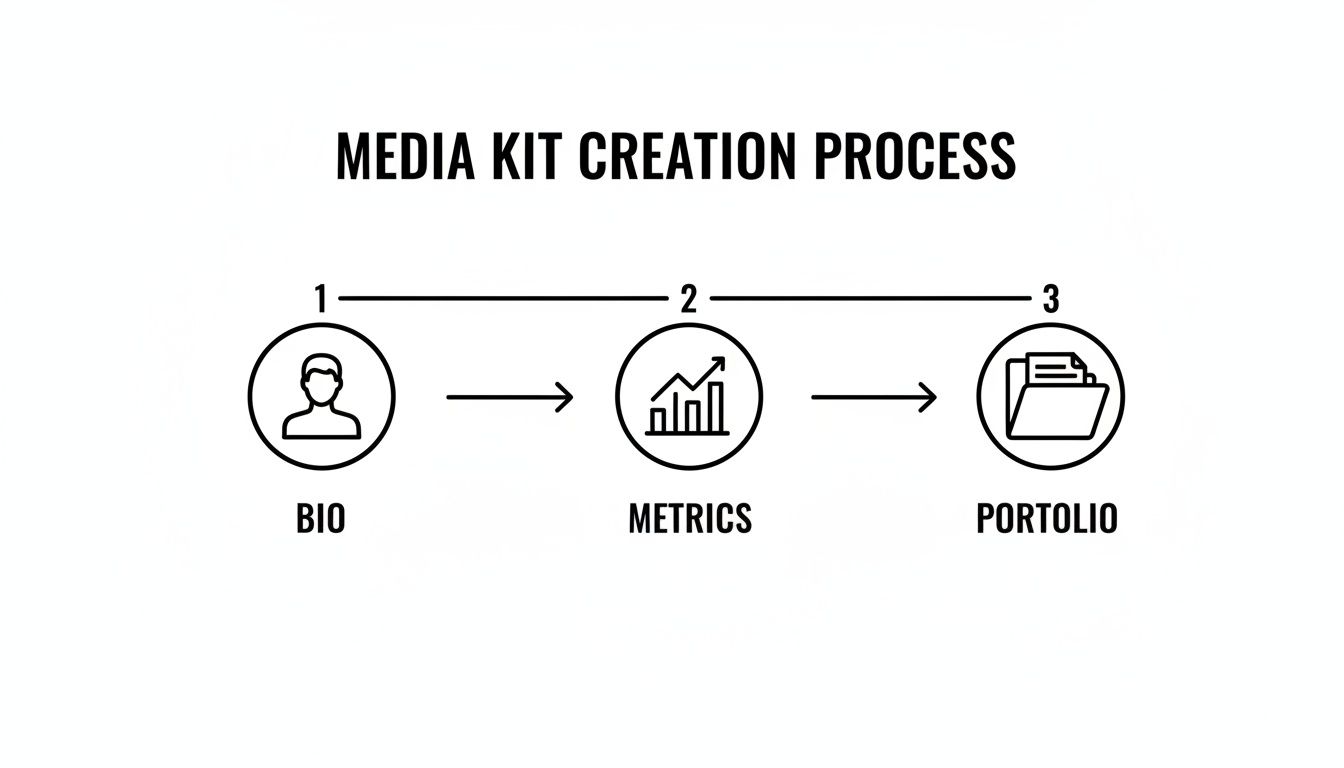
This process shows exactly how your story (bio), your results (metrics), and your past work (portfolio) all come together to prove you're worth the price you're asking.
Real-World Negotiation Tactics
Negotiation is a skill you learn by doing. The key is to stop talking about cost and start talking about value. So when a brand comes in with a lowball offer—and trust me, they will—don't just shut them down. Use it as a chance to show them what you're really bringing to the table.
Your data is your best friend here. I've seen micro-influencers with killer engagement negotiate deals 30% higher than the initial offer simply by showing off the data in their media kit.
For example, a fashion creator with 35K followers and a 6.2% engagement rate was offered $2,500 for three posts. Instead of accepting, she showed the brand that her audience had a 78% demographic overlap with their ideal customer. She countered with a custom package and landed the deal at $3,300—a 30% jump that eventually led to a $28,000 annual retainer. You can dig into more data on what other creators are charging in this comprehensive 2026 guide.
Here’s a script you can steal and adapt the next time you get a low offer:
"Thank you so much for the offer and for considering me for this campaign! Based on my average engagement rate of [Your Engagement Rate]% and the strong alignment between my audience and your target demographic, my rate for this scope of work is [Your Rate]. This price reflects the value and anticipated return for your investment. I'd be happy to discuss creating a custom package that meets your budget while delivering significant results."
This response does a few things perfectly. It’s polite and professional, but it’s also firm. It immediately shifts the focus from price to value and opens the door to creating a custom package. This shows you're flexible without caving on your worth—a crucial skill for landing the brand deals you deserve.
Mastering the Art of the Brand Pitch
If your strategy for landing brand deals is to sit around waiting for DMs from your dream brands, you don’t have a strategy. The creators who are actually building a business don't wait for opportunities—they make them. They find brands that perfectly match their audience, get in front of the right person, and send a pitch that's impossible to ignore.
This is how you stop being a passive creator and start actively building a real business.
Taking the initiative with outreach is the engine that drives a profitable creator career. It puts you in the driver’s seat, letting you pick and choose partners that you and your audience will genuinely love.
Finding the Right Brands to Pitch
Here's the biggest mistake I see influencers make: they only pitch massive, household-name companies. Those are fine as long-term goals, but the real gold is often with the smaller, up-and-coming brands. They have marketing budgets, but their inboxes aren't a warzone yet.
Start by looking at the brands your audience already talks about.
- Dig into your comments and DMs. What products are people always asking you about?
- Analyze your best-performing content. What topics or products spark the most conversation and engagement?
- Look at other creators in your niche. Who are they working with? Don't just copy them, but use it for inspiration.
This isn't just about building a list in a spreadsheet. Follow these brands on social, comment on their posts, and get a real feel for their vibe. This shows you have genuine interest, which makes your pitch a hundred times more effective.
Crafting an Unforgettable Email Pitch
Your first email is your one shot to prove you're a professional. It has to be short, it has to be personal, and it has to be about them, not you. A generic, copy-pasted template is an instant-delete for any busy brand manager.
Your goal is to bypass the general inbox and land in front of a decision-maker. This is usually someone with a title like Brand Manager, Marketing Coordinator, or Social Media Manager.
Here’s what your pitch needs to include:
- A Hyper-Personalized Subject Line: Think "Collaboration Idea for [Brand Name] x [Your Name]" or something even more specific like "Your [Product Name] & My Audience."
- A Quick, Punchy Intro: Introduce yourself and why you're a fan of their brand. Dropping a quick mention of a specific product or recent campaign shows you've actually done your homework.
- The Value Proposition: This is the heart of your email. Don't just say you have a great audience. Prove it. Attach your media kit, but also pull out a killer stat or two. For example: "My audience of millennial women (75% aged 25-34) has a proven interest in sustainable fashion, and my posts on this topic see an average engagement rate of 6.2%."
- A Clear Call to Action: Don't end with a weak "let me know if you're interested." Take charge. Propose a clear next step like, "I have a few creative ideas for how we could partner. Are you available for a quick 15-minute chat next week?"
The market is rewarding creators who can demonstrate their value. With campaigns now delivering an average return of $5.78 for every dollar spent, brands are getting serious. They're shifting their budgets to creators who can deliver measurable results, which makes pitching with proof of engagement more critical than ever. You can learn more about where the industry is heading by reading these in-depth influencer marketing statistics.
The Strategic Follow-Up System
Here's a hard truth: most of your emails will be ignored. It's not personal; brand managers are just swamped. This is why having a simple, non-annoying follow-up cadence is an absolute must.
A good system looks something like this:
- Follow-Up 1 (3-5 days later): This is just a gentle nudge. Reply to your original email and keep it simple: "Just wanted to bring this back to the top of your inbox. Really excited about the possibility of working together!"
- Follow-Up 2 (7-10 days later): This time, add new value. Find something to celebrate, like a recent launch of theirs, or share a relevant win of your own. "I saw you just launched your new spring line—it looks amazing! It reminded me of this post I did on spring trends that got over 20,000 likes."
- The Break-Up (After Follow-Up 2): If it's still crickets, it's time to politely bow out. Send one last email saying, "I can see you're busy, so I'll stop following up for now. Please feel free to reach out if things change in the future!" This keeps it professional and leaves the door open.
Brand Outreach Channel Comparison
Besides firing off cold emails, you can also use influencer marketing platforms to find deals. These sites are basically marketplaces where brands who are actively looking for partners post opportunities. I've found a combination of direct outreach and platform-based discovery to be the most effective way to keep my pipeline full.
To help you decide where to focus your energy, here’s a quick comparison of the main channels.
| Channel | Pros | Cons | Best For |
|---|---|---|---|
| Direct Email/DM | Total control over who you pitch and the terms; builds direct relationships. | Time-consuming; lower response rate without a strong pitch and follow-up. | Targeting your absolute dream brands for long-term, high-value partnerships. |
| Aspire | High-quality campaigns from well-known brands; good for relationship building. | Highly competitive; often requires a larger, established following to get noticed. | Established creators looking for bigger, long-term partnerships. |
| Shopify Collabs | Super easy to use; connects you directly with thousands of e-commerce brands. | Many opportunities start as gifted-only, especially for smaller creators. | Niche influencers and those just starting out with brand deals. |
| Impact.com | Massive network with access to both paid sponsorships and affiliate programs. | The platform can feel a bit corporate and has a steeper learning curve. | Creators who want a mix of one-off sponsorships and recurring affiliate income. |
| Creator.co | Very straightforward with clear campaign briefs and deliverables. | Payments can sometimes be slower than working directly with a brand. | Influencers who prefer highly structured campaigns and clear expectations. |
Think of these platforms as a supplement to your direct outreach, not a replacement. They are great for filling your calendar with opportunities while you continue to hunt down and build relationships with your dream brands.
By combining strategic, personalized outreach with the opportunities you find on these platforms, you create a powerful, two-pronged approach to consistently land brand deals.
Executing Flawlessly and Delivering ROI
You did it. You landed the deal, negotiated the terms, and the contract is signed. It's a great feeling, but this is where the real work begins. Getting the contract is just step one; delivering killer results is what separates a one-off gig from a long-term, high-paying partnership.
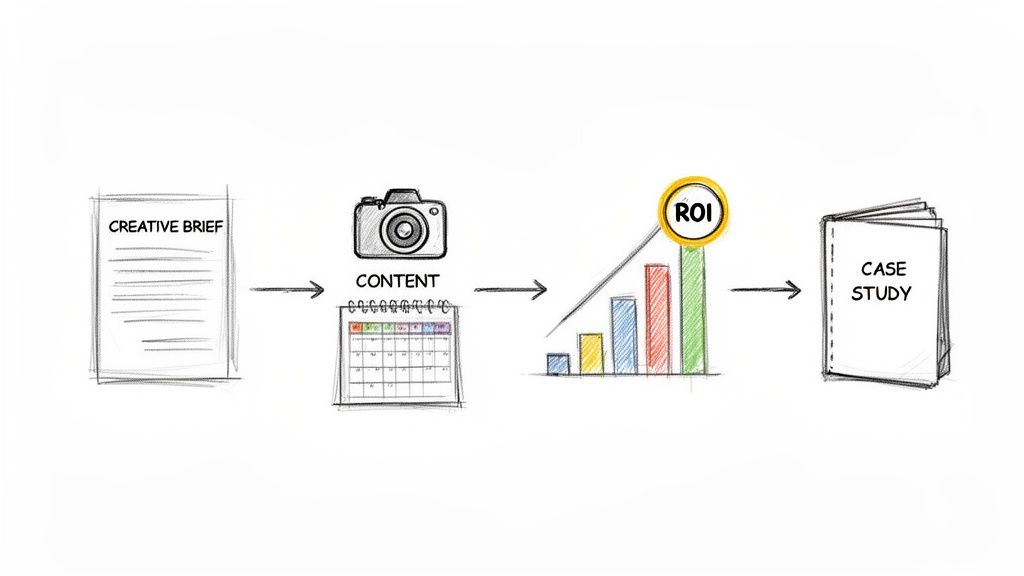
This execution phase is your moment to prove you're worth every penny and then some. A smooth process and undeniable results are your best sales pitch for the next brand deal.
From Creative Brief to Content Creation
Every great campaign starts with a solid game plan, and for us, that's the creative brief. This document lays out everything: the brand’s goals, key messages, specific deliverables, and the "dos and don'ts." Read it. Then read it again.
Your job isn't just to check boxes; it's to translate their marketing-speak into content that your audience will actually love. This is why they hired you. They want your creative spin and the trust you've built with your followers. Don't be shy about suggesting ideas that hit their goals while staying true to what you know works for your community.
A few tips to keep the content process smooth:
- Confirm Key Details: Before you hit record, triple-check the essentials. Product names, features they want you to hit, and the exact call-to-action (CTA) are non-negotiable.
- Establish a Timeline: Lock in deadlines for drafts, revisions, and the go-live date. It’s a simple sign of professionalism that prevents last-minute chaos and shows you value their time.
- Navigate the Approval Process: Brands will almost always want a final look before you post. Get your drafts in on time and be ready for feedback. If a suggested edit feels off-brand for you, don’t just say no. Explain why and offer a better alternative that still achieves their goal.
For example, if a brand gives you some stiff, corporate language, you could say, "I love the message here! For my audience, I think it'll land better if I phrase it like this… It feels more like me and should get way better engagement."
Tracking the Metrics That Matter to Brands
Once your content is out in the wild, your work isn’t done. Now you become a data tracker. Sure, likes and comments are nice, but smart brand managers are laser-focused on metrics that prove a real return on investment (ROI). They need to know how your content actually moved the needle for their business.
You have to go deeper than just vanity metrics. The numbers you share need to tell a compelling story of success.
Your end-of-campaign report is more than just a summary—it's a sales document for your next partnership. By showing a brand exactly how you delivered value, you create a powerful case study that proves you're a results-driven professional.
Brands are getting more and more serious about performance. Many now even use partnership platforms like Impact.com specifically for their robust reporting tools. That alone shows you how critical data has become.
Building Your End-of-Campaign Report
A killer report is clean, visual, and jam-packed with meaningful data. It needs to be simple enough for a busy brand manager to scan and immediately see the win. This report is a golden ticket for your portfolio, making it way easier to get brand deals as an influencer down the road.
Here’s what your report absolutely needs to include:
Key Performance Indicators (KPIs) to Track:
- Reach & Impressions: The total number of unique eyeballs that saw your post and the total number of times it was viewed.
- Engagement: Don't just list the total. Calculate the engagement rate: ((Likes + Comments + Shares + Saves) / Followers) x 100. This shows how well your content resonated.
- Link Clicks: This is a big one. If you used a special affiliate link or a link in your bio, this metric directly shows you drove traffic to their site.
- Story Views & Swipe-Ups: For Instagram or TikTok Stories, track not just views but the completion rate and the number of people who swiped up.
- Saves: This is a seriously underrated metric. A high number of saves tells a brand your content was so valuable that people wanted to come back to it later.
How you present this is key. A clean PDF or a simple slide deck works wonders. If you need some inspiration for creating content that pops, particularly with video, check out some of our top influencer video tips. Nailing the report solidifies your professional reputation and paves the way for the holy grail: a recurring partnership.
Frequently Asked Questions About Brand Deals
Once you start trying to land brand deals, you're going to have questions. It's totally normal. Let's tackle some of the most common ones I see from creators at every level, from getting your first deal to understanding the legal stuff.
How Do I Get Brand Deals with a Small Following?
Stop obsessing over your follower count. Seriously. Brands are getting smarter, and they're now prioritizing engagement rate and whether your audience is the right audience for them. A small, fired-up community almost always converts better than a huge, passive one. According to HypeAuditor's 2023 report, nano-influencers (1K-10K followers) have the highest average engagement rate at 2.53%.
To get on their radar, the first step is a professional media kit. This isn't just about pretty pictures; it needs to scream "I deliver results!" by highlighting your best engagement metrics and a detailed breakdown of your audience demographics. You can also start creating "spec" content—basically, free work for brands you genuinely love—to build a portfolio. Pitching smaller, local businesses for gifted collabs is another fantastic way to get your foot in the door, gather testimonials, and prove you know how to create content that works.
What Is the Difference Between a Paid Post, a Retainer, and an Affiliate Deal?
Knowing these terms is crucial for managing your business and understanding your income. They each represent a different kind of partnership.
- Paid Post: This is a one-and-done deal. A brand pays you a flat fee to create a specific piece of content, like a single Instagram post or one TikTok video.
- Affiliate Deal: This is all about performance. You earn a commission when someone makes a purchase through your unique tracking link or discount code. If this model sounds interesting, checking out something like the Amazon Influencer Program can be a great starting point.
- Retainer: This is the long game. A brand pays you a set fee every month for an agreed-upon number of deliverables.
A retainer is what most seasoned creators aim for. It means stable, predictable income and shows you've built a deep, trusting partnership with a brand that genuinely values your influence.
What Are the Most Important Terms in a Brand Deal Contract?
Never, ever sign a contract without reading every single word. I know it's tempting to skim, but this is your business. While every agreement will be a little different, there are a few non-negotiable clauses you absolutely must understand to protect yourself.
Key Contract Clauses to Scrutinize:
- Scope of Work: This needs to be crystal clear. It should spell out exactly what you're creating—the number of posts, formats, platforms, and any specific talking points or CTAs.
- Content Ownership and Usage Rights: This is huge. Who owns the content once it's made? More importantly, how long can the brand use it, and where? Can they use it on their social media? Their website? Can they turn it into a paid ad? Get specifics.
- Exclusivity: Does this deal stop you from working with the brand's competitors? If it does, you need to know for how long and exactly how they define a "competitor."
- Payment Terms: This covers the total payment, the payment schedule (I always push for at least 50% upfront), and how you'll get paid.
If you're new to this, I strongly recommend having a lawyer look over your first few contracts. It might seem like an unnecessary expense, but that small investment can save you from massive headaches and lost income down the road.