
To build a truly effective buyer persona, you need to dig deep into who your ideal customer is. It’s a mix of art and science—blending qualitative insights from real conversations with hard quantitative data from your analytics. The goal is to create a fictional profile that feels real, guiding your marketing, product, and content decisions with pinpoint accuracy.
Why Buyer Personas Are Your Most Powerful Growth Tool
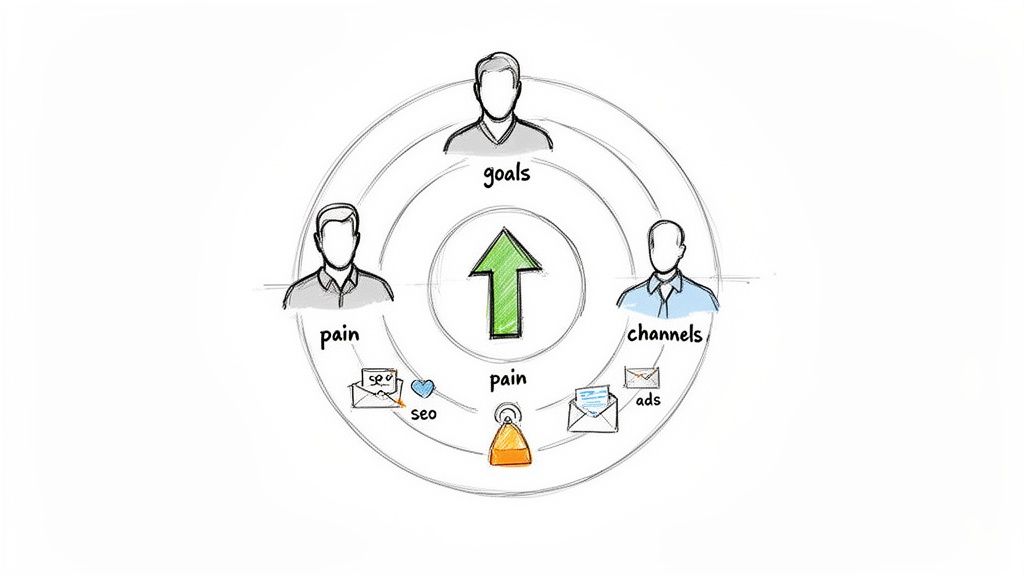
Trying to run an online business without clear buyer personas is like navigating blindfolded. You might get lucky and stumble into some sales, but your efforts will be scattered. Every blog post you write, every ad you run, and every product feature you develop becomes a shot in the dark.
This lack of customer clarity is a silent business killer. I’ve seen it lead to marketing messages that fall flat, ad campaigns that burn cash targeting the wrong audience, and products that nobody ever asked for. Personas are the fix, acting as the strategic anchor for every single growth initiative you undertake.
The True Purpose of a Buyer Persona
A great buyer persona goes way beyond a simple demographic snapshot. Sure, knowing your customer's age or location is a starting point, but the real magic is in understanding the why behind their behavior. It’s a semi-fictional character you create, but one that’s built on a foundation of real data and market research.
Think of it this way:
- A market segment tells you what your customer is (e.g., "male, 30-40, lives in Austin").
- A buyer persona tells you who they are (e.g., "Tech-Savvy Tom, a 35-year-old project manager in Austin who's struggling to find a work-life balance and listens to business podcasts on his commute").
That level of detail is what allows you to truly empathize with your audience. It forces you to step out of your own head and into your customer’s shoes, making decisions that genuinely serve their needs.
A well-crafted persona is not just a document; it’s a shared understanding across your team. It ensures your marketing, sales, and product development efforts are all aligned and speaking the same language to the same person.
The Core Components of a High-Impact Buyer Persona
To get that deep understanding, you need to collect specific pieces of information. This table breaks down the essential components that turn a basic profile into a strategic tool.
| Component | What It Tells You | Example for an Online Business |
|---|---|---|
| Demographics | The basic facts about who they are (age, gender, income, location, job title). | "Sarah, 32, a freelance graphic designer living in a major city, earning $75,000/year." |
| Goals & Motivations | What they are trying to achieve, both personally and professionally. | "She wants to grow her client base and streamline her workflow to achieve a better work-life balance." |
| Pain Points & Challenges | The specific problems and frustrations standing in their way. | "Struggles with time-consuming administrative tasks and finding high-quality project management software that isn't overly complex." |
| Communication Channels | Where they hang out online and how they prefer to get information. | "Follows design influencers on Instagram, is active in professional Facebook groups, and reads industry blogs like Creative Bloq." |
| Watering Holes | The specific blogs, podcasts, social media accounts, and influencers they trust. | "Listens to the 'Deeply Graphic Design' podcast and follows @jessicahische on Instagram." |
| Quotes & Keywords | The actual words and phrases they use to describe their goals and pains. | "I'm just so tired of juggling spreadsheets; I need an all-in-one tool to manage my projects from start to finish." |
Building out each of these areas will give you a complete, actionable picture of the person you're trying to reach.
From Static Profiles to Dynamic Growth Tools
In the past, personas were often just static PDFs, created once and then left to collect dust in a shared drive. That's a huge mistake. Modern, high-performing businesses treat them as living documents that evolve as customer behavior and market trends shift.
The data backs this up, big time. While some studies show that 94% of marketers say personas are essential, a shocking only 18% actually validate them with real customer data. This gap is a massive opportunity. Research shows that 71% of companies that consistently smash their revenue targets have well-documented personas. You can explore more buyer persona statistics and their impact on Prospeo.io.
This proves that creating personas isn’t some "nice-to-have" marketing exercise. It's a foundational piece of a winning business strategy. These profiles are the bedrock of effective:
- Content Marketing: Create blog posts, videos, and guides that solve your persona's most urgent problems.
- SEO Strategy: Target the exact keywords and search queries your ideal customers are typing into Google.
- Paid Advertising: Write ad copy that speaks directly to their pain points and build laser-focused audiences on platforms like Facebook and LinkedIn.
- Email Marketing: Segment your list and write emails that feel like a personal, one-on-one conversation.
- Product Development: Build features that your customers will actually use and love because they solve a real-world problem.
When you truly understand who you're talking to, you can stop guessing and start building a business that connects with the right people, every single time. This guide will walk you through exactly how to do it.
Gathering Your Raw Customer Intelligence
Here's where so many businesses go wrong with personas: they guess. They cook up an imaginary "ideal customer" in a boardroom, and the result is marketing that feels completely generic and misses the mark.
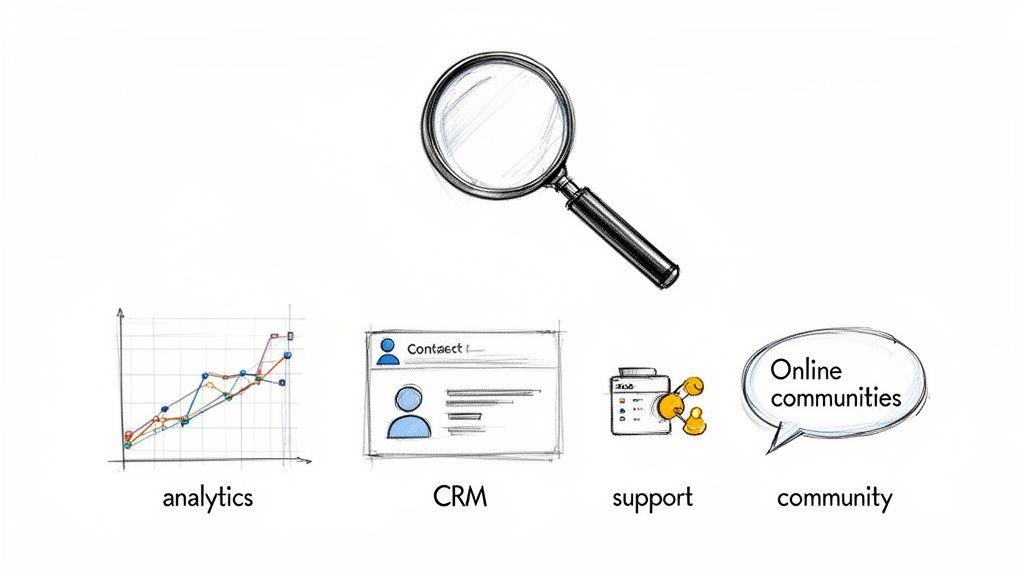
The best buyer personas aren't fiction; they're built on a solid foundation of real customer intelligence. This is the part of the process where you put on your detective hat and start digging for clues. Your goal is to find both quantitative data (the what) and qualitative data (the why).
As Tony Zambito, the originator of the buyer persona concept, emphasizes, the first tells you what people are doing, while the second reveals their motivations. You absolutely need both to build a complete, three-dimensional picture of who you're actually selling to.
Mining Your Quantitative Data
Let's start with the numbers. This is the low-hanging fruit—the objective data you probably already have access to. You don't need fancy, expensive tools for this. Your existing platforms are a goldmine of information if you know where to look.
Here are the key places I always start:
- Google Analytics: Head straight to the
DemographicsandInterestsreports. This gives you a quick-and-dirty baseline of your audience's age, gender, and general affinities. It’s your first layer of insight. - Your CRM or Email Platform: Dig into your customer list. I like to segment my list to find patterns among the highest-value customers. Do they share a common job title? Company size? Location? This tells you who you should be trying to attract more of.
- Social Media Insights: Every major platform—Facebook, Instagram, LinkedIn—provides rich analytics on your followers. Pay close attention to which posts get the most engagement. That's a direct signal of what your audience actually cares about.
This initial analysis gives you a solid, data-backed starting point. It helps you form early hypotheses about your core customer segments before you go deeper. For instance, if your analytics show a huge chunk of your traffic comes from a specific industry, that’s a massive clue telling you where to investigate next.
Uncovering Qualitative Insights
Numbers tell you what happened, but they rarely tell you why. To truly understand your customer, you need to hear their voice—their frustrations, their goals, and the exact language they use to describe their problems. This qualitative research is what breathes life into your personas and makes them feel like real people.
Your mission here is to set up "listening posts" where you can collect this raw customer intelligence without interfering.
The most powerful insights often come from uncensored, unsolicited feedback. These are the moments when customers reveal their true pain points, not the polished answers they might give in a formal survey.
To find these golden nuggets, you'll need to look in a few key places.
Your Internal Resources
Your own business is probably overflowing with this kind of data. Most people just don't know where to look.
| Data Source | What to Look For | Example Insight |
|---|---|---|
| Support Tickets/Emails | Recurring questions, common points of confusion, and features customers are asking for. | "Multiple customers asked how to integrate our tool with their accounting software, revealing a key workflow challenge." |
| Sales Team Notes | The most common objections prospects raise and the "trigger events" that prompt them to seek a solution. | "The sales team noted that most leads mention 'wasting time on manual data entry' as their primary frustration." |
| Product Reviews | The specific benefits customers praise and the disappointments they highlight. | "A review mentioned our product 'saved them 5 hours a week,' which is a powerful, specific benefit to use in marketing." |
External "Watering Holes"
Next, you need to go where your audience hangs out to talk candidly. These online communities are where you'll find unfiltered conversations about the problems your business is trying to solve.
Your job here is pure observation. Don't jump in and start selling; just listen.
- Reddit: Find subreddits related to your industry or niche (like r/ecommerce or r/blogging). Pay attention to the questions people ask and the solutions others recommend.
- Facebook Groups: Join groups where your ideal customers are seeking advice. The language they use and the frustrations they share are direct inputs for your persona’s pain points.
- Competitor Reviews: This is one of my favorite tricks. Read the 1-star and 5-star reviews for competing products. The negative reviews highlight market gaps, and the positive reviews show you exactly which features people value most.
Gathering this information is an essential first step, much like when you build a high-quality list for outreach. By combining these hard numbers with real human stories, you lay the groundwork for creating buyer personas that are not only accurate but also deeply empathetic.
Conducting Insightful Customer Interviews
Your analytics tell you what people are doing on your site. That's a great start. But the real gold is in the why. Customer interviews are where you stop looking at numbers and start understanding the actual human beings behind them.
This is your chance to uncover the stories, frustrations, and lightbulb moments that drive someone to actually pull out their credit card. A good interview isn't an interrogation; it's a conversation. It's how you get past the surface-level stuff and into the real context and emotion that fuels a buying decision.
Recruiting the Right Mix of Interviewees
First things first, you need to find people to talk to. It's tempting to only chat with your biggest fans, but that'll give you a skewed picture. To avoid getting stuck in an echo chamber, you need to cast a wider net and talk to a few different groups.
A solid recruitment plan should include:
- Your Best Customers: These are your raving fans. They get what you do, and they can clearly explain the "before and after" of using your product. Their stories are a goldmine for understanding your core value.
- Recent Customers: The buying journey is still fresh in their minds. They'll remember the exact trigger that started their search, who else they looked at, and what finally tipped the scales in your favor.
- Prospects Who Chose a Competitor: This group is arguably the most valuable. Finding out why someone didn't choose you is incredibly revealing. It puts a spotlight on your weaknesses, pricing issues, or messaging that just didn't land.
- Referrals from Your Network: If you’re just starting out and don't have a big customer list, don't worry. Hit up your professional network. Ask colleagues or contacts on platforms like LinkedIn for introductions to people who fit your ideal customer profile, even if they've never heard of you.
As a rule of thumb, aim to interview 3-5 people for each potential persona you're building. According to Nielsen Norman Group, interviewing just five users can reveal about 85% of usability problems, a principle that can be adapted to persona development; you'll start hearing the same stories and pain points over and over again, which is a good sign you’ve got a solid sample and can move on.
The Art of Asking Better Questions
The quality of your personas hangs entirely on the quality of your questions. You have to ditch the simple "yes" or "no" stuff. Your mission is to ask open-ended questions that get people telling stories. You're not just collecting facts; you're collecting narratives.
Your goal is to get them to walk you through their experience, in their own words.
The most powerful questions are those that prompt a story. Questions like "Walk me through…" or "Tell me about a time when…" invite detailed, context-rich answers that simple questions can't provide.
Here’s a framework of questions I've used time and again to guide these conversations and pull out the most valuable insights for building personas.
Questions to Uncover Goals and Motivations
These questions get to the heart of what your customer is really trying to achieve.
- "What does a 'win' look like for you in your role/business?"
- "When you first started looking for a solution like this, what were you ultimately hoping to accomplish?"
- "Can you describe the ideal outcome you were picturing in your head?"
Questions to Identify Pain Points and Challenges
This is where you dig into the "why" behind their search. The good stuff.
- "Walk me through the day you realized your old way of doing things just wasn't cutting it anymore."
- "What was the final straw that made you say, 'Okay, I need to find something new'?"
- "Describe the single biggest frustration you were dealing with related to [the problem you solve]."
Questions about the Buying Journey
These questions shed light on how they actually find and vet solutions.
- "Once you decided to actively look for a solution, what were the very first steps you took?"
- "What sorts of things did you type into Google?"
- "What other options or competitors did you look at, and what was your gut reaction to them?"
- "When it came down to it, what was the most important factor in your final decision?"
Managing the outreach and scheduling for interviews can be a pain. Using online forms helps streamline the whole thing. If you want to see my specific setup for this, check out my trick for managing applications with Typeform.
And a final pro tip: always offer a small incentive, like a gift card, to thank people for their time. Make it crystal clear that this is a research call, not a sneaky sales pitch. Your genuine curiosity will make people feel valued, and they'll open up with the rich, detailed stories you need to build personas that actually work.
Alright, you've done the legwork. You’re sitting on a pile of survey results, interview transcripts, and analytics reports. Now for the fun part: turning all that raw intel into something you can actually use to make smarter decisions. This is where we sift through the noise, find the patterns, and build out the customer profiles that will guide your strategy.
The whole point here is to find the common threads—shared goals, frustrations, and motivations—that let you cluster your audience into a few distinct groups. These groups will become your buyer personas, the living, breathing representations of your ideal customers.
From Raw Data to Cohesive Groups
Time to get your hands dirty. Lay out all your research—interview notes, analytics dashboards, survey responses, everything. Your first job is to spot the patterns. You're looking for themes that pop up again and again across all your different data sources.
Did a bunch of your interviewees mention the same piece of software they can't live without? That's a pattern. Does your traffic data show that one specific blog post about a certain problem gets all the love? That's a clue.
As you comb through it all, you'll start to see natural clusters emerge. You might spot a group of customers who are super price-sensitive and just want a quick fix. At the same time, another group might be more focused on long-term value and are willing to pay for it. These are your proto-personas starting to take shape.
The real magic happens when you connect the dots between the numbers and the stories. For example, if your Google Analytics shows a high bounce rate on your pricing page, and your interviews reveal people find your pricing "confusing," you've just uncovered a massive insight for a specific persona.
This whole process of gathering quality insights is the foundation for everything that follows. It's not just about collecting data; it's about making sense of it.
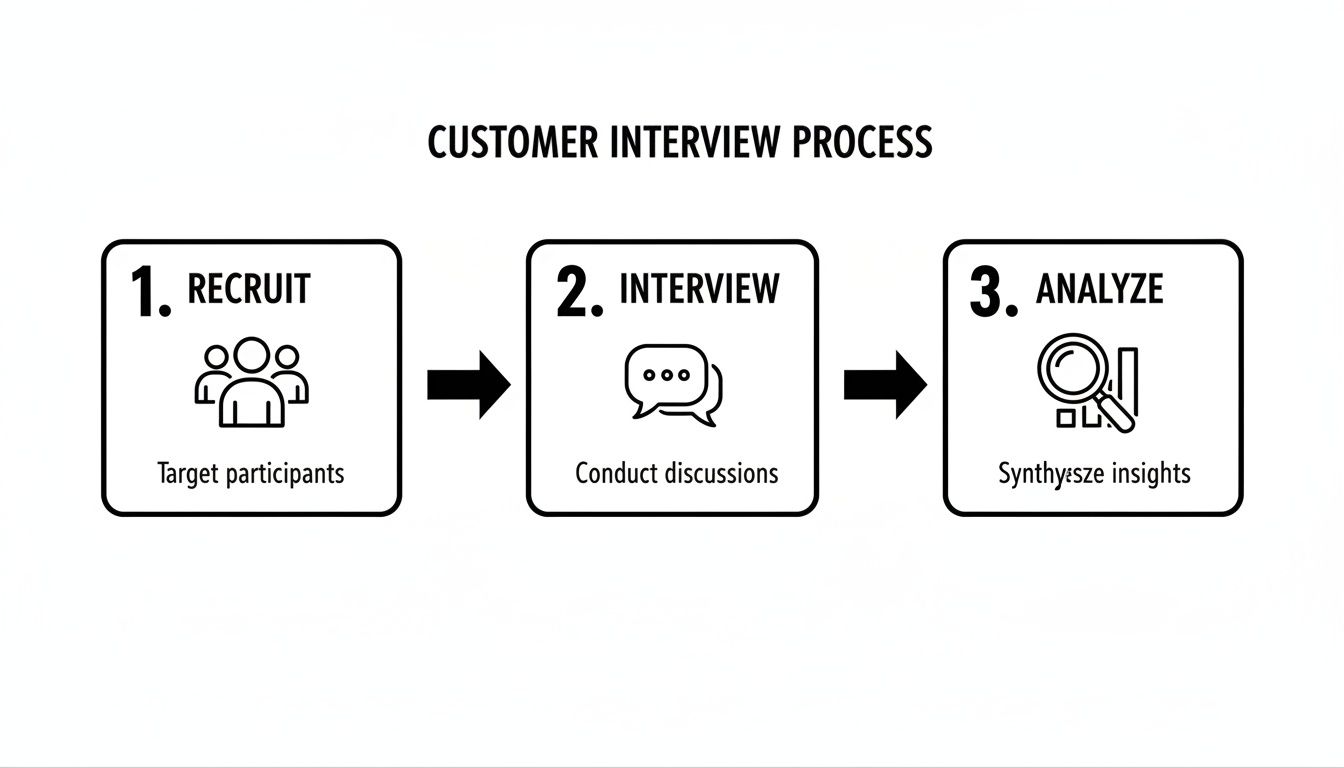
Think of it like this: recruiting the right people and asking the right questions are the inputs. The analysis is where you turn those inputs into profiles that can actually help your business grow.
Crafting the Persona Profile
Once you have 3-5 distinct groups, it's time to give each one a face and a story. This isn't about creating a dry, boring document. The goal is to build a narrative that makes your persona feel like a real person your team can easily understand and rally behind.
Here are the core pieces you'll want to include for each persona:
- Name and Photo: Give them a memorable, alliterative name (like "Side-Hustle Sarah") and find a stock photo that brings them to life. It sounds simple, but it makes a huge difference.
- Background: What’s their job? Company size? What does their day-to-day look like? A little context goes a long way.
- Goals: What are they trying to accomplish, both personally and professionally? What does a "win" look like for them?
- Challenges: What’s keeping them up at night? What are the biggest roadblocks standing between them and their goals?
- Watering Holes: Where do they hang out online? Name the specific blogs, social media channels, podcasts, and influencers they follow and trust.
- A Real Quote: Dig through your interview notes and pull out a powerful, one-sentence quote that perfectly sums up their biggest pain point or desire. This adds a layer of authenticity that's hard to fake.
By 2026, buyer personas are no longer just a nice-to-have; they're a competitive edge. While reports indicate that 44% of marketers report using them, the game has changed. We've moved from static PDFs to dynamic profiles that are constantly updated. The best practice is to refresh them quarterly using your CRM and analytics data, validated with 10-15 new interviews, to maintain 3-5 core personas that can account for 90% of your sales. If you want to go deeper on this, you can explore a complete guide to B2B buyer personas on Mixbright.com.
A Tangible Persona Example
Let's make this concrete. Imagine we run a business that sells productivity software for freelancers. After doing our research, we've identified a key customer segment we'll call "Side-Hustle Sarah."
Side-Hustle Sarah Persona
- Photo: [A stock photo of a woman in her late 20s working on a laptop at a coffee shop]
- Background: Sarah is a 29-year-old graphic designer with a full-time agency job. She spends her nights and weekends building her freelance business, with the ultimate goal of going full-time on her own.
- Goals:
- Land enough consistent client work to finally quit her day job.
- Spend less time on admin and more time on actual creative work.
- Look professional and organized to her clients, even if she feels like a mess behind the scenes.
- Challenges:
- She's completely overwhelmed trying to juggle her 9-to-5 with her freelance projects.
- She's using a messy combination of spreadsheets and free tools to handle invoices, contracts, and project management.
- Her biggest fear is dropping the ball on a client project because she’s so disorganized.
- Watering Holes:
- Blogs: The Futur, Creative Bloq
- Social: Follows design influencers on Instagram, browses Dribbble, and is active in the "Freelance & Business" Facebook Group.
- Podcasts: The Deeply Graphic DesignCast
- Quote: "I feel like I'm spending half my time on admin work instead of designing. I just need a simple, all-in-one system to keep my projects and finances straight without a huge learning curve."
This profile isn't meant to be filed away and forgotten. It's a tool. You and your team should be pulling it up daily to make smarter, more empathetic decisions about your marketing, product, and content.
Activating Your Personas Across Your Marketing
You’ve done the hard work. You’ve researched, interviewed, and built out some incredible buyer personas. Now what?
This is where so many businesses drop the ball. They create these beautiful persona documents, only to let them gather digital dust in a forgotten folder. A persona is worthless until you actually use it. The real payoff comes when you bake these profiles into every single marketing decision you make.
Suddenly, your persona isn't just a document; it's a filter. It becomes the shared language your team uses to make smarter, more empathetic choices. Vague goals like "improve engagement" transform into specific actions, like, "Let's create a video tutorial for 'Side-Hustle Sarah,' because our research shows she loves visual, step-by-step content."
This is how you turn research into revenue.
Tailoring Your Content Strategy
The most immediate and powerful impact of a good persona is on your content. No more guessing what to write about. Your content calendar can now be built entirely around solving your persona's biggest headaches.
Let's say one of your core personas is "Scaling Steve," an experienced Amazon seller who's hitting a wall with inventory management. Your content strategy instantly pivots. You can ditch the generic "how to sell on Amazon" posts and start creating content that actually helps him.
- Deep-dive guides on advanced inventory forecasting methods.
- Head-to-head comparisons of different multi-channel inventory management tools.
- Video interviews with supply chain experts who can speak directly to Steve's fear of stockouts.
Every article, video, and guide is created for a real person. You're answering their questions, using their language, and solving their specific problems. This approach dramatically increases the odds that your content won't just get found—it will resonate on a much deeper level with the exact people you want to attract.
When your content speaks directly to a persona's challenges, it stops feeling like marketing and starts feeling like a solution. This is how you build trust and authority in your niche.
Sharpening Your Ad Targeting
Paid advertising can feel like you're just throwing money at a wall and hoping something sticks. Personas are your best defense against wasted ad spend. When you truly understand who you're talking to, you can move past broad demographic targeting and build laser-focused audiences on platforms like Facebook and Google.
Think back to "Side-Hustle Sarah." Our research showed us she follows specific design influencers on Instagram and hangs out in a few key freelance-focused Facebook Groups. This isn't just trivia; it's targeting gold.
Instead of a generic ad set targeting "women, 25-35, interested in graphic design," you can get surgical:
- Build custom audiences that specifically target the followers of those influencers.
- Target members of the exact Facebook Groups she's active in.
- Write ad copy that mirrors her own words, like using a quote from her interview: "Tired of juggling spreadsheets? Finally get your freelance business organized."
This is the difference between shouting into a crowded room and having a quiet, compelling conversation with your ideal customer. Every dollar is spent reaching the people most likely to buy.
Fine-Tuning Your Email Marketing
Personas give you the power to segment your email list and turn generic email blasts into genuine, one-on-one conversations.
This isn't just a "nice-to-have." Imagine slashing your sales cycles by 36%. A 2026 Forrester report found that high-performing companies map over 90% of their database by persona and directly link that practice to shorter sales cycles.
With this in mind, you can craft entirely different email experiences for each persona. A "Beginner Barry" persona might get a welcome series packed with foundational, educational content. Meanwhile, an "Expert Ellie" persona could receive a sequence highlighting advanced features and customer case studies. For more on this, check out our guide on powerful email marketing tactics.
This kind of targeted approach doesn't just boost your open and click-through rates. It builds a much stronger, more loyal relationship with your subscribers, turning them from leads into legitimate fans.
Activating Personas Across Marketing Channels
To bring it all together, here’s a quick-reference table showing how you can put your personas to work across different channels. This isn't theoretical; these are practical actions you can take today.
| Marketing Channel | How to Apply Your Persona | Expected Outcome |
|---|---|---|
| Content Marketing | Create blog posts, guides, and videos that directly answer your persona's top 3 questions or solve their biggest pain point. | Higher engagement, increased organic traffic from relevant search terms, and more qualified leads. |
| Paid Social (Facebook/IG) | Use persona interests (influencers, tools, groups) to build hyper-targeted Custom and Lookalike Audiences. Write ad copy using their own words. | Lower Cost Per Acquisition (CPA), higher Click-Through Rate (CTR), and a better Return On Ad Spend (ROAS). |
| Email Marketing | Segment your list by persona. Send different welcome sequences, promotional offers, and content based on their specific needs and journey stage. | Improved open/click rates, fewer unsubscribes, and a shorter sales cycle. |
| SEO & SEM | Target long-tail keywords your persona would use when searching for solutions. Optimize landing pages to speak their language. | Higher rankings for commercially valuable keywords and better conversion rates on landing pages. |
| Product Development | Use persona pain points and desired outcomes to prioritize new features or product improvements. | A product that better solves real customer problems, leading to higher satisfaction and retention. |
Putting your personas into action is an ongoing process, not a one-time setup. As you gather more data and interact with more customers, your understanding will deepen. The key is to get started, test your assumptions, and continually refine your approach. This is how you build a marketing engine that truly connects with the people who matter most to your business.
Common Questions About Buyer Personas
Even with a perfect playbook in hand, you're bound to hit a few snags or have questions pop up when you start building out your personas. It happens to everyone. Let's tackle some of the most common hurdles I see people face, with some straightforward advice to keep you moving.
How Many Buyer Personas Do I Really Need?
It’s easy to fall into the trap of creating a persona for every tiny customer variation you can think of. Don't do this. It just creates noise and makes the whole exercise confusing for your team.
A much better approach is to focus on the vital few. For most online businesses, 3 to 5 solid personas will comfortably cover about 90% of your customer base, a best practice cited by many marketing leaders. If you're just getting your feet wet, start with one or two. Seriously. Zero in on the customer segments that are most critical to your business right now. It's way more effective to have a couple of deeply understood, actionable personas than a dozen shallow ones nobody can remember.
The goal isn't to capture every single customer. It's to build a focused set of profiles for your most important customer types, giving your team a crystal-clear picture of who they're serving.
What If I Have a New Business with No Customers?
Ah, the classic chicken-and-egg problem. It’s a common one, but totally solvable. When you don't have existing customers to analyze, you'll be creating what I call "provisional personas." These are built on educated guesses and some good old-fashioned market snooping. Your research just shifts from inside your business to the outside world.
First, size up your direct competitors. Who are they talking to? What language do they use? What problems does their marketing seem to solve? This will give you a rough first draft of your target audience.
Next, you need to become a bit of a digital anthropologist.
- Dive into the online communities where your ideal customers hang out. Think specific subreddits, niche forums, or active Facebook Groups.
- Listen intently. Pay attention to the exact language they use, the questions they keep asking, and the frustrations they vent about. This is raw, unfiltered gold.
- Think about interviewing people who are already using a competitor's product. You can uncover huge market gaps and unmet needs just by understanding their experience—what they love, what they hate, and what they wish the product could do.
These provisional personas are your starting line, not the finish. You have to be ready to test, validate, and refine them with real data as soon as those first customers start rolling in.
How Often Should I Update My Buyer Personas?
Creating your personas is not a one-and-done project you can check off a list. Markets change, tech evolves, and customer priorities shift. For your personas to stay useful, they have to be treated like living documents.
I recommend a formal review and update of your personas at least once a year. This means digging back into the data, maybe running a few new interviews, and re-validating all your initial assumptions.
But don't wait a full year to check in. I've found it incredibly helpful to hold a quarterly meeting with folks on the front lines, like your sales and customer support teams. Ask them one simple question: "Based on the calls you're having every day, does this persona still feel right?"
On top of that, any major business event should automatically trigger a persona review. Things like:
- Launching a major new product or service.
- Expanding into a new market or country.
- A big pivot in your marketing strategy.
Keeping your personas fresh ensures they remain a trusted guide for your entire company, helping you stay in sync with the people who matter most. If you want to go even deeper on the research side, HubSpot’s marketing blog has a ton of excellent resources.