
If you want to turn a simple side hustle into a full-blown, scalable business, you have to master one thing: bulk buying to resell.
This isn't just about finding a good deal here and there. It's a calculated business model designed to blow your profit margins wide open by leveraging volume. When you buy goods in massive quantities, you get access to per-unit costs that are completely out of reach for regular shoppers or even small-time retail arbitrage sellers. According to a 2024 analysis by McKinsey & Company on B2B pricing, volume-based discounts are a cornerstone of supplier-distributor relationships, enabling downstream profitability.
The principle is simple but incredibly powerful. You stop hunting for one-off clearance items and start building relationships with suppliers to buy cases, pallets, or even entire truckloads of a single product. This is what gives you a steady, predictable flow of inventory—the lifeblood of any sustainable business on competitive platforms like Amazon FBA.
Tapping into the Right Sourcing Channels
The first step is knowing where to look. Not all sourcing channels are created equal, and the right one for you depends on your capital, risk tolerance, and business goals. I’ve found success by diversifying, but most sellers start by focusing on one or two.
Here’s a quick breakdown of the main channels to help you figure out where you fit in.
Bulk Sourcing Channel Comparison
| Sourcing Channel | Typical Inventory Condition | Minimum Order Quantity (MOQ) | Potential Profit Margin | Best For |
|---|---|---|---|---|
| Wholesale | New, in-box | Medium to High | Moderate to High | Sellers wanting consistent, replenishable inventory for specific brands. |
| Liquidations | Varies (new, returns, damaged box) | Low to High | Can be very high, but variable | Risk-tolerant sellers looking for high margins and one-off pallet/truckload deals. |
| Direct from Manufacturer | New, in-box | Very High | Highest | Established businesses with significant capital and storage to become distributors. |
Each channel has its own rhythm and set of challenges. My advice? Start where you're most comfortable. Wholesale is predictable, while liquidations can feel like a treasure hunt.
The Real Game Changer for Resellers
This model is especially transformative for Amazon FBA sellers. Look, online arbitrage is a fantastic way to learn the ropes and make your first few thousand dollars. I get it. But it has a hard ceiling. You can only physically find and process so many one-off deals from retail websites. This is a well-documented limitation of arbitrage models, which often suffer from what economists call "scalability constraints."
This is where bulk buying separates the amateurs from the pros. If you're still on the fence, we've broken down the arbitrage model in our complete guide to online arbitrage sourcing tools.
The shift from one-off arbitrage to bulk buying is a shift in mindset. You stop trading time for dollars and start trading capital for scalable inventory and long-term profit.
Let’s be clear, the impact on your business is huge. Once you make the switch, you’ll see immediate benefits:
- Much Higher Profit Margins: Getting access to true wholesale or liquidation prices drastically cuts your cost of goods. This creates serious breathing room for profit on every single sale.
- Scalable Inventory: Forget finding one or two items. A bulk purchase gives you a large quantity of a single ASIN, which lets you actually rank products, run ads, and maintain consistent sales without constantly stocking out.
- Operational Efficiency: You streamline your entire sourcing process. You’ll spend way less time hunting for individual deals and more time on the things that actually grow your business—listing, marketing, and managing your operations.
- A Predictable Supply Chain: When you build real relationships with suppliers, you secure a reliable source for your best-selling products. This is how you stop worrying about stockouts and start planning for growth.
The opportunity here is just massive. The global wholesale market is the engine of all commerce, a multi-trillion-dollar industry. In 2026, its value was estimated between $57-60 trillion, and it's projected to climb over $73 trillion by 2029, according to market research from firms like Grand View Research. Tapping into even a tiny slice of that pie can completely change the trajectory of your resale business.
Mastering Your Sourcing Strategy
Finding profitable inventory is the lifeblood of any reseller. If you want to scale your operation beyond random retail finds into a predictable business, you need a rock-solid sourcing strategy. It's not just about finding products; it's about creating a consistent flow of inventory.
It all boils down to knowing where to look, how to talk to suppliers, and how to spot a good deal when you see one. Let's skip the fluff and get into the real tactics for the most common sourcing channels that actually work.
Decoding Wholesale Opportunities
Wholesale is the classic model for a reason. You're buying brand-new, in-box products directly from a brand or an authorized distributor. This means consistent, replenishable stock, which is the dream for any serious reseller.
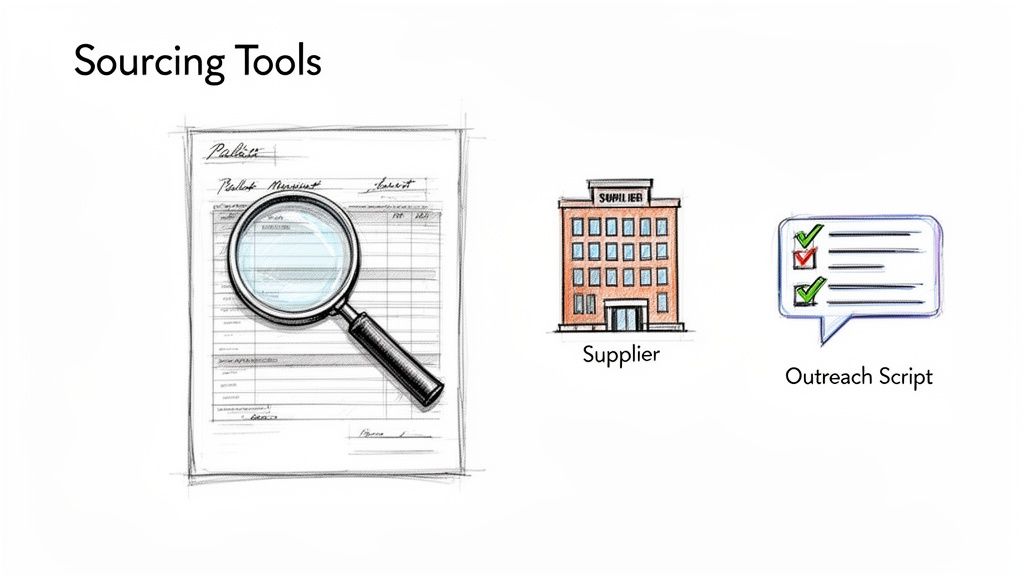
The first hurdle is just finding them. Don't just Google "wholesale suppliers." You have to get more specific. Try searching for things like "[Brand Name] wholesale program" or "[Product Category] distributors USA." Trade show directories—both virtual and physical—are also absolute goldmines for finding suppliers actively looking for retailers like you.
Once you find a potential partner, your first email is everything. A lazy "send me your price list" email will get you ignored.
Pro Tip: Frame your outreach like you're proposing a partnership, not just asking for a discount. You're a serious business that can help them move more product, and you need to sound like it.
Write a professional email introducing your business. Mention where you sell (your website, Amazon, etc.) and show that you have a specific interest in their brand. Dropping the fact that you have a reseller permit or business license is a simple way to show you’re legit.
Navigating the World of Liquidation
Liquidation is where you can hit home runs on margin, but it’s a high-risk, high-reward game. You’re usually buying customer returns, overstock, or shelf-pulls by the pallet or truckload. Success here is all about your ability to read a manifest and stomach a bit of uncertainty.
- Customer Returns: This is where the highest ROI potential lies, but it's also the riskiest. Be prepared for a wild mix of used, broken, and sometimes, perfectly new items. Research from Optoro, a returns logistics company, indicates that only a fraction of returned inventory is immediately ready for resale.
- Overstock/Shelf-Pulls: This inventory is usually new, but the packaging might be a bit beat up from sitting on a shelf or in a warehouse. It’s generally a safer bet than returns.
Platforms like B-Stock or Liquidation.com are great places to start, as they connect you directly with major retailers’ returns. The key is to study the manifest, which lists the items and their estimated retail value. Remember, that's just an estimate. Your real profit is what you can sell the usable items for after tossing the junk.
Tapping into the Recommerce Gold Rush
Beyond the usual suspects, the recommerce (used goods) market is absolutely exploding. This isn't your grandma's garage sale; it's a massive opportunity for bulk buying to resell. The numbers are staggering: by 2025, an incredible 93% of Americans had bought a used item, and the U.S. recommerce market is on track to hit $306.5 billion by 2030. You can explore the full 2025 recommerce report to see just how big this trend is.
This shift opens up entirely new sourcing channels, especially for platforms like eBay. Think about sourcing high-quality used electronics, designer fashion, or collectibles from local auctions, estate sales, or even targeted "we buy" ads. The skill set is a lot like liquidation—you're assessing condition and value—but you're often dealing with more unique, one-of-a-kind treasures. If you're looking for even more places to hunt for inventory, we've put together an exhaustive list of websites for online arbitrage product sourcing.
Finding a potential product to sell is the easy part. The real challenge in buying bulk to resell is knowing, with confidence, whether it will actually make you money.
It’s a process of disciplined analysis, not guesswork. This is where you move from just being a hopeful buyer to a strategic investor who prints money.
The foundation of every single profitable deal is unit economics. This just means breaking down all the costs tied to a product to find your true landed cost per item—the final, all-in price you pay to have a single unit in your possession, ready to sell.
Calculating Your True Landed Cost
Your landed cost is so much more than what the supplier quotes you per unit. It's the sum of that product cost plus all the other fees it takes to get that inventory from their warehouse to yours. This is probably the most critical number for any reseller, a concept widely emphasized in supply chain management textbooks.
Let's walk through a real-world example. Say you're buying 500 units of a popular kitchen gadget.
- Supplier's Cost: 500 units at $5.00 each = $2,500
- Freight Shipping (LTL): Cost to ship the pallet to your location = $400
- Receiving & Prep Fees: If using a 3PL, cost to receive, inspect, and label = 500 units at $0.50 each = $250
Your total upfront investment here is $3,150. To get the landed cost per unit, you just divide this total by the number of units: $3,150 / 500 units = $6.30 per unit.
See how quickly the per-unit cost jumped from $5.00 to $6.30? That’s the number you have to use for all your profit calculations. Ignoring these extra costs is a classic rookie mistake that I see all the time, and it almost always leads to surprise losses.
Forecasting Demand and Competitor Pricing
A great landed cost doesn't mean a thing if the product just sits on a shelf. Before you ever commit to a bulk purchase, you have to validate demand and get a feel for the competitive landscape on whatever marketplace you're targeting, whether it's Amazon, eBay, or your own store.
Start by digging into sales velocity. For Amazon, tools like Jungle Scout or Helium 10 are great for estimating monthly sales for a specific product. On eBay, you can check out completed listings to see how often an item sells and for what price. This research helps you answer the most important question of all: How fast will my investment turn back into cash?
Next, scope out your competition. Who’s selling the product right now? What are their prices? Do they have thousands in stock or are they about to sell out? If you're a new seller on a listing, you'll probably have to price aggressively to win the Buy Box, so you need to factor that into your potential sale price.
A critical part of this process is to ensure you have all the necessary documentation ready for marketplace verification. For a detailed rundown, consider our comprehensive Amazon sellers buying checklist to make sure you're prepared.
The Hidden Costs That Destroy Profits
Your work isn't done after you figure out the landed cost. There are a bunch of "hidden" expenses that pop up on the back end, after the sale, that will absolutely eat into your margins. You have to account for these to get a realistic picture of your net profit.
- Marketplace Fees: Amazon takes a referral fee (usually 8-15%) and FBA fulfillment fees. eBay has its own structure. These are non-negotiable, so know what they are.
- Storage Fees: If you're using Amazon FBA or a 3PL, you’re paying for storage every single month. For slow-moving inventory, these fees can stack up and turn a would-be winner into a total loser.
- Return Rate: Every product category has an expected return rate. Industry reports, like those from the National Retail Federation (NRF), often place average return rates between 10-20% depending on the category. If a product has a 5% return rate, you have to factor in the cost of those lost sales and returned units into your overall profitability model.
- Shipping to Fulfillment Centers: For FBA sellers, don't forget about the cost to ship your prepared inventory from your location to Amazon's fulfillment centers. It adds up.
By meticulously tracking every single cost—from freight shipping all the way to potential customer returns—you build a rock-solid financial model. This data-driven approach is what separates the consistently profitable resellers from those who are just gambling. It transforms bulk buying from a risky bet into a calculated business strategy.
Navigating Logistics From Purchase To Warehouse
You've crunched the numbers, shaken hands on a deal, and now you’re sitting on a purchase commitment. Awesome. But that product isn't going to magically appear in your warehouse. This is where your operational chops get put to the test.
Getting logistics right is the critical bridge between a killer sourcing decision and having actual, sellable inventory on your shelves.
The clock starts ticking the second you agree to the purchase. Your first move is to issue a formal purchase order (PO) to your supplier. This isn't just a friendly email confirmation; it's a legally binding contract. It locks in the product details, quantity, the price you both agreed on, and the payment terms. Treat it with the professionalism it deserves—it really sets the tone for your entire supplier relationship.
Arranging Freight And Receiving Your Goods
Once you’re buying more than a few boxes, you’re officially in the world of freight shipping. This boils down to two main choices: Less Than Truckload (LTL) and Full Truckload (FTL).
It's pretty straightforward. LTL is for shipments that don't fill a whole truck—think a few pallets. FTL is when you've bought enough inventory to command the entire truck space. Most sellers start out with LTL, as it's far more cost-effective for smaller bulk buys.
Sometimes your supplier will handle the freight arrangement, but you can also use a freight broker to shop around for better rates. A non-negotiable step here is getting a tracking number, which in the freight world is often called a PRO number. This lets you see exactly where your shipment is on its journey. As your operation gets bigger, you'll need a deeper understanding of bulk logistics, which can involve complex combinations of rail and trucking.
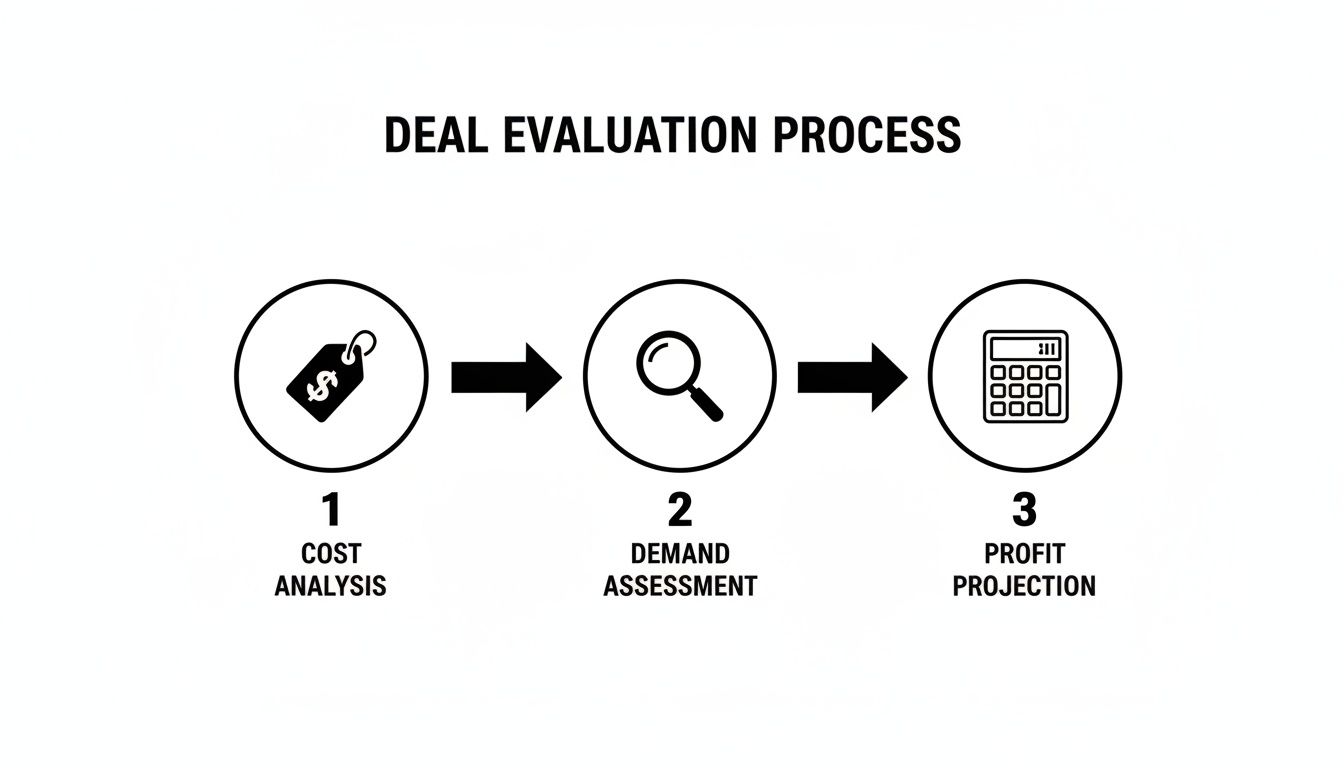
This diagram breaks down the deal evaluation process perfectly. It's a great visual reminder that a good deal is about more than just a low unit cost. It's the sweet spot where that low cost meets proven demand and a healthy, well-calculated profit margin. That’s the trifecta that defines a winning bulk purchase.
To make this tangible, let's walk through how you can calculate the potential return on investment (ROI) for a bulk buy. This simple calculation can save you from costly mistakes.
Sample ROI Calculator For A Bulk Purchase
| Metric | Calculation/Value | Example |
|---|---|---|
| Product Cost | Unit Cost x Quantity | $5.00 x 500 units = $2,500 |
| Inbound Shipping | Total Freight Cost | $300 |
| Total Landed Cost | Product Cost + Shipping | $2,500 + $300 = $2,800 |
| Per-Unit Landed Cost | Total Landed Cost / Quantity | $2,800 / 500 units = $5.60 |
| Projected Revenue | Est. Sale Price x Quantity | $24.99 x 500 units = $12,495 |
| Platform Fees | Revenue x Fee % (e.g., 15%) | $12,495 x 15% = $1,874.25 |
| Fulfillment Costs | Per-Unit Fulfillment x Quantity | $4.50 x 500 units = $2,250 |
| Total Costs | Landed Cost + Fees + Fulfillment | $2,800 + $1,874.25 + $2,250 = $6,924.25 |
| Projected Net Profit | Projected Revenue – Total Costs | $12,495 – $6,924.25 = $5,570.75 |
| Return on Investment (ROI) | (Net Profit / Total Landed Cost) x 100 | ($5,570.75 / $2,800) x 100 = 199% |
Seeing it laid out like this makes it crystal clear. An almost 200% ROI looks fantastic, but you only get there by meticulously accounting for every single cost along the way.
The Inbound Logistics Playbook
The moment that truck backs up to your dock is a moment of truth. Seriously. What you do in the next hour can save you from massive headaches and financial losses from damage or shipping errors. This is your inbound logistics process.
Have your PO and the supplier's packing list (the manifest) in hand. As the driver unloads the pallet, your first job is to give it a quick but thorough inspection. Are boxes crushed? Is the plastic wrap torn to shreds? Note every single imperfection on the Bill of Lading (BOL) before you sign it. If you sign a clean BOL, you're legally accepting the shipment "as is," and your chances of winning a freight claim later drop to nearly zero.
Key Takeaway: You absolutely must count the cartons and compare that count to the manifest while the driver is still there. If there's a shortage or any visible damage, document it on the BOL immediately. This piece of paper is your only leverage.
Once the driver is gone, the real fun begins. You need a dedicated space to break down the pallet and do a detailed check-in.
- Count Everything: Don't just count the boxes. Open them and verify the quantity of each specific SKU.
- Inspect Condition: Now you’re looking for damage that wasn't obvious from the outside.
- Document Discrepancies: Take photos. Create a detailed report of any shortages, damages, or incorrect items you received. Fire off an email to your supplier right away with all the evidence.
Storage And Prep For Resale
With your inventory counted and verified, you've got two new problems: where to put it all, and how to get it ready for sale. Your solution here will evolve as your business grows.
- The Garage/Basement Setup: This is where we all start. It’s free, and you have total hands-on control. The obvious downside is space. Your growth is literally capped by the size of your garage.
- Third-Party Logistics (3PL) Provider: As you start to scale, a 3PL is a total game-changer. They receive, store, and prep your inventory for a fee. This frees up your time and physical space, letting you handle much larger volumes when bulk buying to resell.
- Amazon FBA Prep: If you're an FBA seller, you know Amazon's prep requirements are no joke. This can mean poly-bagging items, slapping on suffocation warnings, and applying FNSKU labels. You can grind this out yourself, or you can pay your 3PL or a dedicated prep center to do it for you.
Choosing the right storage and prep path is a constant balancing act between cost, control, and your own sanity. Most successful sellers I know started with a living room full of boxes and eventually graduated to a 3PL. This disciplined, step-by-step logistical process is what separates the pros from the amateurs and turns a simple purchase into a smooth, profitable operation.
Channel-Specific Strategies for Selling Your Inventory
Sourcing profitable inventory is only half the battle. Turning that inventory back into cash is how you actually win the game. The channel you choose to sell on dictates everything—your listings, fulfillment, even customer service. Each platform has its own rulebook and, more importantly, its own customer culture.
A one-size-fits-all approach just doesn't fly here. The tactics that crush it on Amazon are completely different from what moves product on eBay or a personal Shopify store. Your choice should always come back to the type of inventory you've got sitting in your warehouse.
Making Money on Amazon with FBA
Amazon's Fulfillment by Amazon (FBA) program is a beast, especially for resellers who've sourced new, in-box wholesale goods. The beauty of FBA is that you’re tapping into Amazon's monster logistics network. You get compliant products to them, and they handle the rest: picking, packing, shipping, and customer service.
To really succeed with FBA, you have to become a stickler for compliance. I'm talking about meticulously following Amazon's strict packaging and labeling rules.
- Creating Bulk Listings: Don't waste your life creating listings one by one. Use their inventory loader files to upload hundreds or thousands of products in one go. It’s a game-changer.
- Prepping Shipments: Every single unit has to be prepped correctly. This might mean poly-bagging, slapping on suffocation warnings, or applying FNSKU labels so your stuff doesn't get mixed up with other sellers' inventory in the warehouse.
- Using the FBA Network: When you create a shipping plan, Amazon tells you exactly how to split your inventory and where to send it. This gets your products spread out across their fulfillment centers, which means faster delivery for customers.
Remember, when you're buying wholesale, you're almost always hopping on a listing with other sellers. In the U.S., the First Sale Doctrine gives you the right to resell genuine products you've legally bought. But Amazon can—and often will—ask for proof of authenticity, so keep those commercial invoices from your distributor handy.
Dominating eBay with Unique and Used Goods
eBay is your playground for inventory that doesn't fit the perfect, new-in-box world of Amazon. This is where you can absolutely clean up when you're bulk buying to resell liquidation pallets, customer returns, or unique, one-off items. Success on eBay is all about storytelling and being willing to manage your own logistics.
Since these items often have cosmetic dings or aren't in their original packaging, high-quality photos and brutally honest descriptions are your best friends. Seriously. Show every angle, point out any imperfections, and be transparent. eBay buyers appreciate the honesty and are usually there for a deal, so they're cool with a dented box as long as they know about it beforehand.
Handling your own shipping is a core part of the eBay hustle. That means you need a solid system for:
- Weighing and measuring packages with precision.
- Buying postage (you can get a nice discount right through the platform).
- Fielding all customer service questions yourself.
This hands-on approach gives you way more control, but it definitely eats up more of your time compared to the set-it-and-forget-it nature of FBA.
Building Your Brand with Shopify
For resellers playing the long game, setting up your own branded storefront on a platform like Shopify is the endgame. This strategy is perfect if you’ve locked down a consistent supply of a specific product line or you're thinking about private labeling. It’s the most work by far—you have to drive all your own traffic—but the payoff is total control and much higher margins.
With Shopify, you are the brand. You’re not just another seller on a crowded marketplace; you own the entire customer journey, from the first click to the final delivery. This means you’re on the hook for everything: website design, payment processing, marketing, and fulfillment.
When you're figuring out where to sell your inventory, the choice of marketplace is a huge decision. For anyone eyeing the South African market, you'll find a really solid breakdown in this guide on Amazon vs Takealot: A Seller’s Guide to South Africa’s eCommerce Battle.
No matter which channel you end up choosing, one piece of advice holds true across the board: always test a small batch first. Before you go all-in and ship hundreds of units to FBA or list an entire pallet on eBay, list a small quantity. This simple test confirms that people actually want your product, validates your pricing, and keeps you from getting stuck with a mountain of inventory that just won't move.
Thinking about jumping into bulk buying can feel like a massive leap. I get it. This is often the move that separates a simple side hustle from a business that can actually scale. As we've gone through the playbook, a few big questions always pop up. Let's get right into them so you can move forward with confidence.
How Much Capital Do I Really Need to Start?
There’s no magic number, and it's probably less than you think. Yeah, some manufacturer deals can hit five figures, but you can get your feet wet with liquidation for just a few hundred bucks.
A realistic starting point for your first couple of deals is usually in the $500 to $2,000 range. This is enough to grab a decent pallet of goods or hit a low Minimum Order Quantity (MOQ) from a smaller wholesale operation.
My biggest piece of advice? Start with an amount you are completely okay with losing. Seriously. Treat your first few buys as paid tuition. Your goal is to learn the process, figure out the logistics, and then roll your profits into the next deal.
What Are the Biggest Risks and How Do I Dodge Them?
I've seen it time and time again: the two things that absolutely wreck resellers are buying inventory nobody wants and completely botching the math. Either one can sink you.
You avoid buying duds by doing obsessive product research and starting with small test buys. Before you even think about a 500-unit order, buy 20. Prove there’s real demand before you go all-in.
The second risk—getting the numbers wrong—is all about creating a detailed cost-per-unit spreadsheet for every single deal. You have to factor in everything:
- The cost of the product itself
- Inbound freight shipping
- Marketplace referral fees (Amazon's can be a shocker)
- Fulfillment and storage costs
- A buffer for customer returns
Don't you dare skip this step. A deal that looks amazing on paper can turn into a money-loser once you uncover all the hidden costs.
Where Do I Find Legit Wholesale or Liquidation Suppliers?
Finding good, trustworthy suppliers takes more work than a quick Google search, but this is a skill that will pay you back tenfold. Your entire business is built on your supply chain.
For wholesale, start with industry trade shows (virtual ones are great, too) and trusted online directories. For liquidation, I'm a big fan of direct-to-business platforms like B-Stock. They partner directly with major retailers, which adds a layer of trust.
The First Sale Doctrine in the U.S. generally gives you the right to resell authentic products you’ve bought legally. But here's the catch: marketplaces like Amazon can still demand proof. This is why having proper commercial invoices from verifiable distributors is non-negotiable.
The best suppliers I've found came from cold, targeted outreach. Searching for "[Brand Name] + wholesale" or "[Product Category] distributor" and then sending a professional email can open doors that you'll never find in a public directory.
Is It Legal to Resell Products I Buy in Bulk?
Yes, in the United States, reselling authentic products is generally legal. The key words there are "authentic" and "legally." The legal principle underpinning this is the "first-sale doctrine," affirmed in the Supreme Court case Kirtsaeng v. John Wiley & Sons, Inc. (2013). When you buy from a reputable U.S. wholesaler or liquidator, they give you a commercial invoice. This document is your golden ticket.
That invoice is your proof of a legitimate transaction. It's what you'll show a platform like Amazon if they ever question your product's authenticity. Keep these documents organized. It’s a simple habit that will protect your account and your business.
Is Bulk Buying Better Than Arbitrage?
One isn't "better" than the other; they're just different tools for different stages of the game. Retail and online arbitrage are fantastic ways to learn the ropes. You're basically trading your time to hunt for one-off deals, and you learn a ton about what sells.
But bulk buying to resell is where scalability happens. It's how you shift from trading your time to trading your capital for a steady, replenishable stream of inventory. Instead of spending hours driving around to find single items, you spend that time negotiating one deal for hundreds of units.
This is the jump you make when you want to grow past the daily grind. It's how you transition from being a deal hunter to becoming a true business operator.