
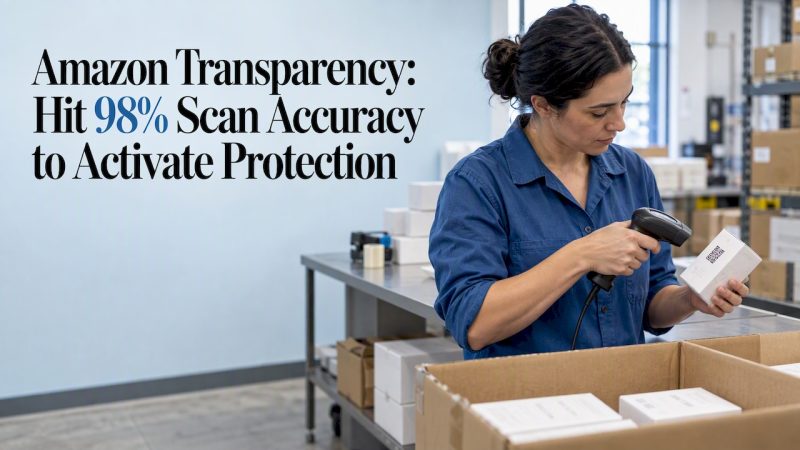
Amazon Transparency is a unit-level serialization program that prevents counterfeits, lets customers verify authenticity, and provides supply-chain insights. There’s no enrollment fee, but you pay per code once you join. Protections don’t switch on the moment you sign up, either: your products need to pass an Operational Performance Review with a 98% scan accuracy rate first.
TL;DR:
- Amazon issued codes let shoppers verify products in Amazon’s apps and see a product page badge; existing serials retain backend checks but lose those features.
- Enrollment requires an active trademark, a GTIN for every product, and Brand Registry access with the rights owner role; every unit needs a scannable code.
- A small test batch can expose poor print quality or inconsistent label placement before full production, avoiding delays during the required operational review.
- There is no enrollment fee, subscription, or minimum order, but every code costs money; discounts depend on order volume and geography.
- Start with a pilot of three to five high risk SKUs, especially counterfeit prone or higher priced products, before committing to catalog wide labeling.
Table of Contents
- How the Program Works: Codes, Scanning, and Verification
- Costs, Fees, and Pricing Model
- Eligibility and Step-by-Step Enrollment Checklist
- Implementation Options and Operational Considerations
- Benefits, What Transparency Prevents, and Pairing With Project Zero
- Impact of Transparency Enrollment on Customer Trust and Brand Reputation
- How Transparency Affects Returns, Refunds, and Fraud Prevention Processes
- Author Perspective: Rollout Recommendations and an Operational Readiness Checklist
- Enroll With Confidence, Then Build the Rest of Your Amazon Operation
- FAQ
- Sources
How the Program Works: Codes, Scanning, and Verification
Every unit enrolled in Transparency gets a unique alphanumeric code, printed as a small square 2D barcode. Amazon controls the code generation protocol, which means you can’t create your own Transparency codes outside the system, you either order them through Amazon or connect serial numbers you already use.
That second part matters more than it sounds. If you choose Amazon-issued codes, customers can scan the code themselves using the Amazon Shopping or Transparency app and see a verification result instantly. Connect your own existing serials instead, and you skip that customer-facing layer entirely: Amazon still checks authenticity on the back end, but shoppers lose the scan-and-verify experience and the product-detail page badge.
Amazon scans units arriving at fulfillment centers as part of the Operational Performance Review. These checks are intended to help prevent counterfeit units from being listed or shipped.
- Customers can use the Amazon Shopping or Transparency app to verify a unit’s authenticity.
- The app can indicate whether a scanned unit’s authenticity is verified.
- Brands using Amazon-issued codes can attach product photos, videos, or promotional content that appears when a customer scans.
The verification flow is simple on the surface, but it’s doing real work underneath: matching a physical unit to a database record before the unit is verified.
Costs, Fees, and Pricing Model
There’s no enrollment fee and no subscription to join Transparency. You pay per code when you order them, whether you’re using Amazon-issued codes or connecting your own existing serials.
98% scan accuracy is the threshold your products must hit during the Operational Performance Review before protections activate, which means budgeting for codes is only half the equation; you also need to budget time for testing.
- Per-code costs apply whether you choose Amazon-generated barcodes or connect serials you already manufacture.
- Volume discounts exist and vary by geography, so a brand’s rate depends on its order volume and location.
- There are no minimums and no subscription required, and check your account terms for details about how volume discounts are calculated.
If you’re trying to estimate what this will cost you, start with your annual unit volume per SKU and work backward. A pilot on a handful of SKUs will tell you more about real per-unit economics than any spreadsheet estimate, because label waste, reprints, and scan failures during testing all eat into the number you first calculate.
Eligibility and Step-by-Step Enrollment Checklist
Before using the enrollment portal, check the program’s current eligibility requirements:
- An active Amazon Brand Registry account where you hold the rights-owner role, not just a Brand Registry user seat.
- A registered trademark that’s active and tied to the brand you’re enrolling.
- A GTIN for every product you plan to enroll. If you’re still sourcing UPC codes for your listings, handle that before you start the Transparency application.
You’ll also need the operational capacity to apply a code to every single unit you manufacture, not just a sample batch. If you’re connecting existing serials rather than ordering Amazon’s codes, they need to meet Amazon’s serial code requirements and be externally scannable on the packaging.
Once eligibility is confirmed, the enrollment flow looks like this:
- Sign in to the Transparency portal using your Brand Registry credentials.
- Enroll your brand and add the products you want covered.
- Add team members who’ll manage codes and reporting.
- Order codes through the portal or API if you’re using Amazon-issued barcodes.
- Apply codes to every unit, then initiate the Operational Performance Review for either self-fulfilled or FBA inventory.
The OPR is where most brands get tripped up. Protections don’t activate until your scan accuracy hits 98%, so a messy label run or inconsistent placement during this review phase delays the whole rollout.
Implementation Options and Operational Considerations
You can order Amazon-issued codes for labels or packaging, or connect serial codes already used in manufacturing.
Each path changes your operational workload. Amazon-issued codes on labels are the fastest to test but add a labeling step if you don’t already print on-site. Designing codes into packaging is more work upfront but removes a manual labeling step later. Connecting existing serials is the least disruptive if your manufacturing already generates unique codes, though you give up the customer scan feature.
- Decide early whether you’ll print codes in-house, use a Transparency service provider, or coordinate labeling through your prep center.
- The API lets you automate code ordering and application if you’re running high volume across multiple SKUs.
- Someone on your team, or at your manufacturing partner, needs clear ownership of where and how codes get applied.
Pro Tip: Run a small sample batch through scanning before you commit to full production labeling, because catching placement or print-quality issues in a small sample batch is preferable to discovering them during your Operational Performance Review on a larger run.
Getting to that 98% scan accuracy threshold is mostly a quality control problem, not a technology problem. Label placement, print resolution, and consistent application across your production line matter more than which implementation option you pick.
Benefits, What Transparency Prevents, and Pairing With Project Zero
Serialization is intended to help prevent counterfeit or mismatched units from being listed or shipped. Because the program uses unique codes to help verify units, it can help prevent counterfeit products from being listed or shipped.
- Amazon scans units arriving at fulfillment centers as part of its verification process.
- Batch- and lot-level reporting gives you visibility into which manufacturing run or distribution point a problem unit came from.
- Amazon-issued codes let you attach product content, like instructional videos or promotions, that appears the moment a customer scans.
Transparency works even better paired with other protections. Project Zero adds automated scanning that proactively flags suspected counterfeit listings and gives you a self-service tool to remove them directly, without waiting on a case ticket. Brands running both programs together get prevention from serialization and fast removal from Project Zero, covering the problem from two directions instead of one.
Impact of Transparency Enrollment on Customer Trust and Brand Reputation
A counterfeit complaint does damage that’s hard to undo. A customer who receives a fake product rarely blames the counterfeiter, they blame the brand on the package, and that review sits on your listing indefinitely.
Transparency changes that dynamic by putting verification directly in the customer’s hands. When a shopper scans a code and sees a green check, that’s a small moment of reassurance that happens before they’ve even opened the box. When using Amazon-issued codes, that same scan can surface brand content, like usage instructions or warranty information, reinforcing that the purchase was legitimate and backed by the actual manufacturer.
For categories where counterfeiting is common, supplements, electronics accessories, beauty products, that verification step does more for repeat purchase confidence than almost anything else you can add to a listing. Shoppers in those categories are often burned once by a counterfeit before they even find your brand, so a visible verification option can be the difference between a one-time buyer and a returning customer.
The badge on the product detail page works the same way passively. It’s not a flashy marketing asset, but it signals to a browsing customer that authenticity is being actively managed, not just claimed in bullet points.
None of this replaces product quality or good customer service. But in categories where fakes are a known problem, removing the authenticity question from a customer’s mind removes one more reason to hesitate at checkout.

How Transparency Affects Returns, Refunds, and Fraud Prevention Processes
Counterfeit returns create a particular kind of headache: a customer returns a fake product, and without serialization, that unit can slip back into inventory or trigger a refund against your account for a product you never actually shipped.
Transparency’s code matching makes that harder to pull off. Unique codes can help identify units, but the supplied information does not establish how Amazon handles returned items that fail a code check. The supplied information does not establish that Transparency reduces fraudulent returns.
The reporting side helps just as much as the prevention side. Batch- and lot-level data lets you trace a spike in returns back to a specific production run or shipment, which is useful information whether the root cause turns out to be a counterfeiting problem or a legitimate manufacturing defect. Either way, you find out faster than you would from customer complaints alone.
This doesn’t eliminate return fraud entirely, and it won’t catch every edge case. But it gives you a data trail where before you had none, and that trail is often what turns a vague suspicion about rising return rates into a specific, actionable finding about where the problem started.
Author Perspective: Rollout Recommendations and an Operational Readiness Checklist
If your brand sells products that may be vulnerable to counterfeiting, consider whether Transparency’s per-code cost and operational requirements make sense for your business. You may also want to assess the counterfeit risk for higher-priced products and products shipped across borders.
Our recommendation: pick 3 to 5 high-risk SKUs and run a real pilot before enrolling your full catalog.
Before you start, confirm you have GTINs ready, an active trademark on file, Brand Registry access with the rights-owner role, a labeling partner or in-house process, and a plan for coordinating code application with your FBA inbound shipments.
— Nathaniel
Enroll With Confidence, Then Build the Rest of Your Amazon Operation
Getting Transparency set up correctly is one piece of running a protected, profitable Amazon business, but it’s rarely the only piece brand owners struggle with. GTIN sourcing, listing optimization, inbound logistics, and reporting all tend to pile up at the same time you’re trying to pass an Operational Performance Review.
We built our Instant Course Access for Life for exactly that stage of growth, when you need step-by-step workflows for the parts of Amazon FBA that don’t come with a clear manual, Transparency included. Current pricing is on our website. The course covers everything from sourcing and listing setup to the operational details that keep a brand running smoothly once the paperwork is done.
If you’re still working through the basics of product identifiers before you even reach the Transparency application, our guide on finding UPC codes for Amazon listings walks through that step cleanly. And if counterfeit sellers are already showing up on your listings, our piece on reporting sellers and problem listings covers the enforcement side that pairs well with Transparency’s prevention.
Get instant access to our full course library today and start building the operational foundation that makes programs like Transparency easier to execute correctly the first time.
FAQ
How much does the Amazon Transparency Program cost?
There’s no enrollment fee or subscription cost to join Transparency. You pay per code when you order them, with volume discounts available that vary by geography, whether you choose Amazon-issued codes or connect your own existing serial numbers.
Is Amazon Transparency worth it?
For brands in counterfeit-prone categories or selling higher-price SKUs, the serialization and customer verification features tend to justify the per-code cost. For low-risk commodity products with little counterfeit activity, the operational lift of labeling and passing the Operational Performance Review may outweigh the benefit.
Can you really get paid to review items on Amazon?
That’s a separate program from Transparency, and it isn’t something the Transparency enrollment process covers. Transparency is a brand protection and serialization tool for sellers and brand owners, not a review or compensation program for shoppers.
How do I get an Amazon Transparency code?
You’ll need an active Brand Registry account with the rights-owner role, a registered trademark, and a GTIN for each product before you can enroll. Once eligible, you sign in to the Transparency portal with your Brand Registry credentials and either order Amazon-issued codes or connect your existing serial numbers.
Sources
- Amazon Transparency | Sell on Amazon
- Amazon Transparency: Counterfeit and brand protection
- Project Zero | Sell on Amazon