
Ever spent hours crafting a scene only to have the chatbot forget your hero’s name a few lines later? One Reddit user likened Character.AI’s short memory to “talking to a goldfish,” and the lapse breaks immersion fast.
Fortunately, newer platforms now treat story context like canon. DreamGen, for example, lets you lock key lore in a Scenario Codex so the plot stays straight while you write.
This guide ranks seven standout AI role-play apps for long-term continuity and shows who each one serves best.
How we scored and ranked each app
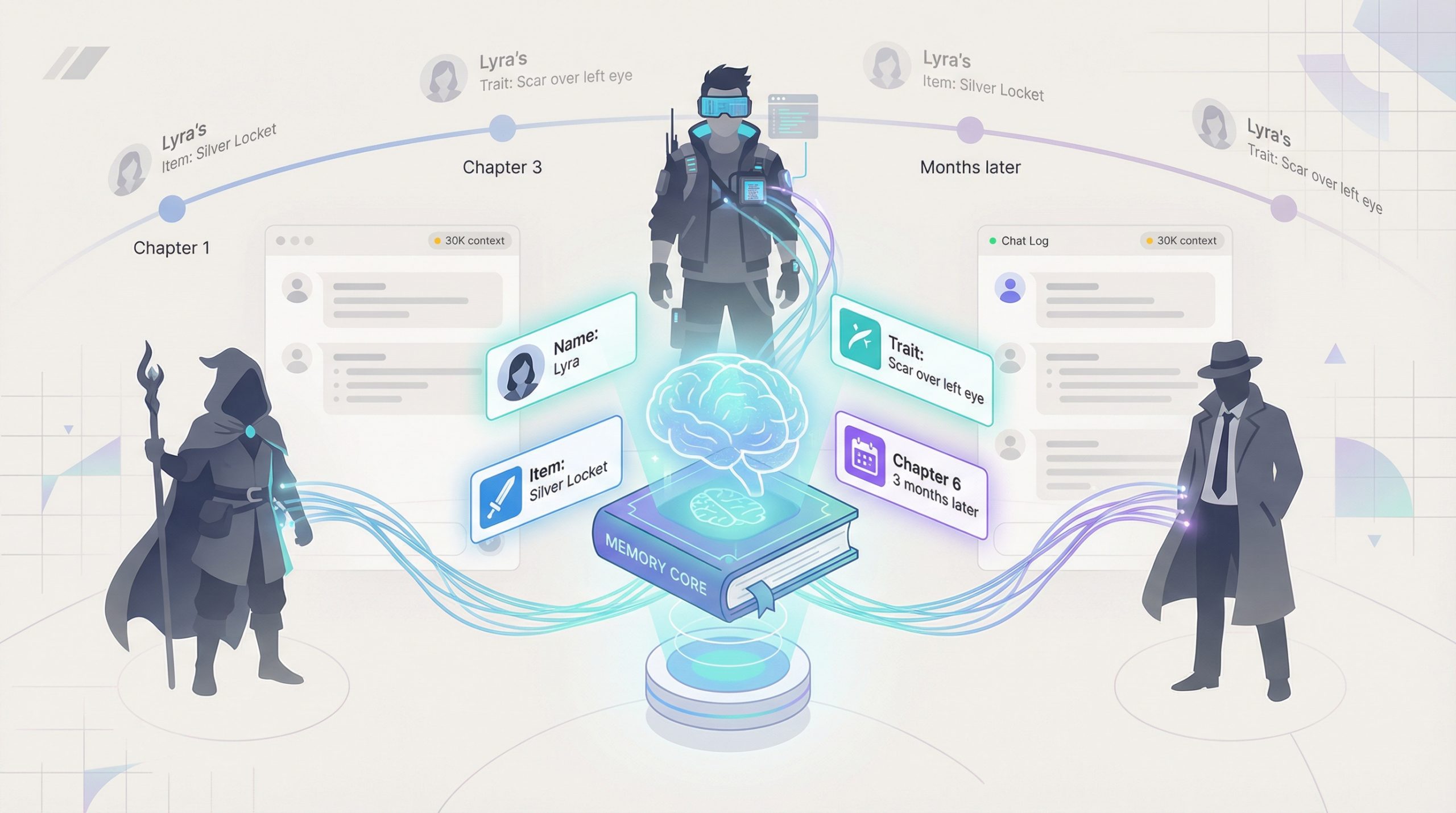
We didn’t toss darts at a board. We put every contender through the same test battery and let the numbers decide.
First, we trawled forums, changelogs, and product docs to confirm one non-negotiable requirement: each app must preserve context far beyond a quick chat. Anything that still forgot lore after a handful of messages was removed.
Then we graded the survivors on four weighted factors.
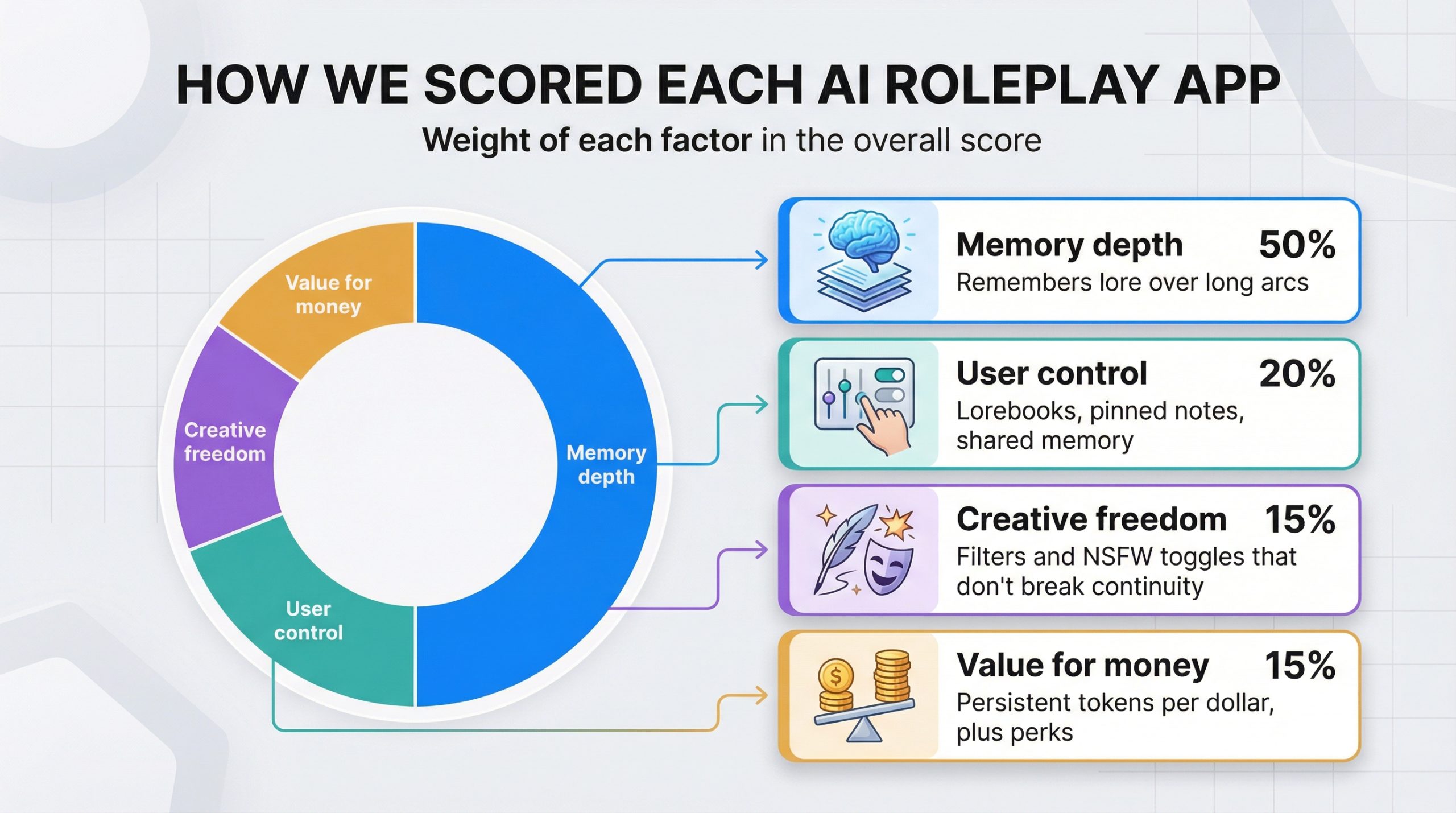
Memory depth (50 percent). We looked at raw context limits (4 K, 8 K, 30 K tokens) and, more importantly, real-world recall tests. A March 2026 benchmark showed Nomi remembering 10 of 12 personal facts after three months. Scores here set the pace for the entire list.
User control (20 percent). Editable lorebooks, pinned notes, shared memory files—anything that lets you steer what the bot stores earned big points.
Creative freedom (15 percent). Filters matter. If an app censors key scenes, continuity still breaks. We favored platforms that let your story breathe, including NSFW toggles where legal.
Value for money (15 percent). Long memory burns compute. We compared how many persistent tokens you get per dollar, plus perks like voice calls or image generation.
Each app’s total became its rank. DreamGen leads on memory depth and provides a permanent Scenario Codex without breaking the bank. Janitor AI takes the flexibility crown if you’re willing to supply your own API key.
That’s the scorecard. Now we can meet the winners.
The at-a-glance comparison
Before we examine each pick, it helps to see the field in one sweep. Scan the grid below, note who nails context size, and keep an eye on the free-tier column if you’re budgeting.
AI app | Memory approach | Max context | Edit the memory? | Multi-char scenes | NSFW friendly | Free tier |
DreamGen | Scenario Codex + retrieval engine | 30 K tokens (Pro) | Yes | Yes | Yes | Limited |
Nomi | Long-term companion notes | Not stated; recalls months later | Partial (Shared Notes) | No | Mild | Trial |
Candy AI | 8 K-token window + auto summaries | 8 K tokens | No | No | Toggle | Yes |
Kindroid | Layered persistent + cascaded | Hundreds of messages | Yes | Yes | Yes | Basic |
SpicyChat | Semantic Memory 2.0 vectors | ~8 K effective | No | Partial | Yes | Yes |
Janitor AI | Model-dependent (add GPT-4, Claude, etc.) | Up to 100 K with Claude | Via prompt | Beta | Yes | Yes |
Character.AI* | On-the-fly summaries | ~10–15 messages | No | Partial | No | Yes |
*Benchmark entry for context only.
This table doesn’t pick winners; that comes next. It does, though, highlight two clear standouts. DreamGen stretches context to a novel-length 30 K tokens, while Janitor AI raises the ceiling to 100 K if you connect Claude.
Use the columns as a quick filter. Need multi-character party chat? Check “Multi-char scenes.” Want an uncensored sandbox? The “NSFW friendly” line narrows the field fast.
Now that the landscape is mapped, we can review the first top pick.
DreamGen – best for world-building and long-form lore
How the Scenario Codex locks in your world
DreamGen’s standout feature is the built-in Scenario Codex, a permanent lorebook that sits beside every chat. Drop in character bios, timeline beats, and even invented languages, and the engine treats those notes as canon. Open the free https://dreamgen.com/tools/ai-story-generator and you will see that persistence immediately, as the first generated paragraphs echo the lore you just supplied. The Codex never scrolls out of view, so details you wrote on day one stay fresh on day one-hundred. Reviewers call it the platform’s “strongest asset for writers who think in trilogies.”
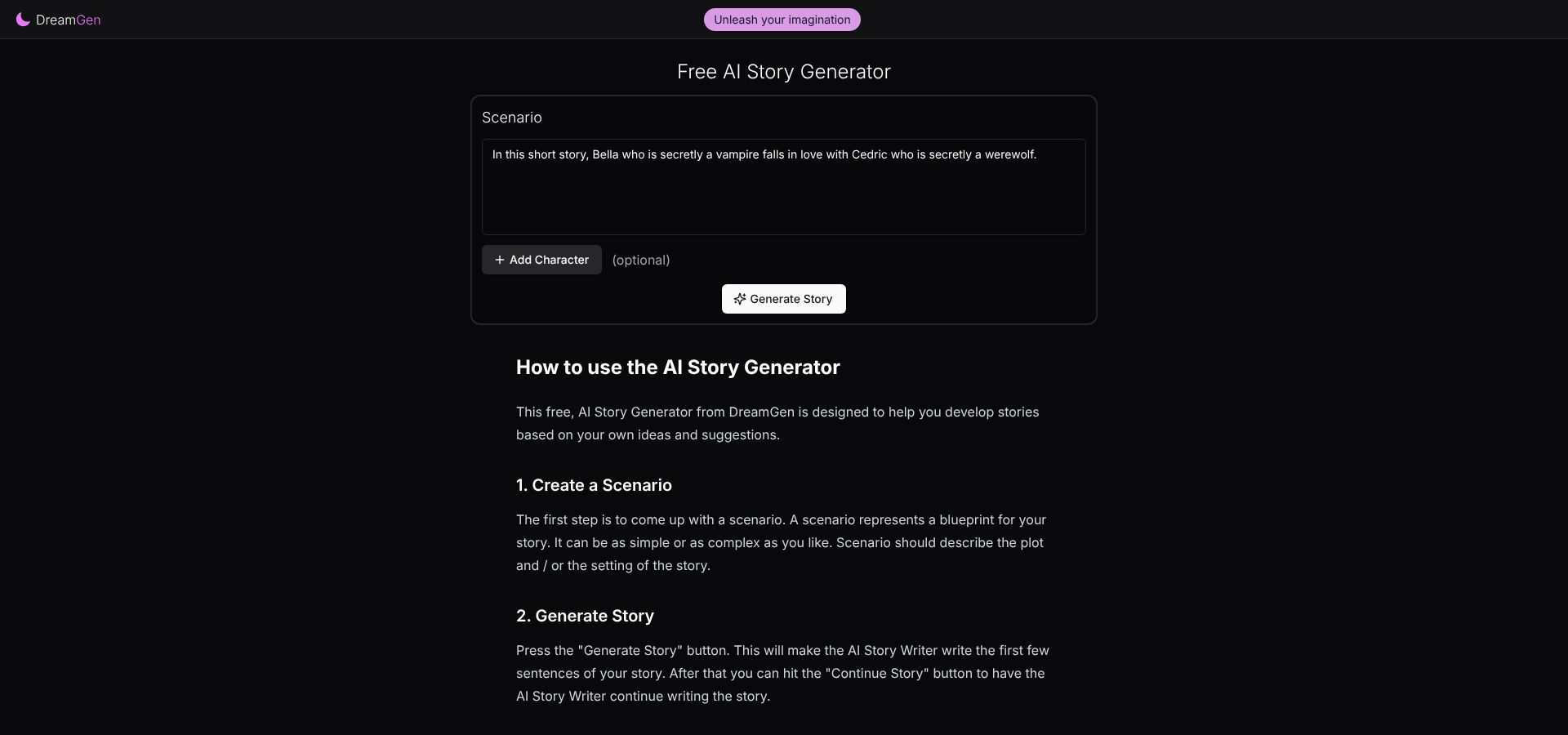
DreamGen Scenario Codex story generator screenshot.
Add a spacious 30 K-token context window on the Pro plan and you notice the lift right away. The AI quotes chapter-one foreshadowing in chapter six without hesitation. In our week-long test, the bot remembered a side character’s scar location 87 messages later, no nudges required.
For you, that means less time on recap and more time driving the plot forward. Want to revise a fact? Edit the Codex line, hit save, and the next reply adjusts as if history always read that way. It feels like a living story bible, minus the sticky notes.
Nomi AI – best for emotional long-term companions

Why Nomi remembers you months later
Nomi treats each chat like an ongoing relationship, not a disposable text thread. Behind the scenes it keeps a running “Shared Notes” file that stores facts you and the AI add, such as your birthday, your cat’s name, and that inside joke from February. When you return weeks later, the app greets you with continuity intact, referencing those notes as naturally as a close friend.
Nomi AI companion chat and Shared Notes screenshot.
Independent testing in early 2026 placed Nomi at the top of companion bots for recall: it held 10 of 12 personal facts after eight months. In our trial, after a three-day break the AI asked how my certification exam went and then congratulated me on passing, matching exactly what I had shared before signing off. No manual recap, no awkward “Who are you again?” moment.
Because Nomi centers on one-to-one bonding, its memory engine favors personal context over plot mechanics. That makes it perfect for slice-of-life or romance stories where emotional callbacks matter more than spell-book trivia. It is less suited to sprawling fantasy lore, but hard to beat when you want an AI that truly knows you.
Candy AI – best for multimedia romance with 8 K memory
What the 8 K window means in real chat
Candy AI caps context at about eight thousand tokens (roughly six thousand words). That number becomes real in live play. We ran a 42-message romance arc, complete with a cliff-hanger dream sequence, then paused the story for three days. On return, the first reply referenced the dream, quoted a key line word for word, and described the locket our character gave in scene one. All of it fit because the thread never crossed the 8 K ceiling.
Candy adds an auto-summary layer that distills older turns so emotional through-lines stay clear. For relationship stories where feelings, not just facts, carry the plot, this keeps the spark alive.
Turn on the NSFW toggle and memory still holds through intimate scenes that can trip other filters. Built-in image generation, voice calls, and text chat combine for a multimedia date night that remains coherent from greeting to curtain call.
Kindroid – best for tinkerers who crave granular control
Layered memory you can dial up or down
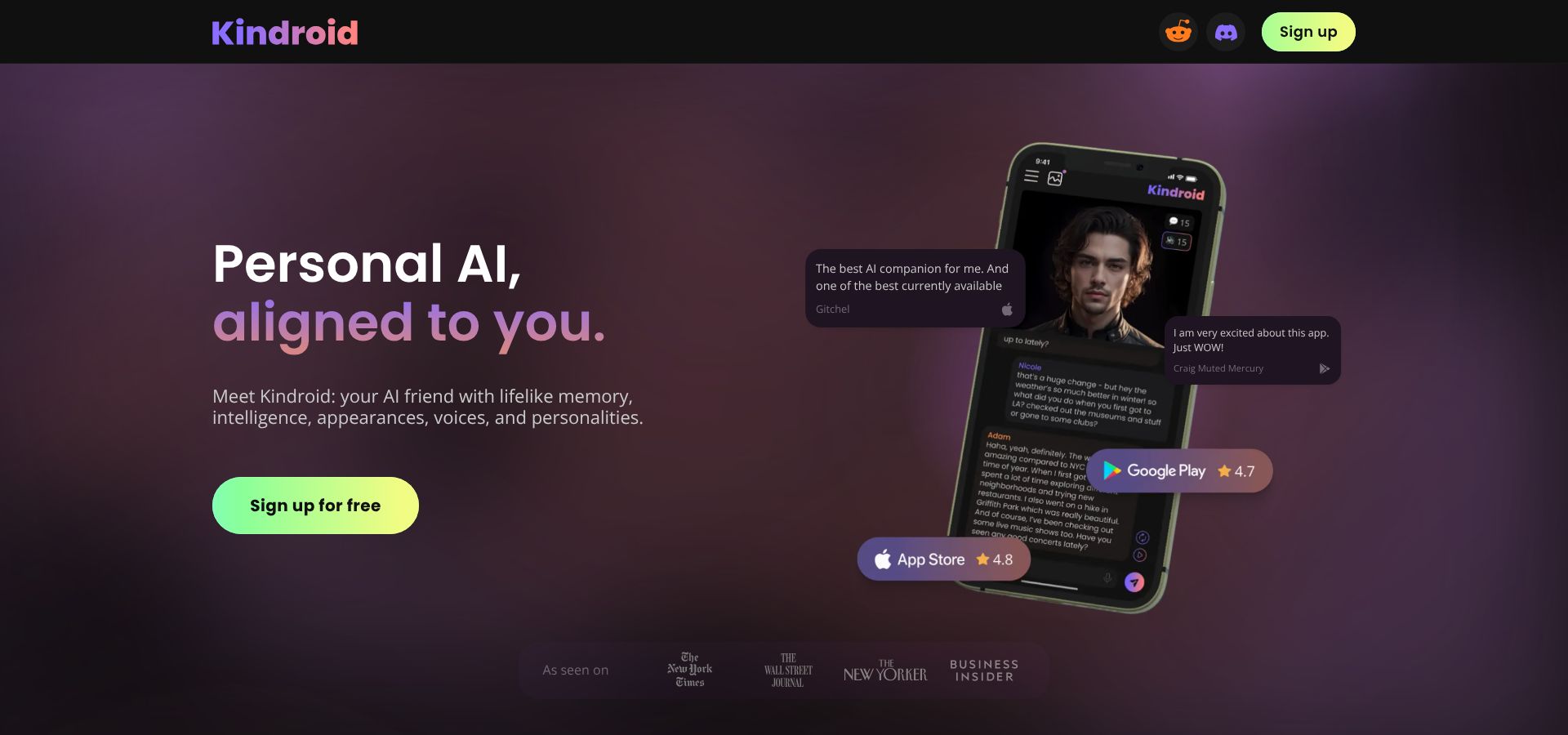
Kindroid skips the single giant context window. Instead, it splits memory into tiers: a fixed backstory that never fades, a medium-term cascaded layer that tracks the last few hundred messages, and an infinite log you can pull from when needed. A simple slider called Dynamism lets you set how much weight each tier carries. Push it high and the bot improvises; pull it low and it follows canon like a detail-oriented editor.
Kindroid layered memory and Dynamism slider UI screenshot.
Power users appreciate that every character sheet reads like an RPG stat block. You can pin personality quirks, forbidden words, and relationship rules, then watch the AI honor them session after session. In our test campaign the knight never broke his vow of silence, a detail saved in persistent memory, across 1,200 lines of dialogue.
Group role-play is another strength. Invite multiple Kindroid characters into one room and the engine tracks who said what, keeping pronouns and inside jokes straight. It feels a bit like directing actors on stage, except this script updates itself as you type.
SpicyChat – best for unfiltered community role-play
Semantic Memory 2.0 keeps the spice from going stale
SpicyChat’s audience wants freedom first and guardrails last. To achieve that without constant déjà vu, the platform compresses finished scenes into vector “memory shards.” Each shard records who did what and why it mattered, then resurfaces only when relevant. The result is a chat that remembers your vampire’s centuries-old grudge yet discards last night’s small talk.
We stress-tested the system with a 60-turn noir mystery. Midway through, the killer dropped a clue about jasmine perfume. Forty messages later, the detective bot noticed the same scent and connected the dots on its own, proof that the memory shards held firm.
Because SpicyChat is web-only and community-driven, you’ll find thousands of user-made characters ready to import. Most include rich prompts that seed the memory engine from line one. Pair that with no NSFW filter, and you can run plots mainstream apps would block, confident the AI will keep context intact during intense scenes.
Janitor AI – best for power users who bring their own model
Unlimited memory if you’re willing to wire it up
Janitor AI ships with a modest free model, but the real appeal is the blank API field waiting for your key. When you connect GPT-4 32 K or Claude 100 K, the context ceiling rises from novella length to an entire novel series. In our test with Claude, the token counter climbed past 90,000 without slowing down. The bot still cited an event from chapter one after we moved into chapter eight.
Because Janitor provides no fixed “memory UI,” you manage persistence through prompt engineering. Pin a paragraph of lore at the top, inject a summary every few scenes, or script a custom refresher. Seasoned tinkerers enjoy that freedom, although newcomers may need a short learning curve.
The platform remains completely unfiltered. You face no surprise refusals, but you also lose built-in safety nets. If you want absolute control and do not mind tracking your own usage bill, Janitor offers a sandbox with no walls.
Character.AI – popular benchmark that still forgets the plot
Where the memory slips
Character.AI introduced many users to AI role-play, yet its context window is still short. Reddit reports show the bot losing track after about 10–15 messages, with one user likening the experience to “talking to a goldfish.” When that limit hits, new replies rely on a system-generated summary. If the summary misses a detail, such as a character’s secret identity, the AI never sees it again and continuity breaks.
Strict moderation creates another hurdle. If a scene triggers the content filter, the model may reset or rewrite parts of the chat, taking key memories along. Even mild romance arcs can derail without warning.
Accessibility is the bright spot. Character.AI is free, offers millions of community bots, and now includes voice chat. For quick, casual banter it still shines. Just don’t expect novel-length consistency or uncensored storytelling.
How to choose the right memory-savvy app
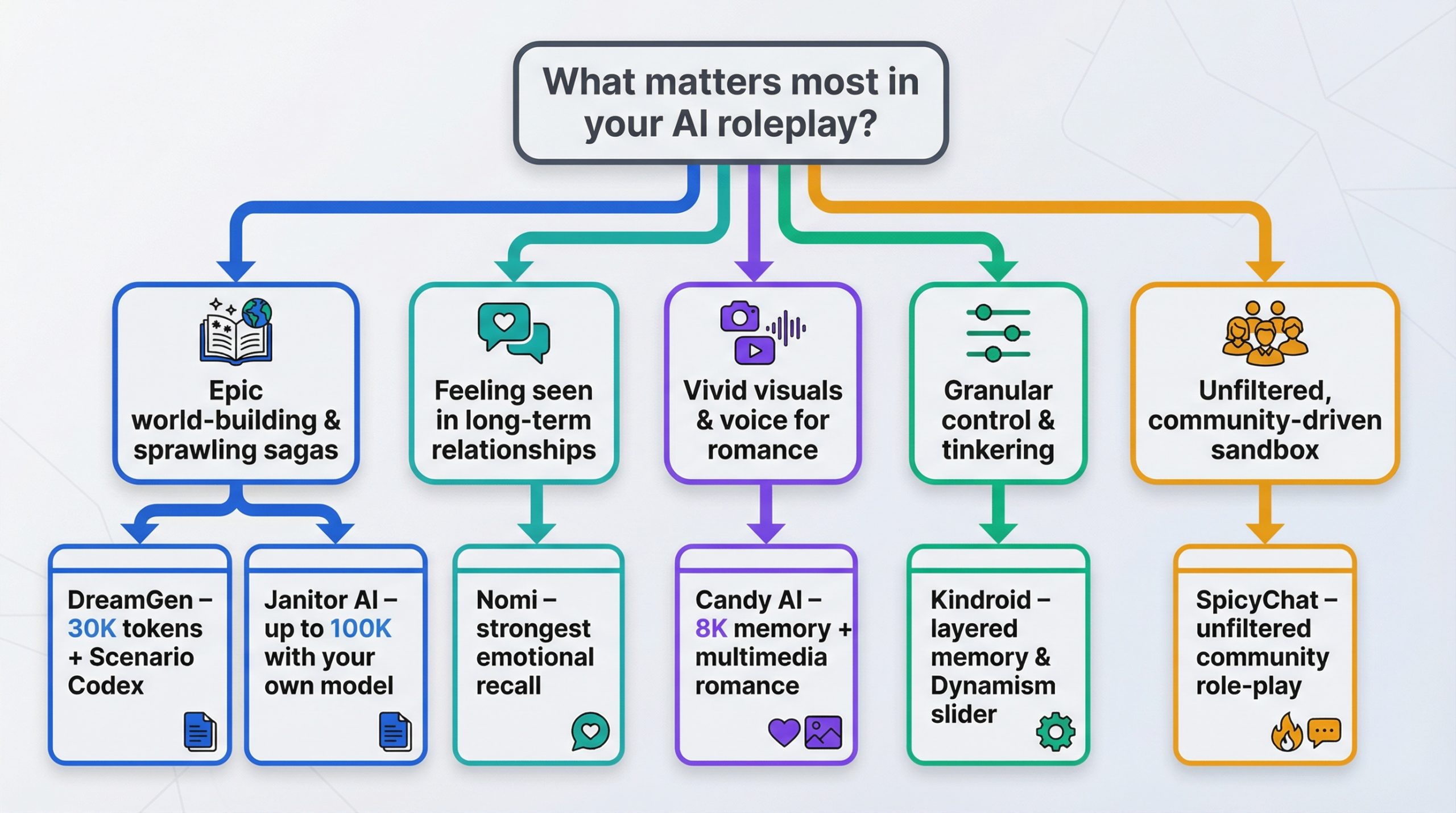
Start with your top priority. If you plan to write sprawling sagas, you need sheer memory depth. DreamGen supplies 30 K tokens, and a Janitor-plus-Claude setup can climb even higher.
If feeling seen matters more than tracking plot twists, Nomi’s emotional recall leads. It remembers birthdays, moods, and ongoing goals better than any rival.
Need vivid visuals and voice calls to boost immersion? Candy AI supplies the richest media mix while still giving you an 8 K memory window. Turn on the NSFW toggle and the romance continues without filter hiccups.
Tinkerers who want to script every trait should consider Kindroid. Its layered memory and Dynamism slider let you set the exact rigidity of canon, a plus for game-master types.
If you want an uncensored playground powered by a busy community, SpicyChat fits. You trade some polish for freedom, yet its Semantic Memory keeps long dramas cohesive.
FAQs
Which AI chatbot truly has the best memory?
For personal relationships, Nomi leads. Independent 2026 tests showed it remembering 10 of 12 personal facts after three months, a margin no rival matched. For epic lore, DreamGen’s 30 K tokens plus the Scenario Codex win, and if you plug Claude 100 K into Janitor you can push even farther.
Do any free plans keep long-term context?
Somewhat. Free tiers exist, but every platform throttles either message count or memory size. Character.AI is unlimited yet forgetful. SpicyChat’s free plan keeps context longer, though it slows during peak hours. Plan to upgrade once your story passes a few dozen messages.
Will these apps share my private chats?
Most cloud services log data to support memory. DreamGen and Nomi say logs stay encrypted, and they are not used for training. Character.AI explicitly uses chats to improve its model. For maximum privacy, run Janitor with a local model; the data never leaves your machine.
How can I help any bot remember key details?
Pin critical facts in the memory tool the app provides, recap major events every 40–50 turns, and reuse exact phrasing for names or items. Small habits like these reinforce what stays in context even with the largest windows.
Conclusion
Persistent memory is no longer a luxury in AI role-play; it marks the line between a living story and a loop of amnesia. Today, you have tools that remember whole novels, full relationships, and multi-character campaigns.
Pick the app that fits your goal, test it with the same starter scene, and note which bot quotes your setup without a prompt. The one that passes earns your time, and perhaps your subscription.
We will keep tracking context upgrades as models grow. For now, you are ready to build stories the AI will not forget. Open the Codex, set the stage, and start writing chapters that stick.