
The video CMS is the part of an OTT platform your team will use every single day, so it deserves more attention than it usually gets in a sales demo. Apps, players, and monetization models tend to steal the spotlight, but it’s the content management system that decides how fast you can publish, how easily viewers find your titles, and how much manual work your team does behind the scenes.
The stakes are high. In 2025, online video revenue overtook pay-TV for the first time, with subscription and transactional streaming revenue reaching $176 billion (Omdia, 2026). PwC’s Global Entertainment & Media Outlook 2026-2030 expects streaming revenue to keep growing 6.1% a year through 2030. As catalogs grow and competition tightens, the services that win are the ones that can organize, schedule, and monetize content quickly.
This guide looks at 6 OTT platform providers that combine a full streaming stack with a capable video CMS. Instead of the household names, we focused on specialist providers built for media companies, broadcasters, ISPs, and content businesses that want their own branded service. You’ll find a quick comparison table, a checklist of CMS features worth looking for, and a closer look at each provider.
What Is a Video CMS in an OTT Platform?
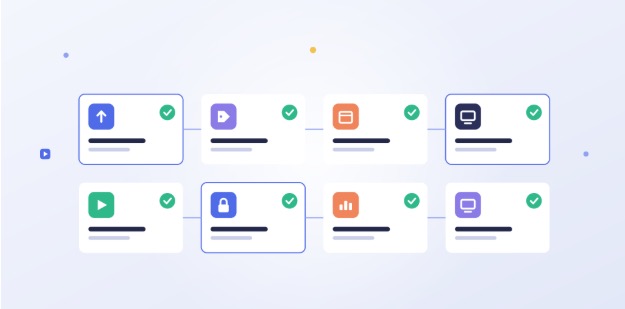
A video CMS (content management system) is the back-office dashboard where a streaming business uploads, organizes, describes, schedules, and publishes its content. In an OTT platform, it sits between your video files and your viewer-facing apps, so every change you make there shows up on web, mobile, and smart TV at once.
A basic video host stores files and plays them back. An OTT-grade video CMS goes further. It manages metadata such as titles, descriptions, cast, genres, and age ratings, which power search and recommendations. It controls which content is free, ad-supported, rented, or locked behind a subscription. It handles live channels and the EPG (Electronic Program Guide), sets release dates and geo-restrictions, and reports on what people actually watch.
In short, the CMS is where your content strategy becomes a working service. A good one saves your team hours every week. A weak one turns every new release into a manual project.
What to Look for in an OTT Video CMS
The best video CMS is the one that fits how your team actually publishes. Before you book demos, check each provider against these capabilities:
- Bulk upload and import. Large catalogs need bulk uploads and metadata imports from CSV, XML, or MRSS feeds, not one title at a time.
- Flexible metadata. Look for custom fields, cast and crew records, multilingual metadata, and custom artwork sizes for each device.
- Scheduling and release control. You should be able to set publish dates, expiry dates, and regional availability in advance.
- Live TV and EPG management. Broadcasters and ISPs need to manage linear channels, program guides, catch-up, and timeshift from the same dashboard as VOD.
- Monetization rules per title. The CMS should let you decide, title by title, whether content is free, ad-supported, rentable, or subscription-only.
- Security settings. DRM, geo-blocking, and access rules should be configurable inside the CMS, not through support tickets.
- Analytics. Viewing, revenue, and churn data should sit close to the content, so your team can see which titles drive results.
- Usability. A clean, no-code interface means editors and marketers can work without waiting on developers.
OTT Platform Providers With Advanced Video CMS at a Glance
| Provider | Best for | CMS highlights | Monetization |
|---|---|---|---|
| inoRain | Mid-size ISPs, TV operators, broadcasters, micro-drama apps | One admin panel for VOD, live TV, EPG, FAST, billing, and users | SVOD, AVOD, TVOD, hybrid, FAST |
| Vodlix | Fast no-code launches | No-code app builder with an integrated CMS | SVOD, AVOD, TVOD |
| Better Media Suite | European broadcasters | No-code CMS with multi-tenant management and HbbTV | Subscription, ad-based |
| Gizmott | FAST channels and vertical video | FAST, VOD, and micro-drama content in one CMS | SVOD, AVOD, TVOD, FAST |
| ViewLift | Sports teams and leagues | Live event and VOD management for sports | SVOD, AVOD, TVOD |
| Mogi I/O | Mid-market and D2C brands | Content management with shoppable video | SVOD, AVOD, TVOD, shoppable |
6 Leading OTT Platform Providers With Advanced Video CMS Solutions
1. inoRain
inoRain is an end-to-end OTT platform provider that builds a complete branded streaming service: white-label apps, a viewer-facing website, and a powerful CMS to run it all. Its CMS is designed as a single control center, so VOD libraries, live channels, monetization, users, and billing are all managed from one admin panel instead of separate tools.
That unified approach is what makes inoRain stand out for operators. ISPs can sync existing subscriber data, billing, and plans, and let customers sign in with their ISP credentials. Broadcasters can manage live TV with an EPG, timeshift, and catch-up alongside their on-demand catalog, and add FAST channels for ad-supported reach. inoRain also powers micro-drama apps, with vertical series, a coin and wallet system, and episode-level unlocks managed in the same CMS as long-form content.
CMS and platform highlights:
-One admin panel for VOD, live TV, EPG, FAST channels, users, and billing
-Monetization rules for SVOD, AVOD, TVOD, hybrid, and FAST, with server-side ad insertion
-Automated transcoding and encoding, with 4K/HD support
-Built-in billing, promo codes, coupons, and subscription management
-DRM, geo-blocking, tokenized streaming, and GDPR tools through OTT security
-Real-time reporting on revenue, churn, top content, and viewing patterns
-AI dubbing and AI subtitles for multi-language catalogs
-Hybrid CDN and P2P streaming to lower bandwidth costs at scale
Device coverage: iOS, Android, web, Samsung Tizen, LG webOS, Android TV, Apple TV, Fire TV, Roku, VIDAA, VIZIO, and set-top boxes.
Best for: Mid-sized ISPs and MSOs, TV providers and broadcasters, content creators, hotels, and micro-drama studios.
Pricing: Plans start at $250 per month, with no revenue share. Enterprise pricing is custom.
Rating: 4.9 on G2.
2. Vodlix
Vodlix is a UK-based white-label OTT platform known for its no-code app builder. Its CMS and app builder work together, so teams can manage content and design their apps without writing code, then publish across mobile, web, and TV.
Vodlix supports subscription, ad-supported, and transactional models, plus partner revenue share. It can be deployed as SaaS or on-premise, and it even supports VR headsets alongside standard devices.
CMS highlights: no-code content and app management, multi-model monetization, and flexible deployment.
Best for: startups, creators, and media companies that want to launch quickly without a development team.
Pricing: from $99 per month for web only; multi-device plans are quoted higher.
3. Better Media Suite
Better Media Suite, from Poland’s Better Media Solutions, is a no-code white-label OTT suite with a CMS that covers live, VOD, and analytics. Its multi-tenant management lets media groups run several services from one place.
It is one of the few platforms here that supports HbbTV, the hybrid broadcast-broadband standard used widely across Europe. A dynamic ad insertion add-on is available for ad-supported services.
CMS highlights: no-code CMS, multi-tenant management, live and VOD in one place, and HbbTV support.
Best for: European broadcasters, cable and satellite operators, and sports and e-learning publishers.
Pricing: custom, on request.
4. Gizmott
Gizmott, built by Gizmeon, is an all-in-one white-label platform that covers OTT apps, FAST channels, micro-drama, and vertical video. Its CMS is useful for businesses that run several formats at once, since linear FAST channels, on-demand libraries, and short-form series sit side by side.
For FAST, it supports SCTE-35 ad markers, and for micro-drama it offers token wallets and episode unlocks. Apps cover mobile, web, and all major smart TV and streaming device platforms.
CMS highlights: FAST, VOD, and vertical content managed together, with SCTE-35 support and episode-level access rules.
Best for: media companies combining FAST channels with on-demand and vertical content.
Pricing: usage-based with no setup fee; quoted on request.
5. ViewLift
ViewLift is a New York-based OTT platform focused on sports, serving pro teams and regional sports networks. In April 2026, DAZN announced it is acquiring ViewLift, which will continue serving third-party clients as a DAZN business unit.
Its back end is built around live events and the VOD content that follows them, such as replays and highlights. Apps run across 16+ device platforms, and reviewers often praise its back end and 24/7 support.
CMS highlights: live event and VOD management tailored to sports workflows.
Best for: sports teams, leagues, and regional sports networks.
Pricing: custom, on request.
6. Mogi I/O
Mogi I/O is a white-label OTT platform with offices in the US and India. Alongside standard monetization, its CMS supports shoppable video and tipping, which is rare in this category, and it has a growing focus on micro-drama apps.
Reviewers point to reliable streaming and responsive support, though some mention limited analytics and needing vendor help for advanced customization.
CMS highlights: content management with shoppable video, tipping, and micro-drama support.
Best for: mid-market media companies, D2C brands, and education businesses.
Pricing: custom; contact sales.
How to Choose the Right OTT Platform Provider for Your CMS Needs
Start with your business model, then test the CMS against how your team works day to day. A platform built for creators will feel very different from one built for operators, even if their feature lists look similar.
| If you are… | Look first at |
|---|---|
| An ISP or telco adding TV to broadband | inoRain |
| A broadcaster moving linear channels to streaming | inoRain, Better Media Suite |
| A media business with a large, varied catalog | inoRain |
| A creator or startup launching quickly | Vodlix |
| A FAST-first or ad-funded business | inoRain, Gizmott |
| A sports team or league | ViewLift |
| A micro-drama studio | inoRain, Gizmott, Mogi I/O |
On every demo call, ask the vendor to show you the CMS live, not just the apps. Upload a title, add metadata, set a release date, change its monetization, and pull a report. Then ask three questions: which TV apps are included in the price, what you’ll pay at 10,000 and 100,000 subscribers, and whether the provider takes a share of your revenue. The answers will narrow your shortlist fast.
Frequently Asked Questions
What is the difference between a video CMS and an OTT platform?
A video CMS is the back-office tool for uploading, organizing, and publishing content. An OTT platform includes the CMS plus everything else needed to run a streaming service: video delivery, players, apps for each device, monetization, billing, and analytics.
Which video CMS features matter most for a streaming business?
Bulk upload, flexible metadata, release scheduling, per-title monetization rules, and built-in security settings matter most. Operators and broadcasters should also look for live TV and EPG management in the same dashboard as VOD.
Can one CMS manage both live TV and video on demand?
Yes. Several providers on this list, including inoRain, manage live channels, EPG, catch-up, and on-demand libraries from a single admin panel, so teams don’t need separate systems.
How much does an OTT platform with a video CMS cost?
Published plans on this list start between $99 and $250 per month, while many providers quote custom pricing. Your real cost depends on bandwidth, the number of TV apps, and whether the provider charges per subscriber or takes a revenue share.
Do I need developers to use an OTT video CMS?
Not usually. Most modern OTT platforms offer no-code CMS dashboards for everyday publishing. Developers are mainly needed for custom integrations or advanced app changes.