
Navigating the world of digital marketing can feel overwhelming for a small business. With countless channels and conflicting advice, it's difficult to know where to invest your limited time and budget. The key isn't to do everything at once, but to master a few proven online marketing strategies for small business that align with your specific goals and resources. Success hinges on a focused, consistent approach rather than trying to be active on every platform. For those just embarking on their entrepreneurial journey, understanding the foundational steps is crucial; a practical guide on How to Start a Small Online Business can be an indispensable first step before diving into advanced marketing.
This guide cuts through the noise. We will provide a prioritized, channel-by-channel roundup of actionable tactics designed to move the needle. You won't find vague tips here. Instead, you'll get a detailed playbook covering the most effective strategies available today, including:
- Content Marketing & SEO-Driven Publishing
- Email Marketing & Newsletter Building
- Paid Advertising on Google, Facebook, and TikTok
- YouTube and Video Content Creation
- Community Building & Partnership Models
We will explore everything from foundational SEO and high-ROI email marketing to scalable paid advertising and community building, complete with mini case studies and citations from industry leaders. This article focuses on a principle Pat Flynn of Smart Passive Income often repeats: "Your earnings are a byproduct of how well you serve your audience." By focusing on the right channels, you can serve your audience effectively and build a predictable, profitable marketing engine. Whether you're bootstrapping with a minimal budget or ready to scale with paid ads, this is your roadmap to sustainable growth.
1. Content Marketing & SEO-Driven Publishing
Content marketing combined with search engine optimization (SEO) is a powerful, long-term strategy for attracting consistent, high-quality traffic. This approach involves creating valuable, long-form content like guides and tutorials that are specifically designed to answer questions your target audience is searching for on Google. By ranking for these search terms, your small business can generate a steady stream of organic traffic without paying for every click, establishing your brand as a credible authority in your niche.
Unlike paid advertising, which stops working the moment you turn off your budget, SEO-driven content is an asset that can produce results for years. This is one of the most effective online marketing strategies for small business because it builds a sustainable and scalable channel for customer acquisition.
"A search-optimized content library acts as your 24/7 salesperson. It attracts qualified leads, answers their questions, and builds trust before they ever speak to you." – Neil Patel, Co-founder of NP Digital
How to Implement SEO-Driven Publishing
To begin, you must understand what your potential customers are looking for.
- Target Long-Tail Keywords: Focus on longer, more specific search phrases (3-5+ words) like "how to clean suede boots at home." These keywords usually have lower competition but much higher purchase intent compared to broad terms like "boots." Tools like Ahrefs and Ubersuggest can help identify these opportunities.
- Create Content Pillars: Develop a "pillar" page, which is a comprehensive guide on a broad topic (e.g., "The Ultimate Guide to Small Business Accounting"). Then, create several shorter "cluster" articles that cover specific subtopics (e.g., "Best Accounting Software for Freelancers," "How to Track Business Expenses"). This model, popularized by HubSpot, signals its importance to search engines.
- Build Link-Worthy Assets: Go beyond simple blog posts. Create original research, data-driven studies, free tools, or in-depth case studies. These unique assets are more likely to earn backlinks from other websites, a critical factor for ranking high in search results. A 2020 study by Backlinko found a direct correlation between a page's total number of backlinks and its Google ranking.
2. Email Marketing & Newsletter Building
Email marketing is the practice of building a direct communication channel with prospects and customers through a dedicated email list. Unlike social media algorithms that can limit your reach, an email list is an asset you own, offering a reliable way to nurture leads and drive sales. This approach focuses on growing a subscriber base, segmenting it for relevance, and deploying strategic email campaigns to build relationships and prompt action.
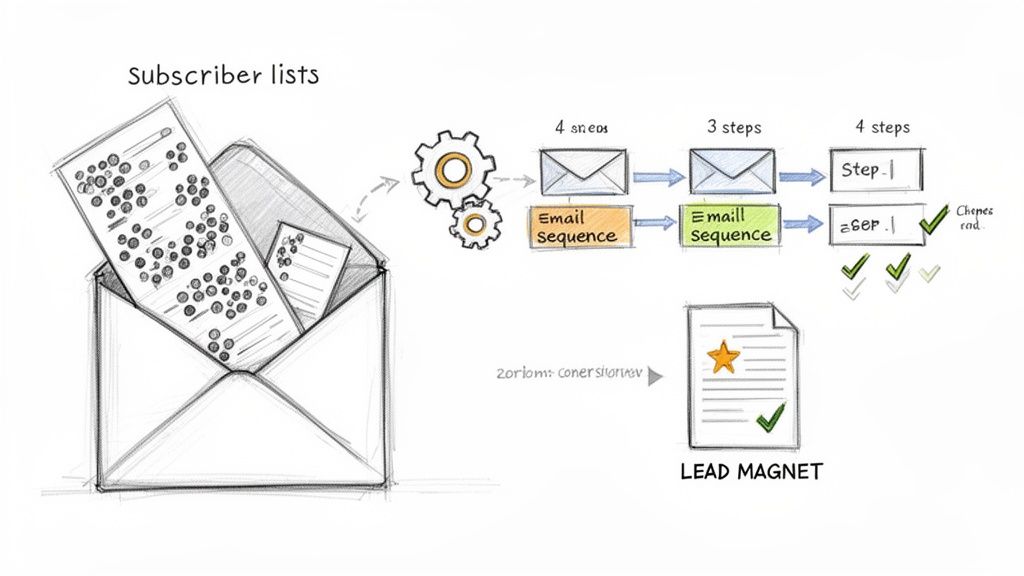
With an average ROI of $36 for every $1 spent, as reported by Litmus in their 2022 State of Email report, email remains one of the most cost-effective online marketing strategies for small business. It allows you to deliver personalized messages directly to an engaged audience, from welcome sequences for new subscribers to promotions for loyal customers. Success stories like The Hustle, which grew to over 3 million daily readers before its acquisition by HubSpot, demonstrate the power of a well-executed newsletter strategy.
"Your email list is your most valuable business asset. It’s a direct, unmediated line to the people most interested in what you have to say and sell." – Joe Pulizzi, Founder, Content Marketing Institute
How to Implement Email Marketing
Getting started requires a clear strategy for attracting and engaging subscribers.
- Create High-Value Lead Magnets: Offer a compelling incentive in exchange for an email address. This could be a checklist, a template, an exclusive video tutorial, or a free tool. The key is to provide something so useful your target audience is happy to subscribe.
- Segment Your Audience: Not all subscribers are the same. Group your list based on behavior (e.g., purchased a product vs. only downloaded a freebie) or interests. According to Campaign Monitor, marketers who used segmented campaigns noted as much as a 760% increase in revenue.
- Automate a Welcome Series: The moment someone subscribes is when they are most engaged. Create an automated 3-5 email sequence that introduces your brand, delivers the promised lead magnet, and sets expectations. This is a critical step for building trust from day one. To ensure your newsletter campaigns are effective, regularly utilize a free email spam checker to monitor your deliverability and maintain a strong sender reputation.
- Focus on Scannable Design: People rarely read emails word-for-word. Use short paragraphs, clear headlines, bullet points, and a single, obvious call-to-action (CTA) in each message. For more tips, you can explore some of the best practices for email design and layout.
3. Affiliate Marketing & Commission-Based Promotion
Affiliate marketing allows your small business to earn a commission by promoting another company's products or services. By recommending tools, software, or products that you genuinely use and trust, you can monetize your audience and create a performance-based revenue stream. This model aligns incentives perfectly: you only get paid when your recommendation leads to a successful sale, making it a low-risk, high-reward strategy for businesses with an established audience.
Unlike direct sales, this approach doesn't require you to create a product, manage inventory, or handle customer support. Instead, you focus on creating valuable content that helps your audience make informed decisions. This is one of the most effective online marketing strategies for small business because it adds a revenue layer to your existing content efforts without appearing overly promotional. The affiliate marketing industry is projected to reach $15.7 billion by 2024, according to research from Influencer Marketing Hub.
"Authentic affiliate marketing isn't about selling; it's about making a great recommendation. When you solve a problem for your audience with a product you trust, the commission is a byproduct of that value." – Pat Flynn, Smart Passive Income
How to Implement Affiliate Marketing
Success hinges on trust and transparency with your audience.
- Promote with Authenticity: Only recommend products and services you have personally used and can vouch for. Your audience's trust is your most valuable asset. Pioneers in this space, like Pat Flynn of Smart Passive Income, built their entire brand on this principle, generating significant income by recommending business tools they used daily.
- Create Comparison and Review Content: One of the highest-converting affiliate content types is a direct comparison, such as "Tool A vs. Tool B." Create unbiased reviews that detail the pros and cons of each option. This positions you as a helpful expert, not just a salesperson, guiding customers toward the best solution for their needs.
- Negotiate and Optimize: As your audience and influence grow, don't be afraid to negotiate higher commission rates directly with vendors. Track which affiliate links perform best and double down on promoting those offers. Additionally, creating exclusive coupon codes or special deals for your audience can dramatically increase conversion rates.
- Ensure Full Disclosure: Always be transparent about your affiliate relationships. The Federal Trade Commission (FTC) requires clear disclosure, but it's also critical for maintaining audience trust. A simple statement like, "This post contains affiliate links, which means we may earn a commission if you make a purchase," is usually sufficient.
4. Paid Advertising (Google Ads, Facebook/Instagram Ads, TikTok Ads)
Paid advertising involves purchasing ad space on platforms like Google, Facebook, and TikTok to reach highly targeted audiences. Unlike organic methods that require time, paid ads deliver immediate visibility and measurable results, making them ideal for small businesses seeking rapid growth. Success hinges on disciplined testing, continuous optimization, and a clear understanding of key performance metrics.
This strategy allows you to bypass the long wait for organic traction and put your offer directly in front of potential buyers. For many small businesses, paid advertising is one of the most direct online marketing strategies for small business because it provides a predictable and scalable way to acquire customers, as seen in countless e-commerce and SaaS success stories.
"Paid traffic is the ultimate lever for growth. Once you find a profitable campaign, you can scale your budget to acquire customers on demand, turning advertising from an expense into an investment." – Perry Marshall, author of "Ultimate Guide to Google Ads"
How to Implement Paid Advertising
Getting started requires a strategic approach focused on tracking, testing, and scaling what works.
- Start with High-Intent Platforms: Begin with Google Search Ads to capture users who are actively looking for a solution like yours. This "pull" marketing targets bottom-of-the-funnel prospects and often yields a higher initial return on investment compared to "push" marketing on social media platforms. Google data shows that for every $1 spent on Google Ads, businesses typically earn an average of $2 in revenue.
- Establish a Tracking Foundation: Before spending a single dollar, ensure your tracking is flawless. Install the Meta Pixel for Facebook/Instagram ads and set up conversion tracking in Google Ads. Use UTM parameters on all ad links to precisely measure which campaigns, ad sets, and creatives are driving traffic and sales.
- Test and Scale Methodically: Launch campaigns with a small daily budget, such as $10-$20, to test multiple ad creatives, copy variations, and audience segments. Identify the "winners" that show a positive return on ad spend (ROAS) and a low cost per acquisition (CPA). Only allocate more budget to these proven performers.
- Master Retargeting and Lookalikes: Your most valuable audience is people who have already visited your site or purchased from you. Create retargeting campaigns to re-engage these warm prospects at a lower cost. Then, use your customer list to build lookalike audiences, which allows platforms like Facebook to find new users who share similar characteristics to your best customers, a tactic widely popularized by figures like Russell Brunson for scaling funnels.
5. YouTube Marketing & Video Content Strategy
YouTube offers a unique opportunity to build an audience by creating educational, entertaining, or storytelling video content. As the world's second-largest search engine, it allows small businesses to connect with customers through a powerful visual medium. While it can take longer to gain traction, this higher barrier to entry often means less direct competition compared to platforms like Instagram or Facebook, making it an excellent long-term asset.
Building a presence on YouTube is one of the most effective online marketing strategies for small business because it creates multiple revenue streams. Creators like Pat Flynn and Ali Abdaal have built multi-million dollar businesses from their channels through ad revenue, affiliate marketing, sponsorships, and digital product sales.
"A YouTube channel functions as both a search engine and a social platform. It answers questions like Google but builds a community like Instagram, giving you the best of both worlds." – Derral Eves, YouTube Certified Consultant and author
How to Implement a Video Content Strategy
Success on YouTube hinges on discoverability and audience retention.
- Focus on Searchable Topics: Treat YouTube like a search engine. Use tools to find what your audience is searching for and create videos that provide clear, valuable answers. A video titled "How to Repot a Fiddle Leaf Fig Tree" will attract a more qualified viewer than a generic vlog.
- Create Clickable Thumbnails and Titles: Your thumbnail is your video's billboard. Use high-contrast colors, clear text, and expressive faces to grab attention. Combine this with a title that blends keywords with a curiosity gap (e.g., "5 Common Skincare Mistakes You're Probably Making").
- Optimize for Watch Time: YouTube's algorithm heavily favors videos that keep viewers watching. The first 30 seconds are critical for hooking the audience. Use timestamps in the description to help viewers find specific sections, which can increase overall session watch time. As noted in a Creator Insider update, YouTube has confirmed that both Click-Through Rate (CTR) and Average View Duration are key signals for its recommendation algorithm.
- Develop Content Series: Instead of creating random one-off videos, build recurring series or content pillars. This trains your audience to return and makes content production more efficient. For example, a real estate agent could have a weekly "Neighborhood Spotlight" series and a monthly "Market Update" series. According to a 2021 Semrush report, consistency in publishing is a key factor the algorithm considers for channel promotion.
6. Social Media Marketing (Instagram, TikTok, LinkedIn, Twitter)
Social media marketing focuses on building a community and brand presence through consistent engagement on platforms where your audience spends their time. While organic reach on many platforms has decreased, social media is still essential for building relationships, gathering customer feedback, and directing traffic to your website and email list. The key is choosing the right platforms that align with your business model and customer demographics.
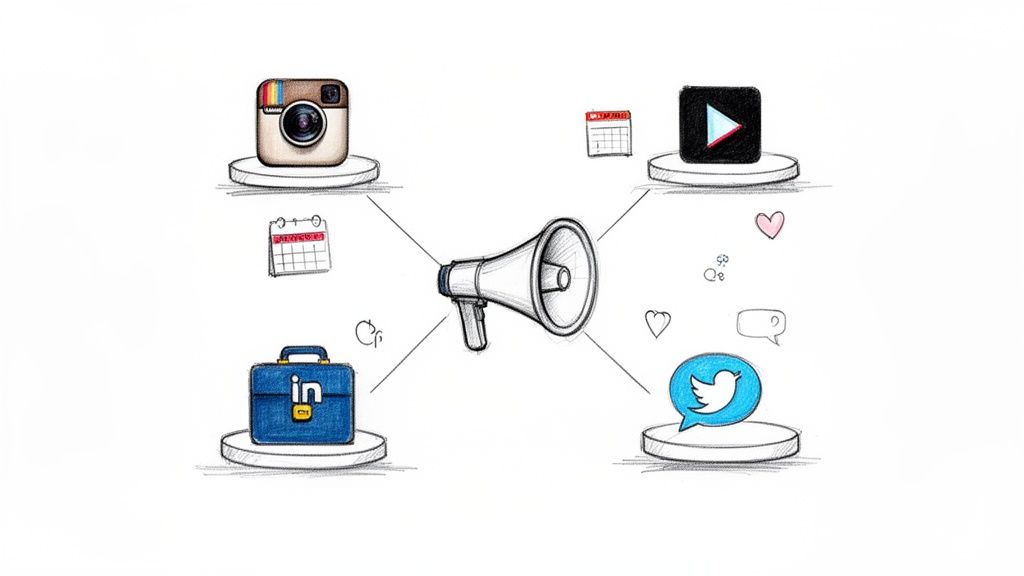
Unlike one-way advertising, social media allows for direct, two-way conversations with your followers, turning them into loyal fans. This makes it one of the most personal online marketing strategies for small business available, perfect for humanizing your brand and building trust.
"Your social media profile is your brand's digital living room. The goal isn't just to talk at people; it's to host a conversation that makes them want to stay and eventually become part of your community." – Jay Baer, author of "Youtility"
How to Implement Social Media Marketing
Start by selecting one or two platforms where your target customers are most active, rather than trying to be everywhere at once.
- Choose Platforms Strategically: Don't spread yourself thin. A B2B service might thrive on LinkedIn by sharing industry insights, while a visual product-based business would likely perform better on Instagram and TikTok. According to Sprout Social data, different demographics prefer different platforms, so audience research is critical.
- Prioritize Value with the 80/20 Rule: Dedicate 80% of your content to providing value, entertainment, or education, and only 20% to direct promotion. This builds goodwill and keeps your audience engaged. For example, Pat Flynn shares behind-the-scenes business content on Instagram, building connection over just selling.
- Repurpose Content Efficiently: Create one core piece of content (like a blog post or video) and break it down into multiple smaller posts for social media. A single guide can become several Twitter threads, Instagram Reels, and LinkedIn text posts, saving significant time.
- Focus on Building Your Email List: Social media platforms and their algorithms can change without notice. Always include a clear call-to-action (CTA) in your bio and periodically in your posts that encourages followers to join your email list, your most valuable and permanent marketing channel.
7. Niche Site & Blog Building (Long-term Authority Play)
Building a niche site involves creating a focused website targeting a specific topic and its associated keywords. Unlike a general business blog, a niche site is a standalone asset designed to generate passive income through affiliate marketing, display ads, and digital products. This strategy requires significant upfront effort and patience but can result in a valuable digital property that produces consistent revenue with minimal ongoing work once established.
While requiring a longer timeline than paid ads, creating a niche site is one of the most effective online marketing strategies for small business owners looking to diversify income streams. This approach builds a defensible, sellable asset that isn't tied directly to your primary business operations.
"A well-built niche site is a digital real estate investment. You build it, rent it out via ads and affiliates, and watch its value appreciate over time." – Spencer Haws, Founder of Niche Pursuits
How to Implement Niche Site Building
Success begins with selecting the right niche and executing a disciplined content plan.
- Validate Your Niche: Before writing a single word, validate your idea. Choose a topic with sufficient search volume (aim for keywords with 1,000+ monthly searches) but manageable competition. Use keyword tools to check difficulty scores and analyze the top-ranking sites. The goal is to find a space where you can realistically become an authority.
- Execute a Content Sprint: Your initial goal is to establish topical authority. Plan to create 100-150 pieces of high-quality pillar and cluster content within the first 12-18 months. This volume signals to search engines that your site is a comprehensive resource. As documented by Pat Flynn in his famous Niche Site Duel, this initial content push is critical for gaining traction.
- Monetize Strategically: Focus content creation on "money keywords," or terms that indicate purchase intent (e.g., "best for [use case]"). Monetize with high-paying affiliate programs in your niche and, once traffic reaches a certain threshold (e.g., 50,000 monthly sessions), apply to premium ad networks like Mediavine or AdThrive for higher RPMs.
- Build Authority from Day One: Backlinks are the currency of the web and are essential for ranking. Actively pursue backlink opportunities through guest posting on related blogs, getting listed in niche directories, and creating link-worthy assets like free tools or original data studies. According to a study from Backlinko, the number of referring domains is a strong ranking signal for Google.
8. Amazon FBA & E-Commerce Product Business
For entrepreneurs with a physical product, tapping into Amazon's colossal marketplace via Fulfillment by Amazon (FBA) is a formidable growth channel. This model allows you to store your products in Amazon's fulfillment centers, and they handle the picking, packing, shipping, and customer service. By selling on Amazon, you gain immediate access to millions of ready-to-buy customers, effectively outsourcing your entire logistics operation to a global leader.
Unlike building an e-commerce brand from scratch, Amazon FBA provides built-in traffic and trust. This makes it one of the most direct online marketing strategies for small business focused on product sales, as it combines a sales platform with a fulfillment service. Documented case studies, like Nate McCallister's journey to over $100K in monthly revenue, show the scaling potential.
"Amazon FBA gives a small product business the logistical power of a corporate giant. Your primary job shifts from shipping boxes to managing inventory and marketing on a platform where customers are already primed to purchase." – Scott Voelker, "The Amazing Seller" Podcast
How to Implement an Amazon FBA Strategy
Success on Amazon requires a data-centric approach from day one.
- Conduct Deep Product Research: Before committing to any product, perform exhaustive market research. Use tools like Helium 10 or Jungle Scout to analyze demand, competition, seasonality, and profitability. You can learn more about how to find winning products to sell on Amazon and beyond to build a solid foundation for your venture.
- Calculate All Costs for Profitability: Your success hinges on knowing your numbers. Meticulously calculate your cost of goods sold (COGS), all Amazon FBA fees (storage, fulfillment, referral), shipping costs, and marketing spend. Aim for a minimum 40% profit margin to ensure you have enough capital to reinvest and weather market fluctuations.
- Optimize Your Product Listings: Treat your Amazon product page like a high-stakes landing page. Conduct thorough keyword research and integrate primary and secondary keywords into your title, bullet points, and description. High-quality images and A+ Content are essential for converting visitors into customers.
- Use Amazon PPC to Gain Momentum: In the beginning, paid advertising is critical for getting your product in front of customers and generating initial sales and reviews. A well-managed Amazon PPC campaign can kickstart the "flywheel effect," where increased sales lead to a higher organic ranking, which in turn drives more sales.
9. Partnership, Collaboration & Joint Ventures
Strategic partnerships allow you to tap into an established, relevant audience without building one from scratch. This approach involves collaborating with non-competing businesses, creators, or influencers who serve a similar customer profile. By creating mutual value, you can accelerate growth, share marketing costs, and gain credibility through association.
Unlike building an audience solo, which can take years, a successful joint venture can deliver immediate exposure and sales. This makes it one of the most efficient online marketing strategies for small business because it directly borrows trust and reach from an established entity.
"A single, well-chosen partnership can be more powerful than a year's worth of independent marketing. You're not just getting traffic; you're getting a warm introduction from a trusted source." – James Wedmore, Business By Design
How to Implement Partnerships and Collaborations
Success begins with identifying the right partners and proposing a clear, mutually beneficial arrangement.
- Identify Complementary Businesses: Look for businesses that solve a different problem for the same customer. For example, a web designer could partner with a copywriter, or a fitness coach could collaborate with a meal prep service. The key is to find non-competing businesses with audience overlap.
- Create a Clear Value Proposition: Your outreach must answer the question "What's in it for them?" immediately. This could be a revenue share, a commission on sales, a reciprocal promotion to your audience, or access to your unique expertise. As Pat Flynn often demonstrates, the best partnerships are built on genuine, shared goals.
- Start Small and Document Everything: Begin with a low-risk collaboration, like a joint webinar or a simple email swap, to test the partnership. Before launching, create a simple agreement that outlines the terms, timeline, promotional responsibilities, and how you will track results. According to a study in the Journal of Marketing, clearly defined roles in alliances are a critical predictor of success.
10. Community Building & Membership Models
Shifting from one-time transactions to recurring revenue is a game-changing move for small businesses, and building a community or membership model is a direct path to achieving it. This strategy involves creating a private space where members pay a recurring fee (monthly or annually) for exclusive access to content, networking opportunities, and direct support. It transforms passive customers into a loyal, engaged audience that provides predictable income.
Unlike strategies focused on acquiring new customers, this model deepens relationships with your existing audience. This is one of the most powerful online marketing strategies for small business because it creates a defensible asset and significantly increases customer lifetime value (LTV), a key metric for sustainable growth.
"A membership turns your audience into advocates and your expertise into a recurring asset. It creates a feedback loop where you can directly serve, learn from, and grow with your most dedicated customers." – Stu McLaren, Founder of The Membership Experience
How to Implement a Membership Model
Success depends on delivering consistent and exclusive value that justifies the subscription fee.
- Define Your Value Proposition: Why should someone pay to join? The offer must be clear and compelling. Common models include access to a private forum (like on platforms such as Circle or Discord), exclusive premium content (courses, webinars, templates), or direct access to you for Q&As and coaching.
- Start with a Minimum Viable Community (MVC): Don't feel pressured to build a massive, feature-rich platform from day one. Start with a small, dedicated group of founding members at a lower price point. Use their feedback to refine your offering before opening it to a wider audience. This "build in public" approach fosters loyalty and ensures you create something people actually want.
- Focus on Engagement and Rituals: A thriving community is built on connection, not just content. Implement regular, predictable events like weekly "wins" threads, monthly expert Q&A sessions, or member-led workshops. According to a 2022 report from CMX, 86% of community managers believe that community has a direct impact on business objectives, proving its strategic importance. These rituals give members a reason to return and participate actively.
10 Online Marketing Strategies: Side-by-Side Comparison
| Strategy | Implementation Complexity 🔄 | Resources Required ⚡ | Expected Outcomes 📊 ⭐ | Ideal Use Cases 💡 | Key Advantages |
|---|---|---|---|---|---|
| Content Marketing & SEO-Driven Publishing | High 🔄🔄 — strategy, technical SEO, consistent publishing | Moderate–High: experienced writers, SEO tools, time; Ramp: slow ⚡ | Sustained organic traffic, authority, compounding ROI over months 📊 ⭐⭐⭐⭐ | Niche sites, affiliate marketers, bloggers, long-term brands 💡 | Low CPA; compounding asset; supports other channels |
| Email Marketing & Newsletter Building | Moderate 🔄 — list growth, segmentation, automation | Low–Moderate: ESP, lead magnets, copywriting; Ramp: fast–medium ⚡ | High conversion and ROI, direct audience access; predictable revenue 📊 ⭐⭐⭐⭐ | All businesses, course creators, e‑commerce, SaaS 💡 | Highest ROI; owns audience; automatable funnels |
| Affiliate Marketing & Commission-Based Promotion | Low–Moderate 🔄 — partnership setup and tracking | Low: affiliate programs, tracking, promotional content; Ramp: medium ⚡ | Variable income tied to audience size and conversions 📊 ⭐⭐⭐ | Content creators, bloggers, email lists, YouTubers 💡 | Low startup cost; passive & scalable income; easy to start |
| Paid Advertising (Google/Facebook/TikTok) | High 🔄🔄 — continuous testing and optimization | Moderate–High: ad spend, creatives, analytics; Ramp: immediate ⚡ | Immediate traffic and measurable ROI when optimized 📊 ⭐⭐⭐ | E‑commerce, course launches, SaaS, performance-driven offers 💡 | Fast scaling; precise targeting; predictable CAC when tuned |
| YouTube Marketing & Video Content Strategy | High 🔄🔄 — production, editing, retention optimization | High: equipment, editing, scripting; Ramp: slow (6–12 months) ⚡ | High LTV audience, multiple monetization paths, long-term discoverability 📊 ⭐⭐⭐⭐ | Educators, course creators, niche experts, personal brands 💡 | Strong viewer loyalty; repurposeable content; multiple revenue streams |
| Social Media Marketing (Instagram/TikTok/LinkedIn/Twitter) | Moderate 🔄 — content cadence + engagement | Low–Moderate: creator time, community management; Ramp: medium (viral boosts possible) ⚡ | Brand awareness, engagement, traffic; conversion varies by platform 📊 ⭐⭐⭐ | Personal brands, service providers, e‑commerce, creators 💡 | Real-time feedback; low entry cost; personality-driven growth |
| Niche Site & Blog Building (Long-term Authority Play) | High 🔄🔄 — many targeted pages and link building | Moderate: dozens–hundreds of articles, SEO tools, writers; Ramp: slow ⚡ | Passive income, sellable digital asset, steady organic revenue 📊 ⭐⭐⭐⭐ | Passive-income seekers, affiliate marketers, serial site builders 💡 | Sellable asset; predictable organic traffic at scale; repeatable |
| Amazon FBA & E‑Commerce Product Business | High 🔄🔄 — sourcing, logistics, listing optimization | High: capital ($5K+), inventory, tools, advertising; Ramp: medium (3–9 months) ⚡ | Scalable product revenue; margins and ROI depend on costs 📊 ⭐⭐⭐ | Entrepreneurs with capital, product-focused operators 💡 | Scalable sales; Amazon handles fulfillment; clear unit economics |
| Partnership, Collaboration & Joint Ventures | Moderate 🔄 — coordination, legal/terms, promotion timing | Low–Moderate: relationship building, co-assets, tracking; Ramp: fast–medium (1–3 months) ⚡ | Rapid audience growth and shared costs; measurable lift from partners 📊 ⭐⭐⭐⭐ | Any business seeking fast list growth, launches, co-markets 💡 | Access to new audiences; shared risk/cost; credibility transfer |
| Community Building & Membership Models | Moderate–High 🔄 — onboarding, content cadence, moderation | Moderate: community platform, recurring content, support; Ramp: medium ⚡ | Recurring revenue, high retention and LTV if engaged 📊 ⭐⭐⭐⭐ | Coaches, niche experts, SaaS add-ons, creators selling recurring value 💡 | Predictable MRR; engaged audience; strong retention and upsell potential |
Implementing Your Winning Strategy: From Plan to Profit
We've journeyed through a deep dive into the most effective online marketing strategies for small business, from the foundational power of SEO and content to the rapid scaling potential of paid ads and the community-building strength of social media. The sheer number of options can feel overwhelming, but clarity emerges when you stop thinking about "doing everything" and start focusing on doing the right things exceptionally well. The goal is not to adopt every strategy listed but to select a potent combination that aligns with your specific business model, budget, and long-term vision.
Remember, a strategy is a choice. It's about deciding where to allocate your most precious resources: your time, your money, and your creative energy. The most successful entrepreneurs, from Amazon FBA sellers to affiliate marketers, don't win by being everywhere at once. They win by achieving mastery in one or two core channels first, building a profitable foundation, and then methodically expanding their reach.
From Information to Actionable Steps
Reading about these tactics is the first step; implementation is where true growth begins. To move from plan to profit, you must translate this knowledge into a concrete action plan. Don't let this article become just another saved browser tab.
Here are your immediate next steps:
- Conduct a Resource Audit: Be honest about what you have. Do you have more time than money? Content marketing, SEO, and organic social media are your starting points. Do you have more capital than time? Paid advertising and strategic partnerships can deliver faster results. A 2023 survey by Constant Contact found that 50% of small businesses planned to increase their marketing spend, highlighting the importance of knowing where to direct those funds for maximum impact.
- Select Your "Major" and "Minor": Choose one primary strategy (your "major") to dedicate 70% of your effort to. This could be building a YouTube channel or mastering Google Ads. Then, select a secondary, complementary strategy (your "minor") for the remaining 30%, like using email marketing to nurture the leads your major channel generates.
- Define Your "First 90-Day Sprint": What can you realistically achieve in the next three months? Set specific, measurable goals. For example: "Publish 8 SEO-optimized blog posts," "Secure 2 guest post placements," or "Run a Facebook Ads campaign with a goal of 100 new email subscribers." This timeframe is long enough to see initial results but short enough to maintain focus.
Key Insight: The difference between a struggling business and a thriving one often comes down to disciplined execution. A simple, well-executed plan focused on the right online marketing strategies for small business will always outperform a complex, poorly implemented one.
The Power of Measurement and Iteration
You cannot improve what you do not measure. Each strategy we've discussed comes with its own set of Key Performance Indicators (KPIs). For SEO, it's organic traffic and keyword rankings. For email marketing, it's open rates and click-through rates. For paid ads, it's cost per acquisition (CPA) and return on ad spend (ROAS).
Commit to tracking these metrics from day one. Use free tools like Google Analytics and the native analytics dashboards on social media platforms. This data is not just a set of numbers; it's direct feedback from the market. It tells you what content resonates, which ad copy converts, and where your ideal customers are spending their time.
- Low open rates on your emails? A/B test your subject lines.
- High bounce rate on your blog posts? Improve your introductions and internal linking.
- Low ROAS on your ads? Refine your audience targeting or test new creative.
This continuous loop of Action -> Measurement -> Iteration is the engine of sustainable growth. The online marketing strategies for small business that work today might need adjustments tomorrow. Your ability to adapt, guided by data, will be your greatest competitive advantage. This iterative process, as highlighted by Eric Ries in "The Lean Startup," is crucial for finding a sustainable business model efficiently.
Your journey to building a profitable online presence is a marathon built on consistent, focused sprints. The principles and tactics laid out in this guide provide the map. Now, it's your turn to take the first step, choose a path, and start running. The market rewards action, and your future success is waiting for you to build it.