

Instagram affiliate marketing means recommending products in your posts, Reels and Stories and earning a commission when someone buys through your tracked link, code or product tag. You don’t need a huge following to start. You do need a clear path from content to checkout, a program you trust and a proper disclosure on every recommendation. This guide walks through all three, with the mistakes we see most often.
TL;DR
- Captions can’t hold clickable links. Your working link spots are the profile link area, the Story link sticker and, where your account is eligible, native product tags.
- There is no universal follower minimum. The old 10,000-follower swipe-up rule is outdated, but individual programs set their own requirements.
- Views don’t pay commissions. You earn on tracked actions, usually a purchase, so build content around one clear next step.
- In the US, you must disclose affiliate relationships clearly, near the recommendation, using words like “ad” or “sponsored”.
- Start with a small set of products that fit your niche, track each link separately and review results weekly.
Table of Contents
- How Instagram affiliate marketing works
- Where affiliate links can go on Instagram
- How to start in seven steps
- Disclosure: what the FTC expects from US creators
- What a first campaign can look like
- Does Instagram pay you for 1,000 views?
- Building more than an Instagram income
- Our perspective
- Want a structured path?
- Common mistakes to avoid
- FAQ
- Sources
How Instagram affiliate marketing works
The mechanics are the same as on any platform. A business pays you a commission for sending it customers, and the commission is tracked through a link or code that identifies you as the source.
The basic workflow looks like this:
- Choose a niche and a handful of offers that fit it.
- Join an affiliate program or negotiate directly with a brand.
- Get your tracking assets: links, codes or catalog access.
- Publish content that shows the product in use.
- Send interested viewers through a link surface Instagram allows.
- Review clicks, conversions, commissions and refunds.
Step 5 is where most beginners stall. Instagram is a discovery platform, not a link platform, so the real skill is designing the route from a post to a purchase page.
If you are new to affiliate marketing in general, our beginner playbook on how to start affiliate marketing covers the fundamentals that apply on every platform.
Where affiliate links can go on Instagram
A regular feed caption can’t make a URL clickable. Shopify’s guide lists the practical placements: the profile link area, the Story link sticker and eligible native product tags. Here is how each one behaves.
| Placement | Best for | Watch out for |
|---|---|---|
| Profile link area | Visitors who land on your page after a Reel or post | Interfaces change, so check how many links your account allows |
| Story link sticker | High-intent viewers who want the link now | Stories disappear after 24 hours unless saved |
| Highlights | Keeping Story recommendations discoverable | Needs tidy covers and clear titles |
| Native product tags | Tagging catalog products directly in content | Availability depends on your market, account and program |
| Disclosed DM flow | Sending a link when someone asks for it | Disclosure still applies to the message |
The Story link sticker
You don’t need 10,000 followers for this. Current guidance describes link stickers as available to all Instagram accounts, which replaced the former swipe-up restriction. If a tutorial still mentions a 10,000-follower threshold, it is out of date.
Stories are where we’d put your most direct calls to action. A viewer who taps through a Story is already interested. Save the best ones to Highlights so the recommendation keeps working after the 24-hour window closes.
Your profile link area
Think of your profile link as your storefront window. Reels and posts create curiosity, and the profile link catches the people who go looking. Shopify notes that profile links can support multiple destinations, but confirm the exact limit in your own account, because Instagram changes this interface from time to time.
A practical setup is to point your first link to your single best-performing offer and your second to a page that lists everything you recommend. Our guide to affiliate links, tools and best practices explains how to keep those links clean and easy to manage.
Native product tags and Meta’s affiliate features
Instagram is pushing further into shopping. According to Business Insider’s March 2026 report, creators can add products from Meta’s brand catalog directly to Reels, and can also add outside URLs. These features roll out unevenly. Eligibility, catalog access, age requirements and follower thresholds can differ by country and account.
Meta also runs its own creator affiliate program. Its program page says the program has moved to a new partner site, so start there for current sign-up details instead of relying on an older tutorial.
Our advice: use native features for convenience, but don’t build your whole business on them. Platform features come and go. An audience you can reach elsewhere, such as an email list, survives those changes.
How to start in seven steps
1. Pick a niche you can speak about from experience
Trust is the central conversion asset. The strongest affiliate content doesn’t look like a product dump. It connects the product to your niche and shows how it’s used. HubSpot’s guidance gives a useful warning: a tech creator suddenly promoting unrelated beauty products may get a few clicks but weakens audience trust.
2. Set up your profile for clarity
A professional account is useful for credibility and analytics, according to the same guidance. Your bio should say who you help and what you recommend. Someone who lands on your page should understand in five seconds why they would follow you.
3. Choose a program
There is no single best affiliate program for beginners. The right one depends on your audience. Look for these things:
- Products that match what your followers already ask you about.
- Tracking that works in the market you’re targeting.
- Commission and cookie terms you can actually understand.
- Policies that permit your traffic source. Read the terms, because some programs restrict where links may appear.
A large retail program is simple for broad physical-product niches. HubSpot’s 2025 guidance describes Amazon Associates commissions as category-dependent, between 1% and 10%. That is not a guaranteed rate for every product or country, so check the current operating agreement and category schedule for your marketplace before you promise anything to yourself or your readers.
A direct software or digital-product program may suit you better when your audience needs tools and the buying journey is longer. Our roundup of affiliate marketing business ideas can help you match a niche to a program type.
4. Test what you promote
Use the product, or understand it well enough to explain it honestly. Recommend only what you can stand behind. This is slower than grabbing the highest commission, and it pays off in repeat trust.
5. Make content that demonstrates something
Shopify’s practitioner advice is to put value before promotion: show a problem, a use case, a comparison or a result, then give one clear call to action. The format roles are fairly consistent:
- Reels create discovery.
- Stories capture higher-intent viewers with an immediate link.
- Bio and Highlights support later browsing.
Treat those as roles, not guarantees. No source we found establishes a universal conversion rate, and you should be wary of anyone who quotes one.
6. Disclose, every time
We cover this in detail below, because it’s the step creators most often get wrong.
7. Track and adjust
A simple spreadsheet is enough for a first campaign. Record each post, the link surface used, clicks, conversions, commission and refunds. Measure each path separately, since a Story link and a profile link behave very differently.

Disclosure: what the FTC expects from US creators
If you earn a commission, you have a material connection to the brand, and you need to say so. The FTC’s influencer guide, Disclosures 101 says the disclosure must be clear and conspicuous and placed near the endorsement.
The practical rules from that guide:
- Use plain terms such as “ad”, “advertisement” or “sponsored”. Shorthand like “sp”, “spon”, “collab” or “ambassador” alone is not recommended.
- Don’t assume a platform’s built-in disclosure tool replaces your own clear wording.
- Disclose in the same language as the endorsement.
- For video, put the disclosure in the video itself, not only in the description.
The reasoning is simple. People may see one Story frame, watch with the sound off or never tap “more” on a caption. A disclosure that sits only in your bio or buried in a caption doesn’t reach them when they see the recommendation.
This catches creators who reuse one caption template across formats. For Stories, put readable text over the image or video. For Reels, say it on screen and in the caption. Transparency isn’t just compliance. It gives your audience context and lets them judge the recommendation knowingly, and hiding the relationship creates avoidable trust and enforcement risk.
The rules above are US guidance. If your audience is elsewhere, check the advertising rules of that country. This article is not legal advice, and a lawyer who handles advertising law is the right person for questions about your specific arrangements.
What a first campaign can look like
You don’t need special software to launch. A first campaign needs an eligible program, a small set of closely related products, native Stories and profile links, and a tracking sheet. Costs depend on the program and any optional tools you add, such as scheduling or analytics, not on a mandatory Instagram fee. Verify current vendor pricing before you pay for anything recurring.
Here’s a realistic two-week plan for a creator in the home-office niche:
- Days 1 to 2: Pick three products you already use. Join the relevant programs and save your tracking links.
- Days 3 to 7: Post three Reels showing each product solving a real problem, with an on-screen “ad” or “affiliate link” label. Add a Story after each Reel with the link sticker.
- Days 8 to 10: Save the Stories to a Highlight called “Tools I use”. Update your profile link.
- Days 11 to 14: Check the sheet. Which Reel drove the most clicks? Which link converted? Double down on that product and drop the one nobody tapped.
Expect a slow start. A handful of clicks in the first week is normal, and what matters is learning which content earns taps.
Does Instagram pay you for 1,000 views?
Not through affiliate marketing. Views are exposure, not commission. Affiliate revenue comes from tracked qualifying actions, usually a purchase or another conversion the program defines. Instagram and Meta may run separate bonus or creator-monetization programs, but those are distinct, depend on eligibility or invitation, and shouldn’t be confused with affiliate earnings.
This changes how you judge your content. A Reel with 200,000 views and no clear next step can earn less than a Story with 800 views and a well-chosen link.
Building more than an Instagram income
Instagram affiliate marketing works best as one channel in a larger system. The same product knowledge can feed a blog post, an email list or a short-video channel. If you want to compare how another platform handles links and tracking, see our guides to affiliate marketing on TikTok, YouTube affiliate marketing and Pinterest affiliate marketing.
Another route is to create your own offer, so you earn the full margin instead of a share. If you have expertise your followers keep asking about, a simple guide or template can be the start. This walkthrough on creating a digital product without a team or coding skills is a practical place to begin, and the same Reels and Stories that sell affiliate products can promote your own.
Our perspective
We’ve spent years sharing what works in online business, and one pattern repeats across affiliate marketing: the people who last treat their audience’s trust like inventory they can’t restock. They recommend fewer things, explain them better and say plainly when they earn a commission.
On Instagram, that matters more than anywhere. The platform rewards quick, casual content, which makes it tempting to paste a link on anything. Resist that. One product demonstrated well beats ten mentioned in passing.
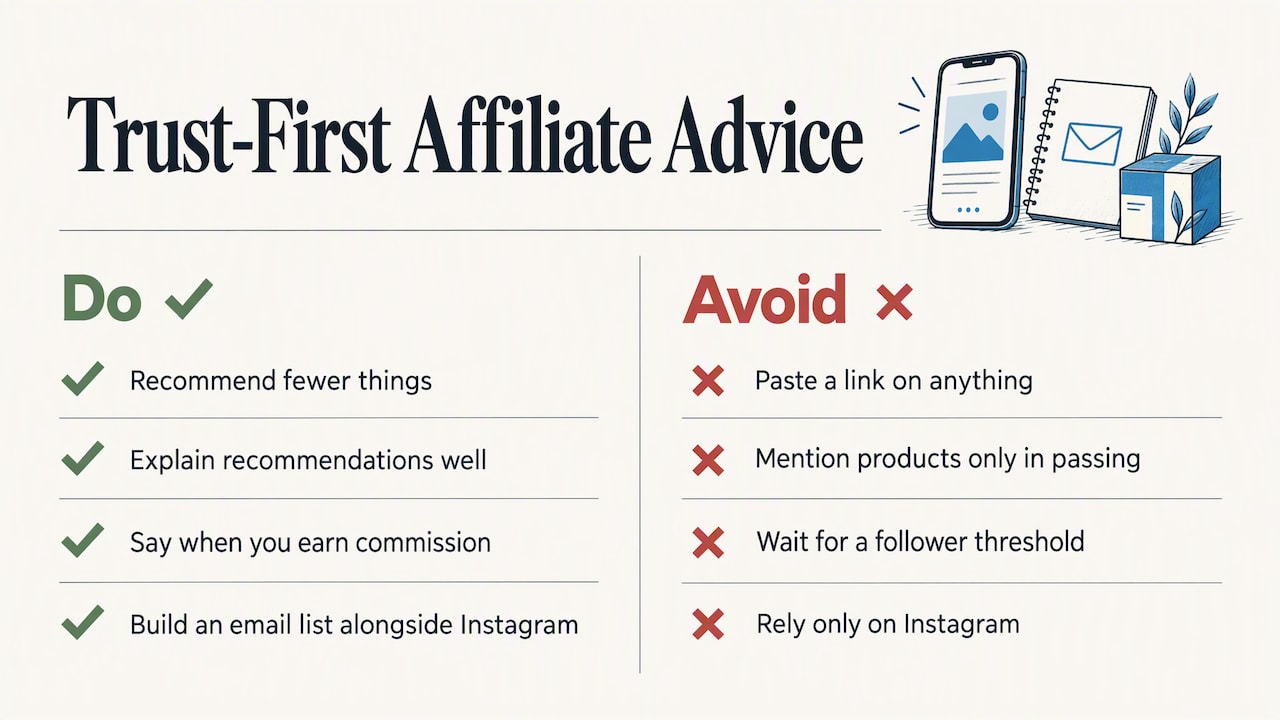
We’d also push back on the idea that you must reach some follower number before you start. Some native features may carry thresholds, but nothing stops you from learning the craft today with Stories, a profile link and a tracking sheet. The skill you build, matching an offer to an audience, transfers to every platform.
Finally, be realistic. Commissions are modest at first, tracking is imperfect and platform rules shift. Build something you control, such as an email list, alongside Instagram, so one policy change doesn’t erase months of work.
— Nathaniel
Want a structured path?
If you’d rather follow a course than piece this together alone, Instant Course Access for Life is available for a one-off $97 at entreresource.com/aip-insiders. You can also browse our free guides first at EntreResource, and see our reader discounts for tools you may need along the way.
Common mistakes to avoid
- Promoting unrelated products. It dilutes trust faster than almost anything else.
- Relying on an outdated tutorial. Instagram features, eligibility rules and market rollouts change quickly, so verify in your own account.
- Pasting links in captions. They render as plain text. Design a different next step.
- Using one caption template everywhere. Your disclosure must fit each format.
- Ignoring refunds. Commission on a refunded sale usually disappears, so track net results, not just sales.
- Chasing commission rate alone. A 10% rate on a product nobody wants earns less than 3% on one your audience asks about weekly.
FAQ
How many followers do you need to become an Instagram affiliate?
There is no universal minimum. Story link stickers are available to all accounts, and the old 10,000-follower rule is outdated. Individual programs and native commerce features can set their own requirements, such as age, market, account standing or a minimum audience, so check the terms of each one.
How do you add affiliate links on Instagram?
Put them in your profile link area, on a Story link sticker or in native product tags if your account qualifies. Captions can’t make a link clickable. Whichever route you use, add a clear disclosure near the recommendation.
Which affiliate program is best for beginners?
It depends on your audience. Choose a reputable program whose products fit your niche, with tracking that works in your market and terms you understand. A large retail program can be simple for physical products, while a direct software program may suit audiences who need tools.
Do I have to disclose affiliate links on Instagram?
Yes, if you’re reaching US audiences and earn a commission. The FTC says to disclose clearly and conspicuously near the endorsement, using words like “ad” or “sponsored”. For video, put the disclosure in the video itself.
Sources
- How To Do Affiliate Marketing on Instagram, HubSpot
- Instagram Affiliate Marketing: How to Start, Shopify
- Disclosures 101 for Social Media Influencers, FTC
- Instagram and Facebook Are Pushing Deeper Into Shopping and Ads, Business Insider
- Join the affiliate program, Meta