

So, you want to do keyword research for your blog. The goal is simple: figure out what your audience is searching for, then create content that shows up when they look for it. It's about finding those high-volume, low-competition keywords and checking out the search results to see what you're up against.
This isn't just a box to check; it’s a strategic move that ensures you’re writing articles people are actually looking for. According to a study by Ahrefs, over 90% of pages in their massive index get zero traffic from Google, largely because they weren't created with search demand in mind.
Building Your Blog's Content Foundation
Let's be real—most blogs fail because they publish content no one is searching for. I’ve seen it a thousand times.
Effective keyword research isn't about chasing random terms. It's about digging deep into your audience's mindset. To build a blog that actually gets traffic, you need to master the core principles of how to do keyword research that actually drives results. This single skill will guide your entire content strategy from day one.
The process shifts your perspective from just "writing stuff" to strategically building a real business asset. It's the difference between shouting into the void and having a meaningful conversation with an audience that actually wants to hear from you.
Keyword research isn't just an SEO task; it's market research for your blog. As SEO pioneer Rand Fishkin has noted, "The best way to understand your audience is to understand the language they use when searching." It tells you exactly what your potential readers want, the problems they need to solve, and the language they use to describe it all.
This foundational work ensures every single article you publish has a built-in audience, which dramatically increases its chances of succeeding.
Macro vs. Micro Research
The way we approach keyword research has changed a lot over the years. These days, it’s all about a data-driven approach that starts with figuring out what your target audience is actively typing into Google.
This process happens on two different levels: macro keyword research, which is about identifying the big-picture topics your readers care about, and micro keyword research, which is about finding the specific phrases they use.
Think of it like this:
- Macro Research: This is your 30,000-foot view. You’re identifying broad categories like "vegan baking," "beginner-friendly yoga," or "DIY home repair." These become the core pillars of your blog.
- Micro Research: This is where you zoom in. Under the "vegan baking" pillar, you might find micro-keywords like "easy vegan chocolate chip cookies" or "vegan birthday cake for beginners." These are your individual blog post ideas.
This two-tiered strategy gives your blog both breadth and depth, helping you build what Google calls "topical authority" over time.
The Power of Search Listening
Here’s a crucial step most people skip: 'search listening.' It’s a simple but powerful practice. All you have to do is actually search for your target keywords in Google and analyze what shows up on the first page (the SERP).
This little bit of homework tells you what the competitive landscape looks like before you invest hours creating content.
By "listening" to what the SERP is telling you, you can uncover critical insights:
- Content Type: Is Google showing articles, videos, or product pages?
- Content Angle: Are the top results "how-to" guides, listicles, or personal stories?
- Search Intent: Is the user looking for information, a product, or a local business?
A keyword map is a great way to visualize how a central topic connects to all the related long-tail keywords and audience questions you discover.

This kind of visual planning shows why solid keyword research is the only way to build a blog that gets traffic and grows over the long haul. When you map out your content, you create a logical structure that makes sense to both your readers and the search engines.
Finding Keyword Ideas Beyond The Obvious
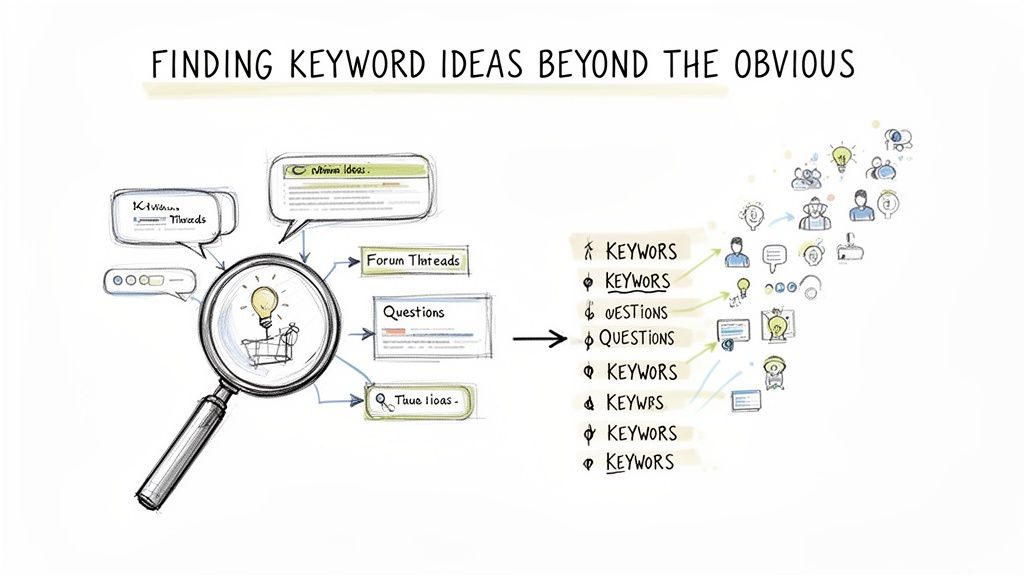
Sure, you can start by plugging a few "seed" keywords into a tool. That's keyword research 101. But the game-changing ideas—the ones your competitors have completely glossed over—don't live there. They live in the specific, emotional, and often messy language your actual audience uses.
Your goal shouldn't be to just build a list of terms. You need a massive, organized master list of opportunities and a repeatable process to keep it full. Let's dig into how I generate thousands of potential keywords so I never have to wonder what to write about next.
Mine Audience Watering Holes
Your ideal readers are already online, grouped together, talking about their problems. These digital "watering holes" are an absolute goldmine for authentic keyword ideas, straight from the source. You just have to know where to look.
Some of the best spots to find these raw, unfiltered keyword ideas are:
- Reddit: Find subreddits related to your niche (think r/personalfinance or r/skincareaddiction). I hunt for post titles starting with "How do I…", "What's the best…", or "Can anyone recommend…". The comment sections are just as valuable for unearthing follow-up questions and secondary keywords.
- Quora: The entire site is literally a Q&A platform. Search for your main topic and pay close attention to the exact phrasing people use in their questions. The "Related Questions" sidebar is a cheat code for finding long-tail variations.
- Niche Forums: Industry-specific forums, whether for woodworking or photography, are packed with die-hard enthusiasts. The "newbie" sections are particularly fantastic for finding the foundational questions people have when they're just starting out in your topic.
This approach gives you a direct line into your audience’s head. As SparkToro's research on audience intelligence confirms, understanding the "language of your customer" is a primary driver of marketing success. You stop guessing what they want and start hearing it from them directly.
Reverse-Engineer Your Competitors
Why start from scratch? Your competitors have already done some of the hard work for you. Analyzing what’s driving traffic for other blogs in your space is one of the smartest, most efficient ways to build your keyword list. The trick is to look for their weaknesses and gaps, not just to copy them.
First, identify 3-5 of your direct competitors. Then, pop their domain into a tool like Ahrefs or Semrush and pull up their "Top Pages" report. This instantly shows you which of their articles are pulling in the most organic traffic.
By analyzing a competitor's top content, you're not just finding keywords; you're validating them. If a term is already driving a ton of traffic for someone else, it's proof that a hungry audience exists for it. This technique, often called a "content gap analysis," is a cornerstone of modern SEO strategy.
As you look through their top-performing content, always ask yourself these questions:
- Can I create something way more thorough or up-to-date on this topic?
- Are there any low-difficulty keywords they rank for that I could easily steal?
- Did they miss any obvious subtopics or user questions that I could answer?
This turns competitor research from a simple spying mission into a strategic way to find validated, winnable keyword ideas.
Use Free Tools to Expand Your List
While paid tools are my go-to, you don't need a pricey subscription to get started. In fact, Google itself is one of the most powerful research tools you can use—and it’s free.
- Google Autocomplete: Just start typing a keyword into the search bar. The suggestions that pop up are based on what real people are actively searching for. It's a direct peek into the collective consciousness of your audience.
- "People Also Ask" (PAA) Boxes: This little box in the search results is a goldmine. According to Semrush data, PAA boxes appear in nearly half of all search results, making them a critical source of keyword ideas. Each question is a potential long-tail keyword or, at the very least, a perfect H2 or H3 for your next article. For an even deeper dive, learn how to use exploding topics for SEO to spot trends before they go mainstream.
- "Related Searches": Scroll to the very bottom of the search results page. Google will hand you eight more keywords that are closely related to your original search. It doesn't get much easier than that.
By combining these free methods with what you've learned from audience and competitor research, you're building a powerful, repeatable system. This ensures your how to do keyword research for blogs process is both thorough and sustainable, constantly feeding your content machine with ideas that are proven to have demand.
Turning Raw Data Into Actionable Insights
You've done the brainstorming and now you're staring at a massive list of potential keywords. That's a solid start, but a spreadsheet full of terms is just raw data. It’s pretty much useless without some context.
The real work of keyword research happens now, as you learn to translate those numbers and phrases into smart content decisions. This is where you cut through the jargon and figure out what actually separates a winning keyword from a completely wasted effort.
Decoding Search Volume
Search Volume is usually the first metric everyone latches onto. It’s the estimated number of times someone types a specific keyword into a search engine each month. It's so tempting to just chase the biggest numbers, but trust me, that's one of the most common rookie mistakes.
Think of search volume as a gauge of traffic potential, not just a raw score. A keyword with 10,000 monthly searches points to a massive audience, but it's also almost certainly hyper-competitive. On the other hand, a keyword with just 150 monthly searches might seem tiny, but it could represent a super-specific, motivated group of people ready to devour your content.
Don't get distracted by "vanity metrics." As Backlinko's Brian Dean often states, "A single laser-targeted visitor is more valuable than 100 untargeted visitors." A blog post that ranks for a keyword with 200 monthly searches and brings in 60 highly engaged readers is infinitely more valuable than one that's stuck on page five for a 20,000-search term and gets zero clicks.
A balanced approach is what you're after. You need a healthy mix of keyword volumes in your content strategy. Those high-volume terms can be your long-term "reach for the stars" goals, while the lower-volume ones are your quick wins, helping you attract your ideal reader right now.
Understanding Keyword Difficulty
This metric is, without a doubt, the most important one for new and growing blogs. Keyword Difficulty (KD), sometimes called "competition," is a score (usually from 0-100) that estimates how hard it will be to crack the first page of Google for a given term.
For a new blog with low authority, targeting a keyword with a KD of 70 is like trying to win a marathon without a day of training. You just won't have the "ranking muscle" or backlinks to compete with the big, established sites that already own that space.
Here’s a more practical way I think about KD scores from tools like Ahrefs or Semrush:
- 0-15 (Easy): These are your green lights. A well-written, properly optimized article has a real shot at ranking, even for a brand-new blog. Go for it.
- 16-30 (Doable): These require a bit more muscle. You’ll need a top-notch piece of content and probably some solid internal links pointing to it.
- 31-50 (Tough): Now we're getting into more competitive territory. To make a dent here, you'll need a truly comprehensive article and probably a few quality backlinks.
- 51+ (Very Hard): Just stay away from these for now. Save them for later when your blog is well-established and has built up some serious authority in your niche.
Your goal is to find that sweet spot: keywords with decent search volume and a low, manageable KD score. Our complete guide on how Ahrefs helps with keyword research digs much deeper into how paid tools can make finding these gems a breeze.
Matching Content to Search Intent
Search intent is simply the why behind a search. It’s the most nuanced metric of all, and honestly, it might be the most critical one for creating content that people actually find useful. If you get the intent wrong, your article will fall flat, even if you manage to rank for it.
There are four main types of search intent, a concept widely popularized by SEO experts:
- Informational: The user wants to know something. They're looking for answers, guides, or solutions. (e.g., "how to bake sourdough bread," "what is a Roth IRA")
- Navigational: The user wants to go to a specific website. (e.g., "EntreResource blog," "YouTube")
- Commercial Investigation: The user is thinking about buying something and wants to compare their options or find the "best" choice. (e.g., "best
email marketing software ," "Ahrefs vs Semrush") - Transactional: The user is ready to pull out their wallet and buy something now. (e.g., "buy nike air force 1," "semrush pro subscription")
As a blogger, your bread and butter will be Informational and Commercial Investigation keywords. A quick SERP analysis is the best way to confirm intent. Just Google your keyword. If the term is "best running shoes for beginners" and the top 10 results are all list-style reviews, that’s your answer. The intent is clearly commercial investigation. Creating a "how-to" guide for that keyword would completely miss the mark. Always look at what Google is already rewarding and create content that matches.
You've done the hard work of brainstorming and digging up a mountain of keywords. Now what?
You’re staring at a spreadsheet with hundreds, maybe thousands, of potential blog post ideas. This is the exact moment where most bloggers either get paralyzed by choice or, even worse, start chasing the wrong topics. Having a huge list is one thing; knowing which keywords to tackle first is the secret to actually growing your blog instead of just spinning your wheels.
It’s time to turn that chaotic list into a strategic content plan. This is about more than just sorting by the lowest Keyword Difficulty. We need a smarter way to pick our battles—one that balances how many people are searching for a term with our blog's actual ability to rank for it right now.
A Framework for Smart Prioritization
The best way I’ve found to do this is to score every keyword against a few core pillars. This takes the guesswork out of it and replaces it with a data-driven approach.
For every keyword on your list, you need to ask three fundamental questions:
- Traffic Potential: How big is the prize? (This is your Search Volume).
- Ranking Feasibility: Can I actually win this prize? (This is a gut-check of Keyword Difficulty vs. your site’s authority).
- Business Relevance: If I win, does it even matter? (This is all about Search Intent and how it lines up with your blog’s goals).
Thinking through these three factors for every single keyword is how you build a content calendar that creates real momentum.
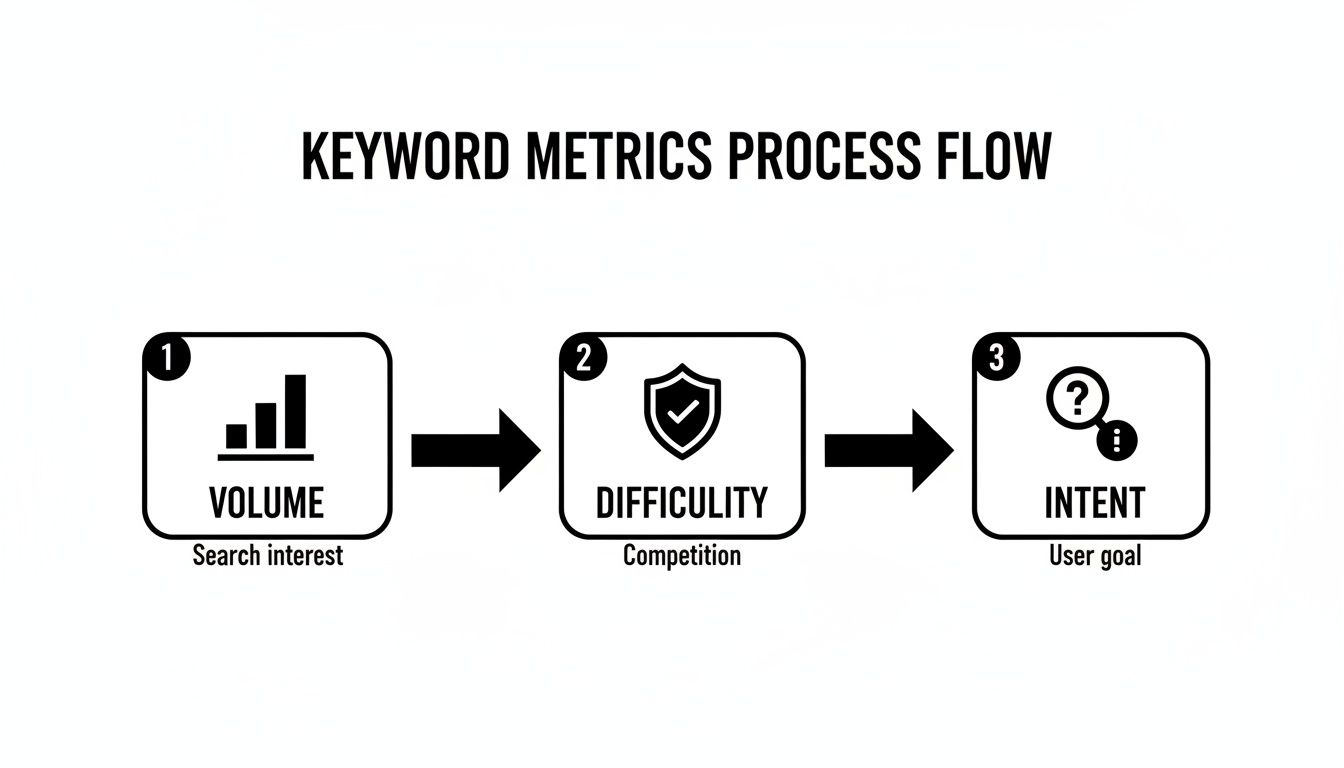
As you can see, it's the sweet spot where all three of these metrics overlap that holds your biggest opportunities.
Building Your Scoring Model
Let's get practical and put this into a simple scoring model you can build right in your spreadsheet. This helps you quickly compare dozens of keywords and see which ones pop.
I like to create a simple scoring matrix. For each keyword, assign a score from 1 to 5 for a few key criteria. A "5" is always the best-case scenario.
- Search Volume (1-5): Is the monthly search volume high? Give it a high score.
- Keyword Difficulty (1-5): Is the KD score low? A low KD gets a high score here because it’s easier to rank for.
- Business Relevance (1-5): How perfectly does this topic align with a product you sell, an affiliate link you can drop, or a core problem your ideal reader has? The closer the alignment, the higher the score.
Now, you just add up the numbers for a total "Priority Score."
Keyword Prioritization Scoring Matrix
Here's a simplified look at how this works in a spreadsheet. We're calculating the Priority Score by adding the three individual scores together.
| Keyword | Search Volume | Keyword Difficulty | Business Relevance (1-5) | Priority Score (Calculated) |
|---|---|---|---|---|
| "best ergonomic office chair for back pain" | 8,000 | 18 | 5 | 13 |
| "what is an ergonomic office chair" | 12,000 | 25 | 2 | 10 |
| "office chair" | 150,000 | 85 | 1 | 6 |
| "DIY office chair repair" | 900 | 5 | 3 | 11 |
By sorting by the final "Priority Score," your best opportunities instantly float to the top. It forces you to find that balance between traffic, feasibility, and real-world value.
Pro Tip: Keep an eye out for trending keywords. Terms that are seeing a sudden surge in interest can be goldmines. A few years back, a term like 'health benefits of mushroom coffee' had tiny volume, but early movers who jumped on it saw massive traffic growth. Finding these trends is a powerful way to get ahead of the competition.
The Non-Negotiable Power of Long-Tail Keywords
For any blog that isn't already a massive authority, long-tail keywords are your lifeblood. I’m serious. It's not just a nice-to-have strategy; it's a requirement for survival in the early days.
These are the longer, more specific phrases people type into Google—think "how to do keyword research for a travel blog" instead of the impossibly broad "keyword research." Data from Ahrefs shows that long-tail keywords, those with over three words, make up the vast majority of all search queries.
They have two huge advantages.
First, the competition is a joke compared to broader terms. While massive sites with huge budgets are battling for "keyword research," far fewer are competing for that super-specific long-tail version. This gives your new or growing blog a real chance to get on the scoreboard.
Second, the search intent is crystal clear. You know exactly what that person wants. If you deliver the answer, you've just earned a highly engaged reader—the kind who sticks around, subscribes, and buys things. To dive deeper into this, check out our guide on finding low-difficulty, high-traffic keywords.
Your scoring model should naturally push these long-tail gems to the top of your list. They’re the "quick wins" that bring in your first trickles of traffic, build your site’s authority, and send all the right signals to Google that your content is worth paying attention to.
Mapping Keywords to Content and Measuring Success
Having a prioritized keyword list is a huge win, but let's be honest—it's just a plan. Execution is everything.
The real work starts now, turning that list of terms into actual blog posts that climb the ranks and pull in traffic. This is where you connect your research to content that people want to read. Get this part right, and you'll create a powerful feedback loop that turns keyword research from a one-time chore into a non-stop engine for growth.
Aligning Keywords with Content Formats
Every keyword has a job to do, and not every job calls for the same tool. The search intent you figured out earlier is your blueprint for what kind of content to create.
Messing this up is like bringing a knife to a gunfight—you’ve completely misread the situation and you're not going to win. Think like your reader: what do they actually want when they type that phrase into Google?
Informational Keywords: When someone searches "how to do keyword research for blogs," they're looking for an education. This is your chance to shine with a comprehensive "how-to" guide, an ultimate guide, or a detailed breakdown that leaves no stone unturned.
Commercial Investigation Keywords: A search for "best SEO tools for bloggers" or "Ahrefs vs. Semrush" means the user is shopping around. They’re in comparison mode. Your best bet here is a listicle ("Top 7 Tools…"), an in-depth product review, or a head-to-head comparison post.
Long-Tail Question Keywords: For a super-specific query like "can you do keyword research for free," the user wants a quick, direct answer. A Q&A-style blog post is perfect for this. These also make for fantastic FAQ sections at the bottom of a larger, related guide.
Match the keyword's intent to the right format, and you've already given yourself a massive leg up. You're giving the user what they want, and Google loves that.
Weaving Keywords into Your Content Naturally
Once you know the format, it’s time to write. The goal is to place your keywords where both readers and search engines expect to find them, but without sounding like a robot from a 1990s sci-fi movie. This is what we call on-page SEO.
The dark days of "keyword stuffing"—cramming your keyword into a post over and over again—are long gone. Thank goodness. Modern search engines like Google use sophisticated natural language processing models, as detailed in their own documentation, to understand synonyms and context, so a natural, conversational approach works best.
Here’s where to put your focus keyword to get the most bang for your buck:
- Post Title (H1): This is non-negotiable. Your keyword needs to be here, ideally toward the beginning. Make it catchy, but get the keyword in.
- URL: Keep it short, sweet, and to the point.
yourblog.com/focus-keyword-hereis the gold standard. - Introduction: Mention the keyword within the first 100 words or so. It immediately tells the reader (and Google) that they're in the right place.
- Headings (H2s and H3s): Use your main keyword and its variations in subheadings to build a logical structure for your article.
- Image Alt Text: Describe your images for visually impaired readers and pop your keyword in there if it feels natural.
Think of your secondary keywords as the supporting cast. Sprinkle them and other related phrases throughout your text to add depth and context. This helps Google see the full scope of your topic and gives you a chance to rank for a much wider variety of searches.
Tracking Your Success with Google Search Console
So, how do you know if any of this is actually working? You measure it.
Flying blind is a terrible strategy. You need to know if you're gaining altitude or about to crash. Your instrument panel for SEO is Google Search Console (GSC). It's completely free, and it's a goldmine of data for seeing how your site performs in Google's eyes. It’s essential for refining your how to do keyword research for blogs strategy.
After a post has been live for a few weeks, head over to the "Performance" report in GSC. Here’s what you’re looking for:
- Impressions: This is how many times your page showed up in search results. It’s proof that Google sees your content as relevant for certain queries.
- Clicks: This tells you how many people actually clicked through to your site. This is the traffic you're after.
- Average Position: Your average ranking for a given keyword. You'll want to see this number going down (which means your rank is going up).
The real magic happens when you filter the report by a specific page. You’ll see all the keywords that page is starting to rank for—often, you'll find terms you didn't even intentionally target.
This is your feedback. If you see you're ranking at position 11 for a juicy keyword, you know you're on the cusp of page one. A little content refresh or a few more internal links could be all it takes to give it that final push.
Common Questions About Blog Keyword Research
Even when you have a solid keyword strategy, you're going to have questions. It's just that kind of field—full of nuances and little details that can trip you up. It's totally normal to hit a few sticking points.
Let's walk through some of the most common questions I hear from bloggers and clear them up.
How Often Should I Do Keyword Research?
I like to think of keyword research as an ongoing part of running the business, not a one-and-done task. That initial deep dive is absolutely crucial for mapping out your blog's core categories and getting your first pieces of content live. But after that, it’s all about finding a regular rhythm.
Many successful bloggers I know do a big "macro" research session once a quarter. This is your chance to spot new trends, see what competitors are up to, and keep your content calendar packed with fresh ideas.
But "micro" research? That happens every single time you write. Before you even type the first word of a new article, you should spend a few minutes double-checking the best primary and secondary keywords. It's a small step that ensures every post is perfectly targeted.
Can I Do Keyword Research Without Expensive Tools?
Absolutely. Don't get me wrong, premium tools like Ahrefs or Semrush are incredible time-savers, but they're a luxury, not a requirement. You can get surprisingly far with free tools, especially when you're just starting out.
Here’s a simple, no-cost tool stack that gets the job done:
- Google Keyword Planner: This is your home base for digging up keyword ideas and getting a rough idea of search volume.
- Google Search Results: This is a goldmine. Pay close attention to Autocomplete suggestions, the "People Also Ask" box, and the "Related Searches" at the bottom of the page. These are direct clues from Google about what people are actually searching for.
- Community Forums: Spend time lurking on sites like Reddit and Quora. The exact language people use when they ask questions is perfect for finding those juicy long-tail keywords.
Sure, your process will be more manual. But the core principles—analyzing intent and hunting for low-competition gems—are exactly the same.
In a landmark study on ranking factors, Backlinko analyzed millions of search results and found a clear correlation between comprehensive content and higher rankings. This suggests that even without tools, focusing on creating the most thorough answer to a question can be a winning strategy.
Search Volume Or Keyword Difficulty: Which Is More Important?
For any new or growing blog, Keyword Difficulty (KD) is king. End of debate.
Going after a high-volume, high-difficulty keyword is just a recipe for frustration. You'll sink hours into crafting the perfect post only to see it get buried on page eight of Google, bringing in zero traffic. It's a classic mistake that stalls so many blogs before they even get a chance to build momentum.
Your focus should be on winning the battles you can actually win. Find those low-difficulty keywords, even if the search volume seems small (think 50-200 searches per month).
Every time you rank for one of these, you score a "quick win." These wins start bringing in your first streams of highly-targeted traffic, which in turn builds your blog's authority with Google. Over time—usually 6-12 months—your site will gain enough credibility to start taking on the more competitive, higher-volume keywords. It's a phased approach, and it’s a proven way to grow your blog for the long haul.